Introduction
Common beggar’s-tick [Bidens alba (L.) DC.] is an annual or short-lived perennial that is native to North America and belongs to the Asteraceae family (Compositae). It is widely distributed in the subtropics and tropics of the northern and southern hemispheres (Hall et al. Reference Hall, Vandiver and Ferrell1991; USDA-NRCS 2020). In Florida, B. alba is commonly found in farmlands and railroad rights-of-way. Bidens alba is a prolific seed producer, and a single plant produces an average of 1,205 seeds that germinate readily and can stay viable for 3 to 5 yr (Hall et al. Reference Hall, Vandiver and Ferrell1991). Seeds of B. alba are easily dispersed by wind, water, or animals due to barbed spines that stick to animal hair or fur (Hall et al. Reference Hall, Vandiver and Ferrell1991). Although B. alba can be controlled with glyphosate, it is a weed species with year-round existence in farmlands such as citrus groves in Florida because of its prolific seed production together with its capability to rapidly establish from seeds (Hall et al. Reference Hall, Vandiver and Ferrell1991). The emergence of B. alba typically starts in spring and persists until late fall in subtropical climates (Ballard Reference Ballard1986; Busey and Johnston Reference Busey and Johnston2006).
Seed germination is regulated by several environmental factors, such as light, temperature, soil moisture, salinity, and pH (Boyd and Van Acker Reference Boyd and Van Acker2003; Chauhan and Johnson Reference Chauhan and Johnson2008a, Reference Chauhan and Johnson2008b; Wang et al. Reference Wang, Zhang, Dong and Lou2016; Woolley and Stoller Reference Woolley and Stoller1978). Seed burial also influences the availability of soil moisture, gaseous diffusion, and light exposure, and thereby the germination, preemergence growth, and subsequent seedling emergence (Baskin and Baskin Reference Baskin and Baskin1998; Benvenuti Reference Benvenuti2003; Benvenuti and Macchia Reference Benvenuti and Macchia1995; Boyd and Van Acker Reference Boyd and Van Acker2003; Chauhan and Johnson Reference Chauhan and Johnson2008a, Reference Chauhan and Johnson2008b; Woolley and Stoller Reference Woolley and Stoller1978). Therefore, a better understanding of seed germination biology facilitates the development of effective weed management options.
Seed afterripening has been demonstrated in a wide range of plant species in which seeds do not germinate immediately after maturity but are innately dormant for a period of time and will not germinate even under conditions typically suitable for germination (Davis and Rose Reference Davis and Rose1912; Eckerson Reference Eckerson1913; Jha et al. Reference Jha, Norsworthy, Kumar and Reichard2015; Kleemann and Gill Reference Kleemann and Gill2018; Taylorson et al. Reference Taylorson1967). Studies have found that multiple factors such as temperature, light, and water status can alter the time required for afterripening (Baskin and Baskin Reference Baskin and Baskin1986; Foley Reference Foley1994; Jha et al. Reference Jha, Norsworthy, Kumar and Reichard2015). Biochemical and/or physiological changes, including enzymatic and nonenzymatic reactions, phytohormones, and reactive oxygen species have been observed in the seed embryos of various plant species during the afterripening period (Foley Reference Foley1994; Khandaker et al. Reference Khandaker, Majrashi and Boyce2016; Morscher et al. Reference Morscher, Kranner, Arc, Bailly and Roach2015). Subsequently, seed response of a given species to environmental cues may vary at different stages of afterripening.
The impact of various environmental factors on germination and emergence of B. alba has been previously explored in Florida. It was reported that the germination of B. alba was not sensitive to light, because seeds germinated equally well with both alternating light and dark and constant dark conditions at the 25/20 and 30/25 C day/night temperatures and germinated better under constant dark than alternating light and dark at 15/10 and 20/15 C day/night temperatures (Ramirez et al. Reference Ramirez, Jhala and Singh2012).
In our preliminary experiments, however, seeds of B. alba collected at the Gulf Coast Research and Education Center (GCREC) in Balm, FL, did not germinate in the dark. This led to a hypothesis that the seeds of the B. alba population were not fully afterripened or the germination biology of this B. alba population was different compared with that reported by Ramirez et al. (Reference Ramirez, Jhala and Singh2012). To determine which of these hypothesis were correct, we conducted supplemental studies to examine the effect of light and temperature on seed germination as well as the effect of temperature and burial depth on seedling emergence using older seeds with a longer afterripening period. The supplemental studies mainly evaluated B. alba germination and emergence under environmental conditions where the seeds collected at GCREC differed in our preliminary experiments compared with the findings of Ramirez et al. (Reference Ramirez, Jhala and Singh2012). The objective of this study was to explore the germination biology of B. alba using the seeds at two different stages of afterripening.
Materials and Method
Seed Source
Mature seeds of a B. alba population from GCREC located at Balm, FL (27.75°N, 82.22°W) were harvested in spring 2016 and stored in dry condition at 4 C for 3 to 5 mo until experiment initiation (new seeds). Mature seeds of the same B. alba population were harvested in spring 2018 and stored in dry condition at 4 C for 13 to 15 mo until experiment initiation (old seeds). In this paper, reference to new and old seeds refers to seeds at early and later afterripening stages.
General Germination Test Protocol
Unless otherwise stated, 25 B. alba seeds were distributed evenly in a 9-cm-diameter petri dish containing two layers of No. 2 filter paper (Thermo Fisher Scientific, 168 3rd Ave., Waltham, MA, 02451). The filter paper was moistened with 5 ml of deionized water (pH = 7) or test solution. The petri dishes were sealed with parafilm and placed in controlled-environment growth chambers with the same light intensity (200 µmol m−2 s−1 photosynthetic photon flux density), but photoperiods were adjusted for some treatments. Seeds were considered germinated when the cotyledons and radical emerged from the seed coat. All new seed experiments were performed from July to October 2017, whereas the old seed experiments were performed from April to June 2019.
Effect of Osmotic Stress on Germination
The effect of osmotic stress on the germination of new seeds was evaluated in a growth chamber with day/night temperatures of 30/20 C and a 12-h photoperiod. The osmotic potentials were created within the petri dishes using the method described by Michel (Reference Michel1983). Solutions with osmotic potentials of 0 (deionized water), −0.25, −0.5, and −1 MPa were prepared by dissolving polyethylene glycol 8000 (Polyethylene glycol 8000, Fischer Scientific, Fair Lawn, NJ 07410) in deionized water. The solutions were used as the germination media. Germinated seeds were counted at 28 d after planting (DAP). Experiments were conducted twice in a completely randomized design with four replications.
Effect of Fluctuating Temperature on Germination
The effect of fluctuating temperature on the germination of new seeds was evaluated in temperature-controlled growth chambers with day/night temperatures of 35/35, 25/25, 35/25, 35/20, or 25/15 C. These temperature regimes were arbitrarily selected to examine the temperature requirement for B. alba germination. The petri dishes were sealed with parafilm. The germinated seeds were counted weekly for 21 d. Experiments were conducted twice in a completely randomized design with four replications.
Effect of Light and Temperature on Germination
In the new seed experiments, B. alba were placed in petri dishes and sealed with parafilm. The petri dishes were maintained at constant temperatures of 20, 25, 30, 35, or 40 C under continuous light or dark with no diurnal fluctuations in temperature. Seed germination in the dark was assessed at 21 and 28 DAP.
In the old seed experiments, the petri dishes containing the old seeds of B. alba were kept at constant temperatures of 5, 15, 20, 25, or 35 C under continuous light or dark with no diurnal temperature fluctuations. To ensure no light penetration in the dark treatment, petri dishes were wrapped with aluminum foil. Seed germination was assessed at 28 DAP. Both new and old seed experiments were conducted twice in a factorial design with four replications.
Effect of Seed Burial Depth on Seedling Emergence
The effect of seed burial depth on seedling emergence of new seeds was studied in a greenhouse. The new seeds were planted in pots (16-cm diameter by 15-cm height) at 0 (soil surface), 1, 2, 3, 4, 6, 7, 8, or 10 cm from the soil surface. The new seeds of B. alba were seeded on the surface of bagged potting soil (Fafard 3B, Sungro Horticulture, 770 Silver St., Agawam, MA 01001) and covered with field soil. The field soil is a Myakka fine sand (sandy, siliceous hyperthermic Aeric Alaquods) with a pH of 7.6 and 0.8% organic matter, and sand, silt, and clay content of 97.6%, 1.0%, and 1.4%, respectively. The top layer was leveled and pressed with the same force to standardize depth and compaction and improve seed–soil contact. The pots were placed in the greenhouse under natural light at 32 C. Pots were surface watered daily throughout the experiment as needed to maintain optimal moisture for seed germination. Seedling emergence was counted at 21 DAP. Experiments were conducted twice in a completely randomized design with four replications.
Effect of Temperature and Seed Burial Depth on Seedling Emergence
The effect of temperature and seed burial depth on seed emergence of old seeds was studied in a growth chamber. The old seeds of B. alba were seeded at 0, 1, 2, or 4 cm from the soil surface. Seeds were planted in pots as previously described. The pots were covered with parafilm to ensure maintenance of soil moisture and placed in growth chambers at 5, 15, 20, 25, or 35 C under a 12-h photoperiod at 200 µmol m−2 s−1 photosynthetic photon flux density. The pots were surface watered as needed using a syringe. Seedling emergence was counted at 14 and 28 DAP. Experiments were conducted twice in a split-plot factorial design with main plot factor of temperature and subplot factor of burial depth with four replications.
Statistical Analysis
Data were subjected to ANOVA using PROC MIXED in SAS (v. 9.4, SAS Institute, 100 SAS Campus Dr., Cary, NC 27513), with experimental repeats and blocks considered random effects and treatments considered fixed effects. One-way ANOVA was used to analyze the effect of fluctuations of day/night temperatures on the germination of new seeds in growth chamber experiments and to analyze the effect of burial depth on the germination of new seeds in greenhouse experiments. Two-way ANOVA was used to analyze the effects of temperature and light on the germination of new and old seeds and to analyze the effects of temperature and burial depth on the germination of old seeds in growth chamber experiments. Data were checked for normality and constant variance before analysis. Treatment means were compared using the least-squares means statement with Tukey adjustment at P = 0.05.
Percent germination values at various osmotic potentials were regressed to a three-parameter logistic model. The model fitted was:
 $$G = {G_{\max }}/\{ 1 + \exp [ - (x - {x_0})/{G_{\rm{rate}}}]\} $$
where G represents total germination (%) at osmotic potential x, G max is the maximum germination (%), x 0 is the osmotic potential required for 50% inhibition of maximum germination, and G rate indicates the slope (Chauhan and Johnson Reference Chauhan and Johnson2008b; Ramirez et al. Reference Ramirez, Jhala and Singh2012; Wang et al. Reference Wang, Zhang, Dong and Lou2016). Percent germination values at various temperatures under continuous light were fit to a three-parameter quadratic regression model using SigmaPlot (SigmaPlot v. 12.5, Systat Software, 1735 Technology Drive, Suite 430, San Jose, CA 95100). The model fitted was:
 $$G = {{{\rm\beta }}_0} + {{{\rm\beta }}_1}*x + {{{\rm\beta }}_2}*x\,\^\,\,2$$
where G represents total germination (%) at temperature x, and β0, β1, and β2 are the constants. These models were chosen for regression analysis because they characterized the relationship of germination curves with osmotic potentials or temperatures after plotting treatment means in the figures.
Results and Discussion
Effect of Osmotic Stress on Germination
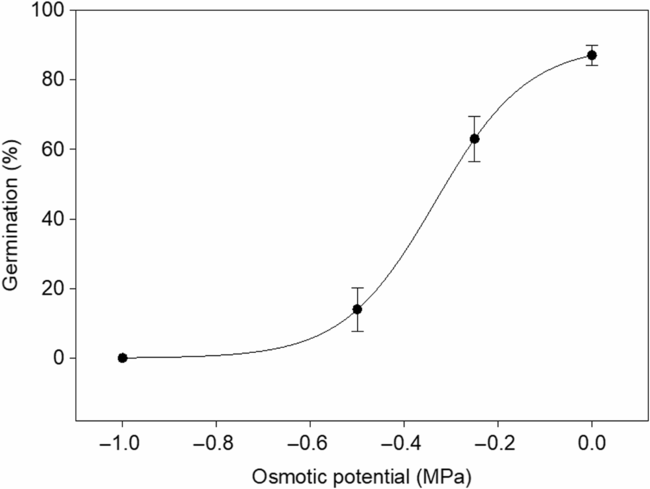
A functional three-parameter logistic model (G = 90.50/{1 + exp[−(x + 0.3499)/0.0983]}, [r2 = 0.88]) described the relationship of new seeds’ germination and osmotic stress (Figure 1). Germination rate decreased from 87 ± 2.9% at 0 MPa to 63 ± 6.8% and 16 ± 6.1% at −0.2 and −0.5 MPa, respectively. No germination occurred at the osmotic potential of −1 MPa. Based on regression analysis, germination rate decreased nonlinearly with increasing osmotic stress, and no germination occurred at osmotic potential below −0.86 MPa. The osmotic stress that would cause 50% germination inhibition was −0.31 MPa.
Germination of Bidens alba seeds under varying levels of osmotic stress at 30/20 C (day/night) with a 12-h photoperiod for 28 d in growth chamber experiments, July–October 2017, Balm, FL. New seeds were used in the experimentation. New seeds were the mature seeds harvested in spring 2016 and stored at 4 C for 3–5 mo until experiment initiation. Results were pooled over experimental runs. Vertical bars represent standard errors of the mean (n = 8). Equation: G = 90.50/{1 + exp[−(x + 0.3499)/0.0983]}. r2 = 0.88. Standard errors for G max, G rate, and x 0 measured 6.70, 0.02, and 0.02, respectively.

As osmotic potential decreased below −0.1 MPa, germination rate decreased sharply, indicating that B. alba favors wet soil for germination. This suggests that germination of B. alba is likely to occur under irrigated conditions or during periods of rainfall but is inhibited under water stress. In previous investigations, Reddy and Singh (Reference Reddy and Singh1992) reported that germination of hairy beggar’s-tick (Bidens pilosa L.) decreased linearly with increasing osmotic potential such that the germination was reduced to 3% at −0.75 MPa. Ramirez et al. (Reference Ramirez, Jhala and Singh2012) reported that germination of B. alba was reduced from 68% at 0 MPa to 12% at −0.6 MPa.
Effect of Fluctuating Temperature on Germination
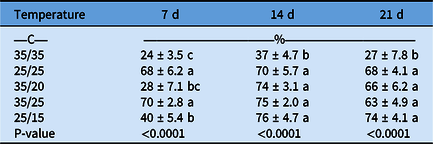
Germination of new seeds was affected by fluctuating temperatures (P < 0.0001) (Table 1). At 7 d, the highest germination was 68 ± 6.2% and 70 ± 2.8% at 25/25 C and 35/25 C, respectively; while the lowest germination was 24 ± 3.5% at 35/35 C day/night temperatures. However, at 14 and 21 d, the constant high temperature of 35 C resulted in significantly less germination than other temperature treatments, including 35/20 C and 35/25 C. These results suggest that physiological dormancy is induced after exposure to high constant high temperature, whereas fluctuating higher and lower temperatures may alleviate the dormancy effect. The germination rate at 14 and 21 d was no higher at 25/15 C than at 25/25 C, which indicates fluctuating temperatures did not affect germination at these temperature regimes.
Germination of Bidens alba seeds in response to fluctuations of day/night temperatures in growth chamber experiments, July–September 2017, Balm, FL.a,b

a Results were pooled over experimental runs. New seeds were used in the experiment. New seeds were mature seeds that were harvested in spring 2016 and stored at 4 C for 3–5 mo until experiment initiation.
b Values followed by the same letter do not differ at the 5% significance level by Tukey adjustment. Means are to be compared within columns. Data represent the mean ± standard errors of the mean (n = 8).
Temperature is an important factor affecting seed germination, with some species able to germinate over a wide range of temperatures, while others require critical levels of relatively high (Chauhan and Johnson Reference Chauhan and Johnson2008a, Reference Chauhan and Johnson2008b) or low temperatures (Baskin and Baskin Reference Baskin and Baskin1974; Evers Reference Evers1980). The data suggest that B. alba germinated over a range of temperatures, although germination rate was significantly reduced at a constant high temperature of 35 C. In Florida and other parts of the southern United States, temperature ranges from 15 to 35 C during most of the year, which should allow this weed species to germinate throughout the year if moisture is adequate.
In this study, the inhibitory effect of B. alba under high-temperature regimes could be attributed to thermo-inhibition, a condition under which seeds are incapable of germinating when exposed to temperatures higher than the optimal temperature for germination (Hills and Staden Reference Hills and Staden2003). Thermo-inhibition of seed germination has been widely documented in a variety of plant species (Bibbey Reference Bibbey1948; Egley Reference Egley1990; Sharpe and Boyd Reference Sharpe and Boyd2019; Tiryaki and Keles Reference Tiryaki and Keles2012). Previous research has demonstrated that thermo-inhibition is regulated by various plant signals and endogenous enzymes such as abscisic acid, gibberellic acid, and ethylene (Corbineau et al. Reference Corbineau, Rudnicki and Côme1988; Gallardo et al. Reference Gallardo, Sanchez-Calle, Rueda and Matilla1996; KeÇpczyński and KeÇpczyńska Reference KeÇpczyński and KeÇpczyńska1997; Nascimento et al. Reference Nascimento, Cantliffe and Huber2000) and endo-β-mannanase (Nascimento et al. Reference Nascimento, Cantliffe and Huber2000).
Effect of Light and Temperature on Germination
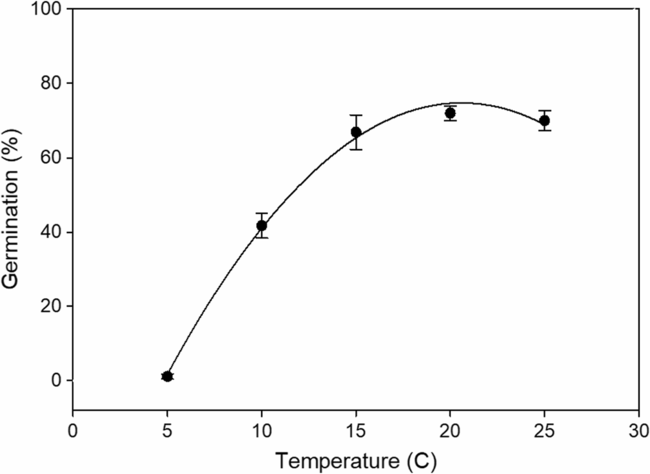
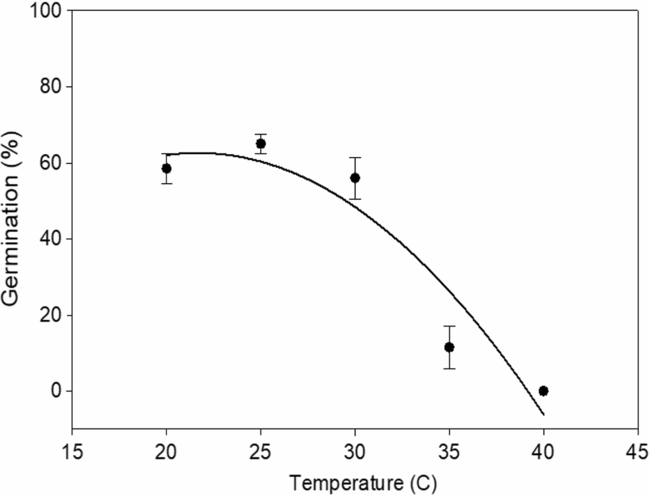
The effects of temperature and light and their interaction on the germination of new seeds was significant (P < 0.0001). In the presence of light, at 21 DAP, a three-parameter quadratic model (G = −54.09 + 12.81*x − 0.3171*x^2, r2 = 0.91) was fit to temperatures ranging from 5 to 25 C (Figure 2); and a three-parameter quadratic model (G = −33.14 + 8.8471*x − 0.2043*x^2, r2 = 0.78) was fit to temperatures ranging from 20 to 40 C (Figure 3).
Germination of Bidens alba seeds under low temperatures in light condition for 21 d in growth chamber experiments, July–October 2017, Balm, FL. New seeds were used in the experiment. New seeds were the mature seeds harvested in spring 2016 and stored at 4 C for 3–5 mo until experiment initiation. Results were pooled over experimental runs. Vertical bars represent standard errors of the mean (n = 8). Equation: G = −54.09 + 12.81*x − 0.3171*x^2. r2 = 0.91. Standard error of the estimate = 8.45. Standard errors for β0, β1, and β1 measured 6.44, 0.98, and 0.0326, respectively.

Germination of Bidens alba seeds under varying levels of temperatures in light condition for 21 d in growth chamber experiments, July–October 2017, Balm, FL. New seeds were used in the experiment. New seeds were the mature seeds harvested in spring 2016 and stored at 4 C for 3–5 mo until experiment initiation. Results were pooled over experimental runs. Vertical bars represent standard errors of the mean (n = 8). Equation: G = −33.14 + 8.8471*x − 0.2043*x^2. r2 = 0.78. Standard error of the estimate = 14.10. Standard errors for β0, β1, and β1 measured 46.33, 3.21, and 0.05, respectively.

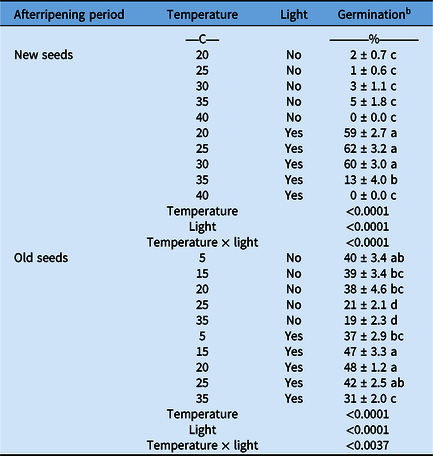
At 28 DAP, germination of new seeds of B. alba was unaffected by temperature and averaged 2% in the dark (Table 2). In the presence of light, the optimum temperature for germination occurred between 20 and 30 C. Germination was substantially reduced when seeds were exposed to constant high temperatures greater than 30 C. No germination occurred at 40 C. This finding agrees with previous research in Florida, where the optimum temperature for the germination of B. alba seeds was reported to be 20 to 30 C (Ramirez et al. Reference Ramirez, Jhala and Singh2012).
Germination of Bidens alba seeds as influenced by temperature and light in growth chamber experiments, Balm, FL.a

a Results were pooled over experimental runs. New seed experiments were conducted from July to September 2017, while the old seed experiments were conducted from April to June 2019. New seeds were the mature seeds that harvested in spring 2016 and stored at 4 C for 3–5 mo until experiment initiation, while old seeds were harvested from the same weed population in spring 2018 and aged for 13–15 mo until experiment initiation.
b Germination data were assessed after 28 d. Values followed by the same letter do not differ at the 5% significance level by Tukey adjustment. Means are to be compared within columns. Data represent the mean ± standard errors of the mean (n = 8).
The effects of temperature and light and their interaction on the germination of old seeds were significant at 28 DAP (P < 0.05) (Table 2). Contrary to the results for new seeds, old seeds did not require light to germinate. Under dark conditions, old seeds exhibited higher germination rate in temperatures ranging from 5 to 20 C than at 25 to 35 C. At temperatures of 15 to 35 C, old seeds exhibited higher germination rates in the presence of light than under dark conditions. Surprisingly, although B. alba is a warm-season broadleaf weed species, the older seeds germinated equally well at temperatures ranging from 5 to 20 C under dark conditions. Germination of old seeds was 40% and 37% at 5 C but was reduced to 19% and 31% at 35 C, under dark and light conditions, respectively. Results showed that B. alba can germinate in a wide range of temperatures, which explains the year-round presence of this weed species in Florida.
Afterripening is a process of dormancy release in which seeds transition from a dormant state to a permissive state for germination (Baskin and Baskin Reference Baskin and Baskin1986; Davis and Rose Reference Davis and Rose1912; Eckerson Reference Eckerson1913; Jha et al. Reference Jha, Norsworthy, Kumar and Reichard2015; Kleemann and Gill Reference Kleemann and Gill2018). Significant changes in carbohydrates, endogenous hormones, enzymes, and reactive oxygen species were noted in the seed embryo during the afterripening period (Allen et al. Reference Allen, Meyer and Beckstead1995; Brown Reference Brown1939; Chen and Varner Reference Chen and Varner1970; Pack Reference Pack1921; Pollock and Harvey Reference Pollock and Harvey1959). The majority of seed germination studies conducted to date using freshly matured seeds, fully afterripened seeds, or seeds at one time point during the afterripening period (Bazin et al. Reference Bazin, Batlla, Dussert, El-Maarouf-Bouteau and Bailly2011; Benvenuti et al. Reference Benvenuti, Macchia and Miele2001) have failed to evaluate the same weed population at a different afterripening period for an environment-mediated germination response.
In the current study, the germination of new and old seeds differed significantly in response to light. The extended afterripening period effectively desensitized the light requirement for germination but did not completely remove it. Few previous investigations found that different seed ages exhibited a varied germination response to temperature. Martinkova et al. (Reference Martinkova, Honek and Lukas2006) noted that newly harvested barnyardgrass [Echinochloa crus-galli (L.) P. Beauv.] seeds required higher temperature for germination than older seeds. Ramirez et al. (Reference Ramirez, Jhala and Singh2012) reported that new seeds of B. alba germinated better than older seeds (3 yr difference) at 15/10 day/night temperatures.
Bidens species have demonstrated varying germination responses to light. For example, seeds of bur beggar’s-tick (Bidens tripartita L.) (Benvenuti and Macchia Reference Benvenuti and Macchia1995; Stefano and Mario Reference Stefano and Mario1997) and burmarigold [Bidens laevis (L.) Britton, Sterns & Poggenb.] (Leck et al. Reference Leck, Baskin and Baskin1994) did not germinate in the dark, while B. pilosa was noted to germinate under both alternating light and dark (Reddy and Singh Reference Reddy and Singh1992) and dark conditions (Fenner Reference Fenner1980). In a previous investigation, B. alba seeds were collected in Lake Alfred and Fellsmere, FL, and stored at 5 C before the light requirement for seed germination was examined. It was found that B. alba germinated under both alternating light and dark and constant dark conditions; and the germination was significantly improved in constant dark rather than alternating light and dark at 15/10 C and 20/15 C day/night temperatures (Ramirez et al. Reference Ramirez, Jhala and Singh2012).
Our results clearly demonstrated that B. alba required light for germination, but afterripening diminished photoblastic germination. There was no clear evidence that the B. alba population used in the present research is different from the previously studied B. alba populations at Lake Alfred and Fellsmere, FL (Ramirez et al. Reference Ramirez, Jhala and Singh2012). The differences in response to light between the B. alba populations are likely due differing stages of seed afterripening. In the present study, B. alba seeds at different stages of afterripening were collected from the same site but different years. In previous research, Sawhney and Naylor (Reference Sawhney and Naylor2011) demonstrated that drought stress during seed development can influence the duration of wild oat (Avena fatua L.) seed dormancy. Further study is needed to examine the variability of seed germination in response to environment due to the differences in environmental conditions during B. alba seed development.
Effect of Depth of Seed Burial on Seedling Emergence
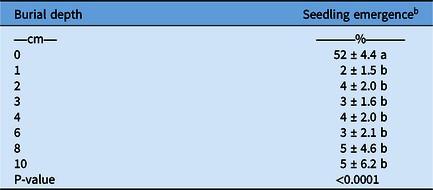
The effect of burial depth on B. alba emergence was studied using new seed in a greenhouse environment. New seeds sown on the soil surface exhibited the highest germination rate, but germination was significantly reduced at a burial depth of 1 cm or greater (Table 3). When the soil depth was 1 to 10 cm, a small proportion of seeds emerged. The portion of the seedbank that does not require light for germination is likely to germinate, if seeds have enough energy to reach the soil surface and other factors such as temperature and soil moisture are suitable as well. Moreover, we noticed that seedling emergence on the soil surface was lower than germination in petri dishes in light. This difference could be due to poor soil–seed contact or more reduced availability of moisture on the soil surface than on the filter papers (Chauhan and Johnson Reference Chauhan and Johnson2009; Ghorbani et al. Reference Ghorbani, Seel and Leiferr1999).
Emergence of Bidens alba seeds as influenced by depth of burial in greenhouse experiments, July–October 2017, Balm, FL.a

a Results were pooled over experimental runs. New seeds were used in the experiments. New seeds were the mature seeds that harvested in spring 2016 and stored at 4 C for 3–5 mo until experiment initiation.
b Experiments were conducted in greenhouse under natural light at 32 C. Seedling emergence data were accessed after 21 d. Values followed by the same letter do not differ at the 5% significance level by Tukey adjustment. Means are to be compared within columns. Data represent the mean ± standard errors of the mean (n = 8).
The observation of poor emergence at burial depths of 1 cm or greater agreed with the growth chamber experiments in which new seeds required light for germination. Reduced emergence of broadleaf weeds due to increased burial depth has been widely reported (Boyd and Hughes Reference Boyd and Hughes2011; Boyd and Van Acker Reference Boyd and Van Acker2003; Chauhan and Johnson Reference Chauhan and Johnson2008a, Reference Chauhan and Johnson2008b, Reference Chauhan and Johnson2009). Light and seed size are the major limiting factors for seedling emergence at greater soil depths. Light penetration is usually limited to the first few millimeters below the soil surface (Woolley and Stoller Reference Woolley and Stoller1978). Larger seeds often have greater carbohydrate reserves and are more likely to emerge from greater burial depths of compared with those of smaller seeds with lower reserves (Baskin and Baskin Reference Baskin and Baskin1998). Other explanations for lack of emergence from deeply buried seeds include hypoxia and low rates of gaseous diffusion (Benvenuti Reference Benvenuti2003; Benvenuti and Macchia Reference Benvenuti and Macchia1995; Woolley and Stoller Reference Woolley and Stoller1978).
Effect of Temperature and Seed Burial Depth on Seedling Emergence
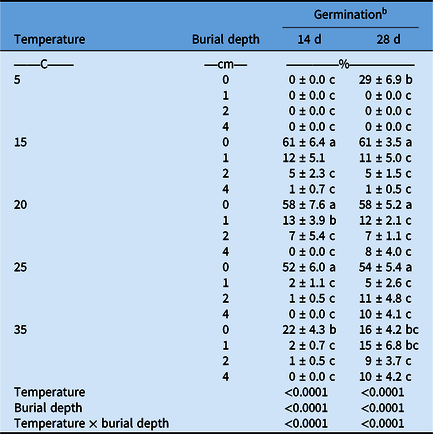
The effect of temperature and seed burial depth on B. alba seedling emergence was evaluated using old seeds in controlled growth chamber conditions. Temperature, burial depth, and their interactions had significant effects on the germination of old seeds at 14 and 28 DAP. The old seeds of B. alba seeded on the soil surface generally exhibited the greatest seedling emergence. The maximum seedling emergence was observed at the temperatures ranging from 15 to 25 C when seeds were sown on the soil surface (Table 4). At 28 DAP, seedling emergence at 15, 20, and 25 C was 61%, 58%, and 54%, respectively, when seeds were sown on the soil surface. In contrast, seedling emergence at 5 and 35 C was 29% and 16%, respectively, when seeds were sown on the soil surface.
Germination of Bidens alba seeds under various temperatures and burial depths at 14 and 28 d after planting in growth chamber experiments, April–June 2019, Balm, FL.a

a Results were pooled over experimental runs. Old seeds were used in the experiments. Old seeds were the mature seeds that harvested in spring 2018 and stored at 4 C for 13–15 mo until experiment initiation.
b Values followed by the same letter do not differ at the 5% significance level by Tukey adjustment. Means are to be compared within columns. Data represent the mean ± standard errors of the mean (n = 8).
Maximum seedling emergence was consistently observed when seeds were sown on the soil surface at the temperatures ranging from 15 to 25 C; however, there was an abrupt decline in emergence when seeds were buried at 1 cm at all temperatures. This observation is similar to results for new seeds in the greenhouse experiments, in which the maximum seedling emergence was noted when seeds were planted on the soil surface, but there was a sharp reduction in seedling emergence; emergence was ≤5% when seeds were buried at 1 cm. Light is not required for the germination of old seeds. However, burial depth is known to decrease weed seed germination, especially for small-seeded weed species like B. alba, due in part to the energy required for preemergence growth to overcome the soil physical barrier (Chauhan et al. Reference Chauhan, Gill and Preston2006; Ghorbani et al. Reference Ghorbani, Seel and Leiferr1999; Ramirez et al. Reference Ramirez, Jhala and Singh2012). Ramirez et al. (Reference Ramirez, Jhala and Singh2012) reported that B. alba emergence was 85% when seeds were sown at the soil surface and declined to 60% when seeds were sown at 1 cm. Therefore, the results of the present and previous studies collectively suggest that B. alba is likely to be favored by no-till systems or on field edges.
In summary, germination occurs more readily under high-moisture conditions, but a significant number of seeds can still germinate at osmotic potentials between 0 and −0.5 MPa. The greatest germination occurred at temperatures of 15 to 30 C. Germination of new seeds was strongly stimulated by light, suggesting that B. alba is positively photoblastic when seeds are not afterripened. However, old seeds were less dependent on light for germination than new seeds. An extended period of afterripening reduced the dependence on light for germination. The maximum seedling emergence was consistently observed when seeds were sown on the soil surface, regardless of seed age. Poor seedling emergence was observed when seeds were buried at depths >1 cm, suggesting shallow cultivation might help to prevent this population of B. alba from emerging in the field. Overall, these findings explain the occurrence of this species throughout the year in Florida on field edges, in ditches, and in perennial crops and other low-disturbance areas and the fact that this species rarely occurs in annual crop systems. Results suggest that targeted irrigation, such as drip irrigation, might help to reduce infestation compared with overhead irrigation. Overall, the results obtained in this research identify some important factors facilitating the occurrence of B. alba in Florida and might contribute to its control.
Acknowledgments
The authors would like to thank Nicole Brown and Radhika Rijal for their assistance. No conflicts of interest have been declared. This research received no specific grant from any funding agency or the commercial or not-for-profit sectors.