


Nuclear proliferation is widely considered to pose a grave threat to international peace and security. For this reason, politicians, policy makers, and academics worry that nuclear-capable states may provide sensitive nuclear assistance to other states or terrorist networks, further fueling the spread of nuclear weapons. For example, following North Korea's nuclear test in October 2006, George W. Bush threatened that “The transfer of nuclear weapons or material by North Korea to states or non-state entities would be considered a grave threat to the United States, and we would hold North Korea fully accountable of the consequences of such action.”Footnote 1
The empirical record provides justification for such concern. Although states, to the best of our knowledge, have never provided sensitive nuclear assistance to terrorists, they have repeatedly transferred sensitive nuclear materials and technology to other states. From 1959 to 1965, France provided Israel with sensitive nuclear assistance and, a mere two years after the end of French assistance, Israel is believed to have constructed its first nuclear weapon. This story about a state helping another state to develop nuclear weapons is neither unique nor confined to the distant past. China assisted Pakistan with its nuclear program in the early 1980s with a package that included uranium enrichment technology, weapons-grade uranium, and a nuclear weapon design. Shortly thereafter, Pakistan is believed to have assembled its first nuclear bomb. More recently, from 1987 to 2002, Pakistan, with the help of Pakistani nuclear scientist A.Q. Khan, distributed sensitive nuclear technology and materials to Iran, Libya, and North Korea.Footnote 2 Since the end of this cooperation in 2002, Libya has agreed to give up its nuclear program, but North Korea has already tested its first nuclear device, and Iran is making steady progress on its own nuclear capability. These are a few of the many important cases of sensitive nuclear assistance that have contributed to the proliferation of nuclear weapons.
Yet, there is significant variation in the patterns of sensitive nuclear assistance. Although some nuclear-capable states repeatedly provide sensitive nuclear assistance, many others refrain from providing sensitive nuclear assistance altogether. Indeed, it is puzzling that states would transfer materials and technology that could help other states acquire nuclear weapons, the world's most destructive weapons, and weapons that could one day threaten the suppliers’ very existence. This raises an interesting question about the motivations of the nuclear suppliers: Why do states provide sensitive nuclear assistance to nonnuclear weapon states, essentially helping other states acquire nuclear weapons?
Scholars have explained why states want nuclear weapons (e.g., Sagan Reference Sagan1996/1997), the causes and consequences of conventional arms sales (e.g., Blanton Reference Blanton2000; Kinsella Reference Kinsella1994), and the effect of nuclear proliferation on the probability of war and crisis behavior (e.g., Powell Reference Powell1990; Sagan and Waltz Reference Sagan and Waltz1995; Schelling Reference Schelling1960), but have not examined the supply side of nuclear proliferation.
I describe a simple logic of the differential effects of nuclear proliferation that is grounded in the nuclear deterrence literature. I argue that the spread of nuclear weapons is more threatening for relatively powerful states than it is for relatively weak states. From this basic insight, I derive three hypotheses about the conditions under which states will be more or less likely to provide sensitive nuclear assistance. First, the more powerful a state is relative to a potential nuclear recipient, the less likely it is to provide sensitive nuclear assistance. Second, states are more likely to provide sensitive nuclear assistance to states with which they share a common enemy. Third, states that are less vulnerable to superpower pressure are more likely to provide sensitive nuclear assistance.
Drawing on a new data set on the international transfer of sensitive nuclear materials and technology, I find support for this strategic theory of nuclear proliferation. I find little support for the idea that economic motivations determine the patterns of sensitive nuclear assistance. I find some empirical evidence that membership in international institutions shapes the behavior of the nuclear suppliers.
This article presents a new approach to the study of the spread of nuclear weapons, focusing on the supply side of nuclear proliferation.Footnote 3 The existing theoretical literature has paid overwhelming attention to the demand side of nuclear proliferation (e.g., Sagan Reference Sagan1996/1997) and has thoroughly examined the factors that lead states to pursue or abandon nuclear weapons programs. Understanding why states want nuclear weapons is important, but demand-side approaches only paint part of the proliferation picture. Other states take actions designed to assist or impede states as they attempt to develop nuclear weapons. Many states with nuclear arsenals and advanced nuclear weapons programs received some form of external assistance from more advanced nuclear states. Contrarily, other states were prevented from acquiring nuclear weapons because states applied pressure on them in the form of technology denial, sanctions, or preventive military strikes. If we are to understand how and why nuclear weapons spread, it is necessary to understand the supply side of nuclear proliferation. This article provides the first theoretical explanation and empirical test of the causes of sensitive nuclear assistance.
EXPLAINING NUCLEAR PROLIFERATION AND ARMS EXPORTS
The vast scholarly literature on the causes of nuclear proliferation has thoroughly examined why states pursue or abandon nuclear weapons programs (e.g.,Campbell, Einhorn, and Reiss Reference Campbell, Einhorn and Reiss2004; Hymans Reference Hymans2006; Quester Reference Quester1973; Sagan Reference Sagan1996/1997; Solingen Reference Solingen1994, Reference Solingen1998, Reference Solingen2007). In recent years, scholars have performed statistical analyses on new data sets to further our understanding of the causes of nuclear proliferation (Jo and Gartzke Reference Jo and Gartzke2007; Singh and Way Reference Singh and Way2004). Unlike this analysis, however, these studies do not explore why states assist other states with their nuclear programs. Individual case studies have chronicled the development of national nuclear weapons programs (e.g., Cohen Reference Cohen1998; Holloway Reference Holloway1994; Lewis and Litai Reference Lewis and Litai1988; Perkovich Reference Perkovich1999), including instances of sensitive nuclear transfer, but this material has not been analyzed in a cross-national, or a theoretical, perspective.
Research on conventional arms sales has examined the effect of military transfers on regional stability (e.g., Kinsella Reference Kinsella1994; Kinsella and Tilemma Reference Kinsella and Tillema1995; Sanjin Reference Sanjin1999) and the causes of conventional arms exports in specific supplier states. For example, Blanton (Reference Blanton2000, Reference Blanton2005) has studied the link between democracy, human rights, and U.S. arms sales. Fuhrmann (N.d.) has examined U.S. exports of dual-use commodities that could be used in legitimate civilian applications or in weapons of mass destruction (WMD) programs; and Donaldson and Donaldson (Reference Donaldson and Donaldson2003) have explained a 2001 Russian-Chinese military cooperation agreement. This literature has not, however, systematically analyzed the causes of conventional military assistance across the entire universe of supplier states, or examined the specific problem of sensitive nuclear assistance.
The literature on the consequences of nuclear proliferation has explored how nuclear weapons affect crisis behavior and has debated the effects of nuclear proliferation on the stability of the international system. Nuclear deterrence theorists argue that states will be reluctant to use military force against nuclear-armed states for fear of nuclear retaliation (e.g., Achen and Snidal Reference Achen and Snidal1989; Brodie Reference Brodie1946; Jervis Reference Jervis1989; Knorr Reference Knorr, Knorr and Read1962; Powell Reference Powell1990; Schelling Reference Schelling1960, Reference Schelling1966). Studies on U.S. foreign policy concur that the United States will be more likely to back down in confrontations with adversaries, when those adversaries possess nuclear weapons (e.g., Betts Reference Betts and Utgoff2000; Glaser and Fetter Reference Glaser and Fetter2001, 69; Posen Reference Posen and Utgoff2000; Powell Reference Powell2003; Waltz Reference Waltz, Sagan and Waltz1995). Building on the insights of the nuclear deterrence theorists, “proliferation optimists” have argued that the spread of nuclear weapons actually leads to greater international stability because nuclear weapons deter military aggression (e.g., Bueno de Mesquita and Riker Reference Bueno de Mesquita and Riker1982; Mearsheimer Reference Mearsheimer1990, Reference Mearsheimer1993; Waltz Reference Waltz1979, Reference Waltz, Sagan and Waltz1995). “Proliferation pessimists” counter that nuclear proliferation decreases international stability because greater numbers of states in possession of greater numbers of nuclear weapons increases the likelihood of preventive wars, crisis instability, and accidental nuclear detonation (e.g., Blair Reference Blair1994; Feaver Reference Feaver1993; Sagan Reference Sagan1993, Reference Sagan and Waltz1995; Thayer Reference Thayer1994). Yet, these scholars do not explain why states provide sensitive nuclear assistance, or explicitly propose an explanation for why states vary in their responses to nuclear proliferation in other states.
Others have suggested explanations for why some states may oppose proliferation more fiercely than others. Pilat (Reference Pilat, Jones, Merlini, Pilat and Potter1985) and Quester (Reference Quester1983) argue that established nuclear weapon states should be more likely than nonnuclear weapon states to take a strong stance against the spread of nuclear weapons because they have an interest in limiting the size of the nuclear club to maximize the relative advantage of nuclear weapons possession. Other scholars (e.g., Jabko and Weber Reference Jabko and Weber1998; Potter Reference Potter1982, Reference Potter1990), and many journalists and policy analysts, attribute state behavior on nuclear proliferation issues to economic incentives. According to the economic logic, states will be unlikely to take measures to stop nuclear proliferation when doing so is contrary to their economic interests. States in certain circumstances may even export sensitive nuclear materials and technology in search of economic gains. Unlike the analysis presented here, however, these authors look to nuclear weapons possession, or economic incentives, not conventional military power, as the key to unlocking proliferation preferences.
A STRATEGIC THEORY OF NUCLEAR PROLIFERATION
Drawing on the nuclear deterrence literature, I extract implications about the differential effects of nuclear proliferation on states with varying levels of conventional military power. From these insights, I develop a new, strategic theory of nuclear proliferation that I apply to the specific problem of sensitive nuclear assistance.
Theories of nuclear deterrence maintain that nuclear weapons deter states from using large-scale, conventional military force to pursue their interests (e.g., Achen and Snidal Reference Achen and Snidal1989; Brodie Reference Brodie1946; Jervis Reference Jervis1989; Knorr Reference Knorr, Knorr and Read1962; Powell Reference Powell1990; Schelling Reference Schelling1960, Reference Schelling1966).Footnote 4 If this is correct, we should expect that the spread of nuclear weapons is most disadvantageous to states that have the option to use conventional military power. States with the ability to project conventional military power over a particular state have much to lose when that particular state acquires nuclear weapons.
I define power-projection capability over a particular state as the ability to fight a full-scale, conventional, ground war on the territory of that particular target state.Footnote 5 I define relatively powerful states as states that have the ability to project power over a particular state, as defined previously. Relatively weak states are states that lack such a force projection capability.Footnote 6
In interactions with a nonnuclear weapon state, relatively powerful states can use their conventional military power to their advantage; they can threaten or contribute to the security of the other state. Once the other state acquires nuclear weapons, however, this source of strategic advantage is certainly placed at risk and may be fully lost. The spread of nuclear weapons deters relatively powerful states from using conventional military power to their advantage.
There are many other costs associated with nuclear proliferation for these relatively powerful states. Nuclear proliferation may reduce the effectiveness of their coercive diplomacy. It raises the possibility that they could be pulled into mediating nuclear crises. It may distract them from other strategic goals as they devote greater levels of strategic attention to new nuclear weapon states. Even if nuclear weapons are acquired by friendly states, nuclear proliferation can entail strategic costs for relatively powerful states. Nuclear-armed allies may enjoy a greater degree of security independence (Weber Reference Weber1991), reducing the strategic advantages that relatively powerful states can gain by offering military protection.
In contrast, states that are unable to project conventional military power over a particular state do not incur these strategic costs to the same extent when that particular state acquires nuclear weapons. These relatively weak states are not in a position to threaten or protect the security of that particular state, so they do not forfeit a strategic advantage as nuclear weapons spread. They are too weak—to intervene militarily, to use coercive diplomacy effectively, to mediate a nuclear crisis, to devote significant levels of strategic attention beyond their own limited spheres of influence, or to extend security guarantees.
In short, when a new state acquires nuclear weapons, the strategic costs are borne disproportionately by the states that once enjoyed the ability to project conventional military power over that state. States that are better able to operate their conventional military forces against a particular state should fiercely oppose nuclear proliferation to that state because, in that instance, nuclear proliferation will constrain their conventional military power. The United States generally opposes nuclear proliferation to other states, for example, and U.S. foreign policy makers and intelligence analysts assess that nuclear proliferation threatens the United States in part because it constrains U.S. military freedom of action (see, e.g., Richelson Reference Richelson2006). States that are less able to use conventional military power against a particular state, however, do not incur as many strategic costs when nuclear weapons spread to that particular state, and will be less likely to vigorously oppose nuclear proliferation to that state. When asked how nuclear proliferation in North Korea would affect Pakistan's security environment, Jehangir Karamat, Pakistan's Ambassador to the United States from 2004 to 2006 and former chief of the army staff, replied, “North Korean nuclear capability does not threaten us directly.”Footnote 7
Applying this logic to the problem of sensitive nuclear assistance, we should expect that nuclear supplier states will be reluctant to provide sensitive nuclear assistance in situations that would have the effect of constraining their own military freedom of action. In other words, the greater a state's strategic advantage over a particular state, the less likely it will be to provide sensitive nuclear assistance to that state. This logic gives rise to the first hypothesis:
Hypothesis 1:The more powerful a state is relative to a potential nuclear recipient state, the less likely it will be to provide sensitive nuclear assistance to that state.
It is also possible, however, that the opposite relationship between relative power and sensitive nuclear assistance holds. Relatively powerful states, because they may be better able to defend against, or deter, a nuclear attack, may be less threatened by nuclear proliferation and may, therefore, be more likely to provide sensitive nuclear assistance. This counterhypothesis rests on the premise, however, that capable nuclear suppliers believe that nuclear recipients would likely use nuclear weapons, not just to deter foreign invasion, but to launch a nuclear attack. This premise is in tension with much of the nuclear weapons literature, which maintains that nuclear weapons are useful for deterring foreign invasion, but are largely ineffective instruments of warfighting (e.g., Betts Reference Betts1987; Glaser Reference Glaser1991; Powell Reference Powell2003; Schelling Reference Schelling1960, Reference Schelling1966). Still, this is a matter that cannot be definitively settled in the theoretical realm and is further evaluated in the empirical analysis.
Because nuclear proliferation entails costs for relatively powerful states, other states may actually welcome the spread of nuclear weapons in certain situations. The spread of nuclear weapons may be advantageous to states when it imposes strategic costs on other, rival states. Applied to the problem of sensitive nuclear assistance, we should expect that nuclear supplier states can provide sensitive nuclear assistance in order to impose strategic costs on rivals.Footnote 8 For example, from 1959 to 1965, France provided sensitive nuclear assistance to Israel, then Egypt's key rival, to constrain Egypt's growing military power in the Middle East (e.g., Cohen Reference Cohen1998). China's sensitive nuclear assistance to Pakistan in the early 1980s was widely seen as a means of imposing strategic costs on India and diverting New Delhi's strategic attention away from Beijing (e.g., Corera Reference Corera2006; Paul Reference Paul2003). If states are to provide sensitive nuclear assistance to constrain rival states, we should expect them to provide sensitive nuclear assistance to states with which they share a common enemy. These are precisely the situations in which sensitive nuclear assistance can impose strategic costs on a rival state. This logic leads to the second hypothesis:
Hypothesis 2:States will be more likely to provide sensitive nuclear assistance to states with which they share a common enemy.
States that are most disadvantaged by nuclear proliferation act to prevent it. The differential effects of nuclear proliferation invite superpower intervention. Superpowers, states with global force projection capabilities, suffer a loss in their strategic position when nuclear proliferation occurs anywhere in the international system. For this reason, superpowers are particularly opposed to nuclear proliferation, and they attempt to establish a hegemonic nonproliferation order to prevent the spread of nuclear weapons.Footnote 9 It was the superpowers that led the establishment of the multilateral institutions of the nuclear nonproliferation regime, including the Nuclear Nonproliferation Treaty (NPT) and the Nuclear Suppliers Group (NSG).Footnote 10 Moreover, in individual cases of nuclear proliferation, it is often superpowers at the forefront, putting together packages of carrots and sticks to rollback the spread of nuclear weapons. Superpowers use their power and influence to dissuade other states from exporting sensitive nuclear technology. Their success in inducing restraint depends on the potential supplier state's vulnerability to superpower pressure. States that depend on a superpower to provide for their own security are likely to judge that the potential costs of jeopardizing a relationship with a superpower patron outweigh the potential gains of providing sensitive nuclear assistance.Footnote 11 For example, Argentina, a state in a formal defense pact with the United States, conceded to U.S. pressure and canceled a proposed sale of plutonium reprocessing technology to Libya in 1985 (Jones et al. Reference Jones, McDonough, Dalton and Koblentz1998, 224). In contrast, states that are less dependent on a superpower patron will be more likely to provide sensitive nuclear assistance, despite superpower opposition. China, a state that was not in a formal alliance with either the United States or the Soviet Union, and that enjoyed the security independence afforded by a national nuclear weapons arsenal, exported sensitive nuclear materials and technology to Pakistan and Iran in the 1980s, despite U.S. objections (Jones et al. Reference Jones, McDonough, Dalton and Koblentz1998, 52–3). This leads us to the third hypothesis:
Hypothesis 3:States that are dependent on a superpower patron will be less likely to provide sensitive nuclear assistance.
The strongest challenge to these hypotheses is that economic incentives drive states to provide sensitive nuclear assistance. I therefore control for a wide set of economic factors. Scholars (Chestnut Reference Chestnut2007; Horowitz Reference Horowitz2004/2005) have argued that economic underdevelopment and low levels of economic growth in North Korea could encourage Pyongyang to transfer sensitive nuclear technology in order to earn much-needed hard currency. Others (e.g., Orlov and Vinnikov Reference Orlov and Vinnikov2005) have argued that poor economic conditions in post–Soviet Russia may have motivated Moscow to export civilian nuclear facilities to Tehran. This logic suggests two hypotheses. First, less developed states may be more likely to provide sensitive nuclear assistance. Thus, among potential suppliers, lower levels of economic development may be associated with a higher propensity to export sensitive nuclear technology and materials. Second, states experiencing low rates of economic growth may be more likely to take extreme measures, such as the export of sensitive nuclear technology and materials, to improve their economic circumstances.
There are other potential economic explanations for the patterns of sensitive nuclear assistance. Scholars have argued that states that are open to the international economy may be less likely to seek nuclear weapons because they are reluctant to risk international trade and investment on controversial foreign policies (Paul Reference Paul2000; Solingen Reference Solingen1994, Reference Solingen1998, Reference Solingen2007). Correspondingly, states that are open to the international economy may be less likely to provide sensitive nuclear assistance to avoid jeopardizing their international economic relationships. Contrariwise, Jabko and Weber (Reference Jabko and Weber1998) have argued that, due to its dependence on international trade, France may be more likely than other states to export civilian nuclear technologies. We may expect, therefore, that states that are more open to the international economy will be more likely to provide sensitive nuclear assistance. Blanton (Reference Blanton2000, Reference Blanton2005) has found that the United States is more likely to export conventional arms to states with which it has a close trade relationship. Similarly, states that are dependent on a particular trading partner may be more likely to provide sensitive nuclear assistance to that state to avoid undermining an important trade relationship.
There are clearly other plausible, alternative explanations for why states may provide sensitive nuclear assistance. I discuss these in the next sections in which I describe the data and examine the evidence for the previous hypotheses.
SENSITIVE NUCLEAR ASSISTANCE DATA
To test this strategic theory of nuclear assistance, I construct an original sensitive nuclear assistance data set. The data set contains yearly information for all capable nuclear suppliers and potential nuclear recipient dyads in the international system from 1951 to 2000. The unit of analysis is the directed-dyad year. Capable nuclear suppliers are states that could conceivably transfer sensitive nuclear materials and technology to other states. States are coded as capable nuclear suppliers beginning in the first full year in which they successfully operate a domestic plutonium reprocessing or uranium enrichment facility (Table 1). This group of states includes nuclear powers such as France, Pakistan, and the United States, as well as states such as Brazil, Germany, and Japan, that have mastered parts of the nuclear fuel cycle, but have not developed nuclear weapons themselves. Potential nuclear recipients are all nonnuclear weapon states in the international system.Footnote 12 States with a nuclear weapons capability are not included as potential recipients because the puzzle motivating this study concerns the motivations leading states to provide sensitive nuclear assistance to nonnuclear weapon states.
Capable Nuclear Suppliers

a Argentina operates hot cells for plutonium reprocessing at Ezeiza (Spector Reference Spector1984, 203).
b Eurochemic center for reprocessing technology begins operation. See The Decommissioning of the Eurochemic Reprocessing Plant, www.belgoprocess.be/03_act/docs/BP02_Eurochemic.pdf. (December 6, 2008).
c Brazil inaugurates its enrichment facilities (Albright, Berkhout, and Walker Reference Albright, Berkhout and Walker1997, 374–5).
d China begins uranium enrichment (Lewis and Litai 1988, 136, 186–9).
e France's first reprocessing plant begins at Marcoule. See World Nuclear Association website: http://www.world-nuclear.org/info/info40.html.
f Germany begins operating enrichment facilities. See World Nuclear Association website: http://world-nuclear.org/info/inf43.html.
g India begins plutonium reprocessing (Jones et al. Reference Jones, McDonough, Dalton and Koblentz1998, 112, 129).
h Israel begins plutonium reprocessing (Cohen Reference Cohen1998, 231).
i Italy begins plutonium reprocessing. See Decommissioning of Nuclear Installations in Italy (Jan 2006), www.nea.fr/html/rwm/wpdd/italy.pdf. (December 6, 2008).
j Japan's first reprocessing facility goes online (Reiss Reference Reiss1988, 113).
k Netherlands begins operating enrichment facilities. See URENCO Company History, http://www.urenco.com/content/16/History.aspx.
l North Korea begins plutonium reprocessing (Jones et al. Reference Jones, McDonough, Dalton and Koblentz1998, 147).
m Pilot-scale reprocessing begins in Norway. See Decommissioning in NEA Member Countries, Current Status: Norway, www.nea.fr/html/rwm/wpdd/norway.pdf. (December 6, 2008).
n Pakistan begins uranium enrichment (Jones et al. Reference Jones, McDonough, Dalton and Koblentz1998, 132).
o The Soviet Union begins enrichment and reprocessing (Holloway Reference Holloway1994, 188).
p South Africa begins uranium enrichment (Jones et al. Reference Jones, McDonough, Dalton and Koblentz1998, 243–4).
q The British begin the operation of sensitive fuel-cycle facilities domestically (Gowing Reference Gowing1974).
r This study begins at the dawn of the nuclear era when the United States used nuclear weapons against Japan in 1945.
s Pilot-scale plutonium reprocessing begins in Yugoslavia (Nichol and McDaniel Reference Nichol, McDaniel, Katz and Marwah1982, 354–6).
The dichotomous dependent variable is sensitive nuclear assistance. It measures whether a capable supplier state provided sensitive nuclear assistance to a potential nuclear recipient in a given year.Footnote 13 I define sensitive nuclear assistance as the state-sponsored transfer of the key materials and technologies necessary for the construction of a nuclear weapons arsenal to a nonnuclear weapon state. Sensitive nuclear assistance takes three forms. States provide sensitive nuclear assistance when they assist nonnuclear weapon states in the design and construction of nuclear weapons, transfer significant quantities of weapons-grade fissile material to nonnuclear weapon states, or assist nonnuclear weapon states in the construction of uranium enrichment or plutonium reprocessing facilities that could be used to produce weapons-grade fissile material.Footnote 14
Sensitive nuclear assistance includes sensitive nuclear transfers regardless of whether they are provided under international safeguards. International safeguards allow for the monitoring of nuclear facilities to detect and report the diversion of fissile materials. States have, however, used the technological expertise gained at safeguarded facilities to develop parallel, unsafeguarded nuclear programs, circumvented safeguards provisions, expelled international inspectors, and subsequently withdrawn from safeguards. Transfers of sensitive nuclear materials and technology increase the recipient's technical capability to produce nuclear weapons, regardless of whether they are provided under international safeguards, and are, therefore, included in this definition of sensitive nuclear assistance.
Sensitive nuclear assistance excludes other types of nuclear cooperation less relevant to the development of a nuclear weapons program. The provision of civilian nuclear assistance, such as scientific exchanges, assistance in the surveying and mining of natural uranium, the provision of reactor fuel and services, and the construction of research and power reactors, do not qualify as sensitive nuclear assistance.Footnote 15 Why states decide to help other states develop the platforms that could be used to deliver nuclear weapons, such as bombers and ballistic missiles, is an interesting question, but beyond the scope of this article. Sensitive nuclear assistance also excludes transfers of sensitive nuclear technology to established nuclear weapon states or transfers that do not materially advance a state's nuclear program.Footnote 16
The international smuggling of sensitive nuclear technology by substate actors, such as individuals, firms, or bureaucracies, without the government's knowledge or approval is not sensitive nuclear assistance as I define it. This statecentric focus permits the study of nearly every case of sensitive nuclear assistance because the substate smuggling of sensitive nuclear materials and technology is empirically rare. There have been one or possibly two cases of sensitive nuclear assistance without direct state involvement.Footnote 17 This empirical finding supports the intuition that it is prime facie implausible that nuclear-capable states would not exert control over their most sensitive nuclear technologies and that substate actors could effectively conduct large-scale, sensitive nuclear transfers without the knowledge and approval of senior government officials.Footnote 18
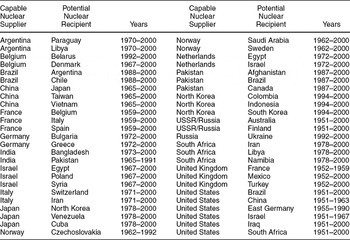
To code the sensitive nuclear assistance variable, I began with an online nuclear weapons database maintained by the Nuclear Threat Initiative (NTI). I also drew on prominent reviews of the proliferation of nuclear weapons and on historical studies of countries’ nuclear weapons programs.Footnote 19 To be included in the data set, a case of sensitive nuclear transfer had to be verified by at least two sources. Appendix A lists the cases of sensitive nuclear assistance and explains the key coding decisions.Footnote 20 A selection of cases in which sensitive nuclear assistance did not occur can be found in Table 2 and in Appendices B and C.
Selected Noncases of Sensitive Nuclear Assistance, 1951–2000
I construct independent variables to test the strategic hypotheses explicated previously. Relative power, a supplier state's ability to project power over a potential recipient, is measured as the capability of the supplier state, discounted by distance from the supplier to the potential recipient state, minus the capability of the potential recipient state. Capability is a composite index containing information on total population, urban population, energy consumption, iron and steel production, military manpower, and military expenditures. Data on capabilities are drawn from the Correlates of War composite capabilities index, version 3.01 (Singer, Bremer, and Stuckey Reference Singer, Bremer, Stuckey and Russett1972) and extracted using EUGene (Bennett and Stam Reference Bennett and Stam2000). Because a state's ability to project power over another state depends on the geographic distance between the two states, the capabilities of the supplier are discounted by distance using the formula advanced by Bueno de Mesquita (Reference Bueno de Mesquita1981). I also construct an alternative power ratio variable, measured as the composite capability of the supplier state divided by the combined composite capability of the supplier and the recipient.
To measure whether the nuclear supplier and the nuclear recipient are threatened by a common rival, I construct enemy.Footnote 21 This dichotomous variable indicates whether the nuclear supplier and the nuclear recipient share a common rival. The variable draws on rivalry data from Klein, Goertz, and Diehl (Reference Klein, Goertz and Diehl2006), which defines a rivalry as a pair of states that engage in multiple, linked, militarized interstate disputes within a given time period.
I construct three variables to measure a state's vulnerability to superpower pressure. Superpower pact is a dummy variable, indicating whether a state relies on a superpower security guarantee. States that rely on a superpower security guarantee are those that lack a nuclear weapons capability and are in a defense pact with a superpower.Footnote 22 I code the United States, from 1951 to 2000, and the Soviet Union, from 1951 to 1989, as superpowers. Data on defense pacts and nuclear weapons possession are drawn from version 3.0 of the Correlates of War alliance data set (Gibler and Sarkees Reference Gibler and Sarkees2002) and on Singh and Way's (Reference Singh and Way2004) coding of nuclear weapon states. An alternate measure, superpower vote, draws data from Gartzke's (Reference Gartzke2006) Affinity of Nations Index and measures the similarity of states’ voting behavior in the United Nations General Assembly (UNGA) with the voting behavior of the nearest superpower. A state that is vulnerable to superpower pressure is likely to vote with, rather than against, its patron. From 1951 to 1989, this variable measures the similarity of states’ voting behavior with the superpower that has the most similar voting profile in each year. From 1990 to 2000, this variable measures the similarity of states’ voting behavior with the United States. For a final, alternate measure of superpower dependence, I draw on Singh and Way's (Reference Singh and Way2004) coding of nuclear weapon states to create a dummy variable, nuclear weapons, indicating whether a country has a nuclear arsenal. Countries with a nuclear deterrent can better provide for their own security and should be less vulnerable to superpower pressure. It is also possible that nuclear weapon states may be more likely to provide sensitive nuclear assistance because the possession of nuclear weapons gives them confidence that they could deter attacks from new nuclear weapon states. Furthermore, nuclear weapon states may be more prolific nuclear suppliers because they are better able to provide nuclear assistance related to the design and construction of nuclear weapons. The inclusion of this variable also permits an evaluation of the alternative hypothesis that nuclear weapon states will be less likely to provide sensitive nuclear assistance because they have an interest in limiting the number of states in the nuclear weapons club.
I also include a number of control variables. We may expect states, regardless of their level of conventional military power, to be reluctant to provide sensitive nuclear assistance to geographically proximate states. To control for this factor, I generate distance, a logged measure of the number of miles between capital cities, as calculated by EUGene (Bennett and Stam Reference Bennett and Stam2000). It is likely, however, that the relationship between distance and sensitive nuclear assistance is nonmonotonic. Previous analysis has suggested that logistical problems may make it difficult for states to transfer sensitive nuclear technologies to distant states (Sands Reference Sands and Potter1990). To test for a nonmonotonic relationship between distance and sensitive nuclear transfers, I also include distance squared, a squared term of the distance variable.Footnote 23
To assess the effects of economic motivations on state decisions to provide sensitive nuclear assistance, I include a number of economic control variables. Economic development is measured as a country's gross domestic product (GDP) per capita in constant 1996 dollars. Economic growth is calculated as growth = log (GDPt) − log (GDPt−1). Following Oneal and Russett (Reference Oneal and Russett1997), I measure trade dependence as total trade (imports plus exports) between the two member states of a dyad as a percentage of the GDP of the first state. Openness to international trade is calculated as a state's trade ratio, total trade (imports plus exports) divided by GDP. The openness variable draws on data from Singh and Way (Reference Singh and Way2004). All other economic data are from Gleditsch (Reference Gleditsch2002) and extracted using EUGene (Bennett and Stam Reference Bennett and Stam2000).
I also control for a number of institutional variables that could affect patterns of international nuclear trade. International institutions are believed to affect state behavior through the establishment of formal rules that regulate state action and through the creation of informal norms that shape understandings of appropriate conduct (e.g., Keohane Reference Keohane1984; Koremenos, Lipson, and Snidal Reference Koremenos, Lipson and Snidal2001; Krasner Reference Krasner1983). The institutions of the nuclear nonproliferation regime set restrictions on the transfer of nuclear materials and technology, which may render member states less likely to provide sensitive nuclear assistance. To measure the effect of international institutions on sensitive nuclear assistance, I construct two dichotomous variables. NPT measures whether a supplier state is a member of the Nuclear Nonproliferation Treaty.Footnote 24NSG measures whether the potential supplier is a member of the Nuclear Suppliers Group.Footnote 25 Previous research suggests that domestic regime type may affect a state's behavior on nuclear weapons issues (Singh and Way Reference Singh and Way2004). To measure regime type, I use polity scores which range from −10 (most autocratic) to +10 (most democratic) from the Polity IV data set (Jaggers and Gurr Reference Jaggers and Gurr1995).
One may expect that states will be more likely to provide sensitive nuclear assistance to allied states. Gowa (Reference Gowa1994) has argued that states benefit from strong allies and that states engage in behavior, such as international trade, that empowers allied states. An alliance variable is not included in the models presented here, however, because contrary to the expectation of this alliance-building hypothesis, states have never provided sensitive nuclear assistance to a state with which they shared a formal alliance.Footnote 26
I also control for factors that influence the demand side of nuclear transactions. Previous research (e.g., Jo and Gartzke Reference Jo and Gartzke2007; Paul Reference Paul2000; Sagan Reference Sagan1996/1997; Singh and Way Reference Singh and Way2004; Solingen Reference Solingen1994, Reference Solingen1998, Reference Solingen2007) suggests that economic development, openness to the international economy, economic liberalization, membership in the NPT, and threat environment shape a state's demand for nuclear weapons. It is likely, therefore, that these variables also shape a recipient's demand for sensitive nuclear assistance. We may also expect that, like nuclear supplier states, potential nuclear recipient states that are dependent on a superpower patron may be more vulnerable to superpower pressure and will be less likely to receive sensitive nuclear assistance. The indicators of economic development, openness, NPT membership, and superpower dependence have already been discussed. To measure liberalization, I use a variable from Singh and Way (Reference Singh and Way2004) that gauges the movement toward greater trade openness by calculating the change in openness over time spans of 3, 5, and 10 years. Disputes is an indicator for the security environment of the recipient state. It is 5-year moving average of the number of militarized interstate disputes per year in which a recipient state is involved. The measure is from Singh and Way (Reference Singh and Way2004) and draws on data from version 3.0 of the Militarized Interstate Dispute data set (Ghosen and Palmer Reference Ghosen and Palmer2003).
DATA ANALYSIS
My central hypotheses concern the importance of relative power between the nuclear supplier and the nuclear recipient, the existence of a shared enemy between the nuclear supplier and the nuclear recipient, and the superpower dependence of the nuclear supplier for understanding the causes of sensitive nuclear assistance. I employ Rare Events Logistic Regression (ReLogit) to test claims about the correlates of sensitive nuclear assistance (King and Zeng Reference King and Zeng2001).Footnote 27 ReLogit offers several advantages of particular relevance to the research question and data. Sensitive nuclear assistance is a rare event, occurring in about 1/1,000 of the observations in the dyadic data.Footnote 28 ReLogit is able to model dichotomous dependent variables and to correct for biased estimates in rare events. In particular, ReLogit is designed to analyze “binary dependent variables with dozens to thousands of times fewer” events than nonevents (King and Zeng Reference King and Zeng2001, 137). Robust standard errors are adjusted for clustering by dyad.
Several types of statistical analyses prove useful in exploring the evidence for or against each of the hypotheses described previously. To begin the investigation, I examine the simple bivariate relationship between the key strategic and economic variables and sensitive nuclear assistance (Table 3). For each measure, I also examine the bivariate relationship after the inclusion of cubic splines to control for temporal dependence in the dependent variable (Beck, Katz, and Tucker Reference Beck, Katz and Tucker1998). The bivariate analysis is only the first step, however. To control for potentially confounding factors, I then evaluate the effect of each of the explanatory variables, including both control variables and the cubic splines (Table 4).
Correlates of Sensitive Nuclear Assistance, 1951–2000: Bivariate Relationships with and without Cubic Splines

Note: Each row in this table presents the results of a bivariate regression.
aSuperpower vote and superpower vote (recipient) are based on United Nations General Assembly voting. Models that include these measures lose observations for dyads in which at least one of the countries was not a member of the United Nations (UN). These models do not drop any observations in which sensitive nuclear assistance occurs with two exceptions. The China seat in the UN was held by Taiwan until 1971 and by China from 1971 to the present. Models using this variable do not capture French assistance to Taiwan in 1975 and Soviet assistance to China from 1958 to 1960. The other models using alternate measures of superpower dependence capture all cases of sensitive nuclear assistance.
*p < .05.
**p < .01.
***p < .001.
The dependent variable is sensitive nuclear assistance coded from 0 (no assistance) to 1 (assistance). Robust standard errors are adjusted for clustering by dyad. For each independent variable, I report results for bivariate regressions with Rare-events Logit (ReL) and for bivariate regressions with Rare-events Logit after including spline corrections for temporal dependence (CS).
Correlates of Sensitive Nuclear Assistance, 1951–2000: Multivariate Results

*p < .05.
**p < .01.
***p < .001.
The dependent variable is sensitive nuclear assistance coded from 0 (no assistance) to 1 (assistance). Robust standard errors are in parentheses and are adjusted for clustering by dyad. The model is estimated after including spline corrections for temporal dependence (Beck, Katz, and Tucker Reference Beck, Katz and Tucker1998).
I first examine the hypothesis that relative power is negatively related to sensitive nuclear assistance. Hypothesis 1 states that the more powerful a state is relative to a potential recipient, the less likely it will be to provide sensitive nuclear assistance to that state. Turning first to the bivariate models, we see that the relationship between relative power and sensitive nuclear assistance is negative and statistically significant in both models. Next, an examination of the multivariate regressions reveals a similar pattern. Again, the sign on the coefficient is negative and statistically significant in each and every model.Footnote 29 There is strong empirical support for the causal significance of the relative power differential between the nuclear supplier and the nuclear recipient for understanding sensitive nuclear assistance. The counterhypothesis that relatively powerful states will be more likely to provide sensitive nuclear assistance because they can better deter a nuclear attack does not find empirical support.
The second hypothesis focuses on the existence of a shared rival as an incentive for nuclear supplier states to provide sensitive nuclear assistance. By providing nuclear assistance to a state with which they share a common enemy, nuclear suppliers can impose strategic costs on rival states. As a reminder, we should expect a positive relationship between the existence of a shared enemy and sensitive nuclear assistance. Turning first to the bivariate models, we find support for this hypothesis. The relationship between enemy and sensitive nuclear assistance is positive and statistically significant in both bivariate models. The inclusion of control variables does not alter this relationship. In the multivariate models, we again see that the sign on the coefficient for the enemy variable is positive and statistically significant in every model. The analysis reveals a powerful link between the presence of a common enemy and the patterns of sensitive nuclear assistance.
Next, I examine the hypothesis that states that are vulnerable to superpower pressure will be less likely to provide sensitive nuclear assistance. In the bivariate analysis, we find the expected negative correlations between superpower pact and sensitive nuclear assistance and between superpower vote and sensitive nuclear assistance. We also find the expected positive correlation between nuclear weapon and sensitive nuclear assistance. Superpower pact is statistically significant in the simple bivariate model, and superpower vote is statistically significant in the bivariate models with the controls for temporal dependence. Nuclear weapon is also statistically significant in both specifications. The rest of the relationships, however, are not statistically significant. Once I control for other relevant variables, however, a discernable relationship emerges. In each and every one of the multivariate models, the variable indicating the superpower dependence of the supplier is statistically significant and in the expected direction. States that are vulnerable to superpower pressure are less likely to provide sensitive nuclear assistance.
The findings of this analysis do not support rival explanations for why states transfer sensitive nuclear materials and technology. Some have argued that nuclear weapon states have an incentive to limit the size of the nuclear club. Thus, we may expect that they will be less likely to provide sensitive nuclear assistance. This hypothesis, however, is not supported by the evidence. Both the bivariate and multivariate analyses reveal a strong relationship between nuclear weapon and sensitive nuclear assistance, but in the opposite direction. As was discussed in the previous paragraph, nuclear weapon states are more, not less, likely to provide sensitive nuclear assistance, undermining arguments that nuclear weapon states are more likely to oppose nuclear proliferation.
The set of economic variables does not appear to offer much explanatory power either. It has been suggested that states with lower levels of economic development, or lower levels of economic growth, will be more likely to provide sensitive nuclear assistance because they will be more willing to take measures to improve their economic circumstances. This expectation is not met with much empirical support. The variable measuring the level of economic development of the supplier is in the expected direction and is statistically significant in the simple bivariate model, but does not reach statistical significance in any of the other bivariate or multivariate models.Footnote 30 Moreover, the sign on economic development is inconsistent, switching from negative to positive under different model specifications. The variable for economic growth is not statistically significant in any of the bivariate models. It is statistically significant in three of the four multivariate models in which it is included, but the sign on the coefficient is in the unexpected direction, suggesting that states experiencing slow economic growth are actually less likely to provide sensitive nuclear assistance. Neither is there a consistent, statistically significant relationship between openness to the international economy and sensitive nuclear assistance. Openness is negative and statistically significant in the simple bivariate model, but is not statistically significant in any of the other models. The coefficient for trade dependence is in the expected direction and is statistically significant in all of the bivariate and multivariate models, suggesting that states are more likely to provide sensitive nuclear assistance to states with which they possess a close trade relationship.
I briefly comment on the other control variables.Footnote 31Distance and distance squared are statistically significant in each of the multivariate models, demonstrating the expected nonmonotonic relationship between distance and sensitive nuclear assistance.Footnote 32NPT is negative and statistically significant in three of the four multivariate models in which it is included.Footnote 33 Membership in the NPT does appear to serve as a constraint on the behavior of the nuclear suppliers.Footnote 34NSG is statistically significant and has a positive coefficient in each multivariate model, suggesting that, contrary to expectation, membership in the NSG may actually increase the likelihood that a state will export sensitive nuclear materials and technology. This finding cannot be explained by superior supply capabilities of NSG members because the analysis excludes states that are incapable of providing sensitive nuclear assistance. Instead, this result may be explained by three factors. First, due to its status as a nuclear cartel, the NSG may have failed to acquire international legitimacy and has, therefore, failed to impose a meaningful normative constraint on its members. Second, an adverse selection effect in the early days of the NSG may have initially brought in the states that were most likely to export sensitive technologies. These states joined the NSG, but continued to provide sensitive nuclear assistance. For example, the United States convinced a reluctant France to join the regime in 1975, but France continued the construction of a pilot-scale plutonium reprocessing plant in Pakistan until 1982. Third, the guidelines of the NSG allow states to export sensitive nuclear materials and technology as long as the exports are placed under international safeguards. NSG states may be more likely to provide sensitive nuclear assistance, but they may also be more likely to place their exports under safeguards. For example, Germany joined the NSG in 1975 and required safeguards on its sensitive nuclear exports to Brazil from 1978 to 1994.
Turning to the demand-side variables, we see that the coefficient on disputes is positive and statistically significant in three of the four models in which it is included, indicating that states in a competitive security environment are more likely to receive sensitive nuclear assistance. The sign on superpower vote (recipient) is negative and statistically significant in the multivariate models, suggesting that states that are dependent on a superpower patron are less likely to receive sensitive nuclear assistance. The coefficient on openness (recipient) is negative and statistically significant in each multivariate model, providing support for the argument that states that are open to the international economy have less demand for nuclear weapons and are thus less likely to receive sensitive nuclear assistance. The other control variables are not statistically significant in any of the models.Footnote 35
Table 5 interprets the substantive effect of these variables on sensitive nuclear assistance, using the results from Table 4, models 2 and 3. The entries represent the first differences and the relative risks (King and Zeng Reference King and Zeng2001) of sensitive nuclear assistance for a given change in the independent variable when all other variables are held at their mean. Probabilities are calculated using the approximate Bayesian method for predicting probabilities in rare events as recommended by King and Zeng (Reference King and Zeng2001). Table 5 also reports the 95% confidence bounds using the procedure developed by King, Tomz, and Wittenberg (Reference King, Tomz and Wittenberg2000). Because sensitive nuclear assistance is a rare event, the differences between probabilities are small. Like other international relations scholars, working with rare events data (e.g., Bennet and Stam Reference Bennett and Stam2003), I focus on relative risks to illustrate the substantive effects of the explanatory variables. Turning first to relative power, Table 5 reveals that a state that lacks the ability to project power over a potential recipient state is nearly three times more likely to provide sensitive nuclear assistance to that state than is a similar state that has the ability to project power over the recipient state.
Substantive Effects of Variables on the Likelihood of Sensitive Nuclear Assistance, 1951–2000

Note: The probabilities are calculated using the ReLogit estimates in model 3 of Table 4. Because the Superpower pact variable is not included in model 3, the probabilities for this variable are calculated using the ReLogit estimates in model 2 of Table 4. The calculations were performed to allow for the presentation of the relative risks as positive numbers. The entries for the relative power and superpower vote variables represent the effect of a change in the independent variable from one standard deviation above the mean to one standard deviation below the mean. The entries for the trade dependence and disputes variables represent the effect of a change from one standard deviation below the mean to one standard deviation above the mean. The entries for the enemy and NPT variables represent the effect of a change from 0 to 1 on the dichotomous variable. The entries of the superpower pact variable represents the effect of a change from 1 to 0 on the dichotomous variable. All other variables are held at their mean.
This effect of relative power on the probability of sensitive nuclear assistance is illustrated in Figure 1. In Figure 1, enemy is set to one, superpower pact is set to zero, and all other variables are held at their mean. The dashed lines represent the 95% confidence interval. Figure 1 demonstrates a clear negative relationship between relative power and the probability of sensitive nuclear assistance. When the capable nuclear supplier lacks the ability to project power over the potential recipient (represented in the graph by negative values of relative power), there is a substantial risk that the supplier state will export sensitive nuclear materials and technology. As the relative power distribution shifts in favor of the potential supplier, however, the risk that a state will export sensitive nuclear materials and technology declines. The probability of sensitive nuclear assistance decreases to near zero as the capable nuclear supplier gains the ability to project power over the potential nuclear recipient (represented in the graph by positive values of relative power).
Effect of Relative Power on Sensitive Nuclear Assistance, 1951–2000

Returning to the substantive effect of the other variables reported in Table 5, we see that states are over seven times more likely to provide sensitive nuclear assistance to a state with which they share an enemy than to a comparable state that is not threatened by a common enemy. A state that is not dependent on a superpower patron by virtue of a defense pact with a superpower is nearly five times more likely to provide sensitive nuclear assistance than is a similar state that is dependent on a superpower patron. Furthermore, a state that is not dependent on a superpower patron, as measured by UNGA voting data, is about three times more likely to provide sensitive nuclear assistance than is a similar state that is dependent on a superpower.
The substantive importance of these variables is also evident when they are taken together (not shown). Sensitive nuclear assistance, a rare event, is extremely unlikely to occur under typical circumstances. Indeed, the baseline probability that a nuclear transaction will occur in any given dyad-year when all explanatory variables are held at their mean is .2%.Footnote 36 When the three strategic variables are set to the worst-case scenario (i.e., relative power and superpower pact set to their minimums and enemy set to its maximum), however, and all other variables are held at their mean, the probability of sensitive nuclear assistance increases to 62%.Footnote 37 Taken together, this analysis indicates that strategic factors have not only a statistically significant effect, but also a substantively significant effect on the probability of sensitive nuclear assistance.
Turning now to the substantive effect of the control variables, Table 5 shows that NPT membership has a substantive effect on the patterns of sensitive nuclear assistance. Non-NPT members are over eight times more likely to provide sensitive nuclear assistance than are states that are members of the NPT. In contrast, trade dependence has a small substantive effect on states’ propensity to export sensitive nuclear technologies. States that are heavily dependent on trade with a particular trading partner are only about 36% more likely to provide sensitive nuclear assistance to that state than is a similar state that has no trade relationship whatsoever with that state. Thirty-six percent may not be a significant difference when one considers that a state with very high levels of trade with a particular state should be much more likely (indeed, more than 36% more likely) to trade any product with that state than with a similar state with which the supplier has absolutely no trade relationship.
DISCUSSION AND CONCLUSION
This article explains why states provide sensitive nuclear assistance to nonnuclear weapon states, contributing to the international spread of nuclear weapons. I found that in order to explain patterns of sensitive nuclear assistance, one must look to the strategic environment of the nuclear supplier. The costs of the spread of nuclear weapons are concentrated on relatively powerful states. This simple logic of the differential costs of nuclear proliferation leads states to provide sensitive nuclear assistance under three conditions. First, because nuclear proliferation constrains states’ ability to use conventional military power to their advantage, the more powerful a state is relative to a potential nuclear recipient, the less likely it is to provide sensitive nuclear assistance. States do not want to impose constraints on themselves. Second, precisely because nuclear proliferation constrains states’ military freedom of action, however, states are more likely to provide sensitive nuclear assistance to states with which they share a common enemy. By providing sensitive nuclear assistance to these states, a nuclear supplier can impose strategic costs on rival states. Finally, because superpowers, states with global force projection capabilities, are threatened by nuclear proliferation anywhere in the international system, they pressure other states in an attempt to prevent sensitive nuclear transfers. States that are vulnerable to superpower pressure are less likely to provide sensitive nuclear assistance.
Arguments that contend that states are driven to provide sensitive nuclear assistance by an economic profit motive do not find support in the data. There is no discernable relationship between poor economic performance and sensitive nuclear assistance. This is not to say that economic motivations are irrelevant to state decisions to transfer sensitive nuclear materials and technology. Indeed, in many cases in which sensitive nuclear transfers occurred, the nuclear suppliers did seek economic benefits. What these findings do suggest, however, is that states are unlikely to pursue economic gains when the result undermines their own security. States may still seek economic benefits when they export sensitive nuclear technology, but they are only likely to do so when such behavior is consistent with underlying strategic conditions.
The empirical analysis provides some reassurance to proponents of the nuclear nonproliferation regime. The findings suggest that NPT members are less likely than non-NPT members to export sensitive nuclear materials and technology. Yet, the analysis also shows that NSG members are more likely to conduct sensitive nuclear transfers. The international institutions of the nuclear nonproliferation regime do not appear to impose a consistent restraining effect on sensitive nuclear exports.
This research on the causes of sensitive nuclear assistance suggests a new, supply-side approach to the study of nuclear proliferation. Scholars have analyzed state decisions to pursue nuclear weapons, but have not explained, through a theoretical lens, the behavior by other states that facilitates or impedes the spread of nuclear weapons to additional countries. There is substantial variation in whether, and the degree to which, states support or oppose nuclear proliferation to additional states. At one extreme, as this research shows, states are willing to provide sensitive nuclear assistance to help other states acquire nuclear weapons. At the other extreme, states are so opposed to nuclear proliferation in another state that they are willing to use military force to stop it. There are other more moderate measures by which states can affect the supply of nuclear proliferation. States show different inclinations to vote for or against nuclear nonproliferation measures in the IAEA Board of Governors and the United Nations Security Council. States also vary in their willingness to apply sanctions against states that are developing nuclear programs. All topics could become the focus of future scholarly inquiry. In fact, the conditions that determine whether states provide sensitive nuclear assistance may also shape state responses to other issue areas related to the supply of nuclear proliferation. For example, if relatively powerful states are more threatened by nuclear proliferation, as this article claims, we may expect that they may be more likely to support measures, such as preventive military strikes, designed to prevent other states from acquiring nuclear weapons.
The theoretical approach of this article may provide a helpful framework for the study of conventional arms transfers. Blanton (Reference Blanton2000, Reference Blanton2005) has argued that the United States is more likely to transfer conventional arms to democratic countries. In contrast, this study found, analyzing the entire universe of nuclear suppliers, that power-based factors are paramount and that the regime type of the recipient does not affect decisions to transfer sensitive nuclear materials and technology.Footnote 38 Scholars could seek to understand further the conditions under which states export conventional military hardware by examining systematically the entire universe of potential suppliers and by including the strategic factors identified here among the explanatory variables. It is possible that relative power, the presence of a common enemy, and superpower dependence shape the probability that states will transfer conventional military, as well as nuclear materials and technology.
The argument of this article began with a simple insight grounded in the nuclear deterrence literature about the differential effects of nuclear proliferation. The existing scholarship on the consequences of nuclear proliferation has centered around the debate about whether the spread of nuclear weapons generates more or less stability at the level of the international system (e.g., Sagan and Waltz Reference Sagan and Waltz1995). There has been less of a focus, however, on whether nuclear proliferation may threaten certain types of states more than others. The findings of this article are consistent with the observation that the spread of nuclear weapons may be worse for relatively powerful states than it is for relatively weak states. The spread of nuclear weapons imposes strategic costs on relatively powerful states because it undermines their ability to tap conventional military power as a source of strategic advantage. To the degree that nuclear proliferation constrains more powerful rivals, however, the global spread of nuclear weapons, in certain circumstances, may improve the strategic environment of relatively weak states. This argument about the differential effects of nuclear proliferation contributes to our theoretical understanding of the consequences of nuclear proliferation.
In his 2007 annual report to Congress on the projected threats to the national security of the United States, Director of National Intelligence Michael J. McConnell assessed that, after terrorism, nuclear proliferation poses the greatest threat to U.S. national security.Footnote 39 This was not a new recognition. Nuclear proliferation has appeared as one of the top threats to U.S. national security in every such annual report for decades. In response to the continuing threat of nuclear proliferation, the United States has implemented a number of policies to stop states from transferring sensitive nuclear materials and technology. In May 2003, the United States announced the Proliferation Security Initiative, a program designed to allow the United States to interdict the international transfer of sensitive nuclear materials and technology. As was stated in the introduction, in October 2006, the United States issued a threat aimed to deter states from providing sensitive nuclear assistance. The effective execution of these and other nonproliferation policies requires an accurate assessment of which states are most likely to export sensitive nuclear materials and technology.
Each of the three hypotheses presented in this article can guide intelligence analysts and policy makers as they attempt to identify and deter future nuclear suppliers. First, as a state's ability to project power increases or decreases, its propensity to provide sensitive nuclear assistance will adjust accordingly. During the Cold War, the Soviet Union was a superpower with global force projection capabilities and nuclear proliferation anywhere threatened to constrain its military power. Partly for this reason, the Soviet Union took a tough stand against nuclear proliferation and was loathe to provide sensitive nuclear assistance. However, Moscow's conventional military power collapsed along with the Soviet Union, and nuclear proliferation was no longer a limiting factor on Moscow's force projection capability. In this altered security environment, Russia became more willing to provide sensitive nuclear assistance. In 1995, for example, just five years after the collapse of the Soviet Union, Russia offered to construct a uranium enrichment facility in Iran.Footnote 40 China is on the opposite trajectory. China's power projection capability has traditionally been limited to a handful of states on its immediate borders. For most of the nuclear era, nuclear proliferation to states beyond this sphere of influence did not directly undermine Chinese power. In recent years, however, as China modernizes its military forces and begins to think about projecting force abroad, it is likely becoming more concerned that nuclear proliferation in distant regions could constrain its military might. This consideration may be contributing to the decline in sensitive nuclear exports from, and a heightened attention to nuclear nonproliferation in, Beijing.
Second, officials must recognize that states that are threatened by U.S. power can provide sensitive nuclear assistance to Washington's enemies in order to constrain U.S. military freedom of action. Military leaders in Pakistan, for example, supported sensitive nuclear exports to Iran, Libya, and North Korea in part because they assessed that, after the collapse of the Soviet Union, the United States had become too powerful in the Middle East and South Asia. They believed that by providing sensitive nuclear assistance to a band of states hostile to Washington, Pakistan, with the support of China, could form an alliance of “strategic defiance” against the United States.Footnote 41
Third, policy makers should beware of the end of security alliances. States that depend on a superpower to provide for their security are less likely to export sensitive nuclear materials and technology. The collapse of the Soviet Union left a number of states without a superpower patron. North Korea, for example, may be at risk of providing sensitive nuclear assistance in part because it can do so without antagonizing a powerful protector. Officials must recognize that nuclear umbrellas can reduce the supply of, as well as the demand for, nuclear materials and technology. Correctly understanding the conditions under which states provide sensitive nuclear assistance matters not only for the scholarly study of nuclear proliferation, but also for efforts to prevent the further spread of the world's most dangerous weapon.
Appendix A: Cases of Sensitive Nuclear Assistance
U.S.S.R to China (1958–60). The Soviet Union provided China with designs and key component parts for the Jiuquan plutonium reprocessing plant and for the Lanzhou uranium enrichment facility. Moscow reneged on a promise to provide Beijing with a prototype atomic bomb (Lewis and Litai Reference Lewis and Litai1988, 60–1, 72, 112, 118–21; NTI).
France to Israel (1959–65). France helped Israel construct the Dimona plutonium reprocessing facility. The French are also believed to have transferred a nuclear weapon design (Cirincione et al. Reference Cirincione, Wolfsthal and Rajkumar2002, 225; Cohen Reference Cohen1998, 73–5; NTI). French nuclear assistance was formally approved by the Guy Mollet government in 1956. In a journalistic account of the development of Israel's nuclear program, Hersh (Reference Hersh1991) erroneously suggests that, in 1960, French president Charles de Gaulle ordered a complete halt to nuclear cooperation with Israel, but that French bureaucrats continued the nuclear transfers without de Gaulle's knowledge or approval. In a scholarly history of Israel's nuclear program, however, Cohen (Reference Cohen1998) documents de Gualle's decision to cease official French government involvement with Israel's nuclear program in 1960, but to explicitly authorize French firms to continue the construction of the sensitive, plutonium reprocessing facility in Israel.
France to Japan (1971–4). France constructed a pilot-scale reprocessing plant for Japan at Tokai Mura (Gale Reference Gale1978, 1124; Lester Reference Lester1982, 422; Reiss Reference Reiss1988, 115).
France to Pakistan (1974–82). France helped Pakistan construct the Chasma and Pinstech reprocessing plants. French assistance to the Chasma plant was halted in August 1978 under U.S. pressure. France continued the construction of the pilot-scale facility at Pinstech until its completion in 1982 (Spector Reference Spector1990, 90–117; Weissman and Krosney Reference Weissman and Krosney1981, 74–84, 161–74).
France to Taiwan (1975). France agreed to provide Taiwan with a plutonium reprocessing facility. The French were able to transfer some of the component parts for the facility before Taiwan canceled the transaction under U.S. pressure. The United States dismantled the facilities related to reprocessing and confiscated the component parts (Spector Reference Spector1984, 342–4; Weissman and Krosney Reference Weissman and Krosney1981, 152–3).
Italy to Iraq (1976–8). Italy constructed a radiochemistry lab consisting of three lead-shielded hot cells capable of reprocessing plutonium in Iraq (NTI; Weissman and Krosney Reference Weissman and Krosney1981, 97–9).
Germany to Brazil (1979–94). In 1975, Germany agreed to provide Brazil with ten nuclear reactors, a plutonium reprocessing plant, and a jet-nozzle uranium enrichment plant at Resende. Construction of the facilities began in 1979. After years of construction delays and cost overruns, Brazil decided to complete only two of the ten reactors and indefinitely postponed the construction of the reprocessing plant in 1985. In March 1994, Brazil also canceled the uranium enrichment plant (Jones et al. Reference Jones, McDonough, Dalton and Koblentz1998, 231–42; NTI; Spector Reference Spector1990, 242–66).
France to Egypt (1980–2). France constructed two hot cells for plutonium reprocessing in the Hot Laboratory and Waste Management Center in Egypt (Bhatia Reference Bhatia1988, 61; NTI).
China to Pakistan (1981–3; 1984–6). In the early 1980s, China supplied Pakistan with a nuclear weapon design and enough highly enriched uranium for two nuclear weapons. Later, China is believed to have assisted Pakistan with the Kahuta uranium enrichment plant. In the 1990s, China also helped Pakistan with its reprocessing facility at Chasma. In 1995, China provided Pakistan with 5,000 ring magnets, a component part for use in a gaseous centrifuge uranium enrichment plant (Jones et al. Reference Jones, McDonough, Dalton and Koblentz1998, 50, 57–8n; NTI; Shuey and Kan Reference Shuey and Kan1995). Medeiros (Reference Medeiros2005) claims that the 1995 ring magnet transfer (but not the nuclear assistance provided in the 1980s) may have been the result of lax export controls that allowed Chinese firms to export sensitive technology without the authorization of the central government. The 1990s transfers occurred after Pakistan is believed to have achieved a nuclear weapons capability and are not recorded as cases of sensitive nuclear assistance.
China to Iran (1984, 1987, 1989, 1995). China provided Iran with calutrons, a key component part for uranium enrichment using the electromagnetic isotope separation method (Albright, Berkhout, and Walker Reference Albright, Berkhout and Walker1997, 359–60; NTI).
China to Algeria (1986–91). China constructed hot cells for Algeria at Ain Oussera and began the installation of a larger plutonium reprocessing facility (Albright and Hinderstein Reference Albright and Hinderstein2001; Jones et al. Reference Jones, McDonough, Dalton and Koblentz1998, 163).
Pakistan to Iran (1987–95). Pakistan provided Iran with designs and key component parts for a gaseous centrifuge uranium enrichment plant. It may have also transferred a nuclear weapon design (Corera Reference Corera2006; Langewiesche Reference Langewiesche2007; Montgomery Reference Montgomery2005; NTI). President Pervez Musharraf (Reference Musharraf2006, 288–9) claims in his memoirs that, when he assumed the office of president in 1999, he was unaware of Pakistan's sensitive nuclear exports to Iran, Libya, and North Korea. There are reasons, however, to doubt Musharraf's claims. More important, regardless of whether Musharraf was initially aware of the transfers, there is overwhelming evidence that indicates that the nuclear exports were actively supported by senior government officials, including chiefs of the army staff and civilian heads of state (Bhatia Reference Bhatia2008; Corera Reference Corera2006; Frantz and Collins Reference Frantz and Collins2007; Langewiesche Reference Langewiesche2007; Levy and Scott-Clark Reference Levy and Scott-Clark2007; Sagan Reference Sagan2006, 53).
Pakistan to Libya (1997–2001). Pakistan provided Libya with designs and key component parts for a gaseous centrifuge uranium enrichment plant. It also transferred a nuclear weapon design (Corera Reference Corera2006; Langewiesche Reference Langewiesche2007; Montgomery Reference Montgomery2005; NTI). These transfers were state sponsored.Footnote 42
Pakistan to North Korea (1997–2002). Pakistan provided North Korea with designs and key component parts for a gaseous centrifuge uranium enrichment plant. It may have also transferred a nuclear weapon design (Corera Reference Corera2006; Langewiesche Reference Langewiesche2007; Montgomery Reference Montgomery2005; NTI). These transfers were state sponsored.Footnote 43
Appendix B: Selected Cases of Nonsensitive Nuclear Assistance
Canada and the United States to India (1955). Canada supplied India with a nuclear reactor moderated with heavy water from the United States (Perkovich Reference Perkovich1999). Nuclear reactors and heavy water do not qualify as sensitive nuclear assistance.
France to Japan (2001–present). The French firm AREVA assisted Japan in the construction of the Rokkasho-Mura plutonium reprocessing facility.Footnote 44 This does not qualify as sensitive nuclear assistance because it does not materially advance Japan's ability to produce a nuclear weapon. Japan has enjoyed the ability to reprocess plutonium since 1977 (Reiss Reference Reiss1988, 113).
Germany to Iraq (1985–94). German firms exported materials that Iraq used in the construction of its nuclear facilities (Morstein and Perry Reference Morstein and Perry2000; NTI). These materials consisted of dual-use industrial materials such as electrical components, industrial pipelines, soft iron, and furnace equipment. Germany did not export sensitive nuclear fuel cycle facilities, or their major component parts, to Iraq.
Israel to South Africa (1977–80). Israel may have provided missile technology and tritium to South Africa in exchange for natural uranium (Liberman Reference Liberman2004). Missile technology and tritium do not qualify as sensitive nuclear assistance as a define it. Although tritium can be used to transform a basic fission weapon into a higher-yield, “boosted” nuclear weapon, it cannot help a nonnuclear weapon state cross the nuclear threshold.Footnote 45 Despite much suspicion, there is no evidence that Israel provided South Africa with sensitive nuclear assistance. Some have speculated that South Africa may have also provided Israel with grounds for a nuclear test site, but this accusation has been dismissed by leading nuclear physicists.
Netherlands to Pakistan (1974–76). While working in the Netherlands in the mid-1970s, Pakistani scientist A.Q. Khan smuggled uranium enrichment designs and equipment from the Netherlands to Pakistan without the knowledge and approval of the Dutch government (Corera Reference Corera2006). This case does not qualify as sensitive nuclear assistance because it was not sponsored by the state.
North Korea or Pakistan to Libya (2000). In February 2005, the U.S. government charged North Korea with transferring uranium hexafluoride to Libya. It is now believed that the uranium hexafluoride came from Pakistan. Uranium hexafluoride does not qualify as sensitive nuclear assistance.
North Korea to Syria (2001–7). North Korea may have helped Syria construct a nuclear reactor. Nuclear reactors are not considered sensitive nuclear assistance. Some have questioned whether North Korea may have also provided Syria with plutonium reprocessing capabilities, but there is no firm evidence that these countries engaged in any sensitive nuclear cooperation.
Russia to Iran (1995–present). Russia rebuilt the Bushehr light-water nuclear power reactors in Iran, but nuclear reactors do not qualify as sensitive nuclear assistance. Russia considered constructing a uranium enrichment facility, but canceled the deal under U.S. pressure.
Soviet Union to North Korea (1956–67). The Soviet Union assisted North Korea with the construction of a research reactor and provided basic scientific training, but did not assist North Korea with plutonium reprocessing or other sensitive nuclear technology (Wit, Poneman, and Gallucci Reference Wit, Poneman and Gallucci2004).
United States Atoms for Peace Program (1953–75). Under the Atoms for Peace program initiated by President Dwight D. Eisenhower in 1953, the United States transferred research reactors and provided basic scientific training to many developing countries. The United States stopped well short, however, of providing sensitive nuclear assistance (Hewlett and Holl Reference Hewlett and Holl1989).
United States to France (1970s and 1980s). In this time period, the United States provided assistance to France designed primarily to improve the safety and security of French warheads (Ullman Reference Ullman1989). This does not qualify as sensitive nuclear assistance because France was, at this time, an established nuclear weapon state.
United States to India (1961, 2005). A U.S. firm, Vitro International, prepared blueprints for the construction of the physical site at the Trombay reprocessing facility in 1961, but did not work on the sensitive nuclear technologies. The sensitive technologies in the Trombay reprocessing facility were developed autonomously with the aid of declassified documents on plutonium reprocessing made available by the United Nations (Jones et al. Reference Jones, McDonough, Dalton and Koblentz1998, 112; Perkovich Reference Perkovich1999, 28). The U.S.-India nuclear deal signed in January 2005 is related to civilian nuclear assistance only and does not provide for the transfer of sensitive nuclear materials or technology. Furthermore, by the time of the U.S.-India nuclear deal in 2005, India was an established nuclear weapon state.
Appendix C: Selected Cases of Nonassistance
Argentina to Iran (1992). Argentina denied an Iranian request for hot cells (Hibbs Reference Hibbs1992).
Argentina to Libya (1985). Argentina offered to sell reprocessing technology to Libya, but canceled the deal under U.S. pressure (Jones et al. Reference Jones, McDonough, Dalton and Koblentz1998, 224).
China, Germany, Great Britain, and Yugoslavia to Iraq(1987–90). Iraq was able to acquire component parts and materials to be used in its uranium enrichment program from various suppliers in Europe and Asia. These were piecemeal acquisitions, however, that consisted almost entirely of unrestricted dual-use items. Iraq never received a substantial infusion of sensitive nuclear assistance from abroad in this time period (Albright and Hibbs Reference Albright and Hibbs1992).
China to North Korea (1964). China denied a North Korean request for assistance with nuclear weapons technology (Wit, Poneman, and Gallucci Reference Wit, Poneman and Gallucci2004).
France to South Korea (1975–6). France agreed to sell reprocessing technology to South Korea, but canceled the deal under U.S. pressure (Katz and Marwah Reference Katz and Marwah1982, 227).
Germany to South Africa (1968–72). There has been speculation, but no concrete evidence, that a German firm assisted South Africa with jet-nozzle uranium enrichment after the German cabinet explicitly prohibited the cooperation (Rogers and Cervenka Reference Rogers and Zedenk1978). If the cooperation did occur, it was not state sponsored and would not count as sensitive nuclear assistance as I define it.
Italy to Argentina (1969). Experts once speculated that Italy may have assisted Argentina in the construction of the Ezeiza reprocessing facility. It is now believed that the facility was constructed indigenously (Spector Reference Spector1984, 203).
Norway to Yugoslavia (1966). Norway considered selling reprocessing technology to Yugoslavia, but the deal was never consummated (Potter, Miljanic, and Slaus Reference Potter, Miljanic and Slaus2000).
Pakistan to Iraq and Syria (1990). Pakistan may have offered Iraq and Syria uranium enrichment technology, but the transactions were never executed (Mongtomery Reference Montgomery2005, 173).
United States to Great Britain (1940–51 and 1960s). Contrary to the belief of many, the United States did not provide sensitive nuclear assistance, as it is defined here, to Great Britain. During the Manhattan Project, the United States selectively exploited Britain's expertise in nuclear physics while systematically denying the British access to America's most sensitive nuclear weapons research. Official U.S. policy was to prevent Britain from obtaining the bomb in this period (Gowing Reference Gowing1964, Reference Gowing1974; Rhodes Reference Rhodes1995). The United States assisted Britain with its nuclear weapons arsenal in the 1960s, but this does not qualify as sensitive nuclear assistance because, by this time, Great Britain was an established nuclear weapon state.
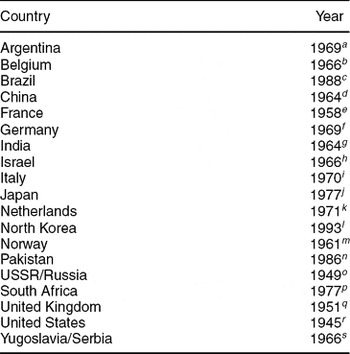
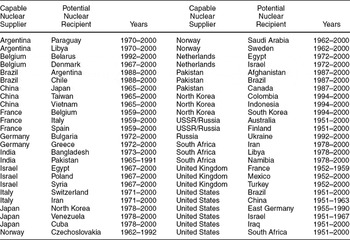
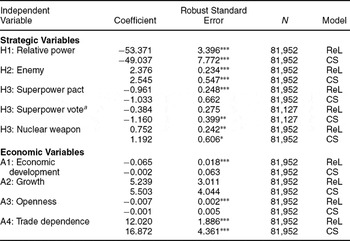
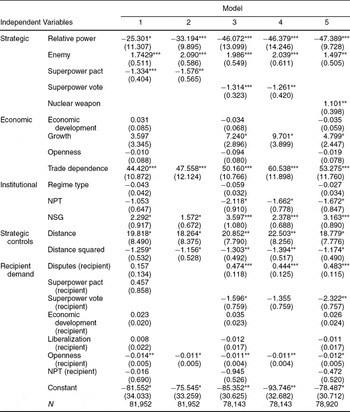
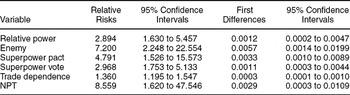
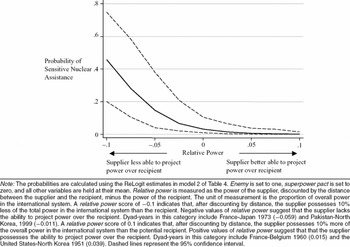



Comments
No Comments have been published for this article.