I. INTRODUCTION
When a metallic material is deformed plastically at high temperature, the storage and elimination of dislocations can occur simultaneously, which is known as “dynamic recrystallization” (DRX).Reference Cram, Zurob, Brechet and Hutchinson1–Reference Doherty, Hughes, Humphreys, Jonas, Jensen, Kassner, King, McNelley, McQueen and Rollett4 For DRX, a large number of dislocations is accumulated and eliminated by the migration of high-angle grain boundaries (HAGBs). In general, there are two types of DRX: (i) continuous dynamic recrystallization (CDRX), which involves the transformation of low-angle grain boundaries (LAGBs) into HAGBs due to increases in misorientation (θ) by the progressive accumulation of dislocations at subgrain boundaries, and (ii) discontinuous dynamic recrystallization (DDRX), which occurs by the nucleation and growth mechanisms of grains with HAGBs.Reference Gourdet and Montheillet5–Reference Kassner and Barrabes13
However, the high stacking fault energy of aluminum results in the cross-slip and climb of dislocations, such that the value of the stored energy is too low to cause DRX. Therefore, the energy restoration of aluminum generally takes place not through DRX but through dynamic recovery (DRV).Reference Chu-ming, Jiang and Zhang14 Nevertheless, several researchers have reported that DRX could take place in aluminum in special conditions, such as equal channel angular extrusion, cyclic deformation, and hot compression at high temperature.Reference Gourdet and Montheillet5,Reference Bai, Liu, Zhou, Gu and Yu15–Reference Ferrasse, Segal, Hartwig and Goforth20 Most previous reports indicated that appropriate temperature was necessary for the occurrence of DRX. YamagataReference Yamagata18 reported that DRX took place during compression tests of high-purity aluminum at room temperature, which means that DRX can take place in high-purity aluminum without thermal assistance. Kassner et al.Reference Kassner, Pollard, Evangelista and Cerri21,Reference Kassner, McQueen, Pollard, Evangelista and Cerri22 also performed compression tests of high-purity aluminum at ambient temperature and demonstrated the saturation in the flow stress as softening due to DRX. However, since the specimens are in contact with the compression platens and the lubricant in compression tests, there may be doubts as to whether DRX is induced by friction between a specimen and compression platens. Moreover, higher strain than 2.0 in compression tests may lead to self-heating of the specimen, which may promote the onset of DRX. To exclude the effect of friction, Ponge et al.Reference Ponge, Bredehöft and Gottstein23 carried out frictionless tensile tests and reported the occurrence of DRX in aluminum single crystal (99.9995% purity) at 260 °C by a stress drop in the stress–strain curve. However, they did not show the occurrence of DRX in aluminum at room temperature. Kassner et al.Reference Kassner, Pollard, Evangelista and Cerri21,Reference Kassner, McQueen, Pollard, Evangelista and Cerri22 also performed frictionless torsion tests at ambient temperature, but they may have the self-heating problem due to a large amount of applied strain (ε > 2.0).Reference Ferrasse, Hartwig, Goforth and Segal16,Reference Hokka, Kokkonen, Seidt, Matrka, Gilat and Kuokkala24,Reference Li, Yang, Xua, Zheng, Zhu and Zhang25 Furthermore, Ponge et al.Reference Ponge, Bredehöft and Gottstein23 and Kassner et al.Reference Kassner, Pollard, Evangelista and Cerri21,Reference Kassner, McQueen, Pollard, Evangelista and Cerri22 presented the stress drops in the stress–strain curve as indirect evidence of DRX during tensile or torsional deformations and did not carry out direct observation of the DRX during the deformations.
In this work, to discuss the occurrence of DRX at room temperature, we performed a frictionless tensile test of pure aluminum using a specially designed in situ microdeformation device positioned inside an electron backscattered diffraction (EBSD) system chamber. This in situ EBSD observation can provide the direct information on microstructure and texture evolution during the deformation. To exclude the self-heating of the specimen due to high strain, a microcrack that localizes the stress at a very small region was intentionally introduced by controlled local necking. Therefore, we could observe DRX very easily at a desired location with small strain (ε < 0.3) inducing little self-heating.
II. EXPERIMENTAL
High-purity aluminum single crystal with a purity of 99.9999% was grown from melt using Bridgman's method. Specimens were cut out of the single crystal so that they have an orientation with low indices, and then the orientation of {001}<110> was chosen. Figure 1(a) shows the specially designed sample used to analyze the microstructural evolution during the DRX of aluminum under plane strain tension. To induce stress localization, the thickness of the center region of the specimen was gradually reduced from 1.5 to 0.3 mm by machining. The upper side of the specimen was thinned by mechanical polishing, and then polished electrochemically to remove residual stress on the surface. Four microindents were marked on the center of the polished surface for positional reference to measure the strain using a micro-Vickers hardness tester. Before tensile loading, we confirmed that the specimen is a perfect single crystal with an initial orientation of {001}<110> using an EBSD.
(a) Schematic of the sample designed for DRX observation and (b) digital image of in situ tension device.

Figure 1(b) displays a digital image of an in situ tension device designed for EBSD measurement. The specimen was uniaxially elongated at room temperature using the in situ tension device equipped in a scanning electron microscope (SEM) (JEOL, JSM-6500F, Akishiam, Tokyo, Japan). The tensile direction was set parallel to the <110> crystallographic direction of the specimen. All crystallographic orientation data were collected from electron-backscattered patterns and processed using a software package (INCA Crystal and HKL Channel 5, Oxford Instruments, Abingdon, Oxfordshire, UK). After EBSD measurements of the deformed specimen, a cross-sectional sample was prepared using a dual beam focused ion beam (FEI, Nova NanoLab 200, Hillsboro, OR) to analyze the microstructure in a highly deformed region. Its grain and dislocation structure were observed by a high-resolution transmission electron microscope (TEM) (JEOL, JEM-2100F).
III. RESULTS AND DISCUSSION
Figure 2 shows the surface SEM image and the corresponding orientation image maps of the loading direction (LD) and normal direction (ND) before applying load. The red, green, and blue colors represent the <001>, <110>, and <111> crystallographic directions, respectively. Figures 2(a) and 2(b) show that the specimen is perfectly a single crystal with the initial orientation of {001}<110> before tensile loading. We also checked the microstructure and orientations of other regions of the specimen, showing the same result as Fig. 2. Therefore, by using aluminum single crystals, we could disregard the effect of pristine grain boundaries on DRX interrupting dislocation movement.
SEM image showing the surface of the specimen before applying load and corresponding orientation maps of (a) LD and (b) ND.
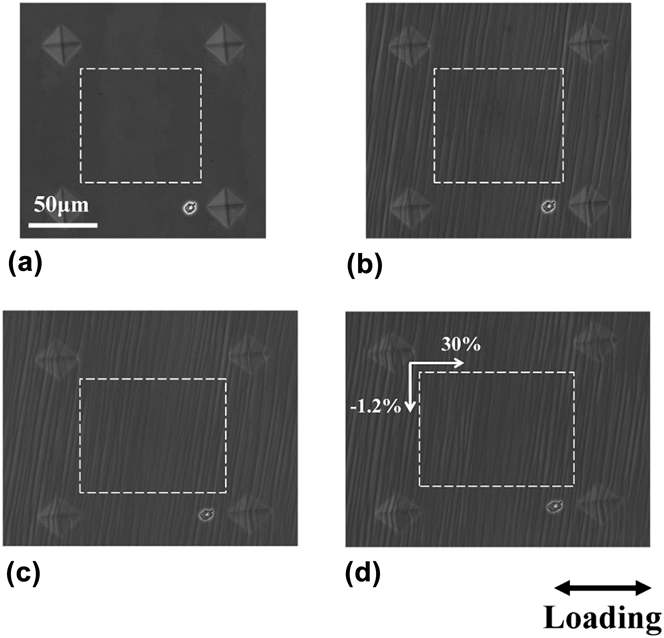
The specimen was uniaxially elongated using the in situ tension device at room temperature. Figure 3 exhibits the SEM images at each deformation step showing the relative displacements of the marked indents. It reveals that the minor strain was approximately 1.2%, whereas the major strain was 30%, representing that the plane strain condition was well satisfied. Necking of the specimen took place at 23% strain and a crack started propagating at 27% strain. EBSD analysis was performed along the crack propagation direction at 30% strain. The dynamically recrystallized grain structure was fully developed around the crack propagation route. It should be noted that the strain of 30% is quite smaller than that for inducing DRX in other previous researches, which may disregard the self-heating effect on DRX. Figure 4(a) shows the measured orientation image maps of the LD and ND in the necking/crack region of the specimen. It can be seen that the blue and pink colors, which represent the <111> and <112> directions, are dominant in the LD and ND maps, respectively. This means that the initial {001}<110> orientation rotates toward the stable orientation of {112}<111> during the plane strain tension.Reference Han, Jee and Oh26,Reference Kim, Kim, Kim, Rollett, Oh and Han27 The left side of the crack area represented by blue color in the ND map might be due to the surface inclination by necking.
In situ SEM images at strains of (a) 0%, (b) 10%, (c) 20%, and (d) 30% showing the relative displacements of the marked indents.
(a) Orientation maps of dynamic recrystallized grains along the necking area at a strain of 30% and (b) inverse pole figures showing the orientation distribution of the dynamically recrystallized grains.
In addition to the changes in crystallographic orientation, interestingly, newly created grains with sizes varying from 100 to 300 μm were observed along the crack propagation route and had orientations that differed from the surrounding orientation. The corresponding orientation images reveal that the DRX could take place at room temperature during plastic deformation in regions severely deformed locally, such as crack propagation routes or necking areas. Also, another specimen with the initial high-index orientation of {114}<252> showed the same DRX behavior along the crack propagation route (not shown here). The recrystallized grains shown in Fig. 4(a) have directionality, such that the recrystallized grains grow along the directions with angles less than 25° from the crack propagation direction. Furthermore, recrystallized grains were observed not only around the crack but also at the front of the crack tip shown in Fig. 4(a). It could be considered that new grains with HAGBs formed and grew preferentially at the necking region, after which a crack propagated across the recrystallized grains. Figure 4(b) shows inverse pole figures with the orientation distribution of the recrystallized grains to LD and ND. The {001}<100> cube texture seems to be slightly dominant, but it is more reasonable that the overall texture is relatively random. The details about the directional grain growth and random texture evolution during DRX will be discussed in the future.
To understand the microstructural evolution in the nucleation stage of the new grains, the most severely deformed region marked by the white circle in Fig. 4(a) was selected and analyzed using a TEM. Figures 5(a) and 5(b) show the cross-sectional TEM images of the selected region. It can be seen in the images that the pure aluminum single crystal was divided into small subgrains, some of which have distinct grain boundaries. Also, a dislocation network with the appearance of grain boundaries was discovered, as indicated by white arrows in Fig. 5(b). This can be considered significant evidence showing the formation of subgrain boundaries by dislocation accumulation. Figure 5(c) shows the orientation map and misorientation line scan graph of the selected area of Fig. 5(a) (red square), which was analyzed by a high-resolution TEM-EBSD system to accurately measure the misorientation between subgrains. From the misorientation line scan, it was seen that the misorientation varied from 1 to 14° indicating the existence of at least two different types of subgrain boundaries, which were possibly evolved by different dislocation accumulation mechanisms. These boundaries have been termed incidental dislocation boundaries (IDBs) and geometrically necessary boundaries (GNBs), in which IDBs form by networking of dislocations into low-energy configurations and GNBs form between regions of different strain patterns to accommodate the accompanying difference in lattice rotation.Reference Hughes, Hansen and Bammann28–Reference Mariani, Mecklenburgh, Wheeler, Prior and Heidelbach30 Hughes et al.Reference Hughes, Hansen and Bammann28 suggested that average misorientation angle increases more rapidly with strain for GNBs than IDBs in Al and Ni polycrystals. So, we can propose that the very LAGB (θ < 5°) shown in Fig. 5 may be comparable to IDBs, although the LAGB (5° < θ < 15°) may be GNBs formed to accommodate large lattice rotation. As strain increases, dislocations forming the GNBs can develop into HAGBs, which are equivalent to ordinary grain boundaries. CDRX can be another possible mechanism for the formation of HAGBs because it is described by the accumulation of dislocations within the crystallites, the generation of LAGBs, the subsequent increase of their misorientation angles, and their possible transformation into HAGBs. However, McQueen and KassnerReference McQueen and Kassner31 suggested that CDRX is not a viable concept for deformation in aluminum single crystal because CDRX invokes continuously increasing misorientation of dislocation walls, which is inconsistent with TEM observations. Furthermore, several researchers reported that CDRX barely take place if purity of aluminum is higher than 99.999%.Reference Yamagata32,Reference Chovet, Gourdet and Montheillet33 Therefore, it can be considered that the subgrains with GNBs were transformed into grains with HAGBs with increasing strain, and the small grains with HAGBs could have acted as nuclei for DDRX.
TEM images and orientation map of the severely deformed region marked by a white circle in Fig. 3(a). (a) Bright-field image of the severely deformed region, (b) high-angle annular dark-field image showing dislocation network and LAGBs, and (c) orientation map and misorientation line scan graph indicating coexistence of IDBs and GNBs.
To investigate the DRX procedure after the nucleation of grains with HAGB, the region highly deformed by 30% indicated by a white square in Fig. 4(a) was selected. The region was deformed additionally by 3% using the in situ tension device, and then its microstructure evolution was examined using an EBSD. Figures 6(a) and 6(b) show the ND orientation maps of the area deformed by 30% and an additional 3%, respectively. The black, green, and white lines in the figure indicate very LAGB (θ < 5°), LAGB (5° < θ < 15°), and HAGB (θ >15°), respectively. As shown in Fig. 6, several interesting and significant behaviors can be observed. Grains 1 and 2 were separated at a strain of 30%, but they were connected during additional deformation, which is due to the highly deformed region between two grains (grains 1 and 2) being transformed into a strain-free region by grain growth via the movement of HAGBs. In addition, the small grain 3 was nucleated on the grain boundary of grain 1 at 30% strain and grew by additional deformation. The grain boundary of grain 3 consists of two parts of LAGB and HAGB, and the average misorientation between grain 3 and the surrounding deformed region is approximately 13°. The two results represent that the dynamically nucleated grains at the severely deformed region grew during additional deformation, which is in agreement with the mechanism of DDRX. The fast movement of HAGBs during DDRX, as shown in Fig. 6, must be caused by the high purity of the aluminum.Reference Montheillet and Le Coze9,Reference Yamagata17,Reference Yamagata32–Reference Zhang, Weertman and Eastman34 In addition to the grain growth, the generation of new very LAGBs inside the recrystallized grains was observed, representing the creation of new subgrains during further deformation after DRX. In general, it has been known that the dynamic restoration process changes from DDRX to CDRX as the deformation temperature decreasesReference Chovet, Gourdet and Montheillet33 and that it is very difficult for DDRX to occur in aluminum at room temperature.Reference Yamagata, Ohuchida, Saito and Otsuka35 However, these experimental results consequently show the possibility of DDRX in aluminum at room temperature, which is considered to be due to the stress localization and high purity (99.9999%) of aluminum.
Orientation maps of the region marked by a white square in Fig. 3(a) showing the grain growth of dynamically recrystallized grains as increasing strain. (a) 30% strain and (b) 33% strain.
IV. CONCLUSION
This study has clarified the DRX procedure of an aluminum single crystal with a high purity of 99.9999% under frictionless deformation mode at room temperature via in situ observation of DRX using an EBSD and TEM. By introducing a microcrack that localizes the stress at a very small region, the self-heating of the specimen due to high strain could be disregarded. The recrystallized grains showed a preferred growth direction and relatively random texture. The microstructural evolution during the DRX in high-purity aluminum at room temperature could be explained by DRV and DDRX. IDBs i.e., very LAGBs were formed by the random networking of dislocations multiplied by localized severe plastic deformation due to DRV. Along with IDBs, GNBs were formed at the severely deformed region for accommodating the difference in lattice rotation. The generation of small grains with HAGBs took place due to the transformation from GNBs to HAGBs with increasing strain. The small grains with HAGBs acted as nuclei for DDRX and then grew by further deformation, and the grains subjected to DDRX were divided into subgrains again during the deformation. DDRX in pure aluminum could take place under frictionless deformation mode at room temperature, and it might be greatly influenced by the mechanical response of grain boundary migration stimulated by the high purity of aluminum. Therefore, the severe plastic deformation induced by stress localization and the high purity are key issues for the DRX of aluminum at room temperature.
ACKNOWLEDGMENTS
This work was supported in part by the National Research Foundation of Korea (NRF) grant funded by the Korea government (MEST) (Grant No. 2012M2A8A1027872) and by a grant from the Fundamental R&D Program for Core Technology of Materials funded by the Ministry of Knowledge Economy (MEK), Republic of Korea. H.N.H was supported by the Basic Science Research Program through the National Research Foundation of Korea (NRF) funded by the Ministry of Science, ICT and Future Planning (2013008806).