I. INTRODUCTION
During the past few decades, silk fiber, which is mainly composed of two protein components—silk fibroin (SF) and silk sericin (SS)—has attracted considerable attentions due to its outstanding mechanical properties.Reference Vollrath and Knight1–Reference Li, Wu, Huang, Shao and Hu4 Many attempts to produce regenerated SF fibers have focused on reconstructing its crystalline structure and ultimately enhancing the mechanical propertiesReference Zhou, Chen and Shao5–Reference Perez-Rigueiro, Biancotto, Corsini, Marsano, Elices, Plaza and Guinea7 using various methods such as wet spinning,Reference Lee, Baek, Ki and Park8–Reference Yao, Masuda, Zhao and Asakura11 electrospinning,Reference Ayutsede, Gandhi, Sukigara, Micklus, Chen and Ko12–Reference Ohgo, Zhao, Kobayashi and Asakura15 and microfluidics.Reference Martel, Burghammer, Davies, DiCola, Panine, Salmon and Riekel16 But the roles of SS in the spinning process of silkworm and the conformational transition of SF were not well investigated in earlier researches although SS has a content of about 25 wt% in natural silk fiber. Recently, it was reported that the crystallization and structure of regenerated silk could be affected by SS. Lee proposed the existence of hydrogen bonds between SF and SS molecules and supposed that SS might retard the crystallization of SF during methanol treatment for the casted regenerated SF/SS blend film.Reference Lee17 Ki et al. prepared SF/SS blend dope for wet-spinning process using 98% formic acid as solvent and found that SS improved the structure and mechanical property of the regenerated silk by affecting the conformational transition of SF molecules.Reference Ki, Kim, Oh, Lee and Park18 However, few researches have been reported investigating the role of SS in the spinning and formation process of regenerated SF aqueous solution similar to the natural dope in the gland of silkworm.
Recently, regenerated silk fibers were prepared from SF solutions by electrospinning process, which offers a practical approach to produce very fine fibers.Reference Kawahara, Nakayama, Matsumura, Yoshioka and Tsuji19–Reference Zhang, Zuo, Zhang and Bai21 The electrospun mats constructed by these fibers have many potential applications, such as medical biomaterials and tissue engineering scaffold.Reference Li, Vepari, Jin, Kim and Kaplan22–Reference Schneider, Wang, Kaplan, Garlick and Egles25 In this work, the regenerated SF/SS blend aqueous solutions with different mass ratios were prepared for electrospinning and the effect of SS on their rheological behaviors and electrospinnability were studied. Moreover, the morphology, the structures and the properties of the electrospun SF/SS fibers, were also investigated.
II. EXPERIMENTAL METHODS
A. Preparation of regenerated silk fibroin aqueous solutions
A regenerated SF solution was prepared according to the method reported previously.Reference Zhu, Shao and Hu26 Bombyx mori cocoons were degummed twice in boiling Na2CO3 (0.5 wt%) aqueous solution for 30 min each at a bath ratio of 1:50 (w/v), then thoroughly rinsed to extract sericin, and dried at room temperature to get degummed natural silk. The dried silk was dissolved in 9.0 M LiBr aqueous solution at a ratio of 1:10 (w/v) at 40 °C for 2 h. After being diluted, centrifugalized, and then filtered, the resultant regenerated SF solution was dialyzed in deionized water at 10 °C for about 3 days using the cellulose semipermeable membrane (MWCO: 14,000 ± 2,000). Finally, a 20 wt% SF aqueous solution was obtained after being subsequently condensed by forced airflow.
B. Preparation of regenerated SF/SS blend aqueous solutions
A 30 wt% SS aqueous solution was first prepared by directly dissolving the SS powder (obtained from Wuxi Smiss Technology Co., Jiangsu, People’s Republic of China) in the deionized water under gentle stirring. Regenerated SF/SS blend aqueous solutions with different SF/SS (w/w) ratios (100/0, 90/10, 85/15, 75/25, and 65/35) were further prepared by adding 30 wt% SS aqueous solution directly into the 20 wt% SF aqueous solution and then condensed to electrospinnable dopes at 10 °C with a total concentration of SF and SS ranging from 25 to 37 wt%. The solutions for electrospinning were homogeneous without any precipitates and air bubbles.
C. Electrospinning process
In the electrospinning process, a high electric potential of 40 kV was applied to a syringe needle with an inner diameter of 0.6 mm, which was set at a distance of 10 cm to the grounded collection screen. The flow rate of the spinning dopes was maintained at 1.5 mL/h by a syringe pump. The process was carried out at an ambient temperature.
D. Characterization
The rheological measurements of regenerated SF/SS blend aqueous solutions were performed on a RS150L (Thermo-Haake, Karlsruhe, Germany) rheometer at 25 ± 0.1 °C using a parallel-plate configuration with a diameter of 20 mm.
The morphologies of electrospun SF/SS fibers were observed using a JSM-5600LV (JEOL Co., Tokyo, Japan) scanning electron microscope (SEM) at 10 kV. The average diameters and standard deviation of the fibers were calculated by measuring 100 individual fibers in the SEM images with image analysis software.
Raman spectra were obtained using a LabRAM-1B microscopy Raman spectrometer (Dilor, Lille, France). The 632.81-nm line of a He–Ne laser was used to generate an intensity of 6 mW on the samples, and the spectra were recorded from 900 to 1800 cm−1. The quantitative analysis of the amide I region was conducted under a deconvolution method reported by Shao and coworkers.Reference Zhou, Chen, Shao, Huang and Knight27 The three main bands of secondary structures commonly used are 1670 ± 5 cm−1 assigned to β-sheet conformation, 1655 ± 5 cm−1 to random coil/α-helix conformation, and 1680 ± 5 cm−1 to intermediate conformation.Reference Zhou, Chen, Shao, Huang and Knight27–Reference Colomban, Dinh, Riand, Prinsloo and Mauchamp29 In addition, the percentage of peak area of 1615 cm−1 band assigned to the phenyl group of tyrosine residues was used as an invariant internal standard to check the validity of each analysis. In our work, this value was controlled to be about 5% of the total peak area for the above four bands.
The differential scanning calorimetry (DSC) experiments were performed using a MDSC 2910 differential scanning calorimeter (TA Instruments Co., New Castle, DE). The regenerated electrospun SF/SS mats were heated from 25 to 350 °C at a heating rate of 5 °C/min under nitrogen atmosphere (flow rate: 40 mL/min).
The mechanical properties of the regenerated SF/SS electrospun mats (5 × 40 mm2) were investigated using an Instron 5565 material testing instrument at 25 °C and 65 ± 5% relative humidity (RH). Tensile tests were performed at an extension rate of 1 mm/min, with a gauge length of 20 mm. The thickness of the samples were measured by using a CH-1-S thickness measuremeter (Shanghai Liuling Instruments Co., Shanghai, People’s Republic of China) with a resolution of 0.001 mm.
III. RESULTS AND DISCUSSION
A. Rheological behaviors of regenerated SF/SS blend aqueous solutions
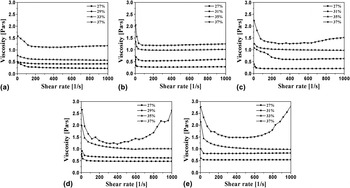
Dope viscosity is an important parameter in electrospinning process.Reference Subbiah, Bhat, Tock, Pararneswaran and Ramkumar30 Figure 1 shows the rheological behaviors of regenerated SF/SS blend aqueous solutions with different total concentrations and SF/SS (w/w) ratios (100/0, 90/10, 85/15, 75/25, and 65/35). For each blend ratio, the apparent viscosity of the regenerated SF/SS solution increased with the total concentration of SF and SS. The SF/SS solution exhibited obvious shear thinning behavior at lower shear rates (0–200 s−1). However, at higher shear rates (≥400 s−1) shear thickening behavior was observed for the solutions with higher total concentration and SS content [see Figs. 1(c)–1(e)]. Meanwhile, some opaque white solids appeared in these solutions. This behavior was quite consistent with the stress-induced phase separation in the spinning process of silkworm.Reference Chen, Knight and Vollrath31
Rheological behaviors of regenerated silk fibroin/sericin (SF/SS) blend aqueous solutions with different total concentrations and a SF/SS (w/w) ratio of (a) 100/0, (b) 90/10, (c) 85/15, (d) 75/25, and (e) 65/35, respectively.

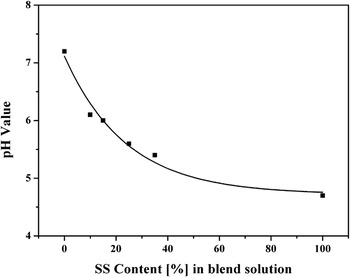
We can also find from Fig. 1 that, at the same concentration, the apparent viscosities of the SF/SS blend aqueous solutions roughly increased with the SS content. This is thought to be resulted from an increase in intermolecular interaction. With a higher content of hydrophilic amino acid side chains (up to 63%) than SF (about 16%),Reference Teramoto, Kameda and Tamada32 SS promoted the SF molecules to entangle more compactly because the water surrounding SF was absorbed by SS. In addition, the decreasing pH value may also cause the increase of the apparent viscosities. As shown in Fig. 2, the pure SF solution had a pH value of 7.2, whereas the pure SS solution had a pH value of 4.7. The pH of their blend solutions decreased with the increase of SS content. When the pH of the blend solution approaches the isoelectric point of silk fibroin (pI = 4.4–5.0),Reference Foo, Bini, Hensman, Knight, Lewis and Kaplan33 the distance between silk fibroin chains becomes closer, accordingly the intermolecular interaction for SF will be enhanced. In conclusion, all the above factors led to the increase of apparent viscosities of the regenerated SF/SS blend aqueous solutions when the SS content was increased.
pH value of regenerated SF/SS blend aqueous solutions with different SS contents.

B. Effects of SF/SS ratio and total concentration on the morphology of electrospun SF/SS fibers
In this study, various electrospun fibers were prepared from regenerated SF/SS blend aqueous solutions with different total concentrations and SF/SS (w/w) ratios. Their diameters and the deviation of diameter were summarized in Table I. It was found that for each blend ratio, the diameter and the deviation of diameter for the electrospun fibers decreased generally with decreasing total concentration. Moreover, the critical electrospinnable concentration of the SF/SS blend aqueous solutions decreased from 33 to 27 wt% with the increase of SS content. For the pure SF solution with a lower concentration, its viscosity was too low to form stable jet, and the electrospun fibers could not be prepared until the SF concentration reached 33 wt%. However, for the blend solutions with SF/SS (w/w) ratios of 75/25 and 65/35, they even could be electrospun at a total concentration as low as 27 wt% to produce fine uniform fibers. This phenomenon probably related to the viscosity and pH of the spinning solutions. It was found from the above rheological analysis that the viscosity of the regenerated SF/SS blend aqueous solution was increased with the increase of SS content, which resulted in better electrospinnablility of the blend solutions. Meanwhile, the blend solution with higher SS content had a lower pH value (much closer to the pI of SF), which facilitated the precipitation of SF/SS fibers.
Effects of silk fibroin/sericin (SF/SS) (w/w) ratio and total concentration on the average diameter and the deviation of diameter of the electrospun fibers from regenerated SF/SS blend aqueous solutions.

The data shown in parentheses refer to the standard deviation of the diameters for electrospun fibers.
N/F, no fiber was obtained.
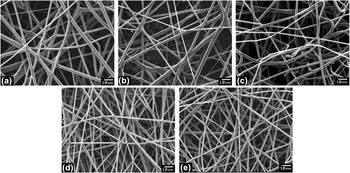
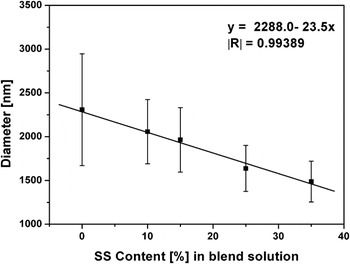
Figure 3 shows the effect of SF/SS ratio on the morphology of the electrospun fibers from the blend solutions with the same total concentration (37 wt%). Combined with Table I, it was found that with the increase of SS content in the blend solution, the average diameter and the deviation of diameter for the electrospun fibers became smaller. The relationship between SS content in blend solution and the average diameter of electrospun SF/SS fibers was further shown in Fig. 4, which exhibited a credible linear regression relationship. These results also indicated that the presence of SS could facilitate and improve fiber formation. In addition, it is noted that the electrospun fibers from SF or SF/SS aqueous solutions had larger diameters than those from the SF solutions using organic solventsReference Ohgo, Zhao, Kobayashi and Asakura15 because the former solutions needed higher concentrations (27–37 wt%) than the latter solutions for electrospinning. Similar results were also reported by Chen et al.Reference Chen, Cao, Ma, Tang and Zhu14 and Zhou et al.Reference Cao, Zhou, Ma and Lin34
Scanning electron microscopy images of the electrospun fibers from regenerated SF/SS blend aqueous solutions (37 wt%) with different SF/SS (w/w) ratios: (a) 100/0, (b) 90/10, (c) 85/15, (d) 75/25, and (e) 65/35.

The relationship between SS content and average diameter of the electrospun fibers from regenerated SF/SS blend aqueous solutions (37 wt%).

C. Characterization of electrospun SF/SS fibers
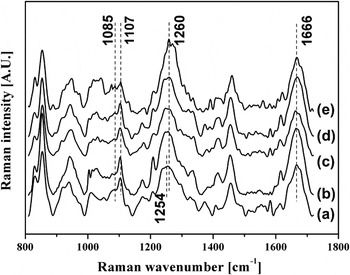
Figure 5 shows the Raman spectra of the electrospun fibers from regenerated SF/SS blend aqueous solutions (37 wt%) with different SF/SS (w/w) ratios. It was found that all electrospun fibers exhibited a peak at 1666 cm−1 (in the amide I region) which was attributed to the β-sheet structure. Moreover, with the increase of SS content in the solution, other two bands at 1085 cm−1 (in the C–C stretch region) and at around 1260 cm−1 (in the amide III region) for the resultant electrospun SF/SS fibers appeared gradually. The former was resulted from the β-sheet structure and the latter was probably attributed either to the β-sheet or to the random coil structureReference Monti, Freddi, Bertoluzza, Kasai and Tsukada35 while the bands at 1254 and 1107 cm−1 (associated with α-helix/random coil structure)Reference Monti, Taddei, Freddi, Asakura and Tsukada36 became weaker with the increasing SS content.
Raman spectra of the electrospun fibers from regenerated SF/SS blend aqueous solutions (37 wt%) with different SF/SS (w/w) ratios: (a) 100/0, (b) 90/10, (c) 85/15, (d) 75/25, and (e) 65/35.

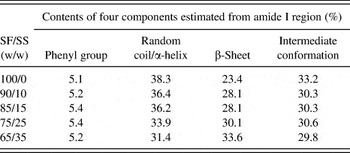
Furthermore, a deconvolution method (see Section II.D) was used to conduct the quantitative structural analysis from the amide I region of Raman spectra for electrospun fibers.Reference Zhou, Chen, Shao, Huang and Knight27 Using this method, we obtained the estimated quantities of an invariant internal standard (phenyl) and three main components of secondary structure for SF (i.e., random coil/α-helix, β-sheet, and an intermediate conformation) in the electrospun fibers with different SF/SS (w/w) ratios. The results are shown in Table II. It was also found that with the increase of SS content, the composition of random coil/α-helix conformation became lower while that of the β-sheet conformation became higher, indicating that the presence of SS facilitated the conformational transition of the electrospun silk fibers from random coil/α-helix structure to β-sheet structure. It is hypothesized that SS can absorb more water molecules surrounding SF and dehydrate SF, which gives rise to the regular arrangement of SF chains by forming hydrogen bonds between SF molecules and consequently results in the formation of β-sheet structure.
Secondary structural compositions of electrospun fibers from regenerated SF/SS blend aqueous solutions (37 wt%) with different SF/SS (w/w) ratios.

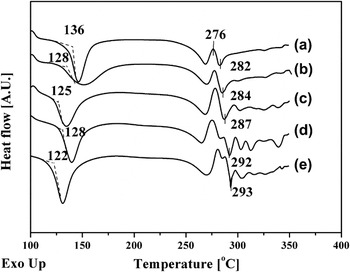
Figure 6 shows the DSC curves of the electrospun fibers from regenerated SF/SS blend aqueous solutions. As shown in the figure, the endothermic peaks, which were attributed to thermal decomposition of the electrospun fibers, were observed to be gradually increased from 282 to 293 °C with the increase of SS content. The exothermic peaks at around 276 °C may result from the transition from the random coil/α-helix structure to β-sheet structure.Reference Motta, Fambri and Migliaresi37 In addition, the onset temperature for water evaporation displayed a decreasing general trend from 136 to 122 °C with the increase of SS content in the fibers. This is because there is a relatively higher hydrophilicity between water and SS molecules. Consequently, the content of restricted water (relatively hard to be evaporated) that hydrogen bonded with SF in the fibers was decreased due to the dehydration by SS.Reference Tanaka, Kobayashi, Inoue, Tsuda and Magoshi38
Differential scanning calorimetry curves of the electrospun fibers from regenerated SF/SS blend aqueous solutions (37 wt%) with different SF/SS (w/w) ratios: (a) 100/0, (b) 90/10, (c) 85/15, (d) 75/25, and (e) 65/35.

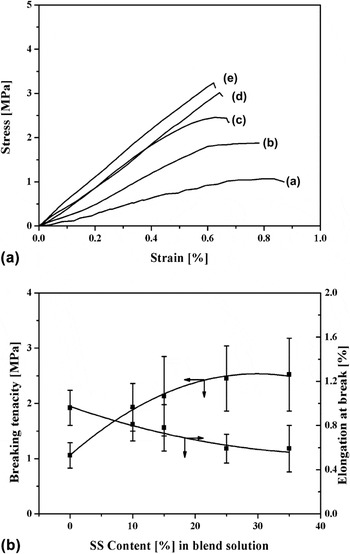
Figure 7 illustrates the typical stress–strain (S–S) curves, the tenacity, and elongation at break of the electrospun SF/SS fiber mats with different SS contents. As shown in Fig. 7(a), it is clear that the different SF/SS (w/w) ratios for regenerated SF/SS blend aqueous solutions resulted in different stress–strain curves of the resultant electrospun fiber mats. From Fig. 7(b), it was further found that mechanical properties of the electrospun SF/SS fiber mats were affected obviously by adding SS in the spinning solutions. With the increase of SS content, the tenacity of the electrospun fiber mats had a rapid increase first and then leveled off (beginning at the SF/SS ratio of 75/25, which is the same ratio as the natural silk), whereas their elongation at break were changed almost in an opposite trend. Compared with the electrospun fiber mat without SS, the breaking strength of the electrospun fiber with 25% SS was increased by nearly 131% to 2.45 MPa. This is possibly related to the SS-induced formation of β-sheet structure in the electrospun fiber mats, as having been verified by the above Raman and DSC results.
(a) Typical stress–train curves and (b) tenacity and elongation at break of the electrospun fibers from regenerated SF/SS blend aqueous solutions (37 wt%) with different SF/SS (w/w) ratios: (a) 100/0, (b) 90/10, (c) 85/15, (d) 75/25, and (e) 65/35.

IV. CONCLUSIONS
Our results showed that SS enhanced the electrospinnability of the regenerated SF/SS blend aqueous solutions by mainly increasing their apparent viscosities in the electrospinning process. The SF aqueous solutions could be electrospun at lower concentration to obtain finer and more uniform fibers by adding SS. The presence of SS promoted the conformational transition of regenerated SF from random coil/α-helix structure to β-sheet structure by dehydrating SF and inducing the formation of hydrogen bonds between SF molecules. Furthermore, the thermal properties and tenacities of the electrospun SF/SS fiber mats were greatly improved with the increase of SS content. These findings help to understand the role of SS in the spinning process of silkworm and facilitate the production of high-quality regenerated silk materials used in medical field.
ACKNOWLEDGMENTS
This work is supported by the National Natural Science Foundation of China (50803011), Specialized Research Fund for the Doctoral Program of Higher Education (200802550001), and Innovation Program of Shanghai Municipal Education Commission.