Suction and sticky card traps are valuable tools for surveying and monitoring seasonal distribution, migration, and abundance of insect populations and their behaviours. Monitoring insect migration and flight heights has relied largely on suction traps that were first developed and shown to be effective in the 1950s (e.g. Johnson Reference Johnson1950). Sticky cards have also been used effectively to monitor insect abundance and seasonal distribution (e.g. Lamb Reference Lamb1983). However, both these traps have drawbacks. Suction traps can be expensive, particularly if multiple heights are monitored, and are subject to potential breakdowns. Removing specimens from and identifying species on sticky cards is difficult and cards are often lost or destroyed by high winds.
Recent field studies to assess the effects of climatic factors on flight heights of Ceutorhynchus obstrictus (Marsham) (Coleoptera: Curculionidae) (Tansey et al. Reference Tansey, Dosdall, Keddie and Olfert2010b) and Phyllotreta cruciferae (Goeze) (Coleoptera: Chrysomelidae) (based on our own observations) near canola (Brassica napus Linnaeus; Brassicaceae) crops required the means to trap flying insects at various heights, allow monitoring at regular intervals, and to preserve samples in a killing solution between monitoring intervals. Here we describe the design of this trap, and provide a comparison of the trapping efficacy between bowl and sticky traps.
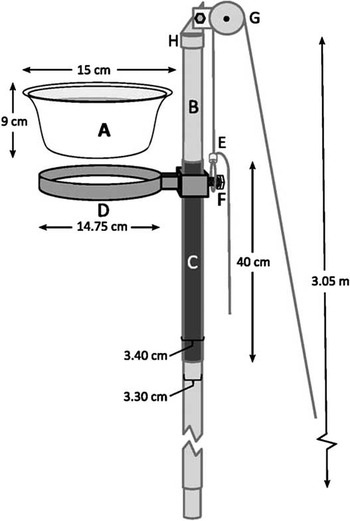
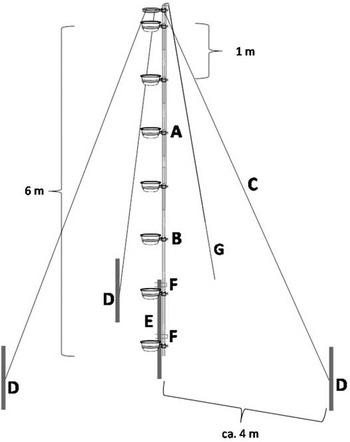
Traps were constructed as a kit for easy transport and assembly in the field and for their dismantling at the end of a study for compact storage. With the exception of the mounting brackets and bowls, all materials are available commercially. Traps consist of yellow (Tansey et al. Reference Tansey, Dosdall, Keddie and Noble2010a), 15 cm-wide, 9 cm-deep, plastic (polypropylene) bowls filled with diluted propylene glycol antifreeze (1:1 water:glycol) spaced ~1 m apart from 0.2–6.0 m above the ground. Bowls are mounted in a steel bracket, consisting of a 14.75 cm hoop welded to a 2.8 cm length of 3.8 cm by 3.8 cm square steel tubing (Figs. 1A, 1D). A 40 cm section of 3.4–3.5 cm internal diameter steel or plastic (acrylonitrile butadiene styrene or polyvinyl chloride) pipe is fed through the square opening in the bracket and secured with a bolt (Fig. 1C). Steel pipe is more durable; plastic is more lightweight. This pipe is slipped over the centre post of the apparatus and allows the position of bowl traps on the centre post to be easily changed. Tansey et al. (Reference Tansey, Dosdall, Keddie and Olfert2010b) attached the bolts of three brackets to loops in a 12 m length of plastic-coated metal clothesline (9-gauge aircraft cable) at 1 m intervals (Figs. 1, 2). The position of loops is maintained with wire rope clips. The lighter weight of plastic sleeves allows the incorporation of four brackets. The weights of metal or plastic sleeves, rings, and bowls are such that, at most, four bowls can be suspended and still easily raised. The cable is fed through a pulley mounted to the top of the centre post (Fig. 1G). Lower traps are secured directly to the centre post (Fig. 2). This design allows the upper three bowls to be lowered to the height of the 4th bowl. Bolts of lower bowl brackets can be loosened to allow upper bowls to be lowered to an easily accessible height. The centre post consists of two 3.05 m, 3.30 cm diameter steel pipes; one end of each pipe is compressed to allow it to slip into the other. These are commonly sold as chain-link fence pipes. The centre post is secured to a steel T-bar fence post using two U-bolts; the T-bar post is driven into the soil (Fig. 2). A mounting bracket is secured to the top of the centre post; three metal clothesline guy wires run from the bracket to secure the apparatus to T-bar posts (Fig. 2).
Bowl trap mounting and height modification system. (A) Yellow, plastic bowl trap  filled with 1:1 propylene glycol:water solution. (B) 6.1 m long central pole made from two 3.05 m long, 3.30 cm diameter steel pipes. (C) 40 cm, 3.4–3.5 cm internal diameter sleeve fit over central pole. (D) Mounting bracket constructed from 14.5 cm diameter metal hoop welded to 2.8 cm length of 3.8 cm by 3.8 cm square metal tubing. (E) Plastic-coated metal clothesline (9-gauge aircraft cable) secured to mounting bracket by a loop secured with a wire rope clip. Three to four mounting brackets can be secured to the cable in series in this manner. (F) Bolt threaded into mounting bracket. (G) Pulley bolted to the top of the central pole by a bracket (H).

Trap array (not to scale). (A) Bowl trap mounted in bracket attached to metal or plastic sleeve slipped over a central metal post. The top four bowl traps are secured to the metal post in this manner. (B) Bowl trap mounted in bracket clamped directly to metal post. The bottom three bowl traps are secured to the metal post in this manner. (C) One of three guy wires that run from a mounting bracket clamped directly to the centre post to metal posts pounded into the soil (D); metal posts are arranged in triangle. (E) Metal post pounded into the ground to secure trap array centre post. (F) U-clamps to secure centre post to anchor post. (G) Line attached to top four mounting brackets used to raise and lower traps.

We compared trapping efficacies of bowl traps at 0.2 m and sticky cards (Contech, Victoria, British Columbia, Canada) mounted at 0.2 m above the ground and facing west, for P. cruciferae and Phyllotreta striolata (Fabricius) next to a B. napus field near St Albert, Alberta, Canada (53.6944°N, 113.6273°W) from mid-May to late-July 2010. Data were compared from four replicate traps of each type arranged in rows. Bowl traps were 8 m apart; sticky cards were 10 m apart. Traps were set next to a shelterbelt dominated by species of Populus Linnaeus (Salicaceae) on the field's eastern edge and monitored approximately weekly. Catches of adult beetles were compared using a SAS proc GENMOD repeated measures analysis specifying a Poisson distribution, and, because of zero-inflated capture data, the “dscale” option was included in the model statement. No significant differences in P. cruciferae or P. striolata captures were detected between bowl traps and sticky cards (χ 2 = 0.41; df = 1; P = 0.521 and χ 2 = 0.42; df = 1; P = 0.516, respectively) (mean ± standard error: P. cruciferae bowl traps 0.19 ± 0.07; P. striolata bowl traps 0.25 ± 0.08; P. cruciferae sticky cards 0.20 ± 0.11; P. striolata sticky cards 1.09 ± 0.77).
The timing and location of traps depends on knowledge of the phenology of the target insect. For example, traps described in the current paper were used to capture C. obstrictus in 2007 and 2008 (Tansey et al. Reference Tansey, Dosdall, Keddie and Olfert2010b). Trap location and timing were based on the report by Ulmer and Dosdall (Reference Ulmer and Dosdall2006) that stated large numbers of overwintering C. obstrictus were captured emerging from leaf litter in shelterbelts, grassy berms, and windrows when mean air temperature reached 9–12°C. Phenological information, climatological factors, and habitat preferences can dictate placement of traps for specific insects. If these parameters are not known, trapping is an effective means of determining them.
An important consideration for capturing insects is trap colour. We selected yellow traps because this colour is attractive to C. obstrictus and P. cruciferae (Lamb Reference Lamb1983; Smart et al. Reference Smart, Blight and Hick1997). However, Rhagoletis pomonella (Walsh) (Diptera: Tephritidae) is preferentially attracted to red traps (Prokopy Reference Prokopy1968); Frankliniella occidentalis (Pergande) (Thysanoptera: Thripidae) prefers blue traps (Brødsgaard Reference Brødsgaard1989) and although not strictly anthophilous; and Tabanus nigrovittatus Macquart (Diptrera: Tabanidae) prefers bright red and brown Manning traps (Granger Reference Granger1970). Ideal trap colours have not yet been determined for many insects.
Another important consideration is the effect of wind and temperature on the killing solution. When conditions are hot or windy, the solution may need to be topped up between sampling intervals.
This trapping system is inexpensive and easy to assemble and disassemble; multiple disassembled units can be fit easily in most vehicles for transportation. The system is also robust. Units constructed in 2007 were still in service in 2011 without modification or repair. This trapping system is also flexible in deployment and trap layout. Multiple traps can be fastened to metal sleeves and bowls can be painted any colour.
Acknowledgements
We thank Jesse Hill and Corielle Walsh for capable assistance with flea beetle collections and identification and trap assembly. Brackets were fabricated by Peter M. Conway of Vegreville, Alberta. Funding for this project was provided by the Canola Council of Canada and the Government of Canada (Canola Cluster Program), University of Alberta, a grant to L.M.D. from the Natural Sciences and Engineering Research Council of Canada and an Agriculture and Agri-Food Canada personal services contract to J.A.T.