INTRODUCTION
Current patterns of land-use in tropical forests have generated a landscape mosaic of fragments of different sizes embedded in a matrix of transformed lands (Arroyo-Rodríguez et al. Reference ARROYO-RODRÍGUEZ, AGUIRRE, BENÌTEZ-MALVIDO and MANDUJANO2007). The ongoing fragmentation of most tropical forests in the world constitutes one of the major threats to the persistence of species (Suárez-Montes et al. Reference SUÁREZ-MONTES, FORNONI and NÙNEZ-FARFÀN2011) and overall diversity (Chazdon et al. Reference CHAZDON, HARVEY, KOMAR, GRIFFITH, FERGUSON, MARTÌNEZ-RAMOS, MORALES, NIGH, SOTO-PINTO, VAN BREUGEL and PHILPOTT2009). For many species, the isolation and reduction in habitat size associated with fragmentation can disrupt several ecological and genetic processes that occur at the population level (Aguirre & Dirzo Reference AGUIRRE and DIRZO2008). Fragmented populations are usually exposed to the negative effects of reduced gene flow (Fischer & Lindenmayer Reference FISCHER and LINDENMAYER2007), increased inbreeding, genetic drift and population differentiation (Young et al. Reference YOUNG, BOYLE and BROWN1996). These effects result in the collective loss of genetic variation, thereby reducing the probability of population adaptation to new environmental conditions and increasing the risk of extinction due to inbreeding depression (Pertoldi et al. Reference PERTOLDI, BIJLSMA and LOESCHKE2007).
Many studies report that forest fragments commonly exhibit lower relative humidity and increased air temperatures due to edge effects (Laurance et al. Reference LAURANCE, LOVEJOY, VASCONCELOS, BRUNA, DIDHAM, STOUFFER, GASCON, BIERREGAARD, LAURANCE and SAMPAIO2002). Such suboptimal site conditions can result in enhanced clonal reproduction (Eckert Reference ECKERT2002), which can in turn enable a plant to persist (Eriksson & Ehrlen Reference ERIKSSON, EHRLEN, Silvertown and Antonovics2001). Nevertheless, clonal growth can adversely affect fitness with regard to increased selfing and inbreeding depression in self-compatible species (Honnay & Jacquemyn Reference HONNAY and JACQUEMYN2008) and result in declining diversity (Watkinson & Powell Reference WATKINSON and POWELL1993).
Most studies assessing genetic consequences of fragmentation focus on temperate rather than tropical species, despite the rich biodiversity and high rate of species loss associated with habitat destruction recorded for the tropics (Lowe et al. Reference LOWE, BOSHIER, WARD, BACLES and NAVARRO2005, but see Kramer et al. Reference KRAMER, ISON, ASHLEY and HOWE2007). Aguilar et al. (Reference AGUILAR, QUESADA, ASHWORTH, HERRERÌAS-DIEGO and LOBO2008) report in their meta-analysis that only 20 out of 102 studied plant species are tropical species, of which only three species are herbaceous. Hence, there is a lack of knowledge on the genetic consequences of forest fragmentation on tropical herbaceous species.
The aims of the present study were to investigate the effects of fragmentation on the clonal diversity as well as the genetic diversity and structure of Heliconia angusta L., which is endemic to the Atlantic rain forest of south-eastern Brazil. The species is able to grow clonally and is found within continuous forest and forest fragments. Heliconia species are considered potential keystone mutualists that provide resources for several animal species (Price Reference PRICE, Herrera and Pellmyr2002). The following hypotheses were proposed: (1) Clonal diversity of H. angusta plants is lower in forest fragments compared with continuous forest due to suboptimal environmental conditions, which enhance clonal propagation; (2) Genetic diversity of H. angusta plants is lower in forest fragments than in continuous forest; and (3) H. angusta plants are genetically differentiated in forest fragments from their conspecifics in continuous forests.
METHODS
Study species
The family Heliconiaceae comprises a single genus, Heliconia, with 250–300 species distributed mainly throughout neotropical areas from northern Mexico to southern Brazil (Kress Reference KRESS1990). Heliconia angusta is a perennial herb that is assumed to be partially self-compatible akin to the majority of Heliconia species (Bruna et al. Reference BRUNA, KRESS, MARQUES and DA SILVA2004, Suárez-Montes et al. Reference SUÁREZ-MONTES, FORNONI and NÙNEZ-FARFÀN2011). Like other Heliconia spp., it is a common component of the understorey of Neotropical forests and has a patchy distribution. Sympodial rhizomes produce erect above-ground shoots (ramets) of up to 1.75 m in height that can develop a single terminal inflorescence (Guimarães Simão & Scatena Reference GUIMARÃES SIMÃO and SCATENA2001). Heliconia angusta displays a steady-state flowering strategy (Stiles Reference STILES1975) producing flowers from April to October, making it a crucial nectar resource for hummingbirds (De Castro & Araujo Reference DE CASTRO and ARAUJO2004). The species is mainly pollinated by traplining hummingbirds (Stein & Hensen Reference STEIN and HENSEN2011), and its blue fruits are dispersed by birds, both of which interactions can be affected by habitat fragmentation (Figueroa-Esquivel et al. Reference FIGUEROA-ESQUIVEL, PUEBLA-OLIVARES, GODÌNEZ-ALVAREZ and NUÑEZ-FARFÀN2009, Kolb Reference KOLB2008).
Study area
The Atlantic rain forest (Mata Atlântica) is regarded as one of the most important biodiversity hotspots for conservation in the world (Myers et al. Reference MYERS, MITTERMEIER, MITTERMEIER, FONSECA and KENT2000), and it is assumed to be the region with the highest species diversity and degree of endemism in South America (Tabarelli et al. Reference TABARELLI, PINTO, SILVA, HIROTA and BEDE2005). However, the forest is highly fragmented and, nowadays, its remnants only cover some 7–16% of its original extent (Ribeiro et al. Reference RIBEIRO, METZGER, MARTENSEN, PONZONI and HIROTA2009).
The study area is located in the state of Rio de Janeiro, Brazil, in the private reserve, Reserva Ecológica de Guapiaçu (REGUA – 22°25′53″S, 42°45′20″W) in the municipality of Cachoeiras de Macacu. The mean annual temperature for this region is approximately 23°C with a mean annual rainfall of around 2560 mm. The continuous forest within REGUA covers an area of ~7000 ha and is connected to the Três Picos State Park, which is ~46000 ha and is connected to the Serra dos Orgaos National Park. The vegetation can be classified as evergreen dense ombrophilous forest (Veloso et al. Reference VELOSO, RANGEL-FILHO and LIMA1991) and is characterized by continuous forest (hereafter referred to as CF) as well as forest fragments (hereafter referred to as FFs) of different sizes.
The FFs were referenced according to their size as follows: XS (< 5 ha), S (5–10 ha), M (10–20 ha), L (20–50 ha) and XL (>50–100 ha). The study included two fragments of the size class M (M1 and M2). No Heliconia plants were found in fragments of size class L. As is typical for tropical regions, no reliable information pertaining to the age of fragments was available, while archived aerial photographs revealed that the largest fragment (XL) existed in the 1970s, with all other fragments having formed thereafter.
Sampling procedure
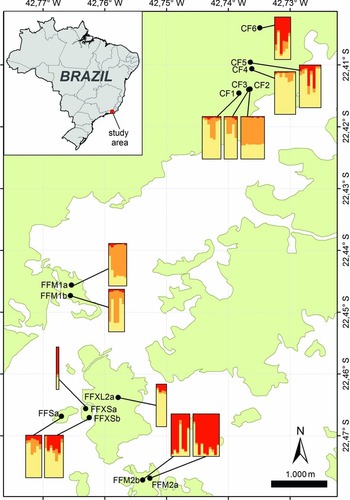
For the present study, Heliconia angusta plants were recorded growing in scattered formations at varying densities from single shoots to batches of up to 12 shoots (hereafter referred to as patches) in the continuous forest and in five forest fragments. Samples of leaf tissue measuring approximately 10 × 5 cm were collected from the most recently formed leaf of every shoot in each patch before being silica gel-dried and stored in a freezer at −30°C until further processing. Only patches with more than eight shoots were sampled, resulting in a mean number of 11 ± 1.14 leaf samples (155 leaf samples in total) being collected from each of the 14 patches (six in the CF, eight in the FFs; Figure 1). Patches within the CF were separated by an average of 544 m (range: 22–1225 m). Patches within FFs were located approximately 600–1600 m (mean: 1180 m) from the nearest CF and separated from each other by an average of 1300 m (range: 37.5–2800 m). All patches were located at 80–350 m asl. We georeferenced the distribution of the investigated H. angusta patches. Patches were then plotted on a map for which we visualized the forest shapes using a basemap of worldwide orthographic aerial and satellite imagery of the Bing Maps aerial imagery web mapping service (MicroSoft Corporation, Redmond, WA, USA) in the ArcMap 10.1 software (ESRI, Redlands, CA, USA).
Map of the sampled Heliconia angusta patches in the Atlantic rain forest of the state of Rio de Janeiro, Brazil and barplots of the distribution of gene pools (STRUCTURE 2.3.2 analysis). Pale yellow represents forest area, whereas white indicates urban or agricultural areas. The grouped barplots (surrounded by a black line) refer to the overall gene pool of the corresponding population. Each of these groups contains several single barplots and each barplot represents one individual within the corresponding population. Individuals of the respective populations are ordered by their sample IDs within the corresponding populations’ barplot. Colours of the barplots represent the individuals’ posterior assignment probabilities to the determined genetic clusters (K = 3). Patches are either located in continuous forest (CF1–6) or in nearby forest fragments (FFM1, FFM2, FFS, FFXL and FFXS). The abbreviations of the forest fragments refer to the sizes of the FFs, ranging from XS (< 5 ha) to XL (> 50 ha).

DNA extraction and AFLP genotyping
DNA extraction from the dried leaf material was performed according to the standard protocol of Doyle & Doyle (Reference DOYLE and DOYLE1987), incorporating slight modifications outlined by B. Ziegenhagen (University of Marburg, Germany). For AFLP investigation (Vos et al. Reference VOS, HOGERS, BLEEKER, REIJANS, VAN DE LEE, HORNES, FRITERS, POT, PALEMAN, KUIPER and ZABEAU1995), four primer combinations were used (detailed protocols for the DNA extraction and AFLP analysis are listed in Appendix 1). In order to validate the identified peaks and determine reproducibility of the AFLP genotyping, we performed replicate analyses on 18 samples (after Bonin et al. Reference BONIN, EHRICH and MANEL2007). We obtained an overall error ratio of 2.96% (calculated as observed mismatches/total number of loci compared), which is congruent with typical error ratios (range: 2–5%; Hansen et al. Reference HANSEN, KRAFT, CHRISTIANSSON and NILSSON1999) associated with the AFLP technique.
Identification of clones and clonal diversity
In order to identify clones, i.e. genetically identical ramets, we pairwise compared all samples using the statistics software R (version 2.15.0) and the R package AFLPdat (Ehrich Reference EHRICH2006). To determine a threshold of pairwise band differences for two genetically differing individuals, a histogram showing the pairwise differences of bands of all individuals within patches was created. In addition, the expected band difference (BDe) was calculated (BDe = number of polymorphic loci multiplied by the error ratio, see Douhovnikoff & Dodd Reference DOUHOVNIKOFF and DODD2003). Both approaches resulted in a threshold of 11 band differences for clones.
To estimate clonal diversity among patches of H. angusta, we determined clonal diversity (PD) as PD = G/N, where G is the number of genets and N is the number of sampled ramets (Ellstrand & Roose Reference ELLSTRAND and ROOSE1987), as well as the modified index of clonal diversity (R) as R = (G−1)/(N−1) (Dorken & Eckert Reference DORKEN and ECKERT2001). To test whether clonal diversity differs significantly between patches from the FFs and patches from the CF, we calculated a Welch two-sample t-test for each index using the statistics software R.
Genetic diversity and structure
Analysis of genetic diversity was restricted to patches consisting of at least six genets, since estimators of genetic variation depend heavily on sample size (Bonin et al. Reference BONIN, EHRICH and MANEL2007). Thus, one patch belonging to the continuous forest (i.e. CF3) as well as two patches belonging to the forest fragments (i.e. FFXLa and FFXSa) were excluded from further analysis other than that to determine similarity patterns between patches (i.e. PCoA and STRUCTURE).
DNA bands were scored as present (1) or absent (0) for each DNA sample. Band (or scored loci) reproducibility was assessed by comparing the 18 replicate samples. In accordance with Pompanon et al. (Reference POMPANON, BONIN, BELLEMAIN and TABERLET2005), we excluded unreliable bands from further analysis, The four primer combinations yielded 444 reliable bands, of which 376 bands were polymorphic (89.9%, confidence interval = 95%) and consequently used in the analysis. The number of polymorphic bands per primer pair of H. angusta ranged between 55 and 114. To estimate the level of genetic diversity within patches, we calculated the percentage of polymorphic loci (PLP) and expected heterozygosity (He) using AFLP-Surv 1.0 (Vekemans et al. Reference VEKEMANS, BEAUWENS, LEMAIRE and ROLDÀN-RUIZ2002), and band richness as a rarefaction of six genotypes Br(6) using AFLPDiv (Coart et al. Reference COART, VAN GLABEKE, PETIT, VAN BOCKSTAELE and ROLDÀN-RUIZ2005). Band richness is the number of phenotypes expected at each locus (i.e. each scored AFLP fragment) and can be interpreted as an allelic richness analogue ranging from 1 to 2 (Coart et al. Reference COART, VAN GLABEKE, PETIT, VAN BOCKSTAELE and ROLDÀN-RUIZ2005). Hardy–Weinberg equilibrium was assumed (Fis = 0), due to unknown level of inbreeding. To test whether the genetic diversity of all three parameters differed between patches in the FFs and in the CF, one-way ANOVAs were calculated using SigmaPlot 12.0. An analysis of molecular variance (AMOVA) was used to describe genetic structure and measure the amount of genetic variation within and between populations; F–statistics were extracted and significance levels were tested with 10000 permutations for each analysis. AMOVA was performed with Arlequin (see Excoffier & Lischer Reference EXCOFFIER and LISCHER2010). Mantel's test (Mantel Reference MANTEL1967), performed with the Vegan package in R version 2.15.0, was used to examine whether the matrix of genetic differentiation among populations (pairwise Fst values) correlated with the matrix of geographical distances.
A Principal Coordinates Analysis (PCoA) including all genets and patches was performed using the Vegan package to investigate potential clusters of patches, and thus genetic differentiation. Square root-transformed Jaccard index was used as a dissimilarity measure. We further evaluated genetic structure by performing Bayesian assignment analysis, as implemented in STRUCTURE version 2.3.2 (Pritchard et al. Reference PRITCHARD, STEPHENS and DONNELLY2000). This method identifies clusters of genetically similar individuals from multilocus genotypes without prior knowledge of their population affinities. STRUCTURE assumes a distinct number of K genetic clusters, with each having a characteristic set of allele frequencies at each locus. The admixture model then uses an iterative Bayesian Markov Chain Monte Carlo (MCMC) method to assign the proportion of each individual's genotype to the K distinct genetic clusters seeking to minimize linkage disequilibria within each group. To determine the optimal number of partitions (K´s), a ΔK-plot ranging from K = 1 (the expected value if all patches represent a single panmixic unit) to K = 13 (the maximum number of patches) was calculated following Evanno et al. (Reference EVANNO, REGNAUT and GOUDET2005). Following recommendations of Gilbert et al. (Reference GILBERT, ANDREW, BOCK, FRANKLIN, KANE, MOORE, MOYERS, RENAUT, RENNISON, VEEN and VINES2012), 20 replicate chains of 500000 MCMC iterations were run discarding the first 100000 burn-in iterations for each K at the bioportal server of the University of Oslo (Kumar et al. Reference KUMAR, SKÆVELAND, ORR, ENGER, RUDEN, MEVIK, BURKI, BOTNEN and SHALCHIAN-TABRIZI2009). We used the recessive allele model implemented for analyses of dominant data (Falush et al. Reference FALUSH, STEPHENS and PRITCHARD2007). Barplots of the individual posterior assignment probabilities were created using CLUMPP 1.1 (Jakobsson & Rosenberg Reference JAKOBSSON and ROSENBERG2007) and DISTRUCT 1.1 (Rosenberg Reference ROSENBERG2004). Finally, barplots were mapped on the distribution of the investigated H. angusta patches.
Results
Clonal diversity
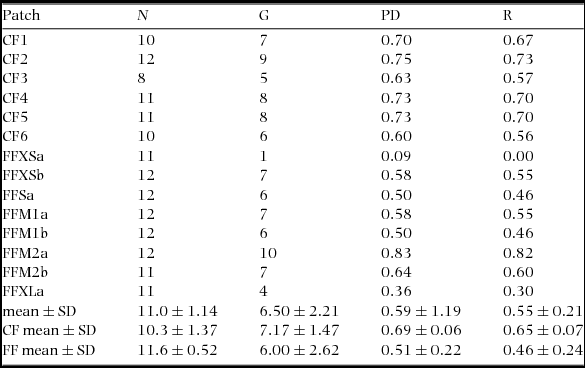
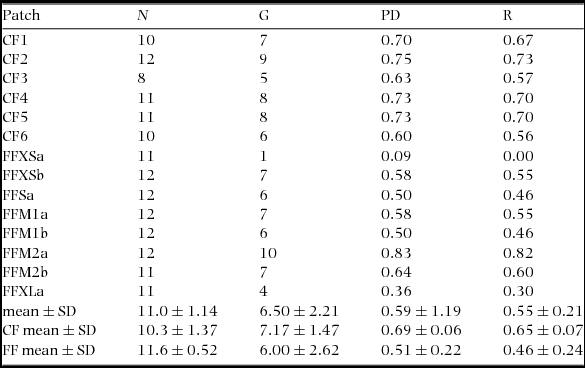
For all investigated patches, we identified a mean number of 6.5 ± 2.21 genotypes, meaning that patches of at least eight ramets consisted of a mean of six genets (corresponding with individuals). The number of genotypes was lower in the FF patches than those of the CF. Concordantly, both indices (R and PD) were lower in the patches of FF (Table 1), although the differences were only significant for one index (clonal diversity in FFs vs. CF, R: t = 2.09, P = 0.07; PD: t = 2.23, P < 0.05, Welch two-sample t-test). The average clonal diversity (PD) of all patches accounted for 0.59 ± 1.19. The lowest clonal diversity (PD = 0.09) was found for the patch FFXSa, which consisted of only one genotype, whereas patch FFXSb in the same FF consisted of seven genotypes. The second index for clonal diversity (R) revealed similar results (Table 1).
A summary of the sampling of Heliconia angusta in continuous forest and forest fragments in the Atlantic coastal rain forest, State of Rio de Janeiro, Brazil, and parameters of clonal diversity of the sampled patches. A patch is defined as a clearly spatial separated group of shoots. Samples were collected from patches in two different habitats: in the continuous forest (CF, six patches 1–6) and in five forest fragments (FF, eight patches), respectively. The FF patches are referenced in accordance with their occurrence in the different FFs. The abbreviations refer to the sizes of the FFs, ranging from XS (< 5 ha) to XL (> 50 ha). The number of patches – either one or two per fragment – is indicated by the letters a and b respectively. N refers to the number of leaf samples collected (one from each shoot) of each patch for genetic analysis, while G indicates the number of identified genotypes per patch. PD and R are indices of clonal diversity, and mean values and their standard deviations (± SD) are given.
Genetic diversity and structure
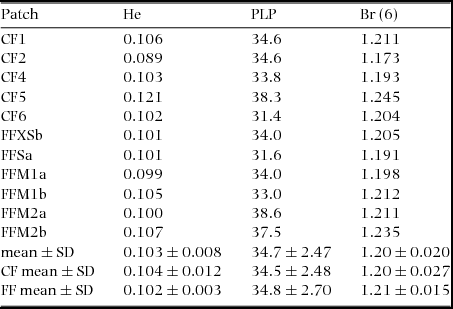
Patches in the FFs showed no differences in average expected heterozygosity (He), band richness Br(6) or percentage of polymorphic loci to those of the CF (FF vs. CF, He: F = 0.158, P = 0.70; Br(6): F = 0.075, P = 0.791; PLP: F = 0.024, P = 0.881; one-way ANOVA) (Table 2).
Descriptive estimates of genetic diversity for Heliconia angusta in the sampled patches within continuous forest (CF) and nearby forest fragments (FF) in the Atlantic rain forest of the State of Rio de Janeiro, Brazil. Patches consisting of less than six genets were excluded since estimators of genetic variation strongly depend on sample size. He (expected heterozygosity), PLP (percentage of polymorphic loci) and Br(6) (band richness) are averaged over 444 loci from the AFLP; standard deviation (± SD) of the mean values are given.

The AMOVA indicated that 20.1% of the genetic variation resides among patches while 79.9% resides within patches (P < 0.001). The overall fixation index Fst accounted for 0.201. Average pairwise Fst values between patches in FFs differed, but not significantly, from those between patches in CF (FF vs. CF, F = 2695, P = 0.114, one-way ANOVA). Genetic distances were not related to geographic distances (Mantel statistic, r = 0.136, P = 0.068) and neither the PCoA (data not shown) nor the STRUCTURE analysis revealed any clear clustering of patches; the latter revealed three groups optimally partitioned (mean value of ln likelihood = −9.51, Figure 1).
DISCUSSION
Clonal diversity
In line with our first hypothesis, clonal diversity of patches was revealed to be lower in the FFs than in the CF, although only one index (Pd) just achieved significance. Clonal propagation in the FFs appeared to be slightly enhanced, probably due to the suboptimal climatic conditions (i.e. the higher temperatures and lower relative humidity resulting from edge effects). Heliconia is known to be intolerant of water stress (Skillman et al. Reference SKILLMAN, GARCIA and WINTER1999), an environmental condition that increases after fragmentation. As such, higher clonal reproduction in the FFs may represent a growth strategy that facilitates survival at sites of higher environmental stress (Eriksson Reference ERIKSSON1996, Honnay & Bossuyt Reference HONNAY and BOSSUYT2005), but one which is also presumed to lead to increased selfing and inbreeding depression in self-compatible species due to reduced mate availability (Eckert Reference ECKERT2000, Honnay & Jacquemyn Reference HONNAY and JACQUEMYN2008). The resultant decline in clonal diversity in the forest fragments with associated suboptimal conditions has been recorded for other species, e.g. the temperate herb Paris quadrifolia (Jacquemyn et al. Reference JACQUEMYN, BRYS, HONNAY, HERMY and ROLDÀN-RUIZ2006).
Genetic diversity and structure
In contrast to our second hypothesis, no evidence was found that indicated genetic diversity was lower in patches within FFs than in those of CF. Our results are in line with the results of both Murawski & Hamrick (Reference MURAWSKI and HAMRICK1990), who investigated the clonally growing, terrestrial, hummingbird-pollinated bromeliad Aechmea magdalenae in Panama, and Suárez-Montes et al. (Reference SUÁREZ-MONTES, FORNONI and NÙNEZ-FARFÀN2011), who studied Heliconia uxpanapensis, which is endemic to Mexico. Both reported similar amounts of genetic diversity and found no differences between continuous forest and forest fragments. As H. uxpanapensis and H. angusta are both endemic species, they may be naturally exposed to high levels of isolation, and resultant moderate levels of genetic diversity, which may partially explain the absence of any specific forest fragmentation effects on the genetic diversity of both species.
In our study, genetic variation was distributed mainly within patches (80%) while variation among patches accounted for 20%. This pattern of distribution of genetic variation is similar to that found in other Heliconia species with narrow distributions (Meléndez-Ackerman et al. Reference MELÉNDEZ-ACKERMAN, SPERANZA, KRESS, ROHENA, TOLEDO, CORTES, TREECE, GITZENDANNER, SOLTIS and SOLTIS2005, Suárez-Montes et al. Reference SUÁREZ-MONTES, FORNONI and NÙNEZ-FARFÀN2011). According to Nybom (Reference NYBOM2004), the value of genetic differentiation of H. angusta (mean: 0.201; range: 0.091 ≤ Fst ≥0.352) is slightly lower than the expected values of 0.25–0.27 for long-lived perennial, outcrossed herbs. However, given the short distances between sites, our Fst value indicates high genetic differentiation between all patches, and thus a generally hampered gene flow.
A number of studies report that habitat fragmentation often disrupts mutualistic plant-animal interactions, such as those between plants and their pollinators (Ghazoul Reference GHAZOUL2005, Kiers et al. Reference KIERS, PALMER, IVES, BRUNO and BRONSTEIN2010, Kolb Reference KOLB2008, Kwak et al. Reference KWAK, VELTEROP and VAN ANDEL1998), which, inter alia, leads to reductions in pollinator abundance and species richness as well as limited pollinator movement among patches (Lennartsson Reference LENNARTSSON2002, Steffen-Dewenter & Tscharntke Reference STEFFEN-DEWENTER and TSCHARNTKE1999). In continuous forest, Heliconia angusta is mostly pollinated by hummingbirds (Stein & Hensen Reference STEIN and HENSEN2011). However, hummingbirds and many other forest-dwelling bird species rarely cross open spaces (Shirley Reference SHIRLEY2006), which may lead to decreased pollination among forest fragments. For the present study, no Heliconia plants were recorded as flowering in the forest fragments and no relevant data on flower visitors could be gathered.
Limited seed dispersal is also considered to affect population structure (Rossetto et al. Reference ROSSETTO, KOOYMAN, SHERWIN and JONES2008). For example, up to 35% of all mature fruits of H. metallica in Peru are dispersed autochorously by just falling to the ground (Schleuning et al. Reference SCHLEUNING, HUAMÀN and MATTHIES2009). Understorey birds attracted to the fruits of Heliconia species are important to the plant's seed dispersal. However, these birds often have a limited range, leading to relatively short dispersal distances (Westcott & Graham Reference WESTCOTT and GRAHAM2000), and Stiles (Reference STILES and Janzen1983) and Schleuning et al. (Reference SCHLEUNING, HUAMÀN and MATTHIES2009) reported that the birds digest the fruit pulp but regurgitate the whole seed at site, resulting in very limited spatial dispersal. In addition, the common patchy distribution of Heliconia plants and their low density (Bruna et al. Reference BRUNA, KRESS, MARQUES and DA SILVA2004) may contribute and enhance the genetic isolation of the patches. Further investigation should therefore focus on the pollen and seed dispersal of H. angusta to investigate the gene flow between continuous forest and forest fragments.
With regard to our third hypothesis, patches in FFs were no more genetically differentiated than patches in CF, suggesting that the fragmented patches have not differentiated yet from the CF patches. The non-significant Mantel test suggests that differentiation is not related to geographical distances between patches. One possible reason may be that the actual rate of outcrossing and gene flow are sufficient to maintain observed levels of genetic variation within fragmented populations (Suárez-Montes et al. Reference SUÁREZ-MONTES, FORNONI and NÙNEZ-FARFÀN2011). Fragments may therefore function as ecological sinks, within which genetic erosion and, eventually, extinction may be anticipated. However, given adequate dispersal, lost individuals from fragments may be replaced by dispersal from growing populations in the CF (Bruna Reference BRUNA2003). However, considering the short-distance seed dispersal by birds discussed above and the fact that pollination disruption has regularly been reported for fragmented habitats (Aguirre & Dirzo Reference AGUIRRE and DIRZO2008, Kolb Reference KOLB2008), a sufficient gene flow from the CF into the FFs may be considered somewhat unlikely.
Another reason for the lack of genetic differentiation of the patches might be the unique and often slow response of plant species to fragmentation, which in our case is a very recent one and is related to specific plant life-history traits such as long generation times or potential for clonal growth (Eriksson & Ehrlen Reference ERIKSSON, EHRLEN, Silvertown and Antonovics2001). It may also take several generations for genetic drift to have a significant impact on population genetic structure (Young et al. Reference YOUNG, BOYLE and BROWN1996). Given that Heliconia species are long-lived perennials and fragmentation has been more intense during the past 20–30 y, it may take more time before the expected effects of fragmentation on genetic diversity become evident (Suárez-Montes et al. Reference SUÁREZ-MONTES, FORNONI and NÙNEZ-FARFÀN2011).
So far, our results for H. angusta provide no support for the anticipation that forest fragmentation affects the level and distribution of its genetic variation. Nevertheless, due to its potential vulnerability, future conservation efforts should be directed toward ensuring the maintenance of pollen and seed dispersal among fragmented and continuous forests. To this end, genetic progeny surveys for the species and genetic data from conspecifics in older fragments will provide useful data that will help determine whether current conditions of fragmentation are affecting gene flow via pollen and seeds. Indeed, given the ongoing high rate of deforestation and fragmentation across the Brazilian Atlantic rain forest, H. angusta represents another useful indicator species in the monitoring of potential adverse impacts on genetic diversity associated with forest fragmentation.
ACKNOWLEDGEMENTS
We are grateful to Nicholas and Raquel Locke from the NGO ‘REGUA’ for providing permission to work on their property as well as providing logistical support. Thanks to Birgit Müller for advice and support during the genetic analysis and to Walter Welß from the Botanical Garden in Erlangen for information on the clonal growth of H. angusta. We also thank the anonymous reviewers for their valuable comments which considerably enhanced the quality of the manuscript. This study was funded by the German National Academic Foundation.
APPENDICES
Appendix 1. Detailed protocols of DNA extraction and AFLP genotyping
For the DNA extraction, 20 mg of silica-gel-dried leaf material and a modified extraction buffer (2% alkyltrimethylammonium bromide (ATMAB), 0.1 m Tris-HCl, 0.02 M disodium-EDTA (pH 8.0), 1.4 m NaCl, 1% PVP) were used. Extracted genomic DNA was double digested with the restriction enzymes MseI and EcoRI, and the ends of the resulting fragments were ligated to double-stranded adapter oligonucleotides (5-GACGATGAGTCCTGAG-3/5-TACTCAGGACTCAT-3 and 5CTCGTAGACTGCGTACC-3/5-AATTGGTACGCAGTCTAC-3) serving as primer binding sites in the following steps. For the further AFLP investigation, four primer combinations (labelled* with fluorescence stain) were used: EcoRI+AAC*FAM, 5-GAC TGCGTACCAATTC+AAC-3/MseI+CAT, 5-GATGAGTCCTGAGTAA+CAT-3; EcoRI+ACG*HEX, 5-GACTGCGTACCAATTC+ACG-3/MseI+CAG, 5-GATGAGTCCTGAGTAA+CAG-3; EcoRI+ACC*FAM, 5-GACTGCGTACCAATTC+ ACC-3/MseI+CAG, 5-GATGAGTCCTGAGTAA+CAG-3 and EcoRI+ACT*HEX, 5-GACTGCGTACCAATTC +ACT-3/MseI+CAT, 5-GATGAGTCCTGAGTAA+CAT-3.
Restriction and ligation were performed for 3 hours at 37°C, followed by 10 min at 65°C in an 11 μl volume containing 1 U of MseI, 5 U of EcoRI, 1 U of T4 DNA ligase, 1.1 μl T4 DNA ligase 10 · reaction buffer (all New England Biolabs, Frankfurt am Main, Germany), 0.05 mm NaCl, 0.05 mg/ml BSA, 5 pmol of EcoRIadapter, 50 pmol MseI adapter, and 5.0 μl DNA extract. The ligation product was diluted with 39 μl of sterile demineralized water and then pre-amplified with the primer combination EcoRI+A/MseI+C (E01, 5-GACTGCGTACCAATTC+A-3/M02, 5-GATGAGTCCTGAGTAA+C-3; primer nomenclature following KeyGene Inc. (2004). Pre-amplification was performed in a 20 μl volume containing 0.5 U BioTaq DNA Polymerase, 2.0 μl PCR 10 × reaction buffer, 1.5 mm MgCl2, 0.2 mm of each dNTP (all Bioline, Luckenwalde, Germany), 5 pmol of both preprimers, and 4 μl of the ligation product with the following temperature profile: 5 min initial denaturation at 94°C, 20 cycles of 20 s denaturation at 94°C, 30 s annealing at 56°C, and 120 s elongation at 72°C. The preamplification product was diluted 10-fold with sterile demineralized water. Selective amplification was carried out in a 20 μl volume containing 0.5 U BioTaq DNA Polymerase, 2.0 μl PCR 10 × reaction buffer, 1.5 mm MgCl 2, 0.2 mm of each dNTP (all Bioline, Luckenwalde, Germany), 5 pmol MseI selective primer, 1 pmol fluorescence labelled EcoRI selective primer, and 3 μl preamplification product with the following temperature profile: 1 min initial denaturation at 95°C, 10 cycles of 20 s denaturation at 94°C, 30 s annealing at 65°C (decreasing by 1°C per cycle), 120 s elongation at 72°C, followed by 20 cycles of 20 s denaturation at 94°C, 30 s annealing at 56°C, and 120 s elongation at 72°C (increasing by 4 s per cycle). For the selective amplification, four primer combinations were chosen for fingerprinting all samples.
AFLP main amplification products in plates (96-well plates, ABgene, Epsom, UK) were purified by centrifugation (910 g at 4°C) through Multi Screen 96-well plates (Millipore MSHVN4510, Schwalbach, Germany) on a column of Sephadex G-50 Superfine powder (GE Healthcare Bio-Science, Uppsala, Sweden), and purified amplification products were analysed using a MegaBACE 1000 sequencer (Amersham Biosciences, Freiburg, Germany).