Introduction
A highly influential literature on good governance has developed across the social sciences (La Porta et al., Reference La Porta, Lopez-de-Silanes, Shleifer and Vishny1999; Rothstein and Teorell, Reference Rothstein and Uslaner2008; Kaufmann et al., Reference Kaufmann, Kraay and Mastruzzi2011), but relatively little is known about differences between good- and poor-governance environments in terms of various practical dimensions of policy. This article focuses on a policy area which is both highly relevant in terms of economic impact, and also strongly connected to governance quality, namely public contracting. The empirical analysis will look at the relation between quality of governance indicators and various characteristics of public contracts in a Europe-wide setting. Two theoretical views on this connection will be formulated and will guide the analysis: a conventional one, in which the quality of governance maps quite directly onto good and bad practices; and an alternative one in which a tradeoff between flexibility and control better explains the relation. The empirical results show that better governance: (i) predicts a formal contracting framework which allows more discretion to officials; (ii) is only weakly and non-robustly associated with competition; and (iii) predicts more decentralized contracting. These results will be interpreted (with varying degrees of confidence) as showing a lack of support for the conventional view, and significant support for the alternative one. This, it is argued in the conclusion, can have important implications for institutional design, by pointing toward the need to go beyond searching for good vs. bad institutions, and instead to recognize the tradeoffs that are often present in institutional choice problems.
The focus on public contracting is justified by its economic importance. The acquisition of goods and services by public institutions has come to make up a large share of the national economies of most middle-income and developed countries. Procurement constitutes 17% of the gross domestic product (GDP) of developed countries (OECD, 2011), and 16% of the GDP of the European Union (European Commission, 2016). Moreover, as the primary point of contact between government officials and private sector interests, the public procurement market is an important locus of corruption and other poor-governance practices such as clientelism and nepotism.
Open-government data provided by the European Union, consisting of some 1.5 million public contracts published between 2012 and 2014, allows a uniquely comprehensive analysis of the governance-contracting relation. The statistical models will use a series of quality of governance and corruption indicators as predictors, and contract characteristics as dependent variables, in order to differentiate between the characteristics which are prevalent in good- vs. poor-governance jurisdictions, and to provide evidence on the competing theoretical views. This research design can be seen as a complement to the many experimental studies of governance and corruption which have been recently published (reviewed in Serra and Wantchekon, Reference Serra and Wantchekon2012). The very large data set, covering an entire continent and including the entire population under study, ensures solid external validity. However, the population has particular features which should be kept in mind when interpreting the results: all contracts come from countries which are democracies, and in which at least some effort is exerted by the public and by institutions within the political system to control corruption and poor governance. Part of the theoretical argument will depend on such a setting being present, and the patterns in the data should not simply be extrapolated to settings which are non-democratic, or in which no significant effort to control poor governance is made.
Theoretical approach
This section presents some theoretical considerations that motivate the analysis. Good governance will be understood here to mean a situation where the actions of public officials (politicians or bureaucrats) advance the public interest, and conversely, poor governance will mean a situation where they prioritize their own private interests. The empirical section will discuss the extent to which this narrow definition can map onto various empirical indicators of the quality of governance and of corruption.
The conventional view
Sketching out what we call the conventional view on the relation between governance and contracting is useful because it illustrates how an uncritical extension of insights from the classic literature on institutions (Knack and Keefer, Reference Knack and Keefer1995; Hall and Jones, Reference Hall and Jones1999; Sokoloff and Engerman, Reference Sokoloff and Engerman2000; Acemoglu et al., Reference Acemoglu and Robinson2001; Banerjee and Iyer, Reference Banerjee and Iyer2005; Dell, Reference Dell2010) to the particular policy area of public contracting can lead to questionable conclusions.
In this view, poor governance should be empirically connected with certain contract features which are known to facilitate extractive behavior by officials, through a straightforward process of mutual causation: On the one hand, as choices regarding contracting are made by public officials, and as good governance environments entail officials who act in the interest of the public, in such environments they should choose practices that limit extraction and maximize social welfare. On the other hand, these choices can influence the prevailing quality of governance, in the sense that some are more likely than others to favor the public interest. As both of these effects go in the same direction, an analysis of the partial covariance of the two elements (e.g. in a regression model with potential additional controls), while not necessarily identifying ceteris paribus effects from one to another, will be able to verify whether the endogenous, reinforcing, connection exists in the data, and can provide positive evidence for this view. Much of the literature on institutions cited above focuses on the potential for certain institutional arrangements to favor extractive behavior, and therefore an application of basic insights from this literature to public contracting in the terms outlined above is worth pursuing.
Understandably, there is significant academic and policy interest in identifying such extraction-promoting contracting features. Fazekas et al. (Reference Fazekas, Tóth and King2016), for example, use Hungarian procurement data to build an index of potential corruption using a set of 14 characteristics. Similarly, the European Court of Auditors (PwC, London Economics, and Ecorys, 2011: 129), considers ways in which institutional characteristics can lead to ‘failures’ in public procurement. On the same note, the European Commission (2016) itself treats a host of indicators as potentially problematic. All these efforts, which we treat as fundamentally sound in terms of identifying the potential for corrupt or extractive behavior, can be used to develop explicit hypotheses arising from the conventional view.
An alternative view
There are a number of challenges which can be made toward the theoretical approach outlined in the previous subsection. Such challenges can be derived from a careful reading of the literature on political agency and the bureaucracy (Besley, Reference Besley2006; Gailmard and Patty, Reference Gailmard and Patty2012; Rose-Ackerman, Reference Rose-Ackerman2013), and also from a qualitative understanding of the procurement process. The alternative view to be sketched, in the following, allows the dynamics outlined so far to be present, but also relaxes a few simplifying assumptions.
One simplification of the conventional view is ignoring determinants of contracting choices and outcomes beyond the myopic self-interest of public officials. These additional determinants can come in the form of other agents imposing constraints on the choices made by officials, inducing them to change their behavior in anticipation of such constraints, or even taking direct actions to influence the contracting process. They may arise from the political process (as the political competitors of existing officials seek to uncover bad behavior, and voters to sanction it), from the media, from law enforcement, from other officials whose interests are more aligned to those of the public, and in this particular case from the EU as well. The academic and administrative efforts described in the previous subsection are examples of such inputs, and it is natural to expect that officials will respond to such attempts to identify ‘red flags’ in their behavior. Prosecutions of politicians for corrupt public procurement, together with the accompanying media scrutiny, in Spain (El Pais, 2014; Bel et al., Reference Bel, González-Gómez and Picazo-Tadeo2015), Croatia (Podumljak and David-Barrett, Reference Podumljak and David-Barrett2015), or Romania (Bazavan, Reference Bazavan2015), serve as further examples of such pressures. Efforts toward ‘open government’ through initiatives such as OpenTED (Pedersen et al., Reference Pedersen, Lindenberg, Homolova, Le Borgne, Cassee, Keegan, Veltman and Wehrmeyer2015) or the many national ‘data.gov’ – style portals are also good examples. And, of course, opposition parties throughout Europe seek to expose and challenge the corruption of those in power.
When outside agents provide their inputs into the system, it is safe to assume they cannot perfectly influence the good- or poor-governance nature of their jurisdiction (otherwise much of the debate on this would be superfluous), so to some degree they take the prevailing quality of governance as a given, and based on this provide inputs into the process that determines contracting features. This view of officials as agents of the other members of society is inspired by well-established principal-agent models of the bureaucracy (Besley, Reference Besley2006; Gailmard and Patty, Reference Gailmard and Patty2012; Rose-Ackerman, Reference Rose-Ackerman2013). The literatures on corruption and on the bureaucracy, however, rarely focus on the specific topic of procurement. Notable exceptions include Fazekas and Tóth (Reference Fazekas and Tóth2016), Fazekas et al. (Reference Fazekas, Tóth and King2016), Søreide (Reference Søreide2002), Celentani and Ganuza (Reference Celentani and Ganuza2002), Piga (Reference Piga2011); as well as, indirectly, Anechiarico and Jacobs (Reference Anechiarico and Jacobs1996), whose argument is closest to the one to be made in this article.Footnote 1
Once this agency problem is considered, the classification of contracting features into good and bad ones can also be challenged as being incomplete. It may be true that some contracting choices, which allow more discretion to officials, make rent-extraction possible (Rose-Ackerman, Reference Rose-Ackerman1999: 18, our emphasis). However, this does not imply that the discretion which characterizes them is always undesirable. In fact, discretion, in the sense of a lack of constraints on one’s behavior, generally helps rather than hinders economic agents in achieving desired outcomes. The fact that there is nothing inherently ‘bad’ about some practices which are suspected of facilitating corruption is shown by the fact that private actors often use them. Private firms, for example, generally keep the prices they pay a secret, may not publicize their acquisition process, may focus on a limited number of trusted suppliers, may employ highly subjective criteria for deciding what to buy, and so on. Such practices only appear suspicious in the case of public procurement because, unlike in the case of private actors maximizing their own utilities, the procurement process may be subject to a tension between the interests of the officials and those of the public. Therefore, rather than seeing contracting features characterized by more discretion as ‘bad’, it is often more accurate to refer to them as being more flexible. The extent to which the public wants to allow more flexibility or impose more control will depend on the extent to which the actions of officials can be expected to be aligned to the interests of the public. Therefore, if the dynamics considered in this section are present to a significant degree, then the patterns predicted by the conventional view may be weakened or even reversed and empirical connections between good governance and flexible, but also potentially corruption-promoting, contracting choices could be expected in the data.
While only empirical analysis can prove or disprove this implication, its plausibility is supported by literature which notes that the procurement systems of developing countries tend to prioritize control rather than efficiency (Schapper et al., Reference Schapper, Malta and Gilbert2006). On the same note, the literature notes that particularly flexible institutional arrangements allowed by the EU rules tend to originate from, and be used mostly in, the better governed and less corrupt countries: ‘Competitive dialogue’, where buyers negotiate the technical features of the product with one or more sellers – has been introduced in 2004 largely at the request of the United Kingdom (Arrowsmith and Treumer, Reference Arrowsmith2012: 17) and is still used almost entirely in this country (PwC, London Economics, and Ecorys, 2011). Another particularly flexible arrangement, the framework agreement, which allows buyers to acquire products from a set of pre-approved suppliers without further calls for bids – is used most frequently in Norway, Sweden, and Denmark (PwC, London Economics, and Ecorys, 2011).
The empirical prediction of a connection between flexibility and good governance, of course, does not imply that poorly governed societies should move toward more flexible practices in order to emulate the well-governed cases. Quite the contrary, it is because of good governance that some societies can afford to allow more discretion to officials. An increase in discretion in environments where there is poor alignment between the officials’ behavior and the public interest is bound to facilitate corruption under this theoretical approach.
The following four subsections discuss how the competing views presented here can be applied to four groups of contract features. In the case of the first group, the application is quite straightforward. For the other three, the extent to which they can be informative for the theoretical discussion will have to be considered further.
The formal contracting framework
The first feature included in this group is the criterion used for deciding winners. The two main choices here are the lowest price, and the combination of cost, quality, credibility, and other considerations in an aggregate score for the ‘most economical offer’. As it allows a more complex decision function, which includes as a limit case the lowest price, the most economical offer criterion is more efficient when officials seek to advance the public interest. However, it is also the case that this more flexible choice also allows more discretion on their part, and that the verification of their thought process in making their evaluations is difficult for the public.
This logic immediately extends to deciding whose bids are to be considered. The basic distinction here is that between an open process, where anyone can submit a bid, vs. various limited-access procedures, such as inviting bids from a select number of qualified firms, or simply doing business again with a trusted supplier. The more restricted procedures may be advantageous when search costs are high and credibility is important, and are frequently used in the private sector. However, once again, they are vulnerable to officials using discretion in socially undesirable ways.
Yet, another decision needs to be made on whether the price paid is to be made public. Keeping the price secret can be justified: by revealing it, the buyer reveals how much they are willing to pay, which reduces her bargaining power in the future. In private contracting, prices are almost never revealed, for this reason. This, however, raises massive verifiability issues, as the principals are kept in the dark about how their money is spent, thus again leading to a clear flexibility-control tradeoff.
In addition to these characteristics, the empirical analysis will also consider the delay in publication of contract results. While the flexibility-control tradeoff is less obvious in this case, this variable is still useful for testing the conventional view, which may predict a positive connection between poor governance and longer delays.
Competition
The level of competition among sellers is less a choice than an outcome which, in part, is influenced by the actions of officials, and indirectly, society. Any tradeoff between flexibility and control in this case will be more subtle, and any empirical patterns arising from this tradeoff may also be quite limited in scope. A simplistic analysis would argue that, as higher competition among sellers is generally socially desirable, it is also likely to go together with good governance. The reasons why more competition is generally desirable have been quite clearly identified: the public administration literature argues that higher competition may shift market power away from the suppliers and may inhibit collusion (Keisler and Buehring, Reference Keisler and Buehring2005; Albano et al., Reference Albano, Buccirossi, Spagnolo and Zanza2006; Kovacic et al., Reference Kovacic, Marshall, Marx and Raiff2006). Similarly, Fazekas and Tóth (Reference Fazekas and Tóth2016) and Fazekas et al. (Reference Fazekas, Tóth and King2016) identify situations where a single supplier makes an offer as potential indicators of corrupt or simply inefficient outcomes. While the positive social effects of higher competition are clear, ignoring situations where not pursuing the maximization of competition may actually be tolerable and even desirable would leave us with an incomplete understanding: first, when quality is important, imposing high barriers to entry via quality requirements may be desirable (Albano et al., Reference Albano, Buccirossi, Spagnolo and Zanza2006, argue this for the case of high-tech military procurement). Second, a buyer may want to ensure the long-term economic health of its suppliers by allowing some super-competitive returns, especially when the suppliers are doing poorly. Third, given that the government itself has substantial market power, and is even a monopsony in some markets, perfect competition on the seller side may not be socially optimal. Therefore, when officials act in the public interest, maximizing competition may not be crucial to public welfare, and the pursuit of other objectives could be prioritized.
Any reasonable formulation of the flexibility-control tradeoff regarding competition has to allow that it plays only a limited role in determining the observed outcome. Therefore, as the theoretical prediction itself is uncertain, it will be difficult to interpret any results as being clearly in favor of the alternative view. However, the lack of a strong connection between governance and competition can be interpreted as evidence against the conventional view.
Decentralization
The debates around decentralization are complex, and undoubtedly any flexibility-control tradeoff here would also overlap with other, potentially more important determinants of the choice between the two. In as much as a tradeoff can be formulated, it can be argued that decentralization is the more flexible option, and centralization the one indicating more control. Decentralization can allow a better satisfaction of the potentially different needs of different regions. However, it can also allow local-level clientelistic networks to prosper, can make it harder for citizens to monitor officials, as national politics receives more media attention in most countries, and can lead to fragmented and inefficient procurement efforts. The fact that national procurement agencies are seen as a solution to corrupt procurement practices, and have therefore been implemented in countries such as France, Italy, and others (Dimitri et al., Reference Dimitri, Dini and Piga2006), provides support for the idea that national-level procurement can allow more control over the process, perhaps at the cost of a loss in flexibility. Further support comes from literature arguing for negative effects from decentralization to various policy outcomes (Gerring and Thacker, Reference Gerring and Thacker2004; Gerring et al., Reference Gerring, Thacker and Moreno2005; Sadanandan, Reference Sadanandan2012; Malesky et al., Reference Malesky, Nguyen and Tran2014).
The types of products being acquired
The data also contains information on the nature of the goods and services being bought in each contract. While features of the contracting process such as the ones discussed in the previous three subsections can be quite readily connected to governance, less obvious is the connection between governance and what is being acquired. There does exist a literature on the mechanisms of corruption in various economic areas, such as electricity or transportation (Campos and Pradhan, Reference Campos and Pradhan2007), and practitioners have identified areas which are argued to be particularly susceptible to corruption (Hardoon and Heinrich, Reference Hardoon and Heinrich2011), but there are few well-known systematic comparative studies of the connection between governance indicators and the composition of public contracting. (A notable exception is Mauro, Reference Mauro1998.) Given the lack of guidance on what to expect regarding these variables and their connection to governance, a post hoc discussion of the observed patterns and of the extent to which they can be informative for the overall discussion will be presented.
Data and methods
Information on all public contracts analyzed here is available in the online Journal of the European Union (ted.europa.eu). This EU information has been web-scraped and assembled in a more manageable form by the OpenTED initiative (Pedersen et al., Reference Pedersen, Lindenberg, Homolova, Le Borgne, Cassee, Keegan, Veltman and Wehrmeyer2015), which is the source of the data used in the following. We have further processed the OpenTED data to allow the estimation of relevant statistical models.Footnote 2 The data covers all public contract awards published in the Journal of the European Union between January 2012 and February 2015, meaning a total of 1,520,984 entries.Footnote 3 The reliability and validity of this data source is supported not only by the legal requirements governing publication of contract data,Footnote 4 but also by the fact that the European Commission uses it for policy analysis regarding the cost and effectiveness of procurement (PwC, London Economics, and Ecorys, 2011; European Commission, 2016).
The data set is exhaustive for public contracts valued above legally defined monetary thresholds, as there is an EU-wide legal requirement for all calls and public contracts estimated to be worth beyond certain sums to be published here. The most important thresholds for the 2012–13 period are 130,000 euros estimated value for most contracts, and 5 million euros for public works contracts (European Commission, 2011). Often, contracts are split in lots, which can individually be of lower value than these thresholds.Footnote 5 The unit of analysis will be the individual award for a lot, to be referred to by the simplified term ‘contract’ from now on. The contracts that must be published are from all public bodies – central and local government, and also publicly funded bodies such as universities and, in some cases, utility companies. Further details on what institutions have to comply with the publication requirements are given in Arrowsmith (Reference Arrowsmith and Treumer2009).
The statistical models connect contract features, as dependent variables, to indicators of the quality of governance, in order to provide tests of the predictions emerging from the theory. Aside from providing tests of the two competing views, the statistical models can also be interpreted as simply identifying contracting characteristics specific to good-governance and poor-governance environments.
For each dependent variable, results using four different indicators for the governance concept are presented. The first indicator is the 2013 European Quality of Government Index (EQI), assembled by Charron et al. (Reference Charron, Dijkstra and Lapuente2015). This variable is measured at the level of the region, with different scores for the 172 European NUTS-2 regions. The index is an aggregation of scores for corruption, rule of law, government effectiveness, and voice and accountability, which are derived from citizen surveys in each of the regions. This indicator has a few significant advantages: its authors (Charron et al., Reference Charron, Dijkstra and Lapuente2015) make a convincing argument that, given that the regions of one country can display significant variation which is hidden by the national average, employing this regional measure can provide a more accurate picture of the quality of governance across Europe. For example, Italy’s Bolzano region lies within the top 10% of European regions in terms of its EQI score, while a handful of Southern regions share the last spots in the ranking with regions in the new EU member states. The EQI score also captures our definition of good and poor governance quite directly. While the individual indicators that make up the EQI score can potentially behave in different ways (e.g. one can imagine a system with strong property rights but corrupt officials), the authors of the index argue, based also on arguments from other authors in the governance literature (Tabellini, Reference Tabellini2008; Kaufmann et al., Reference Kaufmann, Kraay and Mastruzzi2011), that in practice these individual components of the definition of good governance are so highly correlated that it makes sense to talk about a single quality of governance measure (Charron et al., Reference Charron, Dijkstra and Lapuente2015). The fact that the index is based on citizen perceptions is potentially a weakness, in that citizens may not be correctly informed, but also an advantage in the sense that the theory relies on the public perception of the quality of governance to develop the argument.
The second governance indicator considered is a measure from the Transparency International (TI) Global Corruption Barometer (Hardoon and Heinrich, Reference Hardoon and Heinrich2013), namely the average score given by surveyed citizens on how serious they perceive the problem of corruption to be in their country. This variable has the benefit of focusing on only one aspect of governance, corruption, which maps very closely and clearly to the theoretical definition of poor governance as officials maximizing their private welfares at the expense of social welfare. The third governance indicator used is the 2014 TI Corruption Perceptions Index of the country (Transparency International, 2014). This indicator measures corruption, defined by the authors as ‘the misuse of public power for private benefit’. The index maps closely to the definition used in the theory section, and has the advantage of relying on expert opinions rather than citizen perceptions. The fourth governance indicator is a corruption perceptions score derived from the Eurobarometer (EB) (issue 397; European Commission, 2014), namely the proportion of respondents at the level of the country answering that corruption is a widespread problem (EB in the results tables).
In all cases, the location of the contract awarding authority was matched with European regions and countries. While each contract can easily be matched at the country level, only approximately two-thirds of the contracts have the NUTS-2 location identified in the data. For the remaining one-third, a fuzzy matching algorithm was used to connect the name of the city of the contracting authority to the NUTS region. In all, using the recorded data and the automated matching procedure, 1,312,437 out of 1,520,784 contracts have been matched to the relevant NUTS region.Footnote 6 The matching to regions is done according to the location of the contracting authority, and hence of the contracting awarding process, which is the most relevant to the governance and corruption level surrounding the contract. The regional matching may be problematic in the case of decisions taken by the national government, as it could potentially be quite insulated from the governance practices of local authorities in the capital, and it would not be clear which of the two is reflected by the EQI score. In this case the EQI score of the country as a whole may be more relevant. Therefore, all models in which the regional EQI score is the dependent variable will also be estimated while assigning the EQI score of the country as a whole to contracts awarded by the national government, and the results are presented in section A.3 of the Online Appendix.
In order for an empirical connection between contracting and procurement to provide convincing evidence for the competing theoretical views, potential confounders need to be accounted for. The most obvious potential source of bias is the level of development: Richer jurisdictions have better governance, and the development level may also influence contracting patterns. In some cases the possibility is clear, for example, regarding the composition of spending; in other cases less so, for example, when considering access to bidding, decision criteria, or transparency. To account for this potential confounder, the purchasing power parity GDP/capita (Eurostat, 2016) of the region of the contracting authority is included among the controls. This variable is also useful as a proxy for many other factors that are correlated with development levels. Another possible confounder is the inclination of the jurisdiction toward more or less public spending. The extent to which bigger government affects the quality of governance has been debated (Dininio and Orttung, Reference Dininio and Orttung2005; Gerring and Thacker, Reference Gerring and Thacker2005; Persson and Rothstein, Reference Persson and Rothstein2015), and therefore controls for the size of public spending as a share of GDP for the country, as well as the level of the government deficit (Eurostat, 2016), are included. Aside from these economic determinants, the literature on good governance emphasizes the importance of social trust (Rothstein and Uslaner, Reference Rothstein and Teorell2005). A control for the average level of interpersonal trust at the country level reported by respondents in 2013 (Eurostat, 2016), is therefore also employed. The argument against confounders generating the observed patterns is driven not only by the resilience of the relation to controlling for these factors (and indirectly for the factors they proxy for), but also by the fact that the proximate, immediate, determinants of contracting choices are actions by government officials, rather than outside economic or social factors.
Another possible confounding effect may arise from the size or the type of contracts prevalent in each jurisdiction being different, and institutional differences being a function of this. Regarding the size, after GDP per capita is added to the models, there is little predictive effect from contract prices to governance indicators, casting doubt on this source of bias. Regarding the nature of spending, in terms of services vs. supplies vs. works, this does correlate with governance indicators, therefore justifying its inclusion as a control. Adding these variables may be unnecessary, as there is little theoretical reason to believe they determine both governance levels and contracting characteristics, but the robustness of the results to these supplementary controls (results in the Online Appendix A.5) reflects the low likelihood of these factors biasing the findings.
It is also unlikely that the contracting characteristics arise through some process exogenous to the theory laid out here and then determine governance outcomes through a mechanism of reverse causation different from the one allowed by the theory: unlike institutional choices regarding, say, the basic constitutional order, which may have deep historical roots and may have exogenous effects on overall governance outcomes, the kinds of features discussed in this article tend to relate to technical choices made by public officials, thus casting doubt on the likelihood of them being exogenously generated.
Results
The formal framework
Table 1 presents results from a multinomial logit model in which the dependent variable is the procedure for gathering bids. Each procedure is described in more detail in Arrowsmith (Reference Arrowsmith and Treumer2009). The coefficients are average marginal effects of one-unit changes in the main independent variable on the probability of encountering either of the eight categories.Footnote 7 The coefficients on the controls are omitted, because they are not of immediate interest and because of space limitations. The standard deviation is indicated next to each governance variable, to give a sense of the scale of the coefficients. The results show that better governance scores uniformly predict less usage of the open procedure, and more usage of alternative procedures such as restricted calls. Given that the data are dominated by open-bid contracts, and the restricted category makes up 5% of all contracts, the partial effects estimated for it, in the region of a few percentage points, are substantively very significant.
The bidding procedure

EQI=European Quality of Government Index; TI=Transparency International; CPI=Corruption Perceptions Index; EB=Eurobarometer.
The categorical dependent variable is ‘auction/award procedure’. Table presents the average marginal effect of a one-unit change of the independent variables. Controls are: gross domestic product/capita of the region, size of government for country, budget deficit for country, and average trust levels for country. Results from multinomial logit models with standard errors clustered at the country level.
Significance codes: **<0.01, *<0.05, and .<0.10. Results significant at 0.10 level in boldface.
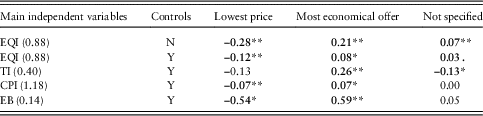
The next formal framework variable is the criterion used for deciding the winner. The results in Table 2 show support for the claim that better governance scores predict a lower usage of the inflexible ‘lowest price’ criterion, and more usage of the flexible ‘most economical offer’ criterion. Again, the results are substantively quite important.
The contract awarding criterion

EQI=European Quality of Government Index; TI=Transparency International; CPI=Corruption Perceptions Index; EB=Eurobarometer.
The dependent variable is ‘award criterion’. Table presents the average marginal effect of a one-unit change of the independent variables. Controls are: gross domestic product/capita of the region, size of government for country, budget deficit for country, and average trust levels for country. Results from multinomial logit models with standard errors clustered at the country level.
Significance codes: **<0.01, *<0.05, and .<0.10. Results significant at 0.10 level in boldface.
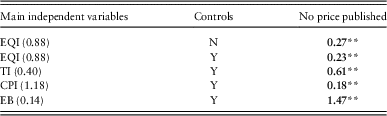
The third dependent variable is whether the price paid is not revealed. Table 3 shows that better governance measures uniformly predict a much higher likelihood of no price data being published.
No price data published

EQI=European Quality of Government Index; TI=Transparency International; CPI=Corruption Perceptions Index; EB=Eurobarometer.
The dependent variable is a dummy for no price being published. Table presents the average marginal effect of a one-unit change of the independent variable. Controls are: gross domestic product/capita of the region, size of government for country, budget deficit for country, and average trust levels for country. Results from logistic regressions with standard errors clustered at the country level.
Significance codes: **<0.01, *<0.05, and .<0.10. Results significant at 0.10 level in boldface.
A fourth, perhaps less informative, descriptor of the formal arrangements surrounding the contract is the timeliness of publication of contract awards. Table A.2.1 in the section A.2 of the Online Appendix shows that in none of the five models is the connection significant at the 0.05 level.
Overall, the results on the formal framework variables do not show evidence in favor of the simplistic view connecting supposedly bad institutions with poor governance, and instead show quite robust evidence that, within the context of this sample, poor governance predicts an institutional framework which is less flexible.
Competition
Two indicators which are directly indicative of the intensity of competition, together with a third indirect one, will be analyzed here.
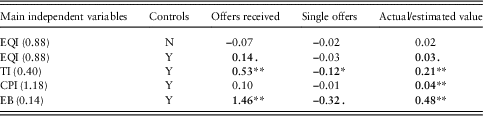
Table 4, first results column, presents coefficients from negative binomial models in which the dependent variable is the number of offers received for the contract. The coefficients can be interpreted as the approximate proportional change in the number of offers predicted by changes in the governance measures (Hilbe, Reference Hilbe2011: 130). The coefficients are positive, and significant at the 0.05 level in two out of five cases. Looking at the TI score model, it shows that a 1 std. dev. increase in the cleanliness score predicts ~21% more bidders.
Competition

EQI=European Quality of Government Index; TI=Transparency International; CPI=Corruption Perceptions Index; EB=Eurobarometer.
Column ‘Offers received’ presents the coefficient on each independent variable in a negative binomial regression on the number of offers. Column ‘Single offers’ presents the average marginal effect, derived from logistic regression, of the independent variables on a single-offer dummy. Column ‘Actual/estimated value’ presents coefficients from a linear regression on this variable. Controls are: gross domestic product/capita of the region, size of government for country, budget deficit for country, and average trust levels. Standard errors clustered at the country level.
Significance codes: **<0.01, *<0.05, and .<0.10. Results significant at 0.10 level in boldface.
It is worth also analyzing the distinction between contracts where there is a single bidder, which can be a more reliable indicator of no competition, vs. all competitive contracts. In the sample, 23% of contract awards receive a single bid. Table 4, the second results column, presents average marginal effects calculated from logistic regressions where the dependent variable is a dummy for single-bid contracts. The coefficients are negative and significant in two out of the five models, showing some, but not overwhelming, evidence for better government being connected to more competition.
Buyers are also required to submit estimated values for the lot when publishing the contract call. This is only done for one-third of the sample. The proportion between the actual value and the estimate is useful to analyze as a measure of how expensive the contract is, given prior expectations. This, if the prior estimate is unbiased, can be used as an indicator of competition. However, strategic behavior on the part of the buyer, who can indicate a higher expected value in order to make the final price seem less expensive, also cannot be discounted. Table 4, the third results column, presents coefficients from regressions where the dependent variable is the proportion actual/estimated value. The results show positive effects from the governance indicators on this measure. If we interpret the price variable as an indicator of competitiveness, the results would mean that buyers are actually getting worse deals in better governance environments. If we interpret it as an indicator of deception by officials, the results would say that such deception is more prevalent in poor-governance jurisdictions. Regardless, positive evidence in favor of competitiveness being connected to better governance is missing.
Overall, results for the competition indicators suggest that there is some support for the conventional view under which better governance should be associated with more competition, but the support is neither clear-cut nor robust. The key single-bid variable, which is often used as a ‘red flag’ for problematic contracting is only significant at the 0.05 level in one out of five models.
Decentralization
Contracts in the data set are classified according to the identity of the buyer in eight types. The results in Table 5 show some support for the hypothesis that better governance scores predict less contracting at the central level and more at the regional level. The key categories ‘national-level ministry’ and ‘regional authority’ show a consistent pattern in terms of their connections to governance and at least one of them is significant at the 0.05 level in three out of five models, while the estimated partial effects are quite large in substantive terms.
Type of buyer

EQI=European Quality of Government Index; TI=Transparency International; CPI=Corruption Perceptions Index; EB=Eurobarometer.
The categorical dependent variable is ‘contracting authority’. Table presents the average marginal effect of a one-unit change of the independent variables. Controls are: gross domestic product/capita of the region, size of government for country, budget deficit for country, and average trust levels. Results from multinomial logit models with standard errors clustered at the country level.
Significance codes: **<0.01, *<0.05, and .<0.10. Results significant at 0.10 level in boldface.
The results here can be interpreted as further evidence against the conventional view, and in favor of the claim that that a more flexible arrangement, namely decentralized contracting, is more widely encountered in better governed environments.
Types of products bought
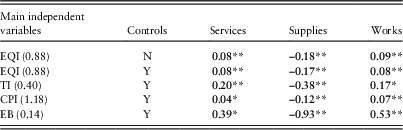
Two variables relate to what the object of the contract is. The first variable indicates whether the product being bought is a physical good (‘supplies’), a service, or a public works project. The results in Table 6 indicate a robust predictive effect from better governance to the likelihood of all three categories. This shows that, even after controlling for economic and social factors, there is still a strong connection between governance and these spending choices. In particular, better governance predicts more service and public works contracts and fewer physical supplies contracts.
Types of products

EQI=European Quality of Government Index; TI=Transparency International; CPI=Corruption Perceptions Index; EB=Eurobarometer.
The categorical dependent variable is ‘type of contract’. Table presents the average marginal effect of a one-unit change of the independent variables. Controls are: gross domestic product/capita of the region, size of government for country, budget deficit for country, and average trust levels. Results from multinomial logit models with standard errors clustered at the country level.
Significance codes: **<0.01, *<0.05, and .<0.10. Results significant at 0.10 level in boldface.
These results cannot easily be interpreted as evidence for either of the two theoretical views, but an argument in favor of contracting on services and works representing the more flexible and corruption-prone options can be made: by their very nature, services are hard to measure in terms of quantity and quality, and opportunities for abuse are rife in such transactions. Faced with this, poorly governed societies may come to prioritize spending on physical goods, which is more easily tracked. However, we also cannot discount the possibility that transactions in physical goods are more desirable for corrupt officials due a direct connection between governance and the nature of the goods, or that worse-governed societies simply need physical goods more than they do services or works, even after accounting for the level of development. The same patterns arise from the analysis in section A.2 of the Online Appendix, where the fine-grained categorization of spending type is the dependent variable.
Discussion of the results
Depending on the amount of theoretical structure one is willing to assume in interpreting these results, stronger or weaker conclusions about what they show can be drawn. At a very basic level, we can dispense with much of the theoretical reasoning presented in second section, and read them simply as a description of contracting patterns in good- and poor-governance environments. We can go beyond this interpretation by formulating a basic set of expectations under which better governance should go together with less discretion, more open access, more competition, and more transparency. At this level, the conclusion that can be drawn is that this set of expectations is not verified by reality, and therefore this conventional view must be in some way incomplete. Given that, as fifth section will argue, this view is likely to seep into much thinking on these topics, this conclusion is quite valuable. Moreover, given that this is a negative finding, it is also quite robust, in the sense that it would be difficult for it to be incorrect.
Going beyond this, if we are willing to also consider the insights of the alternative theory, then the results can be interpreted as showing quite substantial support for the validity of this alternative view. Of course, the possibility that the empirical patterns hold due to reasons other than the ones hypothesized by the alternative view should always be allowed, but it is also the case that the arguments in favor of its validity are compelling, as they are in agreement with a number of disparate arguments and pieces of empirical evidence from the literatures on the bureaucracy, on corruption, and on public administration. Moreover, it is worth reiterating that the empirical connection between flexibility and good governance cannot be interpreted as an endorsement of the adoption of more flexible, less controlled, institutions in poorly governed environments, as this would make the governance problem even worse, according to the alternative theoretical model.
Whatever the level of interpretation, the results must be understood in the context of the population analyzed here, made up of countries which are democratic, middle- and high-income, and in which substantial interest in good governance, and pressures on the political system and the bureaucracy, exist. Especially when considering the alternative theoretical view, its logic greatly depends on some constraints on the behavior of officials existing. In environments where governance is particularly poor, the ability of non-officials to provide any kind of input into the policy process may be severely hampered, and therefore, in that case, the simple predictions of the conventional view may well describe the data better.
Conclusions
This article has sought to show how good governance environments differ from poorly governed ones, in the particular case of public contracting procedures and outcomes. An overarching conclusion is that good governance environments are not generally characterized by having procedures and outcomes which are ‘better’, in the narrow sense of being less likely to lead to extractive behavior. Far from this being the case, it appears that in many instances it is the worse-governed environments that feature more extraction-inhibiting contracting characteristics. This may be because ‘good’ and ‘bad’ are not appropriate categories by which to judge contracting institutions. The impossibility of this categorization arises from the special nature of the relation between the public and government officials, as one of agency with imperfect knowledge and imperfect verifiability by the principal, which is the public in this case. This type of agency problem is specific to the relation between the public and officials much more widely, and therefore the conclusions derived here can be applied more broadly to questions of institutional design.
These findings complement an emerging literature on political transparency which casts doubt on a simplistic relation between this particular aspect of institutional design and social welfare. Ainsley (Reference Ainsley2017) shows that more transparency in central bank decision-making can actually reduce the effectiveness of monetary policy. A large literature on trade bargaining, reviewed in Kucik and Pelc (Reference Kucik and Pelc2015), argues that trade agreements are more likely to be signed when bargaining is less transparent to the public. Bauhr and Grimes (Reference Bauhr and Grimes2014) question the simplistic interpretation of the principal-agent model which underlies much theorizing about governance, and show that in corrupt environments higher transparency can lead to resignation on the part of citizens rather than corruption control. As in these works, the argument made here is not that arrangements which were believed to be ‘good’ are actually ‘bad’, but rather that tradeoffs between desirable objectives may be present in institutional design problems, complicating any effort to define good institutions.
One implication arising from this paper is that the ultimate aim of institutional design regarding contracting, and other similar strategic situations, should not be to maximize control over officials, but rather to ensure the overall incentives officials are facing are aligned with the interests of the public. Control-based solutions are of course needed where no such alignment exists, but they should be regarded as temporary fixes rather than ends in themselves. If no agency problem existed, and the public knew for sure that public organizations were solely devoted to advancing social welfare, it is hard to believe they would be best able to do so in a climate of strict limitations on the discretion of individual workers. Instead, organizational features such as creativity, flexibility, risk-taking, and even moderate secrecy, would likely be celebrated, much as they are in the case of private organizations. In private markets, consumers are generally not helped by being able to tell a firm how to deal with its suppliers, by being able to read the CEO’s emails, or by preventing the firm’s employees from acting on their intuitions. Public settings are of course different – and therefore do require some degree of regulation of how public money is spent, some transparency, and some limitation of discretion. However, such regulation and control cannot be the sole aim of institutional design, as public organizations are not immune from the need for flexibility and creativity present in every aspect of human activity.
While few would disagree with the above, and while this is not the first time such ideas have been put forward, an argument can be made that a disproportionate emphasis on achieving control vs. achieving overall efficiency in the relation between the public and government officials can be encountered in much of the recent academic literature on institutions, as well as in policy evaluation efforts. A widely read summary of the institutionalist arguments, Acemoglu and Robinson (Reference Acemoglu, Johnson and Robinson2012), focuses on the distinction between extractive and inclusive institutions; and the distinction between limited- and open-access orders in another classic, by North et al. (Reference North, Wallis and Weingast2009) is similar. Unless the connections between these notions and the agency problem-facing citizens and officials are carefully considered, there is a risk of them being understood as essentially our ‘bad’ and ‘good’ institutions. In some instances, this will be the correct way to look at the problem – generally when allowing any discretion to officials is clearly undesirable, for example, regarding the enforcement of property rights, economic regulations with no possible social benefit, or the provision of basic literacy. However, many institutional choices are not of this nature: improving educational quality, achieving efficient public procurement, or ensuring cost effectiveness in healthcare, for example, all require some degree of discretion and creativity. Limiting extraction by limiting discretion is the obvious policy implication to arise in the first set of cases, but a simplistic extension of this policy advice to the second set of cases is likely not advisable. The results in this paper show, in the particular case of procurement, that the connection between good governance and such central concepts of the institutionalist literature as open access, competition, and transparency, is nowhere near clear. It can be speculatively hypothesized that the disproportionate focus of the institutionalist literature on topics such as property rights and limitations to market access, rather than, say educational quality or bureaucratic efficiency, arises from the better applicability of the basic theoretical framework to the former rather than the latter.
Similar problems characterize some of the applied policy initiatives regarding procurement, anti-corruption, and open government. The European Commission, for example, uses six indicators to judge the ‘performance’ of public procurement in each member state. All six indicators, however, refer to the procedures followed, rather than the end-result of the procurement process, and five of themFootnote 8 are quite explicitly about controlling possible corruption- or rent-extraction-facilitating behaviors by officials. Such metrics are of course important to consider, but not at the expense of the actual performance of the procurement process, which should be defined in terms of how well the public’s needs are being met.
Acknowledgments
Many thanks to Caitlin Ainsley, Iulia Cioroianu, Magnus Feldmann, Albert Sanchez-Graells, Mark-Wickham Jones, seminar participants at the University of Bristol, the editors, and three anonymous reviewers for comments on this paper.
Supplementary material
To view supplementary material for this article, please visit https://doi.org/10.1017/S1755773917000157