Introduction
Sphincterodiplostomum Dubois, 1936 is a monotypic genus of diplostomoidean digeneans (Diplostomidae Poirier, 1886; Diplostominae Poirier, 1886), which parasitize the intestines of their avian definitive hosts in the neotropics (Niewiadomska, Reference Niewiadomska, Gibson, Jones and Bray2002; Lunaschi & Drago, Reference Lunaschi and Drago2006). The type species Sphincterodiplostomum musculosum Dubois, 1936 was originally described by Dubois (Reference Dubois1936, Reference Dubois1938) based on immature specimens from agami heron Agamia agami (Gmelin) collected in Brazil. Lunaschi & Drago (Reference Lunaschi and Drago2006) have described fully mature adult specimens of the species from great egret Ardea alba Linnaeus in Argentina. Sphincterodiplostomum musculosum is most easily differentiated from other members of the Diplostomidae based on the presence of a well-developed, dorsal, tubular invagination in the opisthosoma with a muscular sphincter (Niewiadomska, Reference Niewiadomska, Gibson, Jones and Bray2002; Lunaschi & Drago, Reference Lunaschi and Drago2006).
The complete life cycle of S. musculosum has not been demonstrated; however, S. musculosum is known to utilize a wide diversity of fish as second intermediate hosts, and has been previously collected from avian definitive hosts (e.g. Dubois, Reference Dubois1936; Lunaschi & Drago, Reference Lunaschi and Drago2006; Rocha et al., Reference Rocha, Pelegrini, Camargo, Abdallah and Azevedo2015; Delgado et al., Reference Delgado, Tantaleán, Martínez and Mondragón2017). Adult S. musculosum have been rarely collected (e.g. Lunaschi & Drago, Reference Lunaschi and Drago2006), whereas metacercariae have been reported in several studies of Neotropical fish helminths (e.g. Szidat, Reference Szidat1969; Zago et al., Reference Zago, Franceschini, Ramos, Zica, Wunderlich, Carvalho and Silva2013; Rocha et al., Reference Rocha, Pelegrini, Camargo, Abdallah and Azevedo2015; Delgado et al., Reference Delgado, Tantaleán, Martínez and Mondragón2017). To date, no DNA sequence data have been published for S. musculosum. Herein, we provide partial 28S ribosomal RNA (rRNA) and cytochrome c oxidase 1 (cox1) mitochondrial DNA gene sequences of S. musculosum and a new Sphincterodiplostomum species collected from avian and crocodilian hosts. The 28S DNA sequence data were used to infer the phylogenetic position of Sphincterodiplostomum spp. among other major diplostomoidean lineages. The sequences of cox1 were used for reliable Sphincterodiplostomum species differentiation.
Materials and methods
Vertebrate hosts were collected in Pantanal, Fazenda Retiro Novo, Municipality of Poconé, Mato Grosso State, Brazil. Mature and immature adult specimens of S. musculosum were obtained from cocoi heron Ardea cocoi Linnaeus, 1776, black-collared hawk Busarellus nigricollis (Latham, 1790), green kingfisher Chloroceryle americana (Gmelin, 1788) and yacare caiman Caiman yacare (Daudin, 1802). In addition, mature adult specimens of the new Sphincterodiplostomum species were collected from B. nigricollis (table 1). Specimens for morphological study were stained with an aqueous alum carmine and permanently mounted according to Lutz et al. (Reference Lutz, Tkach, Weckstein and Webster2017). All measurements given in the text are in micrometres. Type and voucher specimens are deposited in the collection of the Harold W. Manter Laboratory (HWML), University of Nebraska State Museum, Lincoln, Nebraska, USA. As noted in recent publications on diplostomoideans (e.g. Achatz et al., Reference Achatz, Curran, Patitucci, Fecchio and Tkach2019a, Reference Achatz, Dmytrieva, Kuzmin and Tkachb, Reference Achatz, Pulis, Fecchio, Schlosser and Tkachc; Tkach et al., Reference Tkach, Achatz, Pulis, Junker, Snyder, Bell, Halajian and Melo2020), we use the terms prosoma and opisthosoma to refer to the distinct anterior and posterior regions of the body.
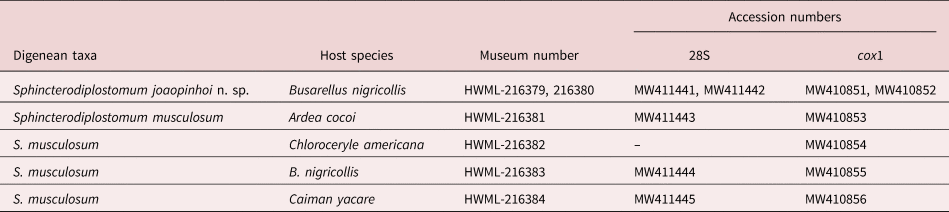
List of Sphincterodiplostomum isolates sequenced in this study, their hosts and GenBank accession numbers.

HWML, Harold W. Manter Laboratory, Lincoln, Nebraska, USA. All specimens were collected at Fazenda Retiro Novo, Municipality of Poconé, Mato Grosso State, Brazil.
Specimens of Sphincterodiplostomum spp. observed under scanning electron microscope (SEM) were dehydrated in a series of ethanol of ascending concentrations and dried with hexamethyldisilazane (Ted Pella Inc., Redding, California, USA) as a transition fluid. Sphincterodiplostomum spp. specimens were mounted on aluminium stubs using conductive double-sided tape, coated with gold–palladium and examined with the use of a Hitachi 4700 SEM (Hitachi USA, Mountain View, California, USA) at an accelerating voltage of 5 kV.
Genomic DNA was extracted from a part of a specimen or a whole single specimen of Sphincterodiplostomum spp. following the protocol described by Tkach & Pawlowski (Reference Tkach and Pawlowski1999) or using a ZR Genomic DNA Tissue Micro Prep kit (Zymo Research, Irvine, California, USA) following the manufacturer's instructions. Amplification and sequencing of 28S and cox1 fragments was carried out as described in Achatz et al. (Reference Achatz, Pulis, Junker, Binh, Snyder and Tkach2019d). Newly obtained sequences are deposited in GenBank (table 1).
Newly obtained and previously published sequences were initially aligned using ClustalW implemented in MEGA7 software (Kumar et al., Reference Kumar, Stecher and Tamura2016). The position of Sphincterodiplostomum spp. among major diplostomoidean lineages was studied using an alignment of 28S, which included newly generated sequences of both Sphincterodiplostomum species and previously published sequences of 16 members of the Diplostomidae, two members of the Proterodiplostomidae Dubois, 1936 and 12 members of the Strigeidae Railliet, 1919. Suchocyathocotyle crocodili (Yamaguti, 1954) was selected as the outgroup based on the topology presented by Achatz et al. (Reference Achatz, Pulis, Junker, Binh, Snyder and Tkach2019d). The phylogenetic analysis was conducted using Bayesian inference (BI) as implemented in MrBayes version 3.2.6 software (Ronquist & Huelsenbeck, Reference Ronquist and Huelsenbeck2003). The best-fitting nucleotide substitution model identified by MEGA7 was the general time-reversible model with estimates of invariant sites and gamma-distributed among-site variation (GTR + I + G). The BI analysis was performed using MrBayes software as follows: Markov chain Monte Carlo (MCMC) chains were run for 3,000,000 generations with sample frequency set at 1000. Log-likelihood scores were plotted and only the final 75% of trees were used to produce the consensus trees. The number of generations for each analysis was considered sufficient as the standard deviation stabilized below 0.01. The pairwise comparisons of Sphincterodiplostomum isolates were performed with assistance of MEGA7 software.
Results
Systematics
Diplostomidae Poirier, 1886
Sphincterodiplostomum Dubois, 1936
Sphincterodiplostomum joaopinhoi n. sp.
Taxonomic summary
-
Type host. Busarellus nigricollis (Accipitriformes: Accipitridae).
-
Type locality. Pantanal, Fazenda Retiro Novo, Municipality of Poconé, Mato Grosso State, Brazil (16°21′53″S, 56°17′31″W).
-
Type material. The type series consists of two mature and four immature adult specimens deposited in the HWML. Holotype: HWML-216379, labelled ex. B. nigricollis, small intestine, Pantanal, Fazenda Retiro Novo, Municipality of Poconé, Mato Grosso State, Brazil, 9 June 2017, coll. A. Fecchio. Paratypes: HWML-216380 (lot of four), labels identical to the holotype.
-
Site in host: Small intestine.
-
ZooBank registration. The Life Science Identifier (LSID) for Sphincterodiplostomum joaopinhoi n. sp. is urn:lsid:zoobank.org:act:DB466D7B-EED6-4959-9EB9-E3C34A3D4885.
-
Etymology. The species is named after Dr Joao B. Pinho (Laboratório de Ecologia de Aves, Federal University of Mato Grosso, Cuiabá, Brazil) in recognition of his contributions into the knowledge of avifauna of Pantanal and his invaluable assistance with collecting specimens reported in this work.
Description
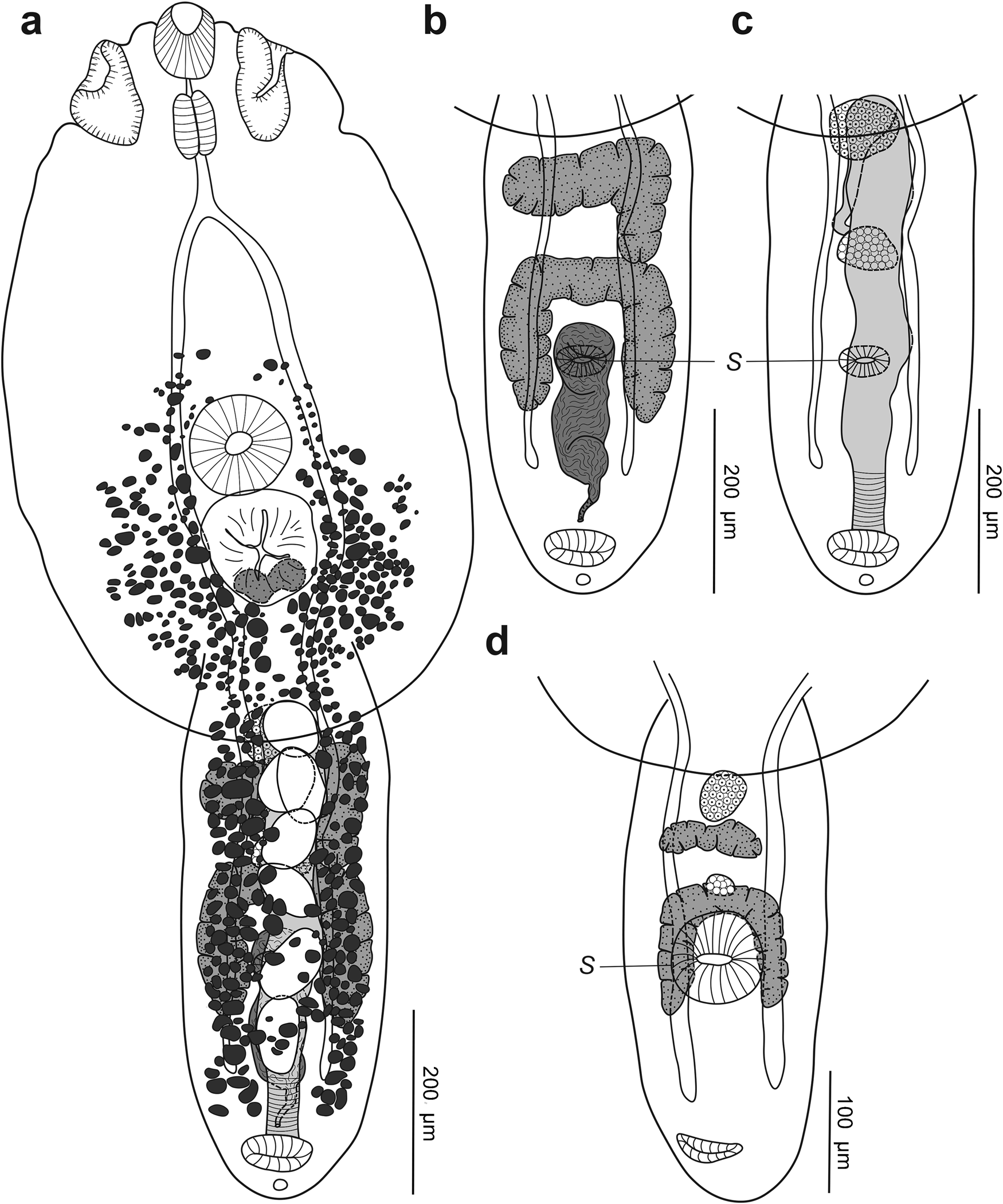
Based on two adult specimens (see figs 1, 2a–e and 3a–e). Body 978–1259 long, consisting of distinct prosoma and opisthosoma; prosoma elliptical, 580–766 long, with maximum width at level of holdfast organ, 428–460; opisthosoma cylindrical, 398–493 long, 226–241 wide. Prosoma: opisthosoma length ratio 1.5–1.6; opisthosoma width ratio 1.8–2. Forebody 347–451 long, 35–36% of body length. Minuscule tegumental spines covering most of prosoma, absent between anterior margin of oral sucker and posterior margin of pseudosuckers; spines scale-like with several small digitiform projections at posterior edge (fig. 3d). Opisthosoma with a tubular invagination with muscular sphincter at level of posterior testis. Oral sucker terminal, oval, 64–72 × 49–56. Pseudosuckers 75–82 × 66–78. Ventral sucker with minute spines covering its base, 93–98 × 98–108, located near 60% of prosoma length; oral: ventral sucker width ratio 0.5. Holdfast organ immediately posterior to ventral sucker; subspherical or oval with ventral muscular portion, 118–128 × 110–168. Proteolytic gland at base of holdfast organ, bilobed, 43 × 79. Prepharynx 24 long. Pharynx oval, 76 × 46. Oesophagus 54–80 long. Caecal bifurcation in anterior third of prosoma. Ceca slender, extending to near posterior end of opisthosoma.
Line drawings of Sphincterodiplostomum joaopinhoi n. sp.: (a) holotype, ventral view; (b) male reproductive system of holotype, ventral view of opisthosoma; (c) female reproductive system of holotype, ventral view of opisthosoma, vitellarium and eggs omitted; (d) paratype, immature specimen, dorsal view. Abbreviation: S, dorsal muscular sphincter associated with the tubular invagination of the opisthosoma.

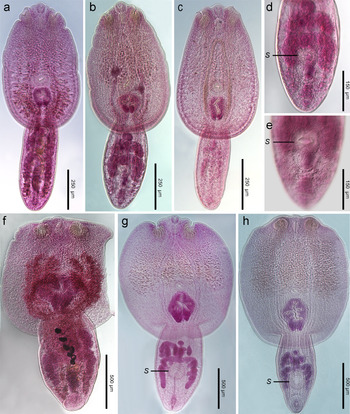
Specimens of Sphincterodiplostomum species/species-level lineages from Pantanal, Brazil: (a) holotype of mature adult Sphincterodiplostomum joaopinhoi n. sp., ventral view; (b, c) paratypes of immature S. joaopinhoi n. sp. at different stages of development, ventral views; (d, e) opisthosoma of S. joaopinhoi n. sp., dorsal views; (f) mature adult Sphincterodiplostomum musculosum from Chloroceryle americana, ventral view, hologenophore; (g) immature S. musculosum from Ardea cocoi, dorsal view; (h) immature S. musculosum from Caiman yacare, dorsal view. Abbreviation: S, sphincter surrounding tubular invagination characteristic of Sphincterodiplostomum species.

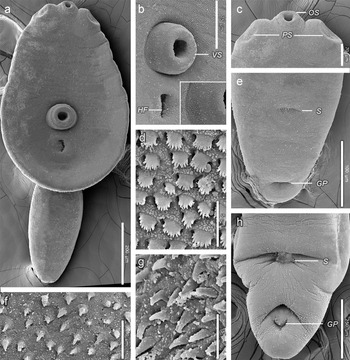
Scanning electron micrographs of Sphincterodiplostomum spp.: (a) entire specimen of Sphincterodiplostomum joaopinhoi n. sp., ventral view; (b) ventral sucker and holdfast organ of S. joaopinhoi n. sp., ventral view; inset shows minute spines at the base of the ventral sucker; (c) anterior end of prosoma of S. joaopinhoi n. sp., ventral view; (d) tegumental spines with digitiform projections of S. joaopinhoi n. sp.; (e) posterior end of opisthosoma of S. joaopinhoi n. sp., dorsal view, note the sphincter surrounding tubular invagination characteristic of Sphincterodiplostomum species; (f, g) tegumental spines of Sphincterodiplostomum musculosum; (h) posterior end of opisthosoma of S. musculosum, dorsal view. Abbreviations: GP, genital pore; HF, holdfast organ; OS, oral sucker; PS, pseudosucker; S, sphincter surrounding tubular invagination; VS, ventral sucker.

Testes 2, in tandem, lobate; anterior testis asymmetrical, 68–112 × 156–203; posterior testis symmetrical, horseshoe-shaped with anterior isthmus, 152–171 × 165–209. Seminal vesicle folded, posterior to isthmus of posterior testis; terminal efferent duct of seminal vesicle joins dorsal side of metraterm to form short hermaphroditic duct.
Ovary pretesticular, near prosoma–opisthosoma junction, subspherical or slightly transversely oval 55–60 × 64–75. Oötype and Mehlis’ gland inter-testicular. Laurer's canal not observed. Vitelline follicles distributed as two lateral bands extending posteriorly from approximately the level of the ventral sucker to near the posterior end of the body, lateral bands sporadically confluent. Vitelline follicles absent in the first 47–68% of prosoma and last 15–20% of opisthosoma. Vitelline reservoir inter-testicular. Uterus ventral to gonads, extending anteriorly to near junction of prosoma and opisthosoma before turning and extending posteriorly. Uterus contains up to eight eggs (74–83 × 42–53). Genital pore subterminal, on dorsal side, muscular. Excretory vesicle not well-observed. Excretory pore subterminal, on dorsal side.
Remarks
The new species clearly belongs to Sphincterodiplostomum based on the presence of a well-developed dorsal tubular invagination in the opisthosoma with a muscular sphincter, along with the results of our molecular phylogenetic analysis (fig. 4). The differential diagnosis below compares the new species with the description of adult S. musculosum by Lunaschi & Drago (Reference Lunaschi and Drago2006) as they were the first to describe mature adult specimens. It is worth noting that specimens described by Lunaschi & Drago (Reference Lunaschi and Drago2006) were contracted as stated by the authors and evident based on their illustrations. As we had only a single fully mature ovigerous specimen, we do not provide a description of S. musculosum. For the same reason, we do not provide a differential diagnosis based on our material, except for the tegumental spine structure and body size, which is skewed in the description by Lunaschi & Drago (Reference Lunaschi and Drago2006) due to contraction.
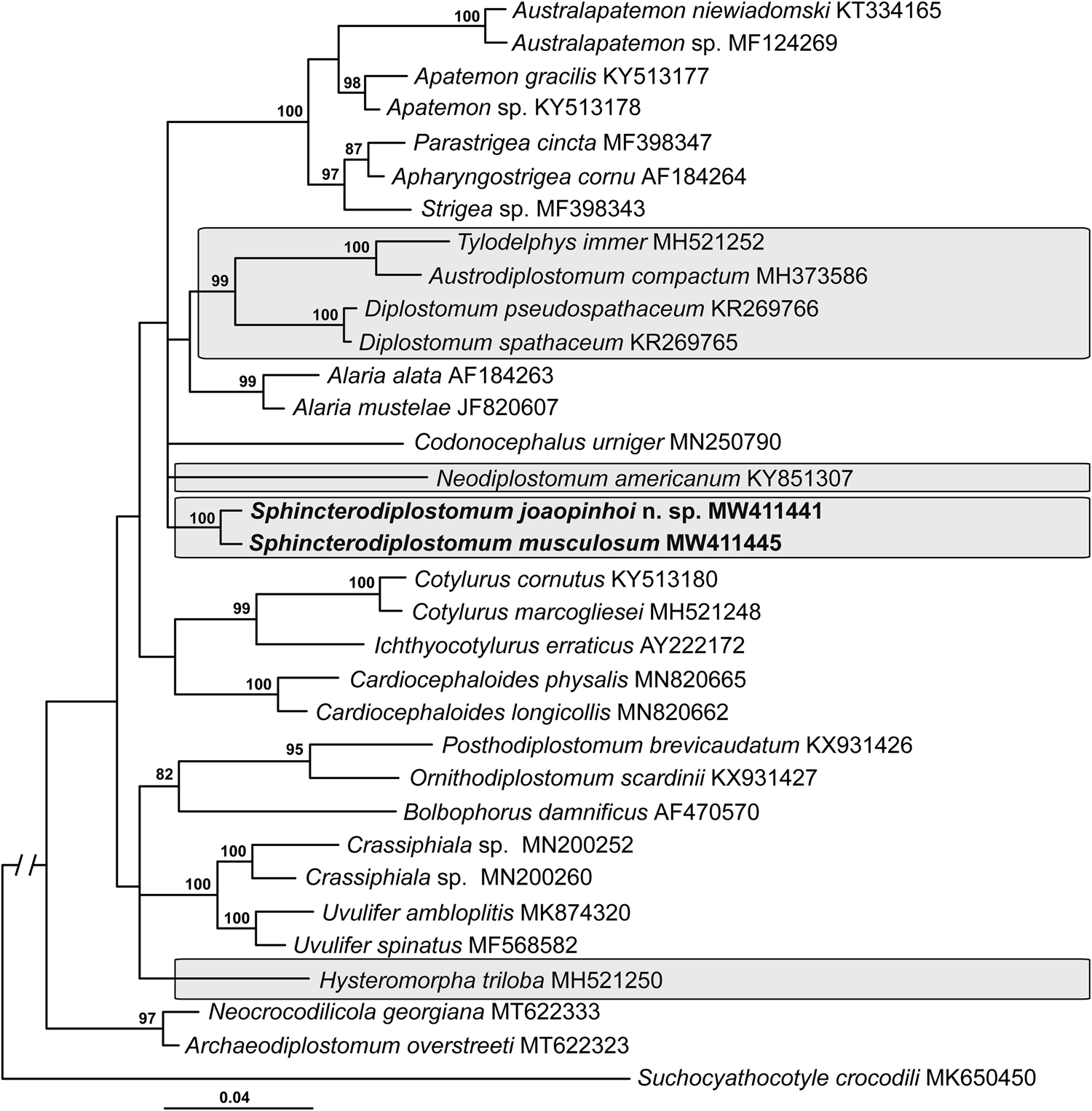
Phylogenetic interrelationships among 33 diplostomoidean taxa including Sphincterodiplostomum spp. based on Bayesian Inference (BI) analysis of partial 28S rRNA gene sequences. Members of the sub-family Diplostominae as currently recognized are indicated by the shaded rectangles. BI posterior probability values lower than 80% are not shown. The new sequences obtained in this study are in bold. Scale bar indicates number of substitutions per site. GenBank accession numbers are provided after the names of all species.

Sphincterodiplostomum joaopinhoi n. sp. can be easily distinguished from S. musculosum based on the anterior extent of vitelline follicles (limited to near level of ventral sucker in the new species versus reaching near the level of the caecal bifurcation in S. musculosum) (figs 1 and 2).
Sphincterodiplostomum joaopinhoi n. sp. is smaller than heat-killed, properly fixed adult specimen of S. musculosum in our material (body length 978–1259 in the new species vs body length 1821 in S. musculosum). Even immature heat-killed specimens of S. musculosum in our material are substantially larger (body length 2145–2593) than the new species (body length 978–1259). Sphincterodiplostomum joaopinhoi n. sp. differs from S. musculosum described by Lunaschi & Drago (Reference Lunaschi and Drago2006) by a much smaller prosoma width (428–460 in S. joaopinhoi n. sp. vs 754–1115 in S. musculosum), smaller oral sucker (64–72 × 49–56 in the new species vs 92–108 × 63–106 in S. musculosum), shorter pseudosuckers (75–82 in S. joaopinhoi n. sp. vs 101–150 in S. musculosum), smaller holdfast organ (118–128 × 110–168 in the new species vs 143–314 × 217–580 in S. musculosum), shorter pharynx (76 in S. joaopinhoi n. sp. vs 111–140 in S. musculosum) and wider anterior testis (156–203 in the new species vs 95–113 in S. musculosum).
Our SEM study demonstrated that the structure of tegumental spines of S. joaopinhoi n. sp. (fig. 3d) also differs from that in S. musculosum (fig. 3f, g). The spines of S. joaopinhoi n. sp. are scale-like and have several digitiform projections at the posterior edge of each spine (fig. 3d), whereas spines of S. musculosum are not scale-like and lack such projections (fig. 3f, g). Sphincterodiplostomum joaopinhoi n. sp. differs from S. musculosum by 0.7% (eight bases out of 1193) in the partial sequences of 28S gene, and by 10.6−11.7% (58–64 bases out of 545) in the partial sequences of cox1 gene.
Molecular phylogeny
After trimming to the length of the shortest sequence, the alignment of 28S was 1117 bases long; two sites were excluded due to indels. The topology of the Diplostomidae and Strigeidae in the phylogeny resulting from our analysis of 28S (fig. 4) was similar to other recent molecular phylogenetic analyses of the group (e.g. Blasco-Costa & Locke, Reference Blasco-Costa and Locke2017; Hernández-Mena et al., Reference Hernández-Mena, García-Varela and Pérez-Ponce de León2017; Locke et al., Reference Locke, Van Dam, Caffara, Pinto, López-Hernández and Blanar2018; Achatz et al., Reference Achatz, Dmytrieva, Kuzmin and Tkach2019b, Reference Achatz, Pulis, Fecchio, Schlosser and Tkachc, Reference Achatz, Pulis, Junker, Binh, Snyder and Tkachd, Reference Achatz, Pulis, González-Acuña and Tkach2020; Pérez-Ponce de León & Hernández-Mena, Reference Pérez-Ponce de León and Hernández-Mena2019; Queiroz et al., Reference Queiroz, López-Hernández, Locke, Pinto and Anjos2020; Tkach et al., Reference Tkach, Achatz, Pulis, Junker, Snyder, Bell, Halajian and Melo2020). Importantly, both the Diplostomidae and Strigeidae were non-monophyletic. Both included representatives of the Proterodiplostomidae formed a strongly supported (97%) clade. Both members of Sphincterodiplostomum formed a strongly supported (100%) clade within a polytomy. This polytomy included three other clades of diplostomids and one well-supported clade of strigeids (fig. 4). The three other clades of diplostomids included (1) an unsupported clade of Alaria Schrank, 1788 + a 99% supported clade of [Diplostomum von Nordmann, 1832 + Tylodelphys Diesing, 1850 + Austrodiplostomum Szidat et Nani, 1951]; (2) Codonocephalus Diesing, 1850; and (3) Neodiplostomum Railliet, 1919. Hysteromorpha triloba (Rudolphi, 1819) was part of a separate, unsupported and unresolved polytomy (fig. 4).
Genetic variation
Pairwise nucleotide comparisons of partial 28S sequences revealed 0.7% difference (eight bases out of 1193) between the Sphincterodiplostomum species/species-level lineages. No intraspecific variation was detected among the partial 28S sequences of either species.
The pairwise comparisons of partial cox1 sequences demonstrated 10.6–11.7% difference (58–64 bases out of 545) between the two Sphincterodiplostomum species. In contrast with the 28S sequences, the cox1 sequences demonstrated 1.3–2.6% (7–14 bases out of 545) intraspecific variation in S. musculosum and 0.6% (three bases out of 545) intraspecific variation in S. joaopinhoi n. sp.
Discussion
This study adds a second species to the previously monotypic Sphincterodiplostomum. According to Niewiadomska (Reference Niewiadomska, Gibson, Jones and Bray2002), Sphincterodiplostomum belongs to the sub-family Diplostominae, which has been since demonstrated to be clearly non-monophyletic (fig. 4; e.g. Blasco-Costa & Locke, Reference Blasco-Costa and Locke2017; Locke et al., Reference Locke, Van Dam, Caffara, Pinto, López-Hernández and Blanar2018; Achatz et al., Reference Achatz, Dmytrieva, Kuzmin and Tkach2019b, Reference Achatz, Pulis, Fecchio, Schlosser and Tkachc, Reference Achatz, Pulis, Junker, Binh, Snyder and Tkachd; Achatz et al., Reference Achatz, Pulis, González-Acuña and Tkach2020; Queiroz et al., Reference Queiroz, López-Hernández, Locke, Pinto and Anjos2020; Tkach et al., Reference Tkach, Achatz, Pulis, Junker, Snyder, Bell, Halajian and Melo2020). Both Sphincterodiplostomum species possess a well-developed, dorsal tubular invagination in the opisthosoma with a muscular sphincter, which is absent in other members of the Diplostominae. This fact, along with the molecular phylogenetic analysis placing the genus in its own clade with no evidence of close relationships with any other group within a polytomy, demonstrates that Sphincterodiplostomum represents a unique evolutionary lineage that likely evolved in South America. Whereas this evidence may be sufficient to erect a new sub-family (or family) for Sphincterodiplostomum, we feel that such an action would be premature until a detailed re-evaluation of all non-monophyletic members of the Diplostominae is undertaken. With the results of this study, 28S DNA sequences are only available for six of the 14 genera within the Diplostominae. Thus, it is not known how inclusion of DNA sequences of the remaining Diplostominae genera may affect the resulting topology and our understanding of the relationships among all members of the sub-family.
The intrageneric pairwise nucleotide comparisons of partial 28S (0.7%) and cox1 (10.6–11.7%) sequences of Sphincterodiplostomum spp. are similar to the levels of intrageneric variation demonstrated within other diplostomoidean genera (28S: 0–4.4%; cox1: 3.4–19.8%; see Achatz et al., Reference Achatz, Pulis, González-Acuña and Tkach2020 and references therein; Tkach et al., Reference Tkach, Achatz, Pulis, Junker, Snyder, Bell, Halajian and Melo2020).
Our mature and immature adult specimens of S. musculosum (fig. 2f–h) conform closely to the original description of S. musculosum from Ag. agami by Dubois (Reference Dubois1936, Reference Dubois1938) and redescription based on specimens from Ar. alba by Lunaschi & Drago (Reference Lunaschi and Drago2006). Both immature and mature specimens of S. musculosum in our material were more similar to immature specimens described by Dubois (Reference Dubois1936, Reference Dubois1938), and were substantially longer than the contracted specimens described by Lunaschi & Drago (Reference Lunaschi and Drago2006). The body length of our specimens of S. musculosum ranged between 1821 and 2593, despite most of them being immature, whereas Dubois (Reference Dubois1936, Reference Dubois1938) described his immature specimens to be up to 2900 long. In contrast, the body length of the contracted specimens described by Lunaschi & Drago (Reference Lunaschi and Drago2006) ranged between 919 and 1329. This provides additional evidence that S. musculosum is a substantially larger digenean than S. joaopinhoi n. sp. Lunaschi & Drago (Reference Lunaschi and Drago2006) described the tegument of S. musculosum as smooth. However, the tegument on the prosoma of our specimens is armed with spines (fig. 3f, g). The contradiction is explained by the extremely small size of the tegumental spines, which are difficult to observe under a light microscope.
This is the first report of S. musculosum from A. cocoi, B. nigricollis (or any raptor), Ch. americana (or any kingfisher) and Ca. yacare (or any crocodilian). We assume that the infection of Ca. yacare was accidental based on the presence of only immature specimens and the lack of any previous reports of S. musculosum in crocodilians. Caimans share both habitat and diet with fish-eating birds, thus making accidental infection possible. The fact that the specimens were collected during an extremely hot time of the year from a caiman in a small, shallow water body likely explains why these digeneans, normally parasitic in birds, underwent some growth and development in a cold-blooded vertebrate.
Sphincterodiplostomum joaopinhoi n. sp. is the second member of the genus and the first Sphincterodiplostomum species to be reported or described from B. nigricollis. While we did find S. musculosum in studied B. nigricollis, we did not find any fully mature specimens. It cannot be excluded that some previous reports of metacercariae of S. musculosum and unidentified Sphincterodiplostomum sp. from a variety of Neotropical fish may actually be S. joaopinhoi n. sp. The larvae of the two species are likely morphologically similar as larvae, as is the case for many other diplostomoideans; therefore, molecular identification of Sphincterodiplostomum metacercariae is recommended in the future. We hypothesize that the genus Sphincterodiplostomum contains additional not-yet-described species as has been recently demonstrated for several other diplostomoidean genera, such as Crassiphiala Van Haitsma, 1925, Hysteromorpha Lutz, 1931 and Uvulifer Yamaguti, 1934 (e.g. Locke et al., Reference Locke, Van Dam, Caffara, Pinto, López-Hernández and Blanar2018; López-Jiménez et al., Reference López-Jiménez, Pérez-Ponce de León and & García-Varela2018; Achatz et al., Reference Achatz, Curran, Patitucci, Fecchio and Tkach2019a, Reference Achatz, Pulis, Fecchio, Schlosser and Tkachc).
Acknowledgements
We are grateful to Dr João B. Pinho (Universidade Federal de Mato Grosso, Cuiabá, Mato Grosso, Brazil) for his invaluable help in organizing the collection of the specimens used in this work and obtaining collecting permits, and to Luís Carlos de Sá Neves for his help with field collecting. We are thankful to ICMBio/SISBIO that kindly provided a permit to collect caimans in Pantanal, Brazil (license permission SISBIO: 53527-4).
Financial support
This work was supported by the National Science Foundation (V.V.T., grant number DEB-1120734); the Department of Biology, University of North Dakota (T.J.A., W.H. Wheeler Award); Annual Midwestern Conference of Parasitologists (T.J.A., AMCOP Student Research Grant); the Coordenação de Aperfeiçoamento de Pessoal de Nível Superior – CAPES (A.F., PNPD scholarship process number 88887.342366/2019-00); and the Conselho Nacional de Desenvolvimento Científico e Tecnológico (F.T.V.M., grant number 431809/2018-6, research fellowship number 304955/2018-3).
Conflicts of interest
None.
Ethical standards
The authors assert that all procedures contributing to this work comply with the ethical standards of the relevant national and institutional guides on the care and use of animals.