In the late 1830s, the British Association for the Advancement of Science proposed extending ongoing studies in terrestrial magnetism to include the south polar regions. Upon the Association’s recommendation, the Royal Society of London with the support of the British government laid the groundwork and established the protocols for a multidisciplinary scientific programme. Land-based magnetical and meterological observatories constructed at Toronto, St. Helena, the Cape of Good Hope, and Tasmania (Hobart) would make possible simultaneous magnetical observations from widely separated, strategically placed sites on the globe. The voyage of James Clark Ross (1800−1862) on the Erebus and Terror in 1839−1843 would become an integral roving component of the overall programme.
Ross’s voyage was enormously successful, the most significant south latitude venture since the early Antarctic circumnavigations of the British navigator James Cook in 1772−1775 and the Russian navigator Thaddeus von Bellingshausen in 1819−1821. Ross’s parties, after stops at the Iles Kerguelen, Tasmania, the Auckland Islands and Campbell Island, courageously advanced southward through the ice pack engirdling what was later fittingly named the Ross Sea. The men were the first human beings to witness the spectacular coastal features of Victoria Land and its associated islands, Ross Island and its active volcano Mt. Erebus, and the Ross Ice Shelf. They spent the autumn and winter months in Australia and New Zealand, and later, after another summer season’s southward foray without landfall, wintered at the Falkland Islands, explored Hermite Island, islands in the vicinity of the Antarctic Peninsula, and penetrated the Weddell Sea before returning to England.
With able scientists aboard and senior scientists at home in Britain, the enterprise made substantial contributions to knowledge not only in magnetics (Sabine, Reference Sabine1843-1868), but also in zoology (the reports of which are the focus of this paper), botany (Hooker, Reference Hooker1844-1847), meteorology (Scott & Strachan, Reference Scott and Strachan1873), geography and hydrography (Ross, Reference Ross1847), and geology (Ross, Reference Ross1847; Stone, Reference Stone2020).
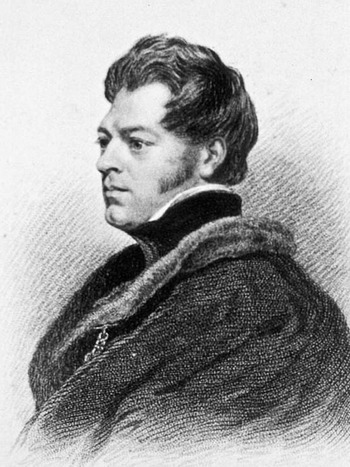
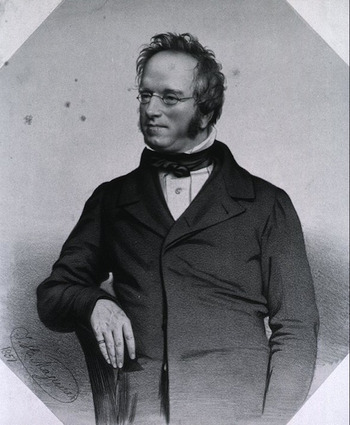
Ross’s surgeon and zoologist on the Erebus, Robert McCormick (1800−1890), whose primary interests were birds, mammals and geology, delivered collections to the British Museum. The Natural History Museum of London still retains innumerable specimens. McCormick was assisted during the voyage by the young Joseph Dalton Hooker (1817−1911), whose principal interest was botany but also included marine invertebrates (Ross, Reference Ross1982, Reference Ross1994). McCormick was probably also assisted by John Robertson, surgeon on the Terror (Ross, Reference Ross1982). At the recommendation of the Admiralty, the British government granted £1,000 (£120,000 in today’s currency) towards publication of the zoological results (Anonymous, Nature 1875). The work was additionally supported through subscription. The project was superintended by John Richardson (1787−1865) (Fig. 1), Arctic explorer and Britain’s leading authority on fishes, and John Edward Gray (1800−1875) (Fig. 2), Keeper of the Department of Zoology of the British Museum.
John Richardson.

John Edward Gray.

The Zoology was issued in parts. The London firm of Longman, Brown, Green, and Longmans, Paternoster Row, published them starting in June 1844 (Evenhuis, Reference Evenhuis2015). All were about 31 to 32 cm in height, in greenish-grey thick wrappers printed in black and bound with very thin quarter deep-green cloth, some plates with tissue paper guards and coloured, printed by E. [Edward] Newman, Printer, 9. Devonshire Street, Bishopsgate [London]. Longman initially intended about 15 parts (indicated on various parts’ rear wrappers). But Longman had to extend the run, funds dwindled, parts were issued more slowly, and Longman ceased production altogether after February 1848 when 18 parts had been produced. The only branch finished was the fishes, the section Richardson authored; the last two parts of it were combined and put out just before Longman withdrew. The sections on mammals, birds, reptiles and insects were left incomplete even though most of the texts and plates, including those requiring colouration, had been largely prepared. The molluscs and crustaceans were entirely unissued. By contrast, J. D. Hooker’s botany, Flora Antarctica, a comparably large work issued in 25 parts under a different London publisher (Reeve, Brothers) with far more plates requiring colouration, and identically supported by the government and similarly by subscription, commenced at the same time as the Zoology in 1844 but was brought to completion in 1847 (Dunn, Reference Dunn1913; Jackson, Reference Jackson1912).
The Zoology was expensive given the effort and detail put into the texts and high-quality lithography and hand colourations. The Longman parts cost 10 shillings each (£60 in today’s currency), meaning the run of 18 Longman parts totalled £9, or £1080 today. We should therefore not be surprised if subscribers were dismayed when Longman had advertised a 15-part run (even after the 15th part had been reached) and came to realize they would have to pay for additional parts. Then they comprehended the Zoology might never be finished at all. Non-completion was considered by a commentator for the journal Nature “discreditable” and a “public scandal”; whether that was the fault of the editors or publisher was never disclosed, but they were blamed equally (Anonymous, Nature 1875).
The Zoology was not completed until 1874 to 1875 when a new, private publisher, Edward Wesley Janson (1822−1891) (Fig. 3) took up the project. Janson was a fellow and later curator of the Entomological Society of London with an interest in the coleoptera. He purchased the Longman remainders and, for which posterity can be grateful, completed the Zoology by producing 6 necessary additional parts, bound similarly to the Longman parts, bringing the total to 24. To complete the run required coordinating the input of fresh zoologists at the British Museum. Richardson had died in 1865, and J. E. Gray in March 1875, just before the last three Janson parts were issued. Thus neither original editor witnessed the completion of the Zoology.
Edward Wesley Janson.

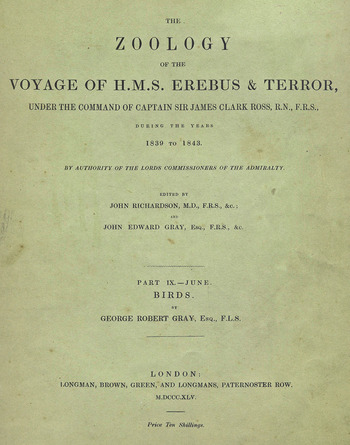
Once the last part was issued, along with title and contents leaves for the 2 volumes provided in the last 2 parts (Quaritch, Reference Quaritch1877), subscribers and their binders typically disbound the parts, discarded the original printed wrappers and tissue paper guards, and arranged the texts and plates (many spread incoherently across the parts) in their correct sequences, thereby inadvertently destroying evidence as to how the original parts were produced (Fig. 4 is an example of a Longman front wrapper). The 18 Longman parts in original state became the exquisite rarities they are today; and among the 6 Janson parts, only the crustaceans and molluscs are encountered with any regularity. Most extant bound volumes not only lack the original wrappers but are also defective due to missing parts, texts, or plates, or they contain reproductions. Likely explanations are the lengthy first 1844−1848 publication period, then the long gulf until 1874−1875, loss of subscribers, and/or dispersal of parts or plates to accommodate specialised scientists. Two-volume sets with complete texts and all the plates in the original state are very rare.
Longman et al, Part IX front wrapper, Birds.

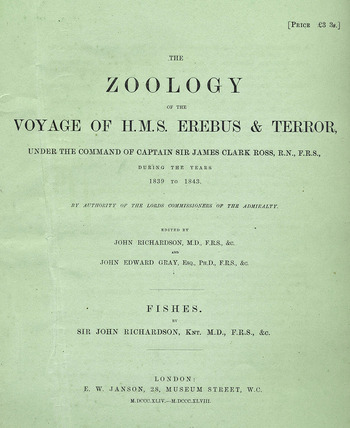
Janson contemporarily reissued the entire fishes, birds and insects from Longman remainders. The fishes, with all the texts and plates, were laid loosely in a newly printed wrapper with Janson’s imprint backdated to the Longman period (Fig. 5). He did similarly with the birds in a newly printed wrapper or reused his wrapper from the last birds part. Whereas all the bird plates were coloured during the original Longman period by master colourists (including the unissued plates that would be integral to the last part issued by Janson), Janson’s reissue contained largely uncoloured remainders. Occasional examples contained original coloured plates or were inartistically coloured by unknown painters; these are distinguishable by the knowing eye. Janson combined his second part of the insects together with the first Longman part, issuing them together with his own binding and backdating the cover and title leaf; he also extracted the lepidoptera for separate publication. These reissues are not exactly rare, but they are distinctly scarce. Janson’s backdating and applying his own imprint to Longman era materials in these reissues as well as to the title leaves of the collated two volumes created a bewildering challenge to future bibliographers. Despite Janson’s significant contribution by completing the Zoology, he regrettably disregarded Longman by imprinting only his own name.
E. W. Janson, Fishes reissue front wrapper, backdated.

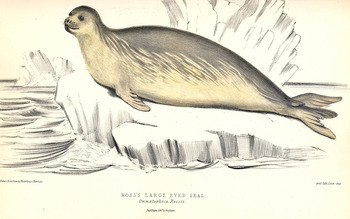
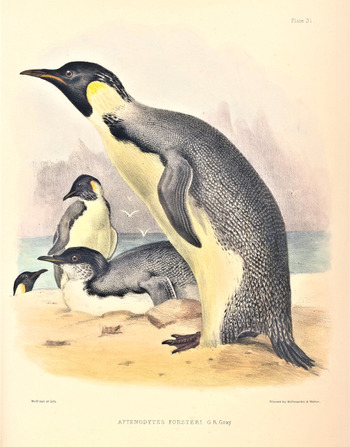
The Zoology contains some work from other expeditions and voyages (Fogg, Reference Fogg1992), but as a whole it is a remarkable achievement comprising landmark observations. These include the marine mammals with the first description of the Ross seal (Fig. 6), the first illustration of the emperor penguin (Fig. 7), the first substantial avifauna of New Zealand, newly described reptiles from Australia and New Zealand, and the first Antarctic fishes including elasmobranchs. The stone engravings throughout the work were beautifully executed (Fig. 8 is an example) as were the colourations. Many fine lithographers of the day were involved including Benjamin Waterhouse Hawkins (1801−1894), William Day (1797−1845), Louis Haghe (1806−1885), David William Mitchell (1813−1859), Charles Joseph Hullmandel (1789−1850), George Henry Ford (1809−1876), William Wing (1827−1855) and Joseph Wolf (1820−1899).
Ross seal, Ommatophoca rossii. Beast. Pl. VII.

Emperor penguin, Aptenodytes forsteri. Plate 31.

Giant bully, Eleotris (now Gobiomorphus) gobioides. Fish. Plate 2. (part).

Ross had kept possession of some of the marine invertebrate collections and intended to write the reports himself but never did, and the neglected specimens were eventually ruined (Ross, Reference Ross1982; Fogg, Reference Fogg1992). Ross’s preoccupations included 4 years writing the official expedition narrative, the demands of new married life, four children, the loss of two close friends Sir John Franklin and Francis Crozier in the Northwest Passage, then his profound grief following the untimely death of his beloved wife, and finally his own decline (Ross, 1982 and Reference Ross1994).
My primary intention herein has been to unravel the conundrum of the 24 original Zoology parts and the reissues, and as a secondary intention to provide a fuller background history of the Zoology as set out in the foregoing paragraphs. I sought parts and reissues in original state by searching WorldCat, copac.ac.uk, google.com, and institutional library catalogues; and querying antiquarian booksellers specialising in Antarctic voyages and natural history, and numerous collectors of Antarctic publications. In the following pages I describe the bibliographical results—the contents of each part, the Janson reissues, and the final 2-volume collation, all based on first-hand examinations. I acknowledge some weaknesses of this study: I have examined all the wrappers but was unable to locate a complete example of Part XXIII, and I examined some parts only as a single copy, which confirms after such an extensive search their extreme rarity. Thus, addenda and corrections are surely possible in the future, if not probable. Despite the limitations, this report is the most comprehensive and descriptive of this complex work to date.
John Richardson and John Edward Gray, editors. THE ZOOLOGY OF THE VOYAGE OF H.M.S. EREBUS AND TERROR, UNDER THE COMMAND OF CAPTAIN SIR JAMES CLARK ROSS, R.N., F.R.S., DURING THE YEARS 1839 TO 1843.
Part I. [Summary of the Voyage; and Mammalia, 1st of 6 parts.] London: Longman, Brown, Green, and Longmans, [June] 1844. [Joseph Dalton Hooker. SUMMARY OF THE VOYAGE.] 4° [b on p. v]. pp. v-xii; hand-coloured lithographed map “Chart of the South Circumpolar Regions”.
John Edward Gray. MAMMALIA. [B on p. 1.] pp. 1−4; 10 plates [4 uncoloured, 6 coloured].

Comment: Hooker’s SUMMARY OF THE VOYAGE with the chart did double duty for the Zoology and Flora Antarctica. The wrapper mentions neither SUMMARY OF THE VOYAGE nor publication month. “Part I” appears above MAMMALIA. Plates imprinted at lower left “Drawn from Nature & on Stone by Waterhouse Hawkins.” (plates III, V-VIII, X), or “Drawn from Nature and on Stone by Waterhouse Hawkins.” (plates IV, IX, XIV, XVI). All plates imprinted at lower right “pre. lith. Linn. imp.”; some additionally imprinted at low centre or lower right “Day & Haghe, lith.rs to the Queen.” (plates III, V-VIII, X, XIV). The plates all concern seals; the four skull plates are uncoloured. (The remaining four seal plates I, II, XV and XVII appeared in Part IV.) Price 10s [£0.50].
The Mammalia section was issued across Parts I, IV, XIII-XV, and XXIII and subdivided into three topics:
-
I.—THE SEALS OF THE SOUTHERN HEMISPHERE. pp. 1−12; “Beasts” plates I-X, XIV-XVII (plate IV lacks “Beasts”).
-
II.—MISCELLANEA. Concerning terrestrial mammals. pp. 12a-12d; “Beasts” plates XVIII, 19−22, 25−29.
-
ON THE CETACEOUS ANIMALS. pp. 13−53; Plates 1−30, “Tab” plates 31−32, 32bis, 33−37, and one plate unnumbered (Balaena antipodarum).
-
Note: “Beasts” plates XI, XII, XIII, 23 and 24 are non-existent.
References: Universitätsbibliothek Leipzig complete copy with wrapper examined (OCLC 753352552). Evenhuis states publication occurred on 1 June. Questionable: Evenhuis gave pp. 1−8 and plates 1−10, and cited Muquardt’s Monthly Circular (1 July 1844, n.s. 24:94) giving pp. 16, 16 plates.
Part II. [Fishes, 1st of 7 parts.] John Richardson. FISHES. London: Longman, Brown, Green, and Longmans, August 1844. 4° [B on p. 1, B2 on p. 3, C on p. 9, C2 on p. 11]. pp. 1−16; 10 plates [uncoloured].

Comment: “No. II.]” printed at top left of front cover. “Part II.” printed above “FISHES.” These are redundant. All plates imprinted at lower left “Drawn on Stone by W. Mitchell.” Plates imprinted at lower right “Printed by C. Hullmandel.” (plates 1−4, 6−7), or “Printed by C. Hullmandel & Walton.” (plates 5, 8−10). Price 10s [£0.50].
The Fishes section was spread across Parts II, V, VII, XII, XVI, and XVII-XVIII without text subdivisions.
References: Universitätsbibliothek Leipzig complete copy with wrapper examined (OCLC 753351087). Woodward and Sherborn both report pp. 1−16 for 1844. Questionable: Evenhuis reported July 1844 from an 1899 Quaritch catalogue but had not seen the wrapper.
Part III. [Birds, 1st of 5 parts.] George Robert Gray. BIRDS. London: Longman, Brown, Green, and Longmans, October 1844. [B on p. 1.] pp. 1−4 (1st state*); 8 plates [coloured].
*Ending on pp. 1 and 4 with “description and drawings.” and “from Chatham Island.”, respectively. This first state of pp. 1−4 is quite rare because it was to be discarded when the second extensively revised state was issued in Part VIII.

Comment: George Robert Gray (1808−1872) was head ornithologist of the British Museum and younger brother of editor John Edward Gray. “[No. III.]” printed at top left of front cover. “Part III.” additionally printed above “BIRDS.” One of these is redundant. The rear wrapper of Part II had noted that Part III would appear on 1 October [1844]. All plates bear the imprint at lower right “C. Hullmandel’s Patent Lithotint.” Price 10s [£0.50]. Of passing interest, the first published account of Antarctic birds observed during the voyage was authored by Robert McCormick while the voyage was still in progress, “A sketch of the Antarctic regions embracing a few passing remarks geological and ornithological.” Tasmanian Journal of Natural Science 1842; 1: 241−247.
The Birds section was spread across Parts III, VIII, IX, X and XXII and subdivided into two sections.
I.—BIRDS OF NEW ZEALAND. Parts III, VIII, IX and X.
APPENDIX. Part XXII. Additional information on the New Zealand avifauna.
Note: Plates 12 and 22 are non-existent.
References: Examined in original state including the wrapper. The Universitätbibliothek Leipzig records an identical copy. Mathews (Reference Mathews1938) notes a copy reported to him with the same collation and detailed differences between the two states. Rosove (Reference Rosove2008) 270−4.A1A. Questionable: Mathews (Reference Mathews1930) stated two forms of Part III, each containing a different state of pp. 1−4 while giving pp. 1−8 for both and not specifying plates. Evenhuis reported seeing only the wrapper and repeated Mathews (Reference Mathews1930). Sherborn gave pp. 1−8 for 1844.
Part IV. [Mammals, 2nd of 6 parts.] John Edward Gray. BEASTS. London: Longman, Brown, Green, and Longmans, December 1844. 4° [C on p. 5]. pp. 5−8; 10 plates [3 uncoloured, 7 coloured].

Comment: “No. IV.]” printed at top left of front cover. “Part IV.” printed above “BEASTS.” One of these was unnecessary. The rear wrapper of Part III noted, “No. IV., MAMMALIA, by John Edward Gray, Esq., will appear on the 1st of December.” Plates listed in the sequence found in the Universitätsbibliothek Leipzig copy. Plates imprinted at lower left “Willis. Lith.” (plate I), “), “B. W. Hawkins, del. & lithog.” (plate II), “Drawn from Nature & on Stone by Waterhouse Hawkins.” (plateXVII), “Drawn from Nature and on Stone by Waterhouse Hawkins.” (plate XV) or “From Nature and on Stone by B. Waterhouse Hawkins.: (plates 19−21, 25). Plates imprinted at lower right “Willis. Lith.” (plate I), or “Day & Haghe, lith.rs to the Queen.” (plates II, XV, XVII, XVIII), or “pre. lith. Linn. imp.” (plates 19−21, 25). Plate 22 has no imprints. “Beasts” plates II, XV, XVII, and I are the last 4 seal plates; the 3 skull plates are uncoloured. “Beasts” plates XVIII, 19−22, and 25 are 6 of the 10 plates illustrating MISCELLANEA, the remaining 4 being “Beasts” plates 26−29, which, along with the MISCELLANEA text (pp. 12a-12d) did not appear until Part XXIII. Price 10s [£0.50].
References: Universitätsbibliothek Leipzig complete copy with wrapper examined (OCLC 753350744). Questionable: Rosove (Reference Rosove2001) 270−1.A1. Woodward gave pp. 1−8, plates 1−10, and assigned plates 14−17 to Part XXIII. Evenhuis gave pp. 13−53, plates 1−37, based on the Natural History Museum Library of London. Sherborn gave pp. 1−8 for 1844.
Part V. [Fishes, 2nd of 7 parts.] John Richardson. FISHES. London: Longman, Brown, Green, and Longmans, January 1845. 4° [D on p. 17, D2 on p. 19, E on p. 25, E2 on p. 27]. pp. 17−32; 10 plates [uncoloured].

Comment: “Part V.—January.” indicated above “FISHES.” Plates listed in sequence according to the Universitätsbibliothek Leipzig copy. All plates imprinted at lower left “Drawn on Stone by W. Mitchell.” Plates imprinted at lower right “.” Plates listed in sequence according to the Universitätsbibliothek Leipzig copy. All plates imprinted at lower left “Drawn on Stone by W. Mitchell.” Plates imprinted at lower right “Hullmandel & Walton Lithographers.” (plates XI-XII), “Printed by Hullmandel & Walton.” (plates 13, 15−18, XIX, 20), “Hullmandel & Walton Printers.” (plate 14), or C. Hullmandel’s Patent Lithotint.” Price 10s [£0.50].
References: Universitätsbibliothek Leipzig complete copy with wrapper examined (OCLC 753351147). Evenhuis reports pp. 17−32, plates 11−20.
Part VI. [Reptiles, 1st of 2 parts.] John Edward Gray. REPTILES. London: Longman, Brown, Green, and Longmans, February 1845. 4° [B on p. 1]. pp. 1−8; 10 plates [uncoloured].

Comment: “Part VI.—February.” indicated above “REPTILES.” Plates imprinted at lower left “Ford del et lith” (plate 9) or “J. Ford del.” (plate 20). Plates imprinted at lower right “Day & Haghe, lith.rs to the Queen.” (plate 9) or “C. Hullmandel’s Patent Lithotint.” (plate 20). Other plates without imprint. The plate number indication “Rept. Plate 20.” is very lightly inked and easily missed. Price 10s [£0.50]. An issue exists with photolithograph plates on glossy paper, likely reprinted in 1875 to produce a complete reptiles when the original plates were exhausted and the stones effaced. New lithographic plates would have been expensive, so photolithographs were produced instead (Gray and Günther, editor Kraig Adler, p. ii).
The Reptiles section was spread across Parts VI and XXIV and subdivided into two sections.
I. —THE REPTILES OF AUSTRALIA. Part VI.
A LIST OF THE SAURIANS OF AUSTRALIA AND NEW ZEALAND. Part XXIV.
References: Examined in original state including the wrapper. Complete copies examined with wrappers at the Universitätsbibliothek Leipzig (OCLC 753352846) and Universitäts und Landesbibliothek Bonn. Rosove (Reference Rosove2001) 270−6.A1. Gray and Günther (editor Kraig Adler, p. ii) notes the same plates present in a copy in his own collection. Evenhuis reports seeing the wrapper. Sherborn gives pp. 1−8 for 1845. Questionable: Woodward gave pp. 1−8, plates 1−4, 7, 9. Evenhuis gave plates 1−4, 8, 9.
Part VII. [Fishes, 3rd of 7 parts.] John Richardson. FISHES. London: Longman, Brown, Green, and Longmans, March 1845. 4° [F on p. 33, F2 on p. 35, G on p. 41, G2 on p. 43, H on p. 49]. pp. 33−52; 10 plates [uncoloured].

Comment: “Part VII.—March.” indicated above “FISHES.” All plates imprinted at lower left “Drawn on Stone by W. Mitchell.” Plates imprinted at lower right “Hullmandel & Walton Lithographers.” (plates 22, 24−25), “Printed by Hullmandel & Walton.” (plate 26), or “C. Hullmandel’s Patent Lithotint.” (plates 21, 23). Price 10s [£0.50].
References: Universitätsbibliothek Leipzig complete copy with wrapper examined (OCLC 753351303). Questionable: Evenhuis had not seen the wrapper but “interpolated” a probable date of April 1845 and gave only plates 24, 28, 34 and 38. Woodward and Sherborn gave pp. 17−52 for 1845, presumably combining Parts V and VII.
Part VIII. [Birds, 2nd of 5 parts.] George Robert Gray. BIRDS. London: Longman, Brown, Green, and Longmans, April 1845. 4° [B on p. 1, B2 on p. 3]. pp. 1−8 (2nd state of pp. 1−4*); 7 plates [coloured].
*Ending on pp. 1 and 4 with “dashes of brown.” and “the throat,”, respectively.

Comment: “Part VIII.—April.” printed above “BIRDS.” pp. 1−4 were to replace pp. 1−4 of Part III. pp. 5−8 were new. All plates imprinted at lower right “C. Hullmandel’s Patent Lithotint.” Price 10s [£0.50]. The iris of the New Zealand Dabchick (Pl. 19) should be yellow-buff instead of red.
References: Examined in original state including the wrapper. Rosove (Reference Rosove2008) 270−4.A1B. Mathews (Reference Mathews1938) states pp. 1−4 of Part III were cancelled and herein replaced, and the same text and plates as above. Evenhuis reports seeing the wrapper and combined text pages and plates from Parts VIII, IX and X as he did not see original parts.
Part IX. [Birds, 3rd of 5 parts.] George Robert Gray. BIRDS. London: Longman, Brown, Green, and Longmans, June 1845. 4° [C on p. 9, C2 on p. 11]. pp. 9−16; 7 plates [coloured].

Comment: “Part IX.—June.” printed above “BIRDS.” All plates imprinted at lower right “C.Hullmandel’s Patent Lithotint.” Price 10s [£0.50]. All species are or have been New Zealand breeders.
References: Examined in original state including the wrapper. The Universitätbibliothek Leipzig records a copy, pp. 9−16, 7 plates. Rosove (Reference Rosove2008) 270−4.A1C. Mathews (Reference Mathews1930) reports the same text pages. Mathews (Reference Mathews1938) reports the same plates. Evenhuis reports seeing the wrapper.
Part X. [Birds, 4th of 5 parts.] George Robert Gray. BIRDS. London: Longman, Brown, Green, and Longmans, October 1845. 4° [D on p. 17]. pp. 17−20; 7 plates [coloured].

Comment: “Part X.—October.” printed above “BIRDS.” All plates imprinted at lower right “C. Hullmandel’s Patent Lithotint.” Price 10s [£0.50].
References: Universitätsbibliothek Leipzig complete copy with wrapper examined (OCLC 753350623). Rosove (Reference Rosove2008) 270−4.A1D. Mathews (Reference Mathews1930, Reference Mathews1938) twice confirms the collation above. Evenhuis gives pp. 17−20. Questionable: Mathews (Reference Mathews1930) gave the date as June 1845. Sherborn gave pp. 9−20 for 1845, presumably combining Parts IX and X.
Part XI. [Insects, 1st of 2 parts.] Adam White. INSECTS. London: Longman, Brown, Green, and Longmans, April 1846. 2° [B on p. 1, C on p. 5 … G on p. 21]. pp. 1−24; 6 plates [uncoloured].

Comment: Adam White (1817−1878) of the British Museum was a zoologist with specialties in arachnids, insects and crustaceans. Plates imprinted at lower left “Drawn on Stone by W. Wing” (plates 1−2), “Drawn on Stone by W. Wing” (plate 3), or “W. Wing lithotint” (plates 4−6). Plates imprinted at lower right “C. Hullmandel’s Patent Lithotint” (plates 1−3) or “C. Hullmandel’s Patent” (plates 4−6). Price 10s [£0.50].
The Insects section was spread across Parts XI and XIX under one heading.
I. —INSECTS OF NEW ZEALAND.
References: Examined in original state including the wrapper. Rosove (Reference Rosove2001) 270−10.A1. Evenhuis gives the same collation and discusses authorship and seeing the wrapper. Sherborn, and copies reported at the Royal Toronto Museum, Universitätsbibliothek Leipzig, Museum-Bibliotheque d’Entomologies Paris, Universitäts und Landesbibliothek Bonn, and the Nautral History Museum Library of London all state pp. 24, 6 plates.
Part XII. [Fishes, 4th of 7 parts.] John Richardson. FISHES. London: Longman, Brown, Green, and Longmans, May 1846. 2° [I on p. 53, K on p. 57, L on p. 61, M on p. 65, N on p. 69]. pp. 53−72; 10 plates [uncoloured].

Comment: “Part XII.—May.” indicated above “FISHES.” All plates imprinted at lower left “Drawn on Stone by W. Mitchell.” All plates imprinted at lower right “Hullmandel & Walton Lithographers.” Price 10s [£0.50].
References: Universitätsbibliothek Leipzig complete copy with wrapper examined (OCLC 753351432). Rosove (Reference Rosove2001) 270−8.A1a (wrapper only). Evenhuis gives a photograph of the front wrapper. Woodward, Sherborn, and Evenhuis give pp. 53−74, presumably including the final blank page.
Parts XIII, XIV, and XV [issued together]. [Mammals, 3rd, 4th, and 5th of 6 parts.] John Edward Gray. MAMMALIA. London: Longman, Brown, Green, and Longmans, August 1846. 2° [E on p. 13, F on p. 17 … P on p. 53]. pp. 13−53, (1); 30 plates [uncoloured].

Comment: “Nos. XIII. XIV. XV.]” printed on the wrapper at upper left. “Parts (III. IV. V.)” above “MAMMALIA” probably refers to these parts of the mammals section. Plates imprinted at lower left “W. Wing del et lith.” (plates 1−2, 7−9, 11−30), “W. Wing lith.” (plates 3−6, 10), or “Blainville del” (plate 5). Additional imprints: “R Ball del” in quasi-manuscript (plate 3), “Luhamel del.” (plate 5). Plates imprinted at lower right “Hullmandel & Walton Lithographers.” (plates 1−30). Plates 1−30 are 30 of 39 cetacean plates (plus the unnumbered Balaena Antipodarum) and are designated “Plate”. Price £1 10s [£1.50].
References: Universitätsbibliothek Leipzig complete copy with wrapper examined (OCLC 753352738). A copy in the Balfour & Newton Libraries, Dept. of Zoology, University of Cambridge, provenance of the cetacean collection of John Willis Clark (1833−1910), lacks the front wrapper, but otherwise pp. 13−53, 30 plates (plates 1−30, without Balaena Antipodarum). The Museum of New Zealand, Te Aka Matua Library, reports a copy with pp. 13−53, 30 plates (OCLC 155680162). Sherborn reports pp. 13−54 for 1846, presumably including the final blank page. Questionable: Woodward reported pp. 13−53, 37 plates and did not give the part number(s). The Natural History Museum Library of London gave pp. 13−53, 37 plates. Evenhuis gave 1846 without the month, pp. 13−53, plates 1−37, and that Muquart’s Monthly Catalog stated this is a reprint.
Part. XVI. [Fishes, 5th of 7 parts.] John Richardson. FISHES. London: Longman, Brown, Green, and Longmans, May 1847. 4° [O on p. 73, O2 on p. 75, P on p. 81, P2 on p. 83, Q on p. 89, Q2 on p. 91]. pp. 73−96; 10 plates [uncoloured].

Comment: “No. XVI.]” on front cover at upper left. “Part (VI).” above “FISHES.” Likely this meant the part of the Fishes, but it is misnumbered and should have been “Part (V).” All plates imprinted at lower left “Drawn on Stone by W. Mitchell.” All plates imprinted at lower right “Hullmandel & Walton Lithographers.” Price 10s [£0.50].
References: Universitätsbibliothek Leipzig complete copy with wrapper examined (OCLC 753351211). Evenhuis (Reference Evenhuis2015) reports seeing the wrapper and gives May 1847.
Parts XVII and XVIII [issued together]. [Fishes, 6th and 7th of 7 parts.] John Richardson. FISHES. London: Longman, Brown, Green, and Longmans, February 1848. 4° [R on p. 97, R2 on p. 99, S on p. 105, S2 on p. 107, T on p. 113, T2 on p. 115, U on p. 121 U2 on p. 123, X on p. 129, X2 on p. 131, Y on p. 137 (p. 139 unmarked)]. pp. 97−139, (1); 10 plates [uncoloured]. [b on p. v] pp. i-viii.

Comment: “Nos. XVII. & XVIII.]” printed on front cover at top left. “Part (VII).” printed above “FISHES.” This likely refers to the part of the Fishes but is misnumbered and should have been “Parts (VI, VII).” pp. i-viii are the “Ichthyology” fly title (p. ii blank) bearing the publication date 1844−1848 without imprint, and “Methodical list of species” and addenda (pp. iii-viii). All plates imprinted at lower left “Drawn on Stone by W. Mitchell.” All plates imprinted at lower right “Hullmandel & Walton Lithographers.” Price £1.
References: Universitätsbibliothek Leipzig complete copy with wrapper examined (OCLC 753351366). Woodward notes the inclusion of pp. i-viii. Evenhuis provides a photograph of the front wrapper. Questionable: Woodward and Sherborn both gave pp. 75−139 for 1848, likely combining Parts XVI and XVII/XVIII. Evenhuis gave pp. 75−139.
Part XIX. [Insects, 2nd of 2 parts.] Arthur Gardiner Butler. INSECTS. London: E. W. Janson, June 1874. 2° [H on p. 25, I on p. 29 … O on p. 49]. pp. (2), i, (1) [fly-title leaf], 25−51, (3); 4 plates [uncoloured].

Comment: Arthur Gardiner Butler (1844−1925) was Assistant Keeper of the Department of Zoology at the British Museum and completed the insect work Adam Smith had initiated as Part XI. “No. XIX” on front cover at upper left. “[Price 10s” on front cover at upper right. “INSECTS. (Conclusion.)” on the wrapper. Plates imprinted at lower left “William Wing del et lith” (plate 7). Plates imprinted at lower right “Hullmandel & Walton Lithographers” (plate 7) or “Hullmandel & Walton’s Patent Litho Tint” (plates 8−10). Price 10s [£0.50].
References: Examined copies in original state including the wrapper. Rosove (Reference Rosove2001) 270−11.A1. Evenhuis gives the same.
Part XX. [Crustaceans, only part.] Edward J. Miers. CRUSTACEA. London: E. W. Janson, June 1874. [No signature markings.] pp. (2), i, (1) [fly-title leaf], (2), 1−5, (3); 4 plates [uncoloured].

Comment: Edward John Miers (1851−1930) had recently become curator of the crustacean collections at the Natural History Museum, London, amanuensis to J. E. Gray. “No. XX.]” printed on front cover at upper left. “CRUSTACEA.” on the wrapper. Plates imprinted at lower left “William Wing del et lith.” and at lower right “Hullmandel & Walton Lithographers.” With or without a blank leaf following the title leaf. Price 10s [£0.50]. The plates were produced years before the text, thus nomenclatures are not in agreement (see p. 1). J. E. Gray was to have written the text but handed it off during the Longman period to Adam White who left it incomplete; Edward Miers finished it during the Janson period. The binding materials and style, and the rear cover advertisements on the “Crustacea” and “Mollusca” issues and the combined “Insects” reissue are the same.
References: Examined in original state including the printed boards. Rosove (Reference Rosove2001) 270−9.A1. Evenhuis gives the same collation.
Part XXI. [Mollusks, only part.] Edgar A. Smith. MOLLUSCA. London: E. W. Janson, June 1874. [No signature markings.] pp. (2), i, (1) [fly-title leaf], (2), 1−7, (3); 4 plates [uncoloured].

Comment: Edgar Albert Smith (1847−1916) was in charge of the mollusc collections at the British Museum and was later Assistant Keeper of the Department of Zoology. “No. XXI.] printed on front cover at upper left. “MOLLUSCA.” on the wrapper. Plates imprinted at lower right “” on the wrapper. Plates imprinted at lower right “Hullmandel & Walton’s Patent Litho Tint.” With or without a blank leaf following the title leaf. Price 10s [£0.50].
“
References: Examined copies in original state including the printed boards. Rosove (Reference Rosove2001) 270−12.A1. Evenhuis gives the same collation and reports seeing the front cover.
Part XXII. [Birds, 5th of 5 parts.] R. Bowdler Sharpe. BIRDS. London: E. W. Janson, April 1875. 4° [E on p. 21, F on p. 29, G on p. 37]. pp. 21−39, (1); 8 plates [coloured].

Comment: Richard Bowdler Sharpe (1847−1909) was an acclaimed ornithologist, curator of the bird collections and Senior Assistant in the Department of Zoology at the British Museum, later Assistant Keeper. “No. XXII.]” printed at upper left of front wrapper. “BIRDS. (Conclusion.)” on the wrapper. pp. 21−39, authored by Bowdler Sharp and titled “APPENDIX” on p. 21, is further discussion of the New Zealand birds. The typeface of pp. 1−20 produced by Longman differs; coupled with the break in signature sequencing, it is clear Janson printed pp. 21−39. Plates imprinted at lower left “Wolf del et lith.” (plates 1, 7, 20*, 27, 31, and 32). All plates imprinted at lower right “Printed by Hullmandel & Walton”. Price 10s [£0.50].
References: Examined copies in original state including the wrapper. Rosove (Reference Rosove2001) 270−5.A1. Woodward, Mathews (Reference Mathews1930), Evenhuis, and the Natural History Museum Library of London report the same collation.
Part XXIII. [Mammals, 6th of 6 parts.] John Edward Gray. MAMMALIA. London: E. W. Janson, May 1875. 4° [D on p. 9, Da on p. 12a]. pp. 9−12, 12a-12d; 13 plates [9 uncoloured, 4 coloured].

Comment: “No. XXIII]” on the front wrapper at upper left. “[Price “ at upper right, with no price given. “MAMMALIA. (Conclusion.)” on the wrapper. The text of MISCELLANEA concerning the terrestrial mammals was a late addition, hence the pagination (pp. 12a-12d). Plates are imprinted at lower left “Drawn from Nature and on Stone by B. Waterhouse Hawkins.” (plates 26−27), “From Nature and on Stone by B. Waterhouse Hawkins.”(plates 28−29), “W. Wing del et lith.” (plates 31−32, 33−37), or “B.W. Hawkins del.” (plate 32bis). Plates imprinted at lower right “Printed by Reeve Brothers.” (plates 26−29), or “), or “Hullmandel & Walton. Lithographers.” (plates 31−32, 32bis, 33−37). The four “Beasts” plates are coloured; the others are not. Balaena antipodarum bears no imprints.
References: Wrapper examined. No original example seen. Quaritch (Reference Quaritch1877) advertised for sale all the original Janson parts (Parts XIX−XXIV) and for Part XXIII reported four coloured and eight uncoloured plates, and the title and contents leaves for the eventual vol. I of collated parts. The plates listed above are the remaining 12 plates not accounted for in Parts I, IV and XIII−XV; the number of coloured and uncoloured plates conform to Quaritch’s listing. The unnumbered Balaena Antipodarum plate is an outlier; however; it was produced differently (embossed) and has no imprints. In which part it was issued remains speculative. Questionable: Rosove (Reference Rosove2001) 270−2.A1. Woodward reported plates 18−28. Evenhuis reported plates 14−17, 18−28.
Part XXIV. [Reptiles, 2nd of 2 parts.] Albert Günther. REPTILES. London: E. W. Janson, June 1875. 4° [C on p. 9, C2 on p. 13, D on p. 17]. pp. 9−19, (1); 10 plates [uncoloured].

Comment: Albert Günther (1830−1914) was associated with the British Museum, a renowned reptile taxonomist, with additional specialties in the fishes and amphibians. He became Keeper of Zoology at the Natural History Museum, London, upon the death of J. E. Gray. “A List of the Saurians of Australia and New Zealand.” heads p. 9. Plates imprinted at lower left “G. H. Ford” (plate 6) or “Ford del et lith (plate 11). Plates imprinted at lower right ‘Mintern Bros. imp.’ (plate 6), Hullmandel & Walton Litho” (plates 7, 15−19), or “Day & Haghe, lith.rs to the Queen.” (plate 11). Plate 10 lacks an imprint. Compared to the first part of Reptiles, the text paper is thinner and the plate captions are in smaller type. (Plate 20, issued in Part VI, is also in smaller type.) John Edward Gray, under his full name, published a monograph out of series, “The Lizards of Australia and New Zealand in the Collection of the British Museum (With 18 Plates of the New Species, by Mr. Ford.)” (London: Bernard Quaritch, Piccadilly, 1867) with a new 8-page text, the 10 plates of the 1845 issue, plus the first appearances of plates 7, 10−11, and 15−19. Plates 5 and 6 had to be omitted because the stones had been effaced; but when the proofs were rediscovered, the images were re-lithographed by the original artist for Part XXIV (Gray and Günther, Reference Gray and Günther1995).
The reptiles were published in a modern edition: John E. Gray and Albert Günther. The Lizards of Australia and New Zealand. Ithaca, New York: Society for the Study of Amphibians and Reptiles, 1 June 1995. Printed and bound by Thomson-Shore, Dexter, Michigan. Facsimile Reprints in Herpetology series. 28.6 cm. Green cloth, spine lettered in gilt, grey endpapers. pp. viii, 19, (1) [1st and 2nd parts], 8 [1867 part], 40 [unnumbered; 20 plates], 4 [advertisements]. This is a combined facsimile reprint of the Part VI, 1867 out-of-series, and Part XXIV publications, 1,000 copies, additionally 500 sets of plates without text, published in cooperation with the Australasian Affiliation of Herpetological Societies, with a series editor’s note by Kraig Adler and introduction by Glenn M. Shea, Department of Veterinary Anatomy, University of Sydney. ISBN 0916984346.
References: Examined in original state including the wrapper, without the laid-in title and contents leaves for the eventual vol. II of collated parts called for by Quaritch (Reference Quaritch1877). Rosove (Reference Rosove2001) 270−7.A1. Quaritch reports 10 uncoloured plates. Gray and Günther (editor Kraig Adler, p. ii), note the same plates in a copy in the library of the Zoological Society of London. Questionable: The Natural History Museum Library of London gave pp. 9−19, plates 5−7, 10−20. Evenhuis reported seeing the wrapper only, gave the date as February 1875, and plates 5−7, 10−20.
The E. W. Janson Combined Reissues of 1874 − 1875.
[Fishes reissue.] John Richardson. FISHES. London: E. W. Janson, 1844−1848. Greenish printed wrappers, text gatherings and plates loose, uncut. pp. viii, 139, (1); 60 plates [uncoloured].
Comment: Sir John Richardson was England’s leading authority on fishes; his Fishes is distinguished as one of the most important zoological studies from the classical era of Antarctic exploration even though many of the specimens had deteriorated due to adverse conditions of their preservation (M. J. Ross, Reference Ross1982). Original Longman remainder text gatherings and plates were reissued by Janson in 1875, the wrapper backdated to 1844−1848 and bearing only the Janson imprint. Price £3 3s [£3.15] (£365 today).
References: Examined copies in original state including the wrapper. Rosove (Reference Rosove2001) 270−8.A1b and c.
[Birds reissue.] George Robert Gray and R. Bowdler Sharpe. BIRDS. London: E. W. Janson, 1846−1875. Greenish printed wrappers, complete text and plates loose. pp. i, (1) [title leaf], 1−4 (2nd, corrected state), 5−20; “APPENDIX.” pp. 21−39, (1); 37 plates [uncoloured].
Comment: Two kinds of wrappers used, either a newly printed one, or the same as that of Part XXII. The title leaf is backdated 1846−1875 (misdated, 1846 should be 1844) with only the Janson imprint. With the second state of pp. 1−4 and all 37 plates of the original 5 parts. Examples of this late issue with plates inartistically coloured should not be confused with the exacting colouration of the originals. The price 10s [£0.50] on the wrapper is the price for Part XXII—the price for the entire reissue was not indicated, but Quaritch stated £3 3s [£3.15] for a colourised issue (£365 today); unknown whether the colouration was original.
References: Examined uncoloured copies in original state including either wrapper, and also copies with original colourised or later colourised plates. Rosove (Reference Rosove2001) 270−4/5.A1.
[Insects reissue.] Adam White and Arthur Gardiner Butler. INSECTS. London: E. W. Janson, 1846−1874. Quarter dark green cloth, greenish printed stiff wrappers. pp. (2), i, (1) [title leaf], 51, (3); 10 plates [uncoloured].
Comment: A reissue of the 1846 Longmans Part XI remainders combined with the 1874 Janson Part XIX. Printed front board backdated with only the Janson imprint. Price 21s [£1.05] (£122 today).
References: Examined copies in original state including the printed boards. Rosove (Reference Rosove2001) 270−10/11.A1. Evenhuis gives a photograph of the front cover.
[Lepidoptera, offprinted from the Insects.] Arthur Gardiner Butler. CATALOGUE OF THE LEPIDOPTERA OF NEW ZEALAND. London: E. W. Janson, June 1874. Quarter red cloth, greenish printed stiff wrappers. 2° [C on p. 3, D on p. 7 … H on p. 23]. pp. [2], i, (1) [title leaf], 25, (3); 3 plates [uncoloured].

Comment: Extracted from “INSECTS.” The text is the same as pp. 28−51 of Part XIX; p. 28 has been reset, becoming pp. 1−2 herein. pp. 29−51 of Part XIX match pp. 3−25 in this offprint. Price not indicated.
References: Examined copies in original state including the printed boards. Rosove (Reference Rosove2001) 270−11.B1. The Natural History Museum Library of London and Zoological Society Library report the same.
The 2-volume completed and collated Zoology.
John Richardson and John Edward Gray, editors. THE ZOOLOGY OF THE VOYAGE OF H.M.S. EREBUS AND TERROR, UNDER THE COMMAND OF CAPTAIN SIR JAMES CLARK ROSS, R.N., F.R.S., DURING THE YEARS 1839 TO 1843. London: E. W. Janson, 1844−1875. 2 vols.
Vol. I. MAMMALIA, BIRDS.
pp. iv [title and contents leaves for vol. I, with the E. W. Janson imprint].
pp. v-xii. “Summary of Voyage”. Hand-coloured lithographed map “Chart of the South Circumpolar Regions. Shewing the Discovery Tracks of Cook, Weddell and Ross. Printed and Published by Reeve Brothers. 1844.” [frontispiece].
“Mammalia”. pp. 1−8, 9−12, 12a-12d, 13−53, (1); 63 plates (“Seals” I-X, XIV-XVII [I, III, V, VII, IX, XIV, XVI hand-coloured], “Miscellanea” XVIII, 19−-22, 25−29 [all hand-coloured], “Balaena antipodarum” [unnumbered], and “Cetacea” 1−30, 31−32, 32bis, 33−37).
“Birds”. (pp. i, (1) [fly-title leaf], 1−4 [2nd, corrected state], 5−20, 21−39, (1); 37 plates (plates 1, 1*, 2−11, 11*, 13−20, 20*, XXI*, 21, 23−35 [all hand-coloured]).
Vol. II. REPTILES, FISHES, CRUSTACEA, INSECTS, MOLLUSCA.
pp. iv [title and contents leaves for vol. II, with the E. W. Janson imprint].
“Reptiles”. pp. 1−8, 9−19; 20 plates (plates 1−20).
“Ichthyology”. pp. viii, 139, (1); 60 plates (plates 1−10, XI-XII, 13−18, XIX, 20−60).
“Crustacea”. pp. i, (1), 5, (1); 4 plates (plates 1−4).
“Insects”. pp. i, (1), 1−24, 25−51, (1); 10 plates (plates 1−10).
“Mollusca” (pp. i, (1), 7, (1); 4 plates (plates 1−3, IV).
Comment: Note: Quaritch (Reference Quaritch1877) stated that the title and contents leaves for vol. I and vol. II were laid in Parts XXIII and XXIV, respectively, and advertised sale of the complete 24 parts for £24 (£2,825 today). Today, 2-volume sets with complete texts and all the plates in the original state are very rare. Imperfect sets are regularly encountered. All known were bound privately.
References: Examined four complete and several incomplete sets. In some, a portion of the original wrappers were bound in.
Acknowledgements
For their valuable assistance, I thank the library staffs at the Scott Polar Research Institute, the Universitätsbibliothek Leipzig, Universitäts und Landesbibliothek Bonn, the Alexander Turnbull Library, and the Zoological Society of London. I am grateful to the peer reviewers and editors for their critical comments.
Conflict of interest
The author declares none.
Financial support
This research received no specific grant from any funding agency, commercial or not-for-profit sectors.