Introduction
ADHD is characterized by core symptoms of inattention, hyperactivity, and impulsivity (American Psychiatric Association, 2013; Barkley, Reference Barkley1997). However, the most dominant feature of ADHD persisting into adulthood is inattention (Mick, Faraone, & Biederman, Reference Mick, Faraone and Biederman2004). It has been suggested that aberrant basic information processing in ADHD patients underlies their symptoms of inattention (Holstein et al., Reference Holstein, Vollenweider, Geye, Csomor, Belser and Eich2013; Olincy et al., Reference Olincy, Ross, Harris, Young, McAndrews and Cawthra2000). Event-related potentials (ERPs) are commonly used as physiological measures of information processing as they are easily measured and non-invasive with high temporal precision (Friedman, Cycowicz, & Gaeta, Reference Friedman, Cycowicz and Gaeta2001; Naatanen & Kahkonen, Reference Naatanen and Kahkonen2009). Mismatch negativity (MMN) is considered to be a reflexive response to the breach of sensory memory patterns, generated in the temporal and frontal cortical brain regions (Alho, Woods, Algazi, Knight, & Naantanen, Reference Alho, Woods, Algazi, Knight and Naantanen1994; Naatanen & Kahkonen, Reference Naatanen and Kahkonen2009; Oknina et al., Reference Oknina, Wild-Wall, Oades, Juran, Röpcke, Pfueller and Chen2005). MMN reflects pre-attentive detection and a subsequent redirection of attention to a stimulus change (Alho et al., Reference Alho, Woods, Algazi, Knight and Naantanen1994; Naatanen & Kahkonen, Reference Naatanen and Kahkonen2009) and is not under conscious control (Naantanen, Reference Naantanen1995; Naatanen & Kahkonen, Reference Naatanen and Kahkonen2009) as such it is often referred to as an automatic orienting response. Generally, a so-called auditory odd-ball paradigm is used to assess MMN, where an occasional deviant sound (the ‘odd-ball’) is presented in a stream of frequently occurring (standard) sounds. In a healthy brain, MMN is a negative deflection in an individual's electroencephalogram (EEG), with maximum amplitude appearing at frontal sites (Naantanen, Reference Naantanen1995), i.e. usually the midline electrodes Fz, FCz, and Cz. MMN is followed by a positive ERP, the P3a amplitude, which maximum usually occurs between approximately 250 and 300 ms after a deviant stimulus. Presumably, the P3a represents an evaluative and more conscious aspect of the orienting reflex (Friedman et al., Reference Friedman, Cycowicz and Gaeta2001). Our paradigm consisted of three types of deviant stimuli, i.e. a frequency, duration, and combined frequency-duration deviant, given that there are many reports in literature indicating differences in MMN and P3a amplitude elicited by these types of deviants between healthy controls (HC) and psychiatric populations.
MMN has been intensively investigated in schizophrenia and found deficient (i.e. decreased compared to HC) from early to late stages of the disease (Javitt, Grochowski, Shelley, & Ritter, Reference Javitt, Grochowski, Shelley and Ritter1998; Light & Braff, Reference Light and Braff2005; Naantanen, Jacobsen, & Winkler, Reference Naantanen, Jacobsen and Winkler2005; Oranje, Aggernaes, Rasmussen, Ebdrup, & Glenthoj, Reference Oranje, Aggernaes, Rasmussen, Ebdrup and Glenthoj2017; Shelley et al., Reference Shelley, Ward, Catts, Michie, Andrews and McConaghy1991), although this appears to be dependent on the type of deviant sound (Todd et al., Reference Todd, Michie, Schall, Karayanidis, Yabe and Naantanen2008). MMN has been proposed as a biomarker candidate for both psychosis and schizophrenia (Light & Naantanen, Reference Light and Naantanen2013; Nagai et al., Reference Nagai, Tada, Kirihara, Araki, Jinde and Kasai2013; Perez, Swerdlow, Braff, Naantanen, & Light, Reference Perez, Swerdlow, Braff, Naantanen and Light2014). Although symptoms of ADHD and schizophrenia differ in many ways, they also share some characteristics, e.g. they are both considered to be neurodevelopmental disorders and from a neurochemical perspective associated with prefrontal dopaminergic hypofunction (Arnsten, Reference Arnsten2009; Howes & Kapur, Reference Howes and Kapur2009). Most individuals with a high risk of psychosis show ADHD symptoms (Corbisiero, Riecher-Rössler, Buchli-Kammermann, & Stieglitz, Reference Corbisiero, Riecher-Rössler, Buchli-Kammermann and Stieglitz2017) which, in addition to the above, brings about the question whether MMN and P3a deficits can also be found in patients with ADHD: Given that patients with ADHD are easily distracted, it could be argued that their response to environmental changes is different from that of HC. It might for instance be that the responses of the patients to standard and deviant stimuli in the MMN paradigm is less pronounced than that of HC, resulting in an equally important perceived environmental change for both types of stimuli, in turn resulting in less MMN and P3a amplitudes.
Methylphenidate (MPH) increases DA signaling in the striatum and prefrontal cortex, where it also increases serotonergic and noradrenergic activity (Lepock et al., Reference Lepock, Mizrahi, Korostil, Bagby, Pang and Kiang2018; Wilens, Reference Wilens2008). Given that there is evidence for involvement of these three neurotransmitter systems in MMN and/or P3a amplitude as well (e.g. Huang, Chen, & Zhang, Reference Huang, Chen and Zhang2015; Kahkonen et al., Reference Kahkonen, Ahveninen, Jaaskelainen, Kaakkola, Naatanen, Huttunen and Pekkonen2001; Polich, Reference Polich2007; Wienberg, Glenthoj, Jensen, & Oranje, Reference Wienberg, Glenthoj, Jensen and Oranje2010), it is important to study these phenomena in ADHD with and without the influence of MPH, preferably in a longitudinal design, so that medication effects can be disentangled from effects of the disorder itself.
MMN and P3a amplitude have to our knowledge not been investigated in adult ADHD patients before. Studies on MMN in children with ADHD have reported contradictory results: While most studies report no deficits in patients with ADHD compared to HC (Gomes, Duff, Flores, & Halperin, Reference Gomes, Duff, Flores and Halperin2013; Huttunen, Halonen, Kaartinen, & Lyytinen, Reference Huttunen, Halonen, Kaartinen and Lyytinen2007; Kemner et al., Reference Kemner, Verbaten, Koelega, Buitelaar, van der Gaag and Camfferman1996; Rothenberger, Banaschewski, Heinrich, & Moll &, Reference Rothenberger, Banaschewski, Heinrich and Moll2000; Rydkjær et al., Reference Rydkjær, Jepsen, Pagsberg, Fagerlund, Glenthoj and Oranje2017; Winsberg, Javitt, & Shanahan, Reference Winsberg, Javitt and Shanahan1997), there are also studies showing (marginally) smaller MMN (Cheng, Chan, Hsieh, & Chen, Reference Cheng, Chan, Hsieh and Chen2016; Huttunen, Kaartinen, Tolvanen, & Lyytinen, Reference Huttunen, Kaartinen, Tolvanen and Lyytinen2008; Oades, Dittrnann-Balcarp, Schepkera, Eggersa, & Zerbm, Reference Oades, Dittrnann-Balcarp, Schepkera, Eggersa and Zerbm1996). A possible explanation for these inconsistent findings could very well be that in the majority of these studies current or previous use of MPH may have masked the effects of ADHD itself. Nevertheless, a recent meta-analysis of MMN in children with ADHD (Cheng et al., Reference Cheng, Chan, Hsieh and Chen2016) has indicated reduced MMN in ADHD children compared to HC.
The present study is to the best of our knowledge the first to investigate the involvement of dopamine on both MMN and P3a amplitude in adult, initially psychostimulant-naïve, ADHD patients without comorb ASD. We previously reported on the influence of a 6-week treatment with MPH on cognition in initially psychostimulant-naïve, adult ADHD patients (Low et al., Reference Low, le Sommer, Vangkilde, Fagerlund, Glenthøj, Sonuga-Barke and Jepsen2018a, Reference Low, Vangkilde, le Sommer, Fagerlund, Glenthøj, Sonuga-Barke and Jepsen2018b). In the present study, we investigated MPH's effect on MMN and the P3a amplitude in this same cohort. Given the literature cited above, we expected decreased MMN and P3a amplitude in patients compared to HC at baseline, while treatment with MPH would ameliorate both deficits.
Methodology
All procedures contributing to this work comply with the ethical standards of the relevant national and institutional committees on human experimentation and with the Helsinki Declaration of 1975, as revised in 2008. This study was approved by the Ethical Committee of the Capital Region Copenhagen (Registration: H-15001438), and the data protection agency (Registration: RHP-2015-007, 03620). The study was part of a larger project: ‘Attention to Dopamine: From Psychological Functions to Molecular Mechanisms’. Written and oral information was given to the participants, and all signed informed consent. The study design is a prospective non-randomized 6-week follow-up study with psychostimulant-naïve adult ADHD patients and matched HC. Patients were medicated for 6 weeks with MPH used as a tool compound.
Subjects
A total of 44 ADHD psychostimulant-naïve adult ADHD patients between 18 and 45 years of age, and 42 HC matched to the patients on gender, age, and parental socioeconomic status were recruited for the study (these same individuals were included in the papers of Low et al., Reference Low, le Sommer, Vangkilde, Fagerlund, Glenthøj, Sonuga-Barke and Jepsen2018a, Reference Low, Vangkilde, le Sommer, Fagerlund, Glenthøj, Sonuga-Barke and Jepsen2018b).
The patients were referred from an outpatient ADHD-clinic of the Mental Health Center Glostrup (Capital Region of Denmark), where they were diagnosed using the Diagnostic Interview for ADHD in adults [DIVA, version 2.0, (Pettersson, Söderstrom, & Nilsson, Reference Pettersson, Söderstrom and Nilsson2015)] and a general clinical psychiatric interview by experienced clinicians, to exclude other primary diagnoses than ADHD, such as ASD and/or psychotic illness. All included ADHD patients met both ICD-10 and DSM-5 criteria for either attention-deficit/hyperactivity disorder, combined type (F 90.0, 314.01; n = 36) or attention-deficit disorder without hyperactivity, predominantly inattentive subtype (F98.8, 314.00; n = 4), and just under half of the patient group screened positive on the clinical interview Mini International Neuropsychiatric Interview (MINI) (Sheehan et al., Reference Sheehan, Lecrubier, Sheehan, Amorim, Janavs, Weiller and Dunbar1998) as having at least one comorbid psychiatric disorder (most commonly an anxiety disorder) (see Table 1). HC were recruited from the community by advertisements (www.forsoegsperson.dk) matching patients on age, gender, and parental educational level. Exclusion criteria for both groups were daily substance abuse during the last 3 months and/or patients fulfilling both ICD-10 and DSM-V criteria of ongoing substance abuse, head injury with more than 5-min loss of consciousness, and/or physical diseases. Additional exclusion criteria for patients were primary neurological or psychiatric diagnosis other than ADHD/ADD [including autism spectrum disorders (ASD)] or processes contraindicating MPH treatment, treatment at any time with ADHD medication and pregnancy. Additional exclusion criteria for HC were any present or previous psychiatric disorders in themselves or in first-degree relatives, documented dyslexia/dyscalculia, and current suicidal tendencies. Blood samples, physical examination, and electrocardiogram were assessed to exclude somatic illness, while urine samples were collected for screening on drug-abuse and pregnancy. HC did not receive any treatment between baseline and follow-up assessments.
Demographics, psychopathology, questionnaires, and medication

B, baseline; FU, follow-up; MINI, The Mini International Neuropsychiatric Interview 5.0; ASRS, Adult ADHD Self-Report Scale; AISRS, adult ADHD Investigator Symptom Rating Scale; PANSS, Positive and Negative Syndrome Scale; GAF-F, Global Assessment of Functioning Scale (functioning); GAF-S, Global Assessment of Functioning (symptoms); CGI-S, Clinical Global Impressions Scale.
a Psychiatric comorbidity (patients only): any anxiety disorder, N = 18; suicidality, N = 8 (no current suicidal ideation); depression, N = 4 (mild); dissocial personality disorder traits, N = 8.
Of the 44 recruited patients, four were excluded at baseline testing: one on suspected severe ASD, one for suspected psychotic disorder, one for hearing loss, and one for suspected ASD/severe anxiety; the data of these patients were not used in our analyses.
Thus, 40 patients completed baseline MMN and P3a assessment, two datasets were lost due to technical issues, resulting in 38 datasets at baseline. One patient dropped out of the study after only 2 weeks of treatment due to adverse effects to MPH and one patient was excluded due to an allergic reaction toward MPH, leaving 38 MMN and P3a datasets at follow-up. Medical treatment commenced the day after baseline testing: All patients were treated with MPH (Concerta®) used as a tool compound, according to their clinical needs (mean dosage 64.22 mg, s.d. 21.9), with individual titration. All patients except one were treated with Concerta® (OROS-MPH) with a stable ‘end-point’ dosage taken for at least 1–2 weeks before follow-up testing, while one patient was treated with a shorter duration MPH (Medikenet® CR) because of high sensitivity to Concerta®. At follow-up blood levels of MPH were assessed, to confirm treatment compliance: 37 out of the 38 patients had a positive serum-MPH on the 6 weeks follow-up testing day, while it was not possible to assess this in one patient due to technical issues. At baseline, a total of 11 patients tested positive in the toxicology screening (eight for cannabis, one for both cannabis and morphine, one for cocaine, and one for both THC and cocaine use), while this was nine at follow-up (eight for cannabis and one for cocaine use).
Forty-two HC completed baseline MMN assessment, four of these elected not to return for follow-up while two datasets were lost due to technical issues, leaving 36 MMN datasets suitable for statistical analyses at follow-up.
All subjects (patients as well as HC) were assessed for the presence/severity of ADHD symptoms with three scales, i.e. the adult ADHD Investigator Symptom Rating Scale (AISRS, range 0–72, Cronbach's α 0.89) (Spencer et al., Reference Spencer, Adler, Qiao, Saylor, Brown, Holdnack, Schuh and Kelsey2010), the Adult ADHD Self-Report Scale (ASRS v 1.1, range 0–72, Cronbach's α 0.88) (Pettersson et al., Reference Pettersson, Söderstrom and Nilsson2015), and the Clinical Global Impressions Scale (CGI-S). The MINI (Sheehan et al., Reference Sheehan, Lecrubier, Sheehan, Amorim, Janavs, Weiller and Dunbar1998) and the Positive and Negative and General Syndrome Scale (PANSS) (Kay, Opler, & Lindenmayer, Reference Kay, Opler and Lindenmayer1988) were administered to screen for comorbidity in patients and assess the presence or severity of overall psychopathological symptoms in patients and HC. The Global Assessment Symptoms Scale (GAF-S) (Pettersson et al., Reference Pettersson, Söderstrom and Nilsson2015) was used as a measure of overall/global psychopathological symptom severity, while the Global Assessment Functioning Scale (GAF-F) was used to assess daily functioning of all subjects (Pettersson et al., Reference Pettersson, Söderstrom and Nilsson2015).
Paradigms and procedures
None of the participants had previously participated in electrophysiological research. All subjects were examined with the Copenhagen Psychophysiology Test Battery (CPTB) (Jensen, Oranje, Wienberg, & Glenthoj, Reference Jensen, Oranje, Wienberg and Glenthoj2008; Oranje & Glenthøj, Reference Oranje and Glenthøj2013a; Wienberg et al., Reference Wienberg, Glenthoj, Jensen and Oranje2010). The CPTB includes PrePulse-Inhibition (PPI) of the startle reflex, P50 suppression, MMN, and selective attention paradigms. To avoid cross-over effects of paradigms, tests were always assessed in this fixed order. To keep this paper focused, only results of the MMN paradigm are presented. To avoid acute and/or withdrawal effects of nicotine, smoking was not allowed from 1 h before testing. Additionally, all subjects were requested not to drink any caffeinated beverages 1 h before testing. MMN was assessed with subjects seated in a comfortable armchair in a sound-shielded (40 dB) cabin. Subjects were instructed to avoid unnecessary movements and, since MMN is usually recorded without the subjects' attention drawn toward the stimuli, they were asked to ignore all stimuli and to watch a muted nature documentary video on a screen in front of them.
MMN paradigm
The MMN paradigm has been described before (Rydkjær et al., Reference Rydkjær, Jepsen, Pagsberg, Fagerlund, Glenthoj and Oranje2017); it consisted of 1800 tones with an intensity of 75 dB, which were presented binaurally. Four types of tones were presented: standard tones with a frequency of 1000 Hz and duration of 50 ms (83%), deviant tones with a frequency of 1200 Hz and duration of 50 ms (6%), deviant tones with a frequency of 1000 Hz and duration of 100 ms (6%), and last, deviant tones with a frequency of 1200 Hz and duration of 100 ms (6%). All stimuli were presented in one run with a total duration of 12 min and the interstimulus intervals were randomized between 400 and 500 ms.
Signal recording and processing
EEG recordings were performed with BioSemi hardware (Amsterdam, the Netherlands), using a cap with 64 active electrodes. MMN and P3a amplitudes were assessed from the midline electrodes Fz, FCz, and Cz for further analysis. BESA software (version 6.0, MEGIS Software GmbH, Gräfelfing, Germany) was used for processing the data in the following way: (1) resampling of the data from the original 2 kHz to 250 Hz to allow easier file handling, (2) correction of the data for eye-artifacts by using the adaptive method of BESA, (3) the data were epoched (from 100 ms prestimulus to 900 ms poststimulus), (4) removing paradigm-unrelated artifacts by excluding epochs from the database that contained amplitude differences of 75 μV between 0 and 500 ms poststimulus, (5) filtering of the data (low-pass set to 40 Hz, 24 dB/octave), (6) construction of the three MMN deviant types by subtracting the average standard ERP from each of the three (average) MMN deviant types per individual, (7) MMN amplitudes were scored individually as the maximum negative amplitude between 50 and 275 ms (this window covered all three MMN types), (8) P3a amplitude was scored individually as the maximum positive amplitude between 175 and 375 ms.
Statistical analyses
All statistical analyses were performed with SPSS version 21.00 (SPSS, USA). Neither gender nor age influenced the between-group MMN and P3a analyses, likely due to our strict matching procedures.
Most of the MMN and P3a data were normally distributed, confirmed by Kolmogorov–Smirnov tests. Some values in the data were more than 3 s.d. above or below the average, in which case they were excluded from analysis. Maximum amplitude across groups and deviant types was reached at electrode FCz for all MMN as well as P3a amplitudes. MMN and P3a amplitude data were analyzed with repeated-measures ANOVA with within-factors ‘time’ (baseline or follow-up), ‘lead’ (amplitudes assessed at electrodes Fz, FCz, or Cz), and ‘deviant-type’ (frequency, duration, or frequency/duration deviants) and between-factor ‘group’ (patients or controls). To avoid alpha-inflation, follow-up tests were only performed whenever the ANOVAs revealed significant results. The effect of MPH (patients only) on psychopathology (AISRS and PANSS scores) and functioning (GAF scores) was analyzed with paired samples Student's t tests (baseline to 6 weeks). The relation between MMN, P3a, dose of medication, symptomatology, and functioning scores were investigated with either Pearson's or Spearman's correlation tests, depending on the distribution of the data.
Results
General
The patients and controls differed neither significantly in age [t(80) = 0.420, p = 0.676] nor gender [χ2(1) = 0.532, p = 0.466], reflecting our strict matching procedures. At baseline, the patients had moderate to severe ADHD, as indicated by their AISRS score (Table 1). As mentioned above, the urine samples of some patients were tested positive for drugs of abuse however, none of the below-reported statistical outcomes changed significantly upon in- or exclusion of these subjects from the analyses.
MMN
The baseline ANOVA showed a significant main effect of deviant type [F (2,73) = 27.61, p < 0.001, η 2 = 0.27] and a significant main effect of lead [F (1.25,91.228) = 36.95, p < 0.001, η 2 = 0.34]. However, neither a significant main effect of group [F (1,73) = 0.045; p = 0.833, η 2 = 0.001] nor significant group interaction effects (p > 0.069, η 2<0.036) were found; this was also the case when splitting on deviant type (p > 0.15, η 2<0.024), indicating that both patients and controls showed comparable baseline levels of MMN.
The follow-up analyses showed similar results: neither main effects of time [F (1,61) = 0.28, p = 0.596, η 2 = 0.005] nor group [F (1,61) = 0.150, p = 0.700, η 2 = 0.002] were found, nor significant group interaction effects (p = 0.075, η 2<0.042), indicating similar levels of MMN in patients and controls, regardless of time (which equals MPH treatment in patients), lead, or type of deviant stimulus (see Fig. 1).
Line graph showing MMN amplitude (±sem) on lead FCz (where maximum amplitude was reached) for both patients and controls, displaying neither significant group nor time (treatment effect for patients) differences.

P3a amplitude
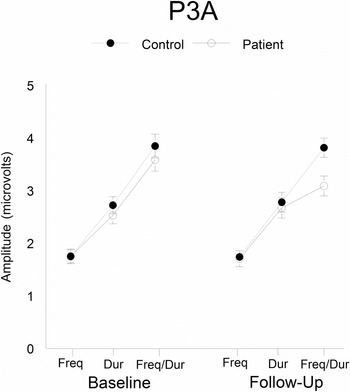
The ANOVA showed significant main effects of deviant type [F (2,64) = 101.15, p < 0.001, η 2 = 0.76] and lead [F (1.35,87.45) = 71.85, p < 0.001, η 2 = 0.53], as well as a significant time × group × deviant interaction effect [F (2,124.2) = 4.62, p = 0.013, η 2 = 0.07]. Splitting the ANOVA on types of deviant revealed no group effects for either frequency (FreqP3a) or duration (DurP3a) deviants (p > 0.171, η 2<0.051). However, the combined frequency/duration (FreqDurP3a) deviant showed a time × group effect [F (1,69) = 4.17, p = 0.045, η 2 = 0.057], indicating higher amplitudes at baseline than at follow-up in patients regardless of leads (electrodes) [F (1,35) = 5.59, p = 0.024, η 2 = 0.138], yet similar P3a amplitudes at baseline and follow-up in HC [F (1,34) = 0.16, p = 0.69, η 2 = 0.005] (see Fig. 2).
Line graph showing P3a amplitude (±sem) on lead FCz (where maximum amplitude was reached) for both patients and controls, displaying a significant reduction in FreqDur-P3a amplitude for patients following 6-week treatment with MPH.

Psychopathology/functioning
Statistically significant reductions in AISRS hyperactivity (t = 10.0, df = 32, p < 0.001), AISRS inattention (t = 10.4, df = 32, p < 0.001), AISRS total (t = 11.8, df = 32, p < 0.001), and PANSS total (t = 3.0, df = 37, p = 0.004) scores were found in patients from baseline to 6-week follow-up. Furthermore, the patients' total GAF-F (t = 9.0, df = 37, p < 0.001) score increased significantly in this same period. All these results reflect the beneficial clinical effectiveness of our treatment (Table 1).
Correlations between psychopathology, functioning, sleep quality, and psychophysiological functions
We found no significant associations between any of these measures in HC (p > 0.05). In patients however, we found the following significant correlations; at baseline, the amplitude of duration-MMN (DurMMN, lead FCz) correlated positively with the GAF functioning scale (GAF-F; r s = 0.342, p = 0.032) and general symptom scale (GAF-S; r s = 0.380, p = 0.019), meaning that the more poor daily functioning and more severe the general symptoms were, the larger this MMN amplitude (more negative) was (online Supplementary Figs S1 and S2). In addition, the amplitude of DurMMN (lead FCz) correlated negatively with the ADHD symptom scale (CGI-S; r s = −0.445, p = 0.005) and the amplitude of frequency-duration MMN (FreqDurMMN, lead FCz) correlated negatively with the Pittsburg Quality Sleep Index (PQSI; r s = −0.362, p = 0.028), meaning that the worse ADHD symptoms and the more severe sleeping disturbances were, the larger these MMN amplitude were (online Supplementary Figs S3 and S4). The amplitude of FreqDurMMN at lead Cz at baseline (r s = −0.400, p = 0.014) (online Supplementary Fig. S5) and Cz at follow up (r s = −0.346, p = 0.039) (online Supplementary Fig. S6) correlated negatively with the ASRS-A (ADHD inattention rating scale) at baseline, meaning that the more severe inattentive symptoms were, the larger this MMN amplitude was. Furthermore, FreqMMN (at leads FCz and Fz) correlated positively with plasma MPH-concentration [(FCz) r s = 0.339, p = 0.05, (Fz) r s = 0.370, p = 0.031)], meaning the higher MPH-plasma concentrations were, the smaller FreqMMN amplitude was. Last, DurP3a (leads FCz, Cz, and Fz) correlated negatively with the dosage of MPH (r s ⩽ 0.339, p < 0.04; Figs S7, S8, S9). No other significant correlations were found between MMN and P3a amplitudes and the scores of psychopathology, daily functioning, or rating scales.
Discussion
This is to our knowledge the first study investigating the effects of MPH on auditory MMN and P3a amplitudes, psychopathological symptoms, and daily functioning in a large group of initially psychostimulant-naïve, adult patients with ADHD. As expected, patients exhibited moderate to severe ADHD-symptoms and reduced daily functioning at baseline compared to HC. Six weeks of treatment with MPH significantly reduced these symptoms as well as significantly improved daily functioning in the patients. At group level, we found neither significant differences in MMN between patients and controls at baseline, nor at follow-up. However, we did find a significant decrease in P3a amplitude (elicited by the combined frequency-duration deviant) from baseline to follow-up in the patient group only, which is likely due to MPH treatment. Furthermore, the data revealed several interesting associations between the electrophysiological and psychometric measures.
Even though the patients exhibited pronounced ADHD-symptoms and significantly reduced daily functioning at baseline, their levels of MMN neither differed significantly from the HC in the psychostimulant-naïve state at baseline, nor after 6 weeks of treatment with MPH. To our knowledge, there are no previous reports on MMN (nor on P3a amplitude) in adult ADHD, but the lack of MMN deficits in our patients is in line with most studies on ADHD in children or young adolescents (Gomes et al., Reference Gomes, Duff, Flores and Halperin2013; Huttunen et al., Reference Huttunen, Halonen, Kaartinen and Lyytinen2007; Kemner et al., Reference Kemner, Verbaten, Koelega, Buitelaar, van der Gaag and Camfferman1996; Rothenberger et al., Reference Rothenberger, Banaschewski, Heinrich and Moll2000; Rydkjær et al., Reference Rydkjær, Jepsen, Pagsberg, Fagerlund, Glenthoj and Oranje2017; Winsberg et al., Reference Winsberg, Javitt and Shanahan1997). Our results suggest that this absence of reported MMN deficits in children with ADHD is most likely genuine, and not caused by MPH masking the effects that this disorder has on MMN amplitude.
The lack of MMN group differences in our study indicates that this important, yet very basic form of information processing is intact in adult ADHD at a group level. Nevertheless, this does not necessarily exclude that subgroups of ADHD patients might still experience disturbances in MMN, due to the heterogeneity of ADHD. Indeed, this could also be the reason why we found significant associations both at baseline and follow-up between (Dur and FreqDur) MMN amplitude on the one hand and ADHD symptom severity (CGI-S), inattentive symptoms (subscale ASRS-A), global symptom severity (GAF-S), global daily functioning (GAF-F), and sleeping disturbances (PQSI-tot), on the other. In general, the more severe symptoms and impairments of function the ADHD patients showed on these scales, the larger these two MMN amplitudes were. These results may appear counter-intuitive, with larger (more negative) MMN amplitudes indicating worse clinical state. However, this is not an uncommon finding; in a previous study from our lab, we found similar associations between more severe ASD-symptoms and larger MMN amplitude, although this time not in adults with ADHD but in children with ASD (Vlaskamp et al., Reference Vlaskamp, Oranje, Madsen, Jepsen, Durston, Cantio and Bilenberg2017). An explanation could be that particularly those adults with ADHD and children with ASD who have larger MMN amplitude are hyper-responsive to deviant environmental stimuli; in turn, this would make these individuals more easily distracted and thus more inattentive to tasks at hand. Interestingly, the association between MMN and symptomatology appears to be reversed in schizophrenia, where smaller MMN amplitudes indicate higher levels of psychopathology, possibly indicating that these patients respond to any environmental stimuli, whether standard or deviant, as we theorized in our introduction above. Indeed, decreased levels of MMN correlate highly with deficient levels of functioning in prodromal (Perez et al., Reference Perez, Swerdlow, Braff, Naantanen and Light2014), first-episode (Salisbury & Haigh, Reference Salisbury and Haigh2016), and established (Friedman, Sehatpour, Dias, Perrin, & Javitt, Reference Friedman, Sehatpour, Dias, Perrin and Javitt2012; Light & Naantanen, Reference Light and Naantanen2013) schizophrenia. Combined, this suggests that MMN amplitude deficits index core pathophysiological mechanisms across psychiatric disorders in general, regardless whether amplitudes are increased or decreased compared to those of healthy individuals.
MPH did not significantly alter MMN amplitude much in our study, which confirms the findings of single dosages of MPH in healthy volunteers (Korostenskaja, Kičić, & Kähkönen, Reference Korostenskaja, Kičić and Kähkönen2008). In contrast, modulators of the N-methyl-D-aspartate (NMDA) system do effect MMN amplitude, e.g. the non-competitive NMDA antagonist ketamine reduces MMN in healthy volunteers (Umbricht, Koller, Vollenweider, & Schmid, Reference Umbricht, Koller, Vollenweider and Schmid2002; Umbricht et al., Reference Umbricht, Schmid, Koller, Vollenweider, Hell and Javitt2000). If MMN amplitude is indeed modulated by the glutamatergic (NMDA) system, it would explain why we found no effect of MPH on MMN amplitude, given that MPH does not affect glutamatergic transmission much (Faraone, Reference Faraone2018). Importantly, this could also explain our above mentioned finding of an association between symptomatology and (Dur and FreqDur) MMN amplitudes, despite the absence of significant group differences in average amplitudes: In theory, the patients with the more severe ADHD-symptoms may benefit from (additional) downregulation of glutamatergic activity, given their higher MMN amplitudes. Indeed, spectroscopy data in children and adolescents with ADHD support the hypothesis of increased levels of glutamate in different brain regions, especially the anterior cingulate cortex (ACC), the posterior cingulate cortex, and the striatum (Altabella, Zoratto, Adriani, & Canese, Reference Altabella, Zoratto, Adriani and Canese2014; Dramsdahl et al., Reference Dramsdahl, Ersland, Plessen, Haavik, Hugdahl and Specht2011; Endres et al., Reference Endres, Perlov, Maier, Feige, Nickel, Goll, Bubl and van Elst2015; Spencer, Uchida, Kenworthy, Keary, & Biederman, Reference Spencer, Uchida, Kenworthy, Keary and Biederman2014). Furthermore, Bauer et al. (Reference Bauer, Werner, Kohl, Kugel, Shushakova, Pedersen and Ohrmann2018) not only found significantly increased glutamate levels in the ACC of ADHD patients compared to controls, but also that these higher levels correlated positively with ADHD symptomatology, especially hyperactivity and impulsivity. Memantine, an NMDA receptor antagonist, improved ADHD symptoms in both children and adults (Biederman et al., Reference Biederman, Fried, Tarko, Surman, Spencer, Pope, Grossman and Faraone2017; Findling et al., Reference Findling, McNamara, Stansbrey, Maxhimer, Periclou, Mann and Graham2007; Surman et al., Reference Surman, Hammerness, Petty, Spencer, Doyle, Napolean, Chu and Biederman2012). In short, these findings support our hypothesis that at least some ADHD patients, particularly those in the higher end of the spectrum of (Dur and FreqDur) MMN amplitudes, may benefit from medication targeting glutamatergic receptors possibly in combination with MPH. Our finding that plasma levels of MPH did correlate positively with FreqMMN shows that this type of MMN is more sensitive to MPH than either DurMMN or FreqDurMMN, although not contributing much to symptomatology of ADHD, given that it did not correlate with any of these clinical measures.
Last, our analyses showed a significant reduction of (FreqDur) P3a amplitude in the patient group from baseline to follow-up, yet not in controls, resulting in a significant group difference of this amplitude at follow-up. These findings indicate that MPH reduces P3a amplitude, which is supported by the fact that both dosage as well as plasma concentration of MPH correlated significantly negative with DurP3a amplitude in the patient group. Given that P3a amplitude is related to frontal focal attention and working memory (Polich, Reference Polich2007; Polich & Criado, Reference Polich and Criado2006) suggests that the dosage of MPH should be kept within certain limits. There are many studies indicating that P3a (and b) amplitudes are mediated by dopaminergic activity, so it is likely MPH's effect on dopaminergic activity that is causing the reduced P3a amplitude at follow-up as found in our current study (Albrecht, Martin-Iverson, Price, Lee, & Iyyalol, Reference Albrecht, Martin-Iverson, Price, Lee and Iyyalol2011; Nishimura, Ogura, & Ohta, Reference Nishimura, Ogura and Ohta1995; Polich, Reference Polich2007; Polich & Criado, Reference Polich and Criado2006; Takeshita & Ogura, Reference Takeshita and Ogura1994).
The most important strength of our study was that we managed to include a larger number of patients than most other studies, not the least when taking their ADHD medication-naive status at baseline into consideration. An additional and equally important strength is that we excluded patients if they suffered from comorbid ASD, a feature that is only rarely met in other studies on ADHD, given their high comorbidity rate. Further strengths are the matching of patients and controls on age, gender, and socio-economic status, a high retention rate between baseline and follow-up, and that we collected plasma levels of MPH to ensure medical compliance. A limitation is that we cannot draw conclusions on long-term effects of treatment with MPH, and thus cannot extrapolate our findings over longer periods than the currently examined period of 6 weeks. Furthermore, as mentioned above, we only included ADHD subjects in our study without comorbid ASD. Given that comorbidity with ASD is usually high in patients with ADHD, this may limit the generalizability of the current findings.
In conclusion, we found similar MMN and P3a amplitudes in adult psychostimulant-naïve ADHD patients and HC at a group level. However, we found that the presence of more severe clinical ADHD symptoms was associated with larger (Dur and FreqDur) MMN amplitudes in the patients, both in their MPH-naïve state at baseline as well as their MPH-treated state at follow-up. In addition, we found that MPH reduced P3a amplitude. Given that glutamatergic neurotransmission appears both involved in ADHD as well as MMN amplitude and that P3a amplitude reflects an important attentional process, future research should investigate whether less MPH responsive adults with ADHD would benefit from treatment with glutamatergic antagonists, either with or without additional treatment with MPH.
Supplementary material
The supplementary material for this article can be found at https://doi.org/10.1017/S0033291721002373.
Acknowledgements
The authors would like to thank the clinicians at the Adult ADHD Clinic at the Copenhagen University Hospital, Glostrup Mental Health Centre, for their invaluable cooperation in recruitment of patients.
Financial support
The study was supported by the UCPH 2016 Program of Excellence (‘Attention to Dopamine’) and the Lundbeck Foundation (Grant numbers: 192/05; 192/04; R25-A2701). Dr Birte Glenthøj is the leader of a Lundbeck Foundation Centre of Excellence for Clinical Intervention and Neuropsychiatric Schizophrenia Research (CINS), which is partially financed by an independent grant from the Lundbeck Foundation based on international review and partially financed by the Mental Health Services in the Capital Region of Denmark, the University of Copenhagen, and other foundations. Her group has also received a research grant from Lundbeck A/S for another independent investigator initiated study. All grants are the property of the Mental Health Services in the Capital Region of Denmark and administrated by them.
Conflict of interest
None.