Introduction
The Neolithic transition in the north-west of the Mediterranean Basin (5500–3500 cal BC) is characterised by the steady development of trade networks, particularly those involving abiotic resources (e.g. obsidian, flint, Alpine rocks, steatite, etc.). The widening circulation of lithic objects runs parallel to a remarkable shift in the complexity and intensity of exploitation of underground resources. Flint mines, for example, are well attested during the Early and Middle Neolithic in Western Europe: Casa Montero in Spain (Consuegra et al. Reference Consuegra, Gallego and Castañeda2004), Defensola in Italy (Galiberti Reference Galiberti2005), Spiennes in Belgium (Collet Reference Collet2004) and the many flint mines in southern Britain (e.g. Barber et al. Reference Barber, Field and Topping1999; Russell Reference Russell2000).
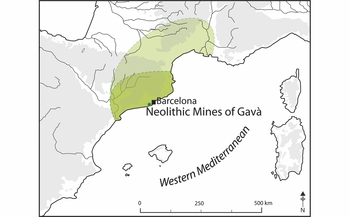
The Neolithic mines at Gavà deserve special attention; they form a unique mining complex where a green phosphate mineral, similar to turquoise and known as variscite or callaïs, was extracted (e.g. Villalba et al. Reference Villalba, Bañolas, Arenas and Alonso1986; Bosch & Estrada Reference Bosch and Estrada1994 a; Bosch et al. Reference Bosch, Estrada and Noaín1996; Villalba Reference Villalba and Guilaine2002; Bosch & Borrell Reference Bosch and Borrell2009). Variscite, found as stratabound layers (1–50mm thick) and veinlet mineralisations (from 1–5mm up to 30mm thick), was processed into prestige goods (beads and pendants) that clearly had a symbolic value. During the Middle Neolithic (first half of the fourth millennium cal BC), variscite beads produced at Gavà circulated through complex and overlapping networks and are found as grave goods in many Neolithic burials in the north-easternmost part of the Iberian Peninsula and southern France (Figure 1). Other lithic materials such as Bédoulien flint from south-eastern France (e.g. Léa Reference Léa2005), obsidian from Mediterranean islands (e.g. Léa 2012) and jadeite and other Alpine rocks (e.g. Pétrequin et al. Reference Pétrequin, Cassen, Gauthier, Klassen, Pailler, Sheridan, Pétrequin, Cassen, Errera, Klassen, Sheridan and Pétrequin2012) circulated through the same trade networks, bringing into contact different contemporary Neolithic cultures in the north-western Mediterranean basin (e.g. Chasséen in southern France, Sepulcres de Fossa (Pit Burial) in north-eastern Spain and Lagozza in northern Italy).
Location of the Gavà Neolithic mines and distribution of variscite ornaments (abundant in the area of dark shading and occasional in the area of light shading).

Other variscite geological outcrops and mines are known in different regions of the Iberian Peninsula (Pico Centeno in north-western Spain) and France (Pannacé in Loire-Atlantique) (Odriozola et al. Reference Odriozola, Linares-Catela and Hurtado-Pérez2010), but the Neolithic chronology, complexity and intensity of variscite exploitation at Gavà remains unparalleled in Western Europe. Therefore, the characterisation and reconstruction of human behaviours related to variscite production at Gavà provides an excellent opportunity to understand: 1) the development of complex Neolithic mining in Western Europe; 2) the intricate networks that enabled the long-distance circulation of ideas and goods; and 3) the increasing social complexity and inter-community interaction during the Neolithic transition in the north-western Mediterranean.
In this paper we summarise early research at the Neolithic variscite mines at Gavà and present the results of recent fieldwork in a new sector (Ferreres). The discovery and excavation of a new set of mines has provided abundant data enabling a better understanding of mining activities and their organisation, site size, land use and exchange networks. The excavation and study of two burial sites with rich grave goods, including variscite beads, found in two mines has shed light on one of the most debated aspects of Gavà: the social agents involved in mining activities—the miners.
Previous research
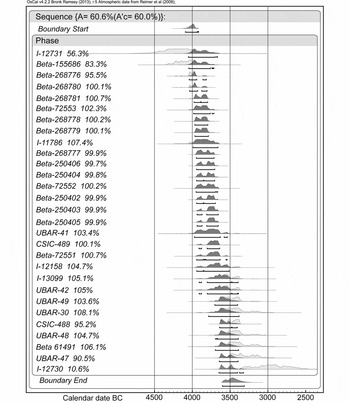
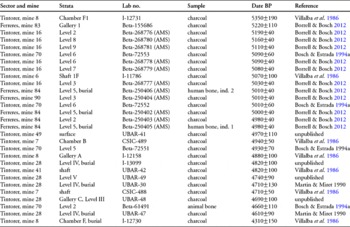
Mining at Gavà was concentrated in the first half of the fourth millennium cal BC (Figure 2 & Table 1). Mine structures vary greatly in complexity and size, from short, simple, vertical or semi-vertical shafts to complex structures that combine semi-vertical shafts, distribution chambers and horizontal tunnel-like galleries at different levels, reaching a total depth of up to 15m. The surface area affected by the mining activities was quite large, probably several hectares. A dozen mines have been fully or partially excavated, while over 90 sections of shafts or galleries have been identified and left unexcavated for future research. Without full excavation it is impossible to determine the total number of mining structures.
Results of a single phase Bayesian model applied to 14 C dates from the Neolithic variscite mines. Note that the boundaries of the single-phased Bayesian model indicate that mining activity lasted for no less than 500 years.

Absolute dates obtained at Gavà.

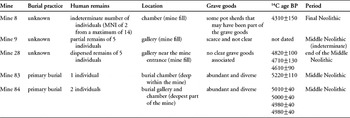
Necklaces and bracelets made of variscite beads were produced in situ at Gavà, as indicated by the presence of unfinished beads and flint micro-drillers. However, whole finished beads were very scarce in the fill from inside the mines (only fragments of beads broken during the manufacturing process were found in the fill in some mines, and they were not abundant). The almost total absence of finished beads at Gavà during the first stages of research, and in successive years, was interpreted as an indicator that the ornaments produced at Gavà were all distributed away from the site, and that the mining community did not enjoy high social status and had no access to the products of their labour (Villalba et al. Reference Villalba, Bañolas and Arenas1992; Villalba Reference Villalba and Guilaine2002). Furthermore, little data had been obtained about the miners at Gavà. The permanent settlement that must have existed near the mines has not been located, which is unremarkable considering that in the whole of north-eastern Iberia very little evidence of permanent Middle Neolithic settlement has been found, compared with the large number of known burial sites. However, a limited number of human remains were found during the first excavation seasons in mines 8, 9 and 28 (Villalba et al. Reference Villalba, Bañolas and Arenas1992), although they provided no conclusive results and the radiocarbon determinations dated these remains to a time when variscite mining at Gavà was waning (the end of the Middle Neolithic) or had ceased (Final Neolithic) (Table 2).
Summary of the location, characteristics and chronology of human remains and burials within the Gavà mines.

Excavations in the main sector at the Gavà mines (Can Tintorer: mines 5, 8, 9, 16, 28 and 70) provided abundant data enabling a preliminary understanding of mining activities and their organisation, but it did not provide definitive answers to basic questions such as: who were the miners? Where did they live? Was it a mining community per se? Who took part in the mining work? Were the resources controlled by a part of the group, or by other groups? Did the miners have access to the products of their labour? And what did they exchange variscite for?
Ferreres sector: new data and new interpretations
Since 2001, two Neolithic mines (83 and 84) have been completely excavated, and a further two (85 and 90) partially excavated. Mine 84 is a medium-sized (10 × 14m) T-shaped mine, combining narrow galleries (1m in diameter) with wider chambers (6.5m deep); mines 83, 85 and 90 are small, simple mines that only reach a depth of 4m. Mining activity in the Ferreres sector has been dated to the first quarter of the fourth millennium cal BC, shortly after the first mining work at Gavà began and at the start of the most industrious period (Figure 2 & Table 1). This indicates that, at its peak, mining activity was carried out simultaneously in different sectors (Borrell & Bosch Reference Borrell, Bosch, Borrell, Borrell, Bosch, Clop and Molist2012). The fact that different mines were exploited with varying levels of complexity indicates that the miners had very good empirical knowledge of geological structures. The learning process must have been based on accumulated experience (transmitted orally within the mining community) that was gained through successive cycles of trial and error. This experience was used to solve the difficulties intrinsic to mining and management of the necessary workforce (Camprubí et al. Reference Camprubí, Melgarejo, Proenza, Costa, Bosch, Estrada, Borrell, Yushkin and Andreiche2003).
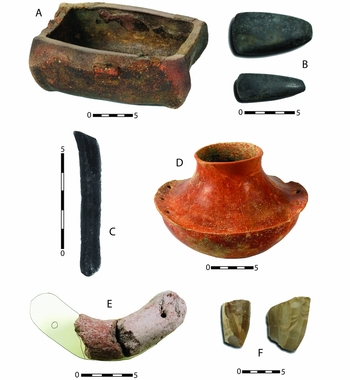
Recent excavations and analysis of material from early excavations have also revealed that the Gavà mines were not only a centre of production and export of variscite objects, but also for imports of other exogenous material goods and non-material concepts such as: 1) Bédoulien flint from south-eastern France (Figure 3 f); 2) eclogite and fibrolite axes from the Alps and Massif Central of France (Figure 3 b); 3) numerous red coral beads with possibly a nearby but not local provenance; 4) dark burnished ware with sgraffito decoration, with parallels in the Chasséen culture in southern France; 5) square- or quadrangular-mouthed vessels similar to the characteristic Vasi a Bocca Quadrata from Neolithic northern Italy (Figure 3 a); 6) a Lagozza-type loom weight, whose kidney shape is common in northern Italy in the Lagozza culture (Figure 3 e); 7) an obsidian blade from Sardinia (Figure 3 c); and 8) a pottery vessel with a red slip, unique in north-eastern Iberia (Figure 3 d), possible parallels for which might be found in the characteristic Almagra ware of the Middle Neolithic in Andalusia or Diana-style pottery in the central Mediterranean (e.g. Bernabò-Brea & Cavalier 1979).
Some of the exogenous artefacts found in mine 83 (a, b, c & f), mine 84 (d) and mine 70 (e).

Bury me deep in the mines
Two mines (83 and 84) were re-used as burial sites during the peak mining period at Gavà. Numerous variscite objects were discovered in mine 83, and, in mine 85, materials including beads, small perforated plaquettes, pendants and medals and polished fragments of variscite had been intentionally deposited, probably as a symbolic or commemorative deposit. These mines offer a more personal kind of evidence for the social agents, and they provide abundant and conclusive data about the Neolithic mining community at Gavà.
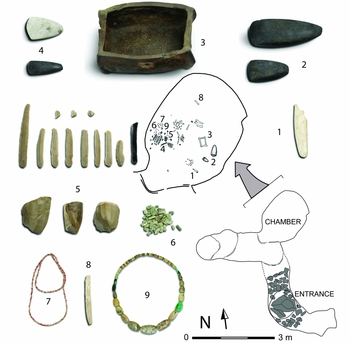
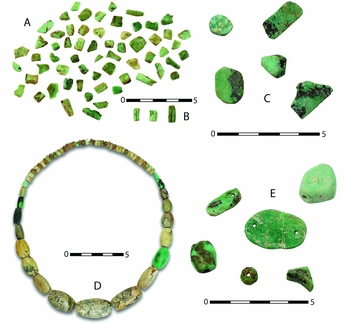
In mine 83, a single individual was buried in a side chamber that was not filled with soil but delimited by two flat, medium-sized limestone slabs (Figure 4). Only the part of the gallery nearest to the entrance of the mine was intentionally filled with sediment and medium-sized stones. The entrance was permanently sealed with a huge rock. The grave goods were extremely rich: an obsidian blade; some cores, blades and geometrics made of Bédoulien flint; some eclogite axes; a square-mouthed vessel; a bone chisel (traditionally interpreted as a mining tool); a necklace made of small beads of red coral; a necklace that combines small discoid and larger cylindrical variscite beads; and a group of variscite fragments, roughly shaped or unworked, that were found together with three more fragments of broken cylindrical beads (Figure 5). The charcoal (species unknown) used to date mine 83 (5220 ± 110 BP, 4326–3793 cal BC (2σ; Beta-155686); all dates cited in the text were calibrated in OxCal v.4.2 (Bronk Ramsey Reference Bronk2009)) was found among the mining debris used to fill the mine directly after the individual was buried and just before the mine was sealed (Table 1). It is reasonable to assume that the lapse of time between the mining activities and the re-use of the mine as a burial place was very short because the mine was kept empty during this time (no evidence of abandonment was documented during the excavation).
Plan of mine 83, detail of the funerary space and location of the grave goods (photographs: B. Solina, Museu de Gavà).

Variscite found in the Gavà mines. Roughly faceted fragments (a), broken beads (b) and a complete necklace (d) from mine 83. Faceted and polished fragments/plaquettes and bead preforms (c), and a series of perforated beads, pendants, plaquettes and a ‘medal’ (e) from mine 85.

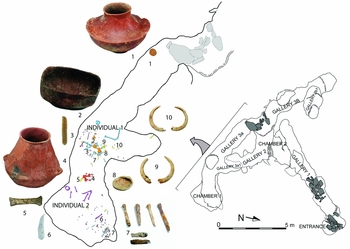
The remains of a male and a female were found in a medium-sized chamber located at the far end of a gallery in the deepest part of mine 84 (Figure 6). Limestone slabs blocked access to this gallery, clearly delimiting the funerary area. The human remains and the grave goods accompanying both individuals had been partially disturbed and moved from their original position. The bones of one individual, identified as male, exhibited a high number of post mortem fractures, some of them clearly made when the bones were fresh. Only a few bones and articulations of the other individual, identified as female, were found in their original position (skull, humeri and knee); most of the post-cranial skeleton was dispersed across the chamber-tomb. Some of the bones, particularly the shafts of the long bones, exhibited post mortem fractures. The condition of the human remains, and the presence of a second internal blockage in the upper mine passage, with stones placed 3m from the entrance, indicate that the mine was not completely sealed off after the burials. The mine and the burial area were re-entered, perhaps to steal grave goods, although it is not known how often. This may have been the reason for filling the mine with spoil and sealing the entrance with large boulders.
Plan of mine 84 and detail of the funerary space and location of the grave goods (photographs: B. Solina, Museu de Gavà).

The grave goods found in mine 84 are quite significant: a square-mouthed vessel, a vessel with a neck and combed decoration, bone implements, wild boar tusks with and without perforations, two flint blades and a clam shell (Glycymeris sp.) with remains of cinnabar inside it. Except for one of the blades, made of Bédoulien flint, the goods were not made of exotic raw materials (obsidian or Alpine rocks) or variscite, which in contrast are particularly abundant in mine 83 and the deposit of materials in mine 85. It is difficult to attribute the grave goods to the individuals because of the combined burial and subsequent looting. The absence of elements common in many contemporary pit burials, together with the clear evidence of incursions in the mine and post mortem disturbance of both individuals, supports the hypothesis that intrusions into the tomb in mine 84 were for the purpose of stealing variscite objects and exogenic artefacts. The burial event has been dated by three 14C samples that date both individuals (5010 ± 40 BP, 3944–3704 cal BC (2σ; Beta-250406) and 4980 ± 40, 3937–3656 cal BC (2σ; Beta-250405)) and the burial level (Level 5) (5000 ± 40 BP, 3943–3695 cal BC (2σ; Beta-250402)). The fourth sample (Level 2) corresponds to a thin layer of silt naturally deposited between the burial level and the circulation level (the level at which the miners were active) (4980 ± 40, 3937–3656 cal BC (2σ; Beta-250403)) during the mining activities, which dates the end of the extracting activities. All four dates are so close to each other that there is little doubt about the mine being re-used as a burial place immediately after mining activities ceased.
Anthropological approach
The human osteological remains found inside mines 83 and 84 are poorly preserved as a consequence of taphonomy and human intervention. Despite the negative impact of these factors, the human bones have allowed a detailed anthropological study that has provided interesting data about the individuals’ living and working conditions. Study of the pathological ailments and traumas, and markers of physical activity has yielded significant results enabling an anthropological understanding of the site. These results may be added to the growing number of studies of aetiology and entheseal changes that have greatly advanced knowledge of past human groups (e.g. Eshed et al. Reference Eshed, Gopher, Galili and Hershkovitz2004; Villotte et al. Reference Villotte, Castex, Couallier, Dutour, Knüsel and Henry-Gambier2010; Jurmain et al. Reference Jurmain, Cardoso, Henderson, Villotte and Grauer2012; Villotte & Knüsel Reference Villotte and Knüsel2013).
Mine 84: individual 1
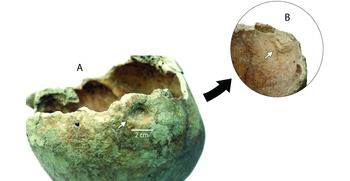
This skeleton belonged to an adult male individual, according to observations of the coxal bone and skull. The skull showed a series of pathological ailments or traumas, which were visible at both exocranial and endocranial levels. In the right frontal bone, on the exocranial side, a deep, oval and clearly bounded depression (Figure 7) corresponded on the endocranial side to an irregular prominence of neo-formed bone and two small foramina. The specific cause of this lesion is difficult to determine, although its characteristics and the archaeological context are consistent with trauma caused by a powerful blow to the head with a heavy blunt object, which depressed the bone without perforating the diploë (Simonin Reference Simonin1962). According to Campillo (Reference Campillo2001: 296), injuries of this kind and in this position suggest trauma with secondary necrosis of the periosteum, followed by scarring, which in turn implies the survival of the individual. It is interesting to note the positive correspondence between the shape and size of this injury and the characteristics of mining picks, even though it is difficult to establish the cause of the injury: accident or violence. Similar well-healed cranial fractures observed in skeletons found at the Kimberley diamond mines (South Africa, nineteenth century) have been interpreted as evidence of interpersonal violence among migrant labourers (Van der Merwe et al. Reference Van Der Merwe, Steyn and L’Abbé2010).
The trauma in the exocranial face caused by a powerful impact (a) and detail of the prominence on the endocranial face (b).

A second lesion was studied on the endocranial face of the left frontal fossa. It was prominent and more or less conical in shape. The most probable explanation for the aetiology of this lesion is that it was due to trauma, originating in a slight injury to the external face of the cranium. The point of impact may correspond to a small depression in the bone on the left of the coronal suture and in the anterior part of it, corresponding to a slightly depressed and irregular surface. It marked the start of a linear fracture caused by a direct impact to the skull (Simonin Reference Simonin1962; Palomo Reference Palomo1992). Although it was a complete fissure, visible on both faces of the skull, signs of scarring could be seen and therefore the lesion was caused some time before the individual’s death. The cause of the trauma might have been a heavy, wide, blunt object, although it could equally have been caused by a fall on to a hard surface, which might have happened while working in the mines. None of the injuries was the direct cause of death, as clear signs of scarring were present.
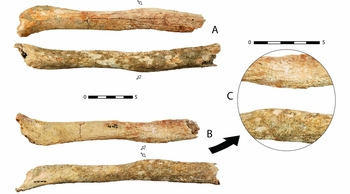
The osteological study indicates that the upper limbs were considerably more developed than the lower limbs. The study of the musculoskeletal stress markers showed that the humeri exhibited a high degree of development of the deltoid tuberosity insertion (Figure 8). These signs of robustness are normally accepted by the anthropological literature as entheseal changes caused by repeated movements involving muscular force. In the femora, the development of the lesser trochanter was noticeable. This is the area of the insertion of the iliopsoas muscle, which is important for the direct flexing of the torso, although this is a zone with important anatomical variability (Villotte & Knüsel Reference Villotte and Knüsel2013). Similarly, insertion tubercles related to the use of prehensile force were visible on the palmar face of the right metatarsals. As these were lateral, they might indicate repeated use of the right hand.
Detail of the development of the deltoid tuberosity insertion: upper face (a) and dorsal face with detail (b & c).

Mine 84: individual 2
The skeleton of individual 2 also belonged to an adult; a female, according to observations of the skull. The small size of the bones and the general slight build were noticeable in the post-cranial skeleton. Even so, some muscle insertions in the upper limbs (humeri, ulnae and claviculae) were well developed, especially on the right-hand side. These insertions and the muscular force and movements they imply suggest that the activity this woman performed in life required her to work more with her upper limbs and especially her right arm, which is fully compatible with mining work. In this sense, it is interesting to note that the difference in robustness between the upper and the lower limbs is the same as those identified in individual 1, as well as in the skeletons recovered from the mines in the Can Tintorer sector, which are somewhat more recent in age (Isidro & Malgosa Reference Isidro and Malgosa2003).
On the posterior face of the occipital bone in the cranium, the marked muscle insertion relief of the nuchal lines corresponded to the insertion areas of a group of muscles at the back of the neck, and especially to the muscles acting at a deep level on the craniovertebral articulations, which controlled the permanent position of the head on the neck. This muscle group, together with the trapezius muscle, stabilised the upper part of the torso. This insertion might be the consequence of this woman repeatedly carrying heavy weights on her head or using a carrying strap around the forehead. Considering the tasks associated with mining, she might have transported baskets with mineral or spoil, or pitchers of water.
Mine 83: individual 1
A few fragmented human bones corresponding to one single individual (an adult of average build, sex not determined) were recovered in mine 83. The only cranial remains were four teeth in a very poor state of preservation. All anatomical parts of the post-cranial skeleton were present, albeit unequally, as the limb bones were better represented than trunk elements (spine, ribs and pelvis), which were almost completely missing. The state of preservation was very poor and the degree of fragmentation was high, hindering any observations apart from anatomical identification.
Hard-working miners
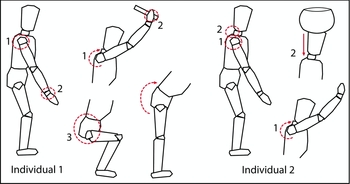
The anthropological study revealed interesting entheseal changes related to the habitual and prolonged adoption of certain postures and actions. Considering the structure of the mines, their organisation in narrow shafts and passages, and the types of activities and movements needed to work in them, the identification and location of the entheseal changes described in the skeletons from mine 84 are consistent with typical mining work. The characteristics of this work accustom the body to certain use of the skeleton and muscles, and to the habitual use of specific postures, actions and movements: in the humeri for arm abduction movements; in the metacarpals for the constant effort of holding a tool; and in the femora for the activity of the iliopsoas muscle in the repeated and constant bending of the torso (Figure 9). In addition, individual 2 had markers compatible with tasks related to carrying and transporting weights.
Illustrations of the stress markers compatible with mining activity. Individual 1: 1) outstretching/raising the arm; 2) prehensile function of the hand; 3) flexion of thigh and torso (spine-pelvis). Individual 2: 1) outstretching/raising the arm; 2) nuchal muscle insertions.

Musculoskeletal stress markers and cranial traumas identified at Gavà are very similar to those identified at other mining sites, such as those in skeleton NK2 from a mining context in Egypt dated to the Palaeolithic (Crevecoeur & Villotte Reference Crevecoeur and Villotte2006), or in skeletons from the Bronze Age salt mine at Hallstatt (Pany Reference Pany, Karl and Leskovar2005; Pany & Teschler-Nicola Reference Pany and Teschler-Nicola2006). The skeletons by themselves may not be sufficient evidence to argue for intense mining activities, or that the individuals buried in mines 83 and 84 were miners. There is constant debate about the general difficulty in analysing osteological remains and demonstrating a relationship between bone remodelling and mining activity in order to differentiate between a miner, a mine owner and a non-miner buried in a mine (e.g. Crevecoeur & Villotte Reference Crevecoeur and Villotte2006; Pany & Teschler-Nicola Reference Pany and Teschler-Nicola2006).
For skeletal evidence to be conclusive it would be necessary to verify the aetiology of a larger number of skeletons of different ages from the same site (e.g. Villotte & Knüsel Reference Villotte and Knüsel2013), which will be possible through further research at Gavà. Furthermore, it should be kept in mind that post-depositional damage of the bones from prehistoric sites, such as Gavà, rarely allows all the relevant observations that are performed in studies with reference collections (e.g. Villotte et al. Reference Villotte, Castex, Couallier, Dutour, Knüsel and Henry-Gambier2010; Jurmain et al. Reference Jurmain, Cardoso, Henderson, Villotte and Grauer2012). In the case of Gavà, data from the archaeological context are a key element in demonstrating that the individuals buried in mines 83 and 84 were miners. Unlike the previous finds of human remains at Gavà (Table 2), these remains belong to primary burials, accompanied by rich grave goods, found in the deepest part of the mines in a space clearly delimited by stone slabs. Secondly, the burials are contemporary with the peak of mining activity both in the Ferreres sector and in the whole Gavà mining complex. Moreover, the mines were re-used as burial places soon after being abandoned and intentionally filled with mine spoil, while the original entrance was sealed with large blocks. Finally, the grave goods include the product obtained at the mines: variscite in different forms (fragments, finished beads and pendants), which was only available to miners, and a typical miner’s tool (a bone chisel). The assessment of the abundant and unequivocal data from the archaeological context, combined with the results of the osteological study, indicates that the three individuals buried in mines 83 and 84 were miners.
Conclusions
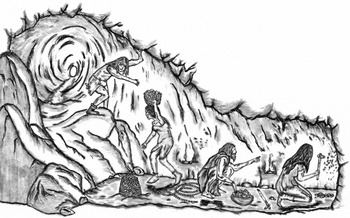
Recent research at the Gavà Neolithic variscite mines represents a leap forward in our knowledge of the still poorly understood social contexts of early mining communities in Europe. In this sense, these results have contributed essential information for reconstructing the lifeways of the miners themselves, providing responses to many questions raised about the Neolithic community that lived, worked, died and was buried in the mines. The primary burials found in mines 83 and 84 are the oldest evidence of the use of the Gavà mines for burials, coinciding with the peak of mining activity. The anthropological study has identified a series of pathological disorders or traumas, as well as occupational musculoskeletal stress markers fully compatible with repeated manual labour, that may be associated with typical mining work such as digging out, transporting and transforming the mineral. This, together with the rest of the data from the archaeological contexts, indicates that the individuals buried in the mines worked there with certain intensity and regularity during a prolonged period of time, and that both genders took part in the work (Figure 10). These individuals might have formed part of a group ‘specialising’ in mining, and the knowledge and skill needed for this work and also for the manufacture of variscite beads would have been handed down within the community over several centuries.
Reconstruction of the mining activities carried out by a group of miners (illustration by F. Borrell).

The study has further shown that it was hard work, where accidents and injuries often occurred, leaving their marks on the workers’ bodies. These two burials constitute a unique and unparalleled find in early mines in Europe. The presence of human remains in Neolithic mines is not rare in Europe, but other examples are not comparable with the primary burials of miners found at Gavà. In most cases, the presence of human remains in mines is poorly documented because they were found accidentally or in excavations in the nineteenth or early twentieth centuries, such as the burials found in Neolithic chert mines at Mauer-Antonshöhe in Austria (Trnka Reference Trnka, Biró and Markó2011), and Blackpatch and Church Hill in the United Kingdom (Barber Reference Barber, Topping and Lynott2005). In other cases a direct relationship between mining activity and the ritual act of burial is not evident and there could be a hiatus between mining and burial, as documented in the Neolithic flint mine at Kleinkems (Engel & Siegmund Reference Engel and Siegmund2005). Elsewhere, isolated human remains in mine fill, whether they are considered contemporary with mining activity or not, are not interpreted as intentional ritual burials. See, for example, the flint mines at Spiennes in Belgium (Collet Reference Collet2004) and Blackpatch (Barber Reference Barber, Topping and Lynott2005).
These results have also contributed to a better understanding of how the variscite was mined and used, and of the role played by the mining community in the first stages of its distribution across the north-east of the Iberian Peninsula and the south of France in the Middle Neolithic. The fact that variscite occurs as grave goods in mine 83 and in the deposit of materials inside mine 85 demonstrates that the mining community had access to the products of their labour, including finished beads, but also all the stages in the ornament-manufacturing process (broken beads, fragments of uncut variscite, roughly shaped fragments, and objects in the process of being manufactured). This, in conjunction with the frequent appearance of the tools used to work the variscite (drills and sandstone polishers) in the fill of some mines, indicates that those who extracted the mineral also manufactured the ornaments. Furthermore, the variety of variscite ornaments found at Gavà (discoidal beads, cylindrical or barrel-shaped beads, small rectangular pierced plaquettes, large plaquettes or ‘medals’ and two pendants with unique shapes) contrasts with the homogeneity of variscite ornaments found in contemporary pit burials in north-eastern Iberia, where the vast majority of the objects are discoidal or cylindrical beads. This variety suggests a double production line at Gavà: on one hand, the highly standardised discoidal and barrel-shaped beads for external exchange and internal use; and on the other, objects solely for local use, which included the wide range of products that have only been found at Gavà (Borrell & Bosch Reference Borrell, Bosch, Borrell, Borrell, Bosch, Clop and Molist2012).
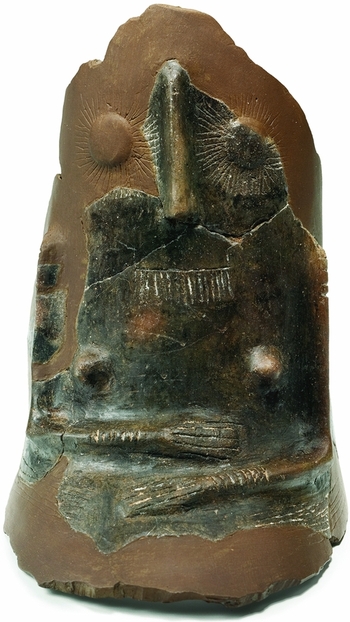
The strong and long-lasting nexus between the mining community, the valued green stone (used in life and after death) and the subterranean landscape (a work place and a final resting place) would not have been possible without the miners at Gavà exercising certain control over the landscape and the first stages of the manufacture of variscite ornaments. This nexus, whilst possessing economic importance, must also have been impregnated with high symbolic significance, infused with social practices that are still unknown. Mines were special places for miners, as a place to work and die, as suggested by the discovery of the Gavà Venus, a fragment of an anthropomorphic figure-vessel found in 1994 (Bosch & Estrada Reference Bosch and Estrada1994 b) with relief and fine incisions representing parts of the body and adornments: sun-shaped eyes, nose, comb-shaped necklace, breasts, arms and forearms with bracelets, and hands resting on a swollen belly with lines over it in a herring-bone pattern (Figure 11).
The Gavà Venus, found in 1994 (photograph: J. Casanova, Museu de Gavà).

In conclusion, the variscite mines at Gavà are the first evidence for a mining community where the manual labour is not the occupation of an underclass while others enjoy the benefits, but rather a collective effort of the group. This community of miners and the variscite itself played a vital role in the development of complex networks in the first half of the fourth millennium cal BC during the consolidation and intensification of a producing economy in the western Mediterranean, allowing inter-group social interaction between communities in the north-eastern Iberian Peninsula, southern France and northern Italy.
Acknowledgements
This paper has benefited from the agreement for scientific collaboration between the Museu de Gavà and the Departament de Prehistòria of the Universitat Autònoma de Barcelona. We gratefully acknowledge the comments and criticisms made by the peer reviewers.