The Latin American Courses of Contemporary Music – Cursos Latinoamericanos de Música Contemporánea (CLAMC) – held in different countries of Latin America between 1971 and 1989 constitute one of the most systematic, prolonged, and significant events of all late twentieth-century musical exchanges between Latin America and Europe.Footnote 1 They were itinerant, self-financed, and of continental scope, developed alternately in Argentina, Brazil, Dominican Republic, Uruguay, and Venezuela. In their fifteen editions, they displayed a comprehensive, updated and critical range of the technical, aesthetic, conceptual, and ideological problems and achievements present in the music of their time.
The objective of this article is to place those courses in the thematic context of the cultural trajectories between Latin American and Europe during the 1970s. I did not add new factual information to the already existing, exhaustive, and rigorous compilation gathered with patience and precision by Graciela Paraskevaídis between 2009 and 2014.Footnote 2 The hard data I provide here comes from that essential source, particularly from its ‘Anexo’ section. One of the first studies of the subject was an article published in 1989 by Eduardo Cáceres in Revista Musical Chilena.Footnote 3 The information in this piece was later expanded in the work of Marcela Perrone, Eduardo Herrera, Camila Juárez, Teresinha Prada, and Daniela Fugellie, among others, about specific individuals present in those events.Footnote 4
The aim of this article is to reflect briefly on these courses by considering what happened in two editions I attended in the 1970s: the third CLAMC (Piriápolis, Uruguay, 1974) and the seventh CLAMC (Buenos Aires, Argentina 1977). My analysis will have an inevitable component of participant observation, testimonial, and personal memory. I use these methodologies despite the risks that they entail, including the limitations of the observer, as well as the difficulties posed by the study of recent historical events and the possible shortcomings of memory in oral history. Another difficulty comes from the need to frame those experiences within the general context of the CLAMC to which they belong. Without that broader perspective, this study would be arbitrarily fragmentary and would lack the proper contextualization to make it intelligible. In that sense, I am also assuming the risk and responsibility of attempting a fragile balance between the individual and general dimensions of the CLAMC.
International networks at the CLAMC
According to the founders of these courses, the idea of creating these gatherings arose in meetings between Coriún Aharonián (1940–2017), José María Neves (1943–2002), and Mariano Etkin (1943–2016), former fellows at the Latin American Center for Advanced Musical Studies – Centro Latinoamericano de Altos Estudios Musicales (CLAEM) – living in Europe, where they all eventually studied.Footnote 5 The aim was to promote the creation of an international space for the study and discussion of contemporary musical issues, with a strong emphasis on the situation of Latin American musicians and the socio-political and artistic contexts where they lived and worked.
There were at least two prestigious models for these meetings. One of them was the Darmstadt International Summer Courses, avoided by this group due to its ‘hegemonic authoritarianism’ and its ‘sophisticated divismo’.Footnote 6 The other was the CLAEM of the Instituto Torcuato Torcuato Di Tella (ITDT), established in Buenos Aires in 1961, which, according to Paraskevaídis, privileged a ‘dialectical reference’.Footnote 7 The closure of the CLAEM coincided with the first CLAMC in 1971. Thereafter, a significant group of former CLAEM fellows would participate in CLAMC as teachers. Many of the European teachers who came to Latin America did so thanks to the relationships that these former ‘Di Tellians’ had established with them in Europe, either as colleagues with whom they collaborated in a variety of musical activities, as professors, or as acquaintances.
The main operating principles throughout the fifteen courses, stated in Paraskevaídis's documentation, could be summarized as follows:
• They should be itinerant, to facilitate access to participants from different countries alternately.
• They would entail two intensive weeks with courses, seminars, workshops, and concerts (live or with recorded music).
• They would be self-managed by a team without hierarchies and independent of any institutional ties.
• They would promote the inclusion of links to other disciplines (theatre, cinema, visual arts, literature, dance, etc.).
• They would provide a space for various musical activities related to contemporary practices, including performance, pedagogy, and musicology.
• Teachers would not receive economic compensation for their work. The organization of the courses covered their accommodation and food expenses and helped to obtain their flight tickets, with the frequent assistance of embassies and different organizations from their countries of origin.
• The students would pay the minimum amount necessary to cover the cost of accommodation and food, plus general expenses (provision and conditioning of instruments, technical equipment for a small electroacoustic study in each course, translations, mail, etc.), and the travel and living expenses of the aforementioned teachers and members of the organization team.
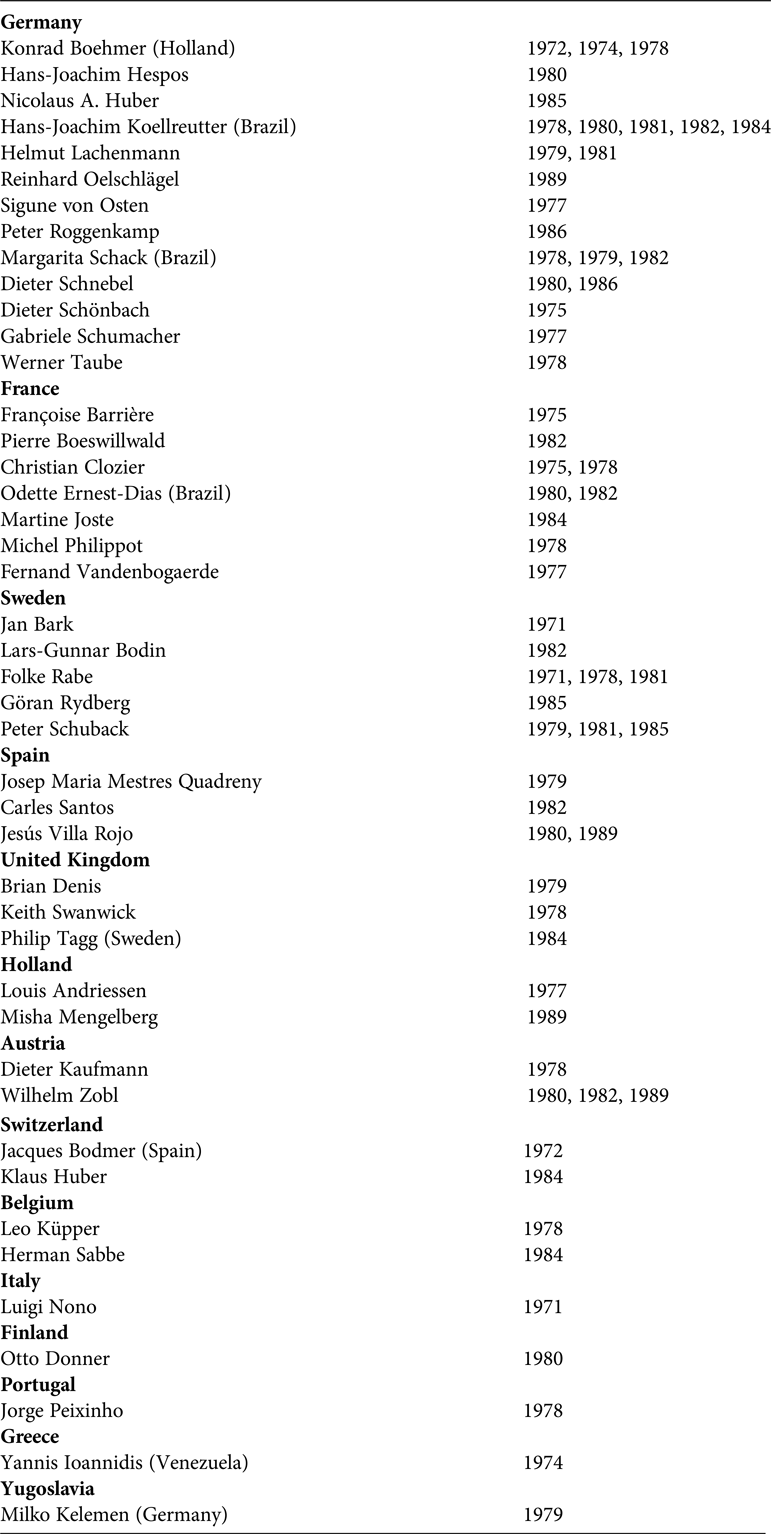
Under these conditions, the organizers were successful in securing the participation of about 150 professors from different countries. Approximately forty-five of them were European.Footnote 8 Most of them were from Germany and France, countries in which many former ‘Di Tellians’ continued their studies. Table 1Footnote 9 shows the complete list of professors.
European professors at CLAMC

This table shows the names of well-established figures such as Luigi Nono and Dieter Schnebel, along younger musicians who were not yet as widely recognized as they would be a few years later, including Helmut Lachenmann, Nicolaus Huber, or Philip Tagg.
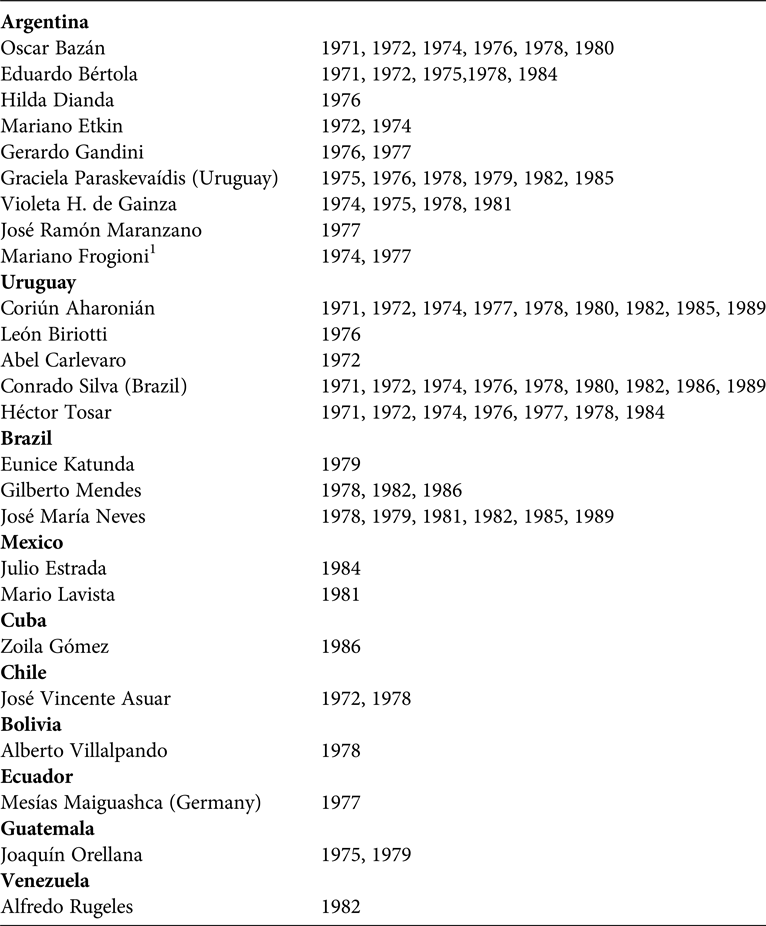
Since the courses were intended as a space for the discussion of ideas, experiences, and practices, it allowed important Latin American composers, performers, and musicologists to share these spaces with their European colleagues. A non-exhaustive list of the former can be found on Table 2.
Some Latin American professors at CLAMC

1 Born in Italy but established in Argentina when he was five years old.
Composers belonging to younger generations, such as Chico Mello (b. 1956), Tato Taborda Jr (b. 1960), Eduardo Cáceres (b. 1955), and Cergio Prudencio (b, 1955), joined the last versions of the courses. Students from Argentina, Bolivia, Brazil, Colombia, Costa Rica, Chile, Dominican Republic, Ecuador, France, Guatemala, Mexico, Panama, Paraguay, Puerto Rico, United States of America, Uruguay and Venezuela as well as from France, Ireland, Israel, Italy, and Morocco attended the courses. In the lists of participating teachers and students and in the locations of the courses, one can notice numerous participants from Brazil, Uruguay, and Argentina. Beside the fact that those were the countries in which most of the CLAMC courses took place, this is also likely because of the existence of consolidated and very active institutions in the field of contemporary music in those countries; for example, the Sociedad Uruguaya de Música Contemporánea, the Agrupación Nueva Música of Argentina, or Música Nova from Brazil, among others. Additionally, they were the places of residence of the more active organizers of the project, including Héctor Tosar (1923–2002), Coriún Aharonián, Conrado Silva (1940–2014), Graciela Paraskevaídis (1940–2017), Eduardo Bértola (1939–1996), and José María Neves.
Two experiences
In this section I examine my experience of the courses in 1974 and 1977, focusing on the most relevant aspects of the participation of European professors in CLAMC. In order to avoid excessive data and descriptions, this analysis does not follow a chronological narrative; instead, it is assembled around selected issues that were common to both courses.
The first four courses were held at the permanent campsite owned by the Christian Youth Association on top of Cerro del Toro, Piriápolis, Uruguay, where teachers and students lived, shared facilities and meals, and participated in the different classes, workshops, and performances. The third course was held on 3–17 January 1974. The professors were Konrad Boehmer (1941–2014), Yannis Ioannidis (b. 1930), Coriún Aharonián, Oscar Bazán (1936–2005), Mariano Etkin, Conrado Silva, Héctor Tosar, Mariano Frogioni (1924–2012), and Violeta H. de Gainza (b. 1929). There were also lectures by invited professors – the Uruguayan semiologist Héctor Massa (1927–1999) – and two Argentinian intellectuals – the writer and literary critic Noé Jitrik (b. 1928) and the specialist in Aesthetics Elena Oliveras (b. 1942).
The sixth course was held, like the fifth one, in Buenos Aires, on 3–16 January, at the Goethe-Institut. The professors were Louis Andriessen (b. 1939), Mesías Maiguashca (b. 1938), Gordon Mumma (b. 1935), Gabriele Schumacher (n/d), Fernand Vandenbogaerde (b. 1946), Sigune von Osten (b. 1950), Coriún Aharonián, Mariano Frogioni, Gerardo Gandini (1936–2013), José Ramón Maranzano (b. 1940), Jorge Rapp (1946–2010), and Héctor Tosar. In this case, the living conditions and the relative isolation of the Uruguayan campsite could not be reproduced; thus, the meetings unfolded differently.
As an example of the dynamics behind the organization of the meetings, I present the programme for a single workday, the structure of which was relatively stable during the course. Some activities overlapped, making it necessary to choose one or the other. The following example corresponds to Friday 7 January 1977, and is transcribed according to the printed programme of the course (translated into English):
9:30 New cello techniques, Schumacher.
10:30 Collective performance and composition IV, Andriessen. Electroacoustic techniques IV, Vandenbogaerde
14:30 Technological resources V, Vandenbogaerde. Composition V, Frogioni
17:00 New clarinet techniques, Frogioni
18:00 Analysis IV, Maiguashca. The clarinet, single session, Frogioni
20:15 Chamber music, Schumacher
21:15 [Concert] The voice. Zeitungsausschnitte op. 11 (1921), voice and piano (fragments), by Hanns Eisler; Black and White Tears (1972), solo voice, by Marek Kopelent; La fabbrica illuminata (1964), voice and tape, by Luigi Nono; Aria, solo voice, by John Cage. Sigune von Osten (voice), Héctor Moreno (piano), Jorge Rapp (sound control), Rolando Französy (lights). Comments by Graciela Paraskevaídis.
Thematic areas
Composition
On both occasions, Composition occupied a significant place in the set of the course's activities. In 1974, there were very detailed and critical analyses of serialism in paradigmatic works by Boulez and Stockhausen. The thematic organization of the classes was based on the study by parameters, followed by that of formal problems and challenges. Although the conception of equating each parameter and controlling it with the same numerical principle, as early serialists did, was already long admitted to be impossible, it was nevertheless attempted, not to renounce to the systematization of pitch, but rather to conduct the process starting from other perspectives. Héctor Tosar explained his own theory and practice of ‘sound groups’, pitch matrixes based on modules of three sounds, each of which starts from a minor or major second, to which another interval of increasing size is added. Then he proceeds in a similar way with groups of a greater number of elements. The use of these theories was studied in Tosar's Aves errantes (premiered in 1965).Footnote 10 These formalizations coincide with others developed in South America, aimed at overcoming the impasse represented by ‘classic’ serialism. An example is Gustavo Becerra-Schmidt's use of ‘complementary tetrachords’ since his String Quartet No. 5 (1959).Footnote 11 A comparable method for both composition and analysis was also proposed by Francisco Kröpfl (b. 1931) with his ‘micro modes’. Predictably, none of these contributions by Latin American composers is recognized in the international literature on this subject.
Several different trends coexisted during the 1977 course. This is evident in the compositions and performances presented by the professors in classes and concerts. Workshops, seminars, and concerts complemented each another and thus allowed for a better understanding of the teachers’ theoretical reflections. Thus, Louis Andriessen's affinity with procedures derived from minimalism was put into practice in his collective performance workshop and in the analysis of his works.
Fernand Vandenbogaerde's relationship with the then-young French composers of L'Itinéraire allowed for a growing familiarity with the techniques and the repertoire of French spectralism, to which a complete recorded concert was dedicated on Sunday 9 January. The concert featured recent pieces, which would later become paradigmatic examples of that trend: Partiels (1976) by Gérard Grisey, Appels (1974) by Michael Lévinas, and Mémoire / Érosion (1976) by Tristan Murail.
In his opening speech Gerardo Gandini introduced himself as someone who had composed neoclassical, twelve-tone, aleatoric music, and so on, and who now believed, provocatively, that ‘Schubert was a great composer’, thus opening a space for the intertextual practices he displayed in his own works, including Lamento di Tristano, Funeral Ceremony for Erik Satie (1975), for string piano and offstage flute, performed at one of the concerts.
There were not many composers from the United States at the CLAMC, but their presence was of great qualitative importance. This is the case of Gordon Mumma, who participated on the sixth course.Footnote 12 He was at that time one of John Cage's main assistants, and he provided abundant information about Cage's thought, work, and attitudes. Perhaps the most relevant of his contributions was the proposal of an electroacoustic music that did not necessarily depend on expensive equipment, developed by Mumma and his colleagues Alvin Lucier, Robert Ashley, and David Behrman in the Sonic Art Union. Their work was recorded in films that were screened during the course to help illustrate Mumma's talks. These were performances that included everyday objects such as bicycle wheels, from which new sounds were extracted via live electronics, contact microphones, and amplification effects. This deliberately ‘poor’ electroacoustic music and its immanent criticism of technological fetishism resonated with the concerns of local composers,Footnote 13 for whom the access to high technology used in sophisticated laboratories was almost impossible. The use of restricted devices was in some cases combined with procedures that were at the same time close to and differentiated from minimalism.
Other contributions came from diverse cultural scenes. The extensive practice of Mesías Maiguashca as assistant of Stockhausen's conveyed knowledge of other compositional and electroacoustic techniques, which were probably more speculative than those exposed, for example, by Mumma and his colleagues. One example of his aim to systematize certain aspects of the compositional process was a class dedicated to inventorying the basic ways in which a musical work can begin, an interesting typology of beginnings.Footnote 14
Performance
The courses encouraged the interest and commitment of the performers with contemporary repertoires. The organizers summoned important musicians who had a lot of experience with those languages, in whose workshops the instrumentalists learned extended techniques, deciphering of the new notations, and the modalities and requirements of recent chamber music. The professors curated a concert with repertoires that invariably included local or world premieres, and which served as another link between theory and practice.
In 1977, the central figures in contemporary performance were the cellist Gabriele Schumacher, who also led a chamber music workshop; Sigune von Osten, who ran a workshop dedicated to the use of voice in ‘new and very new’ vocal music, and Mariano Frogioni, whose workshop was devoted to new techniques for the clarinet, which he had also taught at the 1974 course.
Conceptual framings
Explicit or not, various theoretical frameworks coexisted within the classes. In his 1974 seminar ‘Introduction to contemporary music’, Konrad BoehmerFootnote 15 presented a complex and articulated approach to the history of twentieth-century music. Based on a critical materialist apparatus with Adornian inflections, Boehmer's seminar focused on techniques, socio-cultural and ideological anchors, and aesthetic results. Particularly relevant was a discussion of Adorno's Philosophy of New Music, with his well-known criticism of Stravinsky.
After reviewing the contributions of Italian futurism and connecting some of its manifestations to fascism, Boehmer presented the following statement, which provides a glimpse into his historiographical approach:
There was much doubt among the composers regarding Futurism. Just one composer of our century understood the aesthetic ideology of noise. He said that the function of that tendency was to build the temple, the cathedral of the new capitalist era and that the superficial side of these works could serve reactionary political trends. That composer was Edgar Varèse. In the 20s he was the only composer of some importance who used ‘noise’ aesthetics in a dialectical way … He understood that rivers and shepherds could no longer be evoked in a capitalist society, which has a working class with a totally different way of life.Footnote 16
He also highlighted some of the musical values in works of socialist realism, among them Eisler's settings of Brecht's texts and Prokofiev's Cantata for the XXth Anniversary of the October Revolution (1936/37), whose combination of ‘symphonic material, Russian traditional songs, workers’ mottos (“workers of the world, unite!”) built a more subtle and penetrant image of Socialism than, for example, the works by Mosolov’.Footnote 17
In my opinion, perhaps one of the most innovative theoretical contributions in the 1974 course was Boehmer and Massa's team-taught seminar on musical semiotics. Let us remember that Jean-Jacques Nattiez's historical book, Fondements d'une semiologie de la musique, was published in 1975, and previous to that these ideas were accessible, for instance, via articles in journals such as Musique en Jeu (available in Buenos Aires in a bookstore called Galatea), a magazine that had dedicated its fifth (1971) and tenth (1973) editions to musical semiotics. Despite the power of linguistic models and structuralism in early musical semiology, the seminar emphasized the autonomy of languages, the impossibility of synonymy, and the discontinuities of meaning, ultimately calling into question other influential contemporary – and more formalized theories – of language and communication. The focus of the seminar was on a general semiology, the development of sign theories, rather than on specific musical aspects. However, Boehmer considered musical semantics in connection with the concept of ‘functional music’ (e.g., music in advertisements), opening a perspective for a more sociological semiotics. Noé Jitrik's conferences in the 1974 course opened a space for very productive discussions of contemporary theories of linguistics – among them, Chomsky's.
Popular music
Although the field of popular music studies did not include the participation of European musicians, I consider it necessary to mention that it was a significant area of studies at the CLAMC. Even though the organizers were art music composers, the courses ignored divisions between genres as well as musical practices and thus opened a new space for the early musicological study of popular music. Of the two editions that I am discussing here, the 1974 course was the most representative on this regard. That year, Coriún Aharonián taught a seminar about ‘Mesomúsica’, a term coined by the Argentine musicologist Carlos Vega, in which he exposed the need to find a suitable methodology for the study and understanding of popular music phenomena.Footnote 18 The seminar opened with an analysis of Daniel Viglietti's music, especially the songs on his 1973 album Trópicos. Here, Aharonián focused on the compositional procedures of Viglietti's Spanish version of Chico Buarque's ‘Construçao’ (1971), paying particular attention to its additive form. Rogério Duprat, author of the extraordinary arrangement of the aforementioned song by Buarque, was invited to attend, but at the last moment he cancelled his participation.Footnote 19 Viglietti's version of ‘Construçao’, analysed in the course, used arrangements by Leo Brower with the participation of the Havana's Grupo de Experimentación Sonora.Footnote 20 The presence of Philip Tagg in 1984, one of the founders of the International Association for the Study of Popular Music shortly after, influenced early interest in this field of studies in the courses.
Ideological framings
I also consider it necessary to take into account that during a good portion of the time the CLAMC took place, several Latin American countries were under dictatorship – for instance Brazil (1964–85), Uruguay (1973–85), Chile (1973–90), and Argentina (1976–83). The complex Latin American context of the 1970s, as well as international political confrontations in this period (Cold War, Vietnam War, Chinese Cultural Revolution, the development of socialism in Cuba, government of the Popular Unity in Chile, etc.) was unfailingly present in the reflections and discussions about the interactions between artistic practices and social realities. During the classes, these concerns were sometimes veiled, self-censored for fear of an eventual infiltration by government agents – which actually took place in cultural activities – but were discussed more openly in private meeting conversations.
Brazilian composer Gilberto Mendes (1922–2016) indicates some ways of understanding the political dimension present in these courses. He affirms that the professors who came to collaborate
knew that it was also a form of resistance to Latin American dictatorships: subtle resistance of intellectuals and musicians. And famous composers and performers insisted on contributing to our struggle, coming to work for free, teaching classes and playing recitals only for food and accommodation … A point that honors the Latin American Courses was that they accepted only musicians from recognized stature, very correct political stance, and idealism. Important composers more linked to the official music, to the establishment of their countries, could lose hope, because they would never be invited to participate.Footnote 21
The presence of Luigi Nono in the opening course of the cycle is highly symbolic of these kinds of programming decisions.
On that basis, and although a considerable part of European teachers adhered to different leftist ideologies, the course was thought of as an absolutely horizontal, non-hierarchical, and strongly critical space in which nothing was taken for granted. A recurring critical intervention was to consider how these discussions acquired different ideological inflections in each specific socio-political scenario. In this sense, according to the theory of dependency that was hegemonic among many sectors of the Latin American intellectual field, discussions stressed the need to reflect and underpin local identities as factors of cultural resistance. Regarding musical production, I will point out some sample discussions that illustrate these issues.
The first one is of a general nature. It is about the understanding of music – and contemporary music in particular – as a space for social and institutional criticism. This is part of a larger critique of contemporary societies’ individualism through a re-evaluation of the collective dimension that musical practice allows. Mesías Maiguashca explained this sense of collectivity in relation to the experience he, his wife (Gabriele Schumacher), and other composers had living and composing in a communal farm near Cologne, which became a place of permanent residence and a concert venue. He reflected this experience in Oeldorf Acht (1976), which was included in his 1977 seminar, the title of the work is the address of the farm. Another manifestation of these concerns was the deliberate rejection of individual virtuosity and the choosing of collective performances, albeit ones that required considerable musical capacities.
The articulation between aesthetics and ideology as shown in the works themselves is another aspect of the interest in political theory and practice. The pieces of Louis Andriessen adhere to these conceptual frameworks. He valued popular music, including pop, and especially jazz, whose formations he used in his own works, but rejected the free improvisation by soloists in jazz. Andriessen theorized about this and presented his ideas in his workshop on collective composition, in which he also conducted, with the available instruments, an ad hoc version of his work Hoketus (1976) for two equal sets that alternate in the execution of similar materials. He employs a procedure derived from medieval hocket techniques, in a repetitive but differentiated context of classic American minimalism. Among the works Andriessen analysed in the sixth course, was his own De Staat (1972–76), based on Plato's famous dialogue about the relations between the State and citizens, and the role of music in public behaviors, which he compared with contemporary situations.Footnote 22
In other compositions, political references were more explicit. In Lied aus der ferne (1975), for soprano and orchestra, Konrad Boehmer employs a poem by Ho Chi Minh and dedicates the work to the communist fighter Nguyen Van Troy. Far from the immediate communicative concession one may expect from works of political content, the work is complex and demanding.
To close this brief review, three works can be mentioned that highlight the type of dialogues established between European musicians and different Latin American realities. Two of them were written by composers who taught on the courses considered in this text. I have chosen them as an homage of sorts to Chile, the country that hosted the 2019 Trayectorias conference that would lead to this special issue. The first piece is Wooden Pajamas (1973) by Gordon Mumma, a work dedicated to Salvador Allende and included in one of the concerts presented on the occasion.Footnote 23 The title comes from what the Chilean president declared to a New York Times reporter on 11 September 1973, the day of his death, while resisting the military coup: ‘They'll have to carry me out of here in wooden pajamas.’Footnote 24 The second is a late piece by Konrad Boehmer, La Violeta (2000), composed for bass clarinet, a tribute to Chilean songwriter Violeta Parra.Footnote 25 The author of the third example is the Austrian composer Wilhelm Zobl (1950–91), who composed his Ária brasileira as an ironic and anti-colonial replica, alluding to the invocation of Bach in Heitor Villa-Lobos's Bachianas brasileiras – especially in his Bachiana brasileira No. 5. Zobl wrote about Ária brasileira that it ‘is an acoustic postcard that is sent back to the original sender. The melody of Villa-Lobos’ aria is full of Brazilian rhythms – without Bach. Villa-Lobos fantasies do not exist in Europe. Europeans dream of mulattos at the carnival and not of Bach.’Footnote 26
Some conclusions and projections
At the organizational level, CLAMC constituted a model of autonomous management that showed great operational and professional effectiveness in difficult communicational and political contexts. It allowed the circulation of information about recent music and its critical analysis, it stimulated the study and discussion of the theoretical frameworks at stake, and re-ignited the commitment of all participants – teachers and students – to their role in the musical scenes of their respective places of work. By establishing a democratic principle of communication at all levels, the proposals, discussions, and achievements circulated in all directions, establishing interactions between participants from different backgrounds, with reciprocal influences, and without canonical impositions from hegemonic scenes or countries.
The continuous participation of young students throughout the years made the courses work as a field of musical, aesthetic, conceptual, and ethical training that eventually impacted each of the spaces in which they were later artistically active. Some of the techniques and aesthetic trends and directions of international contemporary music studied and discussed at the courses in the mid-1970s were consolidated and remain relevant in today's music world. Several participants in the courses integrated their experiences there into their teaching, sharing discussions, repertoires, and discourses with the younger generations in their own countries. Through this flow of information, some of the ideals behind the conception of the CLAMC were spread throughout Latin America and became central in the construction of specific narratives regarding local and international contemporary music.
One of the most powerful topics in the discussions at the CLAMC refer to the movement of musicians between Europe and Latin America, and the repercussions this had on the possibility of consolidating local cultural and musical identities. In the professional circles of the musicians who actively participated in the courses, a paradigm of contemporary Latin American music was brewing, which, although not widespread, was considerably influential. This paradigm rejected the mainstream canon, proposing instead independent alternatives as markers of local difference, which would in turn become canonizing regarding practice and theory partially produced in the region. The ideas shared by these Latin American composers with their European colleagues at the two courses discussed herein are diverse and happened at several different moments. This is evident in the 1984 writings by Mariano Etkin and Gerardo Gandini discussed here, which were produced years after the respective authors’ direct participation in the courses – although while the courses themselves were still taking place.
Etkin combines several stylistic features and behaviors that characterize a significant portion of Latin American contemporary musics: the subordination of pitch to texture, timbre, or form; the emphasis on sound – highlighting ‘the acoustic, rather than the “musical”, fact’ as point of departure for the compositional process, more so than ‘speculation lacking any contact with perception’; the use of non-European instruments as well as those from popular musics; the abandonment of ‘directional and teleological conceptions’ and of the formal ‘linguistic’ propositions from the European tradition. Instead of ‘complex thematic development and variation on variation’, Etkin highlights ‘repetition and micro-variation’, behaviors that themselves ‘are a reference to construction mechanisms found in many indigenous and Black musics’.Footnote 27 In distancing from what he considers paradigms of central European thought, Etkin establishes affinities with composers who, though also European, nonetheless diverge from those models in their compositions; according to him, Stravinsky, Satie, Varèse, and Xenakis.Footnote 28
On the one hand, these convictions were not unanimous; on the other hand, each composer who subscribed to them processed them according to their particular language and poetics, which resulted in a considerably personalized repertoire. Other composers who actively promoted the courses, such as Paraskevaídis and Aharonián, have suggested in their seminars, conferences, and writings that some of the aforementioned characteristics were already present among emblematic twentieth-century Latin American composers, including the Cuban composers Amadeo Roldán (1900–39) and Alejandro García Caturla (1906–40), the Uruguayan Eduardo Fabini (1882–1950), or the Mexican Silvestre Revueltas (1899–1940).Footnote 29 In this sense, they represent a historical local continuity in which Latin Americans could trace back their own searches for identity, a political/cultural goal shared by many social actors of their generation.Footnote 30 Professors from other disciplines who taught at the courses directed their efforts similarly. Such was the case of Noé Jitrik, who defined the unrestricted consumption of models generated by markets of production, for whom our countries function as mere providers of raw material, as one of the characteristics of cultural dependency. For them, the production of theory would constitute a form of ‘making our own circumstances’,Footnote 31 a path towards a possible break from cultural dependency.
On the contrary, Gerardo Gandini's poetics are in line with a Borgesian conception of creation, in which originality, if it is aspired to, derives from the productive and transformative capacity of the reception, from a particular way of reading history and languages in their contemporaneity. In this statement, re-readings are more important than the creation of new materials, the emphasis on local particularities, or an explicit will to avoid or relativize the European legacy. As such, in the development of his intertextual proceedings Gandini brings together recurring European composers – Monteverdi, Mozart, Schumann, Schoenberg – and includes himself among ‘those who think that music speaks about itself and that musics dialogue among themselves in the Imaginary Museum of Sounds; those who have realized that this way of thinking is typical of a certain art from Buenos Aires: from Borges to Girondo, from Torre Nilsson to Xul Solar, from the Grupo Nueva Figuración to Alberto Heredia’.Footnote 32 It bears remembering that all Latin American composers mentioned here completed their formation in prominent European centres: Germany, the Netherlands, Italy, and France. The same was true of many composers who participated on the courses.
The continuity of personal connections established on the courses promoted the dissemination of a Latin American contemporary repertoire in specialized European circles at the time, especially in Germany. Even today, this circulation can be seen in the incorporation of Latin American works during the concert seasons of soloists and specialized ensembles, the editing of scores and discs, and the study of Latin American repertoires in musicological journals.Footnote 33 The musical production of Latin American countries also inspired European composers to create works that allude to genres, personalities, repertoires, or issues derived from their experiences in Latin America. As such, it could be said that the dialogue that some European composers started at the courses added a new dimension of meaning and a new perspective to their own musical works.