On several occasions over the course of his life, Leonard Bernstein inadvertently placed himself at the center of politically charged events, apparently unaware of—or perhaps just not concerned with—the consequences his involvement might bring. Sometimes such events may have been the result of simple naiveté; on other occasions something more complex may have been at work. For example, in March 1956 Bernstein, the guest conductor of the Symphony of the Air, a broadcast orchestra, thought he was under investigation as a communist sympathizer by John J. Rooney's congressional subcommittee.Footnote 1 Bernstein confessed to Jerome Toobin, the orchestra's manager, that he didn't concern himself with such matters. Toobin related the situation in his memoirs:
Bernstein didn't remember half the organizations he was supposed to have joined and had never heard of the other half. He admitted in a calmer moment, with a giggle, that in his extreme youth he would join anything if they would put his name in print—Committees for Greek, Polynesian, Eskimo, or Transylvanian Freedom.Footnote 2
Later there were other, more widely known occasions on which Bernstein got mixed up in political matters and was surprised—or at least professed surprise—over the fallout. One particularly infamous example dates from 1970, when Bernstein's wife, Felicia, held a benefit for the Black Panthers at their New York apartment. The author Tom Wolfe was at the event and ridiculed Bernstein in his essay “Radical Chic.” Although the conductor did not organize the party, Wolfe nevertheless lampooned, in his inimitable rambling prose, Bernstein's presence:
They really don't know what they're in for. Lenny is on the move. As more than one person in this room knows, Lenny treasures “the art of conversation.” He treasures it, monopolizes it, conglomerates it, like a Jay Gould, an Onassis, a Cornfeld of Conversation. Anyone who has spent a three-day weekend with Lenny in the country, by the shore, or captive on some lonesome cay in the Windward Islands knows that feeling—the alternating spells of adrenal stimulation and insulin coma as the Great Interrupter, the Village Explainer, the champion of Mental Jotto, the Free Analyst, Mr. Let's Find Out, leads the troops on a seventy-two-hour forced march through the lateral geniculate and the pyramids of Betz, no breathers allowed, until every human brain is reduced finally to a clump of dried seaweed inside a burnt-out husk and collapses, implodes, in one last crunch of terminal boredom. . . . But how could the Black Panther Party of America know that?Footnote 3
Beyond painting Bernstein as a larger-than-life persona, Wolfe also portrays Bernstein as a benign yet eager participant in a politically radical event. Wolfe's Bernstein—“Mr. Let's Find Out”—maintained an open mind, exercising it through the “art of conversation,” which landed him in the awkward position of becoming the de facto host of a party for the Black Panthers.Footnote 4
Although these two anecdotes on their own might suggest that Bernstein was a political naïf, he could also be quite shrewd. He was, after all, the biting satirist who worked on Candide and 1600 Pennsylvania Ave.Footnote 5 The FBI focused on this aspect of Bernstein, tracking his alleged “subversive,” “communist,” or otherwise “un-American” affiliations from 1945 onwards.Footnote 6 At still other times Bernstein was clearly alert to the dangers that getting blacklisted during the McCarthy era could pose to his career. As Carol Oja has noted, either Bernstein or one of his collaborators deliberately removed politically potent references in Wonderful Town.Footnote 7
In this essay I explore one of the earliest documented cases of Bernstein's entanglement with an explicitly political organization, which dates from 1939, his final year at Harvard. As a senior he became involved with the Harvard Student Union, a left-leaning organization that gave at least three plays, one annually from 1939 until 1941, and that also performed skits at the beginning of the group's business meetings. Bernstein worked on two of these shows: the 1939 production of Marc Blitzstein's The Cradle Will Rock, during his senior year at Harvard, and the 1941 production of Aristophanes’ play Peace, two years after he graduated (Table 1).Footnote 8
Harvard Student Union Theatrical Productions

aBernstein played piano and directed the music.
bBernstein composed the incidental music.
Although the Harvard Student Union was a major political voice on campus, especially in the years leading up to America's entrance into the Second World War, Bernstein's relationship with the group seems to have developed mainly because of his interest in musical theater, rather than by way of any overt political convictions. In other words, the young Bernstein closely resembles the man depicted by Toobin: an individual keenly interested in pursuing performing opportunities, with much less evidence of involvement in other facets of the Union. Examination of archival materials surrounding the productions, as well as selected interviews from the larger collaborative Bernstein project of which this article is but one part, reveals Bernstein as a man who was primarily interested in the Harvard Student Union insofar as it was an organization amenable to supporting his musical activities. When considered against the range of political activities with which he was involved during his lifetime, it seems safe to conclude that Bernstein did not consider the group's goals objectionable; rather, I seek to highlight the conspicuous lack of more involvement with the Union on Bernstein's part. As the heat of Bernstein's celebrity cools with time, such findings are an important aid in avoiding drawing overly deterministic conclusions about the significance of Bernstein's affiliations while ignoring his own immediate aims, political or otherwise.
Local and Global: The Rise of the Harvard Student Union
By joining the Harvard Student Union in 1939, Bernstein was affiliating with a large and vocal political organization on campus. The Union was formed early in 1936 and lasted until shortly after the Japanese attack on Pearl Harbor; it cited “lack of funding” as the reason for its abrupt disbandment on 18 December 1941.Footnote 9 Although it retained the same name throughout its existence, the Union's agenda as a student political organization was constantly shifting in response not only to domestic and international events but also to the inevitably rapid turnover in membership of any student group. Nevertheless, its presence was strong on campus; at its height the Union boasted more than 500 members: more than 10 percent of the undergraduate population, which then stood at 3,800.Footnote 10 The first mention of the organization in the Harvard Crimson (the primary student newspaper on campus) was on 19 February 1936, when members of the Peace Society, the Liberal Club, the Student League for Industrial Democracy, and the National Student League joined together to form a single organization, the Harvard Student Union.Footnote 11 Throughout the Union's existence, questions about who, exactly, got included in this loosely-affiliated group were a source of tension. For example, the Farmer-Labor Party's petition to join the Union's ranks in 1936 was greeted with an angry editorial in the Crimson.Footnote 12 Yet the coalition held together, and the Union's activities, at least as represented in the Harvard University archives, reached their most intense pitch between 1939 and the spring of 1941 as American involvement in the Second World War became a topic of national debate. By the beginning of the 1939–40 academic year, the Union had seven different arms, each aimed at advancing a different domestic or foreign policy issue: the political action committee, the labor committee, the public health group, the foreign affairs group, the campus problems group, the Harvard Progressive (their magazine), and—most importantly for our purposes—the Student Union Theater.Footnote 13
The Union's activities reflected in many ways the nationwide swing toward the left that was so characteristic of Depression-era America. The most obvious manifestation of the group's purpose was its name: as a “union” its members aligned themselves with the burgeoning labor movement. As part of the New Deal, legislation that facilitated union building, such as the National Industrial Recovery Act of 1933 (later superseded by the Wagner Act of 1935), spurred organized labor nationwide. One of the defining features of the decade was the huge swelling in size and influence of both the American Federation of Labor (AFL) and, following its founding in 1935, the Congress of Industrial Organizations (CIO).Footnote 14 The rise of these labor organizations constituted nothing less than the emergence of what historian Michael Denning has described as a newly militant working class.Footnote 15 Organized labor, in turn, formed the base of the Popular Front, an internationally oriented web of ideologies that, like the Harvard Student Union, had assembled a network of loosely-knit leftist organizations and interests under a single roof. The Union also reflected Popular Front ideals in both its support of labor and its strong anti-Fascist stance. Like the Popular Front, it began to splinter after the Hitler-Stalin nonaggression pact of 1939, as anti-Fascists increasingly adopted a rhetoric of mobilization that ran alongside, and ultimately replaced, categorical pacifism. In short, what made the Union special was not its general political stance, which was broadly reflective of the left in the United States at the time, but rather its reaction to local political developments on campus and the personalities of its members and affiliates, particularly in the form of faculty sponsors, such as Arthur Schlesinger Sr., and Archibald MacLeish, several of whom wielded significant influence on campus.
The labor movement arrived at Harvard in the guise of the so-called “Walsh-Sweezy affair,” a case of political intrigue that came to a boil at Harvard in the spring of 1939. At the time, Harvard president James Bryant Conant was in the process of transforming the institution into what would now be recognized as a modern research university. Conant, who became president in 1933, was instrumental in implementing an “up or out” system of promotion for junior faculty. Before Conant became president, instructors, whose stay at Harvard was ostensibly limited to four consecutive one-year contracts, in reality stayed much longer. Under Conant's system, each department was instructed to rank its tenure candidates in order, and budgetary considerations would guide his decisions about faculty promotions.Footnote 16 For example, in 1937 the economics department had seven candidates, of whom two were awarded tenure. The other five—including two left-leaning instructors, Raymond Walsh and Alan Sweezy—received three-year terminal appointments.
The subtext—that Conant fired Walsh and Sweezy because of their politics—made their case an ideological lightning rod within the university. The university assembled a committee to review Harvard's hiring policies. The committee included faculty members such as philosopher David Prall and historian Arthur Schlesinger Sr. (both of whom, incidentally, were among the sponsors for the Union's production of The Cradle Will Rock). This so-called Committee of Eight issued a number of reports, one clearing Conant of any political favoritism and calling for the reinstatement of Walsh and Sweezy. (Conant ignored the request.) Time magazine called a second report, which recommended a radical restructuring of Harvard's faculty appointment and promotion procedures, a “Magna Charta [sic]” for Conant. Like King John at Runnymede, Conant assented to the recommendations in the second report rather than struggling to push through his unpopular policies.Footnote 17
Unsurprisingly, members of the Harvard Student Union leapt into the fracas created by the termination of Walsh and Sweezy. The Harvard Progressive ran lengthy essays throughout the affair, criticizing the labor situation at Harvard, eventually even publishing a bristling retort by faculty from the economics department. In the May 1939 issue of the Progressive (printed the same month that The Cradle Will Rock was performed on campus), almost every article centered on Harvard's labor dynamics. Leo Marx's essay “Lean Years for Harvard Dramatics” (discussed below) began with Harvard's difficulty in retaining faculty; a group of students writing under the pseudonym “Karblen Bunde” offered their second in a series of articles about the Harvard economics department, as a kind of extended investigation into the Walsh-Sweezy case; Joseph Philip Lyford gave a synopsis of the Committee of Eight's recent report in “Blueprint for Academic Democracy”; and Rufus W. Mathewson and Fred R. Rosenberg covered the issue of teacher unionization at Harvard.
The pseudonymous Karblen Bunde's essay on the problems of the economics department illustrates some important characteristics of the Progressive's rhetorical style overall. First among these features is a generally stern tone. “We have criticized severely,” Bunde wrote of the economics department. Bunde continued: “We have contented ourselves with enumerating the black marks of the department. The positive qualities which it does contain in some number have not been discussed. We leave their enumeration to the reader.”Footnote 18 This passage also illustrates a second facet of the Progressive: an overtly biased point of view, without pretense of impartiality. This bias surfaced at times in the Progressive by cultivating an air of superiority to other student publications on campus. For example, Bunde opens the essay by taking a swipe at the daily student paper (the Crimson), writing that “Criticism of the Harvard Economics Department may run from an exhaustive analysis of the competence of its members as professional economists to the type of mechanical criticism which the Harvard Crimson gratuitously provides.”Footnote 19
Bernstein's absence on the pages of the Progressive, despite the fact that he was writing on subjects that they covered, suggests that he did not make a concerted effort to align his activities exclusively with the Union. He published most of his reviews of the concert season in either the Harvard Advocate (dismissively called in one Progressive editorial the publication of “precieux” on campus) or in Modern Music, as the Boston correspondent to the New York–based journal.Footnote 20 The Progressive also had a music and records section, but Bernstein, although actively involved in the theatrical productions, apparently never contributed to it. The fact that Bernstein didn't write for the Progressive, combined with the Progressive's antagonistic stance towards a student publication for which he did write, helps to reinforce my claim that Bernstein was largely neutral toward or unaware of the Harvard Student Union's other activities during his college years.
With the German invasion of Poland on 1 September 1939, the Union (and the Progressive along with it) swiftly turned its attention to the escalating European conflict and the United States’ stance toward it. Before that fall, Harvard students had been largely indifferent toward or in denial about Europe. When Lothrop Withington, Jr. (Harvard Class of 1942) swallowed a live goldfish in March of 1939—the first recorded instance of such activity—Harvard historian Richard Norton Smith declared it the “zenith” of “student disengagement.”Footnote 21 The Harvard Progressive described the climate as students returned to campus for the fall 1939 semester in similar terms:
Slight evidences of fear could be seen in the highly emotional and nervous interest in the news. But more evident, and more ominous, were the signs of a new cynicism, of a determination to have a hell of a good time while one could, of a willingness, even an anxiety to forget the things which seemed important a few months before, and to adopt a new set of values based upon the incalculability of the immediate future.Footnote 22
Galvanizing themselves against student escapism, writers for the Progressive shifted from examining local labor politics to articulating ways for the United States to stay out of the war.Footnote 23 Other branches of the Union followed suit. For example, the organization's annual antiwar activities reached their peak in the spring of 1940 and 1941, with successive “peace strikes.” Although the walkout and subsequent rally in Sanders Theatre on the morning of 23 April 1941 was the seventh such event, it was the most intense to date, with over 800 students in attendance.Footnote 24
The Harvard Student Union thrived on campus during its brief existence. Its sizeable membership engaged issues ranging from the local to the global, and its theatrical productions were carefully chosen to resonate with the group's political agenda. The first of these shows, the May 1939 production of The Cradle Will Rock, carried a message that was closely aligned with the Union's numerous other activities at the time.
The Cradle Will Rock (1939)
The theater was a natural medium for the left-leaning organization. On a national level, the stage, financed by the Federal Theater Project, buoyed by institutions such as the Mercury Theatre, and brought to life by polymaths such as Orson Welles, John Houseman, and Marc Blitzstein, had become a powerful medium to enact populist ideals.Footnote 25 Although a survey of the Union's 1940 production of Clifford Odets's Waiting for Lefty, produced on a double bill with faculty member Archibald MacLeish's The Fall of the City, is beyond the scope of the present essay, its status as one of the most important labor plays of the 1930s underlines the Union's commitment to producing politically relevant theater.Footnote 26
At least one important member of the Union saw the theater as a potentially untapped resource on the Harvard campus: Leo Marx, who became editor of the Harvard Progressive and went on to play a major role in developing the “myth and symbol” school of American Studies in the 1950s and beyond. In his aforementioned article from the May 1939 Progressive entitled “Lean Years for Harvard Dramatics,” Marx had harsh words for the aloof theatrical culture on campus:
Once nationally regarded as the most dynamic and progressive academic center of activity in the theatre arts, Harvard University today annually witnesses only a disarray of undergraduate productions ranging from the efforts of the Harvard Dramatic Club to Hasty Pudding's male leg-show. The disappearance of serious dramatic activity is no isolated phenomenon, but is integrally bound up with a stifling, conservative attitude towards the teaching of the arts.Footnote 27
For Marx, one major cause of the gloomy theater scene on campus was the dismissal of Robert Feild, another leftist professor who, like Sweezy and Walsh, was denied tenure for what, at least to Marx, were political reasons. Also, Marx lamented the university's failure to keep on the faculty George Pierce Baker, who left Harvard voluntarily in 1925 to help found the Yale School of Drama. In other words, for Marx, the cultural failure of the university was intimately bound up in its labor politics.
Given the damning tone of Marx's assault, combined with the national rise of theater as a tool for labor protest, it is unsurprising that the Harvard Student Union started its own theatrical arm. The Union's first offering, The Cradle Will Rock, was written by Blitzstein and had become an instant agit-prop classic, due in part to the circumstances of its first performance in 1937. The events of 20 June, the night of the premiere, became the stuff of American theater legend. Performers and audience members alike arrived at the theater to find it padlocked and surrounded by federal guards, in an apparent effort to suppress the performance. Moving quickly, the production team of Blitzstein, Orson Welles, and John Houseman found the Venice Theater empty some twenty blocks away. Blitzstein began to play the piano, expecting to have to perform all the characters himself because Actor's Equity prohibited them from performing onstage. To his surprise, he was joined by the rest of the cast, who sang their parts from the house of the theater.Footnote 28 Since then, a sparse set has been traditional for the play, which was how the Harvard Student Union chose to stage it. Furthermore, minimal set design would have had practical advantages for the Harvard production, because the entire production was mounted in only two weeks.
The plot of The Cradle Will Rock would have resonated strongly with Union members. The play focuses on a number of competing groups in the imaginary municipality of Steeltown, U.S.A., and is ultimately aimed at exposing the tyranny of the corporate mogul Mr. Mister. At the same time, The Cradle Will Rock raises the specter of self-inflicted corruption among the working class, brought about by their own greed. Labor's compromised integrity is symbolized in the imagery of prostitution and embodied by the character of Moll. In addition to its clear pro-labor stance, the work also addressed war profiteering in a similar fashion to the Union's own writings against involvement in World War II. In the third scene of the play, for example, Mrs. Mister and Reverend Salvation debate the validity of going to war, with Mrs. Mister eventually eroding the Reverend's commitment to preaching peace from the pulpit. For the characters in The Cradle Will Rock, the focus is on the First World War, but the theme of nonintervention was fomenting in 1939 as well.
There are competing interpretations about how the play came to be produced at Harvard. Edward Fox (Harvard Class of 1941) recalled in an interview in March 2006 that Bernstein was mainly responsible for the production. During the interview, Fox described a conversation he had with Bernstein while the two were walking back to Eliot House on a spring night in 1939:
My recollection is that at that time we decided to put on The Cradle Will Rock. So then the question came, “Where would we do it?” We wanted to do it in Sanders Theatre, but it had to be sponsored by a student organization. You just can't go in there and say, “Hey, let's put a show on.” I was active in the Harvard Student Union, and I got the Harvard Student Union to sponsor it. That's how we got to Sanders Theatre. Then we all asked our friends to be in it.Footnote 29
Fox's recollection places Bernstein and himself at the center of the decision to produce the show, implying that the Harvard Student Union's involvement came only later and was largely a consequence of Fox's established relationship with the group. Others have suggested different—although not necessarily mutually exclusive—motivations for the production. Bernstein biographer Humphrey Burton's account of the production, for example, focuses on a sexually-charged friendship between Bernstein and Blitzstein and suggests that Bernstein was desperately looking for a mentor—or at least a role model for how to navigate a career in music.Footnote 30 Although Bernstein was instrumental in getting Blitzstein to visit Harvard for the production and, according to Fox, in securing the rights, both Burton and Fox define the production in terms of Bernstein's involvement, obscuring rather than illuminating the complex political circumstances in which the play was produced.
The similarities between the environment on campus in the spring of 1939 and the subject matter of The Cradle Will Rock seem too close to be coincidental. For example, most of the faculty sponsors listed in the program—David Prall, Arthur Schlesinger Sr., Theodore Spencer, Theodore Morrison, and Archibald MacLeish—were already politically active, both on campus and nationally. Prall and Schlesinger were boldly pro-labor and, as previously discussed, advocated tirelessly for Walsh and Sweezy. MacLeish was one of the U.S.'s most eloquent opponents of fascism in the late 1930s, and in the 1940s he held important posts in the Office of War Information and the State Department, where he played an instrumental role in the propaganda element of the war effort.Footnote 31 Furthermore, MacLeish's connection to Blitzstein's work was perhaps the most direct of anyone involved in the Harvard production. MacLeish, who was then Nieman Curator of Contemporary Journalism at Harvard, was at the premiere of The Cradle Will Rock in New York. He had given an ecstatic impromptu speech about the revolutionary nature of the play during the intermission of the New York production, which became the basis for his foreword of the 1938 publication of The Cradle Will Rock's book.Footnote 32 Although the MacLeish papers, housed at the Library of Congress, do not shed any light on his role as faculty sponsor of the production, his populist sympathies—and gradual slide toward an interventionist stance in relation to World War II—have been well documented by his biographers.Footnote 33
There can be little doubt that this production of The Cradle Will Rock was pivotal for Bernstein. Together with conducting the orchestra for a student production of Aristophanes’ play The Birds during the same semester (which Aaron Copland attended and which constituted Bernstein's well-received debut as a conductor), Bernstein's work on The Cradle Will Rock and the personal connection it fostered with a successful musical theater personality such as Blitzstein helped to shape his future interest in composing for the stage.Footnote 34 But the production was also important because it signaled the confluence of many different historical agents on campus. The Union's production had the support of powerful political allies on campus, and it was timed to coincide with the peak of the press coverage surrounding the Walsh-Sweezy affair.
At the same time, as Kay Kaufman Shelemay and Carol Oja have noted, the Union's noninterventionist stance was at odds with Leonard's father Sam's growing concern over the fate of his extended family in Europe, as Nazi Germany's persecution of Jews intensified.Footnote 35 Burton, Leonard's brother, vividly describes the scene at home around the same time, particularly Sam's increasingly grave concern about the situation in Europe:
He [Sam] read the news dispatches from Germany, and he listened to the grisly broadcasts of Hitler's speeches . . . with the sullen fascination of a condemned man. Sometimes Sam would want to discuss the grim events of the day with his family—or lecture on them, at Sunday-afternoon dinner—but as a rule particularly bad news would plunge him into another brooding silence.Footnote 36
Ultimately Sam took action and succeeded in bringing his parents, Yudel and Dinah, from the Ukraine to stay with his sister Clara early in 1940.Footnote 37 Considering how close to home the issues that the Union confronted were to Bernstein's family, one must wonder what Sam and Bernstein's mother, Jennie, thought of Leonard's work with such a group. It could not have been explicitly condemned by his parents, because Bernstein's younger sister Shirley performed with him—playing the role of Moll the prostitute, no less—in The Cradle Will Rock.Footnote 38 I have found no evidence to suggest that Leonard's (and, however briefly, Shirley's) involvement with the Union—an organization whose aims contradicted their family's interests—strained relationships at home. What seems most likely is that Leonard did not discuss with his parents—or, perhaps, was himself only peripherally aware of—the Harvard Student Union's position on U.S. involvement in World War II, and what that stance implied for his extended family.
Peace (1941)
By the time Bernstein returned to Harvard to work on Aristophanes’ Peace two years later, he had developed considerably as a musician, and the Harvard Student Union had become more preoccupied with the war than with the labor movement. Yet Bernstein's involvement with the production remains somewhat mysterious. The score survives in the Bernstein Collection at the Library of Congress, but the script, as modified by students in the Union, does not. Also, there was less press coverage of this production than either The Cradle Will Rock or The Birds, the previously mentioned Greek comedy on which Bernstein worked at Harvard during the same year as his production of The Cradle Will Rock. What does seem clear, however, is that the production of Peace relied on humor much more than the agit-prop tone (albeit with some comic relief) of The Cradle Will Rock.
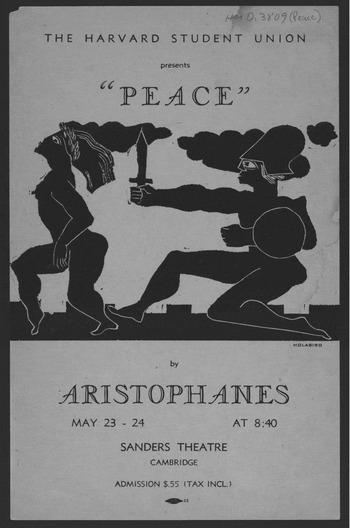
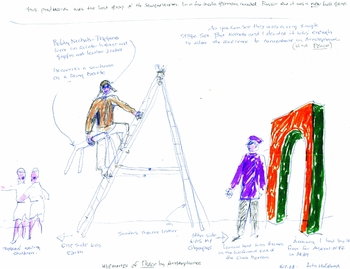
Although no photographs of the production—which took place exactly one month after the “peace strike” on campus (mentioned above)—are to be found in the Harvard University archives, some sense of its visual aspects may be drawn from a contemporary linocut that was published in the Progressive and a recent “visual remembrance,” both by John A. Holabird, the set designer for Peace and active member of the Union. Holabird, who went on to work for his family's well-known Chicago-based architectural firm, Holabird and Root, gave the production (and The Progressive) a distinctive look with his bold sense of line and color (Figs. 1 and 2; the latter is also posted in color in the online version of this issue at www.journals.cambridge.org/sam).
John A. Holabird, Jr., flier for Peace. Reproduced by permission of the artist.

John A. Holabird, Jr., visual remembrance of Peace. 17 April 2008. Ink on paper, 12″ × 9″. Published by permission of the artist.

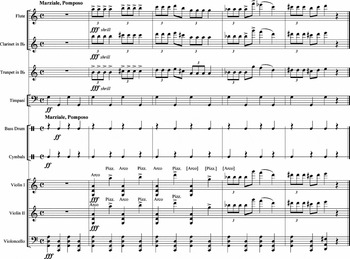
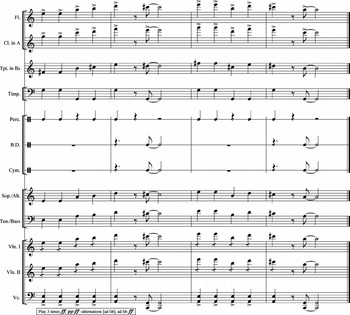
Edward Fox was a generative force for Peace, too, inviting Bernstein to write incidental music for the Union's production. Bernstein, at the time, had just finished his studies at the Curtis Institute in Philadelphia and was back in Boston looking for work.Footnote 39 The instrumentation was for a small theater orchestra: flute, clarinet (in B-flat and A), B-flat trumpet, two violins, cello, and percussion. Although Bernstein's score for Peace does not rank among his best-known works for the theater, echoes of it survive in later Bernstein musicals. The renowned documentary filmmaker Ricky Leacock (Harvard Class of 1941), who also worked on Peace, recalled that the music for the “March of the God of War” was later recycled as the chase music in On the Town (Example 1). Furthermore, Fox remembered the conga line at the end (Example 2) suggesting an early instance of Bernstein's fascination with Latin-tinged music—which also happens to be the way in which Act 1 of Wonderful Town closes. Furthermore, the use of a variety of percussion instruments, as well as indeterminate pitches for the timpani, combined with a liberal sprinkling of woodwind effects, such as flutter-tonguing and glissandi, helped make Bernstein's score as “theatrical” as what was happening on stage.
Leonard Bernstein, “March of the God of War,” from Peace, mm. 1–5. Leonard Bernstein Papers, Library of Congress. By permission of the Leonard Bernstein Music Publishing Company LLC.

Leonard Bernstein, “Conga,” from Peace, mm. 1–9. Leonard Bernstein Papers, Library of Congress. By permission of the Leonard Bernstein Music Publishing Company LLC.

The intersection of a brassy, rollicking score with Aristophanes’ ancient Greek play resulted in a thoroughly irreverent production. The play opens with the farmer Trygaeus attempting to appeal to Zeus for peace among humanity. To obtain an audience with the god, Trygaeus procures and feeds a giant dung beetle, which he then proceeds to ride to the heavens. Leacock called Bernstein's accompanying music “drunken” and vividly recalled the bawdy set-up for the opening:
We had an enormous stepladder in the middle of the stage at Sanders Theater. The dung beetle was a carpenter's sawhorse, with two balls and a tin can underneath as the penis, and that was the dung beetle. The dean of Radcliffe came down and attended a rehearsal, and insisted that we not have the two balls attached, that it was vulgar. So we put three balls, and that made them happy. It was a huge success.Footnote 40
Even though Peace was conceived as an antiwar protest, Fox's and Leacock's recollections suggest that the Union production delivered the play's political message with a good dose of comedy—a levity that is generally absent in, for example, essays that appeared in the Progressive.Footnote 41
Why did the Harvard Student Union develop such a bawdy sense of humor in its final production? There could be many reasons, but the most plausible one looks back to 1939, when Bernstein worked on the Harvard Greek Club's production of The Birds. This production—which was performed entirely in the original Greek—relied on thoroughly updated costumes and staging, as well as the addition of incidental music composed by Bernstein, to make the action intelligible to a contemporary audience, most of whom did not understand Greek.Footnote 42 Although Peace was performed in English, the success of The Birds probably pushed Bernstein, and others involved in the show, in the direction of relying on contemporary popular idioms to convey Aristophanes’ message. Furthermore, Bernstein's impulse to riff on existing traditions would also be evident later, as in his reworking of the Romeo and Juliet theme in West Side Story, or with the vocal trio that comments on the action in his opera Trouble in Tahiti, a trio that Carol Oja has described as “serving the function of a Greek chorus yet doing so with the scat and bounce of the Andrews Sisters.”Footnote 43
***
Bernstein's work with the Harvard Student Union yielded one of his earliest documented involvements in an explicitly political organization—and was also among his earliest connection with shows for the public stage. The events surrounding the Union's production of The Cradle Will Rock suggest that even if Bernstein was solely responsible for the rehearsal and production of Blitzstein's work, he operated in an environment in which many others shared his commitment to the play and were willing to help produce it in an incredibly short time. Furthermore, whatever his view of the Union's political activities, Bernstein must have known that working with this organization guaranteed him a large audience. What little is known about the music and production of Peace suggests that Bernstein's vibrant compositional language, and his penchant for mixing classic and modern, highbrow and lowbrow in his musicals was already being honed by 1941.
Bernstein's involvement with the Union also highlights a paradox of fame. The Harvard Student Union was not unlike many organizations on other campuses at the time, operating under the national leadership of the American Student Union. Despite the number of important figures involved in the shows, the group's theatrical productions might have otherwise gone unstudied were it not for Bernstein's later success as a musician. Yet looking closely at Bernstein's involvement in the Union necessarily causes his own role to recede, while the organization assumes significance as a nexus of leftist political organization on campus during the late 1930s. Although my interest in the Harvard Student Union's productions began with Bernstein, it has become the story of a number of individuals converging for a shared purpose.
These intertwined musical and political networks, and their centrality to the story at hand, is perhaps the most important outcome of considering Bernstein's involvement with the organization. On the one hand, The Cradle Will Rock and Peace are early examples that illustrate how Bernstein thrived in collaborative environments, a feature of much of his best work throughout his compositional career. Any additional information about his early years helps to set the stage for exploring his later collaborations with individuals such as Betty Comden and Adolph Green (to name but one creative team with which he worked). On the other hand, his association with the Union calls into question when his often-shifting political sensibilities began to develop. It seems safe to conclude that his frequently ambiguous relationship with political groups and causes—something that continued throughout his life—was already established by his early twenties.