1. Introduction
About a decade ago, Naomi Klein published her book The Shock Doctrine (Klein, Reference Klein2007), in which she makes several stark claims about the character of liberalizing reforms – i.e. reforms that reduce the size of government, entail deregulation, strengthen the protection of property rights, and open up the economy to international trade and capital movements.Footnote 1 One of her main ideas is that since liberalizing reforms disfavor people in general, the political sponsors of such reforms – whose goal, according to her, it is to make the rich richer – take advantage of, and even at times initiate, crises of various kinds to impose them on confused, ignorant, and powerless voters. Klein cites Milton Friedman as an example of an economist who sees crises as opportunities for pushing through “neoliberal” reforms:
Only a crisis – actual or perceived – produces real change. When that crisis occurs, the actions that are taken depend on the ideas that are lying around. That, I believe, is our basic function: to develop alternatives to existing policies, to keep them alive and available until the politically impossible becomes politically inevitable. (Friedman [Reference Friedman1962] 1982: ix)
If Klein's understanding of how the politics of reforms works is correct, it is not unreasonable to expect voters, once they become aware of the nature of these reforms and how they were implemented, to reduce support for the political sponsors and to become less satisfied with the way democracy works.
This is nevertheless a rather crude understanding of how liberalizing reforms come about. Yet there are milder versions of the idea that liberalization generates negative reactions from voters. For example, Vis (Reference Vis2009) argues that if voters see reforms as being “sneaked through” in a time of crisis, without the purpose or effect of improving the crisis situation, an opinion backlash is to be expected. Hollanders and Vis (Reference Hollanders and Vis2013) find support for the claim that unpopular reforms are undertaken during economic downturns, and argue that it is because the government will most likely be voted out of office in the next election anyway. Moreover, Ponticelli and Voth (Reference Ponticelli and Voth2011) detect a relationship between budget cuts and social unrest in Europe, indicating discontent with reductions in government expenditure. Similarly, Lee et al. (Reference Lee, Jensen, Arndt and Wenzelburgerforthcoming) find that welfare state cutbacks in Britain and Denmark are associated with reduced (and expansions with more) government support.
Still, it is not certain that voters react with discontent when reforms are undertaken. If the real consequences of reforms are deemed to be beneficial, and if the ways in which they are implemented are viewed as legitimate, it could be that people rather react favorably to liberalizing reforms. One indication of this is given by Buti et al. (Reference Buti, Turrini, Van den Noord and Biroli2009), who find that voters reward politicians who undertake structural reforms if financial markets are well-functioning, so as to “bring forward” future yields of reform to the present, thus allowing voters to put less weight on possible short-run costs.
Against this background, we develop a simple theoretical framework and investigate empirically how liberalizing reforms and satisfaction with democracy are related. This research question stems from claims, alluded to above, that the reactions are bound to be predominantly negative. Whether this is the case has not, to our knowledge, so far been tested in a rigorous manner.
Our study makes use of panel data for 30 European countries in the period 1993–2015. The outcome variable is the question “On the whole, are you very satisfied, fairly satisfied, not very satisfied or not at all satisfied with the way democracy works (in your country)?” from the EuroBarometer. As measures of reform, we use distinct changes in the four separate components of (1) the economic freedom index of the Heritage Foundation and Wall Street Journal, (2) government size, (3) the rule of law/protection of private property, (4) market openness and regulation. We add a set of economic and political controls.
The findings imply that liberalizing reforms are not followed by negative popular reactions against the democratic system. Reforms that change the size of government are not related to satisfaction with democracy in a robust manner, but when there is statistical significance, the results imply that expansions of government are negatively related to our outcome variable. We find more robust results for the other three types of reforms. When they reduce economic freedom, they are related to satisfaction with democracy in a negative way, and when they increase economic freedom they are positively associated with satisfaction with democracy.
A central motivation for our study is that it provides new knowledge about how voters in general react to reforms. Decision-makers arguably pay close attention to the perceived popularity of the policy changes they are considering. If they expect a measure to lead to a voter backlash, they may very well refrain from it even if it has beneficial welfare consequences. Since beliefs about voter reactions are important determinants of whether reforms come about or not, it seems essential to provide accurate information about how voters really do react.
2. Theoretical framework
The political process
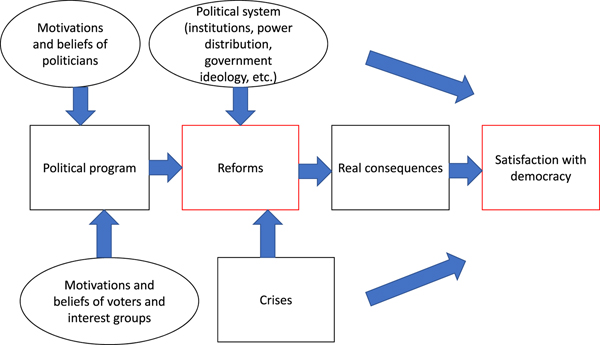
How can liberalizing reforms, and the democratic system in which they are produced, be linked to voters’ assessments of how the democratic system of their country works? Our theoretical framework, which informs our ensuing empirical analysis, is presented in Figure 1. It links reforms to voter satisfaction with democracy.
Reforms in the political process and satisfaction with democracy

A starting point is the formulation of political programs, typically by parties. Such programs are influenced by the motivations and beliefs about how the world works on the part of politicians of the different parties, who then compete in the electoral process, but also by the motivations and beliefs of voters and interest groups (Mueller, Reference Mueller2003; Strom, Reference Strom1990). In other words, while politicians are intrinsically motivated to pursue a particular political program, they all strive to get political power by attracting many voters and by getting support from interest groups. This implies a possible trade-off when the political programs are decided on (Peltzman, Reference Peltzman1976). The politicians pick the program, sometimes in an entrepreneurial fashion (De Vries and Hobolt, Reference De Vries and Hobolt2012), that gives them the highest expected welfare (broadly conceived), considering these three margins of adjustment.
The political programs are inputs into the actual legislative decision-making process, which is affected by the design of the political institutions and the actual power distribution among parties (and other actors in the overall system of democratic governance). The party or parties in power try to implement reforms in accordance with their political program (influenced by their ideology, traded-off against the perceived wishes of voters and interest groups). In this, they might take advantage of, and possibly even cause, crises (Bjørnskov and Rode, Reference Bjørnskov and Rodeforthcoming; Friedman [Reference Friedman1962] 1982). Whatever the cause of a crisis, politicians may use it to facilitate acceptance in the legislature of reform proposals, either because voters and interest groups will be open to change in an adverse situation or because they will not pay attention (which enables unpopular reforms to be pushed through). When a reform has been implemented, it has real consequences – affecting various socioeconomic outcomes such as economic growth, income and wealth distribution, unemployment, welfare benefits, etc.
Lastly, voters will assess the real outcomes and the working properties of the democratic system, which yields a degree of satisfaction with it.Footnote 2 Regarding the working properties, voters may, for example, care about whether reforms are sneaked through or decided on in a transparent manner (these latter grounds for voter assessments are illustrated by the arrows from the political system and crises to voter satisfaction with democracy).
The reforming politicians, before initiating reforms, presumably predict that they will turn out to benefit them electorally in the end, either by voters supporting the reforms (in due course) or by having voters not notice them (while interest groups, for example, might notice them and increase their support) – but whether this proves to be the case is uncertain. Politicians do not have perfect knowledge of voter responses, and it is especially hard to know how they will react since voter satisfaction with democracy is based both on a factual assessment, which can be erroneous, and on a subjective weighting of the real consequences of reforms and how they came about. That voters are not in possession of all the facts, and that they may even be mistaken, opens up for them to be affected by emotive and epistemic factors, implying that the same real consequences and ways in which reforms came about can be perceived and evaluated differently. If voters are not perfectly accurate in their understanding of the world, they are bound to be influenced by how friends, public figures and the media present the issues.Footnote 3
We capture these considerations in the following way:
 $$\eqalign{{\rm Satisfaction}\;{\rm with}\;{\rm democrac}{\rm y}_i = & \,\psi _i(\alpha _i\lpar {{\rm real}\;{\rm consequences}\;{\rm of}\;{\rm reforms}} \rpar {\rm} \cr & + {\rm \beta} _i\lpar {{\rm the}\;{\rm way}\;{\rm reforms}\;{\rm came}\;{\rm about}} \rpar ),} $$
where ψi ∈ [0,1] denotes the degree of precision or accuracy in voter i’s perceptions of the real consequences of reforms and the way they came about, and where αi and βi are the subjective weights voter i accords to each factor in his or her assessment.
Four cases
On the basis of equation (1), one can first distinguish between four “corner” settings, illustrated in Table 1, where “good” and “bad” refer to the objective character of the real outcomes and the way reforms came about. Second, one can distinguish between ψi = 1 and ψi = 0, which in the latter case transforms the objective data into a subjective factual assessment of voter i. In the following, we discuss the four cases in turn, assuming the reforms in question to be of a liberalizing kind.
Four combinations of voter assessments of reforms

A. Good real outcomes, good way of having reforms come about. This implies increased satisfaction with democracy if ψi is 1, but if it is 0, then it is ambiguous how satisfaction with democracy is affected.
B. Bad real outcomes, good way of having reforms come about. This case is fundamentally ambiguous: satisfaction with democracy can either increase or decrease even if ψi is 1 – it depends on whether the voter puts a greater weight on one of the effects than on the other. As in case A, ambiguity applies when ψi is 0.
C. Good real outcomes, bad way of having reforms come about. The same reasoning logically applies here as in case B.Footnote 4
D. Bad real outcomes, bad way of having reforms come about. This implies decreased satisfaction with democracy if ψi is 1, but if it is 0, then it is ambiguous how satisfaction with democracy is affected.
Against this background, two questions emerge. First, which case corresponds to the thesis that liberalizations undermine satisfaction with democracy? Second, if one considers the objective facts, is this thesis supported and, if not, which of the four cases is then the most plausible competing thesis?
The thesis that liberalizations reduce satisfaction with democracy
We propose that the thesis that liberalizations reduce satisfaction with democracy corresponds to case D, but it can in principle take one of two forms, depending on what is assumed about ψi. If the value is assumed to be 0, it would indicate that politicians use crises to take advantage of ignorant people in order to undertake liberalizing reforms that entail bad real outcomes for them. Here, it is unclear whether most people will become more or less satisfied with democracy after such reforms, since they probably rely on emotional or populist impulses to evaluate their satisfaction with democracy in the wake of the reforms, and their overall evaluation depends on who they are influenced by. If a rich elite favored by the politicians through the reforms also owns the media, through which they can portray what is going on as generally beneficial, which may then be believed by people in general, voters can still become more satisfied with democracy. Conversely, they might primarily listen to politicians on the left, in which case they are bound to interpret the reforms negatively, with reduced satisfaction as a result. On the other hand, if ψi is assumed to be 1, under case D, liberalizing reforms not only hurt voters but are also strongly disliked, both because of the real outcomes and the deceitful ways in which they came about, which reduces satisfaction with democracy.
To conclude, arguably the most straightforward prediction emerging from the Naomi Klein type of analysis is a negative relation between liberalizing reforms and satisfaction with democracy, but the full effect hinges on an assumption of voters being aware of the facts and that these are such that both outcomes and implementation methods are bad. Conversely, a positive relation between liberalizing reforms and satisfaction with democracy, on this view of the world, implies that voters are both uninformed and misled by those who supposedly stand to gain from the reforms.
An evaluation and a competing thesis
We next turn to the second question, whether there is reason to think that the thesis of a negative relationship between liberalizations and satisfaction with democracy holds and, if not, which of the four cases in Table 1 that offers the most plausible competing thesis. This is a difficult task, since the three variables of interest – ψi, the real consequences of reforms and the way in which reforms come about – are hard to assess in a general manner.Footnote 5 We nevertheless offer an (admittedly somewhat speculative) analysis.
First, regarding the accuracy with which voters interpret objective reality, there is a literature on voter ignorance that suggests that ψi for the typical i is low: see e.g. Caplan (Reference Caplan2007), Somin (Reference Somin2016) and Achen and Bartels (Reference Achen and Bartels2017). Assuming this to be the case, any type of relation between liberalizing reforms and voter satisfaction with democracy is possible, since voter assessment is not based on factual evaluation but on subjective impressions. However, ψi is probably not 0, and the closer it is to 1, the more precise predictions of the relation are possible, depending on the assessed real consequences of reforms and the way in which they came about.
Second, regarding the real consequences of reforms, the overall evidence seems to point at generally beneficial consequences of liberalizations – e.g. trade liberalization often comes with higher growth rates (Wacziarg and Welch, Reference Wacziarg and Horn Welch2008), as do market-oriented reforms in transition countries (Falcetti et al., Reference Falcetti, Lysenko and Sanfey2006). Moreover, deregulation seems to lead to higher investment (Alesina et al., Reference Alesina, Ardagna, Nicoletti and Schiantarelli2005) and more entrepreneurship and employment growth (Bruhn, Reference Bruhn2011). Studies looking at how more market-oriented policies and institutions relate to various outcomes also tend to find positive effects overall – for a general overview, see Hall and Lawson (Reference Hall and Lawson2014); for findings regarding effects on economic growth, see Justesen (Reference Justesen2008), and on happiness, Gehring (Reference Gehring2013) and Rode (Reference Rode2013). Still, distributional effects differ between countries, reforms and groups of people; and there is often a J-curve effect, such that liberalization entails bad outcomes in the short run but positive ones in the long run (Foster, Reference Foster2008).Footnote 6 But if one assumes consequences to be good overall, this points at cases A or C in Table 1 as being correct.
Third, can we differentiate between A and C by seeing how reforms come about? It does seem to be the case that economic crises are drivers of market-oriented reforms: see e.g. Drazen and Grilli (Reference Drazen and Grilli1993), Pitlik (Reference Pitlik2008), and Pitlik and Wirth (Reference Pitlik and Wirth2003).Footnote 7 However, even though this is a necessary condition for the thesis that liberalizations lead to dissatisfaction with democracy holding, it is not sufficient, since it is not necessarily the case that reforms undertaken due to crises are implemented in a deceptive or non-transparent manner. Rather, they might very well be perceived as legitimate if they are seen as possible remedies for the problems brought about by a crisis if undertaken openly;Footnote 8 and if there is a conflict between voters and interest groups, crisis may help politicians to break free of interest group influences to initiate socially beneficial reforms that would otherwise be blocked (Olson, Reference Olson1982). The fact that liberalization has been adopted in many countries over the past decades in a process of policy diffusion – see e.g. Simmons and Elkins (Reference Simmons and Elkins2004) and Pitlik (Reference Pitlik2007) – might furthermore be taken to suggest that reforms may best be seen as “idea-driven,” rather than a result of national interest groups trying to secure more wealth for themselves. Also, Rode and Gwartney (Reference Rode and Gwartney2012) find that democratization is beneficial to economic liberalization, at least if it is stable, in which case they find clear effects in the first ten years after democratization. That is, more popular and transparent decision making seems to go hand in hand with liberalizing reforms, somewhat undermining the idea that reforms typically result from bad modes of implementation. Even though somewhat speculative, we think more arguments speak in favor of case A than case C in Table 1, as we do not find strong indications of introducing reforms being introduced in a malicious or deceitful manner.
To conclude, we believe that the strongest thesis competing to that of Naomi Klein and others thinking along similar lines (case D) is that of case A. It suggests that liberalizing reforms generally both entail good real outcomes and come about in a good way, which suggests a positive relation between such reforms and voter satisfaction with democracy, at least if voters have a reasonable knowledge of the facts. If they do not, then even case A may be linked to voter satisfaction in a negative way (pointing perhaps at the dangers of populism).
3. Data and econometric approaches
Our data cover 30 European countries observed between 1993 and 2015.Footnote 9 The dataset is an unbalanced panel, as not all countries are included in it from 1993. Including a lagged dependent variable therefore yields a total of 454 observations with full data. Our dependent variable is a measure of satisfaction with democracy and is based on EuroBarometer (2017) data. The basic question is: “On the whole, are you very satisfied, fairly satisfied, not very satisfied or not at all satisfied with the way democracy works (in your country)?” with the reply alternatives coded as 4, 3, 2, and 1 in our data. These data vary between scores close to 1.6 in, for example, Bulgaria and Italy to almost 3.3 in Denmark, Luxembourg, and Sweden in recent years. However, the EuroBarometer has changed its main questionnaire several times, which means that this measure is not available for 1996, 2002–2003 or 2005–2011. Following the approach in Berggren et al. (Reference Berggren, Bjørnskov and Lipka2015), we therefore impute values according to the process documented in the Online Appendix.
As for our outcome variable, one can, in principle, investigate several types of popular reactions to liberalizing reforms where one type would be to measure voter evaluations of specific policies or governments. However, this kind of measure is not available for our sample. An alternative, which we use here, is measuring satisfaction with democracy in one's country, which we consider useful in at least two ways. On the one hand, the Naomi Klein argument largely concerns satisfaction with, or confidence in, the democratic system as such – especially since she stresses that liberalizing reforms are typically pushed through the political system in times of crisis, when few are paying attention or when few have the ability to question what is being done. Klein argues that these reforms are democratically illegitimate, which would make voters less satisfied with their political institutions. On the other hand, even if one does not presume that liberal reforms are implemented in such a manner, it is still possible to consider our satisfaction measure as a “lower-bound” type of measure of voter contentment. If we capture voters becoming less confident in democracy as a system, it is also highly likely that they have disliked specific policies or governments prior to that, and quite strongly. However, if voters come to appreciate the democratic system in their country more as a result of liberal reforms, this does not necessarily imply that they approve of specific policies or governments – it might mean that they think the democratic system as such has worked well in relation to the adoption of these reforms.
Our main variable of interest is reforms and whether they are liberalizing or de-liberalizing. The basic data derive from the Index of Economic Freedom published annually by the Heritage Foundation (2017), one of the most used measures of the degree to which various policy areas and formal institutions are market oriented. We make use of the four components of this index: the size of government, the rule of law/protection of private property, market openness and regulation, each of them measured on a scale from 0 to 100 (increasing in economic freedom). The smaller the government, the stronger the rule of law/protection of private property, the more open the economy and fewer regulations of the business sector, the higher the score. Consistent with several studies exploring the dimensionality of economic freedom, we aggregate the rule of law, regulation and market openness indices into a single index while keeping government size separate (Heckelman and Stroup, Reference Heckelman and Stroup2005; Ott, Reference Ott2018; Rode and Coll, Reference Rode and Coll2012; Sturm and de Haan, Reference Sturm and De Haan2015). In the Online Appendix, we report estimates using all four components separately.
We follow the main approach of Berggren and Bjørnskov (Reference Berggren and Bjørnskov2017) to identify reforms, using dummy variables. The idea is to look at distinct, substantial changes in the four indicators of economic freedom and not just any continuous change. We create two sets of reform dummies by separating the observations of period-to-period changes in each economic freedom variable into three groups of equal size. We then form one set of dummies for large positive changes, which we denote “liberalizing reforms,” and another set of large negative changes denoted “de-liberalizing reforms.’ We estimate their effects compared to the middle third of the observations with small or no changes in economic freedom. These reforms include different types of reforms, and fiscal reactions to the financial crisis, such as increases in government size in Denmark, Estonia and Finland in 2010 (de-liberalizing government size reforms), regulatory modernization and liberalization of the fuel market in Turkey in 2010, and the Berlusconi government's attacks on judicial independence in Italy in 2004.”
We moreover include a set of control variables, capturing economic circumstances, political institutions and features of politics. More specifically, we employ a baseline that includes the lagged annual growth rate of GDP per capita, and a dummy for crisis or recession (coded as 1 in all years in which growth is negative), both coded on the basis of PPP-adjusted GDP data from the World Bank (2017); and government ideology, the Herfindahl index of the legislature, and a dummy for minority government, all of which we take from Berggren and Bjørnskov (Reference Berggren and Bjørnskov2017). In further tests, we also include the inflation rate, the rate of unemployment – both from World Bank (2017) – and the Gini coefficient of net income inequality from SWIID (Solt, Reference Solt2009). We prefer to add these final variables as additional tests instead of as part of the baseline, as all three can be seen as likely transmission mechanisms between reforms and voters’ satisfaction with democracy.Footnote 10
Our econometric approach consists of estimating satisfaction with democracy including its one-year lagged value. We include a full set of year and country fixed effects such that all common shocks, such as business cycle fluctuations and common political influences, are subsumed in the annual fixed effects. Likewise, all approximately time-invariant features (geography, constitutional features, etc.) as well as country-specific long-run trends are subsumed in the country fixed effects. This choice also alleviates the ever-present endogeneity problem, as our approach effectively implies that we are regressing the effects of reforms on subsequent changes in satisfaction with democracy. This means that most sources of endogeneity bias, such as that arising when high levels of initial satisfaction with democracy potentially make reforms more likely, are taken care of by the lagged dependent variable. However, as a result of including a lagged dependent variable, our estimates will suffer from Nickell bias. We nevertheless believe that this is a negligible problem, as the size of Nickell bias is approximately 1/T, where T is the length of the panel. With a T of 22 years for most countries in the sample, the bias is approximately 5% and thus a small price to pay for alleviating the more serious endogeneity problem.
In a final set of estimates, we interact our reform variables with four factors that proxy for characteristics relevant to the perception of the reforms: a left-wing dummy, a crisis dummy, a dummy for minority government, and a dummy for whether the year of the reform is an election year. The left-wing dummy captures the diverse implications of issue ownership theory and of potential Nixon-goes-to-China effects, while the crisis dummy captures Friedman's ([Reference Friedman1962] 1982) basic argument more precisely. Finally, the dummies for minority government and election years capture the fact that with either a minority government or an election, it is difficult for voters to assign blame or credit for reforms to any particular party, bloc, or government. In the text, we interpret the interaction effects given their conditional standard errors calculated by the delta method (Brambor et al., Reference Brambor, Clark and Golder2006).
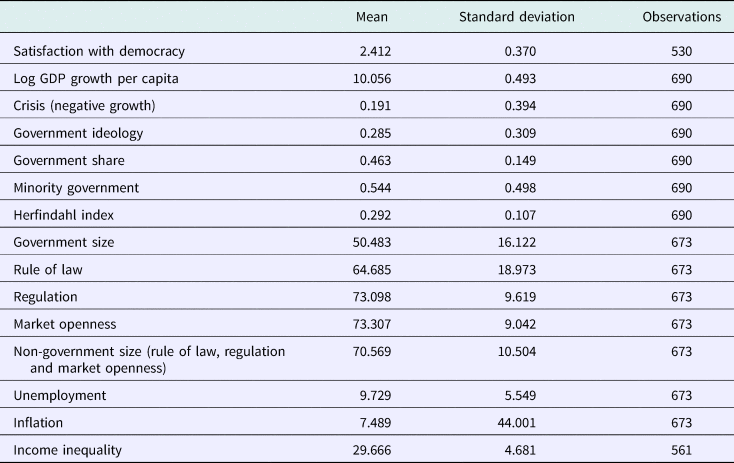
Descriptive statistics are presented in Table 2.
Descriptive statistics

4. Main results
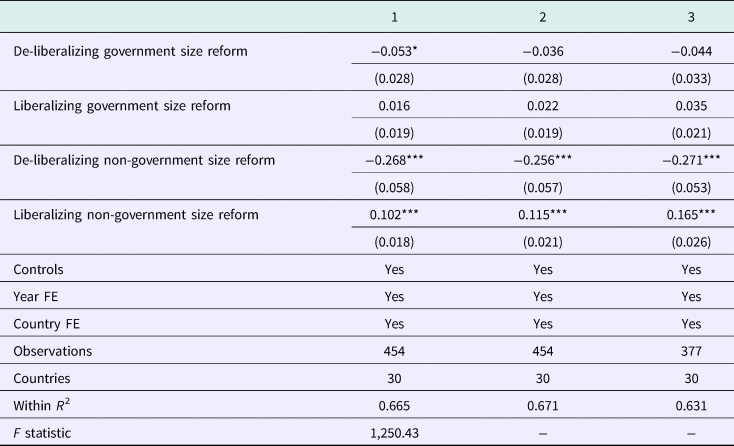
Our main results are presented in Table 3.
Reforms and satisfaction with democracy

Notes: The full specification includes: lagged satisfaction with democracy, growth, crisis, government ideology, Herfindahl index, minority government; in column 2, also unemployment; in column 3, also unemployment, inflation, and income inequality. It is available in Table A1 in the Online Appendix. *** (**) [*] denote significance at p < 0.01 (p < 0.05) [p < 0.10].
Looking at the reform results, there are some indications that an expansion of government size is related to lower satisfaction with democracy, but the finding is not very robust. On the other hand, the aggregate measure containing the three other indicators of economic freedom seems rather robustly related to satisfaction with democracy, and in a largely symmetrical fashion: De-liberalizing reforms are negatively related to satisfaction with democracy, while liberalizing reforms are related to satisfaction with democracy in a positive way. Thus, our findings do not corroborate the most straightforward interpretation of the thesis that liberalizing reforms undermine satisfaction with democracy: If anything, the general pattern is the other way around. Nor do they support the idea that status quo bias is an important factor, since liberalizing and de-liberalizing reforms tend to have opposite effects, whereas people who dislike change per se would be dissatisfied with both. Liberalizing reforms do not seem to come at a political cost; rather, the democratic system is deemed more satisfactory after their implementation.
Table A1 in the Online Appendix provides the full specification underlying Table 3. From that table, we note that satisfaction with democracy is relatively stable over time, as indicated by the highly significant and sizeable coefficient on the lagged dependent variable. We also note that economic growth makes people more satisfied, while crises, defined as episodes of negative growth, do not robustly relate to satisfaction. The political situation matters, as both minority and left-wing governments are associated with lower satisfaction.
Online Appendix Tables A2 and A3 provide disaggregated results, enabling us to see what specific type of reform drives the results for the aggregate variables with three indicators of economic freedom. It turns out that the most immediately important type of reform here is liberalizations that increase market openness, such as reductions in protectionism and the removal of obstacles to capital movements. We nevertheless prefer not to interpret these differences strictly, since the way we code reforms implies that we do not pick up that the size of reforms differs across the three components. The time it takes to fully implement reforms can also differ, making it difficult to pinpoint the effects of an identifiable reform to a particular year, when reforms are implemented over several years. In addition, there could also be some joint effect when reforms of the three types are undertaken together that we miss when only looking at disaggregate results.
5. Interaction results
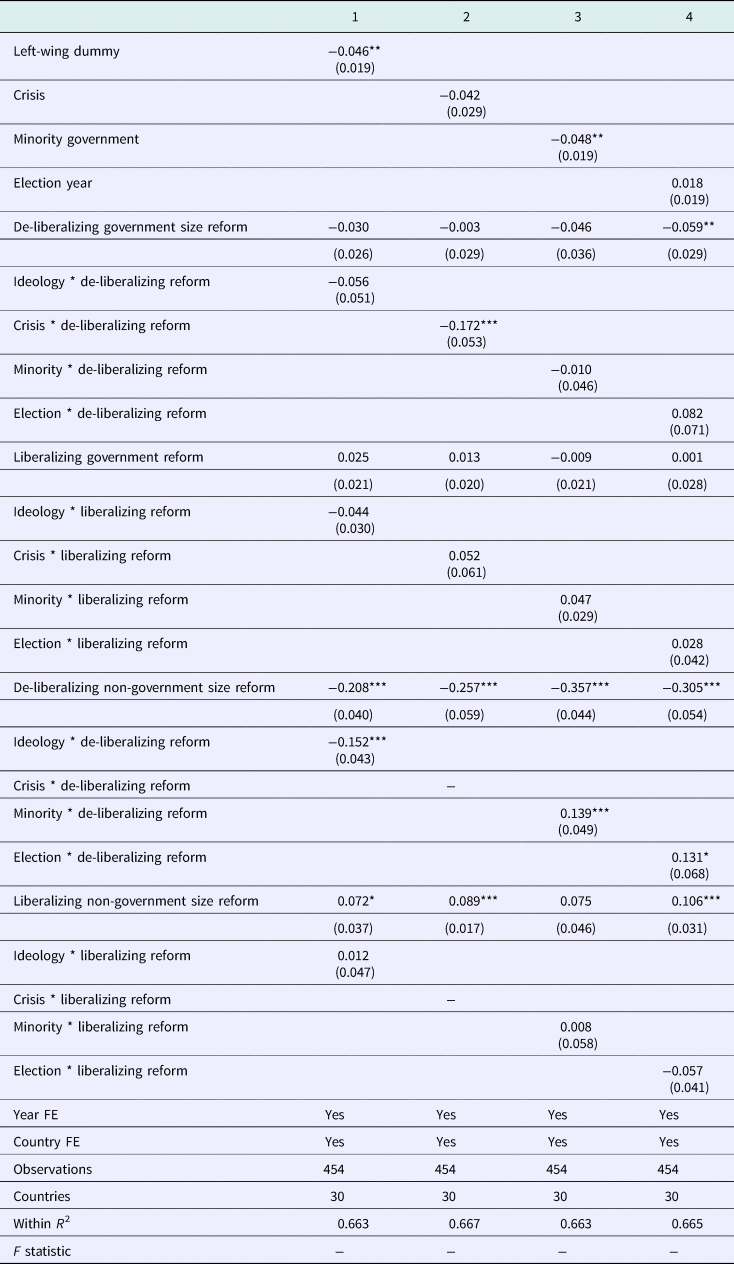
As indicated in Figure 1, it could be that the effect of reforms on satisfaction with democracy are influenced by other factors, such as government ideology, whether there is a crisis, the type of government and whether it is an election year.Footnote 11 We therefore interact our reform dummies with these four variables, and we present the results in Table 4.
Reforms and satisfaction with democracy, interaction results

Notes: *** (**) [*] denote significance at p < 0.01 (p < 0.05) [p < 0.10].
Starting with government ideology, we use a dummy that takes the value 1 if the government is left-wing and 0 otherwise. We do so since two theories suggest that government ideology may play a role in the reform process. On the one hand, right-wing governments may not only be more likely to undertake liberalizing reforms (as indicated by Besley and Case, Reference Besley and Case2003; Potrafke, Reference Potrafke2010). Issue ownership also theorizes that voters perceive right-wing parties to be more competent at handling reforms, while voters tend to perceive left-wing parties to be better or more competent at handling social issues such as unemployment problems (Petrocik, Reference Petrocik1996; Stubager and Slothuus, Reference Stubager and Slothuus2013). On the other hand, Cukierman and Tomassi (Reference Cukierman and Tommasi1998) hypothesize that left-wing governments may be less likely to suffer losses of popularity or legitimacy when undertaking liberalizing reforms, and right-wing governments similarly would be more protected from popularity losses when expanding the size or scope of government. In their “Nixon-goes-to-China” argument, the ideologically “wrong” government is more likely to be able to communicate credibly to voters that such reforms are objectively necessary. As can be seen in column 1, de-liberalizing reforms that involve the aggregate of three reform indicators other than changes in government size are negatively related to satisfaction with democracy – and much more so if the government is left-wing. This could be interpreted as voters being especially dissatisfied with de-liberalization if it occurs in a context of general left-wing policies, which is consistent with issue ownership theory.Footnote 12 Moreover, liberalizing reforms are, again, shown to be positively related to satisfaction with democracy, but we find no difference depending on government ideology here.
Continuing with crises, we use the incidence of negative growth (a dummy variable) as the indicator, and find, in column 2, that reforms that increase the size of government and that are undertaken during crises are negatively related to satisfaction with democracy.Footnote 13 Otherwise, we find no indication of crisis effects, but it is confirmed again that liberalizing reforms tend to relate positively, and de-liberalizing reforms negatively, to satisfaction with democracy.
In column 3 we interact with minority governments (a dummy variable). We do so for two reasons. First, it is possible that the presence of this type of government involves some understanding on the part of voters that minorities may, at times, have to act in ways that satisfy a majority, and hence cannot be held responsible to the same degree as other governments. Second, it also remains a possibility that minority governments are better at reaching and communicating a political consensus when implementing reforms, although it may entail higher costs (Kontopoulos and Perotti, Reference Kontopoulos, Perroti and Poterba1999). Regardless which mechanism is at work, we find that while the estimate of de-liberalizing reforms, involving the three types of reforms other than changes in government size, again takes a negative sign, a minority government in fact reduces the size of the estimate.
Lastly, we look at whether an election year affects the relationship between reforms and satisfaction with democracy. We include this because estimates in election years are likely to be biased. If, for example, an unpopular reform occurs before an election and the incumbent government subsequently loses the election, satisfaction with democracy might increase despite the a priori negative reform effect. Voters may simply interpret the reform and election loss as an indication that democracy works as intended. We find an effect for de-liberalizing reforms of the three reform indicators other than changes in government size: An election year reduces the negative estimate. It could be that during election years, whatever is decided is fine-tuned to the desires of the voters, as there is more transparency due to campaign activities and media reports, which reduces discontent among voters.
Taken together, the pattern reported in the main analysis is confirmed here: Reforms that involve government size are rarely statistically significant; reforms that involve the other three reform areas typically are. The general pattern is that de-liberalizing reforms in this case stands in a negative relation to satisfaction to democracy, and that liberalizing reforms displays a positive association with this outcome variable. Left-wing governments increase the negative estimate, while minority governments and election years reduce the size of the still negative estimates. Crises only seem to matter when government size increases, and then they make the effect on satisfaction with democracy much more negative. These findings are robust to a number of further tests with additional interacting factors and an alternative and broader measure of satisfaction with society.
6. Robustness tests
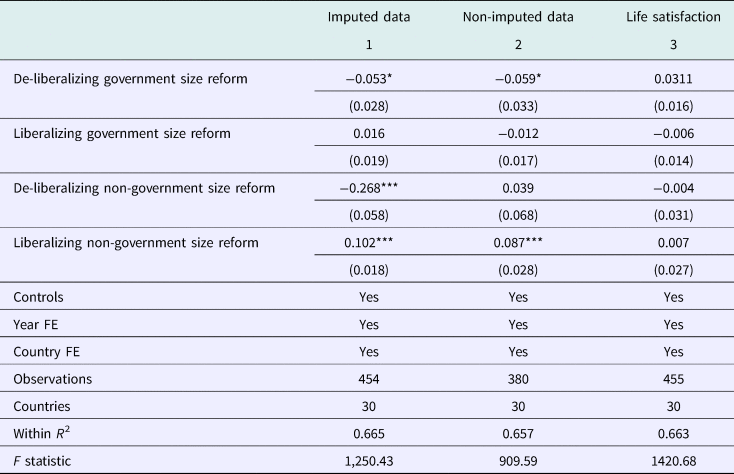
We have conducted a number of robustness tests in order to see if the main results withstand various changes to the way we conduct the empirical analysis. We first run the regressions of Table 3 on non-imputed data only. The key findings are presented in column 2 of Table 5 (with a full specification in Table A4 in the Online Appendix). As can be seen, the results hold with the exception of the point estimate for de-liberalizing non-government size reforms, which does not attain statistical significance in the non-imputed sample.Footnote 14
Reforms and satisfaction with democracy, non-imputed data and life satisfaction

Notes: The basis of the analysis is Table 3, column 1. The full specification includes: lagged satisfaction, growth, crisis, government ideology, Herfindahl index, minority government. It is available in Table A4 (for column 2) and Table A5 (for column 3) in the Online Appendix. *** (**) [*] denote significance at p < 0.01 (p < 0.05) [p < 0.10].
Second, we perform what we think of as a placebo test by replacing the measure of satisfaction with democracy with the EuroBarometer measure of general life satisfaction, which we report in column 3 of Table 5. The background for this test is that the changes we observe might simply be reflections of general changes in citizens’ overall evaluations of the broader society (which may include other reforms than the ones we considered). If so, we would necessarily expect to observe very similar patterns when using life satisfaction instead of satisfaction with democracy. Yet the life satisfaction results are reassuringly different; only economic growth is a common factor behind both satisfaction measures (see Table A5 in the Online Appendix).
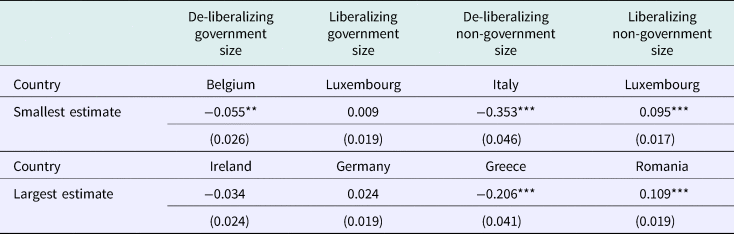
Third, we have conducted a jack-knife analysis for the main results in which we delete a single country at a time. We thereby make sure that the general results are not driven by single countries with very specific preferences or policy developments. These additional tests, with results in Table 6, show that the effects of non-government size reforms are in general very robust.Footnote 15 While the satisfaction changes following de-liberalizing reforms vary substantially depending on whether or not we include Italy and Greece, in particular, the positive effects of liberalizing reforms appear very precisely measured.Footnote 16

Fourth, we have interacted the reform measures with a measure of press freedom available from Freedom House (2017). We do so because our theoretical framework stresses that voter knowledge predictably matters in how they assess the consequences of reforms, because knowledge can be expected to be better where the media is free. While these tests do suggest that countries with more press freedom tend to see different reactions, these apparent differences are driven entirely by Turkey, which is the only country in our sample with substantially restricted press freedom. Hence, this test does not provide much empirically relevant information. Results are available upon request.
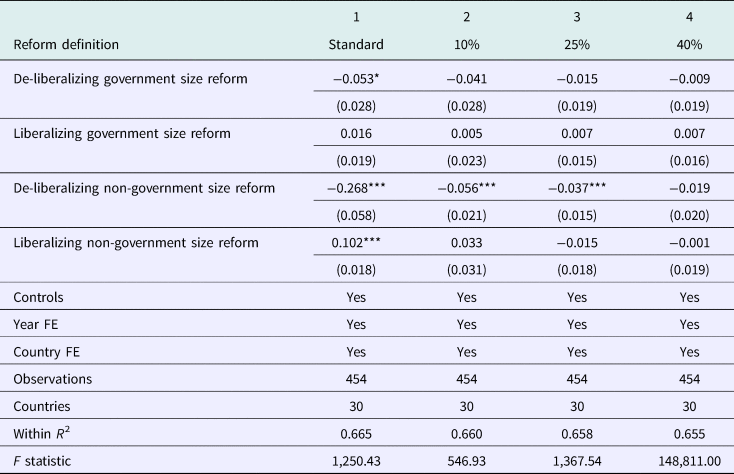
Finally, we have varied the definition of reforms. While our preferred measure divides all observations into three bins of equal size such that a third of the observations are defined as de-liberalizing reform episodes and a third are liberalizing reform episodes, here we change these cut-offs to 10%, 25% and 40%. The key results are presented in Table 7 and the full results in Table A6 in the Online Appendix. When reforms are defined very broadly (column 4), we find no significant effects. When we define them more strictly (columns 2 and 3), we continue to find that de-liberalizing reforms of non-government size indicators are consistently negatively and significantly associated with confidence in democracy. Yet the results also indicate that the smaller, positive effects of liberalizing non-government size reforms apply mainly to reforms of an intermediate size, as indicated in column 1.Footnote 17
Varying the definition of reforms

Notes: The full specification includes: lagged satisfaction, growth, crisis, government ideology, Herfindahl index, minority government. It is available in Table A6 in the Online Appendix. *** (**) [*] denote significance at p < 0.01 (p < 0.05) [p < 0.10].
7. Concluding remarks
Politically influential commentators have claimed that reforms of economic liberalization give rise to unfavorable consequences for most people and that they are pushed through, often during crises, in a non-transparent and even deceitful way. They argue that these characteristics of liberalizing reforms, to the extent that they hold and if voters are reasonably knowledgeable, make many voters strongly dislike them. In fact, one could expect voters in such a setting to become less satisfied with the political system as such, either because the reforms are perceived as having been implemented in an illegitimate way or because the outcomes are regarded as detrimental to general well-being.
Against this background, our main question is whether voters really and strongly dislike liberalizing reforms so much that they experience less satisfaction with the democratic system as a result. We find no support for this contention. In contrast, our empirical analysis indicates that when there is a statistically significant and robust relationship, it tends to be positive in the case of liberalizing reforms and negative in the case of de-liberalizing reforms. Distinct increases in economic freedom hence seem to make voters more satisfied with the way their political system works, while distinct reductions in economic freedom have the opposite effect. If we focus on reforms that increase economic freedom, our result can be connected to the four “corner settings” discussed in our theoretical section: two with objectively beneficial outcomes of liberalizing reforms (one with accurate voter knowledge, one with ignorant voters) and two with objectively detrimental outcomes of liberalizing reforms (again, one with accurate voter knowledge, one with ignorant voters). If we take previous studies seriously, outcomes are generally beneficial, and since voters appear more satisfied with how their political system works after the reforms, this is either because they accurately assess the nature of the outcomes or because they do not really grasp it but hold positive views for other reasons (through being influenced by others, maybe through media). Another feature of this outcome is that voters apparently do not think that the reforms came about in “undemocratic” ways.
An interaction analysis furthermore indicates that if the government is left-wing, the negative effect of de-liberalization increases; that crises increase dissatisfaction with reforms that expand government size; and that minority governments and election years decrease the negative effect of de-liberalization. In other words, this might be taken to suggest that voters for some reason pay attention to who decides and implements reforms, and under what economic and political conditions they do so – or at least that the outcomes that such circumstances give rise to are noticed and assessed.
Although there has been much speculation, to our knowledge, this is the first empirical demonstration of what the relationship between reforms and satisfaction with democracy actually looks like. And it shows that the most straightforward interpretation of what Naomi Klein and others have suggested has turned out to be erroneous, at least in the European context. Voters in general seem to be more satisfied with democracy when reforms introduce more economic freedom.
Supplementary material
To view supplementary material for this article, please visit https://www.dropbox.com/s/z41yahkahbpcnuo/Supplementary%20material.docx?dl=0 (accessed January 21, 2019).
Author ORCIDs
Niclas Berggren, 0000-0003-0673-5123, Christian Bjørnskov, 0000-0002-9765-913X.
Acknowledgments
The authors wish to thank Lasse Aaskoven, Luís Aguiar-Conraria, Gissur Ó. Erlingsson, Luis Kabbach, Tommy Krieger, Antonio Moreno, Peter Nannestad, Hans Pitlik, Niklas Potrafke, Martin Rode, and participants in a 2017 seminar at the University of Navarra, at the 2018 Danish Public Choice Workshop in Copenhagen, at the 2018 Public Choice Society conference in Charleston and at the 2018 European Public Choice Society conference in Rome for helpful comments. Financial support from the Swedish Research Council (grant 2103–734, Berggren), Torsten Söderberg's Foundation (grant ET4/16, Berggren), the Czech Science Foundation (GA ČR) (grant 16-19934S, Berggren), and the Jan Wallander and Tom Hedelius Foundation (Bjørnskov) is gratefully acknowledged.