Introduction
Citrus plants (Citrus spp. L., Rutaceae or Sapindales) are subtropical to tropical perennial fruit trees that are extensively cultivated in more than 150 countries worldwide with application in various food production industries for nutrients contained in fruits (Vacante, Reference Vacante2010). These plants are the most widely cultured crop among various garden products (Bobot et al., Reference Bobot, Franklin, Navia, Gasnier, Lofego and Oliveira2011; Donkersley et al., Reference Donkersley, Silva, Carvalho, Al-Sadi and Elliot2018). One of the most serious problems in citrus fruit production is a cosmopolitan pest, namely citrus red mite (CRM) or Panonychus citri McGregor (Jones and Morse, Reference Jones and Morse1984; Zanardi et al., Reference Zanardi, Bordini, Franco, de Morais and Yamamoto2015; Fazal and Imtiaz, 2016). It is a major pest of citrus orchards in northern Iran (Faez et al., Reference Faez, Fathipour, Shojaii and Ahadiyat2018). This phytophagous pest prefers to feed on leaves; however, when population density increases, it also attacks new growth flushes and fruits (Bobot et al., Reference Bobot, Franklin, Navia, Gasnier, Lofego and Oliveira2011). The feeding behavior of CRM causes serious damage to citrus plants. At first, these mites infest the lower surface of the leaves, young branches, and fruits (Faez et al., Reference Faez, Fathipour, Shojaii and Ahadiyat2018). Due to the decrease in chlorophyll content, the color of leaves changes into bronze, which affects the common process of photosynthesis as well as leaf growth (Ding et al., Reference Ding, Niu, Yang, Zhang, Dou and Wang2013). The bronze spots also appear on fruits, new flushes (Prischmann et al., Reference Prischmann, James and Wright2005), and leaves that cause the fruits to lose their sugar content and flavor (Ding et al., Reference Ding, Niu, Yang, Zhang, Dou and Wang2013). High densities of CRM can lead to severe leaf and fruit drop and eventual dieback of young branches. In addition, people who harvest the fruits are exposed to allergic and dermal problems due to the high number of these mites (Zanardi et al., Reference Zanardi, Bordini, Franco, de Morais and Yamamoto2015).
Acaricide presents a main control strategy against tetranychid mites. The use of acaricides is essential to keep the spider mite populations under economic damage thresholds, even though the short life cycle and high reproductive potential enable them to develop resistant populations (Fernandez et al., Reference Fernandez, Sancho, Simal-Gandara, Creus-Vidal, Huidobro and Simal-Lozano1997; Devine et al., Reference Devine, Barber and Denholm2001; Van Leeuwen et al., Reference van Leeuwen, Tirry, Yamamoto, Nauen and Dermauw2015). However, the widespread application of acaricides has led to a decline in natural enemies of P. citri and increased the CRM population in citrus orchards around the world (Beitia and Garrido, Reference Beitia and Garrido1991; Kasap, Reference Kasap2009). Therefore, control strategies based on integrated pest management (IPM) are urgently needed to overcome the resistance of tetranychid mites to common acaricides (Khanamani et al., Reference Khanamani, Fathipour and Hajiqanbar2013).
Host plant resistance is an environmentally and economically acceptable method in pest management and can be accompanied by other non-toxic approaches such as cultural, mechanical, or biological control methods in IPM (Golizadeh et al., Reference Golizadeh, Kamali, Fathipour and Abbasipour2009; Soufbaf et al., Reference Soufbaf, Fathipour, Karimzadeh and Zalucki2010; Abedi et al., Reference Abedi, Golizadeh, Soufbaf, Hassanpour, Jafari-Nodoushan and Akhavan2019). The use of resistant host plants is the most effective component of IPM (Vieira et al., Reference Vieira, Bueno, Boff, Bueno and Hoffman-Campo2011). Several biological characteristics of pest population are significantly affected by the quality and quantity of their food, as well as chemical and morphological features of the host plant (Levin, Reference Levin1973; Soufbaf et al., Reference Soufbaf, Fathipour, Zalucki and Hui2012). Price et al. (Reference Price, Bouton, Gross, McPheron, Thompson and Weis1980) suggested that the quality of plant materials could also influence susceptibility or resistance to different insect and mite pests. The host plant quality directly affects the life table traits of pests that are of high importance in ecological studies. Life table parameters such as net reproductive rate (R 0) and intrinsic rate of increase (r) determine the potential of a stable population to grow and reproduce in different circumstances, which help us determine the resistant citrus species and varieties against herbivores (Golizadeh et al., Reference Golizadeh, Ghavidel, Razmjou, Fathi and Hassanpour2017; Abedi et al., Reference Abedi, Golizadeh, Soufbaf, Hassanpour, Jafari-Nodoushan and Akhavan2019; Heidari et al., Reference Heidari, Sedaratian-Jahromi, Ghane-Jahromi and Zalucki2020). Therefore, the determination of pest-resistant host plants is a basic need in pest management.
Assessing the resistance of different host plants to pests may provide valuable information on their suitability for the target pest species (Tsai and Wang, Reference Tsai and Wang2001). Plants can be resistant to pest attacks through three types of mechanisms including tolerance, antixenosis, and antibiosis (Smith and Clement, Reference Smith and Clement2012). Tolerance is caused by gene series that help the plants recover after pest damage and does not affect the life table traits of pests. Antixenosis defensive mechanism prevents the pests from feeding on a plant by different morphological or chemical factors. Antibiosis occurs when a resistant host plant directly affects the biological characteristics (survivorship, development, and reproduction) of pests (Smith and Clement, Reference Smith and Clement2012) and is considered the most important mechanism among plant defensive strategies (Painter, Reference Painter1951; Golizadeh et al., Reference Golizadeh, Kamali, Fathipour and Abbasipour2009; Vieira et al., Reference Vieira, Bueno, Boff, Bueno and Hoffman-Campo2011; Silva et al., Reference Silva, Baldin, Souza and Lourenção2012; Cruz and Baldin, Reference Cruz and Baldin2016; Cruz et al., Reference Cruz, Baldin, Guimarães, Pannuti, Lima, Heng-Moss and Hunt2016; Golizadeh et al., Reference Golizadeh, Ghavidel, Razmjou, Fathi and Hassanpour2017). Antibiosis occurs by a series of chemical compounds named secondary metabolites which protect plants against pests (Shete et al., Reference Shete, Tomar, Sirohi and Singh2011). Plant secondary metabolites act as repellents, deterrents, antidigestive compounds and feeding inhibitors that affect pest physiology and reduce its growth and survival rate, and its potential fecundity (War et al., Reference War, Paulraj, War and Ignacimuthu2011; Nikooei et al., Reference Nikooei, Fathipour, Jalali Javaran and Soufbaf2015). The secondary metabolites include three main types based on their structure and physical characteristics: terpene, phenolic, and nitrogen-containing compounds (Agostini-Costa et al., Reference Agostini-Costa, Roberto, Vieira, Bizzo, Silveira and Gimenes2012). Secondary metabolites in citrus plants and their effects on CRM are rarely studied and a comprehensive investigation is necessary.
Due to the high importance of P. citri all over the world, many scientists have investigated its life cycle traits under various environmental conditions (Keetch, Reference Keetch1971; Lei et al., Reference Lei, Hu, Li, Ran, Zhang, Lin, Tian and Qian2004; Kasap, Reference Kasap2009; Bobot et al., Reference Bobot, Franklin, Navia, Gasnier, Lofego and Oliveira2011; Ding et al., Reference Ding, Niu, Yang, Zhang, Dou and Wang2013). Despite several studies on the importance of P. citri in the world; the effect of various citrus plants on its biological characteristics has received less attention. Zanardi et al. (Reference Zanardi, Bordini, Franco, de Morais and Yamamoto2015) explored the reproduction and development of P. citri on various varieties and species of citrus plants including Pera, Valencia, Natal, Hamlin, Sicilian, and Ponkan. The application of citrus plants that are resistant against P. citri in IPM strategies has been relatively ignored.
The life table is a reliable ecological tool to describe age, development time, mortality, and fecundity of a population. These parameters can be useful in pest control approaches. Moreover, the relationships between life history parameters of P. citri and biochemical compounds of citrus plants in Iran are currently unexplored. Therefore, the present experiments were conducted to obtain an understanding of the resistance status of five economically important citrus species on the basis of life table parameters to P. citri from Golestan province of Northern Iran. In this study, we determined the effect of biochemical properties of citrus plant compounds on the life history variables of P. citri. Citrus plant compounds, including two primary metabolites (protein and carbohydrate contents) and three secondary metabolites (phenolic compounds, anthocyanin, and flavonoid contents) in the leaves of host plants were quantified, and the relationship between the level of these compounds and some biological parameters of the pest was examined. Our findings can be beneficial to develop non-chemical control methods for sustainable management of CRM.
Materials and methods
Host plants
In the current study, we used different citrus species that are extensively planted in the north of Iran. These species included grapefruit (Citrus paradise cultivar Red blush), lime (Citrus aurantifolia cultivar Mexican lime), tangerine (Citrus reticulata cultivar Satsuma), orange (Citrus sinensis cultivar Sanguinelle), and sour orange (Citrus aurantium cultivar or common sour orange). All citrus seedlings were grafted on Citrange (a citrus hybrid of the sweet orange and trifoliate orange) and planted in plastic pots (25 cm height and 20 cm diameter). The plants were taken from a citrus nursery certified by Plant Protection Organization of Iran and transferred into laboratory conditions (25 ± 5°C, 60 ± 15% RH, and natural photoperiod). All seedlings had a similar age (about two years from the time of grafting) and height (100–120 cm). To prevent the unwanted infestations, each citrus species was separately kept in a mesh cage (80 × 50 × 150 cm). Moreover, no fertilizers and pesticides were used at least 6 months before experiments.
Mite culture
The initial population of P. citri was collected from infested Citrange seedlings in a citrus nursery of Bandargaz county, Golestan province of Iran. A stock colony of CRM was separately established on five seedlings of each citrus species at the above mentioned conditions. When the P. citri population was too high, new citrus seedlings were used to support it. Before the experiments, the mites were reared for at least four generations on each host plant.
Experiments
Glass cages were used to conduct the experiments. This method is better than leaf disk method because it does not allow mites to escape. In these cages, each individual was separately kept in a single arena. Each cage was made of three glass layers (8 × 4 × 1 cm) that were joined to each other by two paper clips. The middle layer had a hole in its center (1 cm diameter). Fully developed leaves of different host plants were put on the bottom layer. In fact, the lower surface of leaves was used as the experimental arena. The leaves were replaced twice a week with new ones. In addition, a wet cotton stripe was fastened around the petiole of each leaf to keep its freshness. The experiments followed a complete randomized design (CRD).
Life history parameters
All experiments were performed under laboratory conditions at 25 ± 1°C, relative humidity of 60 ± 5%, and a photoperiod of 16:8 (L:D) hours. Before the experiments, about 100 adult females were randomly selected from the stock colony and separately transferred into the glass cages. Then, the females were allowed to oviposit for 12 h. Afterward, all females and their eggs were eliminated and only one egg was maintained in each cage. All eggs were checked daily and their developmental periods and survivorship were recorded. We confirmed each life stage by finding the exuvium that belonged to the previous stage. After emergence of adult, female and male individuals from the same host plants were paired. The number of laid eggs per female as well as adult survivorship was counted. The procedure was continued until the death of all individuals. Adult longevity, adult pre-ovipositional period (APOP), total pre-ovipositional period (TPOP), ovipositional period, and fecundity (eggs laid during the reproductive period) were recorded. To analyze the data obtained, the age-stage, two-sex life table procedure was used (Chi and Liu, Reference Chi and Liu1985; Chi, Reference Chi1988; Huang and Chi, Reference Huang and Chi2012).
Life table analysis
To estimate the age-stage-specific survival rate, the following equation was used:

where n 01 is the individuals number at the beginning of the assay, and nxj is the number of individuals which survived to age x and stage j.
The age-specific survivorship (lx) is a simplified version of sxj which takes both sexes into consideration.

Here, x, j, and n are age, stage, and the number of stages, respectively.
The age-specific fecundity was estimated by the following equation:

The net reproductive rate (R 0) equals to the sum of lxmx and shows the number of individuals will be produced by each female during its life cycle.

The following iterative bisection equation was applied to estimate the intrinsic rate of increase (r). According to Goodman (Reference Goodman1982), this equation was obtained from Euler–Lotka formula:

The finite rate of increase (λ) was calculated as: λ = er.
The required time for a population to increase as R 0-fold of its size is known as mean generation time (T) and was estimated from the following formula: T = LnR 0/r.
Biochemical characteristics of citrus host plants
Biochemical properties of different citrus host plants were determined to detect any relationship between them with life history parameters of P. citri. The assays on each citrus species were conducted in five replicates. The citrus leaves were used to measure all biochemical metabolites of five citrus plants tested. Before preparing the leaf extraction, leaves of citrus species were washed in cold tap water and dried, and then the damaged leaves were discarded. The citrus leaves were broken into pieces with a knife, and then were crushed by a hand mortar.
Carbohydrate and protein contents measurements
Protein content of studied citrus plants was measured through the method proposed by Bradford (Reference Bradford1976) using bovine serum albumin as a standard. The carbohydrate content was assayed using the Anthrone reagent (0.05% in sulfuric acid) (Bemani et al., Reference Bemani, Izadi, Mahdian, Khani and Samih2012).
Total phenolic compounds, anthocyanin, and flavonoid contents determination
Total phenolic compounds were determined with Folin–Ciocalteu method proposed by Tezcan et al. (Reference Tezcan, Gültekin-Özgüven, Diken, Özçelik and Erim2009). Data were quantified as milligram of gallic acid equivalent per 100 ml of extract. Total anthocyanin contents were measured by pH differential method using two buffer systems: potassium chloride, pH 1.0 (0.025 M) and sodium acetate, pH 4.5 (0.4 M) (Wrolstad et al., Reference Wrolstad, Durst and Lee2005). Results were expressed as mg of cyaniding-3-glucoside per 100 ml of extract. Total flavonoid content was measured by aluminum chloride colorimetric assay (Jia et al., Reference Jia, Tang and Wu1999). Flavonoid content was measured as milligram catechin equivalents per one milliliter of extract.
Statistical analysis
The life table parameters including r, R 0, T, and λ were analyzed according to the age-stage, two-sex life table using TWOSEX-MS Chart (Chi, Reference Chi2020). The bootstrap procedure was applied to estimate the means and standard errors of different biological parameters. The paired bootstrap procedure was applied to compare the differences among the means using TWOSEX-MS Chart (Chi, Reference Chi2020). Normality of the data related to plant chemical metabolites were examined using Kolmogorov–Smirnov test by SPSS v. 16.0 statistical program (SPSS, 2007). Biochemical traits of five citrus host plants were analyzed by one-way ANOVA followed by comparison of the means by Tukey test at α = 0.05 (SAS Institute, 2002). Correlation between life history parameters of P. citri with biochemical metabolites of citrus host plants was evaluated by Pearson's correlation test.
Results
Life history parameters
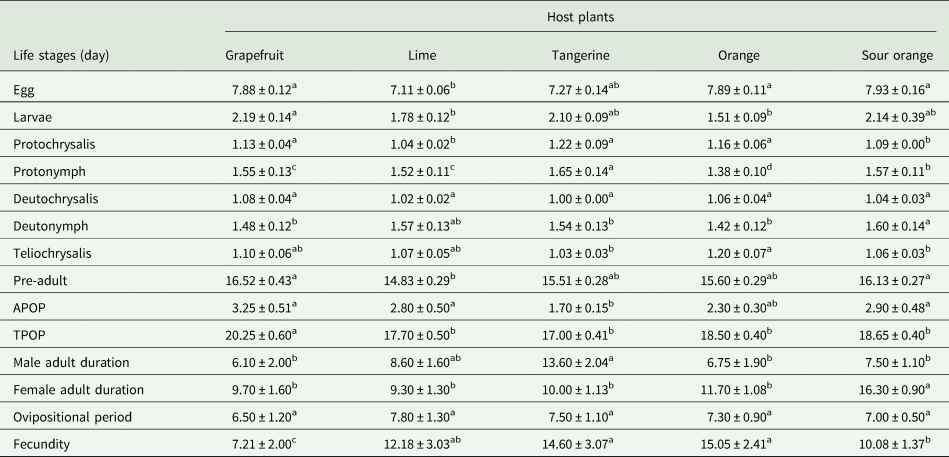
With the exceptions of deutochrysalis and ovipositional periods, the tested host plants significantly affected the duration of different life stages in P. citri (table 1). The lowest and highest duration of egg stage was recorded on lime and sour orange, respectively. The lowest and highest value of pre-adult development time was recorded on lime (14.83 days) and grapefruit (16.52 days), respectively. Both APOP and TPOP had the lowest and highest values on the tangerine and grapefruit, respectively. The duration of ovipositional period was not significantly affected by the type of host plant. Fecundity of P. citri was significantly different among tested citrus host plants (P < 0.05). The mite fecundity on orange and tangerine was significantly higher than on the sour orange and grapefruit. The lowest fecundity was recorded on grapefruit (7.21 ± 2.00 eggs).
Duration of different life stages (mean ± SE) and fecundity (no. eggs laid) of P. citri on different host plants under laboratory conditions

APOP, adult pre-oviposition period; TPOP, total pre-oviposition period.
The means followed by different letters in the same row are significantly different (P < 0.05, paired bootstrap test).
Stage-specific mortality (qj)
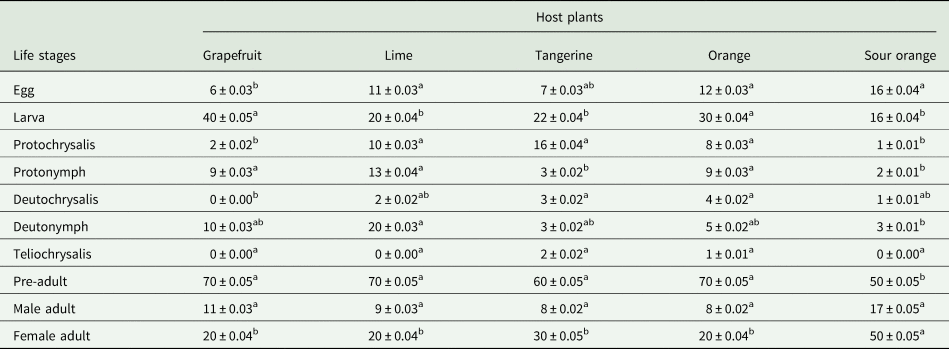
The stage-specific mortality (qj) defined as the proportion of dead individuals in different life stages of CRD is presented in table 2. The mortality of egg stage was affected by various plants under study. Grapefruit and sour orange showed the highest and lowest values of mortality for larval periods, respectively. According to the data obtained, significant differences were detected among the mortality rates of pre-adult stages, while the values for teliochrysalis and male individuals were not remarkably affected. The values recorded for pre-adult stages on grapefruit, lime, and orange were not significantly different and were higher than those recorded on other plants.
Mortality percentage of different life stages (mean ± SE) of P. citri on different host plants under laboratory conditions

The means followed by different letters in the same row are significantly different (P < 0.05, paired bootstrap test).
Life table parameters
Age-stage-specific survival rate (sxj)
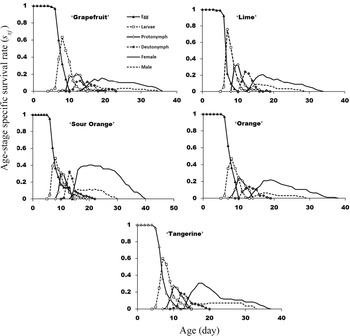
The probability of survivorship for a newborn individual to age x and stage j is plotted in fig. 1. Overlapping survival curves of different life stages revealed the variation in the development rate of various life stages. The females emerged on day 13 of feeding on lime, tangerine, and orange, and day 14 on grapefruit and sour orange. Males emerged on day 13 of feeding on lime and orange and on day 14 of feeding on grapefruit, tangerine, and sour orange.
Age-stage-specific survival rate (sxj) of P. citri on different host plants tested under laboratory conditions.

Age-specific survivorship and fecundity
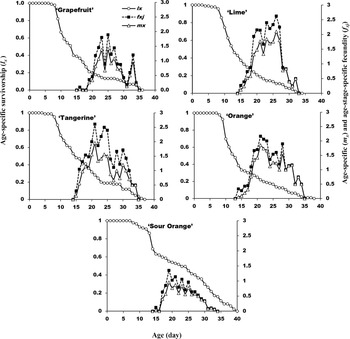
The age-specific survivorship (lx: probable surviving of every individual to age x and stage j including both sexes), age-specific fecundity (mx: mean number of female eggs laid per female at age x), and age-stage-specific fecundity (fxj: the mean number of eggs per female at age x and stage j) are plotted in fig. 2. These graphs confirmed successful development and reproduction of P. citri on all five tested host plants. According to this figure, the ovipositional period of female individuals on grapefruit, lime, tangerine, orange, and sour orange started on days 16, 15, 15, 14, and 15, respectively. Moreover, the highest peak of fecundity on the above mentioned species occurred at age 26, 28, 21, 21, and 19 days, respectively.
Age-specific survival rate (lx), age-specific fecundity (mx), and age-stage fecundity (fxj) of P. citri on different host plants tested under laboratory conditions.

Net maternity (lxmx)
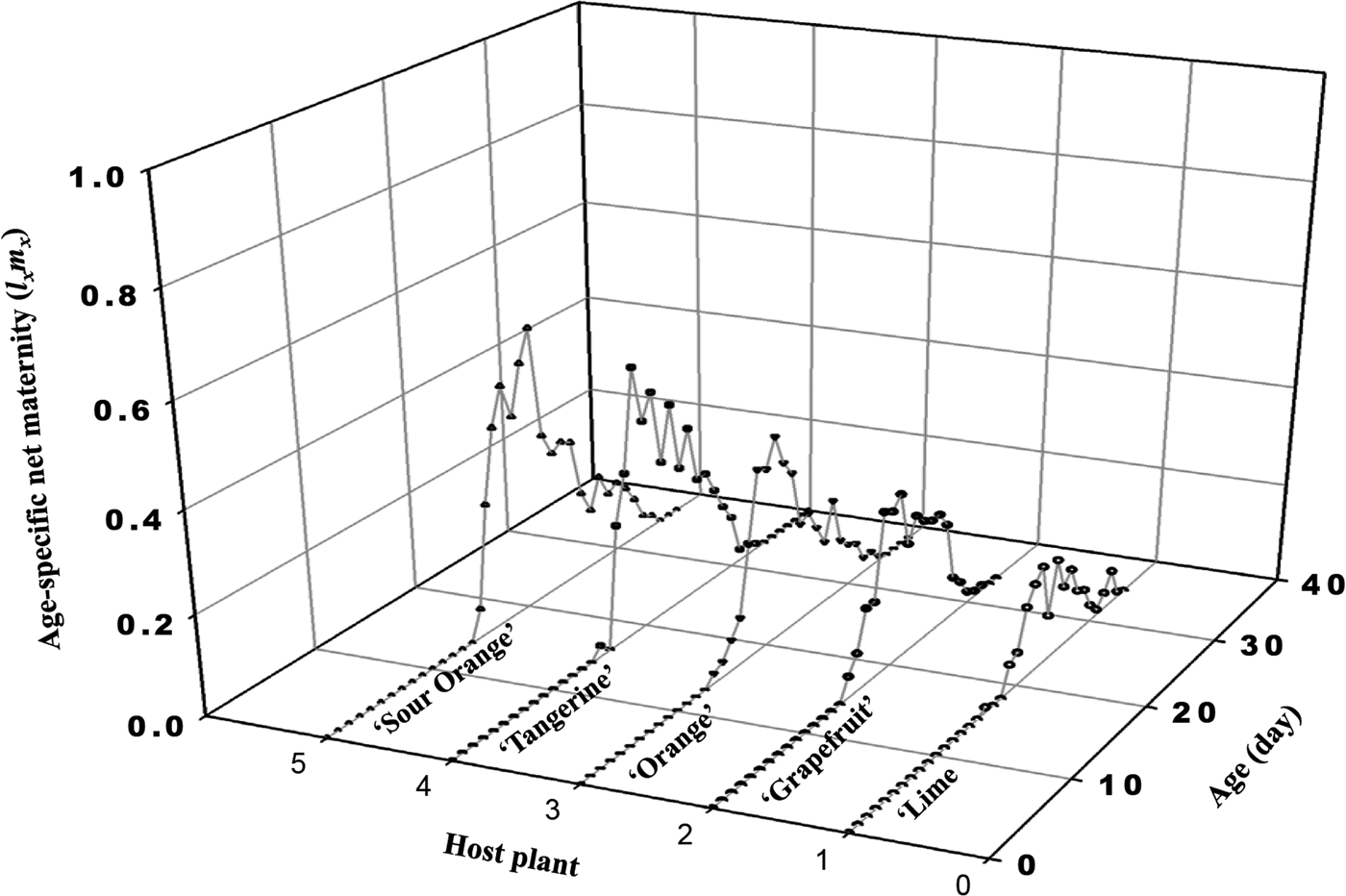
The mean number of eggs per female at a specific age by considering survivorship (lxmx) is plotted in fig. 3. Accordingly, the daily net maternity on orange and grapefruit began on days 14 and 16, respectively. On lime, tangerine, and sour orange, this parameter started on day 15. The value of lxmx increased until day 23 on grapefruit, which was variable until day 34. The maximum and minimum potential of daily oviposition (lxmx) were observed on sour orange and lime (0.53 and 0.02 egg day−1, respectively).
Age-specific net maternity (lxmx) of P. citri on different host plants tested under laboratory conditions.

Population growth parameters
The population growth parameters of P. citri on five citrus host plants are presented in table 3. The highest and lowest values of R 0 were recorded on tangerine (4.80 ± 1.20 female/female) and grapefruit (1.50 ± 0.50 female/female), respectively. Significant differences were observed in r values of CRM on the tested species. Consequently, the highest value was related to those reared on tangerine (0.071 ± 0.012 day−1). The values of finite rate of increase also varied from 1.016 ± 0.014 day−1 on grapefruit to 1.072 ± 0.012 day−1 on tangerine. The value estimated for mean generation time (T) of P. citri was the lowest on tangerine (22.40 ± 0.60 days) and the highest on grapefruit (25.70 ± 2.20 days).
Population parameters (mean ± SE) of P. citri on different host plants under laboratory conditions

R 0, net reproductive rate; r, intrinsic rate of increase; λ, finite rate of increase; T, mean generation time.
The means followed by different letters in the same row are significantly different (P < 0.05, paired bootstrap test).
Biochemical characteristics of citrus host plants
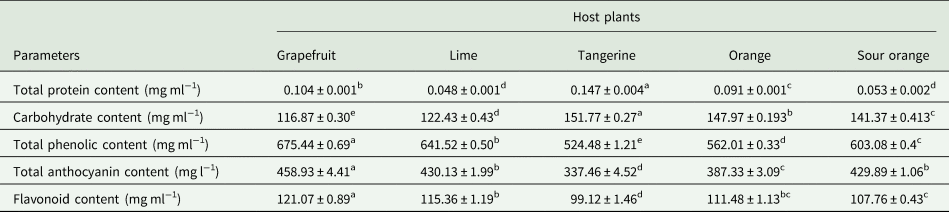
The major citrus biochemical compound including protein, carbohydrate, phenolic content, anthocyanin, and flavonoid content was detected from the citrus leaves. Biochemical traits of tested citrus host plants used for feeding of P. citri are presented in table 4. The total protein contents were significantly different among five citrus species. Tangerine and lime had the highest and lowest amounts of protein level, respectively (F 4,20 = 438.0; P = 0.000). The carbohydrate content was significantly varied from 116.87 ± 0.30 mg ml−1 in grapefruit to 151.77 ± 0.27 mg ml−1 in tangerine (F 4,20 = 2190.6; P = 0.000).
The mean (±SE) of some biochemical compounds content of tested different citrus species

The means followed by different letters in the same row are significantly different (P < 0.05, Tukey test).
Total phenolic content was significantly different among the citrus species (F 4,20 = 7395.3; P = 0.000). The highest and lowest phenolic content was measured in grapefruit (675.44 ± 0.69 mg ml−1) and tangerine (524.48 ± 1.21 mg ml−1), respectively. The highest total anthocyanin value was measured in grapefruit, whereas the lowest value was recorded in tangerine (F 4,20 = 205.3; P = 0.000). Flavonoid content was also significantly different among tested citrus plants (F 4,20 = 58.9; P = 0.000) and varied from 99.12 ± 1.46 mg ml−1 in tangerine to 121.07 ± 0.89 mg ml−1 in grapefruit.
Correlation between biochemical traits of citrus species and life history parameters
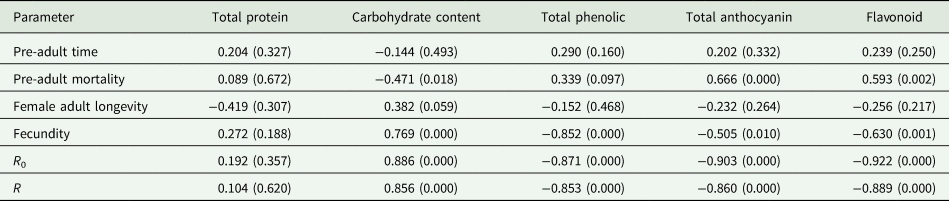
The results for correlations between some life history parameters of P. citri (pre-adult time, pre-adult mortality, female adult longevity, fecundity, R 0, and r) fed on different citrus host plants with biochemical traits of five citrus species tested are presented in table 5. The results revealed positive correlation between pre-adult time with phenolic, flavonoid, and anthocyanin content of the five citrus species tested, while negative correlation was observed between this parameter with carbohydrate content (P = 0.493). Pre-adult mortality had significant and positive correlation with total anthocyanin (P = 0.000) and flavonoid content (P = 0.002), while the correlation between mortality rate and carbohydrate content was significantly negative (P = 0.018).
Correlation coefficients (r) of some life history parameters of P. citri with biochemical traits of various citrus species

Correlations were evaluated based on Pearson's correlation test (P < 0.05).
The number in parenthesis is P value.
Female adult longevity was positively correlated with carbohydrate content (P = 0.059), but its correlation with other measured biochemical metabolites was negative. High positive correlations were detected between fecundity rate, R 0 (P = 0.000) and r (P = 0.000) of P. citri with carbohydrate value. Moreover, significant negative correlations were observed between fecundity rate, R 0, and r of P. citri with all measured secondary metabolites content (anthocyanin, phenolic, and flavonoid content). Leaf protein content did not show a significant correlation with any of the examined life history parameters of P. citri (table 5).
Discussion
The quality of host plant could play an important role in pest population dynamics through affecting pre-adult as well as adult performance. Direct and indirect effects of host plants (as the first trophic level) on biological attributes of phytophagous organisms (as the second trophic level) determine their resistance or susceptibility level to these destructive organisms. Such resistant plants can be extensively used to develop IPM strategies. Therefore, the evaluation of resistance mechanisms in several host plants has been widely used in ecological studies (Sarfraz et al., Reference Sarfraz, Dosdall and Keddie2007; Golizadeh et al., Reference Golizadeh, Kamali, Fathipour and Abbasipour2009, Reference Golizadeh, Ghavidel, Razmjou, Fathi and Hassanpour2017).
The incubation periods of P. citri were significantly different among the host plants under study. Similarly, Karaca (Reference Karaca1994), Gotoh et al. (Reference Gotoh, Ishikawa and Kitashima2003), and Lei et al. (Reference Lei, Hu, Li, Ran, Zhang, Lin, Tian and Qian2004) found significant differences in the egg stage of CRD on a variety of citrus species. Saito (Reference Saito1979) and Kasap (Reference Kasap2009) discussed that the sex of individual, the quality of female food intake as well as experimental conditions can influence the egg development of mites. In fact, due to the impact of the above mentioned factors, physiological characteristics of female individuals and their offspring are significantly affected.
The shorter developmental time of movable stages of CRM (larva, protonymph, and deutonymph) reared on orange relative to other species indicated that probably this species better provided nutritional requirements of movable immature stages than other host plants under study. Variations in developmental time of P. citri could be attributed to differences in nutrients and biochemical features of the studied citrus plants. In the present research, P. citri developed slowly on grapefruit, suggests that nutritional quality of host plants is low for larval and nymphal feeding. The longest development time of P. citri on grapefruit may be explained by the higher secondary metabolites values in this citrus plant. All three measured secondary metabolites showed the highest values on grapefruit. However, the relationship between mite pre-adult time and carbohydrate content of host plants was not significant. Moreover, the lowest carbohydrate value on grapefruit could be another factor affecting development time. The positive correlations between the pre-adult time and secondary metabolites suggest that these chemicals can prolong this period. Some researchers such as Soufbaf et al. (Reference Soufbaf, Fathipour, Zalucki and Hui2012), Nouri-Ganbalani et al. (Reference Nouri-Ganbalani, Borzoui, Shahnavazi and Nouri2018), and Abedi et al. (Reference Abedi, Golizadeh, Soufbaf, Hassanpour, Jafari-Nodoushan and Akhavan2019) are in agreement with this result. Increasing growth period of immature stages can be detrimental to CRM. If the length of this growth period increases, negative impacts of chemical compositions of host plants under investigation as well as predatory mites will increase. On the other hand, if the immature stages of these mites are increased, the survival rate and reproduction of adult females will be decreased (Maleknia et al., Reference Maleknia, Fathipour and Soufbaf2016; Azadi-Qoort et al., Reference Azadi-Qoort, Sedaratian-Jahromi, Haghani and Ghane-Jahromi2019). According to Sedaratian et al. (Reference Sedaratian, Fathipour and Moharramipour2009) and Azadi-Qoort et al. (Reference Azadi-Qoort, Sedaratian-Jahromi, Haghani and Ghane-Jahromi2019), immature stages of herbivore mites will take a long time if their host plants have low levels of nutrient materials. Thus, the mites will be forced to feed more to complete the developmental stages and become adults.
In this study, adult mites reared on the tangerine and orange showed higher fecundity, which indicates suitability of these citrus plants for reproduction of CRM. The lower levels of total phenolic, anthocyanin, and flavonoid contents in tangerine and orange suggest that secondary metabolites may have a negative effect on the fecundity of this mite. All three measured secondary metabolites values negatively correlated with adult mite fecundity. Moreover, the highest contents of carbohydrate and protein in orange suggest that both metabolites play a positive role in the fecundity of CRM and there was a significant and positive correlation between the host plants carbohydrate content and CRM fecundity. A similar relationship was observed between the female adult longevity with phytochemicals of tested citrus plants, but none of them were significant. Golizadeh et al. (Reference Golizadeh, Ghavidel, Razmjou, Fathi and Hassanpour2017) suggested that lower fecundity of female Tetranychus urticae Koch could be due to feeding on plants that have low quality of primary nutrients. Other researchers reported similar findings about lower fecundity of female individuals on herbal tissues with low nutritional quality (Verkerk and Wright, Reference Verkerk and Wright1996; Sarfraz et al., Reference Sarfraz, Dosdall and Keddie2007). Besides, Hare (Reference Hare1988) and Yin et al. (Reference Yin, Qiu, Yan, Sun, Zhang, Ma and Adaobi2013) believed that the lower fecundity of female individuals was associated with lower levels of protein, carbohydrate, and nitrogen in the host plant. All correlations between protein content with mite life history parameters were not significant.
Mortality percentages of each various life stages of CRM were significantly different among the tested citrus plants. According to Azadi-Qoort et al. (Reference Azadi-Qoort, Sedaratian-Jahromi, Haghani and Ghane-Jahromi2019), possible reasons for the mortality of tetranychid mites have not been extensively evaluated. Herein, the pre-adult stage had the higher mortality on all host plants. There were positive correlations between the pre-adult mortality and the amounts of phenolic, anthocyanin, and flavonoid contents of citrus plants. Positive correlations suggest that these compounds may be contributing factors on pre-adult mortality. Moreover, the negative and significant correlation between carbohydrate content with pre-adult mortality suggest that low levels of this primary compound in the leaves of host plants can increase the pre-adult mortality. Due to the high mortality rate of immature stages, it is speculated that these stages are the best target for chemical treatments, which should be further tested in future studies. Soufbaf et al. (Reference Soufbaf, Fathipour, Karimzadeh and Zalucki2010) stated that using pesticides for sensitive stages of pests can increase efficiency that is in parallel with IPM approach due to the reduction in pesticides dose.
There were significant differences in R 0 and r values of P. citri on five tested citrus plants. The r value is related to biological traits of pests such as duration of immature development, survival rate, and fecundity of female individuals. Accordingly, r can be defined as the best indicator to determine the resistance level of host plants to phytophagous pests (Uddin et al., Reference Uddin, Alam, Miah, Mian and Mustarin2015; Golizadeh et al., Reference Golizadeh, Ghavidel, Razmjou, Fathi and Hassanpour2017; Heidari et al., Reference Heidari, Sedaratian-Jahromi, Ghane-Jahromi and Zalucki2020). Grapefruit and tangerine showed the lowest and highest values of both parameters, respectively. The reduced R 0 and r of CRM on grapefruit could be attributed to the positive relationship of these parameters with primary metabolites as well as negative relationship with secondary metabolites of studied citrus plant species. All three measured secondary metabolites significantly and negatively correlated with R 0 and r values. Therefore, probably due to the high amounts of secondary metabolites in grapefruit, the lowest growth rate of P. citri was observed on this citrus plant. Also, the lowest level of carbohydrates content in grapefruit can be another possible reason for the lowest population growth rate on this plant. As suggested by a number of researchers, different levels of secondary metabolites such as alkaloids, phenols, and terpenoids together with genetic and morphological characteristics of leaves may affect feeding and/or ovipositional traits of phytophagous mites (Wittstock and Gershenzon, Reference Wittstock and Gershenzon2002; Lei et al., Reference Lei, Hu, Li, Ran, Zhang, Lin, Tian and Qian2004; Kroymann, Reference Kroymann2011). Other researchers such as Hare et al. (Reference Hare, Morse, Menge, Pehrson, Coggins, Embleton, Jarrell and Meyer1989), Gotoh et al. (Reference Gotoh, Ishikawa and Kitashima2003), Lei et al. (Reference Lei, Hu, Li, Ran, Zhang, Lin, Tian and Qian2004), Kasap (Reference Kasap2009), and Zanardi et al. (Reference Zanardi, Bordini, Franco, de Morais and Yamamoto2015) confirmed the host type effects on life table traits of P. citri, too. They believed that the differences in food quality and nutritional composition of host plants are responsible for different survivorship and reproduction rates of P. citri on various citrus plants. However, in these studies, the effect of citrus secondary metabolites on CRM performance has not been well examined. The current research reveals the presence of interactions between phytochemical metabolites of various citrus host plants with development rate, fecundity, and life table parameters of CRM. Complex interactions of nutrients with other nutritional features can influence life cycle and reproductive rate of herbivore (Chen et al., Reference Chen, Ni and Buntin2009; Abedi et al., Reference Abedi, Golizadeh, Soufbaf, Hassanpour, Jafari-Nodoushan and Akhavan2019). Host plant phytochemical metabolites can be an effective factor for the feeding and development of herbivores (Soufbaf et al., Reference Soufbaf, Fathipour, Zalucki and Hui2012; Golizadeh and Abedi, Reference Golizadeh and Abedi2017).
In conclusion, the present study showed that P. citri was able to feed and complete its life cycle on various citrus host plants, although with different population growth rates. The results indicate that population reared on grapefruit displayed the longest development time and the lowest adult fecundity, apparently as a consequence of the highest levels of total phenolic, anthocyanin, and flavonoid contents (as secondary metabolites) and the lowest level of carbohydrate content (as primary metabolites) of the citrus plant species. Therefore, grapefruit was the most resistant host plant species for P. citri, among citrus plants tested here. Moreover, tangerine was the most suitable citrus plant species for P. citri, apparently as a result of the lower secondary metabolite contents of the host plant. Identifying the resistant/susceptible species of citrus plants helps us manage CRM population in citrus orchards. In this study, grapefruit could be used as an alternative to reduce P. citri population levels in ecologically friendly citrus production systems in Iran. In orchards where tangerine is grown, monitoring programs of P. citri should be more intensive to detect the initial pest population to avoid plant damage. However, it is suggested to perform complementary experiments about the life cycle traits of P. citri to find the resistant citrus host plant cultivars.
Acknowledgements
This work is a part of the PhD thesis of the first author, which was financially supported by the University of Mohaghegh Ardabili, Ardabil, Iran. We are also grateful to Professor Hsin Chi for his generous assistances in the statistical analysis.
Conflict of interest
All authors have read the manuscript and are aware of its content and there isn't any conflict of interest between authors in this research. This research is a part of PhD thesis of Sheila Shirinbeik Mohajer devoted to the bio-ecology of citrus red mite, Panonychus citri on various citrus host plants. Ali Golizadeh and Mahdi Hassanpour as supervisor and Sheila Shirinbeik Mohajer proposed the research subject. Seyed Ali Asghar Fathi, Amin Sedaratian-Jahromi, and Zahra Abedi participated in the data analysis and acted as advisors. This work was carried out in the Department of Plant Protection at the University of Mohaghegh Ardabili, Ardabil, Iran.