Introduction
The Lecanora subfusca group (Lecanora s. str.) includes members of the genus related to L. allophana (Ach.) Nyl (Brodo Reference Brodo1984). The group is characterized by having continuous to areolate, crustose thalli, lecanorine apothecia with corticate margins, calcium oxalate crystals in the amphithecium, medium-sized, ellipsoid ascospores, and filiform conidia (Brodo Reference Brodo1984; Lumbsch 1994 Reference Lumbschb ). Members of the group produce atranorin or related substances, as well as a variety of other secondary metabolites including orcinol depsides, depsidones, and their derivatives, pulvinic acid derivatives, triterpenoids, xanthones, fatty acids, and occasionally usnic acid and related compounds (Brodo Reference Brodo1984; Miyawaki Reference Miyawaki1988; Lumbsch 1994 Reference Lumbschb ; Guderley Reference Guderley1999). The L. subfusca group is well known, at least when compared with other species groups in Lecanora s. lat., with modern revisions for Australasia (Lumbsch 1994 Reference Lumbschb ), North America (Brodo Reference Brodo1984) including the Sonoran region (Ryan et al. Reference Ryan, Lumbsch, Messuti, Printzen, Śliwa and Nash2004), and South America (Guderley Reference Guderley1999), as well as full or partial treatments for India (Upreti Reference Upreti1997, Reference Upreti1998; Upreti & Chatterjee Reference Upreti and Chatterjee1997), Japan (Miyawaki Reference Miyawaki1988) and several European countries (Ibáñez & Burgaz Reference Ibáñez and Burgaz1998; Edwards et al. Reference Edwards, Aptroot, Hawksworth and James2009; Malíček Reference Malíček2014), and smaller treatments of morphologically similar species (Brodo et al. Reference Brodo, Owe-Larsson and Lumbsch1994; Lumbsch et al. Reference Lumbsch, Feige and Elix1995, Reference Lumbsch, Guderley and Elix1996, Reference Lumbsch, Plümper, Guderley and Feige1997). The results of several recent phylogenetic studies (e.g., Rodrigues et al. Reference Rodrigues, Terrón-Alfonso, Elix, Pérez-Ortega, Tønsberg, Fernández-Salegui and Soares2011; Kondratyuk et al. Reference Kondratyuk, Kim, Kondratyuk, Jeong, Jang, Pirogov and Hur2014; Miądlikowska et al. Reference Miądlikowska, Kauff, Högnabba, Oliver, Molnár, Fraker, Gaya, Hafellner, Hofstetter and Gueidan2014; Lendemer Reference Lendemer2015) suggest that the L. subfusca group as traditionally circumscribed is not monophyletic. To date, however, sequence data have not been generated for the greater part of this large and taxonomically complicated group, and the disposition of included species with respect to Lecanora s. lat. remains uncertain, as do the utility of anatomical and chemical characters in circumscribing monophyletic species groups.
During recent fieldwork in woodlands of the Edwards Plateau and southern Great Plains of central North America, the authors discovered a corticolous member of the Lecanora subfusca group which frequently produced yellowish apothecial margins, creating a distinctive and attractive halo effect. The yellowish pigmentation of the apothecial margins is sporadic, sometimes even within a single thallus. The species is described here as new to science.
Materials and Methods
Specimens were studied dry using dissecting microscopes and subjected to chemical analysis using standard spot tests (reagents are abbreviated following Brodo et al. Reference Brodo, Sharnoff and Sharnoff2001) and thin-layer chromatography (TLC). TLC was carried out at KANU using solvent systems A, B′, C, and E following the methods of Orange et al. (Reference Orange, James and White2001). Water mounts were hand sectioned with a razor blade. Microscopic characters were observed in water and images were captured and measured to the nearest 0.1μm. Measurements are presented as a simple range or, where sufficient material allowed, as the average (
 $${ \bar x}$$
) ± one standard deviation (SD), bounded by the smallest and largest observed values, and followed by the sample size (n) (i.e. (smallest observed–)
 $${ \bar x}$$
−1SD –
 $${ \bar x}$$
–
 $${ \bar x}$$
+1SD (–largest observed) (n)).
Taxonomy
Lecanora inaurata C. A. Morse & Ladd sp. nov.
MycoBank No.: MB 816296
A corticolous member of the Lecanora subfusca group with an esorediate, continuous, verruculose, pale grey to glaucous blue thallus; apothecial margins entire to flexuose, often crenulate, concolorous with the thallus or pale to bright yellow; apothecial discs reddish brown, typically epruinose or sometimes finely whitish grey pruinose; amphithecium with large crystals persisting in K (pulicaris-type); epihymenium of coarse, hyaline to brown crystals (chlarotera-type), sometimes sparse or rarely absent; ascospores ellipsoid to broadly ellipsoid, (7·3–)9·5–10·8–12·1(–14·0)×(4·9–)5·5–6·4–7·3(–8·7)µm; and secondary metabolites chloroatranorin and zeorin (major), with or without atranorin, and frequently with calycin in yellow portions of the apothecial margins.
Type: USA, Oklahoma, Comanche Co., c. 8 mi N, 3 mi E of Cache, Wichita Mountains Wildlife Refuge, vicinity of western terminus of Mt. Hood Bike and Foot Trail, 34·75075°–34·75517°N, 98·58026°–98·57452°W, elevation c. 1530–1600 ft, complex of woodlands and scrubby forest dominated by Juniperus virginiana, Quercus marilandica and Q. stellata and extensive glade-like areas of surfacing pink granite bedrock and boulders with little woody vegetation on gentle to moderate, primarily NW-facing slopes on NW end of Mt. Wall, and brushy riparian forest along Cedar Creek dominated by Fraxinus pennsylvanica, Juglans nigra, Q. marilandica, Q. stellata, and Ulmus with Smilax bona-nox abundant in understorey, on Q. stellata, 16 April 2011, C. A. Morse 22298a & K. J. Logan (KANU—holotype; CANL—isotype).
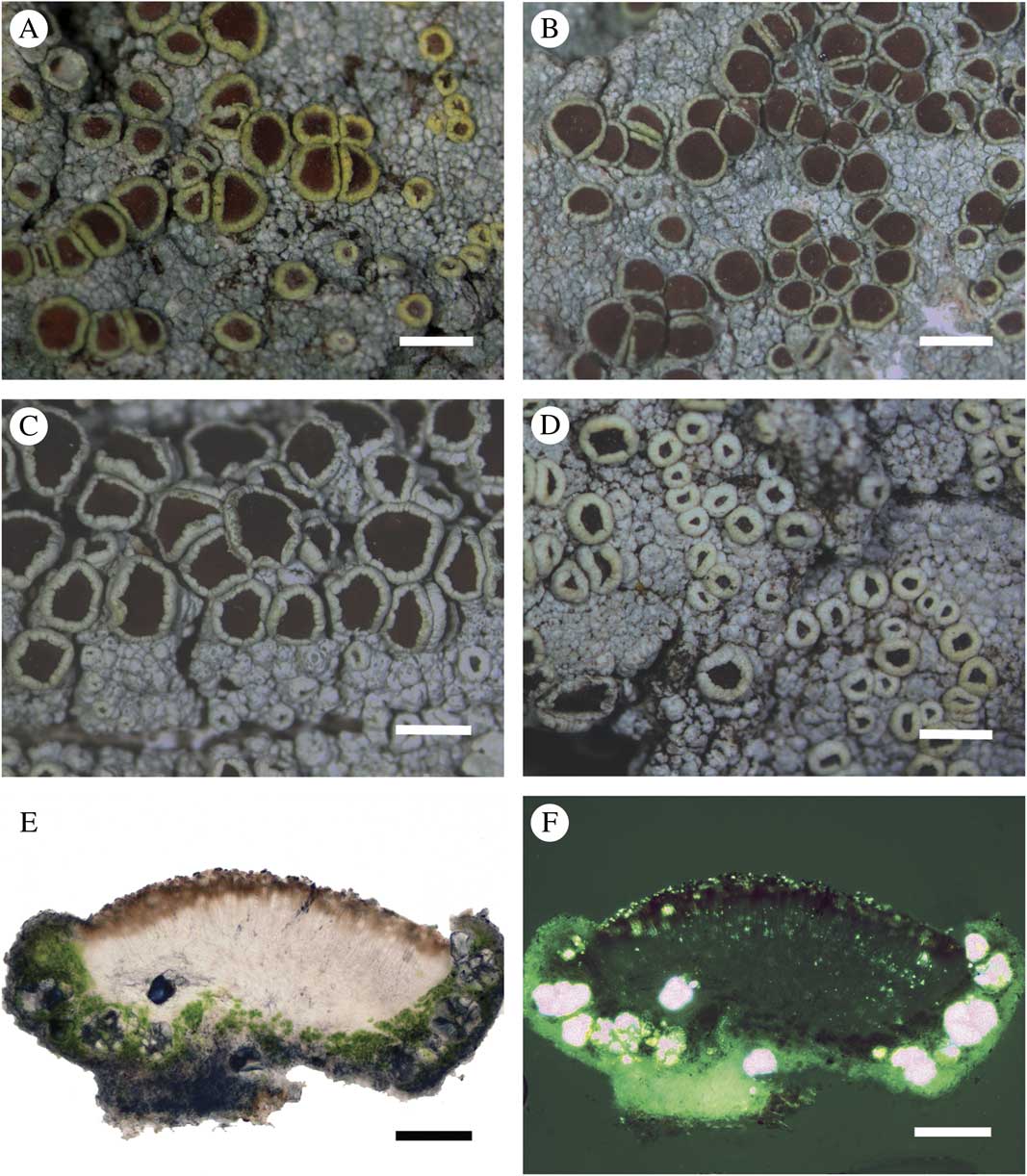
Lecanora inaurata, showing variability in gross morphology. A, apothecia with bright yellow thalline margins (Morse 22298a—holotype); B, apothecia with pale yellow margins (Morse 22298a—isotype, KANU); C, apothecia with grey margins and reddish brown discs (Morse 18509); D, developing apothecia with grey margins and reddish brown discs (Morse 23467). E & F, section of apothecium; E, in bright field illumination; F, polarized light (Morse 22298a—isotype, KANU). Scales: A–D=1 mm; E & F=100 μm.
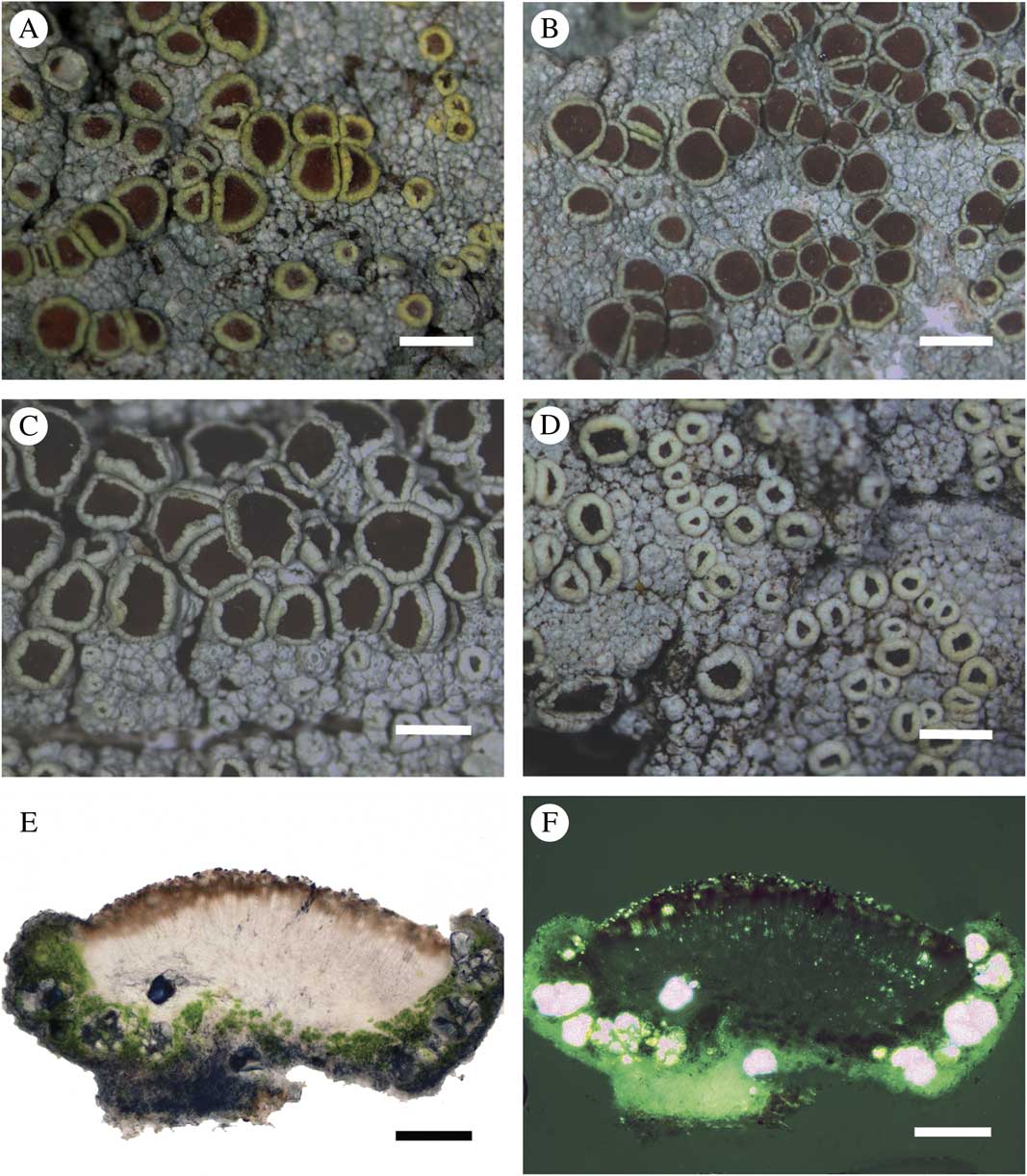
(Fig. 1)
Thallus to 5 cm diam., crustose, continuous, verruculose; prothallus scant to well developed, white, fibrous; verrucae ±evenly rounded, c. 0·2 mm broad; upper cortex smooth, lustrous, pale grey to frequently rough, ±glaucous blue (greenish blue to bluish grey), epruinose, esorediate; older specimens frequently covered with terpenoid crystals.
Apothecia sessile to constricted at base when mature, solitary and ±evenly scattered over the thallus to aggregated, (0·4–)0·6–0·95–1·3(–1·7) mm diam. (n=54); disc plane, tan, yellowish brown, or more commonly medium brown or reddish brown, occasionally dark reddish brown, typically epruinose, but occasionally sparsely whitish pruinose, especially in smaller apothecia; margins c. 0·1 mm thick, entire to verruculose or crenulate, concolorous with thallus or with distinct, pale to bright yellow tones due to the presence of calycin, without a parathecial crown; amphithecium with numerous algal cells, with abundant fine crystals (POL+, dissolving in K) and large crystals (pulicaris-type; POL+, persisting in K, dissolving in concentrated HNO3), corticate; cortex hyaline, poorly developed and frequently eroded in older apothecia, c. 17 µm thick at top to c. 42 µm thick basally, abundantly inspersed with small crystals (POL+, dissolving in K); parathecium hyaline, to 30 µm thick, lacking POL+ crystals or with crystals limited to the uppermost regions; epihymenium of coarse, hyaline to brown crystals (chlarotera-type; POL+, persisting in K, slowly dissolving in concentrated HNO3), although sometimes sparsely granular (thus resembling glabrata-type); hymenium hyaline, 70–80 µm high; paraphyses slender, coherent, sometimes slightly expanded at the brown to reddish brown (K+ dull brown) tips, to c. 2·5 µm wide; subhymenium hyaline, c. 25 µm high; hypothecium hyaline. Asci Lecanora-type, 8-spored, narrowly clavate, 43–58×12–13 µm. Ascospores colourless, ellipsoid to broadly ellipsoid, (7·3–)9·5–10·8–12·1(–14·0)×(4·9–)5·5–6·4–7·3(–8·7) µm, l/w ratio=(1·2–)1·5–1·7–1·9(–2·3) (n=75), wall 0·50–0·75 µm thick.
Pycnidia common, half-immersed, oblong, 0·12–0·20 μm wide, 0·18–0·30 μm high, apices black, lustrous, the walls appearing brown in section; conidia colourless, filiform, arcuate, c. 19–33×1 µm.
Chemistry. TLC (all specimens analyzed): ±atranorin (minor or trace), chloroatranorin (major), zeorin (major), calycin present in yellow portions of apothecial margins, although often not detectable with TLC, several unknown triterpenoids and other unidentified substances variably present. Spot tests of thallus K+ yellow, C−, KC−, P+ yellow, UV−.
Etymology. The common meaning of the Latin adjective inauratus is ‘overlaid with gold’, but it may occasionally mean the opposite, ‘not gilded’. We take it up as an apt epithet to describe the thalline margins of Lecanora inaurata, only some of which are pale to bright yellow.
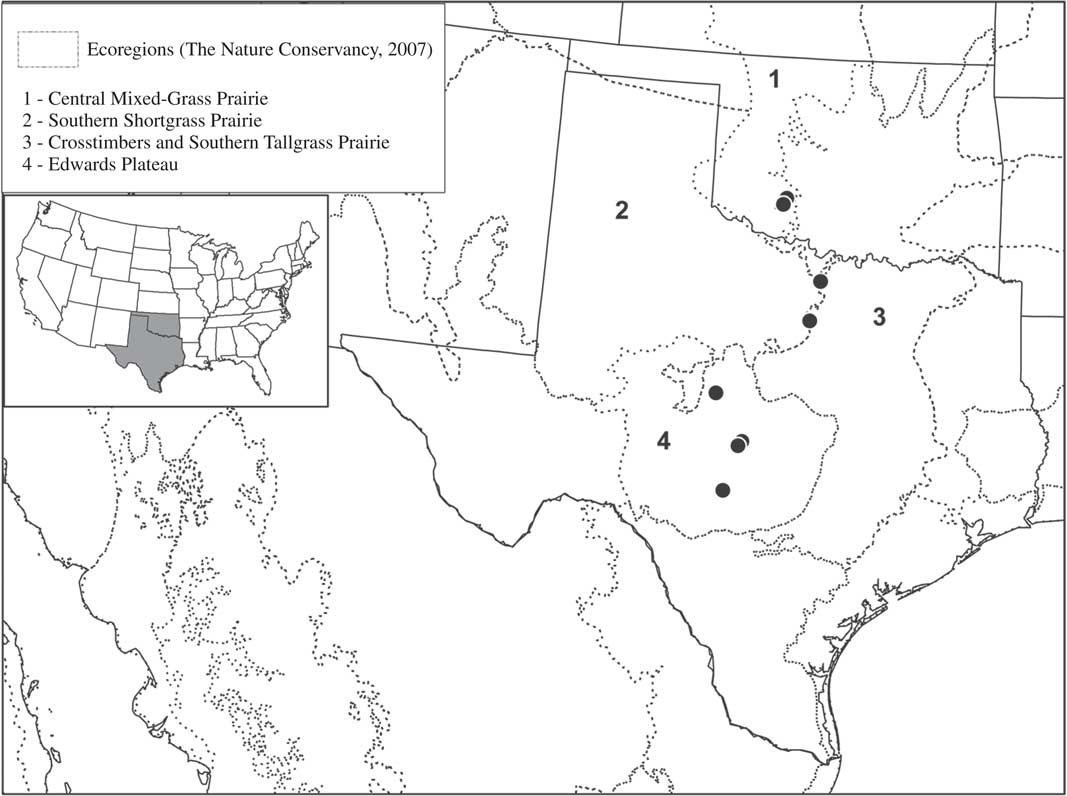
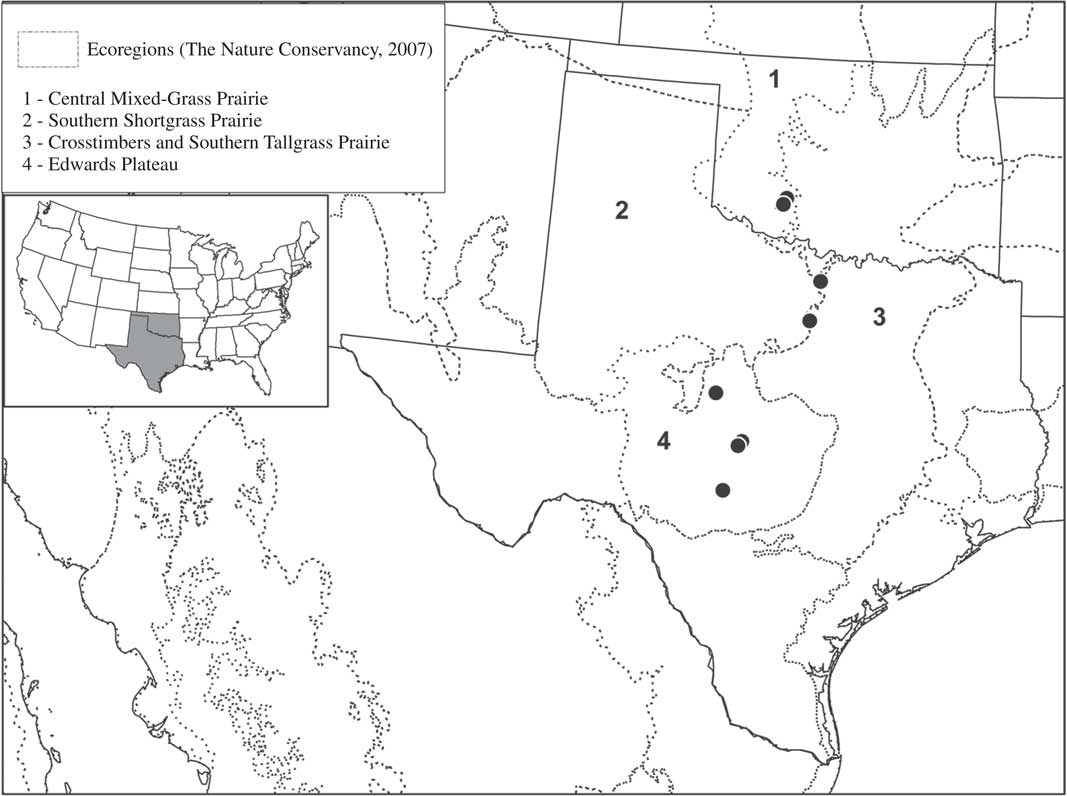
Distribution and ecology. Lecanora inaurata is known from open woodlands in north-central Texas and south-central Oklahoma in central North America, where it occurs in the Edwards Plateau ecoregion, and along the eastern edges of grasslands bordering the Cross Timbers ecoregion, at elevations of 275–652 m above sea level (Fig. 2). It grows in moderately shaded to exposed habitats, and has been documented on branches and boles of Quercus buckleyi, Q. fusiformis, Q. marilandica, Q. stellata, Fraxinus pennsylvanica, Juniperus ashei, J. virginiana, and Ulmus crassifolia. Frequent associates include Caloplaca camptidia (Tuck.) Zahlbr., C. chrysophthalma Degel., C. microphyllina (Tuck.) Hasse, C. pollinii (A. Massal.) Jatta, Haematomma persoonii (Fée) A. Massal., Lecanora horiza (Ach.) Linds., Parmotrema reticulatum (Taylor) M. Choisy, Pertusaria propinqua Müll. Arg., Phaeophyscia hirsuta (Mereschk.) Essl., Physcia aipolia (Ehrh. ex Humb.) Fürnr., Physcia stellaris (L.) Nyl., Punctelia bolliana (Müll. Arg.) Krog, P. graminicola (B. de Lesd.) Egan, Rinodina papillata H. Magn., and Xanthomendoza weberi (S. Kondr. & Kärnefelt) L. Lindblom. The discovery of another new lichen taxon from the Great Plains of central North America adds to a growing body of interesting lichen records from the area (e.g. Sheard et al. Reference Sheard, Knudsen, Mayrhofer and Morse2011; Westberg et al. Reference Westberg, Morse and Wedin2011; Ladd & Morse Reference Ladd and Morse2012; Morse & Ladd Reference Morse and Ladd2013) and further reinforces both the biological significance of the region and the continuing need for fieldwork in North America.
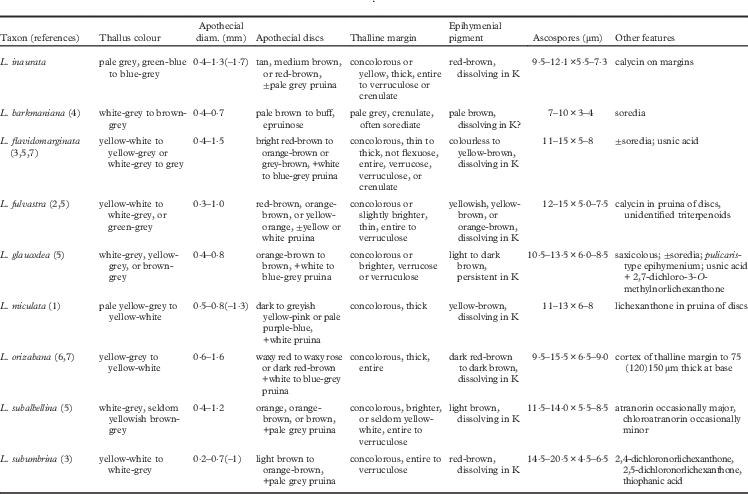
Discussion. The presence of chloroatranorin in North American members of the Lecanora subfusca group is largely unstudied and its taxonomic significance as a major constituent in L. inaurata is unclear. Brodo (Reference Brodo1984) did not separate atranorin from chloroatranorin, indicating instead the ubiquity of “atranorin s.l.” in members of the group. However, Lumbsch (1994 Reference Lumbschb ), Guderley (Reference Guderley1999), Lumbsch et al. (Reference Lumbsch, Messuti and Nash2003), and Ryan et al. (Reference Ryan, Lumbsch, Messuti, Printzen, Śliwa and Nash2004) reported seven tropical and subtropical members of the L. subfusca group in which chloroatranorin and zeorin are major constituents and atranorin is minor. Aptroot & van Herk (Reference Aptroot and van Herk1999) described L. barkmaniana Aptroot & van Herk, a species with this chemistry, from central Europe. Differences between L. inaurata and these species (L. barkmaniana, L. casuarinophila Lumbsch, L. flavidomarginata B. de Lesd., L. fulvastra Krempelh., L. glaucodea Nyl., L. orizabana Vain., L. subalbellina Vain. (=L. caesiorugosa B. de Lesd.; see Guderley Reference Guderley1999), and L. subumbrina Müll. Arg.) are summarized in Table 1. None of these taxa appear to have distributions that overlap with that of L. inaurata, although L. casuarinophila, L. flavidomarginata, and L. orizabana were documented from the Sonoran region (Lumbsch et al. Reference Lumbsch, Messuti and Nash2003; Ryan et al. Reference Ryan, Lumbsch, Messuti, Printzen, Śliwa and Nash2004). Several species listed in Table 1, however, differ only subtly from L. inaurata in their morphology, and may be closely related to the new species. In addition to containing usnic acid, L. flavidomarginata has densely pruinose apothecia and is occasionally sorediate (fide Guderley Reference Guderley1999). Lecanora fulvastra has a yellowish white to whitish grey thallus and produces smaller, sessile apothecia with orange to yellow-orange discs, and calycin on the discs rather than the margins (Lumbsch 1994 Reference Lumbscha ). Lecanora orizabana similarly produces a yellowish thallus, typically has entire thalline margins, and the amphithecial cortex is basally thickened to (75–)120(–150) μm (Lumbsch et al. Reference Lumbsch, Messuti and Nash2003). The thallus of L. subalbellina is whitish grey or yellowish grey and the apothecial discs are orange to brown and densely pruinose (Lumbsch et al. Reference Lumbsch, Plümper, Guderley and Feige1997; Guderley Reference Guderley1999).
Members of the Lecanora subfusca group reported to produce chloroatranorin + zeorin as major constituents
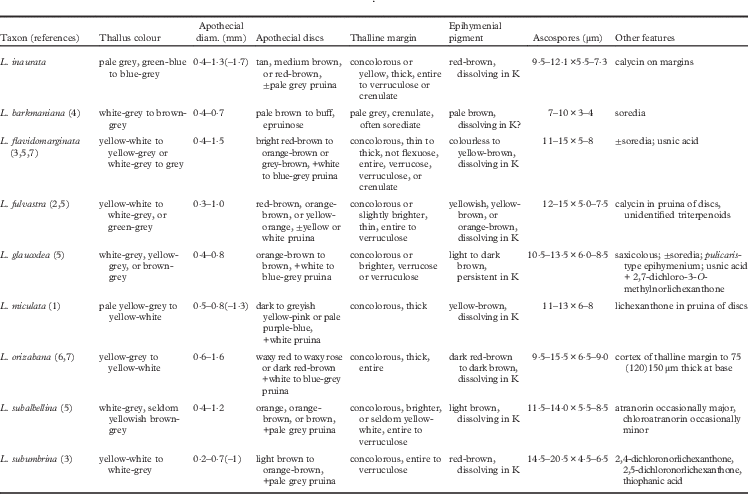
References: 1, Brodo (Reference Brodo1984); 2, Lumbsch (1994 Reference Lumbscha ); 3, Lumbsch (1994 Reference Lumbschb ); 4, Aptroot & van Herk (Reference Aptroot and van Herk1999); 5, Guderley (Reference Guderley1999); 6, Lumbsch et al. (Reference Lumbsch, Messuti and Nash2003); 7, Ryan et al. (Reference Ryan, Lumbsch, Messuti, Printzen, Śliwa and Nash2004).
Thin-layer chromatography performed in conjunction with this study demonstrated that Lecanora miculata Ach. also has a chemistry similar to that of L. inaurata, with atranorin (minor or absent), chloroatranorin (major), and zeorin (major), but that species also produces lichexanthone in the pruina of the apothecial discs. In addition to its chemistry, L. miculata differs from L. inaurata in its paler, consistently pruinose apothecial discs (Table 1). Lecanora miculata appears to be mostly subtropical, restricted to the south-eastern coastal plain of North America and adjacent regions (Brodo Reference Brodo1984). Its range does not appear to overlap with that of L. inaurata.
Lumbsch et al. (Reference Lumbsch, Feige and Elix1995) and Guderley (Reference Guderley1999) noted morphological similarities between Lecanora flavidomarginata and L. subalbinella, even suggesting that broader taxonomic concepts for these entities would lead to them being placed in synonymy. We have considered whether L. inaurata could be included in an expanded concept of L. fulvastra. Excepting the presence of calycin, however, L. inaurata does not appear to be more similar to L. fulvastra than it does to most of the species included in Table 1. Indeed, while most of these taxa may occasionally be difficult to distinguish from one another (sharing similar epihymenial and amphithecial characters, as well as a tendency to produce pruinose apothecia, broadly elliptical spores, and secondary chemistry) there is no reason to expect that they are particularly closely related to one another. Papong et al. (Reference Papong, Boonpragob, Parnmen and Lumbsch2012) found some support for utilizing anatomical characters in circumscribing phylogenetic relationships within the L. subfusca group. Notably, however, those authors found little support for secondary chemistry as a predictor of relationships. To date, none of the species in Table 1 has been the subject of a molecular phylogenetic study. Members of the L. subfusca group sharing these anatomical characters are not limited to the species discussed here, and it is not unreasonable to expect that a study including a broader taxonomic sample will show that the replacement of atranorin with chloroatranorin as a major constituent has occurred more than once within the group, or that species containing chloroatranorin and zeorin as major constituents are closely related to species with a different chemistry.
The majority of the Lecanora species described by Bouly de Lesdain (Reference Bouly de Lesdain1914) from Mexico have been treated by other authors (Lumbsch 1994 Reference Lumbschb ; Printzen Reference Printzen2001; Ryan et al. Reference Ryan, Lumbsch, Messuti, Printzen, Śliwa and Nash2004). The species L. azulensis B. de Lesd., however, has not been the subject of modern revision. Syntypes (México: Michoacán: Morelia, Cerro Azul, Arsène 3776, 3777) apparently were not discovered during exhaustive searches by Lumbsch (1994 Reference Lumbschb ) or Guderley (Reference Guderley1999), and were not located by us. Lecanora azulensis was described by Bouly de Lesdain (Reference Bouly de Lesdain1914) as having a finely granulose-rugose thallus, sessile, epruinose apothecia, 1·0–1·5 mm diam., with pale red discs and a flexuose margin, a yellow, granulose epithecium, and slightly larger spores, 13–15(–17)×7–9 µm. The correct application of this name remains uncertain.
With the exception of Lecanora miculata, the species with a chlarotera-type epihymenium treated by Brodo (Reference Brodo1984) lack zeorin and typically contain other secondary metabolites. However, specimens of L. inaurata examined for this study demonstrated some variability in the presence and abundance of epihymenial granules. For instance, crystals were abundant in Morse 23455, sparse in Morse 23467, and essentially absent in Morse 23570. Brodo (Reference Brodo1984) commented on a similar pattern of variability in L. pseudargentata Lumbsch (= L. sp. 2 of Brodo Reference Brodo1984). Specimens of L. inaurata with grey apothecial margins and sparse epihymenial crystals might be confused with L. pseudargentata or with a species with a glabrata-type epihymenium, such as L. argentata (Ach.) Malme, L. perplexa Brodo, or L. subrugosa Nyl. Lecanora argentata, L. pseudoargentata, and L. subrugosa all lack zeorin and produce other secondary metabolites, and their ranges do not overlap with L. inaurata (Brodo Reference Brodo1984). Lecanora perplexa differs from L. inaurata in having a white to yellowish grey or greenish grey, often distinctly granular thallus, in having slightly larger spores ((10·5–)12·0–15·5(–16·5)×(6·0–)7·0–8·5(–9·5) µm fide Brodo Reference Brodo1984), and in its chemistry. Examination by TLC of L. perplexa revealed atranorin, zeorin, and an unidentified triterpenoid below zeorin in solvent system A; calycin and chloroatranorin were absent. Lecanora perplexa is known from eastern North America and South America (Argentina) (Brodo Reference Brodo1984; Guderley Reference Guderley1999).
In the field, Lecanora inaurata may be confused with several other corticolous members of the L. subfusca group known from the region. The most common of these are L. chlarotera Nyl., L. meridionalis H. Magn., and L. horiza, which occur in association with the new species. Even when the distinctive yellow apothecial margins are lacking, L. inaurata can be distinguished from L. chlarotera and L. meridionalis by its larger, reddish brown apothecia with verruculose thalline margins and blue-grey thallus, as opposed to the smaller, sessile, greyish brown (in L. chlarotera) or black (in L. meridionalis) apothecia with entire thalline margins and white to pale grey thalli. Lecanora inaurata can be distinguished in the field from L. horiza by its blue-grey, verruculose thallus and yellow or concolorous margins, as opposed to the pale grey to greenish grey, typically smooth, rimose thallus with brighter, whitish apothecial margins of L. horiza; in some cases, however, identification may require confirmation of anatomical differences in the apothecia. All of these species produce atranorin as a major constituent and lack zeorin.
In Kerr County, Texas, Lecanora inaurata occurred in close proximity to a morphologically similar species, which contained atranorin and usnic acid (Morse 23590). This taxon was strikingly similar to forms of L. inaurata with pale yellow apothecial margins, also producing yellowish margins, and differed primarily in having a paler grey thallus and yellowish brown apothecial discs. However, confirmation of the presence of atranorin and usnic acid in Morse 23590, and absence of zeorin, was required to separate the two species with certainty. The identity of this taxon is uncertain. It is similar both to L. achroa Nyl., differing from that species primarily in producing larger apothecia (to 1·3 mm diam.) with constricted bases and in lacking xanthones and 2ʹ-O-methylperlatolic acid (Guderley Reference Guderley1999; Ryan et al. Reference Ryan, Lumbsch, Messuti, Printzen, Śliwa and Nash2004), and to L. demosthenesii Lumbsch et al., differing from that species in having apothecia with constricted (not stipitate) bases, a thinner amphithecial cortex (c. 20 µm), broadly ellipsoid spores (8·2–12·6×4·9–8·4 µm) and in producing only atranorin and usnic acid (both major) (Lumbsch et al. Reference Lumbsch, Messuti and Nash2003).
The presence of calycin is unusual in Lecanora, but has been reported from the thallus and pruina of apothecial discs of the Himalayan L. somervellii Paulson, the thallus of the Macaronesian L. sulphurella Hepp, and in L. fulvastra (Lumbsch 1994 Reference Lumbscha and references therein), of which only the last is similar to L. inaurata. In this study, calycin was confirmed by TLC only in a population producing particularly bright yellow margins (Morse 22298a). The substance appears to be present in varying amounts in L. inaurata, and thalli with concolorous margins occurred adjacent to thalli with distinctly (albeit often pale) yellow apothecial margins in all populations studied. We presume the latter thalli also contained calycin, although our attempts to isolate the substance by TLC were mostly unsuccessful. Śliwa et al. (Reference Śliwa, Flakus, Wilk and Flakus2014) reported similar difficulty in identifying calycin in L. fulvastra by TLC, attributing this to the small amount of material analyzed for their study.
Specimens examined. USA: Oklahoma: Comanche Co., c. 4·25 mi N, 2·0–2·5 mi W of Cache, Wichita Mountains Wildlife Refuge, N side of Eagle Mountain and vicinity of The Narrows, 34·70°N, 98·67°W, 2010, Morse 20565 (KANU). Texas: Coleman Co., c. 9–10 mi S, 9–10 mi W of Valera, Jane Padgitt Ranch, 31·61°N, 99·71°W, 2012, Morse 23406 & Freeman (KANU); Kerr Co., c. 4·5 mi S, 7·75 mi W of Mountain Home, Kerr Wildlife Management Area, 30·11°N, 99·50°W, 2012, Morse 23625 & Freeman (KANU); Mason Co., c. 6·5 mi N, 2 mi E of jct of Ranch Rd 386 & US Hwy 87/377 in Mason, Mason Mountain Wildlife Management Area, 30·84°N, 99·20°W, 2012, Morse 23455 & Freeman, Morse 23467 & Freeman (both KANU); c. 5 mi N of jct of Ranch Rd 386 & US Hwy 87/377 in Mason, Mason Mountain Wildlife Management Area, 30·83°N, 99·22°W, 2012, Morse 23555 & Freeman, Morse 23570 & Freeman (both KANU); Montague Co., c. 0·5 mi N, 6·25 mi W of Sunset, property of Wayne and Jeanne Erickson, E-W-trending ridge above Lake Amon G. Carter, 33·46°N, 97·87°W, 2009, Morse 18672 & Ladd (KANU); Parker Co., c. 2 mi N, 4·5 mi E jct of US Hwys 180W and 281 in Mineral Wells, Lake Mineral Wells State Park, NW side of lake, just N and E of Cross Timbers Camping Area, 32·83°N, 98·04°W, 2009, Morse 18509 & Ladd, Morse 18527 & Ladd (both KANU).
Other specimens examined. Lecanora aff. achroa: USA: Texas: Kerr Co., c. 4·5 mi S, 7·75 mi W of Mountain Home, Kerr Wildlife Management Area, 30·11°N, 99·50°W, 2012, Morse 23590 & Freeman (KANU).
Lecanora miculata: USA: Arkansas: Franklin Co., Ozark National Forest, c. 1·5 mi E of Shores Lake, along FS 1501 at bridge over Spirits Creek, near junction with FS 1515, 35°37′58″N, 93°58′29″W, 2005, Ladd 27601 (hb. Ladd); Howard Co., Stone Road Glade, c. 1·7 mi W of Hwy 369, E of Dawson Creek, c. 7 mi ESE of Dierks, 1996, Ladd 19681 (hb. Ladd); Stone Co., c. 0·1 mi N, 2·4 mi E of Fifty-Six, Ozark National Forest, Blanchard Springs Recreation Area, near Blanchard Spring and circle parking area for spring, 35·96°N, 92·17°W, 410–500 ft, 2014, Morse 24273 et al. (KANU).
Lecanora perplexa: Canada: Ontario: Navan, 1902, collector unknown s.n. (CANL); Thunder Bay District, SE of Marathon, S of Heron Bay, 1962, Henssen 14276p & Cain (CANL); Thunder Bay District, Ouimet, at Ouimet Canyon, 48°45′N, 88°35′W, 1954, Brodo 6070 et al. (CANL). Quebec: Ottawa Region, 3·5 mi N of Mayo, along the Rivière Blanche, 45°42′N, 75°21′W, 800–900 ft, 1980, Brodo 23585 et al. (CANL).
Distribution of Lecanora inaurata in north-central Texas and south-central Oklahoma in central North America together with the ecoregions within which it occurs.
This article is dedicated to Irwin Brodo for his foundational contributions to North American lichenology, and for his personal guidance and mentoring of the authors. We are grateful to him for reviewing specimens and offering suggestions for this study. Two anonymous referees provided careful review of the manuscript and helpful comments. Thanks also to the staff of ASU, CANL, MSC, NY, and US for specimen loans; land owners and managers for access and permission to collect on their property; Craig Freeman and Katherine Morse for assistance in the field; and Cindy Pessoni for map preparation. Fieldwork was made possible by anonymous contributions to the McGregor Herbarium Endowment Fund and The Nature Conservancy.