

The study of British Iron Age tankards has been somewhat neglected in recent decades. This echoes the sentiments of John X.W.P Corcoran (Reference Corcoran1952a) who provided the first and foremost study on this object type over sixty years ago in Proceedings of the Prehistoric Society. A new study on tankards and their handles is therefore long overdue. This study will re-examine all aspects of Iron Age tankards including their construction, decoration, form, and function, and present an analysis of use, wear, and repair. Re-examination of the dating evidence and depositional contexts will be followed by a wider discussion. Appearing in the Late Iron Age and continuing into the Roman period these vessels are able to shed light on wider issues such as social structure, communal consumption, feasting traditions, alcoholic beverages, and the formation of identities in both insular and Romano-British cultural contexts. The online Appendices (S1 & S2) list all known examples detailing find contexts, dating evidence, and stylistic groupings.
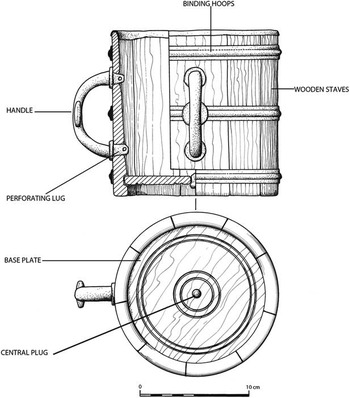
Iron Age tankards are squat-handled vessels with straight or concave sides constructed from wooden staves bound by copper-alloy hoops or sheathing (Fig. 1). They range in size from 15–20 cm in diameter and 14–16 cm in height and had an average volume of around 2.3 litres (4.2 pints) of liquid (see Appendix S1.4). The handles are constructed from sheet or cast copper-alloy and are attached vertically to the side of the vessel. All known tankards have evidence for single handles, with exceptions from Aylesford and Elveden which are reconstructed with two nearly identical diametrically opposed handles (Evans Reference Evans1890, 358–60, figs 9–10). Spratling (Reference Spratling1972, 208–9) challenged these reconstructions arguing that in both cases two single-handed tankards were represented. This was based on the Elveden tankard which included the rim binding for at least two vessels. Nevertheless it is worth noting the existence of double-handled ceramic skeuomorphs as evidence that the original reconstructions were accurate (see below). The majority of handles feature attachment plates which are riveted flat against the vessel wall, though an additional group feature lugs which perforate the vessel wall to be secured on the inside with pins (Fig. 1). The attachment rivets are either copper-alloy or iron and may feature decoration on the rivet heads to form part of a larger decorative motif. The majority of tankard handles are insubstantial and would not accommodate a full single-handed grip, affording at most three fingers entry (Corcoran Reference Corcoran1952a, 88; Jackson Reference Jackson1990, 45). Tankard handles are usually no longer than 13 cm in length (including attachment plates) and range in shape and complexity from simple bar handles to complex cast designs with openwork voids featuring red glass or enamelling. A number of tankards also feature copper-alloy sheet or U-section rim mountings which extend over the lip of the vessel, in some cases held in place by decorative mounts (Fig. 2).
Schematic illustration of the reconstructed Pentuan tankard – base plate is not present in the original (drawn by Alan Braby)

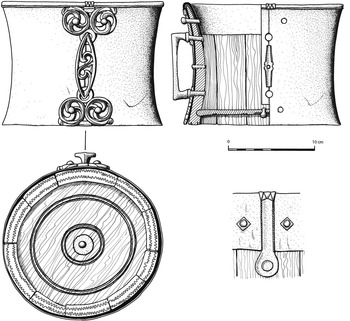
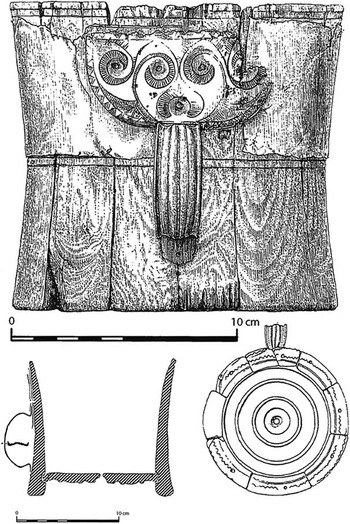
Reconstruction of the Trawsfynydd tankard (drawn by Alan Braby)

There are now at least 139 known examples of tankards and tankard handles from Late Iron Age and Roman Britain (Appendix S1.1) and additionally at least six examples from Continental Europe (Appendix S1.2). This study has more than quadrupled the previously known examples, with a substantial number recently recorded through the Portable Antiquities Scheme (PAS) (www.finds.org.uk).
Previous Studies
Corcoran’s foremost study of tankards included a catalogue of the 25 then-known examples and was complemented by a discussion of chronology and typology, forming the foundations for further work in this area. Subsequent broad studies of Celtic art featured detailed discussions on tankards (Fox Reference Fox1958; Spratling Reference Spratling1972; MacGregor Reference MacGregor1976; Jope Reference Jope2000), whilst assessment of examples recovered from excavations has led to further discussions (Simpson Reference Simpson1972; Raftery Reference Raftery1984; Jackson Reference Jackson1990; Hunter Reference Hunter2003; Reference Hunter2006; Sealey Reference Sealey2007; Joy Reference Joy2006; Gwilt Reference Gwilt2012). Corcoran’s (Reference Corcoran1952a) study of tankards and tankard handles was the first systematic overview of this object type in the archaeological literature. Fox (Reference Fox1958) went on to discuss key examples principally in terms of style and decoration, though also included an examination of their origins, dating, and function. Spratling (Reference Spratling1972, 207–17) incorporated a relatively detailed chapter on tankards within his study of decorated bronze metalwork in later Iron Age Britain which included a reclassification of tankard handles intended to replace that of Corcoran (see below).
MacGregor (Reference MacGregor1976, 283–91) included a worthwhile discussion of tankards in her work on Celtic art in northern Britain, though it is limited by its restricted regional scope and as a result, a comparatively small number of examples are considered. Jope’s (Reference Jope2000, 130–1) study is insightful in many aspects, though it is focused towards the artistic aspects of tankards, rather than how they may have functioned. Such an outlook inadvertently disassociates these objects from their functional uses and contexts, postulating instead that their primary role in prehistoric society was based on their aesthetic qualities.
Origins
The origin of tankards has been discussed in a number of studies (Corcoran Reference Corcoran1952a, 86; Fox Reference Fox1958, 110; Spratling Reference Spratling1972, 213–7; Fitzpatrick Reference Fitzpatrick1989, 358–9; Jope Reference Jope2000, 130–1). All, with the notable exception of Fox (Reference Fox1958), suggest a Roman or Hellenistic origin. The arguments are twofold; firstly that the technology of stave vessel construction (coopering) was new to Britain in the Late Iron Age and therefore must have come from the Continent (Corcoran 1952, 86; Jope Reference Jope2000, 130–1). Secondly, early examples of the tankard tradition can be seen in northern Italy and Greece, from which they claim the British tankards must have been inspired (Spratling Reference Spratling1972, 213–7; Jope Reference Jope2000, 130–1).
The first argument is inconsistent with recent archaeological evidence. Earwood (Reference Earwood1993, 69) points to the earliest example of cooperage in Britain from the mid-2nd millennium bc with the remains of stave-built tubs from Wilsford Shaft, Wiltshire and Caldicot, Monmouthshire (Ashbee et al. Reference Ashbee, Bell and Proudfoot1989, 51–67; Earwood Reference Earwood1993, 68–9; Reference Earwood1997, 208–9). A wooden stave was also recovered from the Early Iron Age occupation of Oakbank Crannog, Loch Tay, Perth & Kinross (Dixon Reference Dixon1981, 20, fig. 4D). Further examples from Lough Gara, Co. Sligo date to the 3rd to 4th centuries bc (Raftery Reference Raftery1972) and oak staves were recovered from a Middle Iron Age pit at Asheldham Camp, Essex (Bedwin Reference Bedwin1991, 34). Another seven stave-built tubs from Glastonbury Lake Village, Somerset are dated to the Late Iron Age (Bulleid & Gray Reference Bulleid and Gray1911). This evidence demonstrates a long and sustained utilisation of coopering technology in prehistoric Britain, beginning in the Middle Bronze Age and continuing throughout the Iron Age.
Spratling (Reference Spratling1972, 213–4) proposed that tankards of a waisted or ‘cooling tower’ profile such as the Trawsfynydd and Carrickfergus examples were inspired by the all-bronze ‘neo-Hellenistic’ tankards of the Calathus or Idris type (see Ulbert Reference Ulbert1960; Périchon Reference Périchon1966, 218, figs 6, 11). These vessels were produced in large numbers in Campanian workshops during the Augustan period and were exported widely (Spratling Reference Spratling1972, 214). However, these vessels do not feature a wooden stave-built core and are therefore fundamentally different to the British tankard form. Their handles also bear little resemblance to insular tankard handles. In addition, very few examples of calathus type vessels or vessel fittings have been found in Britain. It is therefore likely that these two drinking vessel types were created independently of one another. With at least 139 tankards and tankard handles from Britain, compared with only six from the Continent (Appendix S1), it is reasonable to see a British centre of gravity for these vessels. Both the form and decorative style of British tankards are also strongly suggestive of insular inspiration, displaying a high degree of independence from Continental styles. Examples from the Continent show that this vessel type was exported from Britain on a number of occasions, and in at least two cases saw the replication of insular tankard handle style on foreign vessel forms (see below).
Construction Methods
Tankards are technically challenging objects to construct, featuring advanced woodworking and metalworking techniques including coopery, woodturning, casting, and sheet working of copper-alloy. The tools and techniques used in this process have been established by examination of complete and fragmentary vessels, modern coopering methods, and tankard reconstructions (Stead Reference Stead1971; Langsner Reference Langsner1985; O’Neill Reference O’Neill2002).
Woodwork
The body of the Late Iron Age tankard was constructed from a number of wooden staves formed to provide a watertight fit. In a reconstruction of the Carrickfergus tankard, O’Neill (Reference O’Neill2002, 8) constructed a semi-circular mould on which the stave blanks could be placed and checked regularly for fit. In modern coopering terms this process is known as the dressing of the stave. The staves feature an internal groove carved near their base (a croze), allowing for the insertion of a base plate. These base plates are either simple sawn sections of wood (two examples) or were turned on a lathe (five examples).
The lathe-turned bases of the Trawsfynydd, Carrickfergus, Ornavasso, Shapwick, and Vindolanda tankards are embellished with multiple concentric circles, the three former examples also featuring a central perforation. The Trawsfynydd tankard (Fig. 2) retains a copper-alloy plug blocking this perforation, and this feature was probably present on other tankards with perforated bases. Such plugged holes also appear on a number of cauldrons which were turned or finished on a lathe (Joy Reference Joy2014, 339). O’Neill (Reference O’Neill2002, 15) suggests that it was probably caused by the pole lathe pin and mandrel being driven too far through the base plate during production. This may have been avoidable by leaving small pedestals of waste wood on either side of the base plate, which can then be trimmed off once removed from the lathe.
Tankards utilised techniques of white coopering, a division of the coopers craft producing straight-sided single-bottomed watertight vessels such as buckets and churns (as opposed to wet-coopered, double-bottomed vessels such as whisky or beer casks) (Langsner Reference Langsner1985, 9). As is evident on the Kew and Welwyn B tankards, small rectangular recesses were cut into the adjoining stave edges, and these would have been fitted with small dowels. This form of mortis and tenon joint holds the staves in position though will not make vessels watertight on their own (Langsner Reference Langsner1985, 11–2). The heat-affected areas underneath the bronze bands of the Langstone tankard indicate the copper-alloy bands were heated before placement on the vessel, at which point they cooled and contracted, forcing the staves into a watertight fit (Adam Gwilt pers. comm.). The Trawsfynydd, Carrickfergus, and Ornavasso tankards also feature thin serpentine indented lines on the base of their staves (Fig. 2). Still present on the Trawsfynydd tankard, these wavy indents held lengths of copper-alloy wire hammered flat into the stave ends which may have supported the structural integrity of the vessel, a technique also paralleled in iron on a chariot wheel hub from the Roman fort of Bar Hill, North Lanarkshire (Raftery Reference Raftery1984, 225; Jope Reference Jope2000, 131). It is also worth noting the potential use of organic binding material to secure the staves, though no definitive examples of this survive.
The wood species in all examples noted (11 examples), is exclusively that of the European yew (Taxus baccata). Yew was an extremely uncommon choice for vessel construction in general (Cool & Richardson Reference Cool and Richardson2013, 211). Functionally it is a durable wood which is resistant to decay when wet. However, it is also particularly difficult to work as it is often heavily knotted and therefore prone to splitting (O’Neill Reference O’Neill2002, 14). Such a split occurs on the base plate of the Langstone tankard which was plugged with molten tin in antiquity (Adam Gwilt pers. comm.). Yew is one of the longest-lived tree species in Northern Europe (Bevan-Jones Reference Bevan-Jones2002, 1). Surviving trees at Crowhurst Churchyard, Sussex (Hindson & Elphick Reference Hindson and Elphick2012, 4–5) and Fortingall Churchyard, Perth & Kinross (Bevan-Jones Reference Bevan-Jones2002, 38–9) have date estimates at 1300 and 2000 years respectively, though the latter may be far older. Bevan-Jones (Reference Bevan-Jones2002, 29) notes that charters often refer to yew trees as pre-dating the churches themselves. This would suggest a religious or traditional significance for this tree species, which predated Christianity in Britain (Bevan-Jones Reference Bevan-Jones2002, 29).
The use of yew in a drinking vessel is intriguing, as the species is known to contain highly toxic compounds. These are found in all elements of the tree except for the berry-like red aril which surrounds the seed. Recent cases of yew poisoning from ingestion of the leaves and seeds have been examined in both humans (van Ingen et al. Reference van Ingen, Visser, Peltenburg, Ark and van der Voortman1992; Pietsch et al. Reference Pietsch, Schulz, Schmidt, Andresen, Schwarze and Dreβler2007) and animals (Tiwary et al. Reference Tiwary, Puschner, Kinde and Tor2005; Kite et al. Reference Kite, Lawrence and Dauncey2000). There is good evidence to suggest that the poisonous qualities of yew were well known in prehistory. Various historians including Dioscorides, Nicander, Galen, and Plutarch noted the poisonous qualities of yew (Lowe Reference Lowe1897, 136–9). Caesar describes the suicide of Cativolcus, king of the Eburones who used a poison derived from the yew tree (De Bello Gallico 6.31). Pliny the Elder also notes that wine flasks made from yew have been known to cause death (Natural History 6.12.16). A recent study examined the uptake of poisonous taxoids from a dried section of yew heartwood. This study found that wine readily extracted the harmful taxoids at a rate of 20% in comparison to pure methanol. Non-alcoholic liquids or foodstuffs had far lower taxoid uptake (Kite et al. Reference Kite, Rowe, Veitch, Turner and Dauncey2013, 26). This suggests that the consumption of alcoholic beverages from yew vessels could be potentially dangerous, though probably required prolonged exposure. It implies that beverages with lower alcohol content such as beer would have a lower taxoid uptake than wine, though a number of other variables such as the levels of taxoids required and contact duration for a lethal dose are still unclear. That being said it is reasonable to suggest that drinking from a yew vessel is unlikely to have caused death, as it was recurrently used for drinking vessels from the Late Iron Age onwards (see below).
In general the use of yew in prehistory is relatively rare, with notable appearances in the form of votive objects such as the anthropomorphic figure from Ralaghan, Co. Cavan and five Late Bronze Age figures and miniature boat from Roos Carr, East Yorkshire (Coles Reference Coles1990). A Late Bronze Age yew sword was deposited in a peat bog at Groatsetter, Mainland Orkney (Stevenson Reference Stevenson1960, 191–3). Stave-built yew buckets appear contemporaneously with tankards in Late Iron Age Britain and the Continent (see below). Similar buckets also appear in a large number of Anglo-Saxon graves (see Cook Reference Cook2004). It is also worth noting the use of yew in early medieval reliquaries or caskets from Northern Europe (Edwards Reference Edwards2013, 138).
The use of yew was an unusual and deliberate choice. If durability was the only concern, ash or oak could have been used in their construction, as in other stave-built vessels and tools found in prehistoric Britain (see Bulleid & Gray Reference Bulleid and Gray1911). This suggests that some of the other characteristics of the yew species played an important part in the choice. The toxicity of yew was well known in prehistory and this probably gave it a symbolic role. Its significance to this extent is emphasised by its use in religious and ritual objects.
Metalwork
The hoops or sheathings for tankards were constructed from copper-alloy sheet. A number of tankard handles were similarly formed of sheet metal (17 examples) though the majority were cast (118 examples). Tankard handles can often be differentiated from other handle fittings by the curvature of their attachment plates, indicating their intended attachment to the curved-walled vessel. They were produced from lost-wax castings with the mould being destroyed in order to produce the tankard handle; each piece, therefore, is one of a kind. So far no moulds for tankard handles are known. Many cast tankard handles feature recesses which may have been cut after casting using drills and gravers (Spratling Reference Spratling1972, 273). Tankard handles were attached to the vessel using one of two methods. In the first method the handle is riveted through its attachment plates which lay flat against the vessel wall. In the second method the handle features lugs which perforate the wall of the vessel and are secured on the inside with pins (Fig. 1).
Glass and enamel
Glass or enamel is found on a number of tankard handles. Red glass is found on 15 examples (see Appendix S1), and was a particularly popular embellishment on insular Late Iron Age metalwork (Northover Reference Northover1995, 294). The method of application involved the heating of glass until it formed a soft paste which could then be pressed and shaped into a setting (Mary Davis pers. comm.). As the glass remains partially solid it can be set within voids and recesses. The use of polychrome or red enamel is found on only six tankard handles and is primarily a Roman-era technology (Davis & Gwilt Reference Davis and Gwilt2008, 155). The application of this enamel entails the heating of powdered glass which is fused within a setting and retains a crystalline structure differing to that of red glass (Mary Davis pers. comm.).
Evidently, a wide range of skills, tools, and technologies were employed in the construction of tankards, probably requiring the collaboration of a number of skilled craft workers. Thus, the creation of relationships was a necessary element in the manufacturing process, and may have been part of the future lives of the artefact (Joy Reference Joy2010, figs 3.1–3.3).
Decoration, Form, and Function
The majority of tankards display decorative features which are primarily focused on or around the handle. The decoration around the handles of the Trawsfynydd and Carrickfergus tankards (Figs 2 & 3) is focused on the concealment of their attachment methods. The hoops or sheathings of tankards were usually undecorated, with the exception of the Elveden tankard which features repoussé triskele motifs (Evans Reference Evans1890, 359, fig. 10). The Trawsfynydd tankard also features triskele motifs, though cast rather than repoussé, on four separate mouldings above and below the tankard handle (see Fig. 2). The Carrickfergus tankard features a decorative plate over the upper handle attachment with cross-hatched ‘mirror-style’ motifs (Fig. 3) (Joy Reference Joy2010, 136). The thin copper-alloy binding hoops on the Pentuan tankard had raised, moulded ribs around their circumference (Fig. 1). All other sheet fittings for tankards are notably plain. The choice to decorate or to leave blank was a conscious one, and appreciation of the reflective qualities of polished copper-alloy may have been preferred over other embellishments, while the elegantly curved ‘cooling tower’ shape of the Trawsfynydd and Carrickfergus tankards is in itself pleasing to the eye. The wood was originally visible beneath the hoops of most surviving tankards, suggesting a choice to display the technical craftsmanship, and composite material structure of these vessels. It is also possible that the grain of the timber was appreciated as an attractive feature, with its contrasting light and dark colouration and swirling patterns of knotting.
The Carrickfergus tankard (O’Neill Reference O’Neill2002, 9, fig.1)

A number of tankards originally featured decorated rim-binding clasps over the lip of the vessels. An example is intact on the Trawsfynydd tankard (Fig. 2). Other decorated clasps are noted from contexts relating to tankard handles at Bredon Hill (Hencken Reference Hencken1938, 67–71), Hod Hill (Brailsford Reference Brailsford1962), and Camerton (Jackson Reference Jackson1990, 45–6). Further examples have been recorded via the PAS (Marshall Reference Marshall2006a; Reference Marshall2006b; Gwilt Reference Gwilt2010; Creighton Reference Creighton2013a; Reference Creighton2013b), though these are practically indistinguishable from shield-binding clasps so their identification can only be labelled as ‘possible’ (Parfitt Reference Parfitt1995; Joy Reference Joy2010). Oversized dome-headed rivets on the Kew and Trawsfynydd tankards are also notable as they combine both decoration and function.
Almost all tankard handles incorporate some form of decorative feature. The simple U-shaped handles from Elveden are therefore unusual, and must have been chosen in order not to distract from the decorative motifs on the body of the vessels. Opaque red glass is a common feature on tankard handles and is commonly applied over circular settings or voids as on the Much Hadham, Warminster, and Seven Sisters handles. Red glass is also featured on a number of examples overlying the rivet heads, effectively concealing the attachment method. Different metal compositions were utilised on the Camerton II handle (Jackson Reference Jackson1990, 45) and the tinning on the Greenhill handle to provide colour contrast. Anthropomorphic designs feature on a number of tankard handles including those from Carlingwark Loch, Burwell Fen, and Knockin.
The decoration of tankards was not a passive decision to fill an unoccupied space. They were decorated for a reason. The virtuosity and skill required to decorate tankards has been discussed by Joy (Reference Joy2010, 38) who cites Gell’s (Reference Gell1999) discussion on Trobriand canoe prows, in which he argues that they display such artistic and technical brilliance as to make them almost incomprehensible to the average onlooker (Giles Reference Giles2008). This analogy when applied to tankards can be extended to the construction of the vessel itself, not just the decorative elements. The technical skill required for the coopering of the vessel was such that very few individuals would understand how such a feat was accomplished. The purposeful concealment of the techniques used for handle attachment and sheet riveting on the Trawsfynydd and Carrickfergus tankards would further baffle any onlookers trying to comprehend the construction of these vessels. The technical skill and artistry would imbue these objects with ritual power, and the individuals or communities who owned these tankards would gain social and political prestige from their use. The construction elements required the bringing together of individuals and materials, and therefore this association with social and political power was in effect a material representation of the real-life power that particular individuals or communities held.
Estimates of volume (Appendix S1.4) indicate that tankards on average can hold 2.3 litres (4.2 pints) of liquid and when full, the vessels would weigh between 4.5 kg and 5.5 kg. Corcoran (Reference Corcoran1952a, 88) notes that the diminutive size of tankard handles makes it almost impossible to hold a full tankard as you would grasp a modern-day mug, with the handle in the fist. Instead, it is clear that the vessel should be held with both hands, with two or three fingers slotted through the handle to prevent slippage (Corcoran Reference Corcoran1952a, 87–8; Fox Reference Fox1958, 107; Jackson Reference Jackson1990, 45). This grip also ensured that the decoration on the handle was not obscured during use, but instead became ornamentation on the hand of the user. When lifting the vessel to drink, the underside became visible to onlookers for the first time. In the case of the Trawsfynydd, Carrickfergus, and Ornavasso tankards, this would display the concentric circles, a central pellet, and the serpentine copper-alloy wire which had been hammered into the stave ends.
Parallels Within Iron Age Material Culture
Tankards share a number of parallels with other classes of Iron Age artefacts. Unsurprisingly, they have strong similarities within the ensemble of drinking and feasting equipment. The most immediate parallels are with decorated and stave-built buckets. These are similarly constructed to tankards, with wooden staves (often yew) bound by copper-alloy or iron hoops. A number have been recovered from late La Tène burials in Britain dating from the 1st century bc to the 1st century ad (see Stead Reference Stead1971; Spratling Reference Spratling1972, 230–4; Gwilt Reference Gwilt2012). Often found alongside amphorae, strainers, and copper-alloy vessels, it is usually proposed that these vessels were used for mixing imported wine (Stead Reference Stead1971, 276), though their use for holding native beverages should also be considered.
As composite objects of both wood and copper-alloy components, tankards and chariots share similarities in their construction techniques and decorative style. Many of the tools used in the production of the wheel spokes, coachwork, axle beams, and wheel hubs would have been well suited to the manufacture of tankards. The wheel hubs on chariots from Garton Slack, Yorkshire (Brewster Reference Brewster1971, 291–2) and Newbridge, Edinburgh (Carter et al. Reference Carter, Hunter, Smith, Hastie, Lancaster, Dalland, Hurford, Bailey, McDonnell and Swiss2010, 50, fig. 9B) required similar metal binding hoops to those seen on tankards, while the serpentine copper-alloy wire hammered into the stave ends of the Carrickfergus, Ornavasso, and Trawsfynydd tankards also finds parallel in iron on the Bar Hill wheel hub (Jope Reference Jope2000, 131).
Strong stylistic similarities can also be drawn with the metalwork associated with chariot harnesses and horse gear. For instance the tankard handle from Glastonbury Lake Village referenced terret form (see Fig. 13) (Bulleid & Gray Reference Bulleid and Gray1911, 231, fig. 46), while bridle bits have strong links in form to Type 3 mirror handles (Joy Reference Joy2010, 141–3) and a number of tankard handles. Further links can be made from the curvilinear enamelled features of Groups IV and VIIa tankard handles (see below) closely paralleled in dragonesque brooches.
Tankard and mirror handles share parallels in decorative style and form (Corcoran Reference Corcoran1952a; Spratling Reference Spratling1972; Joy Reference Joy2010). Handle types consisting of multiple joined loops are found on Group II tankard handles and Joy’s Type 3 mirror handles (Joy Reference Joy2010, 141–3). In particular, mirrors from Colchester, Essex; Desborough, Northamptonshire; Dorton, Buckinghamshire; and Llechwedd-ddu, Conwy closely resemble the tankard handles from Kelvedon, Kew, Puddlehill, and Bulbury, among others. Similarities should also be noted between Joy’s (Reference Joy2010, 143) Type V mirror handles from Lochlee Crannog, South Ayrshire and Bac Mhic Connain, North Uist and the Hayling Island II and Rossington tankard handles. The circumferential u-section mounts on the lip of tankards are paralleled on mirrors and shields, the latter also featuring similar decorated edge clasps to those found at Camerton and on the Trawsfynydd tankard.
The level of technical knowledge and crafting skills applied to the manufacture of tankards and tankard handles indicates that the individuals involved had a practiced craft. The referencing of numerous contemporary Iron Age objects on tankards suggests that the same craftworkers were responsible for creating these objects. The functional crafting abilities and learnt skills would lead craftworkers to produce objects with similar style to which they were already familiar, and to those which were in vogue at the time. As a corollary of this, such cross-relationships of style provide important supporting evidence for the chronological development and dating of tankards.
Ceramic tankards
Strong similarities can be found in the ceramic handled tankards of Durotrigan and Severn Valley Wares (see Brailsford Reference Brailsford1958, 103, figs 1, 8; Webster Reference Webster1976, 30–1, Class E; Timby Reference Timby1990, 251). Examples of the former are found exclusively within the conventional zone of the Durotriges (primarily Dorset and its borders) and have been noted at Hod Hill and accompanying burials at Jordan Hill and Maiden Castle (Wheeler Reference Wheeler1943, 233; Brailsford Reference Brailsford1958, 118–9; Richmond Reference Richmond1968, 37, fig. 22). The earliest dating of Durotrigan wares is conventionally ascribed to the mid-1st century bc (Cunliffe Reference Cunliffe2005, 117), though tankards primarily appear at the beginning of the 1st century ad (Brailsford Reference Brailsford1958, 118–9). Their ceramic form appears to mimic wood and metal tankards, though are notably plainer and feature a wider variation in size and volume (Corcoran Reference Corcoran1952a, 86–7; Webster Reference Webster1975). The existence of double-handled ceramic tankards from Hod Hill and Jordan Hill (Brailsford Reference Brailsford1958, 119, pl. xxii facing 112) are noteworthy and provide credence to the reconstructions of the Elveden and Aylesford examples as double-handled vessels (Evans Reference Evans1890, 358–60, figs 9–10).
Severn Valley Ware tankards appear in the post-conquest period and take their inspiration from Durotrigan types (Webster Reference Webster1977; Timby Reference Timby1990, 249–51). They are predominantly distributed throughout the Severn basin, though a considerable number of examples are found further afield in the west Midlands, Welsh Marches, and in northern Britain, reaching as far north as the Antonine Wall in the mid- to late-2nd century ad (Webster Reference Webster1977, 172). Their forms often reference the sheathing found on wood and metal tankards. On balance it would seem that ceramic tankards were inspired by wood and metal versions, and both types were contemporaneous from the 1st century ad. Ceramic tankards are only discussed briefly here, as it is hoped this topic will be considered more fully in the future.
Use, Wear, and Repair
It is possible to gain insight into how tankards were used by examining physical evidence indicative of wear and repair, which can suggest how frequently these vessels saw use, how they were treated, whether they were modified, and in what state they were deposited. This was carried out by first hand examination of objects where possible (39 examples), or by inspecting photographic or illustrated records and notes made by other authors.
The Biddlesden tankard fittings include three copper-alloy bands and a handle, the wooden core of the vessel having completely decayed. On examination Joy (Reference Joy2006, 2) noted that the handle was not the original one, with rivet holes evident on the copper-alloy bands above and below the current handle (also indicating the original handle was longer than its replacement). Similarly, the Langstone tankard features evidence suggestive of handle replacement (Adam Gwilt, pers. comm.), visible from the presence of nail fragments in situ under the current handle. A small irregular carved notch on the internal wall on the obverse side of these nails probably occurred during the removal of the original handle. The base plate of this tankard also features repair to a split which was filled with the addition of molten tin (Gwilt Reference Gwilt2012). The Trawsfynydd tankard shows evidence of a repair to a crack near to the base of its outer sheathing with the use of three folded pins (Spratling Reference Spratling1972, 568).
The tankard from Corbridge Roman fort features copper-alloy bands similar to those found on the Langstone tankard. Unusually however, both bands have a section missing over the stave to which the current handle is attached. Two thin iron hoops directly overlie these incomplete copper-alloy bands. The clean vertical cuts on the copper-alloy bands indicate this section was removed intentionally. This was probably carried out in order to replace an earlier handle. Removal of this section would have caused the staves to expand involuntarily, therefore requiring the addition of iron hoops to hold the staves in place. Deposited within a chest containing primarily Roman military objects, it seems this tankard came into the hands of individuals within the Roman army and subsequently had its original handle replaced.
Handles are the most commonly surviving remains of tankards. This is largely due to the wood and sheet metal elements being more prone to deterioration. It is clear, though, that a large proportion of tankard handles were deposited separate from their vessels, as nearly three-quarters are fragmentary. The most common breaks occur, unsurprisingly, over their weakest points on the handle arms and the attachment plates. Whilst it is possible that some of these breaks occurred after the object was placed in the ground, the majority are old breaks occurring prior to or at the time of their deposition. The Seven Sisters (I & II), Chew Valley Lake, and Kelvedon examples are amongst those which show direct breaks to their rivet holes suggestive of stress fractures due to wear. The Coelbren handle exhibits damage to the left rivet hole and uppermost right edge which may indicate that this handle was removed from its vessel. Combined with the indication for replacement of handles on complete tankards, this evidence suggests that handles often broke with use and were subsequently replaced. Few handles show any definite evidence for repair and it is likely that once damaged, handles were usually discarded and replaced. However, it should not be assumed that the original handle had broken prior to removal, as the replacement of handles may have been undertaken due to the changing aesthetic tastes of their owners. A number of complete and fragmentary examples evidence this replacement by still retaining one or more of their rivets. We can also see evidence for the intentional destruction of tankards and tankard handles. The handle from Hallaton was broken over its mid-section and deposited with folded copper-alloy sheet, suggesting deliberate disassembly and destruction of this tankard in antiquity (Score Reference Score2011, 77–8).
The results of this analysis provide compelling evidence for the complex and varied object histories of tankards. These vessels saw regular and prolonged use, and warranted the time and expense of repair when damaged to prolong their use-lives. The replacement of tankard handles appears to have been relatively common, whether due to damage sustained by the original handle, or to changing tastes.
Typology and Chronology
Previous attempts at typologies for tankard handles constructed by Corcoran (Reference Corcoran1952a, 93) and Spratling (Reference Spratling1972, 207–13) were not entirely successful. Corcoran (Reference Corcoran1952a, 93; Reference Corcoran1952b, 239) subsequently admitted that the Elveden, Trawsfynydd, and Burwell Fen handles did not fit into his typological sequence. This problem recurred in Corcoran’s (Reference Corcoran1957, 233) later report on the newly found tankard handle from Puddlehill, which he was also unable to place with any certainty. Spratling’s (Reference Spratling1972) subsequent reclassification of tankards maintained that Corcoran’s typology was unworkable. Spratling (Reference Spratling1972, 207) excluded tankards from contexts later than the Flavian period from his typological discussion (see below), arguing that they are significantly later in date than the main series. However, this has proven to be unsubstantiated, and therefore he unnecessarily neglected an important group of tankard handles from his typology. Jackson (Reference Jackson1990, 44–5) notes that Spratling’s typology is overly complex, deeming his division of the Seven Sisters hoard into separate groups as unnecessary. Yet it is clear that groups of handles found together (such as at Camerton and Seven Sisters) do show significant variation, and therefore splitting them into separate groups can be justified.
One of the recurring problems in creating a typology for tankard handles is that many have unique designs. Sealey (Reference Sealey2007, 12) recognised that the innovation of those who produced these artefacts limited clear typological relationships. Indeed, many examples lack any direct parallels at all (see Fig. 13). Tankard handles feature a wide array of physical characteristics which often overlap, making typologies overly complicated, time consuming, and contentious (Doran & Hodson Reference Doran and Hodson1975, 158).
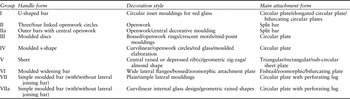
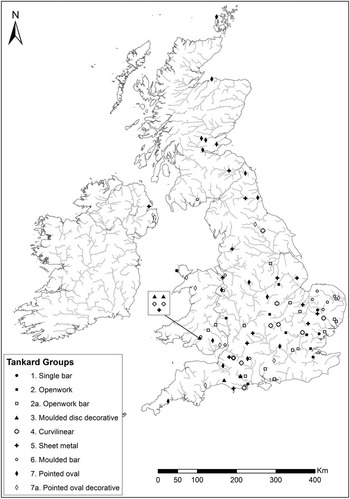
Tankard handles originated in the Late Iron Age and continued through the Roman period. Their design was subject to varying influences during this time, whether aesthetic or social, and they cannot be easily accommodated into a neat typological scheme. However, some do form looser groups which can be categorised in terms of handle form and decoration style (Table 1). These groups are reinforced by a chronological currency and coherence (see Appendix S2) evidenced by independently dated examples, and are outlined below (see Fig. 15). Numerous tankard handles cannot be categorised as they currently lack parallels (14%) or are too fragmentary to identify (10%), and are therefore placed within a miscellaneous category pending further discoveries.
Summary Of Handle Groups

I. Simple Bar Group
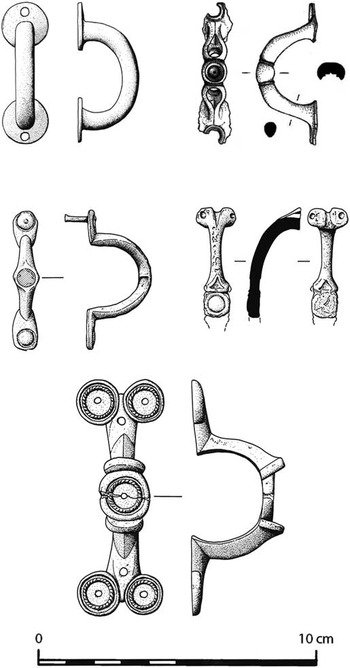
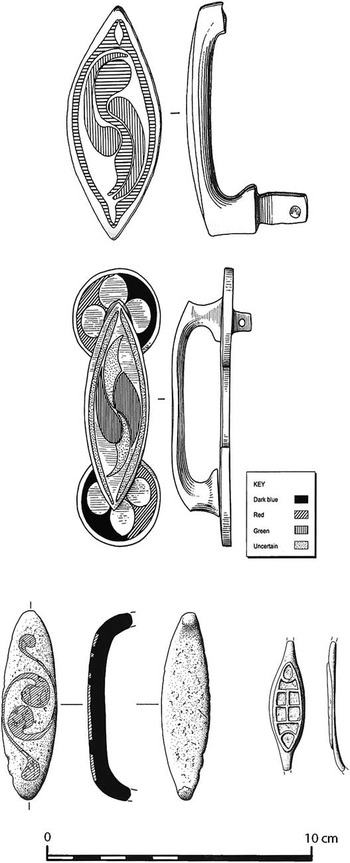
These handles consist of a single bar, semi-circular in profile, with circular or bifurcating circle attachment plates (Fig. 4). Decoration is primarily restricted to simple inset mouldings on the central section and attachment plates. Some examples also feature red glass inserted within these circular settings. This group is similar to Corcoran’s (Reference Corcoran1952a, 93) Class V but excludes sheet tankard handles. Examples with dating evidence suggest a deposition period of 75–10 bc. The group’s distribution is restricted to the south-east of England, often within burials.
Group I clockwise from top left: Elveden, Suffolk; Kelvedon, Essex (Sealey Reference Sealey2007, 13, fig. 6, no. 9; © Sue Holden); Swithland, Leicestershire; Aylesford, Kent; Hatfield Broad Oak, Essex (unless otherwise stated, drawn as reconstruction by Alan Braby)

II. Openwork Group
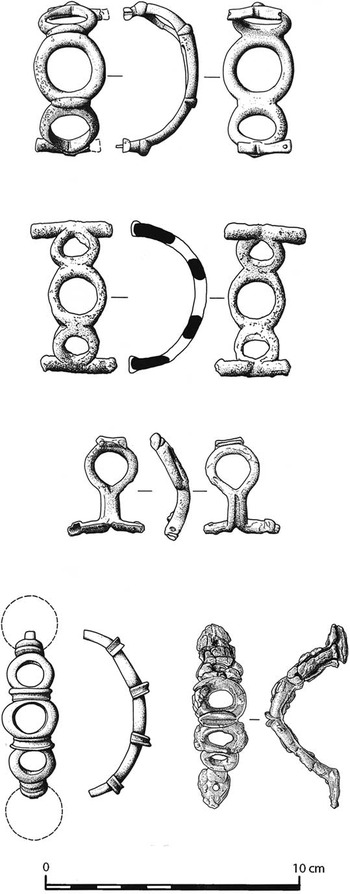
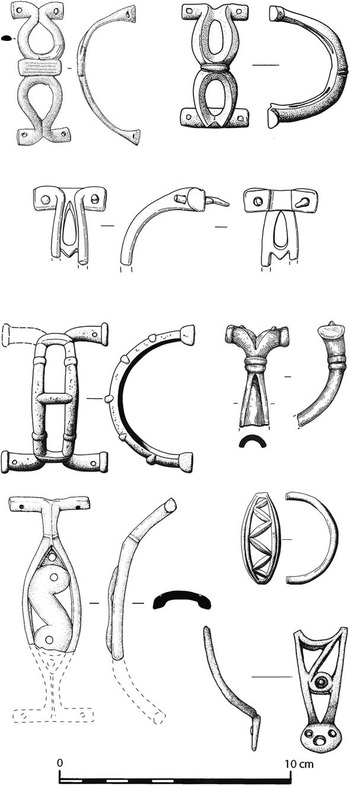
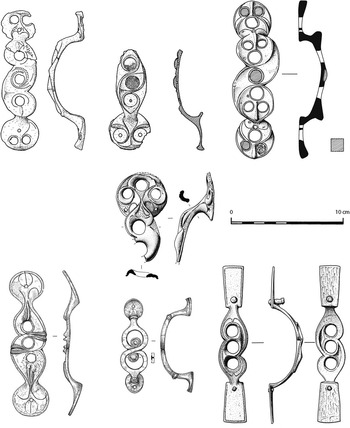
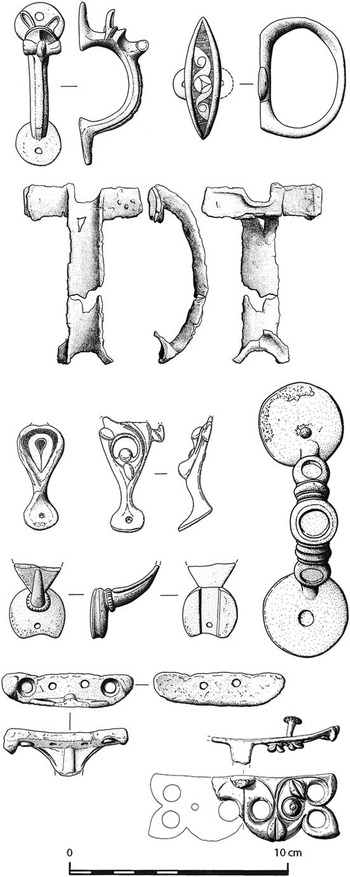
This group comprises handles which feature three or four circular linked rings (Fig. 5). All examples are cast and most have bifurcating bar attachment plates. The group is similar to Corcoran’s (Reference Corcoran1952a, 93) mirror handle type (Class IVa), named after their strong similarities to mirror handles. There are at least nine examples from Britain and two from the Continent, as well as clearly inspired vessel handles from Mont Beuvray and Saint-Rémy-de-Provence, France (Périchon Reference Périchon1966, 218, figs 6, 11; Tendille Reference Tendille1981, 88, figs 21, 1; Feugère Reference Feugère1991, 129, fig. 11; see Appendix S1.2). Contextually dated examples indicate a deposition range of around 50 bc–ad 50. Strong stylistic similarities are shared with Joy’s (Reference Joy2010, 145) Type IV mirror handles, which are similarly dated 25 bc–ad 50. The distribution within Britain is centred in southern England, with geographical outliers in Anglesey and Lincolnshire. Subgroup IIa features geometric or curvilinear openwork sections set within two bifurcating central bars (Fig. 6). These split off at their ends to form attachment bars. This subgroup is primarily distributed within southern England and is dated to the beginning and middle of the 1st century ad.
Group II clockwise from top: Long Bennington, Lincolnshire; Porth Dafarch, Anglesey; Watford, Northamptonshire; Hayling Island II, Hampshire (© Anthony King, Grahame Soffe & Hayling Island Excavation Project); Puddlehill, Bedfordshire (unless otherwise stated, drawn as reconstruction by Alan Braby)

Group IIa clockwise from top left: Hayling Island I, Hampshire (© Anthony King, Grahame Soffe & Hayling Island Excavation Project); Kew, City of London; Bromeswell, Suffolk (© Suffolk County Council); Camerton III, Somerset (Jackson Reference Jackson1990, pl. 12, no. 21; © Trustees of the British Museum); Bredon Hill, Worcestershire; Rossington, South Yorkshire (Dearne & Parsons Reference Dearne and Parsons1997, 71, fig. 8, no. 4); Colne Fen II, Cambridgeshire (Evans et al. Reference Evans, Appleby, Lucy and Regan2013, 343, fig. 4.24, no. 8); Colchester, Essex (unless otherwise stated, drawn as reconstruction by Alan Braby)

III. Moulded Disc Decorative Group
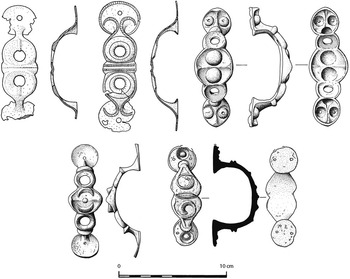
This group consists of tankard handles exhibiting individual decorative motifs based around moulded discs decorated with bosses, crescents, and openwork discs (Fig. 7). They are regionally constricted to the south Wales and Dorset areas with a deposition date range of ad 40–75.
Group III clockwise from top left: Seven Sisters I & II, Neath Port-Talbot (Davies & Spratling Reference Davies and Spratling1976, 134, fig. 9, nos 21 & 22); Waddon Hill, Dorset; Welwyn B, Hertfordshire (unless otherwise stated, drawn as reconstruction by Alan Braby)

IV. Curvilinear Group
This group consists of handles which exhibit insular curvilinear decorative elements which link together. They often feature red glass inserts in circular voids and s-shaped (or reverse s-shaped) motifs (Fig. 8). Contextually dated examples suggest their currency and deposition in the early campaigning period of the Roman army in Britain, centring on the 3rd quarter of the 1st century ad. Their distribution extends from south-east Wales to as far east as Buckinghamshire and as far south as Dorset. They are primarily deposited in votive hoards.
Group IV clockwise from top left: Seven Sisters III & IV, Neath Port-Talbot (Davies & Spratling Reference Davies and Spratling1976, 134, fig. 9, nos 23 & 24); Warminster, Wiltshire; Hallaton, Leicestershire (Score Reference Score2011; © University of Leicester Archaeological Services); Hod Hill I, Dorset; Camerton II & I, Somerset (Jackson Reference Jackson1990, 45–6, pl. 12, nos 19 & 20; © Trustees of the British Museum) (unless otherwise stated, drawn as reconstruction by Alan Braby)

V. Sheet Metal Group
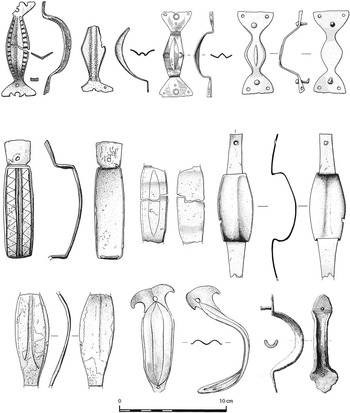
This group features handles formed from sheet metal. It is related to Corcoran’s (Reference Corcoran1952a, 93) Class V but omits the cast lugged tankard handles (Fig. 9). Decoration usually consists of geometric patterns of punched dotted lines, incised zigzags, or raised lateral mouldings. These tankard handles generally lack the elaborate moulded features seen in the Curvilinear Group. There are 17 examples, of which seven have dating evidence for deposition c. ad 70–140. These tankard handles are primarily deposited within both hoards and Roman military or settlement contexts. Their distribution is widely spread with examples throughout England, Wales, and southern Scotland.
Group V top row from left to right: Newstead, Scottish Borders (MacGregor Reference MacGregor1976, 290); Seven Sisters V, Neath Port-Talbot (Davies & Spratling Reference Davies and Spratling1976, 134, fig. 9, no. 25); Chew Park, Somerset (Rahtz & Greenfield Reference Rahtz and Greenfield1977, 284, fig. 112); West Stow, Suffolk. Middle row: Hod Hill II, Dorset; Eccleston, Cheshire; Cromwell, Nottinghamshire. Bottom row: Revesby, Lincolnshire; Ribchester, Lancashire (Howard-Davis & Buxton Reference Howard-Davis and Buxton2003, fig. 66); Salmonsbury, Gloucestershire (Dunning Reference Dunning1976, 111, fig. 25, no. 395) (unless otherwise stated, drawn as reconstruction by Alan Braby)

VI. Moulded Bar Group
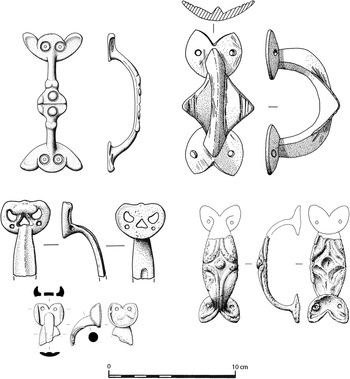
This group consists of handles with a main bar which widens towards its middle with lateral flanges, or moulded geometric and bossed decoration (Fig. 10). The bifurcated, fishtail-shaped attachment plates trend towards zoomorphic representations. Three examples from Norfolk make up a localised core for the group with geographical outliers from Caerwent and Carlingwark Loch (although the bossed style on the latter suggests a central British style). The only contextually dated example from this group is from Carlingwark Loch, dated ad 75–150, and this seems a plausible date range for the rest of the group.
Group VI clockwise from top left: Carlingwark Loch, Dumfries & Galloway; Morley, Norfolk (Gurney Reference Gurney2002, 153, fig. 2, D; © Norfolk County Council); West Rudham, Norfolk (Gurney Reference Gurney2003, fig. 2, C; © Norfolk County Council); Fincham, Norfolk (PAS 2013 © Norfolk County Council); Wroxeter, Gloucestershire (unless otherwise stated, drawn as reconstruction by Alan Braby)

VII. Pointed Oval Group (lugged attachment)
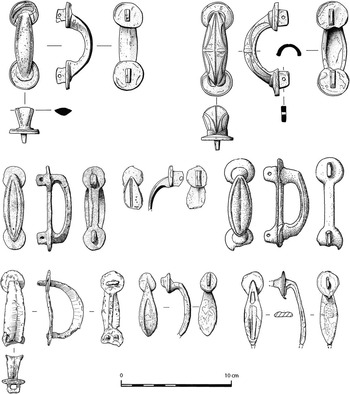
The final group is typified by its robust and heavy cast form with convex oval or almond-shaped body (Fig. 11). These usually feature lugs protruding from the attachment bars/plates which perforate the tankard wall to be secured internally with pins. The decoration for this group primarily consists of understated, raised, lateral mouldings. Within Group VII is a subgroup, Group VIIa, which features polychrome enamel or openwork mouldings often in a curvilinear/dragonesque form (Fig. 12). Group VII/VIIa includes at least 21 examples of which dated handles suggest a primary deposition period in the 2nd century AD. Their distribution is focused towards northeast England and southern Scotland with an outlier from Intercisa Roman fort, Dunaujváros, Hungary. This group is overwhelmingly associated with Roman military and settlement sites and is often recovered in close association to Roman material culture.
Group VII top row left to right: Airth, Falkirk (© National Museums Scotland); Castle Craig, Perth & Kinross (© National Museums Scotland). Middle row: Caerleon, Newport (Evans & Metcalfe Reference Evans and Metcalfe1992, 158, no. 328); Woolder, Northumberland; Okstrow, Orkney (MacGregor Reference MacGregor1976, 290). Bottom row: Wallsend, Northumberland (Hodgson Reference Hodgson2003); Great Barrow, Cheshire; Ellesmere, Shropshire (PAS 2006) (unless otherwise stated, drawn as reconstruction by Alan Braby)

Group VIIa: Caenarfon, Gwynedd (Casey & Davies 1993); Catterick, North Yorkshire (Wilson Reference Wilson2002, 58, fig. 251, no. 138; © English Heritage); Topsham, Devon; Greywell, Hampshire (unless otherwise stated, drawn as reconstruction by Alan Braby)

Summary
The combined date group for the deposition of tankards in Britain ranges from 75 bc–ad 200. The form of tankard handles has a clear development pattern through this period which is summarised below:

Nearly one-quarter of tankard handles (33 examples) are not placed within these groups, 14 of which are fragmentary and therefore cannot be placed with any certainty. The rest are placed within a miscellaneous group (Fig. 13) as their unique forms have little or no direct parallels.
Miscellaneous group clockwise from top left: Burwell Fen, Cambridgeshire; Glastonbury Lake Village, Somerset; Loughor, Swansea (Marvell & Owen-John Reference Marvell and Owen-John1997, 251–2, fig. 95, no. 60); Castor, Cambridgeshire; Tanwork in Ardern, Warwickshire; Charsfield, Suffolk; Canvey Island, Essex; Lakenheath, Suffolk; Knockin, Oswestry; Mileham, Norfolk (Gurney Reference Gurney1996, 389, fig. 2, D; © Norfolk County Council) (unless otherwise stated, drawn as reconstruction by Alan Braby)

Tankards were deposited in Britain over a period of up to 300 years. They first appear in the Late Iron Age at a time when dramatic changes were taking place (Mattingly Reference Mattingly2006; Sharples Reference Sharples2010). Their form and decoration mirrors these changes in the relatively fast-paced development from the early Groups I and II to the increasing stylistic complexity of Groups III and IV which place greater emphasis on Iron Age stylistic forms. This stylistic development may have initially represented an expression of outward rebellion against Roman influences and tastes during the early campaigning period in Wales and south-west England. Eventually however, these stylistic traits came to epitomise a coming-to-terms and an acceptance of the cultural transformations which were occurring at that time (Davis & Gwilt Reference Davis and Gwilt2008; Hunter Reference Hunter2008). This can be seen in the later groups which favour linear and geometric decorative styles yet often reference native decorative motifs (in particular Group VIIa). The development of tankard handle form and decoration can therefore be seen to mirror the changing identities of their users (Hunter Reference Hunter2007, 293), though the ability for material culture to participate in shaping these identities should also be appreciated (see below; Joy Reference Joy2010). The currency of different tankard handle styles had significant overlap, as is demonstrated by the Seven Sisters hoard which contains tankard handle Groups III, IV, and V. Presumably tankards were being used and exported for some time (perhaps a generation) prior to their earliest recorded deposition as is evidenced by one of the earliest examples located in northern Italy. At least two examples come from 4th century contexts, suggesting that some tankards were kept as heirlooms for significant periods of time.
Distribution and Deposition Contexts
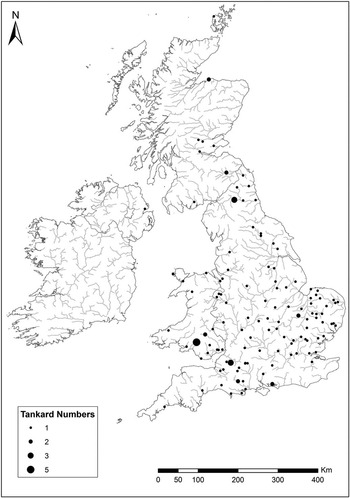
The increasing number of tankards and tankard handles allows new observations of trends in their distribution and deposition contexts. These can inform further interpretations as to how these vessels functioned in society, who used them, and what they represented to those depositing them. The updated distribution maps (Figs 14 & 15) suggest a number of important zones of deposition, including south Wales, Somerset, and Dorset (27); East Anglia (25); Hertfordshire and Essex (12); and the Midlands (20). In contrast we see areas of sparsity in Devon and Cornwall (2); mid-Wales (1); Kent, Sussex, and Surrey (3); Cumbria and Lancashire (1); and the west coast of Scotland (1). However, it is worth noting that these patterns are strongly conditioned by selective depositional practices such as votive offerings, burials, and hoards in addition to casual loss or discard, and do not provide an exact map of when and where tankards were used (see Garrow Reference Garrow2008, 21–5). Tankards are found right across Britain and the intensity of their distribution is matched roughly with the overall distribution of Celtic art (see Garrow & Gosden Reference Garrow and Gosden2012, 65, fig. 3.2), though comparison to specific object categories reveals significant disparity. For example, swords share a similarly widespread distribution to tankards, whereas Late Iron Age brooches, coins, and mirrors are predominantly concentrated in south-east Britain (Joy Reference Joy2010, 1–3, fig. 1.2; Garrow & Gosden Reference Garrow and Gosden2012, 67–9, figs 3.4–3.5).
Distribution of tankards and tankard handles in Britain

Distribution of tankard handles by group

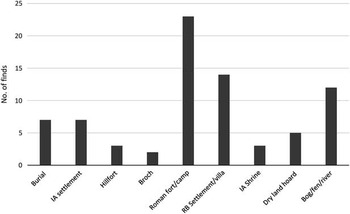
Tankards appear in a wide range of contexts including burials, hoards, shrines, settlement sites (both Roman and native), hillforts, and Roman military sites and are summarised below (Fig. 16). Detailed notes on the region and context of each example can be found in Appendix S1 and S2.
Numbers of tankards within each context (total 75)

Tankards deposited within burials
A small but important group of tankards were deposited within cremation burials in southern England. Complete tankards were deposited within single graves at Elveden (Fox Reference Fox1923, 99) and Aylesford (Birchall Reference Birchall1964, 22–3). A complete handled tankard was deposited in the lavishly furnished grave 1 at Welwyn B (Smith Reference Smith1912; Stead Reference Stead1967), another from the warrior burial at Kelvedon (Sealey Reference Sealey2007), and a further example may be suggested from a possible disturbed burial at Bulbury Hillfort (Cunliffe Reference Cunliffe1972). These burials all pre-date the Roman invasion and are dated to c. 75 bc–ad 43. There are two geographical outliers from this group. The first is from the San Bernardo cemetery (grave 1) in Ornavasso, northern Italy and is dated to the last half of the 1st century bc (Graue Reference Graue1974; Haeussler Reference Haeussler2013, 138–9). The second is from Saint-Nicolas-les-Arras (grave 1) in northern France (Jacques Reference Jacques2007, 37). Additionally, a chronological outlier is from a Romano-British burial at Bartlow Hills tumuli cemetery (Gage Reference Gage1834) and is dated ad 117–125.
Tankards from shrine sites
Two tankard handles were found on Hayling Island in the ditch just outside of a Late Iron Age shrine (Downey et al. Reference Downey, King and Soffe1980). A large quantity of metalwork was also found within this ditch including horse and vehicle equipment, weapons, brooches, and coins (Downey et al. Reference Downey, King and Soffe1980, 293). The disassembled remains of a complete tankard was deposited at the Late Iron Age open air shrine at Hallaton, in close proximity to a feasting deposit comprised of a large number of pig bones (Score Reference Score2011).
Tankards deposited at Iron Age settlements
Tankards are relatively uncommon finds from Iron Age settlements and hillforts, with only seven examples. The Puddlehill tankard handle came from the boundary ditch of an enclosed settlement in Bedfordshire (Corcoran Reference Corcoran1957, 233–4). A tankard handle of unusual terret-like form came from Glastonbury Lake Village (see Fig. 13; Bulleid & Gray Reference Bulleid and Gray1911). The tankard handle from Bulbury is probably an element of a disturbed burial within the hillfort. The tankard handle from Bredon Hill, however, was found in one of the Late Iron Age ditches of the hillfort (Hencken Reference Hencken1938). Another handle from Stonea Camp was a stray find from the surface of the low-lying hillfort. Two handles have been found at broch sites: from the lowland broch overlying the ramparts of Castle Craig hillfort, Perth & Kinross (James Reference James2012); and from Okstrow Broch in Orkney (MacGregor Reference MacGregor1976, 291). In both cases the tankard handles were probably Roman Iron Age.
Tankards deposited at Roman forts and settlements
At least one quarter of tankards and tankard handles have been recovered from Roman military (23) and civilian (14) sites. They appear at Roman forts in south and north-west Wales. In England they appear primarily in the south-west and up the north-east coast of England into the Scottish Borders up to Hadrian’s Wall. Civilian sites with tankards are distributed primarily in southern England with a further couple of instances in the north. The majority of tankards from Roman forts and settlement sites consist of handles, often in a fragmentary state, indicating discard after breakage (whether through use or deliberately) or replacement, as exemplified by the Corbridge tankard. Equally, some tankard handles were being deposited in structured deposits, such as pits, wells, and within hoards on Roman sites. These examples are datable primarily from c. ad 43–200.
Tankards deposited in watery contexts
A number of tankards have been found in wet, boggy, and waterlogged conditions. They are included in hoards of metalwork from Seven Sisters and Carlingwark Loch (Piggott Reference Piggott1953; Davies & Spratling Reference Davies and Spratling1976, 123–5). Single tankards have been deposited in the River Thames at Kew, and at Carrickfergus and Trawsfynydd in bogs (Jope Reference Jope2000). The Shapwick tankard was found along with two pewter bowls in a bog, within the vicinity of a number of other Romano-British coin hoards (Dewar & Godwin Reference Dewar and Godwin1963, 41). The Langstone tankard was found on the margins of a boggy or waterlogged area of ground, close to the deposition of a hoard of bowls and strainers (Gwilt Reference Gwilt2012). Whilst not technically part of a hoard, the Pentuan tankard should be discussed here. Deposited at the base of a tin mining stream in Cornwall, it shares parallels with those singly placed examples from watery deposits, as both exhibit placement at boundaries within the landscape. There is a good case to suggest that complete tankards, like cauldrons and bowls, were deposited, often unaccompanied, within watery contexts (Spratling Reference Spratling1972; Joy Reference Joy2014). The retrieval of such items was almost impossible, and they must have been purposeful depositions of a probably votive nature.
Tankards from landscape hoards
A number of examples were deposited in landscape hoards (ie those away from settlements or rivers). Fragments of a complete tankard were found within one such hoard at West Stow, which included votive metalwork such as headdress ornaments, eagle figurines, staff terminals, and copper-alloy sheet ‘feathers’ (Worrell & Pearce Reference Worrell and Pearce2011, 24–7). The tankard handle from Greenhill was discovered in association with a group of copper-alloy objects including a ‘Wraxall’-type neckring fragment, nail cleaner, horse pendant, and decorated belt plate (Megaw Reference Megaw1971, 149). Another complete tankard was recovered during quarrying at Cromwell, Nottinghamshire (Horn Reference Horn2015).
Tankards with poorly known or unknown contexts
A significant number of tankards have little or no direct contextual evidence. The majority are finds made by metal detectorists, though stray finds recovered by other means have also been noted. Forty-six examples have been recorded with the PAS and a further 16 are recorded elsewhere (Appendix S1.1). The majority of these finds are fragmentary with no associated context.
Summary
Tankards and tankard handles have been discovered in a wide variety of contexts and follow particular deposition trends within temporal and spatial spheres. The earliest deposited examples were interred within high status native burials and shrines in southern Britain. Soon after the Roman invasion in ad 43 we begin to see an increase in the deposition of tankards within hoards containing a mixture of both indigenous and Roman metalwork. During the early campaigning period significant numbers of tankard handles were deposited at Roman military sites. The later campaigning period sees the deposition of tankards for the first time at numerous sites in northern Britain, probably following in the footsteps of the Roman army. This practice continues until at least the Antonine period at which point deposition evidence steadily declines. Tankards were buried as complete objects almost exclusively within burials and hoards. In contrast, tankard handles were often fragmentary when deposited at Roman military and settlement sites. These changing contextual and regional patterns appear to roughly match those for other examples of Celtic art, in particular the deposition within burials and hoards in the 1st centuries bc and ad followed by Roman forts and settlements in the late 1st and 2nd centuries ad (Garrow & Gosden Reference Garrow and Gosden2012, 76–9). The relatively large number of examples deposited at Roman military sites indicates that the use of tankards became relatively commonplace within the Roman army in Britain. This also implies a general acceptance of particular aspects of native drinking practices and beverage choices.
Discussion
Tankards were vessels created specifically for the consumption of alcoholic beverages. Sherratt (Reference Sherratt1986, 90) points out that our lives are structured by drinking events, and both alcoholic and non-alcoholic beverages are consumed at particular occasions. The use of substances such as alcohol and other stimulants is often structured by etiquette and ritual which helps formulate and reaffirm social connections, establishing social bonds and friendships (Dietler Reference Dietler1990). The wealth and effort placed into the construction, decoration, and deposition of tankards would suggest that in later prehistory alcohol shared a similar role. Tankards fall within a wider assemblage of feasting material in Late Iron Age Britain which includes iron firedogs, cauldrons, buckets, amphorae, and both ceramic and metal serving and drinking vessels. Their regular inclusion in burials indicates the social importance placed on feasting. Conscious decisions were made to express or uphold the identity of those interred as arbiters of the feast (Fitzpatrick Reference Fitzpatrick2010). Holding a feast in the Iron Age was an act by which an individual or group could control the social context of a group activity. This would entail the conspicuous consumption of wealth and is therefore comparable to traditions of gift giving. Partaking in these activities would create an unofficial debt for which repayment in the form of allegiance or tribute may have been expected. Pryor (Reference Pryor1977, 280–3) refers to this exchange as a ‘centric transfer’ whereby alcohol flows up and down the hierarchical social structure. This expected allegiance may well have been expressed in the form of martial support in times of war (Dietler Reference Dietler1990, 371). Communal feasting undoubtedly played a significant role in the formation and maintenance of social and political power within Iron Age Britain.
The tankard form is significant and can provide interesting indications into social structure and drinking practice in society. Their comparatively large size and volume (2.3 litres) contrasts that of Roman drinking cups which primarily served individual needs (<0.5 litres) (Gwilt Reference Gwilt2007, 314). Tankards could have served as both individual and communal drinking vessels. Anthropological comparisons for the latter can be drawn to traditional stave-built vessels such as the Finnish haarikka and Orcadian bride’s cog which are passed around at weddings and special events (Vuoristo Reference Vuoristo1978; Fenton Reference Fenton2008). This fits well with the Celtic drinking practices described by Athenaeus (IV 36) who refers to the sharing of the ‘common cup’, and a similar scene is depicted in Beowulf (lines 480–1, 620–2).
The particular form of vessel is also an important consideration for the type of alcoholic beverage it was used for: particular vessel types are often tied by tradition and function to certain alcoholic beverages. For instance, wine and beer drinking vessels in modern western society follow particular forms. There is therefore a question as to the nature of the drink being consumed from tankards in the Late Iron Age. Wine should be ruled out: there is scant palaeobotanical and archaeological evidence for viticulture in Britain prior to the Claudian invasion (Hornsey Reference Hornsey2003, 166), and evidence for imported wine amphorae has been argued as too scarce to support its consumption by social elites on a regular basis (Haselgrove Reference Haselgrove1982, 168–75; Hornsey Reference Hornsey2003, 166; Cool Reference Cool2006, 132; also see Sealey Reference Sealey1999, 122–3). Corcoran (1952, 86) suggested that Iron Age tankards were used for beer, asserting that the best containers for its storage are wooden barrels. Sealey (Reference Sealey1999, 203; Reference Sealey2007, 12) has corrected the usage of the term beer to ale – he points out that the former requires the use of hops for flavouring, the first evidence of which dates to the 6th century ad (see Rösch Reference Rösch2008). It is unfortunate then that no residue analysis has been possible on tankards to date. In lieu of this it is necessary to examine evidence for alcoholic beverages prior to, during, and after the period of the British tankard tradition.
Residues of cereal-based drinks are known from a number of British sites dating back as far as the Neolithic (see Barclay Reference Barclay1983; Barclay & Russell White Reference Barclay and Russell White1993; Dickson Reference Dickson1978; Dineley Reference Dineley2004; Haggerty Reference Haggerty1991, 91; Wickham-Jones Reference Wickham-Jones1990; Wickham-Jones et al. Reference Wickham-Jones, Card, Appleby, Care-Brown, Isbister, Leith, Dineley and Dineley2000), while Continental evidence demonstrates the use of both cereal- and honey-based beverages (Sealey Reference Sealey2007, 123). This indicates a long and sustained tradition for the brewing of cereal-based drinks – sometimes with the addition of honey – in prehistoric Britain. It is likely that such cereal-based beverages were being consumed from Iron Age tankards. Furthermore, the choice to drink from stave-built containers may reference the use of wooden tubs and barrels for the fermentation, storage, and maturation of these drinks (Corcoran Reference Corcoran1952a, 86; Cool Reference Cool2006, 143). Such stave vessels are still regularly used for brewing traditional Finnish Sahti ale (Ovell Reference Ovell1996). The use of stave-built containers for the storage and maturation of ales continued until the mid-20th century when they were superseded by steel drums – though are still used in the maturation of Lambic and aged ales which have particularly long traditions in Belgium and England (Sparrow Reference Sparrow2005).
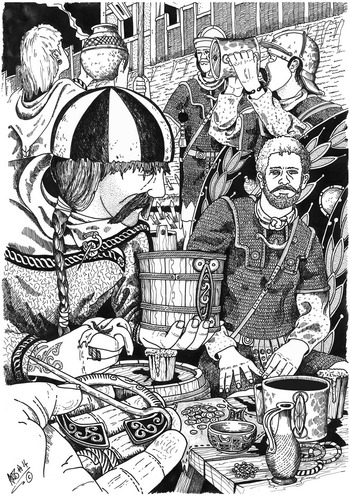
During the early Roman campaigning period in Britain tankards were commonly deposited along with a variety of other metalwork in hoards. The assemblages from Seven Sisters, Greenhill, and Camerton include Roman military equipment along with native Iron Age geometric and curvilinear metalwork, causing uncertainty as to the identity of those who made these depositions. Davis and Gwilt (Reference Davis and Gwilt2008, 146) suggest these metalwork groups are the product of the careful uptake of Roman materials and technologies by native Iron Age populations. Equally though, they could represent deposition by auxiliaries within the Roman army who shared strong cultural affinities and ‘sympathetic tastes’ to those with whom they were at war (Hunter Reference Hunter2007, 292). There is a clear interest in tankards by individuals within the Roman army, indicated by their recurrent deposition within Roman military contexts. The tankards from Langstone, Corbridge, and Biddlesden were found in Roman contexts, though were probably originally constructed by native craftworkers. The evidence for repair and re-handling of these vessels indicates they were highly prized. The appropriation of these culturally important objects by individuals within the Roman army is significant, indicating adoption of indigenous customs and beverages (Fig. 17). Indeed, confirmation of the consumption of native ales within the Roman army is revealed at Vindolanda where ‘Celtic beer’ is mentioned in at least six of the wooden tablets (Tabs 182, 186, 190, 482, 581 & 628) (http://vto2.csad.ox.ac.uk/). Tablet 628 even describes a dire shortage of beer and asks for more to be sent. In addition, wooden remains of four tankards have been recovered from the fort at Vindolanda (Rob Sands pers. comm.). A tankard handle from Intercisa Roman fort, Dunaujváros, central Hungary is also of interest here, as troops of the Ala I Britannica civium Romanorum are identified as being stationed at the site from ad101–105 (Lőrincz Reference Lőrincz2001, 17). Five further examples from the Continent (Appendix S1.2), including two from seemingly high-status burials, demonstrate these vessels were highly valued exports.
A speculative reconstruction of a trading scene between Roman auxiliary soldiers and natives outside a Roman fort (© Alan Braby)

The tankards from Trawsfynydd and Carrickfergus are masterpieces of insular Celtic art, deposited in bogs at the furthest reaches of the known Roman world, in north-west Wales and north-east Ireland respectively. These two tankards share common features of lathe-turned bases with concentric circles and serpentine copper-alloy wire which suggest related craftsmanship, perhaps within the same workshop. Harding (Reference Harding2007, 234) argues that rather than being inspired by Romanising influences, these objects were the product of displaced elites reasserting their native identity through deposition of decorated metalwork which referenced pre-Roman stylistic traditions. However, these vessels do exhibit elements of mixed influence: the Carrickfergus tankard with its geometric handle and the ‘mirror style’ decorative plate, the Trawsfynydd tankard with its ‘dragonesque’ handle and triskele fittings. Given these associations, along with the provenance of their handle forms, it seems more plausible that these vessels were deposited by individuals within the Roman army. The adoption of these vessels, along with their associated beverages and potentially their attributed drinking customs, by individuals within the Roman army is one of the many intriguing aspects of these fascinating vessels.
Conclusion
The Late Iron Age witnessed a significant increase in the production and deposition of decorated metalwork in Britain (Garrow Reference Garrow2008). Arguably one of the driving forces behind this movement was the increasing need to express cultural identities at a time when strong influences from beyond Britain were becoming noticeable. A re-exploration of insular style on tankards emphasised the artistic lineage to which the inhabitants of Late Iron Age Britain perceived that they belonged. These artistic styles imbued the vessels with added meaning and allowed for considerable diversity of form. As drinking vessels, tankards facilitated the maintenance and reformation of social relations through feasting and drinking events. Their significance in this capacity was amplified by the religious or ritual implications to which their materials (especially the use of yew), form, and decorative features are likely to have alluded. The Roman invasion in ad 43 probably exaggerated the need for markers of cultural identity to set natives apart from invaders. Yet the mixture of Roman and native metalwork in various contexts reflected the complexities of the historical narratives which were being played out at this time. The evidence undoubtedly indicates an acceptance of tankards within Roman military and civilian settings. The original meanings and associations held by these vessels were appropriated and eventually remoulded by their new owners, mirrored by the changing form and decorative style visible on tankard handles. These vessels began to articulate the changing identities of those individuals living on the edges of the Roman Empire. These ‘frontier identities’ reflect the wider cultural and political developments of this period.
Acknowledgements
Thanks to Niall Sharples who supervised the original MA dissertation upon which this paper is based. I am grateful to Adam Gwilt, Fraser Hunter, and Paul Sealey for their indispensable advice and comments on early drafts of this paper. Mary Davis, Adam Gwilt, Jody Joy, Fraser Hunter, Gemma Cruickshanks, and Caroline McDonald kindly allowed access to various museum collections. The following individuals are due my sincerest thanks for providing me with articles, pictures, and further information: Mark Lodwick, Lesley Lettice, Fraser Hunter, Joe Lewis, Tony Daly, Tanja Romankiewicz, Helen Sharp, Jody Joy, Richard Hoggett, Heather Hamilton, Rob Sands, Helen Parkin, Julia Farley, Oliver Davis, Niall Sharples, Katie Hinds, Faye Minter, Paul Sealey, Sara Taylor, Keith Cunliffe, Andrew Rogerson, Ralph Jackson, Barbara Rowan, Oliver Blackmore, Georgina Muskett, Alex Croom, Ralph Jackson, Grahame Soffe, Vicki Score, Emma Jarman, Tony King, Lindsay Allason-Jones, David Breeze, Virginia Baddeley, Pete Wilson, Stratford Halliday, Sue Holden, Ann-Rachael Harwood, Kevin Booth, Steve Minnitt, Jane Marley, Hilary Cool, Imogen Gunn, Glenys Wass, Caroline McDonald, Frances McIntosh, Garry Crace, Erica Darch, Kate Sumnall, Teresa Gilmore, Peter Reavill, Julie Cassidy, Graeme Erskine, and Edward Besly. I am indebted to Alan Braby for producing the illustrations, which were generously funded by the Research Fund of the Prehistoric Society and the University of Edinburgh’s Research Student Support Fund. Thanks also to Graeme Erskine who produced the distribution maps. My current supervisors Ian Ralston and Gary Lock also have my thanks for support and encouragement in persevering with this project whilst undertaking a PhD. I am grateful to The National Museum of Wales and the PAS for welcoming me as both volunteer and research student. A final thanks to Emily Gal for her support and discussion throughout, and for her time spent proofreading. All errors remain my own.
Online Supplementary Material
Appendix S1.1: Tankard database
Appendix S1.2: Continental tankards
Appendix S1.3: Possible tankards
Appendix S1.4: Volume estimates
Appendix S2: Chronology of British tankards
Appendix S3: Bibliography relating to Appendices S1.1–S1.4 & S2
To view supplementary material for this article, please visit http://dx.doi.org/10.1017/ppr.2015.15