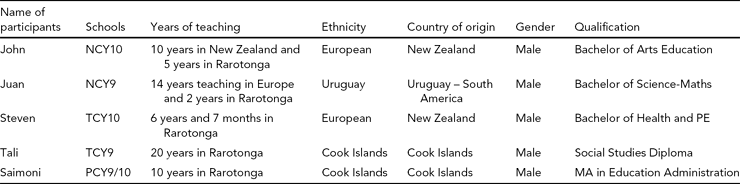
Teachers’ efforts to understand and create culturally responsive pedagogy are the focus of this article. We explore teachers’ reception of an implementation of cultural values in Cook Islands secondary school physical education classes. The focus is on investigating teachers implementing the cultural values into classroom physical education teaching rather than students’ reception of the new implementation of cultural values. The official language in the Cook Islands is English and not all teachers are proficient in Cook Islands Maori language. Cook Islands Maori language is now diminishing and younger generations are not speaking the Cook Islands Maori language. Ama (Reference Ama, Crocombe and Crocombe2003) argues that Cook Islanders could become disoriented because the use of Cook Islands Maori language is being discouraged in the Cook Islands. Importantly, today there are a few teachers and parents trying to revitalise Cook Islands Maori language through songs and cultural events. Yet not all teachers are proficient in Cook Islands Maori language (te reo Maori Kuki Airani). This study highlights the ways in which teaching operates in the community and not in isolation from elders, values, culture and language. Limited attention has been given to te reo Maori Kuki Airani, and it is unclear what the official language of the location is. This article builds on an earlier study that identified relevant Cook Island cultural values (Te Ava, Reference Te Ava2011). Teachers in the Cook Islands come from diverse backgrounds, including New Zealand, Uruguay, and the Cook Islands. Table 1 illustrates the teachers biographical information, including names (pseudonyms), the schools where they teach, their ethnicity, country of origin, gender, and qualifications they hold. There were no female teachers teaching physical education (PE). Usually PE teachers come from New Zealand, and the Cook Islands Ministry of Education is trying to encourage Cook Islander female teachers to teach PE. There were no gendered issues with teaching PE. Education systems in the Cook Islands are influenced by the New Zealand education systems. Western values are dominant in the schools and cultural values are disengaged. As a result, the high school dropout rate has increased by 10% (Cook Islands Ministry of Education, 2004). Cultural practices of learning in the classroom were discontinued because the curriculum focuses on academic achievement of students. Indigenous Pacific scholars such as Thaman (Reference Thaman2006), Samu (Reference Samu2006), and Anae (Reference Anae2007) argue for decolonisation methodologies for education curriculum. Rather than Western education values, these scholars argue for indigenous perspectives and ways of knowing. These teachers teach the curriculum, which was initiated in New Zealand. As defined by the integration of cultural values into Cook Islands physical education, an action research process enabled the participants to develop their teaching practices through professional learning about cultural values and pedagogy. The participants analysed the existing practice and then identified and enacted change. In this way, the teachers were more than professional knowledge users. They were professional knowledge makers who bridged the divide between theory and practice by exploring ways in which the ideal of cultural values in teaching might take form in practice (Waters-Adams, Reference Waters-Adams2006). This article describes professional knowledge made possible by open, honest inquiry by teachers into cultural values, their teaching context, and their own practices (Stenhouse, Reference Stenhouse1975; Carr & Kemmis, Reference Carr and Kemmis1986).
Biographical Information of the Participant Teachers

Definition of Values
Cultural values are integral to pedagogy. There are many different interpretations of values; however, within the historical and geographical context of this research, we explored values that are appreciated within a Cook Islands context. Our interpretation of values was influenced by the work of a Cook Islands researcher (Jonassen, Reference Jonassen, Crocombe and Crocombe2003), who said that a value is like a metaphor of the boat that has a sail guiding the boat to a new land. In this sense, it is a direction and pathway that guides a person to new achievements. How did that person get to that level? What motivated him to get there? Meyers (Reference Meyers2003) believes that values are the foundation of knowledge, growth and development, which leads to success. She suggested that the value of what we learn comes from experience and integrity. It could be argued that the value of research is the same. Anae (Reference Anae2007) argues that value in research is understanding and knowing how and what questions to ask, and how to explore ways to improve research, and how to go about making changes for the betterment of education. So, within the historical and geographical context of this research, we explored values from the context of the Cook Island ways of knowing, and how to embed that in the curriculum of teaching physical education.
It is recognised that teachers, national curriculum developers and communities bring in values that implicitly and directly affect the pedagogical system in education. Values relating to pedagogy and teaching explicitly affect schooling; however, they are aligned with education. Indeed, teachers, designers of the national curriculum and communities initially influence the values that are generated and maintained through the education system. This approach to pedagogy is supported by a variety of values (Ama, Reference Ama, Crocombe and Crocombe2003). Halstead and Taylor (Reference Halstead and Taylor1996), for instance, suggest that ‘values are principles, fundamental convictions, ideals, standards or life stances which act as general guides to behaviour or as reference points in decision-making or the evaluation of beliefs or action’ (p. 5). In the Cook Islands education context, values are an important part of teaching and learning, not only in physical education, but also in cross-curricular activities. There was no indication of what the curriculum says and how values should be addressed. The PE teachers implement not what the curriculum says, but what teachers think works for the students. That is why we use cultural values, because this shows how teachers teach and why inclusive pedagogy is important. Tinning (Reference Tinning2010) and Kirk (Reference Kirk2004) support the idea that teachers, curriculum, and knowledge of the curriculum is where learning is integrated. We support Tinning's (Reference Tinning2010) and Kirk's (Reference Kirk2004) suggestion that because what teachers teach comes from a curriculum, this is how construction of knowledge is taught to students.
Jonassen (Reference Jonassen, Crocombe and Crocombe2003) identified values that are culturally important to Cook Islands students’ learning and are expressed through cultural rituals, customs and identity, cultural ceremonial systems, and also education. Eight interconnected values in Cook Islands Maori culture have been identified that could be useful for male and female students to engage equally in physical education: kitepakari (wisdom), ‘irinaki (faith), akakoromaki (patience), ora (life), rota'i'anga (unity), akaaka (humility), noa (freedom) and aroa (love) (Jonassen, Reference Jonassen, Crocombe and Crocombe2003). In order for teachers to facilitate an effective teaching strategy that represents the values mentioned above, it is crucial to gain an understanding of values and how these are adopted into the curriculum and taught in the classroom (Crocombe & Crocombe, Reference Crocombe and Crocombe2003).
Cultural Values for Culturally Responsive Pedagogy
In this study, respected pa metua (elders) who are knowledgeable about Cook Island core values and educational experts identified core values that they believed could be incorporated into educational practice (Te Ava, Reference Te Ava2011). These core values were developed through a culturally responsive pedagogy using cultural knowledge, prior experiences, and performance styles of the students to make learning more appropriate and effective for them; it teaches teachers how to become aware of students’ cultural background and how to go about strengthening and improving students’ learning of the culture. To implement the core values, an action research approach was designed and used by teachers to attempt to solve problems and improve professional practices in their own classrooms, from a culturally inclusive point of view. Action research involves systematic observations and data collection that can then be used by the practitioner-researcher in reflection, decision-making and the development of more effective classroom strategies (Parsons & Kimberlee, Reference Parsons and Kimberlee2002). Adopting an action research collaborative approach between the teachers and researcher as the basis for collecting data is described as follows:
Tāueuez
The value tāueue (participation) was put into practice by having students engage in their learning through participating in cultural activities. The goals were for students to develop creative thinking in solving issues and problems, to improve leadership skills by accepting responsibility in group activities, and to develop team work. Helping students become proactive and productive individuals enables them to become part of their culture, with pride and unity.
Angaanga taokotai
This value, angaanga taokotai (cooperation), encourages students to communicate with each other without reservation, for shared outcomes. It involves persuading students to identify issues and possible solutions to help resolve conflict, to initiate problem solving when issues arose, to work well with others outside immediate friendships, and to be attentive to group tasks.
Akatano
The value of akatano (discipline) was put into practice by teaching students to accept the rights of others and to respect different views other than their own, to listen to others without interrupting, and to acknowledge the strengths and abilities of their peers.
Angaanga oire kapiti
The value of angaanga oire kapiti (community involvement) was included to ensure that students maintained high expectations of community and classroom learning. The aim of implementing this value was to encourage students to openly discuss their knowledge of their community and share that within the group. It was believed that this would support students’ background, strengths and weaknesses, and fairness.
Te reo Maori Kuki Airani — Te reo Maori Kuki Airani (Cook Islands Maori language)
This value was initiated in physical education so students would learn about Cook Island cultural practices in physical education rather than in other classes such as maths and science. Having students learn their culture would help them remember their identity and genealogy, and understand their history, legends, cultural activities and how to go about reviving them. Te reo Maori Kuki Airani was also fostered by incorporating it into lessons through greetings, commands and other interchanges. Students in the research were not only Cook Islanders, but also included some students from Samoa, Solomon Islands, Fiji, Vanuatu, and Europe. They showed an interest in learning Cook Island cultures and language.
Auora
The value auora (physical and spiritual wellbeing) was included to enable students to learn about quality of life by being active and productive, feeling good about themselves, looking great, and staying healthy for the rest of their lives. In their group discussions the students are encouraged to understand good health, to strive for peace of mind, to practise consideration and self-respect for the wellbeing of others, to have a clear conscience in their commitment to these values, to show love and compassion for their peers, and ultimately to enhance their spiritual happiness by working together in groups, families and in the community.
Method
Research Group
Five physical education teachers from three different schools were invited to be part of this research. The biographical information outlined in Table 1 presents the pseudonyms given to the participants, their country of origin, and ethnicity, schools, the number of years they have been teaching, their gender and their qualifications.
Setting
The study was conducted during the second school term in 2007. The schools were located in the Cook Islands main island of Rarotonga. The research was conducted in English and te Maori Kuki Airani. This study focused only on teachers teaching the cultural values in PE and did not seek student perspectives.
Procedure
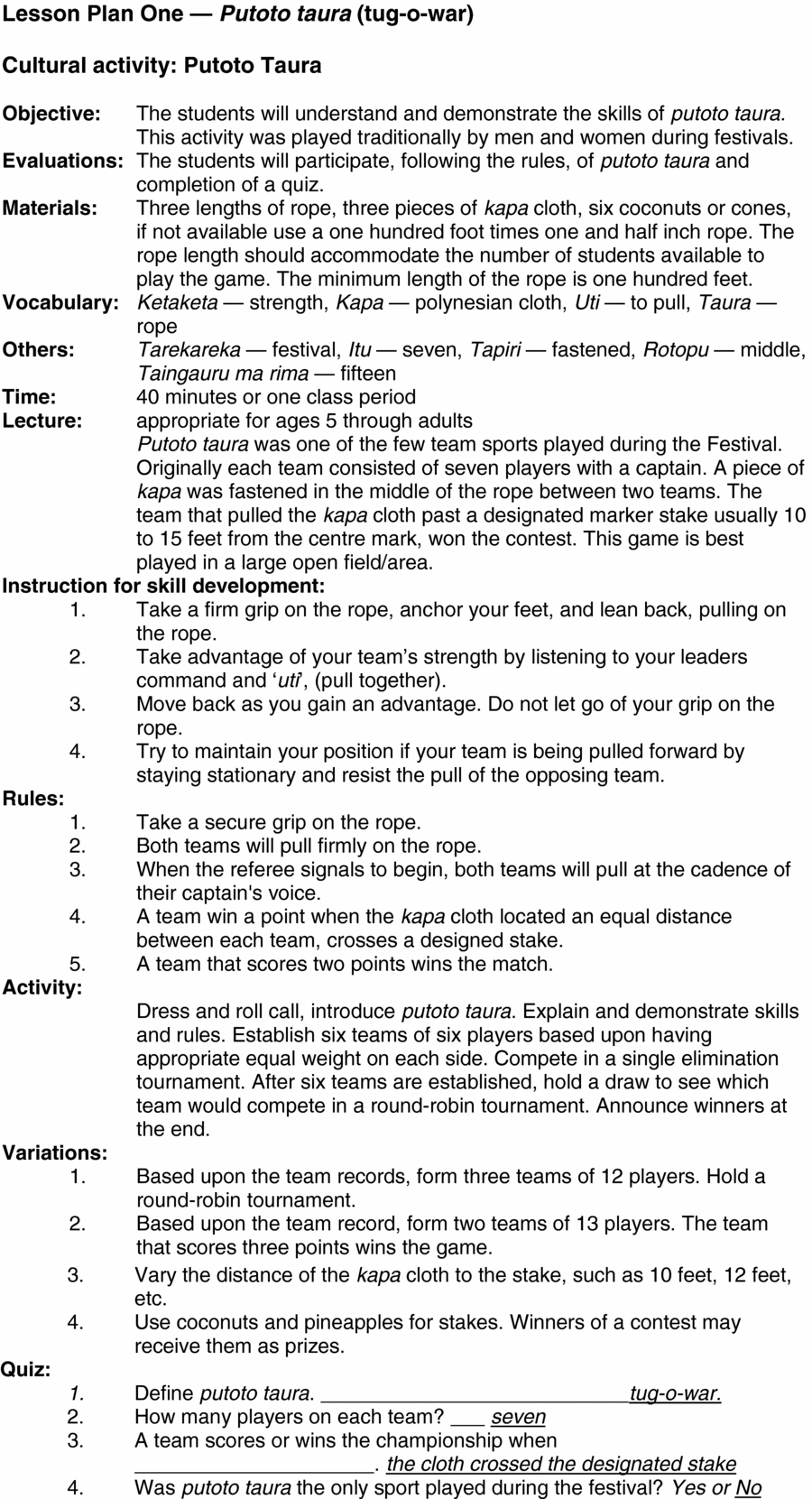
During the first phase of this study, the teachers met and discussed the core values that were identified by the pa metua. They planned two organised, distinct lessons for each of two cycles in which Cook Islands activities were the focus. The putoto taura (tug-o-war) provided the focus of the first cycle (see Figure 1). Observations were recorded by one of the researchers (Te Ava) and participants kept journals of their experiences. These were recorded on site as well as afterwards.
Lesson Plan One — Putoto taura (tug-o-war)
The teachers agreed that the researcher (Te Ava) incorporated all the values as discussed from the list while they observed his teaching. After that the teachers implemented the core values and the researcher observed. After the first cycle the research team met to discuss the themes and share experiences; plans were then outlined for the second cycle.
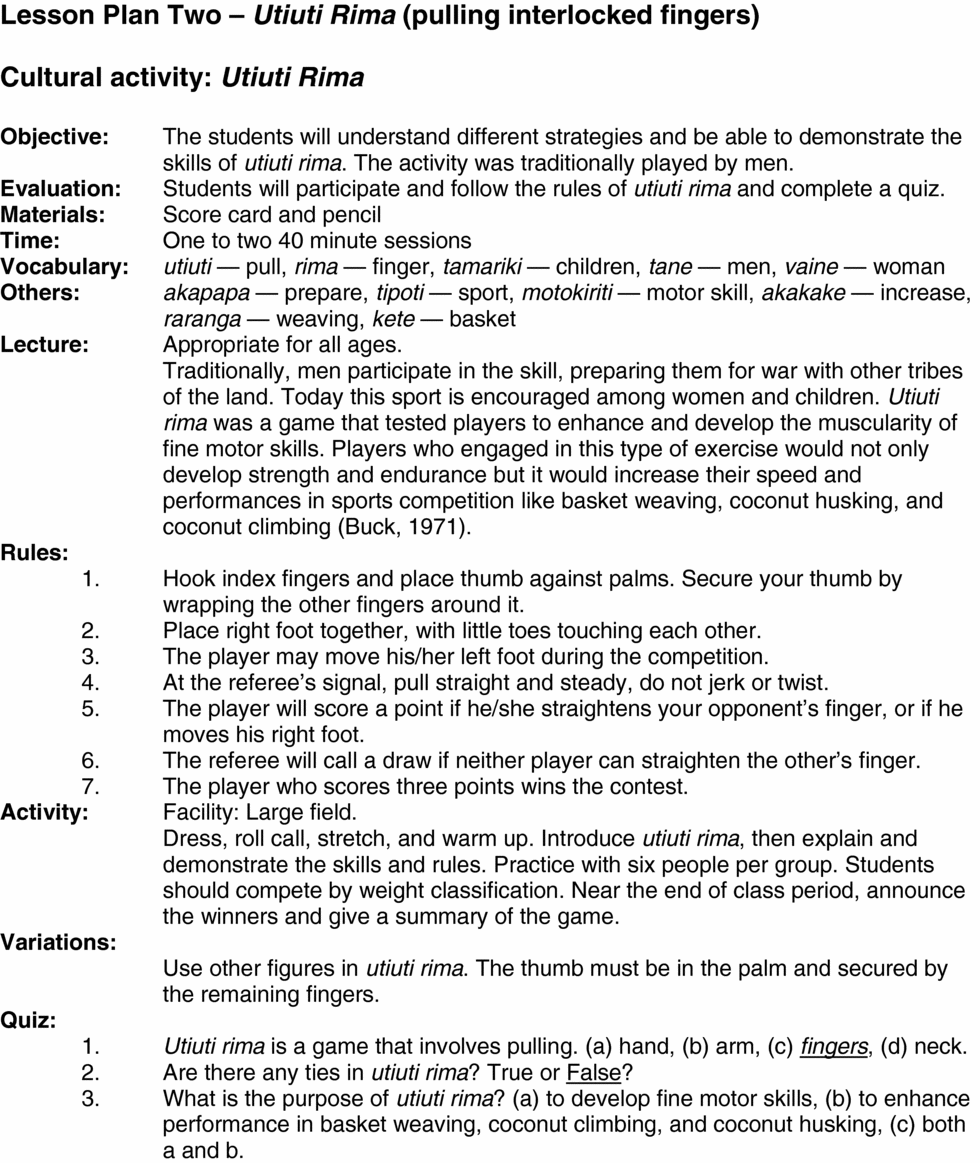
The traditional activity utiuti rima (pulling interlocking fingers) was the focus point of the second cycle (Figure 2).
Lesson Plan Two — Utiuti Rima (pulling interlocked fingers).
In the second phase, these lesson plans were taught with strategy and structure whereby teachers were able to alternate roles with the researcher (Te Ava) and eventually build up self-confidence in teaching the values mentioned in this study. In each of the two cycles, observations were recorded on site by the researcher that ensured that the data collected were informative and useful to this study (Kemmis & McTaggart, Reference Kemmis, McTaggart, Denzin and Lincoln2000). When the second cycle expired, the team had the final meeting. The team shared experiences, themes highlighted in the teaching, and how well the values had been incorporated into the teaching.
The final phase involved group evaluation meetings where participants’ attempts to be culturally responsive inferred both teacher and student successful achievement. As a result, the research questions the teachers formulated were as follows:
1 How would the teachers use the values to be implemented into physical education teacher practice? The sub questions were:
a. What strategies did the teachers use to instil the values within a culturally responsive pedagogical framework for physical education?
b. How did the teachers respond to the teaching of the values?
c. What issues and challenges did the teachers encounter when implementing the values into teaching?
d. Would the values promote students’ tāueue and enjoyment in physical education, and if so, how might this be achieved?
Subsequently, as the teachers attempted to address these questions, they were faced with challenges in implementing these values.
Data Collection
The data collection was multifaceted: a journal of field notes that particularly highlighted the researcher's (Te Ava) thoughts and experiences of the project; discussions and conversations with teachers during group meetings; collected participant observation reports of each of the 10 lessons; and the researcher's reflective notes of the overall research experience. In addition, a weekly record of ideas aimed at improving teachers’ practice was a useful tool to collect pertinent data for this research (Denzin & Lincoln, Reference Denzin and Lincoln2005).
Data Analysis
Following the action research, the data analysis proceeded in several phases, namely:
• A reconnaissance phase where a collective analysis of entries from field notes were shared with the group. Furthermore, the phase involved the gathering of categorical data from these field notes which identified key concepts. The group then worked with these collaboratively to integrate the values into their teaching.
• At the end of each cycle, key concepts were highlighted which resulted in categorisation of the data.
• The researcher (Te Ava) recorded all data from group meetings, which were transcribed and then connected to the theoretical literature.
Results
From the collective analyses mentioned above, four themes emerged and were explained in Cycle One as follows: integrated lesson plans, new learning opportunities for teachers that the experience offered, student behaviour, and teacher confidence in teaching the core values. In Cycle Two, however, three themes evolved, and are evaluated later in this section: student engagement in the lesson, student perception of the lesson and teacher growing confidence in teaching cultural activities. The findings in relation to Cycle One and Cycle Two are presented below.
At the end of Cycle One the teachers got together to reflect on their experiences and to discuss some ways to improve the implementation of the core values in the second cycle. As a result of this meeting, four new possible strategies were identified. First, based on their learning experiences, the inclusion of new cultural games in sports activities offered non-Cook Islands participating teachers an opportunity to learn the culture. Second, despite their initial reluctance and hesitations about incorporating Cook Islands values into their teaching, the teachers collaboratively and willingly enjoyed trying out the new games which students were collectively and actively engaged in, after some initial apprehension. Third, understanding students’ challenging behaviours and responsiveness to culturally responsive practices generated flexible and adaptable lesson plans that had altered learning foci from Western sports to cultural activities. Fourth, although newly introduced approaches such as self-confidence and beliefs had unexpectedly reduced students’ participation in Western sports within schools, it had also created strong student leaders who often initiated social involvement and interactions with peers.
Themes for Cycle One
Theme 1: Integrated Planned Lesson
After observing the modelling of teaching integrating core values, the teachers identified a variety of teaching approaches that could be developed to benefit the learning of their students. For instance, one of the observation entries described how a non-Cook Islander agreed to integrate values despite students’ lack of concentration:
This is the first time John experienced such teaching . . . values implemented in a culturally responsive way in the Cook Islands. John has been in Rarotonga for 5 years and he has come to realise how important it is to teach Cook Islanders the values integrated into culturally responsive practice. The lesson plan was well organised. There were times when they did not enjoy the cultural component of the activity which unfortunately began to produce unnecessary behaviours. (Observation, May 28, 2007, p. 12)
Another non-Cook Islander teacher, Juan, shared his opinion on teaching physical education aligned with values. The observation entry was recorded in the following way:
Juan admitted that my way of teaching was very foreign. He was so used to the Western teaching style where the teacher organised the ‘to do’ task that having students choose their sports and activities was uncommon. This was to minimise behaviour problems. In return, Juan gave students options to either participate or to idly cruise around. If they wanted to sit under the trees and tell stories, Juan did not mind at all, as long as they were not running around the school disturbing other classes. Nonetheless, they also had a clear understanding that it will not affect their grades if they did not participate in the chosen activity. Juan was glad that he could learn from this experience and be able to develop some new teaching skills that will possibly expand his views and understanding of culture. (Observation, May 31, 2007, p. 13)
The data above shows that giving students alternatives in their own learning provided them with the opportunity to take responsibility for their own choices. In fact, they reacted responsively to this pattern of teaching. The recording that follows demonstrates new strategies in regular teaching were necessary to enable improvement and experience. According to observations of teachers, the students were giving alternatives to develop their leadership skills by making choices. So that students would learn to choose what learning is beneficial when they were working with other students. Sheets (Reference Sheets2005) argues that teachers need to provide multiply ways of learning for the students and certainly providing students with alternatives allowed them to be creative and innovative about their learning.
Theme 2: New Learning Opportunities for Teachers
The new teaching methods, though challenging, contributed to developing trust as the teachers and students cooperated with each other, as indicated in the observation record:
I observed the teachers’ new learning approaches in social interaction with the students as they tried to explain the values to the students. Bilingual education in the Cook Islands has not been enforced by the Ministry of Education in the Cook Islands. Regardless of their inadequacy in the reo Maori Kuki Airani and their uncertainty of students’ reactions toward their teaching, the teachers taught Cook Islands Maori words confidently and impressively. As a result of their efforts, students were motivated to overcome their own fears to learn the Cook Islands culture. (Observation, May 11, 2007, p. 13)
The previous data from the research journal shows teachers grasping new opportunities in understanding te reo Maori Kuki Airani and how this influenced students’ perceptions of culturally responsive learning. Both cooperation and collaboration between teachers and students created an effective communication link which Saimoni, a physical education teacher, recognised as good teaching practice that represented culturally responsive pedagogy. The journal entry stated:
Saimoni enjoyed observing me [the researcher] teaching the activity putoto taura to the students. Saimoni was impressed with how students communicated with each other as they learned to build confidence in the activity. (Journal, May 29, 2007, p. 11)
Theme 3: Student Behaviour
A PE teacher named Steven advocated that Cook Islands students in Year 9 and 10 physical education classes should learn Cook Islands values, which are the essence of their culture. He explained:
The values taught through culturally responsive lessons were important to our students. The activity of putoto taura emphasised the importance of the Cook Islands Maori language. Although students in physical education made a mockery of te reo Maori Kuki Airani and akatano, they definitely need to understand that without te reo Maori Kuki Airani they would not survive in their culture. (Observation, June 7, 2007, p. 14)
Another observation journal entry stated:
When I began incorporating te reo Maori Kuki Airani into a Year 9 and 10 physical education class, some students did not like it. Some of them even complained. They preferred the Western language rather than te reo Maori Kuki Airani. Eventually, most of the students cooperated despite their dislike while others remained pessimistic about te reo Maori Kuki Airani. (Journal, June 26 2007, p. 15)
The data documented in the journal entries showed observations of how students of Year 9 and 10 students perceive te reo Maori Kuki Airani and that their reactions in physical education classes in relation to cultural values were not positive at all. Practically, teachers occasionally had to modify their lesson plans to motivate students’ learning behaviours toward the inclusion of new Cook Islands values. Substantially, teachers continually encouraged students to stay on task despite some assumptions that attitudes attributed to the amendment in teaching style and to new participation assignments. Students’ motivation was important for integration; however, those who were not interested in learning the culture distracted other students in their effort to absorb those values.
Theme 4: Teacher Confidence in Teaching the Values
Maintaining teachers’ confidence in teaching Cook Islands values was challenging. Physical education teachers struggled with getting students excited about the culture. Tali, a physical education teacher, told me about his apprehension in trying to incorporate Cook Islands values into his teaching. The observation journal entry noted:
He was inconsistent in the teaching of Cook Islands values at the beginning of the project because of his fear of making mistakes, as well as lack of confidence. Notwithstanding, he did his best to communicate with the students in te reo Maori Kuki Airani to which they responded positively, even though some preferred English. (Journal, June 4, 2007, p. 15).
Another observation entry stated:
I have learned about teaching with passion. Effectively, these teachers have shown that passion in their teaching as they tried to teach the best they could. As a result, improvements took place, leaving room for further improvements. (Observation, June 6, 2007, p. 21).
Though he was not confident enough in the culture, Saimoni observed the importance of language within teaching contexts and simply used selected words. The researcher (Te Ava) observed that:
He felt connected with the students, who shared fun stories about the putoto taura activity they had done together. This new dimension of enjoyment generated effective communication between teachers and students who actually valued putoto taura more than the usual sports and activities they had normally played. Definitely, Saimoni enjoyed team work; it assisted students with solving their own problems such as students not getting along or showing disrespect with each other. Communicating with each other with aroa (love) was the possible way to solve problems. (Observation, June 6, 2007, p. 14).
The data above shows the teachers’ great efforts in successfully incorporating Cook Islands values in teaching through cultural activity and language. The teachers had worked tremendously hard in Cycle One and were able to see positive results at the end of the process. After Cycle One, the focus group met to discuss the experiences that they had gained together how much they had learned new ways of teaching. The group believed that they had learned to include the values and intended to embrace the same values but opted to teach a different Cook Islands cultural activity, utitui rima, in Cycle Two.
Themes for Cycle Two
Theme 1: Student Engagement in the Lesson
Student engagement stimulated awareness of a culturally responsive pedagogy. Based on the observation of the teachers, the following information was highlighted in the researcher's (Te Ava) journal entry:
I was impressed by the students’ contribution to the class. They participated amazingly and shared their ideas with their peers. Eventually, the students enjoyed the game because they all utilised their knowledge in the language te reo Maori Kuki Airani and supported each other in fulfilling their assignments. (Journal, June 7, 2007, p. 17)
Juan agreed that students’ engagement in the activity showed cooperativeness. He observed:
I was impressed with the students’ engagement in their learning of cultural values and activities. In groups, they assisted each other with the game and encouraged those who did not fully participate. (Observation, July 9, 2007, p. 18)
Meanwhile, Steven discussed how developing students’ thinking improved their engagement in cultural activities. According to Steven:
I was impressed with the students’ thinking in helping other students participate in the activity. Assigning team leaders made my teaching easier; for, they played the role of a motivator in and out of the classroom. Consequently, they reduced behaviour problems and increased responsibilities during physical education (Journal, July 11, 2007, p. 19)
The observational data above emphasises students’ engagement, which was fundamentally important to their learning. The students showed that they were capable of taking on leadership roles, and of working collaboratively with their peers.
Theme 2: Student Perception of the Lesson
From the students’ perspective, experience occurred before perceived learning. For instance, in experiencing learning students arrived at the physical education classroom prepared and ready to begin. They waited for the teacher to get ready and were eager to participate. In the observation journal, an explanation from Saimoni, a physical education teacher, was given indicating how he thought that students learned self-motivation in group situations where they looked forward to new knowledge. The focus was to investigate how the teachers react to this practice and students remarks to teachers teaching:
Saimoni believed that the students showed some interest in understanding how the values and the activity utiuti rima helped them to create opportunities in learning cultural practices in their groups. They were disciplined and participated very well. Students continued to create opportunities where they could help others share their ideas. (Journal, July 12, 2007, p. 14)
Similarly, Tali, a male physical education teacher, recognised the importance of motivating students’ engagement and participating in activities. The researcher (Te Ava) observed that:
Tali felt that motivation encourages students to learn from each other's backgrounds. Also, Tali knew the importance of expectation in helping and sharing. Tali actually made the activity fun and enjoyable. (Observation, June 21, 2007, p. 15)
In addition, in a conversation with Steven, Tali supported the idea that talking to students about how they felt about language was important to create and to develop the skills of listening and of communication.
Theme 3: Teachers’ Growing Confidence in Teaching Cultural Activities
Increasing the confidence of the participant teachers was also a challenge. However, in Cycle Two, the teachers, aware of their role in developing quality teaching that enabled students to reach their highest potential, had in this same process the opportunity to build their own confidence. Samu (Reference Samu2006) reported that quality teaching generated diversity in learning. This would help students become culturally valued. The following field notes show how the teachers experienced a shift in their teaching. John showed confidence and further added:
I was confident in teaching the values and learned that confidence leads to developing relationships with the students. At the same time the students enjoyed the activity. Regardless of how I taught the values and activity, the most important thing was my self-belief in building strong relationships with others, which played an important part in students’ learning of cultural activities. (Journal, July 17, 2007, p. 15)
The researcher's (Te Ava) field note also included recognition of times when teachers utilised the values:
I learned a lot from observing the physical education teachers teach the values. I was impressed with the physical education teachers trying their best to teach the values for they are expatriates. Expatriate teachers came from different culture and it was not easy for them to teach. I am glad they showed confidence (Field note, July 17, 2007, p. 16)
The data above demonstrates that continual efforts in teaching values in physical education would eventually improve confidence in practice. In support of this, Tinning (Reference Tinning2010) suggested that confidence in teaching cultural physical education arises from the teachers’ ability to reflect on their practice and to become better teachers. At the end of Cycle Two the teachers met together to discuss and reflect on practice. One of the teachers commented: ‘It was a wonderful experience teaching the values because we were able to learn Cook Islands culture and were able to teach the values to the students. It was exciting.’.
Discussion
Participating in cultural activities did not discourage Westernised students from verbally resisting the implementation of Cook Islands values through cultural teaching. Notwithstanding this behaviour, the teachers began experiencing unpredictable student responses to the new programs. Despite the participating teachers’ ability to implement distinctive lesson plans, this did not undermine their support of students’ learning. Teachers’ growing confidence in a culturally responsive pedagogy demonstrated that it was crucial to include Cook Islands values in teaching physical education notwithstanding the fact that it was challenging and time consuming. Tinning (Reference Tinning2010) states that even though the teachers’ Westernised educating style did not prioritise Cook Islands values, teachers believed that culturally responsive pedagogy represented the holistic development of a person's growth socially, culturally and spiritually. Eventually, they recommended that the values be taught in physical education in order to raise the focus of culturally responsive pedagogy in their teaching.
For example, in Cycle One, significant changes made to lesson content as well as to strategies and language allowed opportunities for students to be exposed to different types of cultural practices. Subsequently, these changes, which included structured and well-organised lesson objectives, could be utilised in the Cook Islands curriculum to engender an inclusive opportunity leading to learning physical education more effectively. Five per cent of students decided not to participate in physical education learning of cultural values. Despite the difficulty of accommodating all the students’ needs, considering Cook Islands values in the physical education curriculum would certainly assist teachers with some possible teaching tools that would practically motivate students to tāueue in physical education. Nonetheless, adaptation difficulties remained evident for both teachers and students in this context as attempts to implement culturally responsive practices were inconsistent. As a result, the first author recommended that teachers should consistently keep contexts focused on the cultural emphasis to encourage students’ cooperation, collaboration and interaction skills, where te reo Maori Kuki Airani would be spoken, and where Cook Islands values would be highlighted. Through this strenuous task, practice would most likely bring positive outcomes.
In Cycle Two, implementing the values increased confidence in team work. The teachers spent considerable time collaborating together to implement culturally responsive practice into their planning. In active participation during physical education classes where the teachers had ensured use of Cook Islands values, students created opportunities for their learning through persistent peer checking. Further, teachers had strengthened their relationship with their students as they facilitated their lessons. Consequently, both teachers and students had increased in confidence, in experience and in language as they collaborated with each other.
During the culturally responsive teaching, the teachers gradually built up confidence in using te reo Maori Kuki Airani in their teaching as knowledge was mutually exchanged (Samu, Reference Samu2006). Furthermore, during this process of discovery, the teachers agreed that having Cook Islands values integrated into physical education had provided an opportunity for collective endeavour. This experience had enabled growth, trust, and integrity, attributes which, the participants anticipated, would be further enhanced with further practice. Eventually, the teachers had observed changes in students’ behaviour and their levels of cooperation whereby the introduction of Cook Islands values had played an influential role. Students had become exemplary leaders and social participants. In order to expand and to extend these skills, it is necessary to create collaborative projects with community cultural experts who would possibly contribute to better achievement and greater success in physical education.
During reflection and discussion, one of the aims in Cycle Two was to explore further the inclusion of values. Focusing on the nature of students’ learning created opportunities to increase teachers’ awareness in teaching effective lessons. As Cycle One demonstrated, the learner-centred approach allowed students to demonstrate their ability to improve their learning where opportunities to develop trust and relationships with their peers were made possible.
Students’ expectations were significantly enhanced as they appeared to progressively enjoy developing an understanding of cultural knowledge. At the same time, the teachers’ increasing confidence benefitted their learners because their teaching strategies involved awareness of students’ backgrounds and of their learning abilities that facilitated their lesson planning.
The findings of the study in Cycles One and Cycle Two showed that core values are important to Cook Islands physical education schooling. Students’ learning outcomes were enhanced particularly when students began to exercise leadership skills and take ownership of their learning. Cycles One and Two also showed some difficulties in implementing the values into lesson planning. However, collaboration improved the extent to which values were integrated into teaching in Cycle Two compared with Cycle One, because of the teachers’ willingness to work cooperatively in planning, teaching and evaluating lessons based on the values. The teachers worked very hard in addressing the issues identified in Cycle One. They received encouraging and positive feedback for their efforts from the researcher. Anae (Reference Anae2007) suggested that working collaboratively with teachers in an educational setting is an example of culturally responsive pedagogy, which, she argues, is to be explored and encouraged among educational practitioners.
There are a number of limitations of action research. For example, action research is dependent upon the willingness and availability of the teachers. Sometimes they have other priorities and limited time. Although intending to offer their best, the ability to give fully to one action research project can be unavoidably compromised by professional development time or the opportunity for critical thinking and for learning new concepts, language and values. In this study, the way in which the participants engaged with the process shifted over time. Initially there may have been a degree of scepticism about the value of the project, a degree of uncertainty as to their role, and some lack of confidence in working with a researcher with whom they were not very well acquainted. Another limitation of this study was that the research was only over a brief period; that is, teachers only taught two lessons. Had the teachers taught more lessons, they probably would have become more competent and confident and students would also have become more accepting.
However, the process of developing trust and rapport with the schools and teachers took time well before the research began. The researcher (Te Ava) spent several months before the project was implemented working alongside the teachers and taking classes for them in order to build the teacher-researcher-student relationship. Cycles One and Two showed some difficulties in implementing the values into lesson planning. However, collaboration improved the extent to which values were integrated into teaching in Cycle Two compared with Cycle One because of the teachers’ willingness to work cooperatively in planning, teaching and evaluating lessons based on the values. The teachers worked very hard in addressing the issues identified in Cycle One. Anae (Reference Anae2007) suggested that working collaboratively with teachers in an educational setting is an example of culturally responsive pedagogy, which she argues, is to be explored and encouraged among educational practitioners.
In Cycle Two, the teachers’ growing confidence in experiencing a different way of teaching was apparent. It was noteworthy that they understood the importance of relationships within the context of a cultural perspective. While some distinct changes took place, other learning concepts, such as incorporating a Cook Islands perspective, required much more time to solve, and to demonstrate the teaching attributes which could be further investigated. The study showed the divergent changes that may occur in teachers’ pedagogical behaviour and confidence when learning to teach using culturally responsive approaches. As indicated in previous research, these changes might be facilitated through good relationships with peers, the development of active social skills, positive interaction attributes, and taking on an excellent leadership role (Salter, Reference Salter1998). The pa metua and the communities, teachers and government administrators have an input, whether indirect or direct, into the development of quality teaching practices and wise decision-making for classrooms. As Wendt-Samu, Mara, & Siteine (Reference Wendt-Samu, Mara, Siteine, Carpenter, Jesson, Roberts and Stephenson2008) reported, as policy develops, teachers, communities, cultural experts and pa metua must collaborate to define what is needed for the students in order to make changes to education that better link the student to their local environment and national curriculum.
Conclusion
The findings of this study elicited a new teaching approach in the Cook Islands based on the integration of cultural values. The pa metua had suggested that the values tāueue, angaanga taokotai, akatano, angaanga oire kapiti, te reo Maori Kuki Airani, and auora were needed in physical education classes for they could generate understanding of culture and lead to improved achievement. According to discussions with the teachers involved, changes to content, structure, language and context in lesson plans should accommodate students’ engagement and alertness to their responsibility toward learning; moreover, these amendments should explicitly emphasise Cook Islands values for the purpose of increasing student identity within cultural contexts. During the first process of implementing Cook Islands values in teaching physical education, meaning Cycle One, the teachers found this task challenging and difficult to implement as it provided a totally different perspective to learning. The teachers were motivated and received encouragement and practical advice to support the integration of cultural knowledge within their physical education contexts. In turn, approximately 50% of the students enjoyed the activities while only a very small proportion (approximately 5%) of students were disinclined to participate in traditional and focussed Cook Islands cultural activities. The question remained, however, of how students perceived the relative merits of teaching infused with Cook Islands activities and values compared with those based on Western models and content.
In Cycle Two, teachers extended their learning experiences from the challenges in Cycle One. In this particular process, the teachers had improved their teaching skills in terms of culturally responsive practices; students focused on being independently responsible for their own learning and this created a significantly different learning environment. Subsequently, the emphasis of the Cook Islands values in teaching not only increased teachers’ confidence in being culturally responsive, but also enabled students to take up leadership roles and to participate positively.
Developing competence in implementing a culturally responsive pedagogy in the Cook Islands physical education curriculum was evident during this research. This could help teachers teaching in Rarotonga become confident in teaching cultural values, and realise how that was associated with teaching contexts. It also could help students learn about their culture. The findings of the study show that the research was beneficial for enabling teachers to make sense of the situation in which they are operating, and to develop a deeper understanding of what needs to done if their practices are to be culturally responsive in physical education. This is a dynamic process of sense making in the situation (Carr & Kemmis, Reference Carr and Kemmis1986). It is also, therefore, a process of collaboration between community and practitioner. The question of the extent of educational change is open and remains so. This research shows something of the possibilities of reflection on individual practice. By expanding the scope and range of collaboration, and by bringing together groups to explore culturally responsive pedagogy, and thereby challenging and changing professional knowledge and practice, what more could be possible for improving student learning outcomes?
About the Authors
Dr Aue Te Ava completed his PhD research in the discipline of physical education at The University of Auckland. His research focuses on culturally responsive pedagogy, teacher education, Cook Islands education, Pasifika education, Pasifika methodologies, health and physical education, and policy. In November 2012, Dr Te Ava began his new appointment as a Lecturer in Physical Education and Health at Charles Darwin University's School of Education.
Dr Christine Rubie-Davies is an Associate Professor and Head of the School of Learning Development and Professional Practice, Faculty of Education, The University of Auckland. Her research interests include teacher expectations and beliefs; student academic and social outcomes when mediated by teacher beliefs; and ethnic issues, particularly those related to low expectations for minority ethnic groups. Christine is currently leading a large intervention project aimed at raising teachers’ expectations.
Dr Airini has an adult education, policy and teaching background and is Head of School, Critical Studies in Education, Faculty of Education, The University of Auckland. Her research focuses on equity in education. She has recently published research into university teaching and how this helps/hinders indigenous and Pacific student success in degree-level studies.
Dr Alan Ovens is a Principal Lecturer in Physical Education in the School of Curriculum and Pedagogy at The University of Auckland. He is also the President and Chair of the Board of Physical Education New Zealand (PENZ). His interests are centred on critical pedagogy, professional learning, and quality teaching in physical education.