Paediatric preventive care visits are opportunities for primary care providers to encourage healthy behaviours and identify issues of concern such as inadequate growth, neurodevelopmental/behavioural concerns, and obesity. Reference Shumskiy, Richardson and Brar1 These visits are especially important for children with medical complexities, such as heart conditions (congenital or acquired later in life), who may be at higher risk for adverse outcomes. Reference Jenkins, Botto Lorenzo and Correa2,Reference Lantin-Hermoso, Berger and Bhatt3 According to the American Academy of Pediatrics, children should receive primary care within a medical home, defined as an approach to care that is “accessible, continuous, comprehensive, family centered, coordinated, compassionate, and culturally effective”. 4 Receipt of care within a medical home has been associated with decreased hospitalisations and emergency department visits, increased use of preventive care services, improved health outcomes, increased family satisfaction, lower out of pocket costs, and reduced medical expenditures. Reference Long, Bauchner and Sege5–Reference Mosquera, Avritscher and Samuels7
The 2017 American Academy of Pediatrics policy statement, “The Care of Children with Congenital Heart Disease in their Primary Medical Home”, Reference Lantin-Hermoso, Berger and Bhatt3 emphasised the importance of primary care providers and medical homes in the care of a child with CHD. However, there are no estimates of the percent of children with CHD, or heart conditions overall, who have medical homes. Additionally, only two studies have estimated the percent of children with heart conditions that received preventive care in the last 12 months or that have a primary care provider. Reference Downing, Oster and Farr8,Reference Young, Shyr and Schork9 Both studies are based on data collected prior to 2011 and did not examine characteristics associated with preventive care.
Understanding the percentage of US children with heart conditions who receive preventive care and have medical homes, and associated sociodemographic and health characteristics, can help policy makers and healthcare providers determine ways to improve these outcomes and track implementation of the American Academy of Pediatrics policy statement recommendations. The objectives of this study are to estimate the prevalence of the receipt of preventive care, medical home status, and associated characteristics among US children with heart conditions.
Methods
We used data from the 2016–2017 National Survey of Children’s Health conducted by the US Census Bureau under the direction of the US Department of Health and Human Services, Health Resources and Services Administration, and Maternal and Child Health Bureau. The National Survey of Children’s Health is a parent-reported, population-based, cross-sectional survey of US children aged 0–17 years, in all 50 states and the District of Columbia. The National Survey of Children’s Health uses a complex sampling strategy, and data are weighted to generate prevalence estimates and estimated total numbers for the entire US population of children 0–17 years of age. Survey information is collected via mail or online, about children’s health. 10
Parents were asked whether their child had one or more of 27 different health conditions, including a heart condition (see footnote in Table 1 for list of conditions). Parent-reported heart condition was the exposure of interest for this analysis. Parents were asked “Has a doctor or other health care provider ever told you that this child has a heart condition? (yes/no)”. If parents answered “yes”, children were considered to have a heart condition. Those parents were then asked if the child currently had a heart condition (“current heart condition”; “yes/no”). Because a parent may perceive that surgery has “fixed” their child’s heart condition and, therefore, may respond “yes” to the first question but “no” to the second, we used “ever diagnosed with a heart condition” as the group of interest but also examined the subset of children with a “current heart condition” in a sensitivity analysis. Children were considered to have any of the 26 other health conditions if a parent reported that a child currently had the diagnosed condition. Those 26 conditions were categorised into 0, 1, and ≥2 other health conditions.
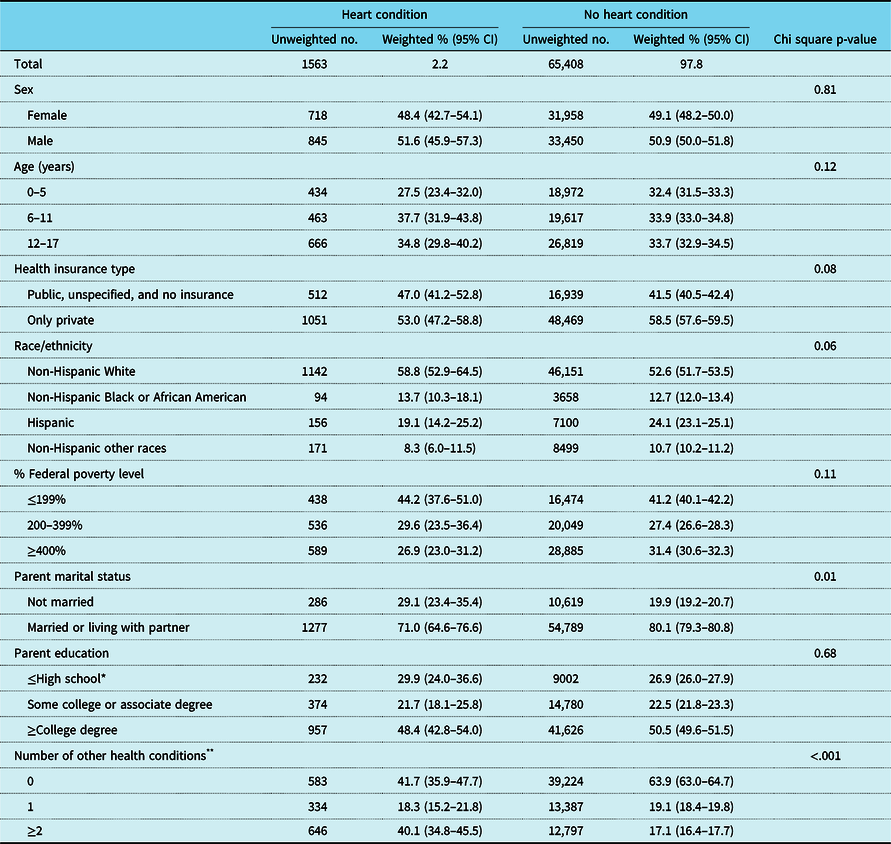
Characteristics of children by presence of a heart condition, National Survey of Children’s Health, 2016–2017

* Including vocational, trade, or business school
** Excludes heart conditions but includes allergies, arthritis, asthma, blood disorder, brain injury, cerebral palsy, cystic fibrosis, diabetes, Down syndrome, epilepsy or seizure disorder, genetic condition, severe headache, Tourette syndrome, anxiety, depression, behaviour problems, developmental delay, intellectual disability, speech disorder, learning disability, other mental health conditions, autism, attention-deficit/hyperactivity disorder, substance abuse, deafness or problems with hearing, and blindness
The outcomes of interest were receipt of preventive care in the past 12 months and the parent’s perception of whether the child has a medical home, hereafter referred to as “having a medical home”. Details on how each parent-reported outcome was assessed are described below. Preventive care is based on two questions. The first question asked, “During the past 12 months, did this child see a doctor, nurse, or other health care professional for sick-child care, well-child check-ups, physical exams, hospitalizations or other kind of medical care?” If “yes”, then the parent was asked “During the past 12 months, how many times did this child visit a doctor, nurse, or other health care professional to receive a preventive check-up? (A preventive check-up is when this child was not sick or injured, such as an annual or sports physical, or well-child visit.)” Answers of “1” or “2 or more” indicated the child received preventive care in the last 12 months.
Having a medical home is a National Survey of Children’s Health-derived variable that assesses the parent’s perception of the five components of medical homes as defined by the American Academy of Pediatrics Reference Bethell, Kogan and Strickland11 (Online Appendix 1). For a child to have a medical home, the parent must affirm the child’s healthcare experience meets the first three components: has a personal doctor or nurse, has a usual source for care, and receives care that is family-centred (e.g. listened to parent, respected family’s values). For children whose parents indicated that their child needed referrals and/or care coordination, parents must affirm the child’s healthcare experience meets the fourth and fifth components: received appropriate referrals and received coordinated care.
Online Appendix 1 lists all questions used to construct the medical home variable. The first component of a medical home, a personal doctor or nurse, was based on the question “Do you have one or more persons you think of as this child’s personal doctor or nurse?” The second component, usual source of care, was composed of two questions asking if the child has a place he or she usually goes when sick or needing medical advice and the type of facility (e.g. doctor’s office). The child was coded as having a usual source of care if the parent indicated the child had a typical place for care other than a hospital emergency room. The third component, family-centred care, was assessed through five questions that ask whether a physician spends enough time with the child, listens to parents carefully, is sensitive to family values/customs, gives needed information, and makes the family feel like a partner in care. Children received family-centred care if parents answered “usually or always” to all five questions. The fourth component of a medical home, receiving needed referrals, was assessed through two questions. Parents were asked, “During the past 12 months, did this child need a referral to see any doctors or receive any services?”. If parents respond “yes” to this question, then those parents were asked about the difficulty of getting needed referrals. Children were defined as receiving needed referrals if the parents answered that getting referrals was “not a problem”. The last component of a medical home, care coordination, was asked of parents who reported that their child saw more than one healthcare provider in the past 12 months. Care coordination is comprised of six questions that assess communication between doctors, communication between doctors and schools, and getting help coordinating care. Children received effective care coordination if parents answered that they “usually” got as much help as needed and were “very satisfied” with the communication between their doctor and others, when needed.
Previous literature and the social determinants of health theory Reference Braveman, Egerter and Williams12,Reference Braveman, Cubbin and Egerter13 were used to determine the demographic and socioeconomic factors that may be associated with receipt of preventive care and having a medical home among children with heart conditions. Factors examined were child’s sex, age, health insurance type, race/ethnicity, family income as a percent of the federal poverty level, number of other current health conditions, parent’s marital status, and parental educational level.
Statistical methods
We determined the percentage of children with missing data on variables of interest and, before excluding from further analyses, compared them to children without missing data using chi-square tests. Among children with data on all variables of interest, we examined demographic and socioeconomic variables stratified by heart condition status. Next, we estimated the percentage of children, stratified by heart condition status, who received preventive care in the last 12 months, and the percentage that reported having a medical home. Among children with and without heart conditions, we used the predicted marginal approach to logistic regression in separate multivariable models, one for each outcome, to examine whether having a heart condition was independently associated with receiving preventive care in the last 12 months and having a medical home. Using the same method, among children with heart conditions, we examined the adjusted prevalence ratios between demographic and socioeconomic factors and both outcomes. We also conducted several sensitivity analyses. To assess whether associations were generalisable to children with heart conditions without syndromes, we repeated the analyses after excluding all children with parent-reported Down syndrome or other genetic conditions, regardless of heart condition status. We also limited the exposed group to only children whose parent reported the child had a current heart condition.
Lastly, we limited analyses to children with parent-reported special healthcare needs to understand whether children with heart conditions with special healthcare needs differed from children with parent-reported special healthcare needs in general. Children with parent-reported special healthcare needs were considered children whose parents affirmed the child needs or uses medications (other than vitamins) prescribed by a doctor; needs or uses medical care, or mental health or educational services beyond those of a similarly aged child; has a limitation in the ability to do things most children of the same age can do; needs or uses specialised therapies such as physical, occupational, or speech therapy; and/or needs or receives treatment or counselling for an emotional, behavioural, or developmental problem. All analyses were conducted in SAS-Callable SUDAAN to account for the complex sampling design and included weights to generate population-based estimates.
Results
There were 71,811 children whose parent or guardian completed the 2016–2017 National Survey of Children’s Health, representing 146 million US children. Of those, 4840 (8.9%) were excluded from the analysis due to missing data on one or more variables of interest. The prevalence of having a heart condition did not differ among children included (2.2%) and excluded (2.3%) from the analysis (p > 0.05; Online Appendix 2). Children excluded from our sample were less likely to have received preventive care in the last 12 months (75.5 and 82.8%) and to have a medical home (39.5 and 49.5%; p < 0.05 for both), relative to those included. Of the 66,971 children included in the analytic sample (representing 133 million US children), 1563 had a heart condition (2.2%). The majority with and without heart conditions, respectively, were male (51.7 and 50.9%), privately insured (53.0 and 58.5%), non-Hispanic White (58.8 and 52.6%), and had married parents (71.0 and 80.1%) (Table 1). Heart condition status was significantly associated with parental marital status and number of health conditions (p < 0.05). Among children with heart conditions, 40.1% had ≥2 other health conditions compared to 17.1% of children without heart conditions.
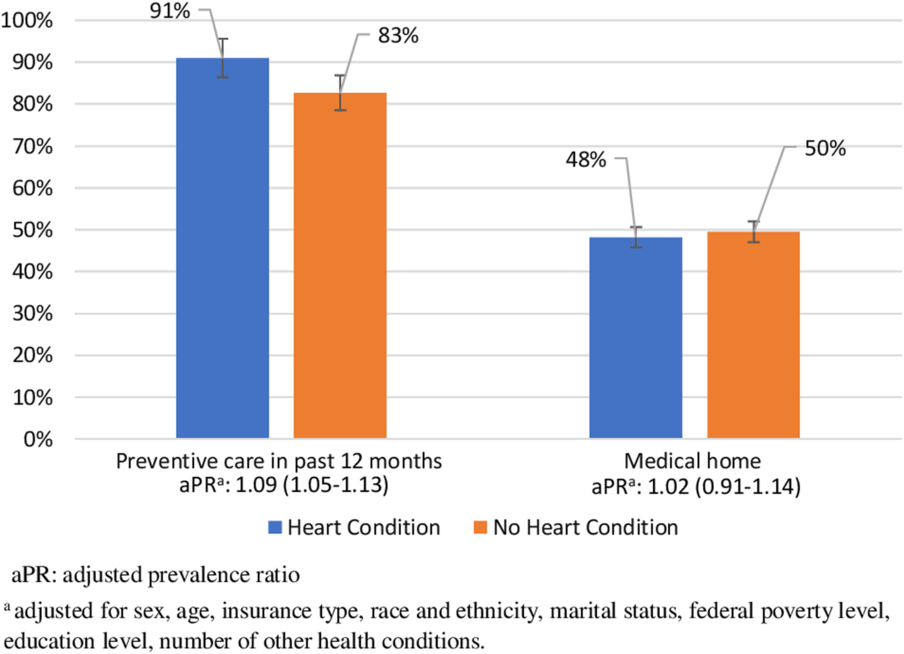
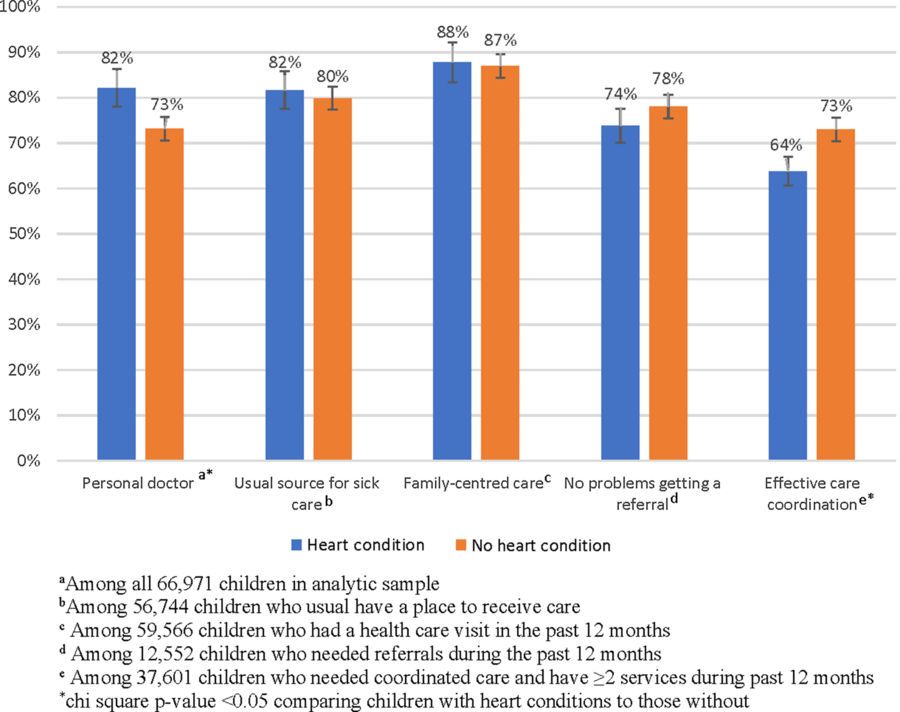
Most children with heart conditions (91.0%) and without (82.7%) received preventive care in the last 12 months (p < 0.001; adjusted prevalence ratio = 1.09, 95% confidence interval: 1.05–1.13; Fig 1). There was no statistically significant difference between the percent of children with heart conditions (48.2%) and those without heart conditions (49.5%) who met the criteria for having a medical home (p = 0.67; adjusted prevalence ratio = 1.02, 95% confidence interval: 0.91–1.14). Meeting individual medical home components ranged from 63.8% for care coordination to 87.8% for family-centred care, among children with heart conditions (Fig 2). Children with heart conditions, compared to those without, respectively, were more likely to have a personal doctor or nurse (82.2 and 73.2%; p < 0.05) but less likely to have received care coordination (63.8 and 73.0%; p < 0.05).
Prevalence of receiving preventive care in the past 12 months and having a medical home, by presence of heart condition, National Survey of Children’s Health, 2016–2017.

Prevalence of medical home components by heart condition status, National Survey of Children’s Health 2016–2017.

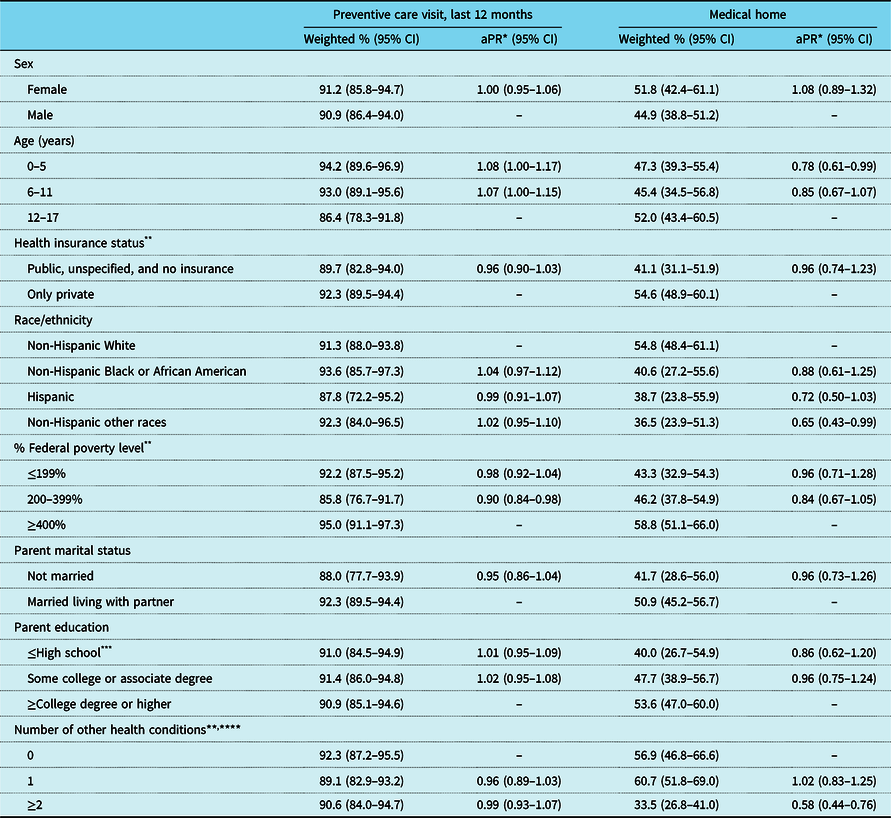
Among children with heart conditions (n = 1563), those least likely to have received preventive care in the last 12 months were 12–17 years of age (86.4%), had public, unspecified, or no insurance (89.7%), were Hispanic (87.8%), had family incomes 200–399% federal poverty level (85.8%), and had unmarried parents (88.0%) (Table 2). After adjusting for other variables, children 0–5 years old (adjusted prevalence ratio = 1.08, 95% confidence interval: 1.00–1.17) and 6–11 years old (adjusted prevalence ratio = 1.07, 95% confidence interval: 1.00–1.15) were slightly more likely than children 12–17 years to have received preventive care. Children with family incomes between 200 and 399% federal poverty level (adjusted prevalence ratio = 0.92, 95% confidence interval: 0.85–0.98) were less likely than children with family incomes ≥400% federal poverty level to have received preventive care.
Characteristics associated with receiving preventive care in the past 12 months and having a medical home among children with heart conditions, National Survey of Children’s Health, 2016–2017.

aPR = adjusted prevalence ratio, CI = confidence interval
* Adjusted for sex, age, insurance type, race and ethnicity, marital status, federal poverty level, education level, other health conditions
** Univariate chi-square p-value <0.05
*** Including vocational, trade, or business school
**** Excludes heart conditions but includes allergies, arthritis, asthma, blood disorder, brain injury, cerebral palsy, cystic fibrosis, diabetes, Down syndrome, epilepsy or seizure disorder, genetic condition, severe headache, Tourette syndrome, anxiety, depression, behaviour problems, developmental delay, intellectual disability, speech disorder, learning disability, other mental health conditions, autism, attention-deficit/hyperactivity disorder, substance abuse, deafness or problems with hearing, and blindness
Similar to findings on preventive care, children with heart conditions least likely to have a medical home were those who had public, unspecified, or no insurance (41.1%), were Hispanic (38.7%), and had unmarried parents (41.7%) (Table 2). Additionally, children who were categorised as non-Hispanic “other” race (36.5%), non-Hispanic Black (40.6%), had parents with a high school education or less (40.0%), and who had ≥2 other health conditions (33.5%) were also least likely to have a medical home. After adjusting for all variables, children 0–5 years of age compared to 12–17 years were less likely to have a medical home (adjusted prevalence ratio = 0.78, 95% confidence interval: 0.61–0.99), similar to findings on preventive care. Additionally, those categorised as non-Hispanic “other” race (adjusted prevalence ratio = 0.65, 95% confidence interval: 0.43–0.99), compared to non-Hispanic White children, and those with ≥ 2 other health conditions (adjusted prevalence ratio = 0.58, 95% confidence interval: 0.43–0.77), compared to none, were also less likely to have a medical home. Hispanic children (adjusted prevalence ratio = 0.72, 95% confidence interval: 0.50–1.03) compared to non-Hispanic White children were slightly less likely to have medical homes, although the 95% confidence interval crossed 1.0.
Results did not change when limiting the group of interest to children with parent-reported current heart conditions (n = 858). Children with current heart conditions, compared to those without heart conditions, were slightly more likely to receive preventive care (91.2 and 82.7%; adjusted prevalence ratio = 1.09, 95% confidence interval: 1.04–1.14) and as likely to have a medical home (44.6 and 49.5%; adjusted prevalence ratio = 0.94, 95% confidence interval: 0.83–1.07). Similarly, when limiting analyses to the 15,305 children with parent-reported special healthcare needs, we found that children with parent-reported special healthcare needs with heart conditions (91.7%) were as likely as those without heart conditions (89.3%) to receive preventive care (adjusted prevalence ratio = 1.03, 95% confidence interval: 0.97–1.08). While having a medical home did not differ significantly among children with parent-reported special healthcare needs with (38.7%) and without heart conditions (43.6%; adjusted prevalence ratio = 0.93, 95% confidence interval: 0.80–1.10), these estimates were 6–10 percentage points lower than among all children without heart conditions (49.5%). Excluding 2450 children with Down syndrome and other genetic conditions also did not substantially change results.
Discussion
To our knowledge, this is the first study to examine the prevalence of preventive care, medical home status, and associated characteristics among children with heart conditions. We found that over 90% of children with heart conditions received preventive care in the last 12 months, similar to children without heart conditions. Additionally, less than half of children with heart conditions had a medical home, similar to children without heart conditions. Results were similar among children with parent-reported current heart conditions. However, only 39% of children with both heart conditions and special healthcare needs had a medical home. Among all children with heart conditions, receipt of preventive care was more common among younger children and less common among those with a family income between 200 and 399% federal poverty level, compared to ≥400%. Having a medical home was less likely among younger children, those categorised as non-Hispanic “other” race compared to non-Hispanic White, and among those with ≥2 other health conditions compared to none.
The American Academy of Pediatrics generally recommends that children under 3 years of age receive more frequent preventive care visits throughout the year and children between 3 and 21 years of age receive an annual preventive care visit. 14 Our findings reveal that the large majority of US children with heart conditions may be following those guidelines, although older children with heart conditions may be slightly less likely than younger children with heart conditions to receive preventive care annually, similar to previous studies on children with parent-reported special healthcare needs Reference Shumskiy, Richardson and Brar1,Reference Morris, Schettine and Roohan15 and children without chronic conditions. Reference Morris, Schettine and Roohan15 It is unclear whether this difference is due to the routine vaccination schedule, which recommends more vaccinations at younger ages, 14 or competing priorities for older relative to younger children.
Children with CHD, a subset of children with heart conditions, may have healthcare needs for which the medical home can provide or coordinate care. Reference Lantin-Hermoso, Berger and Bhatt3 The primary care provider within the medical home also can identify issues affecting parents and families of children with CHD, such as mental health and cardiopulmonary resuscitation training. Early in life, the primary care provider for a child with CHD can ensure proper nutrition and growth and that immunisation needs are met and assess neurodevelopmental concerns. Throughout childhood, the primary care provider can advise parents on exercise, sports participation, and obesity prevention for their child and assist with the child’s transition to adult care. Our results show that almost all children with heart conditions have contact with their primary care provider at least annually, providing an opportunity for the primary care provider to provide comprehensive care. However, our results show that improvements could be made to ensure children with heart conditions receive coordinated care among all of their medical and service providers.
For children with heart conditions, we found the prevalence of having a medical home was lowest among racial/ethnic minorities, among children of lower socioeconomic status, and among those with multiple medical conditions. Among children with heart conditions, children categorised as “other race” had the lowest prevalence of having a medical home, followed by Hispanic and non-Hispanic Black children. Similar to our results, studies have shown that children with chronic conditions whose parents had less education were less likely to have a medical home. Reference Mulvihill, Altarac and Swaminathan16,Reference Singh, Strickland and Ghandour17 Low-income families may have fewer healthcare visits and health services that tend to lack continuity, resulting in more unmet healthcare needs. Reference Larson and Halfon18 It is unclear why these healthcare disparities exist, and more information is needed to improve health equity, specifically medical home access for children with medical complexities such as heart conditions.
Only one study has examined preventive care among children with parent-reported special healthcare needs with heart conditions, Reference Downing, Oster and Farr8 while others have examined preventive care among children with parent-reported special healthcare needs in general or children with medical complexities, which may include heart conditions. Reference Shumskiy, Richardson and Brar1,Reference Morris, Schettine and Roohan15,Reference Van Cleave and Davis19 These studies estimated receipt of preventive care in the last 12 months by 90% of children with parent-reported special healthcare needs with heart conditions, Reference Downing, Oster and Farr8 80–91% of children with parent-reported special healthcare needs in general, Reference Van Cleave and Davis19 and 60–89% of Medicaid-covered children with medical complexities in New York. Reference Morris, Schettine and Roohan15 Our study and these indicate that a large percentage of children receive preventive care in any given year.
Our findings on children with parent-reported heart conditions and medical homes are consistent with findings from previous studies on children with parent-reported special healthcare needs and medical complexities in general. One study, published in 1994 and conducted among a convenience sample of 92 children with CHD, found that all had a primary care provider. Reference Young, Shyr and Schork9 Although healthcare practices likely have changed since its publication, the study found that the primary care provider did not provide care for many of the child’s healthcare needs and no information was provided on whether the child had a medical home. In studies using parent-reported Reference Singh, Strickland and Ghandour17,Reference Strickland, Singh and Kogan20,Reference Lichstein, Ghandour and Mann21 and medical record data, Reference Lin, Romley and Carlin22 about half of children with parent-reported special healthcare needs had a medical home, but prevalence varied by state Reference Singh, Strickland and Ghandour17 and metropolitan area. Reference Lin, Romley and Carlin22 Additionally, there are important differences between our results among children with heart conditions and those of children in the general population without special healthcare needs. Reference Lichstein, Ghandour and Mann21 Among the general paediatric population, younger age was associated with having a medical home. Reference Lichstein, Ghandour and Mann21 In contrast, our results indicate that younger children with heart conditions are less likely to have a medical home, possibly due to more frequent cardiac specialty care and procedures in infancy and early childhood.
Using national data on over 66,000 US children, and over 1500 children ever diagnosed with heart conditions, this study provides national estimates for receipt of preventive care and medical home status among children with heart conditions. However, there are limitations. First, the National Survey of Children’s Health is parent-reported data and is not validated through medical records. The components of the medical home are subjective and based on the parent’s perception of the type of care their child received. Additionally, a parent whose child received surgery or treatment for a heart condition, such as CHD, may report that their child no longer has a heart condition. However, in most cases, surgery does not cure the CHD, which may require life-long care. Conversely, children with an innocent murmur may be included in children ever diagnosed with a heart condition. Therefore, we examined heart conditions several ways: we examined children who were ever diagnosed with a heart condition, as well as subsets of children with a current heart condition and children with both a heart condition and special healthcare needs. Nevertheless, our findings among children reported to have a current heart condition were similar to the larger group of children ever diagnosed with a heart condition.
Additionally, limiting children to those with special healthcare needs likely resulted in excluding many children with minor heart conditions. Secondly, there was no information on whether the heart condition was acquired or congenital. Thus, we were unable to examine outcomes stratified by type of heart condition. Finally, the 9% of children in the National Survey of Children’s Health excluded from this analysis due to missing data were less likely to receive preventive care and have a medical home. Excluding them may have slightly overestimated the prevalence of our outcomes.
Based on 2016–2017 data, an estimated 91% of US children with parent-reported heart conditions received preventive care in the past 12 months, but less than half received their care in a medical home. Children with heart conditions were less likely than children without heart conditions to receive coordinated care. Disparities in receipt of preventive care and presence of a medical home among children with heart conditions were found for younger children, children of lower socioeconomic status, racial/ethnic minorities, and those with two or more other health conditions. These results can serve as a baseline to assess future changes in prevalence of medical homes as recommendations within the American Academy of Pediatrics’s policy statement are implemented. These findings also highlight opportunities to improve care and health equity for children with heart conditions.
Supplementary Material
To view supplementary material for this article, please visit https://doi.org/10.1017/S1047951120003443
Acknowledgements
None.
Financial support
This research received no specific grant from any funding agency, commercial, or not-for-profit sectors.
Conflicts of interest
None.
Ethical standards
This analysis used publicly available data and the Emory University Institutional Review Board deemed the analysis non-research.