Introduction
The psychological profile of the archdeacon within the Church of England is an enduring, if not always endearing, established component of English literature, as evidenced by the Trollopian Archdeacon Theophilus Grantly (see Trollope, Reference Trollope1857). This historical caricature has been complemented and corrected by a series of relatively recent studies focusing on legal aspects of the role (Jones, Reference Jones1991; Ravenscroft, Reference Ravenscroft1995), practical aspects of the role (Buckingham, Reference Buckingham1997), theological reflection on the role (Percy, Reference Percy2011), and future trajectories for the role (Oxford Centre for Ecclesiology and Practical Theology, 2011). There have also been three empirically based studies of the role of archdeacons within the Church of England by Myers (Reference Myers1991), Brierley (Reference Brierley2004), and the Oxford Centre for Ecclesiology and Practical Theology (2011).
In the first of the three empirical studies, Myers (Reference Myers1991) analysed the responses to a questionnaire survey that combined both quantitative and qualitative questions. From 109 questionnaires sent out, 87 were returned (80 per cent response). The findings from this survey show considerable variation among archdeacons in terms of how they see their role and how well they feel equipped to fulfil their role. For example, while a small majority (57 per cent) of archdeacons personally inspected church buildings at least every fifth year, a substantial minority (43 per cent) rarely, if ever, inspected churches, preferring to leave this function to the rural dean.
In the second of the three empirical studies, Brierley (Reference Brierley2004) sent a largely quantitative questionnaire to three constituencies: bishops, archdeacons, and rural deans. Evidence was gathered from 70 bishops (65 per cent response), 110 archdeacons (83 per cent response) and 792 rural deans (56 per cent response). The main findings from this study are as follows. The role of archdeacons varies from diocese to diocese. Archdeacons work an average 67 hours per week. Brierley concluded that archdeacons within the Church of England:
ensure a reasonable degree of uniformity in applying ecclesiastical law. This is done by their attendance at numerous committees, a fifth of which they chair, spending on average a day a week in this process. Two days a week they are involved with the parishes in their archdeaconries, which some rural deans find too intrusive. The other two days are spent in a plethora of responsibilities, each archdeacon having at least two other major tasks. (Brierley, Reference Brierley2004, p. 2)
In the third of the three empirical studies, the Oxford Centre for Ecclesiology and Practical Theology (2011) employed both qualitative and quantitative techniques. Interviews were conducted among three groups: five bishops, fifteen archdeacons, and five diocesan secretaries/chief executives and four national officers. An online questionnaire was sent to all archdeacons who had not been interviewed, all bishops who had not been interviewed, and a sample of rural/area deans. Combining both interviews and questionnaire responses, evidence was gathered from 62 archdeacons (85 per cent response), 51 bishops (81 per cent response) and 28 rural/area deans (28 per cent response). The combined evidence made it very clear that the role of archdeacons within the Church of England is in transition, holding in tension traditional expectations and novel expectations within a changing Church. It is the contention of this present study that each of these expectations may require quite different psychological strengths.
Psychological Profiling
None of the empirical studies concerned with archdeacons within the Church of England have as yet included measures of psychological profiling. The value of such profiling for identifying strengths and weaknesses among religious leaders was proposed in the USA by Oswald and Kroeger (Reference Oswald and Kroeger1988) and has been tested in the UK, the USA and Australia by Francis and his associates in a series of studies (see Francis, Reference Francis2009). These studies have drawn both on psychological type theory as proposed by Jung (Reference Jung1971) and developed by instruments like the Myers Briggs Type Indicator (Myers and McCaulley, Reference Myers and McCaulley1985), and on temperament theory as proposed by Keirsey and Bates (Reference Keirsey and Bates1978). Recent debates regarding the strengths and weaknesses of psychological type theory from both psychological and theological perspectives have been well discussed by Bayne (Reference Bayne1995, Reference Bayne2005), Francis (Reference Francis2005, pp. 88-95), and Lloyd (Reference Lloyd2007, Reference Lloyd2012, Reference Lloyd2015).
At its core, psychological type theory identifies four key psychological differences that are regarded as deep-seated and as stable. Each of these four differences is conceptualized as binary polar opposites. The two orientations, defined as extraversion and introversion, are concerned with the source of energy. Extraverts gain their energy from the outer world of people and things; introverts gain their energy from the inner world. The two perceiving functions, defined as sensing and intuition, are concerned with ways in which information is gathered: sensing types begin with the detailed information (facts) and build up to the bigger picture; intuitive types begin with the bigger picture (theories) and draw in the details. The two judging functions, defined as thinking and feeling, are concerned with ways in which information is evaluated. Thinking types base judgement in the head, using objective and logical analysis; feeling types base judgement in the heart, giving weight to the human subjectivity within the situation. The two attitudes, defined as judging and perceiving, are concerned with the way in which the outer world is operated. Judging types employ their preferred judging function (thinking or feeling) in the outer world and model a structured external environment; perceiving types employ their preferred perceiving function (sensing or intuition) in the outer world and model a flexible external environment. Psychological type theory also distinguishes between the relative strength of an individual’s preferred perceiving function (sensing or intuition) and preferred judging function (thinking or feeling). The strongest of these two functions is styled the dominant function. The dominant function gives insight into the individual’s leading strength: dominant sensing is recognized in the practical person, dominant intuition in the imaginative person, dominant feeling in the humane person, and dominant thinking in the logical person.
Since the late 1960s there has been an established tradition of empirical research employing psychological type theory among religious professionals in the USA, reported in studies like Greenfield (Reference Greenfield1969), Harbaugh (Reference Harbaugh1984), Holsworth (Reference Holsworth1984), Cabral (Reference Cabral1984), Macdaid, McCaulley, and Kainz (Reference Macdaid, McCaulley and Kainz1986), Bigelow, Fitzgerald, Busk, Girault, and Avis (Reference Bigelow, Fitzgerald, Busk, Girault and Avis1988), Francis, Robbins, and Wulff (Reference Francis, Robbins and Wulff2011), Burns, Francis, Village, and Robbins (Reference Burns, Francis, Village and Robbins2013), and Royle, Norton, and Larkin (Reference Royle, Norton and Larkin2015). From the late 1980s this tradition has also flourished in the UK, including studies among Presbyterian Church of Scotland ministers (Irvine, Reference Irvine1989), Anglican clergymen serving in the Church in Wales (Francis, Payne, and Jones, Reference Francis, Payne and Jones2001; Francis and Payne, Reference Francis and Payne2002; Francis, Littler, and Robbins, Reference Francis, Littler and Robbins2010), male and female Bible College students (Francis, Penson, and Jones, Reference Francis, Penson and Jones2001), evangelical church leaders (Francis and Robbins, Reference Francis and Robbins2002; Craig, Francis, and Robbins, Reference Craig, Francis and Robbins2004), male missionary personnel (Craig, Horsfall, and Francis, Reference Craig, Horsfall and Francis2005), evangelical lay church leaders (Francis, Craig, Horsfall, and Ross, Reference Francis, Craig, Horsfall and Ross2005), Roman Catholic priests (Craig, Duncan, and Francis, Reference Craig, Duncan and Francis2006), youth ministers (Francis, Nash, Nash, and Craig, Reference Francis, Nash, Nash and Craig2007), Anglican clergymen and clergywomen serving in the Church of England (Francis, Craig, Whinney, Tilley, and Slater, Reference Francis, Craig, Whinney, Tilley and Slater2007; Village, Reference Village2011), evangelical Anglican seminarians (Francis, Craig, and Butler, Reference Francis, Craig and Butler2007), Assemblies of God theological college students (Kay and Francis, Reference Kay and Francis2008; Kay, Francis, and Craig, Reference Kay, Francis and Craig2008), lead elders serving within the Newfrontiers network of churches (Francis, Gubb, and Robbins, Reference Francis, Gubb and Robbins2009), Church of England hospital chaplains (Francis, Hancocks, Swift, and Robbins, Reference Francis, Hancocks, Swift and Robbins2009), Methodist Circuit ministers (Burton, Francis, and Robbins, Reference Burton, Francis and Robbins2010), male and female Free Church ministers in England (Francis, Whinney, Burton, and Robbins, Reference Francis, Whinney, Burton and Robbins2011), leaders in the Apostolic Networks (Kay, Francis, and Robbins, Reference Kay, Francis and Robbins.2011), and leaders within the Newfrontiers network of churches (Francis, Robbins, and Ryland, Reference Francis, Robbins and Ryland2012).
A first attempt to draw upon psychological type profiles of Church of England clergy was published by Francis, Craig, Whinney, Tilley, and Slater (Reference Francis, Craig, Whinney, Tilley and Slater2007). They drew on data provided by samples of 626 clergymen and 237 clergywomen who completed the 126-item Form G (Anglicized) of the Myers-Briggs Type Indicator (Myers and McCaulley, Reference Myers and McCaulley1985), generally in the context of a wide range of personal and professional development programmes, including courses run for curates in the early years of ministry, for mid-career development, and for pre-retirement preparation. This first attempt was replicated a few years later by Francis, Robbins, Duncan, and Whinney (Reference Francis, Robbins, Duncan and Whinney2010) who drew on data from 622 clergymen and by Francis, Robbins, and Whinney (Reference Francis, Robbins and Whinney2011) who drew on data from 83 clergywomen. These replication studies drew on data collected in a similar way to that of the foundation study and generated highly similar results. According to these studies what characterized Church of England clergymen and clergywomen were preferences for introversion, for intuition, for feeling and for judging. Introverts are good at working alone and in small groups, but may be less comfortable with the social aspect of church life. Intuitive types are good at visionary ideas, but may be less comfortable with the practical details of church life. Feeling types are good at appreciating harmony and agreement, but may be less comfortable with needing to take and to implement tough decisions needed in church life. Judging types are good at operating within a clearly planned framework, but may be less comfortable with the unpredictable and spontaneous aspects of church life. This profile offered by psychological type theory may offer a good guide to understanding the way in which Anglican clergy approach ministry.
Psychological Temperament
Drawing on the basic building blocks of psychological type theory, Keirsey and Bates (Reference Keirsey and Bates1978) distinguished between four temperaments characterized as SJ, SP, NT and NF, and to each of these temperaments they ascribe a distinctive name rooted in classic mythology. The Epimethean Temperament characterizes the SJ profile, people who long to be dutiful and exist primarily to be useful to the social units to which they belong. The Dionysian Temperament characterizes the SP profile, people who want to be engaged, involved and doing something new. The Promethean Temperament characterizes the NT profile, people who want to understand, explain, shape and predict realities, and who prize their personal competence. The Apollonian Temperament characterizes the NF profile, people who quest for authenticity and for self-actualization, who are idealistic and who have great capacity for empathic listening. Oswald and Kroeger (Reference Oswald and Kroeger1988) built on Keirsey and Bates’ (Reference Keirsey and Bates1978) characterization of the four temperaments to create profiles of how these four temperaments shape four very different styles of religious leadership.
The Epimethean Temperament (SJ) is styled ‘the conserving, serving pastor’. SJ clergy tend to be the most traditional of all clergy temperaments, bringing stability and continuity in whatever situation they are called to serve. They proclaim a simple and straightforward faith, committed to down-to-earth rules for the Christian life. They serve as protectors and conservers of the traditions inherited from the past. If change is to take place, it emerges by evolution, not revolution. They excel at building community, fostering a sense of loyalty and belonging. They bring order and stability to their congregations, creating plans, developing procedures and formulating policies; and they are keen that these procedures should be followed. They can be trusted for their reliability, punctuality and efficiency. They are effective pastors, showing particular concern for the young, the elderly, and the weak. They are realists who offer practical and down-to-earth solutions to pastoral problems.
The Dionysian Temperament (SP) is styled ‘the action-oriented pastor’. SP clergy tend to be the most fun loving of all clergy temperaments, possessing a compulsive need to be engaged in activity. They have little need for or interest in the abstract, the theoretical, and the non-practical aspects of theology and church life. They are flexible and spontaneous people who welcome the unplanned and unpredictable aspects of church life. They can bring the church to life with activities for everyone from cradle to grave. They have a flare for grasping the moment. They are entertainers and performers at heart. They are at their best in a crisis and are good at handling conflict resolution. They are fun loving and enjoy working with children and young people. They are better at starting new initiatives than at seeing things through. SP clergy may be particularly attracted to charismatic worship, responding to the leading of the Holy Spirit, welcoming a free-flowing form that allows for impromptu testimonials, speaking in tongues, and spontaneous singing.
The Promethean Temperament (NT) is styled ‘the intellectual, competence-seeking pastor’. NT clergy are the most academically and intellectually grounded of all clergy temperaments, motivated by the search for meaning for truth and for possibilities. They are visionaries who need to excel in all they do, and they tend to push their congregations to excel as well. They enjoy the academic study and analysis of the faith, and may try to run their church as an extension of the seminary. They make great teachers, preachers, and advocates for social justice. They look for underlying principles rather than basic applications from their study of Scripture. They see the value of opposing views and strive to allow alternative visions to be heard. They are more concerned with finding truth than with engineering harmony and compromise. NT clergy need to be challenged in their ministry and to be able to move from one challenge to the next.
The Apollonian Temperament (NF) is styled ‘the authenticity-seeking, relationship-oriented pastor’. NF clergy tend to be the most idealistic and romantic of all clergy temperaments, attracted to helping roles that deal with human suffering. They want to meet the needs of others and to find personal affirmation in so doing. They can be articulate and inspiring communicators, committed to influencing others by touching their hearts. They have good empathic capacity, interpersonal skills, and pastoral counselling techniques. They find themselves listening to other people’s problems in the most unlikely contexts, and really caring about them. NF clergy tend to be high on inspiration, but lower on the practical down-to-earth aspects of ministry. They are able to draw the best out of people and work well as the catalyst or facilitator in the congregation as long as others are on hand to work with and to implement their vision. They are at their best when leading in people-related projects, such as starting a project for the elderly or for youth. They are most comfortable in unstructured meetings where they are good at facilitating group decision-making processes.
The studies of Church of England clergymen and clergywomen reported by Francis, Craig, Whinney, Tilley, and Slater (Reference Francis, Craig, Whinney, Tilley and Slater2007), Francis, Robbins, Duncan, and Whinney (Reference Francis, Robbins, Duncan and Whinney2010), and Francis, Robbins, and Whinney (Reference Francis, Robbins and Whinney2011) demonstrate the predominance of the Promethean (NT) and the Apollonian (NF) temperaments among Church of England clergy. This profile offered by psychological temperament theory may complement and augment the understanding afforded by psychological type theory into the way in which Anglican clergy approach ministry.
Profiling Bishops
Francis, Whinney, and Robbins (Reference Francis, Whinney and Robbins2013) employed psychological type theory to test the extent to which the characteristics of bishops identified by the ordinal for the consecration of bishops set out by the Book of Common Prayer (Church of England, 1662) and by Common Worship (Church of England, 2000) resulted in the Church of England selecting for episcopal orders men who differed significantly from the overall profile of Church of England clergymen. While the profile of clergymen emerged as INFJ, Francis, Whinney, and Robbins (Reference Francis, Whinney and Robbins2013) argued that for bishops the 1662 ordinal in the Book of Common Prayer preferred the STJ profile: men called to ‘Government in the Church’ and ‘to the Administration’ who were committed to ‘banish and drive away from the Church all erroneous and strange doctrine’. To these qualities the 2000 ordinal in Common Worship added extraversion (ESTJ): men who were good at leading God’s people in mission and making their home a place of hospitality and welcome. Francis, Whinney, and Robbins (Reference Francis, Whinney and Robbins2013) also speculated that suffragan bishops may differ from diocesan bishops in terms of preferences on the judging process. While diocesan bishops may be chosen for tough-minded administration, they may in turn be inclined to appoint suffragan bishops better equipped to deal with the pastoral aspects of the diocese.
For the study by Francis, Whinney, and Robbins (Reference Francis, Whinney and Robbins2013), 168 bishops serving or retired in the Church of England completed the Francis Psychological Type Scales (Francis, Reference Francis2005). The psychological profile of those bishops was compared with the profile of the 626 Church of England clergymen reported by Francis, Craig, Whinney, Tilley, and Slater (Reference Francis, Craig, Whinney, Tilley and Slater2007). The bishops differed significantly from the clergymen on three of the four aspects of psychological type. The bishops were more likely to prefer extraversion (53 per cent compared with 43 per cent), more likely to prefer sensing (49 per cent compared with 38 per cent), and more likely to prefer judging (88 per cent compared with 68 per cent). Overall the SJ temperament was preferred by 47 per cent of the bishops compared with 31 per cent of the clergymen. Moreover, there was a significant difference between diocesan bishops and suffragan bishops in terms of the judging process. While 37 per cent of the suffragan bishops preferred thinking, the proportion rose to 56 per cent among the diocesan bishops.
Profiling Archdeacons
Against this background, the research aim of the present study is to project the functions associated with archdeacons within the Church of England onto the theoretical frameworks proposed by psychological type theory and temperament theory, and then to explore the profile reflected by archdeacons in the recent past. Drawing on the analysis offered by the Oxford Centre for Ecclesiology and Practical Theology (2011), a clear distinction will be drawn between what may be described as the traditional statutory functions of archdeacons and the newly emerging functions of archdeacons.
The traditional statutory functions of archdeacons within the Church of England are seen as essential to maintaining the order and governance of the Church. The Archbishops’ Council (2008) in its document, Statutory Functions of an Archdeacon, roots the work of archdeacons within:
a theology of order. Rules and regulations are useful in resolving differences of opinion or interpretation, becoming accessible ‘measuring rods’. They save every generation from having to ‘reinvent the wheel’ every time a problem arises or a decision has to be made. Since the following of rules avoids disputes and conflict, it facilitates the work of the gospel.
This document then itemized eight areas in which such rules and regulations need to be exercised. Archdeacons are ‘required to enforce compliance by each parish with the provisions of the Inspection of Churches Measure 1955’. Archdeacons are ‘required by Canon to hold yearly visitations’. Archdeacons are ‘required on receiving the directions of the Bishop to induct any priest who has been instituted to a benefice’. Archdeacons are under the Pastoral Measure 1983 ‘responsible for identifying the need for pastoral reorganisation and negotiating with all other interested parties any proposals for it’. Archdeacons are under the Vacation of Benefices Measure 1977 responsible for deciding whether ‘a formal enquiry into the pastoral situation’ in a parish should be instituted. Archdeacons are under the Repair of Benefices Buildings Measure 1972 ‘an ex-officio member of the Parsonages Board’. Archdeacons are under the Church Representation Rules responsible for ‘convening and conducting an extraordinary meeting of a Parochial Church Council’. Archdeacons are under the Care of Churches, and Ecclesiastical Jurisdiction Measures 1991 ‘the most important person concerned with the enforcement of the faculty jurisdiction’. To these eight areas of statutory responsibility should be added dealing with the implications of the Ecclesiastical Offices (Terms of Service) Measure 2009 and the introduction of holding ecclesiastical office under common tenure since 2011.
The emerging functions of archdeacons within the Church of England are itemized by the Oxford Centre for Ecclesiology and Practical Theology (2011) as wide ranging and diverse, but include the following specified matters: the management of change; conflict resolution; the pastoral care of clergy and their families; appointments; ministerial development reviews; a growing number of HR functions; strategic planning for workforce development; advice to parish officers such as churchwardens and treasurers; and mission. Reflecting on this diversity, in his foreword to the report, the Archdeacon of Cleveland and Chair of the Archdeacons’ Forum, Paul Ferguson, wrote, ‘In our ministry amid a changing context, archdeacons need to be able at the same time both to respond flexibly and be visionary’.
The traditional statutory functions of archdeacons map well onto the characteristics of the Epimethean Temperament (SJ) offered by Oswald and Kroeger (Reference Oswald and Kroeger1988). This profile may be nuanced further by the additional insights of psychological type theory. The traditional statutory role of the archdeacon may be particularly attractive to the introvert (energized by working through documentation) and to thinking types (applying logical impersonal analysis to matters shaped by systems and procedures). The ideal traditional archdeacon may indeed be the ISTJ. The ISTJ profile may, however, be far from ideal for the new emerging functions capturing archdeacons’ attentions. To return to Paul Ferguson’s aspiration, the capacity to respond flexibly and to be visionary are not deeply embedded within the Epimethean Temperament (SJ). Flexibility is more associated with perceiving types (P) and vision is more associated with intuitive types (N). Strategic planning may be more associated with the INTJ profile, while pastoral care may be more associated with feeling types (F).
Given the notion that the Church of England is at a point of transition in the conceptualization of the role of archdeacons, this study now proposes to analyse a dataset collected in 2009 and not previously analysed. Such an analysis, including retired archdeacons as well as active archdeacons, may still be able to capture the profile of those who have served as archdeacons in the recent past. The challenge will then be for others to replicate the study among a new generation of archdeacons to test whether the psychological profile is changing in line with changing institutional expectations.
Method
Procedure
All male archdeacons, active or retired, recorded on the Church Commissioners’ database as serving or having served in the Church of England were invited during 2009 to complete a short questionnaire. Only male archdeacons were included in the survey because the number of female archdeacons at the time was too small to protect the anonymity of their responses. The questionnaire was sent by post under a personalized covering letter from Bishop Michael Whinney and returned by freepost to the research centre. The male archdeacons were assured of anonymity and confidentiality. A total of 257 questionnaires were dispatched, and 186 were returned, making a highly satisfactory response rate of 72.4 per cent.
Instrument
Psychological type was assessed by the Francis Psychological Type Scales (FPTS: Francis, Reference Francis2005). This 40-item instrument comprises four sets of ten forced-choice items related to each of the four components of psychological type: orientation (extraversion or introversion), perceiving process (sensing or intuition), judging process (thinking or feeling), and attitude toward the outer world (judging or perceiving). Recent studies have demonstrated this instrument to function well in church-related contexts. For example, Francis, Craig, and Hall (Reference Francis, Craig and Hall2008) reported alpha coefficients of .83 and for EI scale, .76 for the SN scale, .73 for the TF scale, and .79 for the JP scale.
Sample
Of the 186 male archdeacons who participated in the survey, 71 were currently in office, 71 had retired but remained in active service, and 44 had retired and were no longer in active service; one was in his forties, 44 in their fifties, 42 in their sixties, 64 in their seventies, and 35 were aged 80 or over.
Data Analysis
In the following analyses comparison is made between the 626 Church of England clergymen reported by Francis, Craig, Whinney, Tilley, and Slater (Reference Francis, Craig, Whinney, Tilley and Slater2007) and the 186 male archdeacons who responded to the present survey. The scientific literature concerned with psychological type has developed a distinctive way of presenting type-related data. The conventional format of ‘type tables’ has been used in the present paper to allow the findings from this study to be compared with other relevant studies in the literature. In these tables the statistical significance of differences in the psychological type profiles of different groups is tested by means of the Selection Ratio Index (I), an extension of the classic chi-square test (McCaulley, Reference McCaulley1985).
Results
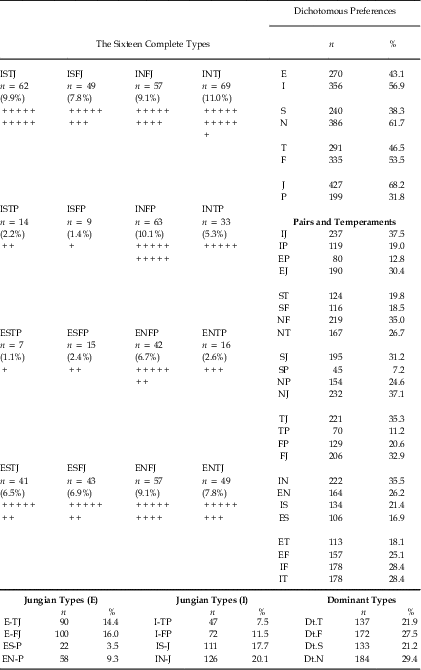
Table 1 reproduces the psychological type profile of the sample of 626 Anglican clergymen published by Francis, Craig, Whinney, Tilley, and Slater (Reference Francis, Craig, Whinney, Tilley and Slater2007). Table 1 profiles a group of men who prefer introversion (57 per cent) over extraversion (43 per cent), intuition (62 per cent) over sensing (38 per cent), feeling (54 per cent) over thinking (47 per cent), and judging (68 per cent) over perceiving (32 per cent). The dominant type preferences, in descending order were intuition (29 per cent), feeling (28 per cent), thinking (22 per cent), and sensing (21 per cent). The psychological temperament preferences, in descending order were the Apollonian Temperament (NF) at 35 per cent, the Epimethean Temperament (SJ) at 31 per cent, the Promethean Temperament (NT) at 27 per cent, and the Dionysian Temperament (SP) at 7 per cent.
Type distribution for Anglican clergymen

Note: N = 626 (NB: + = 1% of N).
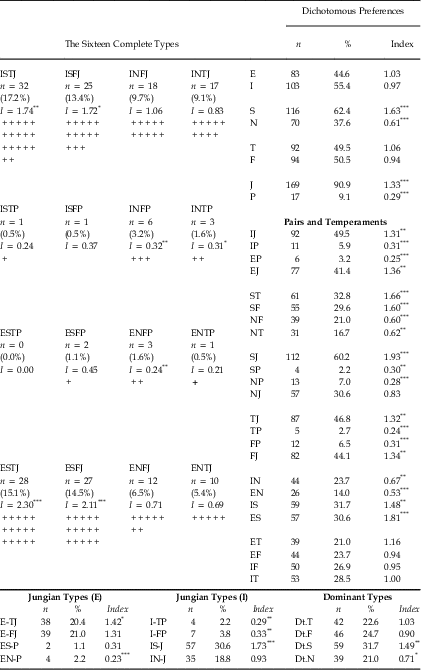
Table 2 presents the psychological type profile of the sample of 186 male archdeacons. Table 2 profiles a group of men who prefer introversion (55 per cent) over extraversion (45 per cent), sensing (62 per cent) over intuition (38 per cent), and judging (91 per cent) over perceiving (9 per cent), and who show a balance between thinking (50 per cent) and feeling (51 per cent). The dominant type preferences, in descending order, were sensing (32 per cent), feeling (25 per cent), thinking (23 per cent), and intuition (21 per cent). The psychological temperament preferences, in descending order, were the Epimethean Temperament (SJ) at 60 per cent, the Apollonian Temperament (NF) at 21 per cent, the Promethean Temperament (NT) at 17 per cent, and the Dionysian Temperament (SP) at 2 per cent.
Type distribution for male archdeacons compared with Anglican clergymen

Note: N=186 (NB: +=1% of N).
* p < .05,
** p < .01,
*** p < .001.
Table 2 also draws attention to the statistical significance of differences between the profile of the Anglican clergymen and the profile of male archdeacons, employing the Selection Ratio Index (I), an extension of the classic chi-square test (Myers and McCaulley, Reference Myers and McCaulley1985). The most salient features are as follows. In terms of the perceiving process, the archdeacons are more likely to prefer sensing (62 per cent compared with 38 per cent) while the clergymen are more likely to prefer intuition (62 per cent compared with 38 per cent); the archdeacons are more likely to prefer judging (91 per cent compared with 68 per cent), while the clergymen are more likely to prefer perceiving (32 per cent compared with 9 per cent). In terms of the 16 complete types the archdeacons are more likely to report ISTJ (17 per cent compared with 10 per cent) and more likely to report ESTJ (15 per cent compared with 7 per cent). In terms of the four temperaments, the archdeacons are more likely to report SJ (60 per cent compared with 31 per cent) and consequently less likely to report NF (21 per cent compared with 35 per cent), NT (17 per cent compared with 27 per cent), and SP (2 per cent compared with 7 per cent).
Discussion and Conclusion
This study set out to chart the psychological type profile and psychological temperament profile of Church of England male archdeacons at the beginning of the twenty-first century. The study was stimulated by the findings of the Oxford Centre for Ecclesiology and Practical Theology (2011) that drew clear attention to the changing expectations of archdeacons within the Church of England. These changing expectations continued to embrace the traditional statutory functions of archdeacons but to add to these a range of wider expectations appropriate for leading the Church of England within a changing environment. An analysis of the traditional statutory functions suggested that the role was ideally suited to the Epimethean Temperament (SJ) as nuanced by a preference for introversion and for thinking (ISTJ). On the other hand, the new and emerging functions (specified as requiring flexibility and being visionary) were seen to be less suited to the Epimethean Temperament (SJ).
Empirical data collected in 2009 from 71 male archdeacons currently in office combined with 71 who had retired but remained in active service and 44 who had retired but were no longer in active service provided the opportunity to document the profile of long-established archdeacons serving within the Church of England, as a baseline against which future studies could explore for development and change. These data confirmed the following expectations of how the traditional statutory functions of archdeacons projected onto psychological type theory and psychological temperament theory.
The first prediction was that the traditional functions ideally suited the Epimethean Temperament (SJ). While 31 per cent of Church of England clergymen reported the SJ profile, the proportion rose to 60 per cent among archdeacons.
The second prediction was that the traditional functions especially suited the Epimethean Temperament nuanced by preference for thinking (ISTJ and ESTJ). While 10 per cent of Church of England clergymen reported the ISTJ profile, the proportion rose to 17 per cent among archdeacons. While 7 per cent of Church of England clergymen reported the ESTJ profile, the proportion rose to 15 per cent among archdeacons.
The high concentration of the SJ profile implies that intuitive types and perceiving types are less well represented among archdeacons than among Church of England clergymen in general. Intuitive types are particularly good at offering the visionary potential identified by Paul Ferguson as key for the archdeacons of the future. While 62 per cent of Church of England clergymen prefer intuition, the proportion falls to 38 per cent among archdeacons. Perceiving types are particularly good at offering the flexibility identified by Paul Ferguson as key for the archdeacons of the future. While 32 per cent of Church of England clergymen prefer perceiving, the proportion falls to 9 per cent among archdeacons.
As the Church of England changes the specification of what it expects archdeacons to do, there are both empirical and theoretical questions raised. The empirical question concerns the value of replicating the study reported in this paper to discover whether the appointment of archdeacons since 2009 is reflecting a change in psychological profile. The theoretical question concerns the implications for the efficient and effective implementation of the traditional functions of archdeacons if in fact the psychological profile of those appointed to this ministry is changing. Indeed, it may be the case that the efficient and effective implementation of the traditional functions of archdeacons within the Church of England and the efficient and effective implementation of the new and emerging functions may require the recruitment of two very different types of people.