Introduction
Cirsoid aneurysms are actually arteriovenous fistulas of the scalp that have a characteristic variceal dilatation of the draining veins.Reference Gurkanlar, Gonul, Solmaz and Gonul1 (The Greek term for ‘cirsoid’ is kirsos, which means varix.) These lesions present with spontaneous or post-traumatic, localised, pulsatile scalp swelling. They can present clinically as pulsatile swelling, cosmetic deformity, discoloration and, rarely, intractable tinnitus. A comprehensive depiction of the feeding artery (or arteries), draining vein(s) and arteriovenous communication is necessary in order to make an appropriate management decision. In the past, surgery formed the sole treatment modality for such lesions. However, percutaneous and endovascular methods of embolisation have recently evolved as less invasive techniques for managing these fistulas.
We report a case of a spontaneous arteriovenous fistula of the temporal region presenting with intractable tinnitus, which was treated by endovascular embolisation using n-butyl cyanoacrylate glue, leading to instant relief of the symptoms.
Case report
A 52-year-old female presented with a one-year history of tinnitus, with a pulsatile swelling in the right temporal pre-auricular region associated with headaches. The tinnitus was continuous, with a ‘swishing’ sound that had become more troublesome in the two months prior to presentation. There had been no history of trauma at the local site.
On examination, a pulsatile swelling in the right pre-auricular region was observed, approximately 3 × 2 cm in size, with the presence of tortuous vessels in its vicinity and a bruit on auscultation. The overlying skin was unremarkable, as was the ear examination and the rest of the general physical examination.
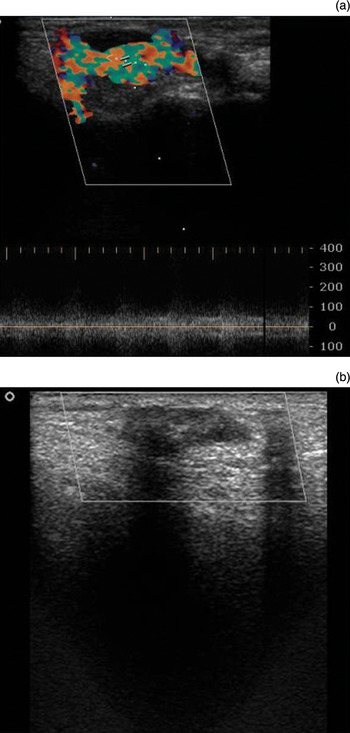
A colour Doppler ultrasound examination revealed a prominent superficial temporal artery that had a fistulous communication with the dilated, tortuous corresponding vein. The superficial temporal artery distal to the fistula showed significantly reduced blood flow, indicating near-complete redirection of blood towards the venous side. Time of flight magnetic resonance angiography confirmed these findings, and also excluded the presence of any intracranial vascular communications. The patient was subsequently informed about the surgical and endovascular treatment options and she decided on the latter.
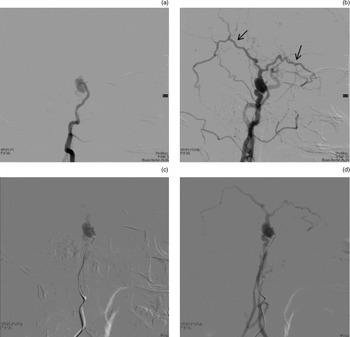
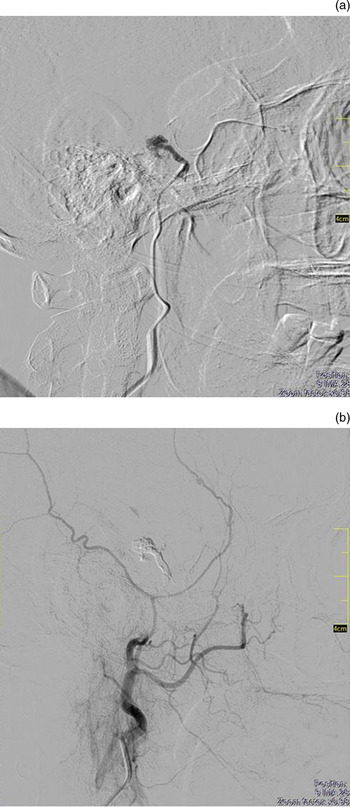
Diagnostic head and neck angiography was performed to delineate the exact fistulous site and the status of the draining vein. The most optimal position for embolisation of the fistulous site was attained with the help of a coaxial system using a diagnostic 5F Picard catheter (Cook, Bloomington, Indiana, USA) and a Progreat microcatheter (Terumo, Tokyo, Japan) inserted through the right femoral artery. Figure 1 shows the angiograms of the external carotid artery and the superficial temporal artery, revealing the exact site of the fistulous communication between the artery and the vein. A diagnostic test run through the microcatheter, with distal venous compression against the mandibular ramus, ensured that we had complete control over the flow of the liquid embolising agent. With the same manoeuvre of distal venous compression, approximately 2 ml of a 1:1 mixture of n-butyl cyanoacrylate glue (Histacryl®) and ethiodised oil (Lipiodol, Laboratories Guerbet, Aulnay-sous-Bois, France) (i.e. 50 per cent glue) was injected into the fistula. Figure 2 shows the angiographic images of the fistula during and after embolisation.
Lateral digital subtraction angiograms showing: (a) the external carotid artery; (b) the superficial temporal artery (the arrows indicate the early filling of the venous channels and retrograde opacification of scalp veins); and (c) & (d) the exact site of fistulous communication between the arteries and vein.

Digital subtraction angiograms: (a) peri-embolisation image showing the desirable glue cast in the distal, main arterial feeder, going across the fistula and into the proximal venous side; and (b) post-embolisation, external carotid image, showing complete obliteration of the fistulous communication.

A control angiography showed complete occlusion of the arteriovenous fistula (Figure 2b). The clinical response was also instantaneous, with the patient reporting an immediate cessation of tinnitus. No procedure-related complications were encountered. A follow-up Doppler scan, carried out 24 hours after the procedure, showed complete occlusion of the fistula (Figure 3). The patient opted against cosmetic surgical correction for the minimal residual swelling as she did not consider it bothersome, and she was subsequently discharged after two days.
(a) Pre-procedure colour duplex examination image showing turbulent flow at the fistulous site, as depicted by the colour filling and spectral pattern. (b) Post-embolisation Doppler examination image showing an echogenic glue cast and thrombus with complete absence of colour filling or flow.

Discussion
Cirsoid aneurysms, unlike their name suggests, are actually fistulous connections between feeding arteries and draining veins, without an intervening capillary bed. They were first described by Brecht in 1833,Reference Elkin2 and have been referred to by various names, such as aneurysma serpentinum, aneurysma cirsoide, aneurysma racemosum, arteriovenous aneurysm, plexiform angioma and so on. Fifty per cent of all these soft tissue lesions arise in the scalp.Reference Gupta, Purkayastha, Bodhey, Kapilamoorthy, Krishnamoorthy and Kesavadas3 The superficial, subcutaneous branches of the external carotid artery are the major feeder vessels in most cirsoid aneurysms of the scalp region. The superficial temporal artery is the dominant supply in up to 70 per cent of cases. This is due primarily to its unprotected courseReference Barnwell, Halbach, Dowd, Higashida and Hieshima4 and its consequent high risk of incurring trauma. The venous drainage is through the corresponding scalp veins, which become progressively dilated and tortuous with time. These appear as aneurysms, and occasionally lead to a cosmetically unacceptable appearance. Intracranial venous drainage can sometimes be present, which demands special attention prior to initiating therapy.
The origin of these lesions has been a subject of debate. The majority of cirsoid aneurysms (approximately 80 per cent) are thought to be congenital in origin, while the rest arise from traumatic causes. The presenting symptoms include a progressively enlarging, pulsatile scalp swelling associated with pain, a throbbing headache or tinnitus.Reference Luessenhop5 Tinnitus, although described as a symptom, is an uncommon manifestation of these aneurysms. However, it is one of the most bothersome symptoms for the patient. A few incidents of haemorrhage have also been reported, but this is very rare. Patients seek treatment primarily because of the irritation associated with the continuous bruit, and for cosmetic relief.
Diagnosis is clinically evident in the majority of cases. However, a dedicated Doppler ultrasound, computed tomography, magnetic resonance imaging scan or catheter angiography helps to identify the feeding arteries and draining veins and to demonstrate the various fistulous connections.
Nowadays, multiple treatment options are available (depending on the local expertise), including: surgical excision; ligation of the feeding artery; transarterial, transvenous or percutaneous embolisation;Reference Hendrix, Meyer and Erickson6 and electrothrombosis. Endovascular and percutaneous treatment modalities have become the preferred treatment options due to their minimally invasive nature and low risk of complications. In difficult cases (e.g. involving high-flow or multiple shunts), these modalities can also be used as adjuncts to surgery. Surgery is generally reserved for complicated fistulas, and for cosmetic correction following embolisation procedures.
• Head and neck arteriovenous fistulas are challenging to treat
• Surgical management risks bleeding, major vessel ligation and cosmetic deformity
• This scalp arteriovenous fistula case had intractable tinnitus
• This was managed with endovascular embolisation using cyanoacrylate glue
• Transarterial embolisation is a safe, effective treatment for such fistulas
Our patient had a single feeding artery with venous drainage into the corresponding vein and eventually into the ipsilateral jugular veins, without any intracranial vascular communications. The lesion was therefore a solitary fistula, which we decided to treat using an endovascular approach. The liquid embolic cyanoacrylate glue was delivered through a microcatheter placed just proximal to the site of the fistula, in the superficial temporal artery. Manual compression was applied to the surrounding skin to completely occlude the draining veins, thus preventing any risk of venous contamination and subsequent pulmonary embolism. Many techniques have been described for temporary venous occlusion, including the placement of an elastic ring, a strap and the recently described ‘cookie-cutter’ technique.Reference Duncan and Fourie7 In our case, as there were only two draining veins, manual compression was easier and effective.
We chose cyanoacrylate glue as the embolising agent as it is inexpensive, readily available and polymerises quickly. It polymerises to form a cast as it comes in contact with ionic components in the blood, and causes immediate occlusion of the respective vessel. We did not opt for steel coils because the superficial temporal artery lies close to the skin's surface, and the coils would form a surface irregularity in the overlying skin.
No procedure-related complications were encountered, with the exception of mild pain, which was relieved with oral analgesics. The patient was very pleased with the results of the treatment. Surgery, which may have led to a permanent pre-auricular facial scar, was completely averted in our patient.
Conclusion
Cirsoid aneurysms, also known as arteriovenous fistulas, are relatively common entities. However, they pose a great challenge in terms of treatment, particularly those in the head and neck region. Treatment options include surgical and endovascular embolisation techniques. Surgical management can be associated with a high risk of bleeding, major vessel ligation and cosmetic deformity. Transarterial embolisation is a safe and effective procedure in the management of cirsoid aneurysms of the scalp, and it can be used as a first-line treatment.