

Single parenthood in the United States is quite common. In 2013, 28% of children were living with a single parent (U.S. Census Bureau, 2013a), with 85% of these children living with their mother. In fact, 77% of single parents are mothers (U.S. Census Bureau, 2013b). Most single parents are divorced or separated and have one child. In 2013, 55% of children in single-parent families were living with a parent who was separated, divorced, or widowed. Forty-five percent were living with a never-married parent (U.S. Census Bureau, 2013c). In 2013, 56% of single parents had one child and 30% had two (U.S. Census Bureau, 2013d). Many studies have focused on the hardships of single parenting and outcomes for children of single parents. For example, a search for ‘single parents’ effect on children’ in PsychInfo yields over 1,500 results. However, very few have investigated single parental dating and the effects of being a parent on potential mate perceptions of dating. One such study (Sommer, Plumm, Terrance, & Tubré, Reference Sommer, Plumm, Terrance and Tubré2013) found that perceptions of single adults in a dating profile varied by their gender and parental status, as well as the number of children they reported having. Sommer et al. (Reference Sommer, Plumm, Terrance and Tubré2013) suggested that parental status may affect the perception of others as attractive and desirable as a mate. The current study sought to explore the effects of both parental status and previous relationship status on perceptions of a potential dating partner via an online dating profile.
Previous studies have shown that divorced parents are likely to be perceived as a less attractive potential partner in the dating market (De Graaf & Kalmijn, Reference De Graaf and Kalmijn2003). De Graaf and Kalmijn (Reference De Graaf and Kalmijn2003) found that children living with their single parents negatively affect parental repartnering. However, Goldscheider, Kaufman, and Sassler (Reference Goldscheider, Kaufman and Sassler2009) found that men are more likely to enter a relationship with a single mother if he has more positive attitudes about marrying a woman with children. Results were similar for women, except her willingness to marry a man with children was found only if he had not been married before (Goldscheider et al., Reference Goldscheider, Kaufman and Sassler2009). Regarding men's acceptance of marrying a woman who has already been married, a man would be more likely to enter a relationship with a previously married woman only if she had no children (Goldscheider et al., Reference Goldscheider, Kaufman and Sassler2009). Taken together, it appears that a potential dating partner's attitude toward and willingness to date a divorced adult and/or single parent plays a part in the perceived dateability of that individual.
Studies have shown that some aspects unique to single parenting can have an impact the dating and social lives of single parents. Single parents tend to receive less support and experience more stress (e.g., work longer hours, higher rates of social isolation, less stable social networks) than married parents (Weinraub & Wolf, Reference Weinraub and &Wolf1983). Children themselves also have an impact on these areas of their parents’ lives. Single parents may have difficulty balancing the quantity, timing, and spontaneity of romantic experience with the needs of their children (Darling, Davidson, & Parish, Reference Darling, Davidson and Parish1989). Studies have suggested that single parents may find themselves choosing between reducing social contacts outside of the home in an attempt to improve their parent-child relationship, or increasing social contacts in order to improve dating relationship satisfaction (Sommer et al., Reference Sommer, Plumm, Terrance and Tubré2013; Weinraub & Wolf, Reference Weinraub and &Wolf1983).
One study focused on this choice by investigating how single parents balance the needs of their children for parental affection and attention with their own desire for romance and adult companionship (Anderson & Greene, Reference Anderson and Greene2011). This study emphasised single mothers and found that there were two types of mothers — mothers with child focus and mothers with adult focus. It is likely that child-focused mothers may have potentially worse dating outcomes due to the greater amount of attention placed on the child or children versus potential romantic partners. Additionally, if a potential romantic partner assumes less attention will be paid to her or him, this may lessen the level of attractiveness for the single parent, resulting in a lack of instigating a relationship in the first place.
In addition to attention paid to children, attentional resources of a single parent may also be allocated to previous romantic partners with whom the individual shares a child or children, which may decrease the appeal of dating that individual in the eyes of a future potential dating partner. Shared parenting with an ex-spouse may be perceived differently by potential mates than single parents who were not married and/or were in a relationship with their child's other parent. Although a few studies have focused on the effects of divorce (Anderson & Greene, Reference Anderson and Greene2011; Booth, Brinkerhoff, & White, Reference Booth, Brinkerhoff and White1984), as well as the effects of non-marital parenting (Bzostek, McLanahan, & Carlson, Reference Bzostek, McLanahan and Carlson2012) on dating and repartnering for single parents, none have yet considered how these variables may affect perceptions of a potential partner. Given the rise of online dating, highlighting or downplaying these variables in a dating profile could be advantageous. For example, if someone was only interested in short-term or non-committed relationships, downplaying information about family may be beneficial; whereas if someone is only interested in building a long-term committed relationship, highlighting familial relationships may be beneficial.
The occurrence of online dating has been rising for many years. The ‘dating world’ has shifted in the past decade from the more conventional method of meeting in person to a more convenient and technological method of using online dating sites. A national study between the 2005 and 2012, using a sample of over 19,000 participants, concluded that 30% of Americans began their marriage online (Cacioppo, Cacioppo, Gonzaga, Ogburn, & VanderWeele, Reference Cacioppo, Cacioppo, Gonzaga, Ogburn and VanderWeele2013). Additionally, 38% of American adults who are currently ‘single and looking’ for a partner have used online dating sites or mobile dating apps (Smith & Duggan, Reference Smith and Duggan2013). Not only has dating been transformed, but it also suggests that the online method of meeting a partner shows promise for future marriages. Cacioppo et al. (Reference Cacioppo, Cacioppo, Gonzaga, Ogburn and VanderWeele2013) concluded that individuals who met their spouses online reported a more satisfying marriage in comparison to those who met their spouse offline. In addition to marriage satisfaction, participants who began their marriages online were less likely to be involved with divorce or separation (Cacioppo et al., Reference Cacioppo, Cacioppo, Gonzaga, Ogburn and VanderWeele2013).
There are dating sites specifically created for and targeting single parents. Many of these sites assume that single parents seek other single parents when looking for a dating partner (e.g., singleparentmeet.com, justsingleparents.com), and at least some research supports this. For example, using data from the National Survey of Families and Households, Goldscheider and Sassler (Reference Goldscheider and Sassler2006) found that single parents often chose to marry partners who were also parents. Various websites even offer supplemental ‘how to’ guides for newly single parents entering the online dating scene. Topics in these guides (e.g., Casey, Reference Casey2014; Coppa, Reference Coppa2011) include, but are not limited to, advice for when to introduce children, finding time to date, dating non-parents, and giving online dating a chance.
There are specific aspects to online dating that single parents may find appealing. For instance, online dating allows for a way to search for a partner without leaving the home. Single parents may be more time sensitive because of work, their children's activities, and so on. They may also be more resource sensitive because time away from the home costs money in the form of childcare for many single parents. It would be advantageous for them to essentially ‘review’ the individual (via his or her profile) to decide if they are interested prior to the date. This early decision about attractiveness and dateability of particular profiles can lead to contacting a potential mate or not. Additionally, it allows users to view their similarities. According to Finkel, Eastwick, Karney, Reis, and Sprecher (Reference Finkel, Eastwick, Karney, Reis and Sprecher2012), users were more likely to contact individuals similar to themselves, including parental status and single versus divorced status.
Online dating provides the ease of making choices based on ‘matching’ (Finkel et al., Reference Finkel, Eastwick, Karney, Reis and Sprecher2012). This means that dating is not random or based on intuition or recommendations from others, but is based on scientific data and mathematical algorithms to find compatible partners for users (Finkel et al., Reference Finkel, Eastwick, Karney, Reis and Sprecher2012). Depending on the dating site, matching can focus on a variety of variables, including self-concept, family background, communication style, and more (Finkel et al., Reference Finkel, Eastwick, Karney, Reis and Sprecher2012). Online dating also allows for users to communicate with potential dating partners prior to meeting. This may range from sending emails to text messaging, which is more immediate and convenient than having to wait until the date to talk to each other. Depending on the time between communicating online and meeting face to face (see Ramirez & Zhang, Reference Ramirez and Zhang2007), forms of online communication can promote romantic relationships. Alternatively, the ability to view profiles and choose whether or not to interact with someone on the basis of the information included in that profile is one aspect of online dating. These early perceptions about attractiveness and dateability of particular profiles can lead to decisions about contacting a potential mate regardless of how well ‘matched’ profiles may be.
The purpose of the current study was to investigate perceptions of online dating profiles. Studies of online dating profiles indicate that among other variables, a majority of users prefer someone who has no children (69%) and someone who is single/never married (67%) (Hitsch, Hortaçsu, & Ariely, Reference Hitsch, Hortaçsu and Ariely2010). However, the interaction of these variables, along with the current parental status of users remains equivocal. Using a 2 (Parental status of the participant: yes vs. no) × 2 (Parental status of the person in the profile: yes vs. no) × 2 (Previous relationship of the person in the profile: divorced or no relationship described) factorial design, we asked participants to rate their perceptions of the person described in the profile they read. Specifically, we asked them to rate their perceptions of the potential dating partner's positive traits, childrearing ability, family relationships, dating appeal, future investment as a mate, and stress level. Each of these scales were created by deriving questions from previous studies (Bennett & Jamieson, Reference Bennett and Jamieson1999; Brase, Reference Brase2006; Etaugh & Kasley, Reference Etaugh and Kasley1981; Hewitt, Reference Hewitt1958; Simpson & Gangestad, Reference Simpson and Gangestad1992; Sommer et al., Reference Sommer, Plumm, Terrance and Tubré2013); in order to assess particular aspects of interest when looking for a potential mate, we included items that assessed positive traits, dating appeal, and stress to assess any general interest, as well as scales related to childrearing, family relationships, and future investment to assess longer-term interest. Each of the aspects may have their own effect on one's interest in dating.
It was hypothesised that participants would respond with more favourable perceptions (i.e., higher positive traits and dating appeal, and lower stress levels) to profiles that did not include children, as well as to profiles that did not include a previous marriage. We also hypothesised that profiles including children or a previous marriage would be rated more favourably among parental/family dimensions (i.e., childrearing ability, family relationships, and future investment). Additionally, we hypothesised that participants who were parents themselves would have higher ratings of profiles that included children.
Method
Participants
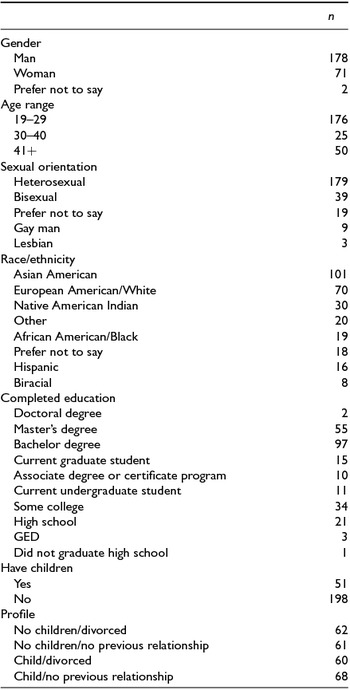
Two hundred and fifty-one participants (178 men, 71 women, and 2 prefer not to say) completed the study. In order to complete the study, participants must have indicated that they were currently single and looking to date. See Table 1 for participant descriptive characteristics.
Participant Descriptive Characteristics (N = 251)

Materials
Participants were asked to state the gender they preferred to date and then to read a brief ‘about the person’ section of an online dating profile of the gender they specified and respond to a series of questions about their perceptions of the person described in the profile. The information varied in the profiles, including parental status of the profile and previous relationship information (changes indicated in italics) such that participants received one randomly generated vignette:
Female parent:
Hi! I'm XXXXXXXXXX. I'm hoping to meet someone who is kind, smart, and interested in a longer-term relationship. I'm a single mother with one child. I haven't dated anyone since long before my child was born {I haven't dated anyone in the past year since my divorce from my child's father}.
Male parent:
Hi! I'm XXXXXXXXXX. I'm hoping to meet someone who is kind, smart, and interested in a longer-term relationship. I'm a single father with one child. I haven't dated anyone since long before my child was born {I haven't dated anyone in the past year since my divorce from my child's mother}.
Female non-parent:
Hi! I'm XXXXXXXXXX. I'm hoping to meet someone who is kind, smart, and interested in a longer-term relationship. I'm a single woman with no children and I haven't dated anyone in a very long time {I haven't dated anyone in the past year since my divorce}.
Male non-parent:
Hi! I'm XXXXXXXXXX. I'm hoping to meet someone who is kind, smart, and interested in a longer-term relationship. I'm a single man with no children and I haven't dated anyone in a very long time {I haven't dated anyone in the past year since my divorce}.
Questionnaires
The questions we used to assess perceptions of dating profiles were derived from previous studies focusing on perceptions of single parents and/or desirable qualities of romantic partners (Bennett & Jamieson, Reference Bennett and Jamieson1999; Brase, Reference Brase2006; Etaugh & Kasley, Reference Etaugh and Kasley1981; Hewitt, Reference Hewitt1958; Simpson & Gangestad, Reference Simpson and Gangestad1992; Sommer et al., Reference Sommer, Plumm, Terrance and Tubré2013). We incorporated items from these questionnaires based on our hypotheses. Reliability indices were calculated for each scale used in analyses as indicated below.
Manipulation check
The manipulation check questions asked participants, after having read the scenario, whether or not the adult in the scenario was male or female and whether or not that person had any children. Participants chose either ‘yes’ or ‘no.’ Those who answered incorrectly received an electronic thank you and were not asked to complete the remainder of the study.
Demographics
The demographic questionnaire asked participants to indicate their age, gender, sexual orientation, race/ethnicity, level of education, and parental status.
Perceptions
This questionnaire contained multiple scales that measured various perceptions of the profile. All scales consisted of Likert-type response choices ranging from 1 (not at all) to 7 (very).
Positive traits
This scale was created by combining positive trait questions derived from the previous studies (Bennett & Jamieson, Reference Bennett and Jamieson1999; Etaugh & Kasley, Reference Etaugh and Kasley1981; Hewitt, Reference Hewitt1958; Simpson & Gangestad, Reference Simpson and Gangestad1992; Sommer et al., Reference Sommer, Plumm, Terrance and Tubré2013). This scale consisted of 24 items with a Cronbach's alpha level of 0.96. This scale included items related to various positive traits about a person, such as: ‘The person in the profile is friendly.’
Positive childrearing
This scale was derived from questions used on the childrearing ability subscale of a measure utilised by Bennett and Jamieson (Reference Bennett and Jamieson1999) focusing on how parents are viewed based on their sex and marital status. This scale consisted of four items with a Cronbach's alpha level of 0.79. This scale included items related to positive parenting, such as: ‘This person has the qualities of a good parent.’
Positive family relationships
This scale was created by combining items from Bennett and Jamieson's (Reference Bennett and Jamieson1999) family lifestyle and family of origin subscales to focus on measuring the overall perception of the individual's current and past family relationships. This scale consisted of three items with a Cronbach's alpha level of 0.80. This scale included items related to positive family relationships, such as: ‘This person had a good relationship with their parents.’
Dating appeal
This scale was created by combining items focusing on dating appeal from studies conducted by Brase (Reference Brase2006) and Sommer et al. (Reference Sommer, Plumm, Terrance and Tubré2013). This scale consisted of three items with a Cronbach's alpha level of 0.83. This scale included items related to interest in dating the person in the profile, such as: ‘How interested are you in dating the individual whose profile you read?’
Future investment
This scale was derived from questions utilised in Brase's (Reference Brase2006) study focusing on cues of parental investment and how that influences attractiveness. This scale consisted of nine items with a Cronbach's alpha level of 0.91. This scale included items related to perceptions of what the person in profile would be like as a romantic partner in the future, such as: ‘This person would invest emotionally in a future spouse.’
Stress
This item was also utilised by Sommer et al. (Reference Sommer, Plumm, Terrance and Tubré2013). Participants responded to one item asking if the person in the profile experiences a lot of stress.
Procedure
All research was completed in accordance with prevailing ethical principles and was approved by the Institutional Review Board. Participants signed up to take part in the study via Amazon Mechanical Turk (MTurk). After agreeing to participate, a link brought them to the survey posted on Qualtrics. Participants first chose the gender of person they would be interested in dating and randomly received one of those gender-specific profiles. They were asked to read the brief vignette carefully and then were asked to respond to manipulation check questions to ensure their eligibility. After correctly answering the manipulation check items, they were asked to complete the perceptions and demographics questionnaires. Upon completion of the study, they received an electronic thank you and were compensated for their time via MTurk.
Results
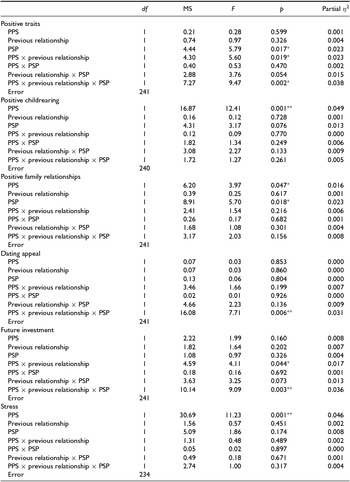
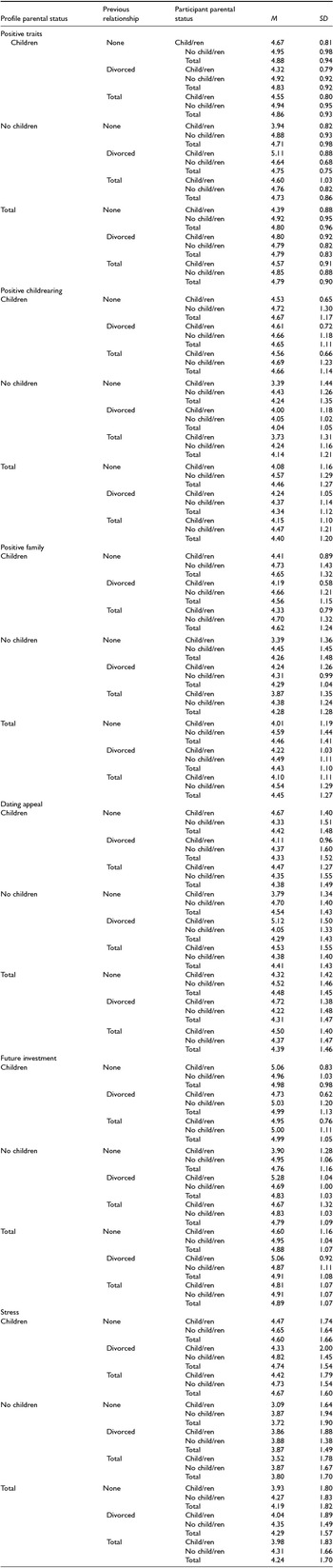
All analyses of variance (ANOVAs) were conducted utilising a 2 (Parental status of the person in the profile: yes vs. no) × 2 (Parental status of the participant: yes vs. no) × 2 (Previous relationship of the person in the profile: divorced vs. no relationship described) factorial design. Follow-up simple effects analyses were conducted when significant interactions were indicated. Any missing data are the result of participants choosing to not answer some questions and are considered missing completely at random. These data are handled as default by SPSS as system missing values and analysed accordingly. Please see Table 2 for all analyses and Table 3 for descriptive statistics.
Analyses of Variance Results

Note: PPS = profile parental status; PSP = parental status of participant.
* = significant at the p < .05 level.
** = significant at the p < .01 level.
Descriptive Statistics for Analyses of Variance Results

Positive Traits
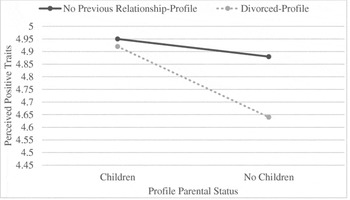
Results indicated a significant main effect for parental status of participant, F(1, 241) = 5.79, p = .017, such that participants with no children rated the profile higher in positive traits than participants who reported being parents. Results also indicated an interaction for parental status of the profile and parental status of the participant, F(1, 241) = 5.60, p = .019. This was qualified by a significant three-way interaction with previous relationship, F(1, 241) = 9.47, p = .002. Simple effects indicated significance for conditions in which the person in the profile had no children, F(1, 241) = 12.79, p < .001. Simple, simple effects indicated significance for conditions in which the person in the profile had no children and no previous relationship, F(1, 119) = 11.76, p = .001, such that participants who did not have children rated the profile describing no children and no previous relationship more positively than participants who had no children and were divorced. See Figure 1.
Perceptions of positive traits for the profiled person among participants without children.

Positive Childrearing
Results indicated a significant main effect for parental status of the profile, F(1, 240) = 12.41, p = .001, such that when the person in the profile had a child they were rated higher in positive childrearing than when the person did not have a child.
Positive Family Relationships
Results indicated a significant main effect for parental status of the profile, F(1, 241) = 3.97, p = .047, such that when the person in the profile had a child they were rated as having higher levels of positive family relationships than when the person did not have a child. Results also indicated a significant main effect for parental status of participant, F(1,241) = 5.70, p = .018, such that participants who reported not having children rated the person in the profile as having higher levels of positive family relationships than participants who do have children.
Dating Appeal
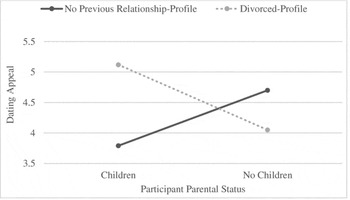
Results indicated a significant three-way interaction for parental status of profile, parental status of participant, and previous relationship status of the person in the profile, F(1,241) = 7.71, p = .006. Simple effects analysis showed significance of parental status of profile with no child only, F(1, 241) = 9.27, p = .003. Simple, simple effects showed significance for previous relationship of divorce only, F(1, 119) = 6.53, p = .012. Participants who have children rated the profile with no child and divorced higher in dating appeal than participants who do not have children. See Figure 2.
Perceptions of dating appeal for the profiled person without children.

Future Investment
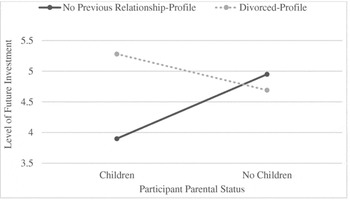
Results indicated a significant interaction for parental status of profile and parental status of participant, F(1, 241) = 4.11, p = .044. This was qualified by a three-way interaction with previous relationship of the person in the profile, F(1, 241) = 9.09, p = .003. Simple effects showed significance for parental status of profile with no child only, F(1, 241) = 11.80, p = .001. Simple, simple effects showed significance for no previous relationship only, F(1, 119) = 8.99, p = .003. Participants who have children rated the profile with no child and no previous relationship lower in future investment than participants who do not have children (see figure 3).
Perceptions of level of future investment for the profiled person without children.

Stress
Results indicated a significant main effect for parental status of profile, F(1, 241) = 11.23, p = 0.001, such that when the person in the profile has a child, he or she is rated as having higher levels of stress than when the person in the profile does not have a child.
Discussion
The current study explored the effects of participant parental status and both parental and previous relationship status on perceptions of a person in a dating profile. Contrary to previous research (Goldscheider & Sassler, Reference Goldscheider and Sassler2006), it appears that single parents do not necessarily seek other single parents as potential dating partners. In fact, the results of our study indicate that single parents perceive single adults with no children in a more positive manner than other single parents. However, single parents do have more positive perceptions of other single parents than participants with no children.
The parental status of a potential dating partner had an effect on perceptions in every area we measured. When the person described in the profile stated he or she did not have any children, he or she was rated higher on positive traits and dating appeal than the profile stating he or she had one child. Individuals described in profiles without children were also rated lower than the profile with one child on childrearing ability, positive family relationships, future investment, and stress. The parental status of the person in the profile interacted in all cases, except for positive childrearing and stress (where the parental status of the profile was the only main effect), with parental status of participants.
Participants who did not have children rated the profile with no children and no previous relationship highest in positive traits. This same trend occurred for ratings of dating appeal. Additionally, participants who did have children perceived the profile of the person stating they had one child higher in family relationships and future investment than participants who did not have children. Results indicated that participants with no children rated dating profiles more positively than participants with children. This finding is supported by previous studies that have indicated that single parents tend to be more critical of potential dating partners (Gibson-Davis, Edin, & McLanahan, Reference Gibson-Davis, Edin and McLanahan2005). Simply stating that one is a parent seems to increase perceptions of parenting ability, especially among potential partners who do not have children. Our results indicate that perceptions of childrearing ability, as well as family relationships, were significantly more positive for single adults with children than for single adults with no children. Additionally, participants with no children rated the profile with children more positively in family relationships than participants who had children. Taken together, our results suggest that single parents who are seeking to repartner may want to include their parental status as a highlighted feature in an online dating profile.
Despite the data indicating that repartnering potential is rated more highly when a dating profile indicates that when the person is a parent, perceptions of dating appeal show a different pattern. Results of this study indicated that single parents’ perceived dating appeal was significantly higher in the profile of someone divorced than a profile of someone with no previous relationship described. It is quite likely that single parents looking to date (rather than repartner) are interested in someone who is more likely to understand the dynamics of family and perhaps more likely to be flexible and understanding about demands on their time that detract from the spontaneity and time afforded to dating (Sommer et al., Reference Sommer, Plumm, Terrance and Tubré2013; Weinraub & Wolf, Reference Weinraub and &Wolf1983). Alternatively, single parents may view dating as a step to repartnering whereas single adults without children may not. In fact, our results indicate the same pattern for perceptions of future investment such that when the dating profile indicated that the person did not have children, single parents rated future investment significantly higher for the profile that indicated divorce than for the profile that indicated no previous relationship. Additionally, the profile of the single parent was perceived as having significantly higher levels of stress than that of the single adult with no children.
The previous relationship of the person in the profile had an effect on perceptions of positive traits, dating appeal, and future investment as it interacted with other independent variables. Generally, divorce was perceived negatively by participants who had no children — especially when the person in the profile also had no children. More specifically, we found that participants with no children rated the profile with no children and no previous relationship described more positively than the profile of someone divorced with no children. This finding is also supported by previous research indicating a mix of perceptions related to divorced individuals as potential dating partners (Hitsch et al., Reference Hitsch, Hortaçsu and Ariely2010). Specifically, divorced individuals are often viewed in a positive light, especially if they have children, for having had experience and commitment with another person. Alternatively, they are viewed negatively when divorced with no children, presumably because they either made a mistake or could not be successful in creating a family with a former spouse.
The view potential dating partners may have of information in a dating profile may be coloured by their intent. If one intends to find a long-term partner, then information that may enhance their potential partner's relationship and parenting skills (e.g., previous relationship and parental status) may be viewed positively. Alternatively, if the intent is to date, this information may be viewed negatively. Taken together, our findings suggest that being divorced with no children is viewed more positively by single parents than single adults who are not parents, whereas single adults with no children view other single adults with no children and no previous relationship most positively in an online dating profile. However, both groups (parents and non-parents) preferred partners who did not have children. This finding is especially important in light of the many efforts paid to connecting single parents with other single parents (Casey, Reference Casey2014; Coppa, Reference Coppa2011). Although we recognise that this study is merely a first step in understanding how perceptions of dateability may be perceived when a potential partner is a parent, we believe it to be an important first step that allows further exploration of the details.
Future research in this area should consider additional aspects involved in the lives (and specifically, the dating lives) of single parents. For example, do the ages and number of children have an impact on perceptions of partners? If dating profiles are tailored to include or not include information, how might this perceived when information is disclosed at a later time? Future research in this area should also address the intent of the participant in looking at dating profiles (e.g., Are they looking to repartner? Are they looking for dating without commitment?). Additional research in this area should also consider the differences in perceptions for single mothers and single fathers. Given the stereotypical expectations of mothers versus fathers as single parents (Valiquette-Tessier, Vandette, & Lussier, Reference Valiquette-Tessier, Vandette and Lussier2016), the perceptions related to previous relationship and parental status may vary greatly.
As is the case with all studies, there are limitations. Although we did ask only for participants who were looking to date, we provided them only with a short description of someone on which to base their judgments. Among this short description, there was mention of a child, but no additional information about the child was provided (e.g., gender, age). This information might also alter the interest one may have in a potential dating partner and should be considered in future research. Realistically, one would likely have more information and the opportunity to contact someone to gather more information if he or she was interested. Therefore, our ecological validity was compromised. However, we chose to make this compromise for the control we would have over the experimental variables included in the study. This allowed us to make direct comparisons across groups and to specifically target the relevant variables.
These ecological limitations notwithstanding, it is important to understand the various perceptions others may have in order to help determine the obstacles they may create. Whereas online dating might be preferred by single parents for many reasons (Finkel et al., Reference Finkel, Eastwick, Karney, Reis and Sprecher2012; Ramirez & Zhang, Reference Ramirez and Zhang2007), it may also create barriers to choosing a potential dating partner. If single parents are more likely to perceive a divorced adult with no children most positively, perhaps they are choosing not to engage in a conversation with someone who has not been married. Understanding the perceptions of profiles in dating can help to tailor education to the kinds of questions and inquiries that might be helpful to various folks utilising online dating profiles. Additionally, many of the dating sites we looked at assume that a single parent would prefer to date another single parent. If these sites are ‘matching’ single parents with other single parents and this is not something they are interested in, they will be less satisfied with their online dating experiences.