The dramatically improved long-term survival rates of children born with congenital heart disease has resulted in a new and growing population of adults with repaired tetralogy of Fallot and transposition of the great arteries.Reference Warnes 1 , Reference Brickner, Hillis and Lange 2 This has raised interest in the quality of life of these patients.
Adults with tetralogy of Fallot or transposition of the great arteries differ from the general population by medical status and medical history, and have specific psychosocial needs and problems.Reference Kovacs, Sears and Saidi 3 It has been shown that young adults with congenital heart disease obtained a lower educational and occupational level compared with normative reference groups.Reference van Rijen, Utens and Roos-Hesselink 4 Furthermore, with regard to subjective health status, patients experienced more limitations in physical functioning.Reference van Rijen, Utens and Roos-Hesselink 5
Since 1980, many aspects of diagnostic, surgical, and medical treatment of congenital heart disease have improved, supposedly resulting in less physiological stress on the patient. Our hypothesis is that improvements in cardiological outcome may also specifically result in a more favourable long-term psychosocial outcome. To the best of our knowledge, this study is the first to test this hypothesis using two cross-sectional samples of all adult patients with tetralogy of Fallot or transposition of the great arteries – matched for age and cardiac diagnosis – comparing results over a 10-year period.
The objective of this study was threefold: (1) to investigate the psychosocial outcome of adults operated recently (between 1980 and 1990) for tetralogy of Fallot or transposition of the great arteries; (2) to compare those outcomes with a matched historical cohort, operated between 1968 and 1980; and (3) to make a comparison within the recent transposition of the great arteries group between patients operated with the Mustard procedure and those operated with the arterial switch procedure.
Materials and methods
Study design
In this cross-sectional single-centre study, psychosocial outcome of a recent versus a historical patient sample was compared using a comparable age range, that is, 20–37, and comparable cardiac diagnostic groups: transposition of the great arteries and tetralogy of Fallot.
Assessment procedure
For both the recent and historical samples, the institutional ethics committee on human experimentation approved the research protocol. In both studies, patients were approached uniformly and signed informed consent was obtained before participating. All patients were medically examined by a cardiologist in our centre. The semi-structured interview and psychological questionnaires were completed in our hospital. In both samples, data collection took place in the same standardised way.
Recent patient sample
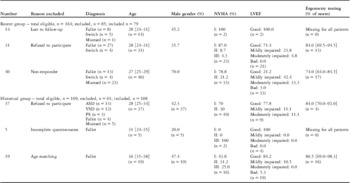
Out of 164 eligible patients, 14 patients were lost to follow-up and 40 did not respond to multiple invitations. Of the remaining 110 patients, 31 refused to participate, resulting in a total of 79 participating patients.
The recent sample (n = 79) consisted of all consecutive surviving patients with either tetralogy of Fallot (n = 48) or transposition of the great arteries (n = 31), who underwent their first open heart surgery in our centre between 1980 and 1990, and were younger than 15 years at the time of surgery. At the time of follow-up in 2010, all patients were between 20 and 35 years of age. Of the 31 patients with transposition of the great arteries, 18 patients underwent arterial switch surgery (58%) and 13 patients underwent a Mustard or Senning procedure (42%). All patients with tetralogy of Fallot had a complete correction, and in 76% a right ventricular outflow tract patch was inserted. The median follow-up time of this group was 24.2 years [22.7–26.5].
Patients who were not able to understand the questionnaires or were unable to read or write Dutch were excluded.
Historical comparison
Historical patient selection
The 132 congenital heart disease patients who have been included in the historical patients’ sample have been described in detail previously.Reference van Rijen, Utens and Roos-Hesselink 4 These patients were all operated for congenital heart disease between 1968 and 1980 in our centre, and were evaluated medically and psychosocially in 2000/2001. Out of this population, we excluded a total of 21 patients who did not fill in the questionnaires we needed for the historical comparison, and three patients were excluded because of severe mental retardation, resulting in 108 eligible patients. For both the recent and historical group, the same inclusion and exclusion criteria were maintained.
Matching procedure
Table 1 shows the characteristics of the patients who were included and excluded, for both the recent and the historical patient sample. For both samples, the same inclusion and exclusion criteria were maintained. The mean age of the 108 eligible patients in the historical sample was significantly higher than the selection of patients participating in the recent study. The mean age of the historical transposition of the great arteries group did not differ from the mean age in the recent group (26.0 ± 3.9 versus 26.7 ± 1.6, p = 0.33), and also the number of men and women was the same between the historical and the recent group (29.1% versus 30.8%, p = 0.9). However, patients from the historical tetralogy of Fallot group were significantly older than patients from the recent tetralogy of Fallot group. We therefore removed 19 patients with the highest ages until age was not significantly different anymore (27.6 ± 3.8 versus 26.3 ± 3.4, p = 0.07); gender was the same between the historical and recent group (37.7% versus 34.1%, p = 0.71).
Overview of the included and excluded patients in the recent and historical sample.

ASD = atrial septal defect; LVEF = left ventricular ejection fraction; PS = pulmonary stenosis; VSD = ventricular septal defect; Fallot = tetralogy of Fallot; Switch = patients with arterial switch (subgroup of transposition of the great arteries); Mustard = patients with Mustard correction (subgroup of transposition of the great arteries); NYHA = New York Heart Association
Overall group details of the historical sample have been described in detail previously
Ergometry testing is presented in percentages of predicted, corrected by age, gender, and body height
Thus, 108 patients were included (tetralogy of Fallot, n = 53; transposition of the great arteries, n = 55).
Instruments and normative data
The psychological examination consisted of the following instruments:
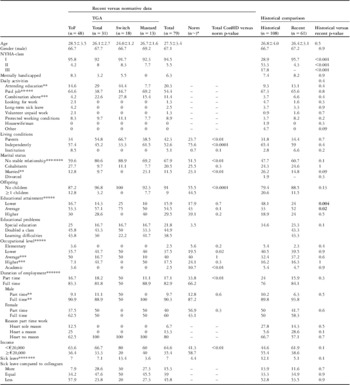
Biographical characteristics, such as nationality, living conditions, marital status, offspring, educational, and occupational status were assessed by a semi-structured interview.Reference Utens, van Rijen and Erdman 6 For the biographical characteristics and social functioning, recent normative data were derived from the Netherlands Central Bureau of Statistics and, wherever possible, were specified by age and sex. 7 These recent reference data were derived from a variety of normative samples. Owing to the fact that these concerned very large samples, the representativeness for the average Dutch situation was warranted. Sample sizes of these multiple and very large reference groups were not indicated in Table 2 to prevent confusion.
Medical and biographical characteristics of the recent and historical sample compared with normative groups (in percentages).

Fallot = patients with tetralogy of Fallot; TGA = patients with transposition of the Great arteries; Switch = patients with arterial switch (subgroup of TGA); ConHD = patients with Congenital heart disease; Mustard = patients with Mustard correction (subgroup of TGA); Part-time is working <36 hours a week; Full time is working ≥36 hours a week
Group size for normative data group varies per variable and is therefore not displayed in the table (n∼)
*Normative data were derived from the Netherlands Bureau of Statistics 2010. Normative data on daily activities were not available and are therefore not displayed in the table
**Significant difference Switch versus Mustard
***Significant difference in ToF versus TGA
****All patients who do not live together with a partner
*****Persons living in institutions for mentally handicapped are excluded
******Only persons who have a paid job and are between 25 and 35 years of age are included
*******Sick leave percentage was used instead of number of days on sick leave, as the number of hours a person works a week (full time/part time) might vary considerably. p-Values could not be calculated as data on standard deviations or ranges were missing for the normative groups. p-Values for the historical comparison were calculated using Mann–Whitney U-tests because of the skewed nature of the data
Subjective health status was assessed by the Short Form-36.Reference Ware and Sherbourne 8 Good reliability and validity for the Dutch Short Form-36 has been reported.Reference Aaronson, Muller and Cohen 9 Normative data were derived from a nationwide, population-based Dutch health status survey.Reference Aaronson, Muller and Cohen 9
The Satisfaction with Life Scale has been proven to be psychometrically sound to be used in patients with congenital heart disease.Reference Moons, Van Deyk and De Bleser 10 Normative data were derived from a large general population sample.Reference Moons, Van Deyk and De Bleser 10
The linear analogue scale was used to assess self-perceived quality of life. This instrument has been proven valid, reliable, and responsive for the congenital heart disease population.Reference Moons, Van Deyk and De Bleser 10 Normative data were derived from a large general population sample.Reference Moons, Van Deyk and De Bleser 10
Statistical analyses
In order to make the comparison between the historical and the recent sample, both data sets of the recent and historical patient samples were categorised according to the age and gender categories of normative groups. For categorical characteristics, proportions of patients are presented in percentages.
p-Values were calculated on the basis of 95% confidence intervals. Owing to the skewed nature of the data, Mann–Whitney U-tests were used to assess the difference in outcome (Short Form-36, Satisfaction with Life Scale and linear analogue scale) between diagnostic groups within the recent patient sample. Pearson's χ 2-tests were used to test for differences in distributions of gender and cardiac diagnoses between both patient samples. If cell values were <5, the Fisher exact test was used. In order to correct for multiple comparisons, only the differences in biographical characteristics with a level of significance <0.02 were considered significant. The statistical package IBM SPSS Statistics for Mac version 19.0 (release 19.0.0) was used. Figures were made using GraphPad Prism version 6.0a for Mac, GraphPad Software (released 18 July 2012, La Jolla, California, United States of America).
Results
Recent sample versus normative data
Biographical characteristics (Table 2, Figs 1 and 2)
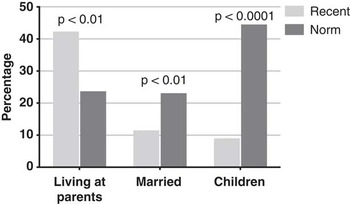
Patients with tetralogy of Fallot or transposition of the great arteries were living less often independently (p < 0.0001) and were less often married or had a stable relationship compared with the normative data (p < 0.01). Patients with tetralogy of Fallot or transposition of the great arteries were less likely to have children compared with normative data, stratified by age and gender categories (p < 0.0001) (Fig 1).
Biographical data show the comparison on three different biographical variables between the recently operated patients with congenital heart disease (shown in black) and a normative group (shown in grey). Living with parents = proportion of people still living with their parents, mother/father or both. Married = the proportion of people who are married. Children = the proportion of people who have one or more children. p-values were calculated by chi-square tests.

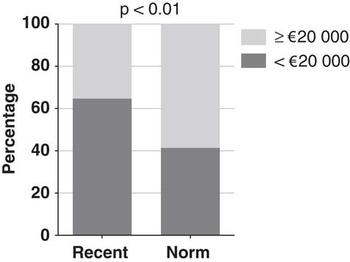
Comparison on income between the recently operated congenital heart disease group and the normative group, matched on age and gender. Shown in black is the proportion of the group that earns <€20,000, shown in grey is the proportion of the group that earns ≥€20,000.

Patients with tetralogy of Fallot or transposition of the great arteries obtained a similar educational level compared with normative data, except for women aged 25–35 years, who less often had higher education (p < 0.05, not listed in the table). With regard to occupation, recent patients less often had an academic occupational level (p < 0.01), and more often had a lower occupational level (p = 0.02) compared with normative data.
Considering employment, remarkably, patients with tetralogy of Fallot or transposition of the great arteries who had a paid job were less frequently working part time (p < 0.01) and more often working full time compared with normative data. There was no effect of gender with regard to working part time versus full time. The tetralogy of Fallot or transposition of the great arteries diagnosis did not appear to be the reason for working part time in the majority of patients (80%). Regarding income, patients with tetralogy of Fallot or transposition of the great arteries earned significantly less compared with the general Dutch population (p < 0.01) (Fig 2). Finally, patients with tetralogy of Fallot or transposition of the great arteries showed a significantly higher percentage of sick leave compared with the general Dutch population (7% versus 4.4%). This effect was mainly found in arterial switch patients.
Quality of life (Table 3)
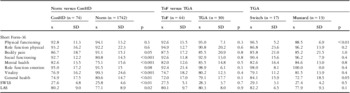
Subjective health status: Compared with normative data, the recent patient sample obtained less favourable results on bodily pain, vitality, and general health scales. Patients with tetralogy of Fallot or transposition of the great arteries more often experienced bodily pain (p = 0.05), and with regard to vitality reported to feel more worn out and tired (p < 0.0001). Patients scored their general health as significantly lower and believed it was likely to get worse over time (p < 0.01). In addition, the recent sample obtained more favourable scores (p < 0.0001) on social functioning, indicating less interference from physical or emotional problems in attending social activities. Recent patients reported a better general mental health compared with normative data (p < 0.0001).
Mean scale scores of the recent sample and normative data on instruments.

ConHD = all ConHD patients (ToF and TGA combined). Norm = normative data for the general Dutch population corrected for age and sex where possible; ToF = patients with tetralogy of Fallot; TGA = patients with Transposition of the Great Arteries, including patients operated with the arterial switch procedure and patients operated with the Mustard procedure; Switch = patients with arterial switch operation; Mustard = patients operated with the Mustard procedure
The Short Form-36 scales range from 0 to 100. Lower scores indicate poorer subjective health status; higher scores indicate a more favourable subjective health status
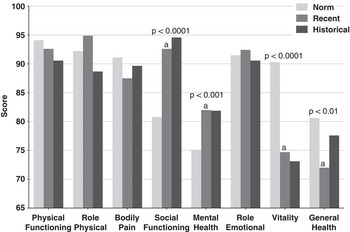
Compared with normative data (Fig 3), the recent tetralogy of Fallot group obtained more favourable scores on social functioning (p < 0.0001) and mental health (p < 0.001). Less favourable scores for the recent tetralogy of Fallot group were obtained on the vitality scale (p < 0.0001) and general health scale (p < 0.01).
Comparison between normative data, recently operated tetralogy of Fallot patients, and historically operated tetralogy of Fallot patients; shows the comparison on the Short Form-36 scale for the recent patients with tetralogy of Fallot (shown in black) and the historical patients with tetralogy of Fallot (shown in light grey) and a normative group (shown in dark grey). The Short Form-36 scales range from 0 to 100. Lower scores indicate poorer subjective health status; higher scores indicate a more favourable subjective health status. a = significant difference between the normative group and the recently operated congenital heart disease group.

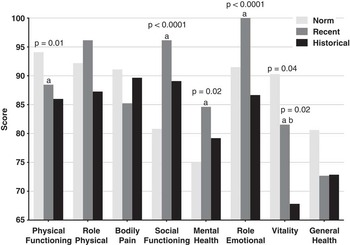
The recent Mustard group obtained more favourable scores compared with normative data, on social functioning (p < 0.0001), mental health (p = 0.02), role emotional (p < 0.0001), and less favourable on physical functioning (p = 0.01) and vitality (p = 0.04) (Fig 4).
Comparison between normative data, recently operated patients operated with the Mustard procedure, and patients historically operated with the Mustard procedure; shows the comparison on the Short Form-36 scale for the recent patients operated with the Mustard procedure (shown in black) and the historical patients operated with the Mustard procedure (shown in light grey) and a normative group (shown in dark grey). The Short Form-36 scales range from 0 to 100. Lower scores indicate poorer subjective health status; higher scores indicate a more favourable subjective health status. aSignificant difference between the normative group and the recently operated congenital heart disease group. bSignificant difference between the recently operated congenital heart disease group and the historically operated congenital heart disease group.

Within the recent sample, no differences were found between patients with tetralogy of Fallot and patients with transposition of the great arteries. When comparing Mustard and arterial switch procedures within the recent sample, two differences were found: patients operated with the arterial switch procedure reported better physical functioning compared with patients operated with the Mustard procedure (p < 0.01). This indicates that patients with an arterial switch feel less limited in performing physical activities compared with patients operated with the Mustard procedure. Patients operated with the arterial switch procedure reported better general health compared with patients operated with the Mustard procedure (p = 0.05).
On the Satisfaction with Life Scale, the recent patients showed more favourable scores compared with normative data (p < 0.01). No difference was found for patients with tetralogy of Fallot versus patients with transposition of the great arteries, nor for the patients operated with the arterial switch versus the Mustard procedure – in-between transposition of the great arteries.
On the linear analogue scale, the recent sample rated their quality of life significantly higher compared with normative data (p = 0.02). No difference was found for patients with tetralogy of Fallot versus patients with transposition of the great arteries or patients with arterial switch versus patients operated with the Mustard procedure.
Recent sample versus historical sample
Medical background
A trend was visible for the age at first treatment between the recent and historical sample (recent: median = 0.8 [0.5–1.9] years. Historical: median = 1.4 [0.6–4.1] years, p = 0.07). The difference in age at treatment was also observed in recent patients with tetralogy of Fallot versus historical patients with tetralogy of Fallot (median = 1.3 [0.6–3.1], respectively 2.8 [1.2–4.7], p = 0.008), and a trend for recent patients operated with the Mustard procedure versus historical patients operated with the Mustard procedure (median = 0.5 [0.2–0.7], respectively 0.7 [0.4–2.3], p = 0.08). No significant difference was found on the number of surgeries using a right ventricular outflow tract patch between the recent sample (76%) and the historical sample (77%) (p = 0.9).
Biographical characteristics (Table 2)
A trend was observed showing that the recent patients less often had a relationship (p = 0.1) and were married less often (p = 0.09) compared with the historical sample. Recent patients obtained a significantly higher educational level compared with the historical sample. Both recent and historical samples showed a comparably high amount of special education: 35% for the historical group and 23% for the recent group (p = 0.1).
Quality of life (Figs 3 and 4)
Diagnostic groups
Figure 3 shows no differences between recent and historical patients with tetralogy of Fallot on any of the Short Form-36 scales. Figure 4 shows that recent patients operated with the Mustard procedure obtained more favourable scores on the vitality scale of the Short Form-36 compared with historical patients operated with the Mustard procedure (p = 0.02). The other non-significant differences, except for general health, all pointed in the same direction of a better outcome for recently operated patients with transposition of the great arteries.
Discussion
Although the recent sample of patients with tetralogy of Fallot or transposition of the great arteries overall shows a favourable quality of life, impairments were found in living conditions, relationships, offspring, and occupational level; in addition, the income of patients with tetralogy of Fallot or transposition of the great arteries is still lower than expected. Compared with the historical sample, the recent sample showed no significant improvements on psychosocial outcome, except for a better educational level.
To our knowledge, this is the first published psychosocial study making a historical comparison on long-term psychosocial outcome between a recent and historical sample of adult patients with tetralogy of Fallot or transposition of the great arteries. To ensure that both samples were comparable, patients with the same diagnoses and same age range were selected. Clinically relevant areas of psychosocial functioning were investigated, using internationally standardised assessment instruments.
Recent sample versus normative data
Biographical outcome
Although a few older studies showed similar patterns on living less independently and lower offspring rates, our recent findings still show an impressive impact on living conditions in our complex ConHD population.Reference Kokkonen and Paavilainen 11 – Reference Moons, Van Deyk, Marquet, De Bleser, De Geest and Budts 16 The relatively young age of this patient sample cannot be the sole reason for these findings, as the same categories for age and sex were used in comparing our patient data with normative data. The low rate of offspring might be explained by the high number of patients working full time, but it can also be the other way around, that patients less often have children and thus keep on working full time. The recent sample obtained a lower occupational level and was earning a significantly lower income compared with the general Dutch population. Our present findings on living conditions, marital status, and occupational level all point in the same direction of being less independent and having a lower socio-economic status for patients with tetralogy of Fallot or transposition of the great arteries. A delayed process of gaining autonomy and striving for independence might explain the differences in biographical outcome and occupational level.Reference Kovacs, Sears and Saidi 3 , Reference Kokkonen and Paavilainen 11 , Reference Utens, Verhulst and Erdman 17 , Reference Simko, McGinnis and Schembri 18 Furthermore, overprotectiveness from parents may play a role in the delayed process of gaining autonomy.Reference Ong, Nolan, Irvine and Kovacs 19 This research supports previous research from Kovacs et al, Kokkonen and Pavliaanen et al, van Rijen et al, and Zomer et al.Reference Kovacs, Sears and Saidi 3 , Reference van Rijen, Utens and Roos-Hesselink 4 , Reference Kokkonen and Paavilainen 11 , Reference Zomer, Vaartjes and Uiterwaal 20 The way in which the physician informs the parents may play a role in overprotectiveness as well.
The recent patients reported a higher amount of sick leave compared with the general Dutch population. Surprisingly, when asked about sick leave, the majority of patients with tetralogy of Fallot or transposition of the great arteries reported to be sick less often compared with their colleagues. These findings point towards a gap between objective and subjective sick leave. Van Rijen explained a similar phenomenon by “denial”, social desirability, or overcompensation by the patients with congenital heart disease.Reference van Rijen, Utens and Roos-Hesselink 4
Recent patients still experience more education-related problems compared with normative groups. The percentage of patients requiring special education in the recent sample was 24%, which is almost seven times as high as that in normative data (3.5%). In addition, 45% of our patients reported having repeated a class and 39% experienced learning difficulties. Although normative data on these two categories were not available, we assume that this is higher than in the general population.Reference Wernovsky 21 , Reference Miatton, De Wolf, François, Thiery and Vingerhoets 22 Possible explanations for these findings are the underlying cardiac diagnoses with frequent periods of cyanosis, cardiac surgery, and school absences due to hospitalisations. These unfavourable findings may be explained neuropsychological impairments in patients with surgically corrected congenital heart disease, which have been reported in reviews.Reference Wernovsky 21 , Reference Miatton, De Wolf, François, Thiery and Vingerhoets 22 Besides pre-operative factors (genetics, structured brain injury, severity of disease), preoperative (e.g. deep hypothermic circulatory arrest, pH management during cooling, hemodulation) and postoperative factors (e.g. number of operations, clinical and EEG seizures), and also school absenteeism may contribute to learning problems. Genetic patterns, such as the 22q11 deletion, can play a role in impaired neuropsychological findings; however, the amount of mental retardation between the recent and historical group did not differ, and thus we do not think this has played a major role.Reference Wernovsky 21 , Reference Miatton, De Wolf, François, Thiery and Vingerhoets 22
Quality of life
Our recent sample reported a quality of life that was comparable or even better than that of normative groups on three different instruments – Short Form-36, Satisfaction with Life Scale, and the linear analogue scale. Our results are in line with previous studies, in which a good quality of life for patients with tetralogy of Fallot and patients operated with the Mustard procedure has been reported.Reference Moons, Van Deyk and De Bleser 10 , Reference Moons, De Bleser and Budts 14 , Reference Daliento, Mapelli and Russo 23 – Reference Bygstad, Pedersen, Pedersen and Hjortdal 25
On the Short Form-36 social functioning scale, recent patients obtained a more favourable outcome compared with normative data. Previous studies have shown that a favourable social functioning has a protective role against a low quality of life.Reference Moons, Gewillig and Sluysmans 26 , Reference Kovacs, Saidi and Kuhl 27 The favourable self-reported social functioning on the Short Form-36 scale could therefore be protecting our patients from a low quality of life.
Recent sample versus historical sample
Biographical outcome
The educational level of the recent sample was significantly better than that of the historical sample. This might be explained by improved social acceptance of tetralogy of Fallot and transposition of the great arteries over time, stimulating patients to get the same educational levels compared with normative data. Despite this improvement, the need for special education was comparable in both samples and high compared with the general population.
The historical sample showed a higher amount of sick leave compared with normative data. This finding was also seen in the recent sample.
Quality of life
Recent patients with tetralogy of Fallot obtained comparable scores on all Short Form-36 scales compared with historical patients with tetralogy of Fallot.
The only significant difference found between the recent and historical patients operated with the Mustard procedure was the improved Short Form-36 vitality score for current patients. Although not significant, improvements were found on role limitations because of physical and emotional health, bodily pain, social functioning, and mental health. These findings all pointed towards a better psychological functioning for patients operated with the Mustard procedure over time.
Role of Mustard versus arterial switch surgical procedures
Our data showed comparable psychosocial functioning for patients operated with the Mustard procedure versus the arterial switch patients. Within the present sample, arterial switch patients scored more favourable results on two Short Form-36 scales, namely, physical functioning and general health. These findings are in line with Görler et al,Reference Görler, Ono and Thies 28 who found no significant difference between Mustard and arterial switch patients, but did describe a tendency towards a better result of the arterial repair group in general health perceptions and role limitations due to emotional problems. Loup et alReference Loup, von Weissenfluh, Gahl, Schwerzmann, Carrel and Kadner 29 found that patients operated with the Mustard or Senning procedure showed significantly lower scores on vitality and the psychological functioning Short Form-36 scales. These findings indicate that arterial switch patients feel less limited in performing physical activities and evaluate their personal health as being better compared with patients operated with the Mustard procedure. Despite these improvements, the overall quality of life was not affected as reported on the Satisfaction with Life Scale and the linear analogue scale.
Clinical implications
The more dependent lifestyle and high amount of special education are prominent in patients with tetralogy of Fallot or transposition of the great arteries. Patients still score less favourably on vitality and general health compared with normative data. Considering the problems in the domain of education and occupation of the recent complex ConHD group, we recommend, in line with the 2008 Guidelines for the Management of Adults with Congenital Heart Disease, timely neuropsychological screening during childhood.Reference Loup, von Weissenfluh, Gahl, Schwerzmann, Carrel and Kadner 29 – Reference Marino, Lipkin and Newburger 31 Remedial teaching in case of learning problems can be offered to prevent delay in education and – by consequence – occupational status, and to optimise psychosocial outcome in these areas for our patients. In case of emotional or behavioural problems, we recommend psychological counselling, preferably by a psychologist with expertise in this specific field.
When looking at the historical picture, some improvements over time can be seen, especially for patients operated with the Mustard procedure on the quality of life instruments.
Limitations
The patients included in this study either had tetralogy of Fallot or transposition of the great arteries, and all these patients were followed up in a tertiary academic medical centre. The obtained results therefore may not be representative for all patients with congenital heart disease.
Future research
Future research should aim to investigate the relationship between a lower occupational level and a lower income in patients with tetralogy of Fallot or transposition of the great arteries, and what interventions can be implemented to decrease these impairments in socio-economic status. In addition, the low offspring rate and low independence should be studied further. Furthermore, the relationship between psychological characteristics and quality of life should be investigated in more depth. A large cohort is advisable to avoid underpowered conclusions.
Conclusion
This article presents a comparison between psychosocial problems encountered in patients with tetralogy of Fallot or transposition of the great arteries, operated between 1980 and 1990, and those of patients with tetralogy of Fallot or transposition of the great arteries operated between 1968 and 1980.
Despite evident improvements in treatment, hardly any changes were found in psychosocial outcome. The recent patients showed a favourable quality of life, despite several psychosocial impairments with regard to relationships, offspring, lower occupational level and lower income
Acknowledgement
The authors gratefully thank the participating patients for their contribution to this study.
Funding
No funding received.
Conflicts of Interest
None.
Data sharing statement
No additional data.
Author contributions
All authors have made significant contributions to the design, execution, analysis, and writing of this study and will share responsibility for published material. All the authors have seen and approved of the manuscript and consent to their names on the manuscript. The manuscript contains original work that has not been previously published and will not be published elsewhere.