Introduction
Everyone but an idiot knows that the lower classes must be kept poor or they will never be industrious. (Young, 1771)
The aim of this article is to explore the opportunities for economic improvement available to the lower classes in a rural European Ancien Régime society through the analysis of nearly one thousand agricultural workers’ postmortem inventories.Footnote 1 Our approach seeks to connect the long tradition of studies on poverty and lower classes’ living standards with the more recent debate regarding the industrious revolution. On presenting this concept, Jan de Vries posited that a greater intensification of work was compatible with increased consumption, contrary to the dominant thinking in the social sciences from the eighteenth century onwards, reflected in the above quote by Young. Thus, for de Vries, in seventeenth- and eighteenth-century north-western Europe and British North America, ‘a growing number of households acted to reallocate their productive resources (which are chiefly the time of their members) in ways that increased both the supply of market-oriented, money-earning activities and the demand for goods offered in the marketplace’ (de Vries, Reference de Vries2008: 10). Defending this idea requires demonstrating that new consumption patterns reached the working population. This point has always proved controversial, even for north-western Europe, where de Vries situated the industrious revolution, and is even more so when referring to the rural world.Footnote 2
Another problematic aspect of the debate regarding the industrious revolution is the lack of dialogue between historiographies (Clunas, Reference Clunas1999; Béaur, Reference Béaur2017), highlighted by the arguments in favour of excluding the Mediterranean area, which we shall discuss through the example of Catalonia. Leaving aside the issue of family structures, which we shall not address here,Footnote 3 it is surprising that de Vries ignores something that the historiography referring to southern Europe highlighted some time ago: that specialisation – and therefore the growing link with the market – is one of the most striking features of agricultural growth in the Mediterranean area (Vilar, Reference Vilar1964–8: III, 185). In the case of vines, one of the main commercial crops in the region, Labrousse emphasised how it transformed the family economy of growers and tightened their links with the market. For this French historian, the vine grower lived in an exchange economy and variations in prices determined the variations in his income (Labrousse, Reference Labrousse1944: LII). Eighteenth-century Catalonia is a good example of the power of specialisation processes in this regard. The expansion of wine growing linked to foreign trade led to other specialisations – in agriculture, forestry, industry – and was one of the keys to economic growth in the eighteenth century (Vilar, Reference Vilar1964–8; Torras, Reference Torras1984; Valls, Reference Valls2004).
In relation to the increase in consumption, the main argument put forward by de Vries, aside from the apparent low consumption of colonial products, which we will discuss later, is the trend in real wages, which has been taken to be proof of economic stagnation in Mediterranean Europe (de Vries, Reference de Vries2008: 83; Allen, Reference Allen2001). However, the isolated urban series on which de Vries based his arguments can hardly be deemed to be representative of southern Europe as a whole. In the case of Catalonia, the series of wages in Barcelona are closer to those of the Netherlands than the southern ones presented by de Vries (Vilar, Reference Vilar1964–8: II; Llopis & García Montero, Reference Llopis and García Montero2011). Furthermore, it is far from clear whether wages are the best indicator with which to study the income levels of a rural population largely comprised of individuals who, although wage-earners, often also cultivated plots of land.
De Vries himself acknowledged that little is known about the changes in consumption in Mediterranean Europe. However, in the case of Catalonia, it is quite clear today that the wave of changes in consumption patterns that took place in north-western Europe reached the more prosperous groups of society, as well as the urban middle classes and wide groups of artisans (Lencina, Reference Lencina2001; Moreno, Reference Moreno2007: 219–46; Torra, Reference Torra1999; Marfany, Reference Marfany2012: 146–78). Although some research suggests that changes in the poorer levels of rural society were only modest, this evidence is limited to just a few areas of Catalonia (Moreno, Reference Moreno2007; Marfany, Reference Marfany2012: 171–8).Footnote 4
Our study will verify whether there were signs of improvement in the material standards of living, work intensification and increasing links with the market among such a social group – the treballadors of the Girona region. In order to examine this issue, we have analysed the inventories of 933 male treballadors over five time periods (1725–34, 1745–54, 1765–74, 1785–94 and 1800–07). These documents provide detailed information regarding the ownership of real estate and goods (in 920 and 900 of the 933 documents, respectively). Unlike other Catalan areas, where documentary evidence does not differentiate between social groups of the agricultural population, notary sources in the Girona region facilitate the analysis of the poorest ranks of rural society, distinguishing between ‘treballadors’ and ‘pagesos’. These latter were the owners or sharecroppers of masos, the name given to self-sufficient farms. The label ‘treballador’ literally means ‘worker’, but at the time it specifically referred to pure wage earners and smallholders who sometimes worked for a daily wage.
Exploring this social group’s opportunities for economic improvement might seem pointless in the context of the eighteenth century. The increase in the number of treballadors, in both relative and absolute terms, in a general context of demographic growth, could a priori be interpreted as a process of proletarianisation. Even though rural wages behaved better than urban ones in late eighteenth-century Catalonia (Vilar, Reference Vilar1964–8: III, 615–24), the rise in prices in the second half of the century suggests that there was a general fall in real wages. Neither is it clear that changes in the relative prices improved the treballadors’ purchasing power. In the second half of that century, the price of cereals, which many treballadors had to purchase, rose faster than the price of wine, their largest source of income. This may well have reduced their ability to buy manufactured goods, despite slower growth in textile prices.Footnote 5
The above being said, there are some signs that point in the opposite direction, however. Treballadors’ dowries, which are a good indicator of their wealth levels, stayed constant in real terms throughout the second half of the eighteenth century, whereas they fell for the population as a whole. Further evidence of this is the appearance of a new social label at the end of the century, that of menestral, for enriched treballadors (Congost, Ros and Saguer, Reference Congost, Ros and Saguer2016; Congost and Ros, Reference Congost and Ros2013). The analysis of the postmortem inventories presented in this article suggest some of the ways through which some treballadors might have improved their living standards: the spread of intensive crops; the participation of treballadors in agricultural specialisation processes; and, especially, the opportunity to access land through emphyteusis, a form of land tenure that conferred permanent rights on the cultivator.
Access to land, an element that de Vries does not take into consideration, is central to our article, which is divided into five sections. The first examines the characteristics of the source and the sample, and shows their high representativeness in comparison with other areas. The second section explores the changes in treballadors’ real estate, as well as some signs of work intensification and increasing orientation towards the market. In the third section, we will see that not only did the treballadors manage to maintain their levels of consumption, but they began to consume some new products in the second half of the eighteenth century. And the fourth section compares our data with those of other European areas in order to draw conclusions that will link back to this Introduction.
1. Characteristics of Catalan postmortem inventories and representativeness of the sample
Although there were diverse reasons for writing a postmortem inventory, the most common (63 per cent in our sample) was to guarantee the widow’s rights. In the very frequent cases in which men left the usufruct of their estate to their wives, the latter would make an inventory to prevent future conflicts with the heir. Other widows also had an interest in making an inventory. According to the law, only the widow who executed this document had the right to be supported by the heir during the first year of widowhood and, after this period, to enjoy the usufruct of the husband’s property if the heir did not return her dowry. The dominant dowry system in rural Catalonia (Congost and Ros, Reference Congost and Ros2013) was therefore one of the main reasons for the abundance of inventories in all social strata at that time. Other less frequent types of inventories referred to assets contributed by brides to their first or second marriages (16 per cent), which provide evidence of their fathers’ or first husbands’ wealth, and those made by heirs (8 per cent) and their guardians (6 per cent), or the executors of the will (4 per cent).
The different types of inventory shared common characteristics in terms of structure and the kind of items listed (Moreno, Reference Moreno2018: 39–40). It is particularly noteworthy that, unlike other places in Europe, Catalan inventories included real estate. As for goods, they list household objects, household clothing, furniture, livestock, tools, and stocks of grain, wine, and other products, although without assigning a monetary value to them. The degree of detail regarding the different items is particularly satisfying compared to British inventories. By way of example, in Muldrew’s study (2011: 193), 28 per cent of goods in eighteenth-century inventories were not itemised, while this group comprised a mere 2 per cent of goods in our sample.Footnote 6 There are types of goods that are underrepresented, which often coincide with those also underrepresented in French or British inventories (Baulant, Reference Baulant2006: 272–4; Overton et al., Reference Overton, Whittle, Dean and Hann2004: 14–18). Perishable foodstuffs are not usually listed, for example, nor are debts against the estate, and as for clothing, often only that of the deceased appears.
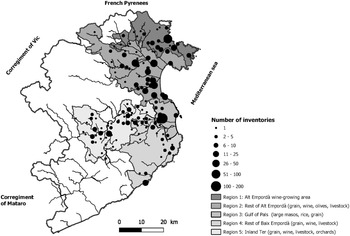
Our sample is composed of 933 inventories, notarised in different places, corresponding to five areas of contrasting socio-economic characteristics (Figure 1).Footnote 7 Region 1 is a specialised wine-growing area, mountainous and with very poor soils, where numerous new smallholdings granted in emphyteusis were found during the eighteenth century. There was also an increase in small farms in areas of cereal and livestock polyculture, among which we can distinguish Region 4, which also had a notable presence of vineyards, Region 2, with more olive cultivation, and Region 5, crossed by the River Ter, which had a strong presence of garden crops. In contrast, Pals Bay (Region 3) was an area of large masos, where rice-growing became widespread during the eighteenth century, and where we find the nearest examples to the pure wage-earner.
Location of treballador inventories.
Note: Reference territory is that within the borders of the Corregiment of Girona.
Sources: See endnote 7.

It is worth emphasising the high social representativeness of inventories in the Girona region. The use of inventories in European research is frequently affected by strong social biases.Footnote 8 In Catalonia, this problem seems to be less pronounced, although the data on the Penedès show that it did exist (Moreno, Reference Moreno2007: 48–9). However, the lower rural social groups seem to be well represented in the Girona area, as the percentage of treballadors inventoried is similar to their proportion in the overall adult population.
In order to further refine our analysis, we have compared the percentages of treballador inventories in two notary offices (Llançà, in Region 1, and Torroella de Montgrí, in Region 3) with the number of treballadors listed in the death registers of the corresponding parishes.Footnote 9 Together, the two districts contain 335 treballadors’ inventories (36 per cent of the entire sample).
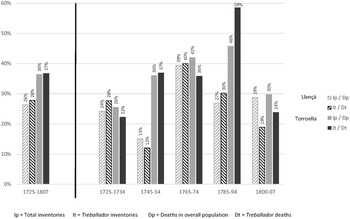
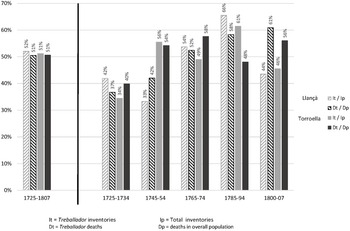
Figure 2 shows that, in both Llançà and Torroella de Montgrí, the proportion of treballadors’ inventories compared to deaths of treballadors is quite similar to the percentage of inventories to deaths in the overall population. The high presence of treballadors in the inventories, with similar percentages to their share among deceased men over the age of twenty-five, is therefore not surprising (Figure 3). In both cases, the data display considerable volatility between periods, but the representativeness of the inventories of treballadors in relation to the rest of the population remains high and stable.
Proportion of inventories compared to deaths, for overall population and treballadors.
Note: For all periods as a whole, the number of observations conducted is as follows: deaths of men with a known trade: 1,012 (Torroella de Montgrí) and 647 (Llançà and Selva de Mar); inventories of residents including all trades: 351 (Torroella de Montgrí) and 172 (Llançà and Selva de Mar). Sources: See endnote 7.

Presence of treballadors in inventories and deaths.
Sources: See endnote 7.

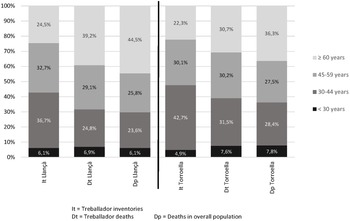
Lastly, we will carry out an exercise to analyse the ages of inventoried treballadors. Many criticisms of this source stress its habitual bias in favour of the older population, which distorts the representativeness of the inventories in terms of both consumption patterns and household industriousness.Footnote 10 The data used to check this hypothesis proceed from inventories notarised in Llançà and Torroella de Montgrí, and relate to the 152 treballadors whose age we know, as this was recorded in the parish death registers; these individuals comprise 45 per cent of the total number of inventories in both places (Figure 4). The majority of inventories were compiled for men who died between the ages of thirty and sixty, a higher proportion than the deceased of these ages in the parish registers. Older ages are therefore under-represented. If we disaggregate the data by subperiods, we also find no relevant changes in the age distribution of the inventories. Finally, no significant differences are detected in the content of the inventories depending on age,Footnote 11 which is probably due to the predominance of the stem family, meaning that many of the older treballadors will have lived with a conjugal unit from the following generation.
Age of inventoried treballadors.
Sources: See endnote 7.

2. Changes in treballadors’ access to land and means of productionFootnote 12
Before analysing whether treballadors’ consumption increased, it is appropriate to consider whether they had the necessary resources for this to happen and how these resources might have conditioned their relationship with the markets. In this section, we will address three questions that will help us in this endeavour. Firstly, did a process of proletarianisation take place in the region of Girona during the eighteenth century, or, contrarily, can a greater access to the means of production, and especially to land, be observed among treballadors? Secondly, do the treballadors’ inventories reveal signs of their participation in the process of agricultural intensification that the region underwent during the second half of the century? And finally, can we observe a greater link between treballadors and the market from the supply side, or did access to land reinforce the trend towards self-subsistence?
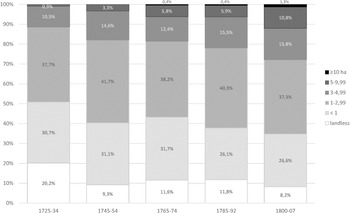
Regarding the first question, the most relevant fact highlighted by our inventories is that treballadors had a high degree of access to land. Most had some plots, and the percentage of those who had some plots increased over time. We also note a progressive increase in the amount of land they owned, reaching in some case more than five hectares (Figure 5).
Land owned by treballadors according to inventories.
Sources: See endnote 7.

The expansion of agriculture in the eighteenth century, and particularly in the latter half, was largely due to the transferral of land rights through emphyteutic contracts, which gave treballadors greater access to land at a time of high demographic growth. When they accessed land, many did so on uncultivated or forest plots that they had to clear before cultivating crops. It is hardly surprising, therefore, that woods and wasteland accounted for just 4.2 per cent of the land inventoried here. The most commonly cultivated plant was the vine (67.1 per cent), which became far more common during the eighteenth century. The next most-frequent use of land was for cereals and legumes (23.3 per cent), while the remaining land was dedicated to vegetable gardens (2.2 per cent) and olive trees (3.2 per cent).
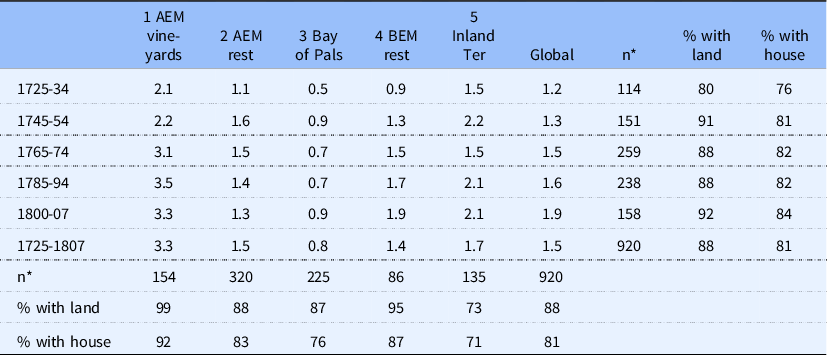
The predominance of vines led to regional differences in access to land (Table 1). This was greatest in Region 1, the more specialised wine-growing area, where the initial size of plots was highest and grew to a point where the median size of inventoried land was 3.3 ha. At the other end of the scale, the treballadors in Regions 3 and 5 had lower levels of access, a smaller initial amount of land and made less obvious progress. It should be taken into account that in these areas, a sizable proportion of smallholdings were composed of leased plots that, unlike those held through full ownership or emphyteutic rights were not recorded in inventories. The result of these different territorial specialisations is trajectories with differing intensities and directions, which attenuates the overall results and alerts us to the biases that can be caused by a partial selection of indicators when it comes to means of production.
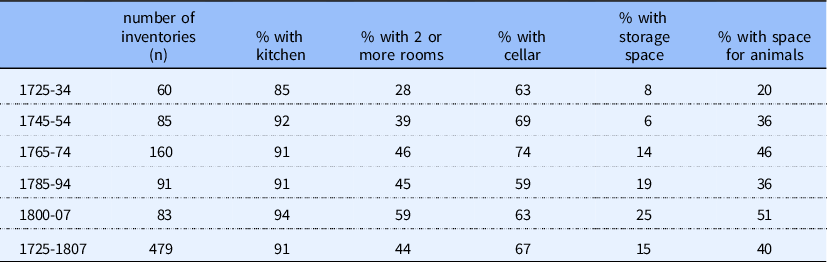
Houses must also be included within real estate. Most of the inventoried treballadors owned a house, and this became ever more common throughout the eighteenth century (Table 1). The homes would certainly have been modest, and 53 per cent of the inventories give some detail regarding their layout. Very few consisted of a single, undivided space. Among those with several spaces, many of the rooms served various functions (Table 2). Proof of this is that 26 per cent of beds were not in bedrooms: 12 per cent were in the kitchen; 9 per cent in the parlour; 2 per cent in the entrance hall; and the remaining in mixed areas.Footnote 13
Land owned by treballadors (median, in hectares)

Note: n: Total number of inventories per period – not only those that included plots of land – used to calculate median; AEM: Alt Empordà county; BEM: Baix Empordà county.
Sources: See endnote 7.
Types of space mentioned in inventories

Sources: See endnote 7.
Most of the houses divided the living area (excluding stables, cellars and storerooms) into two (28 per cent), three (29 per cent), or four parts (23 per cent). Although the number of rooms showed no notable change, with the median staying constant at three, this is not the case of spaces referred to as bedrooms; the percentages of houses with two or more bedrooms rose from 28 per cent (1725–34) to 59 per cent (1800–07).Footnote 14
The productive spaces of the houses give an indication of type of production and levels of specialisation. The most common such space was the cellar, which is logical considering the importance of vineyards. It should be noted that the presence of wineskins, vats and grape presses, which rose from 75 per cent to 86 per cent, exceeded that of cellars. These spaces were most common in the Alt Empordà area (93 per cent), where the median amount of wine stored was higher than the overall median (250 litres, as opposed to 185). These high levels of stock are a clear indication of the strong market orientation of these treballadors’ domestic economies.
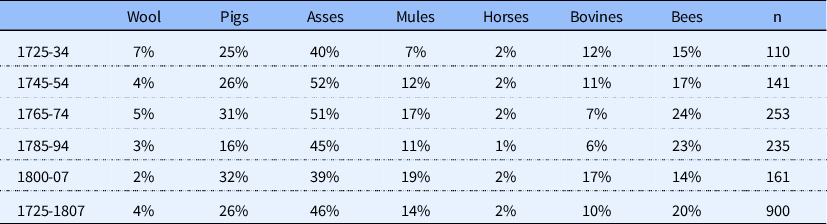
The second most important productive space were pens for livestock, which became increasingly frequent, rising to 51 per cent in the final period. This may be due to greater care having been taken of the animals and to a rise in livestock endowment, although the latter is uncertain, as this trend is not clear. The numbers of wool-producing animals were low and falling, while those of pigs varied, being mentioned in between a quarter and a third of inventories at different times. The most important livestock asset was working animals: 60 per cent of treballadors had one, and 11 per cent two or more. The ass was the most common (46 per cent), while 10 per cent had oxen and 14 per cent mules, the animal that saw the greatest increase in frequency, from 7 per cent to 19 per cent (Table 3). This is noteworthy, as the mule’s working and transporting potential could be an important source of wages and other kinds of income; its high price also shows the investment capacity of some treballadors. Bees were also important, mentioned in 20 per cent of the inventories.
Presence of animals in inventories of treballadors

Sources: See endnote 7.
Some treballadors had specific storage spaces for agricultural products, above all granaries and haystacks, the numbers of which rose from 8 per cent to 25 per cent. Stocks varied widely across the region depending on local specialisation. Very little cereal (17 per cent of inventories) and few pulses (9 per cent) were stored in the wine-growing area, while in the other zones these figures ranged from 39 to 55 per cent and 31 to 42 per cent, respectively.
The stocks of grains and agricultural tools provide us with information regarding the processes of introducing new crops and work intensification, often related to market-oriented specialisation processes other than wine making. The most common cereal was wheat (in 28 per cent of inventories), but this was followed by new crops such as maize (16 per cent) and rice (6 per cent), the latter concentrated in Region 3 and perhaps cultivated on rented plots or obtained as wages in kind, since rice was mainly cultivated on large farms. The presence of maize is important, as it has often been linked to new crop rotations. The mention of rice and maize in the inventories indicates that treballadors were also involved in two sources of agrarian intensification usually associated with masos. The numerous references to pulses, above all beans (27 per cent) and kidney beans (31 per cent), suggest that crop rotation was more intense and complex than the traditional biennial course of cereal and fallow. Among vegetables, garlic and onions, mainly cultivated in Regions 4 and 5, are mentioned in 21–23 per cent of inventories. These were market-oriented crops that may well have been an important source of income for local treballadors.
When examining the frequency of agricultural tools, which are mentioned in 95 per cent of inventories, the most notable aspect is that their number rose from a median of seven to nine. A common tool was the fanga, a type of spade related to intensive agriculture. Also, 18 per cent of treballadors owned a plough; the most relevant trend being the sharp rise (from 10 to 32 per cent) of their presence in inventories, especially in the areas specialised in cereals, such as Region 5, where the figure reached 37 per cent.
References to other tools allow us to infer that treballador households engaged in multiple activities, although it is not always possible to determine whether these were for self-production or market-oriented. Fishing tackle is present in 7 per cent of inventories, above all in coastal areas and the wine-growing area of the Alt Empordà (11 per cent). Although construction tools are mentioned in just 3 per cent of inventories, carpentry tools are much more frequent (24 per cent). Also present are other craft utensils (11 per cent), in particular those used for making clogs and shoes, and ironwork. Items used in textile production are listed in 45 per cent of inventories. These were always connected to obtaining fibre (scutching tools) or spinning (winders, spindles, spools); no references are made to looms. When mention is made of a specific fibre, it is hemp or flax. We found references to a mere three wool spinning wheels, and none to cotton. The cloth would have been mainly for domestic use, being spun first at home and then taken to a local weaver. The declining presence of these tools after 1765–74 may be considered a sign of the fall of textile self-consumption in the last decades of the eighteenth century.
In conclusion, the inventories show a social group that does not seem to have experienced a process of proletarianisation, at least during the latter half of the eighteenth century. On the contrary, there was a tendency for their endowment in means of production (above all arable land, but also working animals, agricultural tools, and housing) to improve. Furthermore, the treballadors seem to have been involved in processes of agricultural intensification. On the other hand, wine specialisation, the presence of commercial crops and the availability of beasts of burden refute the notion that access to land may have implied a lower participation in the market for these treballadors.
3. Did the treballadors consume more?
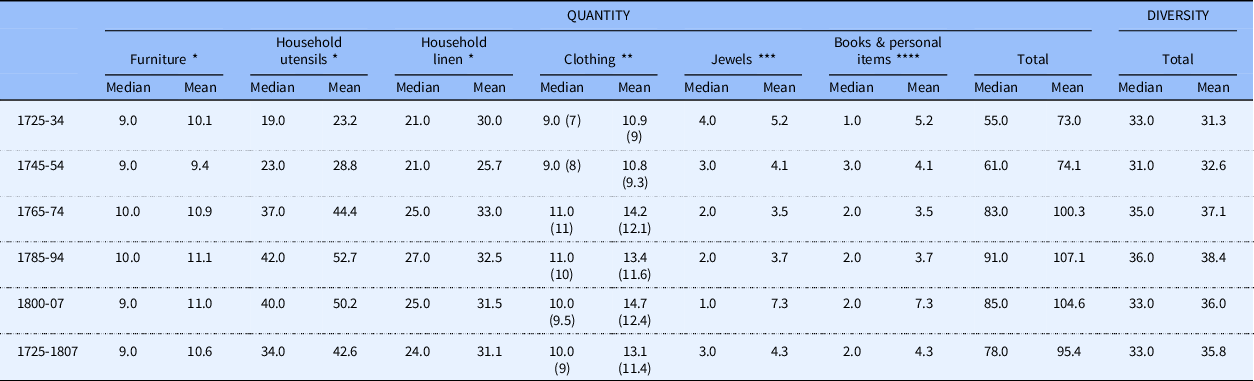
To what extent did access to land entail sacrifices in consumption in favour of investment? The analysis of inventoried personal and domestic objects carried out here will allow us to determine whether the increase in the wealth of some treballadors was accompanied by an improvement in their household consumption. Regarding the amount of their inventoried household and personal objects, the global median and mean number increased by 55 and 43 per cent, respectively, over the period (Table 4). This rise was particularly notable between 1745–54 and 1765–74, before slowing in the last third of the century, only to fall slightly at the start of the nineteenth century. Although comparing these figures with those of other European areas is complex, as we will explain below, a 50 per cent increase in the number of objects owned is not inconsiderable. However, despite there being more objects in homes, there was little change in their diversity. In other words, the treballadors did not experience access to the ever-increasing number of different items described by those who defend the idea of a consumer revolution in north-western Europe.Footnote 15
Quantity and diversity of objects in treballadors’ inventories

Note: *100 per cent of inventories contain information about these items; **72 per cent of inventories (between 70 and 74 per cent depending on period) contain information about these items; ***15 per cent of inventories mention jewels, and their number fell sharply over the century, from 26 per cent in the first period to 6 per cent in the last; ****26 per cent of inventories (between 23 and 29 per cent depending on period) contain references to these items. The figures in brackets in the clothing column refer to men’s clothes. We understand diversity to refer to the number of different object types, regardless of their formal characteristics (material, colour, …). Sources: See endnote 7.
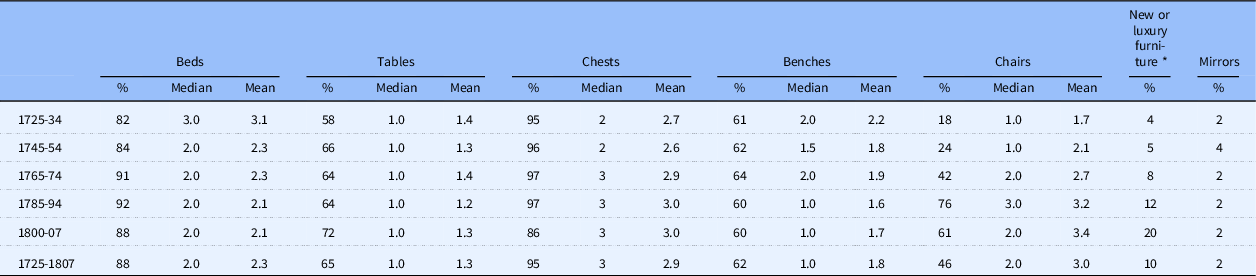
The overall rise in the number of objects is the result of items undergoing different trajectories (Tables 4–7). In the case of furniture, the total number remained stable, and there was little change in the most fundamental items: beds, tables, chests and benches. There were still some interesting changes, however, notably the increase in the percentage of treballadors who owned chairs (the number of which also increased), and at least one ‘luxury’ item (chests of drawers, wardrobes, and others indicated in Table 5). Although the wood that furniture was made of is only mentioned in 14 per cent of cases, it seems clear that the vast majority of items (80 per cent) were made of cheap wood, such as pine or poplar. Nonetheless, furniture made from walnut, among the highest quality produced in the region,Footnote 16 is mentioned in 17 per cent of inventories, rising to 23 per cent in 1800–07.
Furniture in treballadors’ inventories

Note: *Cupboard, escritoire, sideboard, chest of drawers, cabinet, vitrine, wardrobe, desk.
Sources: See endnote 7.
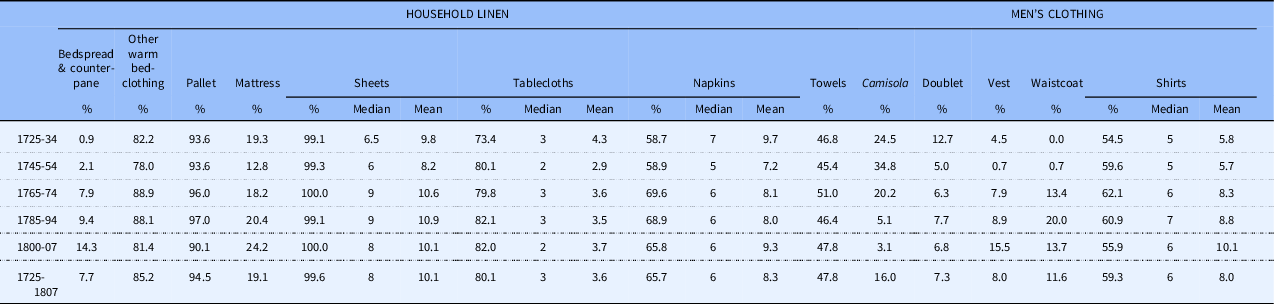
Cloth in treballadors’ inventories

Sources: See endnote 7.
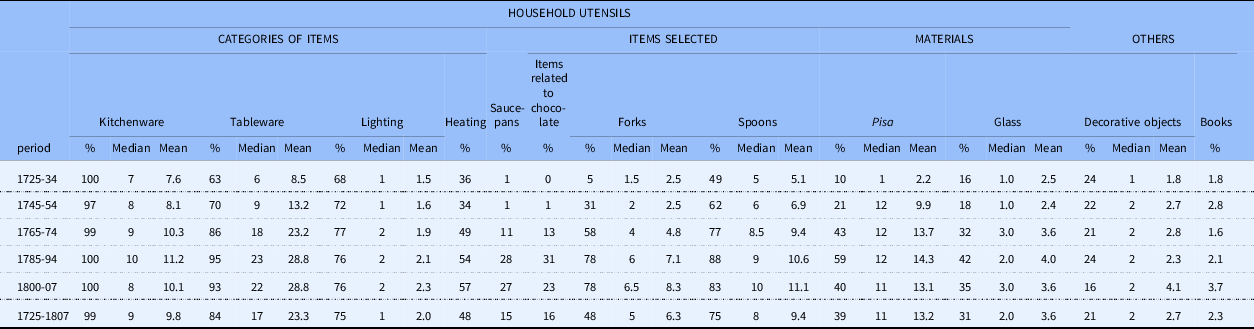
Household utensils and other objects in treballadors’ inventories

Sources: See endnote 7.
As far as textiles are concerned, both continuities and changes are observed (Table 6). Regarding bed linen, which was one of the most important household items, and a sign of status in many modern European societies,Footnote 17 our data show an increase in the number of sheets, some changes in warm bedclothing (with new bedspreads and counterpanes replacing other more traditional items), and a slow rise in the use of mattresses, which were added to the ubiquitous straw pallets, rather than substituting them. There were fewer changes in other household linen, but the number of napkins increased in the mid-century.
We limited our analysis of clothing to that of men, as it was often only the deceased male’s clothing that was included in inventories, although in some cases it is not even mentioned, probably because it was bequeathed or used to pay for the funeral. For this reason, Table 6, which shows a low presence of such a universal item as shirts, for example, has to be treated with caution. The main changes noted are a slight increase in the number of shirts, and changes in fashion, above all the declining numbers of camisoles (jackets without lapels) and doublets, and the increasing use of vests and waistcoats. This, and a greater range of colours, not systematically recorded in the inventories, had been noted by the traveller Francisco de Zamora. According to him, ‘since the middle of this century’ the rural population of the Girona area had substituted ‘the blue of the gambetos (cloaks) for dark and brisa colours, and all but stopped using the straw-coloured doublets and camisoles, thus altering the old styles’, concluding that ‘the propagation of luxury has reached all classes’ (Zamora, Reference Zamora1973: 333).
Other changes are related to fabric types. Household linen and shirts were almost always made of hemp, a fabric that was not sold by shops (Torra, Reference Torra1997), but came largely from local self-consumption or, perhaps, from pedlar sale circuits that are almost completely unknown to us. However, this does not imply that no changes occurred. One was the increasing use of cotton in household linen (above all counterpanes and bedspreads, but also in table linen) and in clothing, spurred by a fall in its relative price against cloth made from other fabrics (Torra, Reference Torra2002: 24–8). However, the diffusion of cotton was only moderate. The proportion of household items made from cotton, whether alone or blended with other fibres, rose from between 6 and 10 per cent in the first four time periods, to 17 per cent in 1800–07. In the case of male and female outerclothing (excepting shirts and stockings), cotton rose from 2 per cent of items in 1725–34 to 12.6 per cent in 1800–07, and was more often used in female clothing (skirts, aprons, neckerchiefs). Since this is precisely the clothing most infrequently mentioned in the inventories, the real presence of cotton must have been higher. However, this increase in cotton was only noted in the homes of some treballadors, given that the percentage of inventories mentioning cotton remained largely stable, at around 25 per cent, or between 35 and 46 per cent if we add cloth made of cotton and another fibre. Furthermore, the average number of cotton items per inventory only increased significantly in 1800–07, when it reached 5.3 items, as opposed to an average of 2.9 in previous periods.
The inventories reflect other changes with regard to textiles. Their variety increased from 37 different types in 1725–34 to 51 in 1800–07, as did the presence of higher-quality clothing. Low-quality drapery, in the form of setzens and burells, represented 23 per cent of all clothing (except shirts and stockings) in 1725–34, and fell to 10 per cent in 1800–07. Less than 1 per cent of pieces of cloth were made of medium to high-quality drapery (vint-i-dosens and vint-i-sisens) in the first two periods, this rising to 8–12 per cent from 1765–74 onwards. Fewer than 2 per cent of inventories included clothes of this quality in the first two periods, increasing to 10–14 per cent in the last three.
The greatest changes were in domestic utensils (Table 7). Pieces of kitchenware increased, and new ones became available. Some of these reveal changes in eating habits, among them saucepans, linked to cookery that was more sophisticated than the traditional boiled dishes (Overton et al., Reference Overton, Whittle, Dean and Hann2004: 98–101), and chocolate pots. In contrast, there is no record of items linked to coffee, and very few references to tobacco-related objects.
Another increase is seen in the frequency that lamps, and other ways to light or warm the home, are mentioned in the inventories. But the aspect of domestic life that saw greatest change was that of tableware, which rose by a factor of 3.5 over the century, and also increased in diversity, from an average of 2.3 different items in 1725–34, to five at the close of the century. The rise was particularly notable in the case of forks and spoons.
The materials used also changed. The frequency and number of glass items (glasses, bottles) rose together with the use of pisa, which was decorated unglazed pottery. Pisa varied in quality, but was always more expensive than simpler locally produced earthenware, and came from outside the region, from Barcelona, Valencia, or even Genoa. It appears in the inventories in the form of plates and dishes, but also items of certain decorative importance, such as holy water stoups and jugs, or objects linked to changes in eating habits, like xicres (small cups for chocolate). It would also have changed in line with fashion. Traditional Catalan pisa was decorated in blue on a white background, but inventories from the 1790s onwards mention chocolate-coloured pottery, an innovation surely related to the increase in consumption of this colonial foodstuff.
The inventories also provide information regarding other aspects of the treballadors’ material culture. A significant percentage owned decorative objects (images, paintings, engravings, and prints with religious motifs), as well as jewels and other objects of silver or gold. Silver was far more common, in the form of ‘poor people’s silverware’ (Ferrières, Reference Ferrières2004: 109) of small spoons and jewels, while gold was only more frequent in rings. However, the percentage of homes that owned jewels fell sharply (Table 4), a phenomenon that was also seen in other parts of Catalonia among farmers and artisans.Footnote 18 Finally, books, mostly on religious subjects, were far less frequently inventoried, although there was a trend for their number to increase, particularly in the 1800–07 period, which qualifies the image of treballadors as being completely illiterate.
Was this increase in the number of objects the result of improvements in the treballadors’ purchasing power? In order to answer this question, it is important to bear in mind the fact that changes in material culture reflect different types of phenomena. In some cases, items were replaced by others. This could indicate changes in fashion, in the supply structure, or in their relative prices, and not necessarily improvements in purchasing capacity, although they do show a link between treballadors’ consumption patterns and markets of a certain scope and complexity. A similar interpretation can also be applied in the case of cheap new products, such as forks. In contrast, access to higher-quality goods, such as luxury furniture, pisa, glass objects, or middle- to high-quality drapery, can be seen as an unequivocal sign of greater purchasing capacity, even if further knowledge of how often items were replaced and of the role of the second-hand market is needed in order to assess this properly. In addition, it does not appear that the purchase of manufactured goods, especially textiles, was driven by the fall in their prices, as has been pointed out in the cases of England and Italy (Shammas, Reference Shammas1990: 96–100; Malanima, Reference Malanima1990: 163–70), since, with the exception of calicos, textile prices probably increased in eighteenth-century Catalonia (Torra, Reference Torra2002: 24–8).
4. Comparing Catalonia with north-western Europe
The inventories we have studied suggest that the level of consumption among treballadors was higher than that among similar social groups in other parts of Catalonia, such as the Penedès County. Small differences are found between the two areas in relation to basic clothing such as shirts, or household linen, such as sheets and napkins, as well as ‘traditional’ luxury goods, such as jewellery and silverware, although numbers of decorative objects of devotion grew more in the Penedès than in Girona.Footnote 19 However, the labourers and small farmers of the Penedès had very few forks, and no chocolate pots or ‘luxury’ furniture.Footnote 20 There are little data with which to compare other areas of Spain. Those from the province of Palencia show that rural smallholders there were far poorer than treballadors in the Girona region. They had far less household linen, cutlery, ceramic items or furniture, although there was a greater presence of chocolate pots (Ramos Palencia, Reference Ramos Palencia2010).
What happens if we compare the data from Girona with those from north-western Europe, the supposed cradle of the industrious revolution? There are risks inherent in such a comparison. The first problem lies in the fact that the lower social groups have different characteristics in different societies, which raises the question of which groups it makes sense to compare. For the British case, we have focused mainly on the inventories of labourers and paupers. It is true that access to land was less frequent among labourers than among treballadors, most of whom owned some plots. But two considerations support our choice. First, labourers and paupers, on the one hand, and treballadors, on the other, share the fact of being the lower social groups in their respective societies, even if the case of paupers is more complex, given the importance of the life cycle factor in this group (King, Reference King1997: 161–6; Harley, Reference Harley2022). In the Catalan case, there is no label below that of treballador. The label certainly included individuals of different levels of wealth and the poorest treballadors would not have inventoried their assets. But even so, the comparison between the percentage of treballadors in the postmortem inventories and in the parish registers of deaths that we have presented in Section 1 suggests that the social structure left little space below the treballadors included in our sample. Secondly, there are reasons to assume that the inventoried labourers were likely to be more affluent than the majority of members of this group (Sear and Sneath, Reference Sear and Sneath2020: 249–50) and many of them must have had access to some plots of land,Footnote 21 meaning they resembled our treballadors more than those labourers who did not have inventory.
A second problem presented by the comparisons is related to which goods would be inventoried and how they are detailed. In this sense, one of the shortcomings of the British inventories and those of other areas of northern Europe is that they do not include real estate. Furthermore, since the majority of studies do not give totals of inventoried items, global comparisons of objects for personal or domestic use are almost impossible. The total number of goods owned by the labourers studied by Muldrew (an average of 74 during the eighteenth century) is lower than the 95.5 in our inventories. This may be due to the fact that English inventories often grouped large numbers of items, especially clothing, which is seldom detailed (Muldrew, Reference Muldrew2011: 193; Mee and Spufford, Reference Mee and Spufford2017). Regarding the intensity of growth, one of the few global indicators available is that proposed for the Meaux region in France by Béaur using Baulant’s methodology (2006: 287–317). It shows that the social groups comparable with our treballadors (journaliers and vignerons) were those less favoured by the eighteenth-century ‘revolution of objects’. However, the standard of living index based on their inventories grew by around 60 per cent between 1651–1700 and 1751–90, and by 35 per cent between 1701–50 and 1751–90 (Béaur, Reference Béaur2017: 38–41). These figures are similar to the rise in the number of items owned by treballadors.
If aggregate comparisons are so limited, what do those that focus on specific items tell us? The literature on the industrious revolution has often emphasised the emergence of new products, which denoted certain levels of luxury or comfort. It is important to emphasise the problems with comparisons based on such types of goods, however. On the one hand, especially when we study modest social groups, the amount of basic goods is an important variable to take into account. Only minimal differences exist between our inventories and those of the British rural working class regarding the most basic items, or some treballadors are even found to have owned far more of such items. The amount of household linen is much higher in our inventories than those of British labourers studied by Muldrew (Reference Muldrew2011: 196), with an average of 14.7 items in the period 1700–49; our inventories also compare very favourably in this respect with those of the Cornish middling sort in the first half of the eighteenth century, even if they are far lower than those of the prosperous middle class of the county of Kent (Overton et al., Reference Overton, Whittle, Dean and Hann2004: 109). The sample of pauper inventories in Essex studied by Peter King (Reference King1997: 163–4) provides somewhat similar findings: they had fewer sheets, tablecloths and napkins than the treballadors, and a similar number of beds. The fact that the treballadors owned similar amounts of household linen and basic furniture as their English counterparts is interesting, but needs to be treated with caution, because the British inventories contain more non-itemised goods than the Catalan ones, and aspects such as the quality of cloth (certainly lower in Catalonia, where hemp was by far the most common material) or frequency of replacement are not taken into account (de Vries, Reference de Vries2008: 144–9; Shammas, Reference Shammas1990: 95).
Furthermore, comparing specific objects entails the danger of taking cultural differences or differences in the supply of products to be disparities in purchasing power. While the treballadors’ inventories make no reference to the consumption of tea or coffee, that of chocolate is noted. This was an elite product available only to the wealthiest in the Netherlands, France, Italy and other countries (de Vries, Reference de Vries2008: 152; McCants, 2008: 184; Garnot, Reference Garnot1995: 55; Sarti, Reference Sarti2003: 236), but in Spain, whose empire included the largest cocoa producing areas in the world, chocolate was the colonial foodstuff par excellence (Fattacciu, Reference Fattacciu2020; Ramos Palencia, Reference Ramos Palencia2010: 154). Comparing the frequency of chocolate pots in our sample and items used in tea drinking by the British lower class is highly complex, given the widely differing results of studies referring to England. Sear and Sneath (Reference Sear and Sneath2020: 284) found that 7 per cent of labourers and 22 per cent of husbandmen owned items related to hot drinks in 1750–1800. The figures referred to husbandmen are similar to those for chocolate pots owned by treballadors at the end of the eighteenth century, but other English studies give far higher percentages, of between 46 and 71 per cent (King, Reference King1997: 163; Harley, Reference Harley2021: 35). Although it is true that the presence of utensils used to make chocolate does not imply regular consumption, there is some evidence that chocolate was consumed in humble households. Townsend, a British traveller who visited Spain between 1786 and 1787, drank chocolate at numerous inns, many of which were of very low standing (Townsend, Reference Townsend1792, vol 1: 381–2 and vol 2: 3).
A further example of differences deriving from the disparity in supply is the complete lack of mention of feather mattresses in our sample, whereas they were found to be present in the homes of many English labourers and paupers (Sear and Sneath, Reference Sear and Sneath2020: 131–4, 286; Harley, Reference Harley2021: 35). In the Mediterranean area, where the supply of feathers was lower than in the Atlantic due to fewer breeding colonies of large ocean birds, high-quality mattresses, found in the homes of the well-off and increasingly in those of treballadors, were made of wool (Moreno, Reference Moreno2007: 39–40; Malanima, Reference Malanima1990: 16). This is, therefore, the yardstick we should use when assessing the comfort of beds in poorer families.
Differences in supply are not only limited to production. Those related to distribution may also be decisive. The limited diffusion of cotton could have been partly due to distribution channels in eighteenth-century rural Catalonia. Cotton fabrics were increasingly for sale in the textile shops in Figueres (a town in our studied area) during the eighteenth century (Torra, Reference Torra1997: 183), but it is doubtful that the treballadors could afford many of the textiles sold there. Little is known about where the poor shopped, but Catalonia seems not to have had the dense network of trade in second-hand cotton clothing that, according to Lemire (Reference Lemire1991: 61–76), played a key role in England in accustoming the working classes to this and other new products before technical change in the late eigheenth century brought their prices down and made them affordable to these social groups as well.
Cultural differences would probably explain the disparity in Catalan and English inventories regarding tableware, especially glasses, glass recipientsFootnote 22 and, above all, forks. While 78 per cent of treballadors owned forks at the end of the eighteenth century, Sear and Sneath report figures of 7 per cent for English labourers, 4 per cent for husbandmen, 13 per cent for yeomen, and 28 per cent for the gentry (Sear and Sneath, Reference Sear and Sneath2020: 283). The frequency of forks in treballadors’ homes was also higher than in the case of the lower urban classes of a large trading city such as Amsterdam.Footnote 23 These differences are probably due to geographical diffusion patterns with regard to innovations: after all, forks originated in Italy, a country with close ties to Catalonia, from where the use of this utensil spread across the continent (Sarti, Reference Sarti2003: 195–6).
In summary, the treballadors owned chocolate pots instead of tea or coffee pots; there was little difference between their stocks in household linen and those of their counterparts in north-western Europe, and items linked to more refined and hygienic manners were more present in Catalonia than in England or the Netherlands. There is also little difference in the ownership of books, which are all but absent in King’s sample, while they were present in only 7 per cent of labourers’ homes and 4 per cent of husbandmen’s according to Sear and Sneath.Footnote 24 Aside from this, it is true that treballadors’ homes either did not have, or had fewer of, a long list of items, considered markers of certain levels of luxury or comfort, which were present in labourers’ and paupers’ north-western European homes. There were no clocks, hardly any curtains, and far fewer mirrors or other luxury pieces of furniture such as chests of drawers.Footnote 25 To ignore these absences would constitute an error, as would assuming without caution that they are proof of treballadors being much more modest than their peers in north-western Europe, because comparisons referring to other items point, as we have seen, in the opposite direction. The evidence presented here can be read in different ways. But what it does unequivocally show is that the differences between the levels of consumption of treballadors and their British counterparts, if they existed, do not justify the stereotype often applied to the Mediterranean area.
5. Conclusions
One of the most interesting aspects to derive from the thesis of the industrious revolution lies in the prominence given to poor families. It is the intensification of market-oriented work experienced by these families and their increasing demand for consumer goods that allocates them a central place in explaining the economic growth of the eighteenth century. Agrarian workers could, therefore, be seen as active agents of historical change rather than mere victims of the processes of impoverishment and proletarianisation, as historiography has generally held.
The analysis of treballadors’ inventories in the region of Girona, located in the Mediterranean area that de Vries excludes from the industrious revolution, provides indications of the existence of characteristics that define that process: a greater intensification of work, increasing orientation towards the market, and a rise in consumption. In making this observation, we neither seek to participate in a possible taxonomy to classify regions according to their conformity to the ‘model’ of the industrious revolution, nor to claim for Catalonia a position alongside the regions that led the ‘little divergence’. More interesting to us is the call for dialogue between historiographies. Regarding consumption, comparisons between different regions must take into consideration cultural differences and the structure of supply. In terms of production, the processes of agricultural specialisation, which involve links to the market, are a distinctive feature of some Mediterranean regions, as historians such as Labrousse and Vilar pointed out many years ago. Referring to eighteenth-century Catalonia, the latter noted that the country ‘had got used to producing, not to consume, but to sell’ (Vilar, Reference Vilar1974: 21). The inventories of treballadors in the Girona region show that the poorest groups of rural society participated very actively in this transformation.
Our study highlights the importance of opportunities to access land and other means of production, a variable not contemplated by de Vries. In the region of Girona in the eighteenth century, treballadors’ access to land, which was accompanied by a growing openness to the market, was a key factor in explaining the apparent paradox that increases in wealth and consumption were particularly pronounced in the second half of the eighteenth century, coinciding with the period of stronger demographic and price growth.
The saying that ‘Catalans can get bread out of stones’, which became widespread across Spain, must have originated then. The reference to stones evokes Catalans’ industriousness, but also the access that poor people had to plots of land, even if of poor quality, through emphyteutic contracts. This may be one of the most important lessons from our study: the need to incorporate regional differences regarding access to land into historical studies on poverty and ways of escaping it in Ancien Régime Europe. The stereotypes that still exist can only be surmounted by following a research agenda that is sensitive to the diversity of opportunities in relation to access to means of production and, on the demand side, to the plural nature of consumption patterns.
Acknowledgements
This work is part of the RECSNETS I project (PGC2018-096350-B-I00), funded by the Ministry of Science, Innovation and Universities, and the European Regional Development Fund (EU). The authors would like to thank Jaume Abulí, Nil Coma, Maria Fontané, Eduard Lazo, Guillem Mancilla, Josep Mas, Dignoris Mateo, Josep Lluís Òdena, Bàrbara Schmidt, Albert Serramontmany and Sergi Torrent for their participation in the documentation search and data extraction tasks. The data used in this research <https://doi.org/10.34810/data607> can be found in the CORA repository <https://dataverse.csuc.cat/dataverse.xhtml?alias=CRHR>.