I. Introduction
Everyone today agrees that human dignity is of great moral importance, but exactly how notions of dignity should enter into moral practice and judgment is no simple matter. Complications arise for at least two reasons. First, the concept of dignity is itself neither simple nor well defined, and so when speakers invoke it in moral contexts, exactly what they refer to is often unclear. Second, claims about “human dignity” might feature in moral discourse at different levels. On the one hand, they may operate only at the surface of moral practice, used by agents in a largely unreflective or conventional way to express or justify first-order moral judgments, as when they denounce hate speech, torture, slavery, and human trafficking as violations of human dignity, or urge antipoverty policies for its sake. On the other hand, they may also be implicated in higher-order philosophical reflection about morality, as when a principle of “respect for human dignity” is assigned a privileged theoretical role in explaining, assessing, or validating a whole range of first-order moral commitments.
This last suggestion, exemplified in Jeremy Waldron's recent remark that dignity is not merely “what some of our rights are rights to” but also a concept that somehow “grounds all of our rights,” forms the focus of this paper.Footnote 1 Thanks largely to Kant and his influence on contemporary moral philosophy, the suggestion that the concept of human dignity captures an idea about the special moral standing of persons that no adequate theoretical account of our moral practice can do without has become almost axiomatic in many quarters. On this view, human dignity is not merely one moral commitment among many. It is also a concept that plays a special role in explaining the underlying point and character of (at least some) paradigmatically moral expectations. Yet, despite the appeal and familiarity of such claims, exactly how, and in what form, the concept can do essential philosophical work in higher-order reflection about morality is not obvious. As already noted, notions of “dignity” are indefinite and open to multiple interpretations. Impressed by its diverse senses and meanings, many critics suggest that the concept is simply too nebulous to bear the theoretical weight philosophers today often heap upon it.
My aim in this essay is to assess the credentials of “human dignity” as a philosophical concept of this kind. To make headway in this difficult terrain, this essay distinguishes four ways in which the concept of human dignity might be construed for the purposes of critical moral reflection (Sections IV–V). With this array of possibilities on the table, I then ask whether any of them seem auspicious given the theoretical uses to which contemporary dignitarian philosophers have put the concept of human dignity (Sections VI–VII). Although my discussion is provisional and open-ended, it suggests both good and bad news for dignitarians. The bad news is that some very familiar ways of framing the idea of human dignity likely have limited philosophical utility. The good news is that my typology exposes a neglected sense in which human dignity holds promise as a central concept in philosophical reflection about morality, one that I think deserves further investigation. In the opening two sections, I specify the target of my analysis more precisely and clarify the methodological strategy by which I hope to justify my conclusions.
II. Dignitarian Critical Morality
Writing in his personal journal a few years before the outbreak of the First World War, R. H. Tawney captured the claim that those who today accord human dignity a central role in moral philosophy usually have in mind: “The essence of all morality is this: to believe that every human being is of infinite importance, and therefore that no consideration of expediency can justify the oppression of one by the other.” Although Tawney does not use the term “dignity” here (he does elsewhere), his remark succinctly captures two basic assumptions made by contemporary dignitarian philosophers that taken together form the object of my argument here.
First, they assume the protection of human dignity to describe a very fundamental, rather than merely derivative or superficial, moral commitment (Tawney: essential to “all morality”). The relevant distinction between fundamental and superficial is that drawn by H. L. A. Hart (following classical utilitarianism) between “critical” and “positive” morality. “Critical morality” here refers not so much to a body of moral doctrine as to an activity: that of stepping back from the stock of familiar moral assumptions into which all societies socialize their members (“positive morality”) and asking whether they should be preserved or revised and, if so, on what basis. It characteristically involves seeking some set of guiding principles that, on reflection, make the best sense of our practices of moral judgment, moral deliberation, moral complaint, and so forth. For all their differences, utilitarianism, contractualism, Kant's ethical theory, and Aristotelian eudaimonism are essays in “critical morality” as I intend that term. They do not aim to guide our conduct directly, at least not in the first instance. Rather, they aspire to a systematic and authoritative account of why the moral norms that should guide our day-to-day action and moral reactions are fit to do so. Conversely, they claim to be able to show why some purportedly moral norms that actually do (or might) guide conduct ought on reflection not to do so and, hence, form no part of morality properly understood.
The “positive morality” that forms the generic object of a critical morality therefore need not refer only to the scheme of conventionally accepted moral norms actually in place in some society or culture, but also to any such norms that we can imagine being internalized and applied by agents in a sustained way in the course of ordinary human interaction. The distinctive feature of positive morality, then, is not instantiation in an actual social world, but rather its location, real or possible, at the surface of everyday ethical discourse, as a set of expectations whose moral character is common knowledge among the members of some speech-community.
We do not have to imagine a speech-community in which a commitment defending “human dignity” figures in positive morality, for although people today disagree about what exactly counts as a violation of human dignity, that commitment is now a familiar part of our ethical vernacular, accepted very broadly and unselfconsciously as a basis for moral judgment and protest. Whether “human dignity” can play a role, even a central or dominant one, in positive morality is therefore not an interesting question—casual observation of our own moral practices proves that it can. The more challenging and interesting question pursued here is whether its prominent place in the conventional ethical sensibility of late modern society is not just a contingent feature of contemporary culture, but also a symptom of an underlying philosophical importance in virtue of which that prominence is deserved.
Attempting to address that question simply by appealing to widely held “intuitions” that dignity must have such importance is bound to be unsatisfying. Without further explanation, we have every reason to suspect that such intuitions lack sufficient independence from extant positive morality to afford the required critical perspective. The aspiration of critical morality is to somehow transcend the moral prejudices of time and place and assess them from some impartial standpoint. Some today find this a hopeless enterprise, but whether or not critics are right to dismiss it, that project falters at the first tee to the extent that it proposes critical moral principles that simply repeat central doctrines of regnant positive morality under the label of fundamental “intuitions.” Begging the question in that way only reinforces the suspicion that “our” intuitions about human dignity are merely historically contingent prejudices that lack any special standing as critical moral principles. It may seem sacrilegious to entertain the possibility that those intuitions are merely local prejudices but the historical record leaves us no alternative: the positive morality of many societies, past and present, has denied modern intuitions about human dignity. Indeed, many of these cultures would regard the very notion that dignity could be a universal human attribute shared equally by all human agents as absurd or even abhorrent.
It is important to stress that one can imagine critical moral principles capable of vindicating familiar precepts of modern dignitarian positive morality that nonetheless accord the concept of human dignity no privileged philosophical role. The critical morality of classical utilitarianism, for example, is (notoriously) no respecter of human dignity, but might nonetheless urge that both positive morality and positive law (along with associated forms of legal reasoning) acknowledge and uphold its claims (somehow specified) as a matter of social policy. Utilitarians' fundamental indifference to the idea of personal dignity is shown by their willingness to reverse that judgment should it turn out that, on balance, a socially generalized attunement to dignitarian claims would tend to depress rather than augment overall welfare.Footnote 2 At least under modern conditions, I doubt that any plausible utilitarian view could actually recommend that course given the prohibitive costs, and likely failure, of efforts to revise conventional moral sensibility so radically. For many, however, the fact that utilitarians are prepared to contemplate it at all is alone enough to discredit the utility principle as a critical moral standard. Such critics deny that any adequate critical morality could tolerate relaxing first-order dignitarian expectations just for the sake of promoting “desirable consciousness.” The upshot of this well-worn criticism is that, in treating that possibility as even thinkable, utilitarianism displays a vitiating insensitivity to persons' moral worth. Tawney's sneering reference to “expediency” makes just this anti-utilitarian point.
Still, if we are seeking to vindicate the norms of dignitarian positive morality from some genuinely impartial, critical perspective, one might well suspect that the utilitarian's account of the value of those norms is ultimately the only one that makes philosophical sense. On that account, dignitarian positive morality derives its value solely from its tendency, when accepted and applied in ordinary life, to contribute to overall welfare. To show that the concept of human dignity is essential to critical as well as positive morality, then, one must show how that concept has philosophical punch independent of standard consequentialist or welfarist considerations.
This brings us to the second main dignitarian assumption flagged in Tawney's remark. Those philosophers who believe that “human dignity” does play an indispensable role in fundamental principles of critical morality assume that it does so by remedying an impoverished conception of personal worth they associate with utilitarianism, and perhaps consequentialism more generally. Dignitarian critical moralists typically insist that, as a matter of principle, there is more to the basic desideratum of moral impartiality between persons (and allied notions of moral standing and worth) than the expectation that each person's welfare count equally in a cost-benefit calculation. The point of appealing to the concept of human dignity in this context is to motivate philosophically the seemingly crucial yet elusive idea that persons as such partake of an overriding moral importance or worth that rules out “even the tendency to regard men as means to one another's welfare” and grounds the sort of weighty constraints on how they may be treated often associated today with the idea of human rights.
Vindicating “agent-centered restrictions” of this sort (the term is Sam Scheffler's) requires a philosophical explanation of why the worth of persons is not just another consequentialist goal, but rather a more basic constraint on the pursuit of any such goal. As Robert Nozick famously asked:
If non-violation of C is so important, shouldn't that be the goal? … What is the rationale for placing the non-violation of rights as a side constraint upon action instead of including it solely as a goal of one's actions? Side constraints upon action reflect the underlying Kantian principle that individuals are ends and not merely means; they may not be sacrificed or used for the achieving of other ends without their consent. Individuals are inviolable.Footnote 3
For present purposes we need not expect a defense of agent-centered restrictions (or side-constraints) with the particular—highly controversial—shape Nozick himself advocates (nor, for that matter, of Tawney's understanding of oppression). The only aspect of Nozick's challenge that concerns us here is the need to explain philosophically (1) how the worth of persons is qualitatively different from that of other objects of value and (2) why it is rational for agents to regard the worth of persons as overriding all other values or forms of worth. Both of these connected claims are central to the sort of deontological critical morality with which the concept of human dignity has recently become philosophically associated. Vindicating the first claim requires that we show that the worth of persons is an independent and self-sufficient end, not reducible to any other kind of value (the advancement of welfare, reduction of suffering, the realization of the human telos, and so forth). To use Kant's formulation, persons have dignity but not price. Establishing the second claim requires an account of how personal worth (so understood) should matter to rational agents such that they have some sort of fundamental reason to accord it an unconditional priority in their practical reflection about how persons should be treated. (This last desideratum entails that dignitarian critical morality has a reflexive structure, since agents' own moral worth as well as that of others must matter in the same way). Our question, then, is whether the concept of human dignity helps address these questions in a way that makes it an indispensable feature of any adequate critical morality.
III. Doubts and Opportunities
There are several reasons to question whether the concept of human dignity can help perform these philosophical tasks. The most obvious doubts center on its vagueness and elasticity. Pinker's complaints are typical: dignity, he tells us, is a “squishy, subjective notion, hardly up to the heavyweight moral demands assigned to it.”Footnote 4 Such critics need not deny that the concept has a certain rhetorical force. If a principle lacks conceptual integrity, however, pointing to its forensic utility is not enough to salvage it for use in philosophical argument.
A yet more serious set of reasons to doubt the theoretical credentials of dignity concepts reflects not the suspicion that dignitarian ideas are indistinct, but rather a concern that their content and connotations are all too clear. One such difficulty derives from the religious overtones of the idea of human dignity. Asserting that persons are ends-in-themselves with overriding moral worth imputes something like sacred significance to certain of their claims. As a way of expressing the special significance of deontological constraints, the language of sacredness is in some ways welcome, but to be of use for secular moral philosophy, the relevant notion of the “sacred” must somehow be purged of religious associations. The Christian idea of the Imago Dei, lodged in the soul of every person, for example, will not do. Whether any coherent notion of human dignity is left when all such religious ideas are stripped away is unclear.
Another problem is that the discourse of dignity developed in often very hierarchical societies as a category describing authority, superiority, class, status, and other forms of social power. Honor, rank, contempt, intimidation, social comparison, aristocracy, and deference are among its pervasive overtones. A related and similarly troublesome aspect of the concept's historical pedigree is its common association with practices involving violence. It is not for nothing that criminal organizations like the Mafia are heavily invested in dignity and respect. Psychiatrist James Gilligan has documented how the idiom of dignity recurs in the moral outlook of the violent offenders he treated in Massachusetts prisons, implicated at a deep level in their dispositions toward violence.Footnote 5 In the past, dignity was central to the irrational and self-destructive practice of dueling, and even today fuels petty, yet often dangerous, diplomatic squabbles between nations over perceived slights.
Dignitarian idioms therefore seem too closely tied to rather specific, and often questionable, social practices and traditions to serve as a starting point for genuinely critical reflection about secular moral expectations. One might well worry, therefore, that far from achieving the required critical distance, the morality of dignity arbitrarily privileges very particular moral outlooks, ones inflected, moreover, with a marked hierarchical accent.
Waldron's recent writings have tried to make a philosophical virtue of these historical connotations, arguing that even the honor-cultures of the ancien regime contain within them an egalitarian kernel. He concedes that those cultures were highly inegalitarian. Yet, as a point of honor, members of the same, highly ranked, classes were expected to treat each other as equals—the sense in which (for example) members of the House of Lords are still referred to as (each others') “peers.” Waldron suggests that we think of modern egalitarian morality as preserving this idea of intrarank equality, but enlarging the relevant peer group to encompass the whole human species. The status of moral equality that has become central in modern ethics is simply the result of generalizing aristocratic notions of honor, “leveling up” so that all enjoy a “very high rank” and hence the same moral dignity.Footnote 6 George Kateb makes a similar move, claiming that human dignity consists ultimately in equal membership in a species of “high stature.”Footnote 7
The Kateb-Waldron thesis is unsatisfying because it fails to appreciate that the ancien regime morality of dignity attracts two quite different sorts of criticism. One of these concerns the hierarchical, exclusionary character of aristocratic honor culture; a second complains that the morality of dignity must simply be a projection of contingent social practices and is therefore ideological in Marx's sense, falsely refracting universality onto ethical assumptions that are culturally partial and historically local.
The Kateb-Waldron thesis successfully addresses the first worry but is complacent about the second. As we have seen, one expects categories purporting to serve as genuinely critical moral standards to capture commitments that are somehow fundamental to practical reason as such rather than merely transitory, superficial, or contingent features of some positive morality. However, the gradual replacement of hierarchical, aristocratic conceptions of dignity by the more horizontal, egalitarian alternatives current today is on the face of it a sociological shift in the positive morality of modern society, not the philosophical demonstration of an underlying ethical truth. That these historical developments are welcome does not automatically show that the concept of human dignity has any special philosophical standing in critical morality, playing an essential role in explaining why we should prefer modern dignitarian norms to their aristocratic predecessors. For all we know, our reasons to welcome them are fundamentally utilitarian in character. After all, aristocracy produces economic inefficiency, the misery of humiliation and an infelicitous mix of boredom and drudgery, so one might think that appropriating and transforming the aristocratic idiom of dignity for democratic purposes is ultimately justified for the sake of overall welfare, not for the sake of human dignity itself. Intuitively attractive as the Kateb-Waldron thesis may initially appear, then, its philosophical credentials are questionable, and a fortiori, those of egalitarian ideals of human dignity are as well. The concern is that the thesis mistakes the superstructure of positive morality for its critical philosophical base.
How can we determine whether, in claiming that persons have dignity not price, dignitarian moral philosophers are not just repeating a moral convention central to their own ethical culture, but accessing theoretically a deeper principle about the nature of personal worth against which to judge the adequacy of that and other norms of positive morality? My own suggestion, central to the approach I take in what follows, is that we look more closely at the ordinary language of dignity. One might think that this is exactly the wrong direction in which to move, in that dignitarian metaphors in ordinary use seem likely to be too closely linked to (various) extant positive moralities to serve as a basis for critical reflection upon them. Perhaps that is ultimately why the position taken by theorists like Waldron and Kateb seems unsatisfying: their arguments fail to achieve the required critical distance precisely because they set too much store by formulations familiar in current ordinary language. If we want to transcend positive morality, we must also turn our back on the field of ordinary use and identify critical moral principles on some independent basis, untainted by assumptions made by agents in everyday interaction, or so one might charge.
For two important reasons, this line of response is misguided. First, it is a mistake to identify ordinary language exclusively with positive morality. In the case of dignity, much of the relevant ordinary language is anyway not specifically moral in character (for instance, “a dignified gait,” “the ambassador and other dignitaries arrived,” and so on). More generally, ordinary language is a reservoir of uses and metaphors that is independent of, and in a sense more basic than, positive and critical morality. Both of the latter are ultimately constructions deploying concepts in ordinary language. The only difference is that one is the result of largely unconscious historical change, in which agents find themselves using concepts and metaphors available in everyday discourse to make various ethical judgments and set moral expectations, while the other explores the same field of concepts and metaphors in a more self-conscious, systematic and sophisticated way for the purpose of critical moral reflection. But in either context what makes sense is at least partly a function of what the relevant metaphors of ordinary language allow us to say. If so, the way forward lies not in fleeing everyday discourse for some independent philosophical doctrine, but rather in a more discriminating understanding of the logic of relevant ordinary use.
Second, the aim here is not to treat ordinary use as an automatically authoritative source of critical moral insight. Rather, the point is to look to the metaphors of ordinary language as providing important clues about how dignity concepts actually function, and hence how they might (or might not) be put to effective philosophical use in characterizing the nature of our rational interest in the unconditional worth of persons. Of course it is true that those concepts do not function always in exactly the same way, and so need not imply just one interpretation of personal moral worth. That is why critics worry about ambiguity and vagueness. But such ambiguities can be philosophical opportunities rather than liabilities, helping us to understand more precisely when and how dignity concepts are theoretically fruitful or fruitless. Indeed, I suspect that theorists have found the vagueness of dignity concepts troublesome precisely because they have attempted to deploy them without attending closely to their modalities in ordinary use. Carefully thinking through some of these ambiguities may yet have something to teach us about the range of ways in which the idea of moral worth might be construed within critical moral reflection. This, at any rate, is the working hypothesis on which the rest of this paper depends.
IV. The Physics of Dignity
I will focus on two dimensions of ambiguity within ordinary concepts of dignity. The first of these concerns the social location of dignity and can be introduced by considering the close tie between the notions of dignity and respect. Idioms involving respect tend to import into the contexts in which they are applied a strong spatial element, projecting a distinctive topology of boundaries, distance and altitude. One thinks, for example, of Hart's notion of a “protective perimeter,” or of Nozick's talk of lines and “hyperplanes” defining agents' moral jurisdiction. Standard gestures of respect (kneeling, bowing, and so forth) symbolically convey the upward-looking quality of respect, representing objects of respect as above the respecter. Conversely, contempt, humiliation and disrespect “bring people low.”
Where might dignity find a place within that social topology? Ordinary use suggests two possibilities. The opening pages of Charles Taylor's The Sources of the Self describe the first. According to Taylor, our understanding of what it means to respect human beings must presuppose some “account of what it is that commands our respect…. [Such] account[s] … [tell] us, for instance, that human beings are creatures of God and made in his image, or that they are immortal souls, or that they are all emanations of divine fire, or that they are all rational agents and thus have a dignity which transcends any other being, or some other such characterization; and that therefore we owe them respect.”Footnote 8 As Taylor suggests, different theories might claim that dignity consists in different personal qualities. But they agree in conceiving of dignity as inherent in the person, a property or possession that itself commands respect.
A second topological possibility will require a bit more explanation. Dignity might refer, not to something inherent in persons in virtue of which they command (moral) respect, but rather to a configuration of relations in which they stand to each other. The idea that dignity inheres in relationships may at first seem peculiar, but we can make it more accessible by noting the close tie between the idea of dignity and notions of status. Perhaps we can speak of agents' moral status or standing as a “possession,” inherent in their personality, but this way of putting it strikes me as forced. Status concepts are relational—something enjoys a status in comparison, or by reference, to something else.
To capture the contrast between these two possible modalities of dignity, I will speak of human dignity as (1) being inherent in the person or (2) being abroad in interpersonal relations, using the concept of “abroadness” as the poet Gerard Manley Hopkins does in the following suggestive passage:
Sake is a word I find it convenient to use … It is the sake of “for the sake of,” forsake, namesake, keepsake. I mean by it the being a thing has outside itself, as a voice by its echo, a face by its reflection, a body by its shadow, a man by his name, fame, or memory, and also that in the thing by virtue of which especially it has this being abroad, and that is something distinctive, marked, specifically or individually speaking, as for a voice and echo clearness; for a reflected image light brightness; for a shadow-casting body bulk; for a man genius, great achievements, amiability, and so on.Footnote 9
If we apply this line of thought to human dignity, we wind up with the suggestion that persons' dignity, while in some way reflecting their individuality, is not simply inherent in them, but is also at least partly constituted by distinctive forms of interpersonal interaction in which it is expressed.
The idea that respect is the proper response to a dignity that inheres in persons seems straightforward, but at first glance the claim that a diffuse social property commands respect seems to stretch ordinary understanding. Can conceiving of dignity in this socially dispersed way be reconciled with our everyday ways of talking about it?
I think the answer is yes, but careful footwork is required to see how. The key move is to grasp that respect need not be a response to dignity construed as someone's property or possession, but might also involve a disposition to confer dignity on its objects. The view that this opens up affirms exactly what Alan Gewirth denies when he says that the “existence and nature of dignity cannot be constituted by respect; on the contrary, it is because humans have inherent dignity that respect is demanded or required of other persons as the recognition of an antecedently existing worth.”Footnote 10 In contrast, I am suggesting that the way in which dignity is “abroad” among persons is a result of the respect that they receive from each other, not a preexisting moral datum that makes certain forms of respect appropriate.
One might think that Gewirth has natural language on his side and that inverting the relation between dignity and respect in this way must conflict with the ordinary use of these concepts. But that is wrong. Such expressions as “dignity commands respect” or “one ought not to disrespect a person's worth,” occur mainly within technical and scholastic idioms (e.g., within that of Kantian ethics). I wager that equivalents of these formulations figure far more rarely in the ordinary language of moral complaint and exhortation than their currency among philosophers might lead one to suppose. What we would normally say, I think, is not that a person's dignity commands our respect, but rather that he or she commands our respect. At first hearing, this sounds hair-splitting, but it is worth noting how natural it is to say that in treating someone or something “with respect” we thereby “dignify” him, her, or it. Moreover, there are important advantages to allowing that my respect for X confers dignity upon X, but that such respect is triggered in the first instance by an appreciation of features of X that, while impressive, intimidating, admirable, reckonable, and in other ways attention commanding, nonetheless do not themselves comprise X's dignity.
To appreciate one of these advantages, consider the puzzling quality (recently underlined by Michael Rosen) of the respect conventionally owed to corpses.Footnote 11 Rosen challenges us to explain that obligation exclusively within the terms of the humanistic assumption that “the goodness and badness of anything derives ultimately from its contribution, actual or possible, to human life and its quality.”Footnote 12 The puzzle arises, of course, because a dead person does not stand to suffer or benefit from any disrespect or respect shown to his lifeless corpse.
I do not have an answer to Rosen's challenge, but I am confident that we are likely to make no progress in addressing it insofar as we try to depict corpses as possessing some inherent property of dignity. Corpses lack all of the standard attributes that philosophers have canvassed as aspects of personal dignity: they are devoid of consciousness, personality, agency, rationality, the capacity to pursue projects, and so on. They are also frequently objects of disgust, pity, and horror as well as eloquent symbols of our materiality and subjection to the forces of nature. These suggest the absence of dignity rather than its presence. If corpses possess any dignity at all, then, it would seem to be the result of the way in which we treat them—indeed Rosen himself uses the familiar language of treating “with dignity.” Viewed from this angle, a memorial service, in which the lives, characters and accomplishments of a deceased person are publicly shown respect through ceremony, reminiscence, and even the willingness to bear the opportunity costs of attending, bestows dignity upon them. They do so by emphasizing the importance of what the bereaved has lost, and hence the importance of the person's life “abroad.” Here dignity adheres to a person not simply as an inherent possession, but rather in the ramifications of her life among her associates, as reflected in a public display of the respect in which her associates held her.
Recognizing that dignity can be bestowed by a respect that responds to independent personal qualities has the further advantage of dissolving a simplistic philosophical opposition that often clouds discussion of the ethics of dignity. Alan Donagan objects to Nietzsche's depiction of the “noble type of man” whose agency “experiences itself as determining values; … it is value-creating. Everything it knows as part of itself it honors; such a morality is self-glorification.” Donagan replies that it “did not occur” to Nietzsche that
if according honor to things creates value, then in themselves the things honored have no value … In a society Nietzsche would consider healthy, what passes for value is created by the masters, as Louis XIV multiplied distinctions of rank at the court of Versailles. Yet the masters find value nowhere…. The honors they confer, being grounded on nothing but arbitrary will, can be upheld only by force.Footnote 13
Donagan's objection implicitly assumes that the ethics of dignity must choose between two exhaustive models, one in which dignity is inherent (“found”) in persons, and another in which dignity is simply an arbitrary social construction. Our discussion however suggests that this is a false opposition. From the fact that honor and dignity are conferred by those with the power to do so, it does not follow that this power must always be exercised arbitrarily in relation to the “value” of those on whom they are conferred, still less that the “value” itself is simply a human creation. Even if someone's dignity is partly bestowed rather than purely inherent, the respect that bestows it on her might itself be an appropriate response to, and be nonarbitrarily informed by, an appreciation for the valuable qualities the respecter “finds” in her. Here, as in the earlier example of a memorial services dignifying a person by public affirmations of respect, dignity is not the cause of respect, but rather the result of an independently generated respect.Footnote 14 Much more might be said about the implications of a view along these lines, but we have done enough to outline the likely structure of an alternative view that fits neither of Donagan's categories. The idea is to conceive our dignity as an emergent property conferred by practices or reactions involving respect. On this view, human dignity is “abroad” in that it lives and dies in the secondary repercussions of primary, more immediate, respect-engendering encounters.
Consider now, much more briefly, a second dimension of ambiguity in ordinary dignity concepts. Our dignitarian consciousness allows that personal dignity can undergo change and so our concept of dignity implies not only a social topology, but also a physics. Dignity can be violated, destroyed, or denied. Sometimes it deserts us, and so “moves.” It has weight and mass.Footnote 15 It even has (I would maintain) a speed, or at least a tempo: there can be no dignity in rapid twitching or stuttering. Dignity is stately, not hasty. As reflected in the metaphors of ordinary use, however, the laws of this dignitarian physics look rather odd. Thus, Pinker complains about the “outright contradictions” one finds when “we read that slavery and degradation are morally wrong because they take someone's dignity away. But we also read that nothing you can do to a person, including enslaving and degrading him, can take his dignity away.”Footnote 16 As before, however, such ambiguity need not be an occasion for despair, but rather an opening for philosophical clarification. So, just as we might interpret dignity as “inherent” or “abroad,” we can also distinguish between construals of dignity as an unchanging, undying, property (a sort of moral constant like the speed of light), and those that allow that it is subject to change, especially that it is vulnerable to certain sorts of damage or diminishment.
V. Four Concepts of Dignity
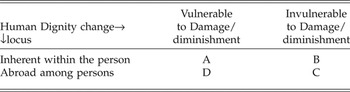
These two distinctions I have drawn (dignity as inherent/abroad; dignity as subject to change/unchangeable) are logically independent. Putting them together yields the following four possible combinations, each corresponding to a certain way of construing the concept of human dignity.
Moving clockwise through Table 1 above, consider some illustrations of these four possibilities.
Four Concepts of Dignity.

A-Dignity: Sometimes we see indignity in agents who lose their “cool,” or “temper.” We also often speak of those who find themselves in some humiliating predicament as seeking to extricate themselves from it with their “dignity intact” or a “shred of dignity.” In a more serious vein, we might say that physical torture or cruelty takes victims' dignity away. These formulations presuppose a notion of dignity that is inherent but vulnerable. One's “cool” refers to a disposition conveying serene and confident self-possession to observers; “temper” implies something similar. Both are lost when we are overwhelmed by some impulse that perceptibly undermines them (uncontrollable sobbing, flying off the handle, and so forth). Talk of dignity as something that can be “shredded” makes an implicit analogy between bodily laceration and damage to such aspects of one's dignity as (for example) one's self-confidence, credibility, or moral character (imagine a person's habitual deceit being suddenly exposed for the world to see), or even more directly, the ability to maintain control over physiological functions such as defecation, urination, or perspiration. Suggesting that torture or physical cruelty takes someone's dignity away similarly presupposes that it was with them in the first place. In all these cases, dignity consists in some features located within its bearer: the “cool” or temper that one might lose or maintain; the self-confidence, character, and bodily control that humiliating circumstances may “shred”; and a possession that cruel or violent treatment can (in effect) steal from us.
B-Dignity: The second possible combination, located in the northeast quadrant of Table 1, is illustrated by the view, familiar within many versions of Kantian and Christian ethics, that human dignity refers to an invulnerable “inner worth” within agents that grounds strong moral expectations (rights not to be wantonly killed, abused, terrorized, and so on), but that always remains unchanged regardless of whether those moral expectations are in fact met. This view has the challenging implication that no wrongdoing can be so extreme nor any humiliation, agony, or cruelty so severe as to alter or tarnish the moral dignity inherent in the personality of those who perpetrate or suffer them. Dignity is a possession that one cannot lose.
C-Dignity: In her heroic and intriguing defense of retributivist punishment, Jean Hampton drew an important distinction between “diminishing” treatment, which reveals or effects a lower status or worth, and merely “demeaning” treatment. “There is a difference,” she wrote,
between being demeaned and being literally lowered in value [diminishment]. A prince who is mistaken for a pauper and who therefore fails to receive royal treatment will regard this treatment as demeaning, not because he will believe or even worry that the treatment literally … causes him to lose his princely status, but because he will believe the treatment is too low for him given that princely status. It is because he believes he is not lower in status that he regards the treatment as insulting.Footnote 17
Insofar as Hampton's prince identifies his dignity in terms of his royal status, we have here a conception that exemplifies C-dignity. For it seems impossible to specify “royal status” simply as an inherent feature of the prince. It is rather a relational property, one that depends on his social recognition as royalty. Perhaps this is not a pure case, in that one might imagine social circumstances—a revolutionary overthrow of the monarchy, for example—in which that social recognition would evaporate, to the detriment of his dignity. In that case, the example trespasses onto the territory of D-Dignity. On the other hand, insofar as the practices constitutive of monarchical governance exist and are stable in a society, Hampton seems correct to say that the prince's dignity is impervious to local disrespect of the sort she describes. His dignity always emerges intact from any demeaning treatment (in Hampton's sense) he receives. The complaint against those who demean him in this way is not that something suffers damage, but rather that they have failed to attend to a stable social fact in the right sort of way.
Stephen Darwall's recent attempt to conceive of moral dignity in terms of “second-personal authority” appropriates this model for critical morality.Footnote 18 Although it is theirs to wield, second-personal authority in his sense is not simply an inherent feature of agents, but rather an aspect of their relation to the moral community they jointly constitute with all other agents. Here, the inherent reflexivity we discerned in dignitarian conceptions of personal worth is generalized across the community of persons, generating what Darwall sometimes calls a “common dignity.” In his account, then, moral practices (complaints, forms of resentment and indignation, ascriptions of wrongdoing, the recognition of moral duties, etc.) presuppose, and thereby in a sense constitute, the second-personal authority of all agents. The character of both wrongdoing and our moral reactions to wrongdoers is properly understood only from within the “second-person standpoint”. Yet neither those who wrong nor those who are wronged are thereby ejected from the moral community: in his account, nothing anyone can do can ever revoke or change anyone's standing within that community. Second-personal dignity is thus abroad but invulnerable.
D-Dignity: The discourse of social honor, fame, and reputation provide most familiar illustrations of our final category, inhabiting the table's southeastern cell. Reputation, “glory” and “good name” are abroad in a straightforward way, and are subject to damage, even destruction, as a result of interpersonal transactions of one sort or another. Although the concept of dignity is closely tied to that of honor, dignitarian philosophers usually sharply differentiate honor-related notions of dignity from those they believe fundamental to moral thinking. As we shall see, however, dismissing the possibility of a critical morality built around D-dignity may be a bad mistake.
These are just illustrations intended to clarify the possibilities mapped out in Table 1. I do not intend the typology to be taken too rigidly. The borders defining the table form permeable membranes, and so in the context of specific theoretical constructions, conceptions of human dignity may defy confinement within any one quadrant. Nor, as long as we are clear about the different senses in which we use them, must we choose between these options. In what follows, I will use this typology to put pressure on some familiar assumptions about the ethics of dignity, and to suggest that some less familiar dignitarian ideas have hitherto unappreciated promise. I would like to think, however, that the typology provides useful clarification whether or not my conclusions turn out to be sound.
VI. Putting Dignity to the Test
Section III suggested a number of desiderata that any conception of human dignity would have to satisfy in order to do what moral philosophers today often ask of it. We seek a conception that: is not simply a label or rhetorical trope that bears no substantive weight in critical moral argument; does not beg questions by simply repeating, under different labels, leading norms from the positive moralities for which it claims to account; is fully compatible with egalitarian moral principles; is genuinely secular; helps specify how the worth of persons is qualitatively distinct from, and irreducible to, other values; and—most crucially—explains why agents ought to find in the recognition of that personal worth (in themselves as well as others) an overriding reason to value and respect a range of “agent-centered restrictions.” In what region of my typology (if any) are we likely to find a concept of human dignity that does real philosophical work in showing that the worth of persons must matter to rational agents in that overriding way while simultaneously satisfying the other desiderata just listed?
We need not dwell at length on A-dignity. At least since Kant, dignitarian critical moralists have recognized A-dignity as a discrete category, but primarily in order to distinguish it from the unconditional “equal” dignity of persons that is their chief concern. Gewirth's complaints against (what he calls) “empirical dignity” are representative. Like most Kantians, Gewirth accepts that A-dignity is a real phenomenon and would concede that the relevant sorts of “gravity or decorum or composure or self-respect or self-confidence …” are objects of genuine moral concern. For example, no Kantian would deny that undermining someone's composure just for the fun of it (“winding people up”) is at the very least unkind. But rules proscribing such conduct are first-order expectations, features of some possible or actual set of positive norms directly regulating day-to-day interaction (in this instance, perhaps, closer to politeness than to morality). They are hardly serious candidates for bedrock principles of critical morality. More generally, since (by hypothesis) A-dignity “is a contingent feature of some human beings as against others … [that] … may be occurrently had, gained and lost,” it cannot yield a suitably egalitarian, or unconditional, account of human rights or moral constraints more generally. As Gewirth says, the qualities involved “are not always had by all human beings, let alone equally.”Footnote 19
The conclusion Gewirth and many others draw is that dignitarian critical moralists need a conception of human dignity that is static and unchanging rather than variable. As my typology shows, that conclusion could be premature: moving eastward on my chart is not the only direction available to those seeking an alternative to A-dignity. One could also go south, toward D-dignity. Later, I urge dignitarian critical moralists to move in just this direction. To see why the southwestern quadrant encompasses unexpectedly fertile ground for critical morality, however, we must first appreciate how regions east of the watershed prove surprisingly barren. I will focus mainly on B-dignity because of its current familiarity, though I will also discuss a problem that it shares with C-dignity. Nothing I say discredits the notions of B-dignity and C-dignity entirely and they may have many legitimate uses beyond those I consider here. My criticisms are aimed only at those who recruit them to the cause of critical morality, and even as such, these criticisms are provisional rather than definitive.
In order to play a basic role in authenticating (or indeed invalidating) the norms and expectations of positive morality, B-dignity must be recognizable apart from any conventional moral expectations about how persons should be treated. Otherwise, it will merely express, rather than independently justify, such positive moral conventions. But when a critical moralist invokes this inner possession of persons, to what does she refer? What could she do to persuade someone uncertain about whether persons possess B-dignity that indeed they do?Footnote 20 Unlike many of the aspects of persons identified with A-dignity, those involved in B-dignity lack clear empirical referents. When Smith blushes or “loses it” (note the possessive implication), we directly see that his dignity (here identified with his composure or temper) has deserted him. But if we just do not see B-dignity in this way, it is hard to see how pointing to any empirical data might persuade a skeptic to believe in a B-dignity that inheres in persons. In any case, efforts to predicate inherent worth on some empirical feature of persons run into the much canvassed problem that few, if any, of the most likely candidate features appear to be equally distributed across the human population.Footnote 21 This is bad news for those who look to B-dignity to generate a fully inclusive and egalitarian conception of the dignity of all agents.Footnote 22
From its inception, the Kantian tradition has recognized this difficulty but sidestepped it by simply denying that moral dignity is an empirical property of persons. For Kantians, the moral point of view is not one from which we observe ourselves as if from outside, third-personally, but one constituted by a special kind of reflexive attention. It involves the cultivation of a set of attitudes, dispositions, and forms of deliberation that appear appropriate, indeed compulsory, when rational agency attends to itself in the right way, and thereby comes to appreciate the force of moral reasons. Of course, rational agency is located (so far as we know only) within individuals identified on the basis of certain empirically discernable characteristics (possession of human DNA, opposable thumbs, and so on), and so in this sense we recognize rational agents on an empirical basis. However, it is one thing to perceive a rational agent, and another to attend to her for the purpose of reflecting on how she should be treated. As Richard Sorabji rightly points out, to attend to something one perceives “is not an extra bit of perception,” any more than to “realize that I saw my friend after my friend is no longer there to be seen” is to somehow see her.Footnote 23 It is to make her the object of one's thought in a fashion quite distinct from immediate sensory perception. The intimate connection between concepts of attention and respect, captured in Kant's frequent use of the term “Achtung” (which in German straddles both notions) here acquires special significance. On Kant's account, moral “respect” is not a form of empirical perception, but the mode (partly reflective, and partly affective) in which rational agency comes to its own attention as an object of moral significance. It does so, he claims, in the form of an inner dignity that commands respect.
I have no quarrel with this Kantian line, but doubt that B-dignity can adequately render the notion of inner dignity required by it. An initial difficulty is that in order to offer us a genuinely secular (rather than religious) moral position, the dignitarian critical moralist must show that the point of view within which inner dignity comes to our attention is intelligibly human rather than divine. Can this be true if inner dignity is construed as B-dignity? Insofar as persons come to our attention as possessors of B-dignity, we must discern in them (and ourselves) an inner dignity that cannot be altered by anything that they (and we) do or suffer. On this view, Christ enduring the torments of the cross and monsters like Hitler and Stalin can come to my attention as bearers of a dignity that has remained unchanged since their birth, despite their subsequent moral careers, and they can do so from within a recognizably human standpoint.
The current banality of talk about an unalterable dignity inherent in each of us may lead one to underestimate the strangeness and radicalism of such claims. Stoicism is often ridiculed for suggesting that even those tortured on the rack can retain their dignity (and with it the happiness that consists in tranquil imperturbability of soul). But not even Stoics maintained that this dignity is completely invulnerable, for they allowed that we can maim it by our own poor choices—in particular by identifying ourselves excessively with endeavors or goals whose outcomes lie beyond our control. Stoic dignity is inherent, yet vulnerable and therefore by my lights exemplifies A-Dignity rather than B-Dignity. Views that genuinely instantiate B-Dignity must not permit even our own delinquency to taint it. To invoke Stephen Darwall's useful language, we must be able to recognize B-dignity in Hitler and Stalin despite our appraisal of their moral depravity. However, while I do not doubt the logical coherence of this distinction between recognition-respect and appraisal-respect, I find it hard to imagine any intelligibly human standpoint from within which Hitler and Stalin can command our attention as bearers of a moral dignity that remains unaltered in the face of their deeds. They can do so, it would seem, only from the standpoint of one capable of superhuman sympathy and charity toward human wickedness. If in such cases B-dignity can be recognized only by a divine being, it is an inherently religious idea, and must have limited value for any critical morality aspiring to secularity.
Perhaps, though, this misses the point: if B-dignity is an inner possession, we should not seek it in others (least of all in exemplars of suffering and wickedness like Christ, Stalin and Hitler), but rather through introspection. A common suggestion along these lines is that attending to our own purposes and values automatically leads us to locate within our self-conception an inherent, unchanging, moral dignity. Gewirth's attempt to ground human rights on a doctrine of inherent, undamageable, personal dignity takes this route. He declares: “Every human agent must attribute worth to his purposes … [because he] regards his purposes as good according to whatever criteria enter into his purposes.” From this assumption of “agent-estimated worth” Gewirth infers that an agent must see him or herself as the “source” of this worth: “they are his purposes, and they are worth attaining because he is worth sustaining and fulfilling, so that he has what for him is a justified sense of his own worth.” The conclusion is that the “generic purposiveness” of rational action, just as such, “underlies the ascription of inherent dignity to all agents” (including oneself).Footnote 24
I see no reason to doubt that, as Korsgaard and Raz have suggested,Footnote 25 insofar as we are conscious of ourselves as having values at all, we presuppose the value of the valuers who have them, and therefore of ourselves. But it is one thing to say that persons have basic moral significance for that reason, a claim that (for example) no utilitarian need deny and that can be expressed without any recourse to the language of dignity, and another to say that attending to our valuings and purposive commitments from the inside should confirm us in the possession of a stable and unalterable moral worth on the model of B-dignity. The latter claim becomes especially problematic once we face up to the unsettling fragility of judgments about our worth mediated through inside contemplation of our values and aspirations. It is a truism that in engaging in actions and projects I presume them to be worthwhile. But it is also a truism that this presumption is often provisional, risky, and subject to revision, even falsification, at a later date. In the first blush of commitment and aspiration, we may experience the speculative quality of human activity as benign, even exhilarating. Over time, however, we often come to see its darker side: existential bets don't always pay off as we hope. Some discover themselves to be habitually lousy gamblers, often when it is too late to make a difference.
Clinical depression frequently presents as an intensely felt judgment that one's endeavors have proven vain and pointless on reflection. It would be convenient if we could confine ourselves to a clinical perspective and simply regard this phenomenon as a descriptive fact about likely human reactions to certain triggering experiences. Unfortunately, however, one sometimes has good reason to reach such conclusions: it may simply be true that one has wasted precious life time on relationships, careers, aspirations, and projects that were not worth the energy and trouble. When this is our fault (perhaps we were warned), we have reason to see ourselves as agents of our own humiliation and abasement. Despair may sometimes be the only honest response. This puts pressure on Gewirth's claim that attending to the way we attribute value to our purposes and pursuits should automatically induce a “justified sense of … worth” and inherent dignity. In at least some cases, it induces the self-indictment and conviction of worthlessness characteristic of depression: at the limit, it may lead one to consider suicide, and it is hard to see in that project an image of invulnerable human dignity and worth.
Perhaps this is an aberrant case, posing no threat to Gewirth's position. Depression is after all a disease, in some ways akin to insanity, and therefore nonrational. One might therefore think that those who reflect on their projects and purposes, even when they have gone badly awry, and fail to immediately affirm their B-dignity must be, for that reason alone, in the grip of some sort of false consciousness. But, apart from its spectacular begging of the question, such a response looks psychologically naïve. Freud was much nearer the mark when he suggested that depressive self-accusation “must surely be right in some way and … describe … something that is as it seems to” the sufferer. He went on to say that those in the throes of clinical depression have “a keener eye for the truth than other people who are not melancholic,” adding, mordantly, that “we only wonder why a man has to be ill before he can be accessible to a truth of this kind.”Footnote 26 Clearly, not everything about depression is rational, as Freud would have been the first to concede. Still, the despair and damaged self-worth that partly constitute it are sometimes the only honest and reasonable reactions to inside reflection on one's valuings and their vicissitudes. If so, it is hard to believe that reflexive attention of that kind automatically discloses a stable and unchanging moral worth or dignity within.
What of Kant's own approach, which is certainly quite different from Gewirth's? Kant's position is too complicated to permit extensive discussion here, but contemporary orthodoxy notwithstanding, the assumption that Kant's view depends on a notion of B-dignity is questionable. Even a cursory inspection of his views reveals the possessive and settled character of B-dignity to be quite at odds with the mechanics of Kantian moral psychology.
Kant analyzes moral agency not as a simple unity, but as a complex and dynamic set of internal relations among at least five aspects of the self. From within Kantian practical reason, I recognize: the (“noumenal”) “me” who commands obedience to the moral law; the (“empirical”) “me” who is continually tempted into disobedience and whose conceits must be struck down; the retrospective “me” who reflects on my moral career and assesses whether I am “worthy of happiness”; the “me” who other agents encounter and are supposed to treat with respect; and the “me” that encompasses all of these, the site at which they interact antagonistically to constitute moral agency. Which of these aspects might be construed as the possessors of B-dignity, and which is its location within the self are no simple matters.
These aspects certainly do not fall together to form an untroubled unity. To the extent that Kantian agency displays any structural integrity, it is sustained through tensions among these various internal aspects, of which powerful moral emotions such as awe, fear, intimidation, frustration, and a sense of elevation are symptoms. So, while it would be accurate, at a superficial level, to depict Kantian moral dignity as within the self, it would, I think, be still more accurate to describe it as an unsettled relation, like a dissonant chord that never resolves or achieves completeness and equipoise. Since that relation is not merely internal to the individual, but also one that describes the moral relations in which humanity as a whole stands to itself, dignity in this sense is not merely within individuals, but also in a sense abroad. Although I cannot show this here, I am confident that elaborating all this in its complexity would show that interpreting Kant's view as a simple B-dignity conception verges on caricature. What would emerge, rather, is a more sophisticated hybrid, some of whose most compelling aspects anticipate conceptions of dignity I will later defend under the heading of D-dignity.
A final problem with B-dignity also affects C-dignity, because it implicates any view that invests in a notion of dignity as unchanging. Consider again Hampton's prince/pauper example. The pauper's disrespect is inappropriate given the prince's royal dignity (a form of C-dignity), but no one's respect is needed to maintain dignity of this sort, because (by hypothesis) such dignity is invulnerable. The complaint against the pauper, then, cannot be that he damages the prince's C-dignity. Rather, it is that he has violated a norm within a particular positive morality internalized by prince and pauper alike. To ask whether such complaints have moral weight, then, ultimately requires an assessment of that positive morality itself. Yet how could a critical morality purporting to vindicate these and other positive moral norms argue that they are important for the sake of the prince's C-dignity, if there is nothing anyone can do to change or damage it? It would seem that it would either have to assess the relevant positive morality by nondignitarian (e.g., consequentialist) criteria, or that it would have to appeal to some aspect of the prince's dignity that needs to be defended. A dignity that requires defense, however, is presumably vulnerable in some way and hence neither C-dignity nor B-dignity.
The same applies when, as per the Kateb-Waldron thesis, we generalize invulnerable C-dignity to everyone and require equal respect for persons as such. The natural way to account for the overridingness that dignitarians want to claim for that requirement of respect is to treat it as a powerful or basic need, on a different plane from other concerns. But if human dignity is the source (and not just a positive moral expression) of that need it presumably is so because it is somehow in need of defense and, hence, vulnerable in some way. Neither B-dignity nor C-dignity delivers such a concept.
VII. For Our Sake
However, D-dignity does, and so may hold untapped potential for dignitarian critical morality. In conclusion, I develop this possibility. Although what follows does little more than gesture in a direction, I hope to at least suggest how a commitment to D-dignity might be integral to critical moral reflection in a way that avoids some of the difficulties we have identified here.
When I introduced D-dignity, I illustrated it using examples drawn from the practices of social honor, in which agents' “name” or prestige fluctuates (in part) in accordance with the treatment they receive. Suppose, as a first step, that we preserve the essential structure of such practices, but substitute for such concepts as “name,” “face,” “reputation,” “infamy,” “glory,” “prestige,” and so forth, around which honor discourse characteristically revolves, the concept of a person's sake. Despite its currency in both philosophical and everyday moral discussion, the word “sake” is not well understood. It originated as a term signifying a cause of dispute or conflict (from the Old English “sacan” to “quarrel, fight, claim at law, accuse”; the Old Saxon sakan “accuse”: Old High German sahhan to “strive, quarrel, rebuke”). In due course, it became a word for a lawsuit and more generally for a “cause,” in the sense of “he gave his life for the cause.”
Sake as cause in this sense has several relevant properties. First, such causes normally face resistance and incite contention; they must be fought for and (as in legal proceedings) outcomes are uncertain. Second, causes in this sense are objects of our choice. Not only do we choose which side to be on, we also make judgments about the relative worth of different causes. Yet, while these latter are decisions about the effort we are prepared to expend in furthering them, to depict them as cost-benefit calculations, simply preferences about what costs we are willing to incur in order to obtain something we desire, misses a large part of their character. Far more centrally, these are judgments expressing rankings of importance and priority, rather than preferences or desires. Accordingly, ordinary language classifies our efforts for the sake of such causes, not as measurable amounts of energy (or even time), but rather as deployments of our powers that we describe as more and less urgent, important or worthy. The issue is far more about when our efforts are called for (e.g., when we should “drop everything” and head to the emergency room, wade into Singer's pond, and so on), and about how single-minded and determined they should be, than about how much personal expense it is reasonable for us to incur given some estimate of personal gain.
Two things follow: (1) what people actually do (and how, in what spirit, and so forth) for the sake of causes informs observers about the sort of importance they attach to those causes or “sakes”; (2) these importance-rankings (How urgent? How strong a priority? How overriding? How supreme? etc.) in principle cannot be adequately represented as a quantum of some disposable substance (money, labor, time) agents give up in acting for something's sake. They reflect exercises of human powers that are not fully quantifiable.
Suppose now that we combine these considerations with the conception of sake as abroad as Hopkins understood it and treat human dignity as (a) an essential part of persons' sakes in that sense and (b) conferred by respect-displaying conduct. In such a view, each of us separately, and humanity collectively, become causes worth fighting for, “sakes” that we rank as of higher and lower importance or worth. The degree of respect agents actually accord them then represents the dignity respecters actually confer upon them. (Note here how “degree” implies height and altitude, higher and lower planes, etc., and how for that reason, we would not ordinarily speak of a “high degree of expense/cost” or a “low degree of benefit”).
The result, I submit, is a fundamentally nonpossessive account of human dignity that nonetheless preserves the idea that the worth of persons supersedes, in part because it is incommensurable with, other concerns. Rather than an inherent property of the person, dignity is here construed as a common responsibility consequent upon a circumstance plausibly basic to the conditions of human life: our power to confer importance, priority, and worth on each other by respecting (or showing respect), and concomitantly upon our power to withhold such importance, priority or worth from them by treating one another with contempt. My proposal is that this feature of the human condition might play the same formal role in a dignitarian critical morality as that played by the rational interest in welfare and the avoidance of suffering in the critical morality of classical utilitarianism. A fully worked out theory along these lines would yield a non-utilitarian, non-eudaimonistic, non-rights-based account of moral rules and their point. Its leading idea would be that respect for persons (and associated deontological side-constraints, however specified) acquires special urgency in practical reasoning because without it the dignity essential to persons' sake (and hence their sake itself) would be damaged or destroyed.
This is a regrettably compressed account of a complex hypothesis. Whether it can be vindicated remains to be shown. However, several advantages over the more traditional alternatives considered above are already apparent. To begin, this conception offers the critical moralist a thoroughly humanized notion of dignity. It dispenses with any idea that human dignity is a metaphysical or religious quality, present to consciousness as an impervious, constant rational directive preempting our own judgments about how to respond to and treat people. It instead takes human dignity to consist in the ways we choose to dignify each other through conscious patterns of mutual respect, thereby making our dignity a concrete consequence of human action and placing its fate firmly in our hands.
In traditional accounts built around the assumption of an inherent and/or unchanging, moral status, citations of human dignity in contrast function rather like passports offered at a border, authenticating rights to certain sorts of treatment. Just as the presentation of a valid passport directs the border guard to let us through automatically, the rational certification of our inherent dignity, or our unimpeachable second-personal authority, dictates the forms of consideration and respect due to us. But the politics of border control is a poor model for the ethics of human dignity. Torture attacks human dignity, but it is not plausibly understood as a species of insubordination or improper resistance to a legitimate authority. At stake is not the authority of the victim over her torturer, but the power of the torturer over his victim. Torture, and the indignity it implies, is possible at all only because in principle, humans wield a terrifying power over each other, the power to humiliate, domineer, abuse, and violate, a power we summarize as disrespect. That power is an unfortunate fact of life, but we do our moral thinking no favors by ignoring it, or pretending that human dignity consists in a form of authority or moral status invulnerable to any abuse, no matter how cruel. While logically coherent, conceiving human dignity as untouchable in that way is morally blind.
The sort of critical morality suggested here instead confesses to our mutual vulnerability with open eyes. It allows, in a way that may seem disturbing, that (say) my dignity is in some sense hostage to your (and indeed my own) disrespect. But in seeing us at the same time as respecters, it also implies that each of us shares in the power to dignify values, persons, achievements, and so forth by engaging in action that marks them as especially important, more highly ranked, or of greater priority in our hierarchy of concerns. When we abuse that power by belittling, contemning, trivializing, and degrading people, we do not diminish a dignity that can be isolated as a possession of its immediate victims, for we at the same time debase our humanity itself. Its action, positive and negative, is always abroad, something that is our responsibility.Footnote 27
Another advantage of this approach is that it shifts the focus of dignitarian concern away from the juridical categories of “status” and “authority” and puts it where it intuitively belongs, centered on the idea of personal worth and its accurate social representation. When sincere respect is triggered by (what David Velleman calls) an “arresting” awareness of someone's true value,Footnote 28 any dignity that that respect visibly confers in principle conveys information about how her value has affected the respecter. She comes to know something of how she is abroad in the appreciated repercussions of her worth, as it has come to the attention of others. This also naturally suggests a promising account of our rational interest in human dignity, and may go some way toward explaining the sense in which it is a fundamental need, which, as we saw earlier, is the most natural way to account for the overriding importance claimed for personal worth in dignitarian theories. In doing so, it helps construe John Rawls's crucial but telegraphic claim that “in a public utilitarian society, men will find it more difficult to be confident of their own worth.”Footnote 29 For, in refusing to confer on moral rules protecting agent-centered restrictions the dignity of priority or urgency, such a society signals its willingness to treat people disrespectfully when this improves the prospects of the many. Its failure to demand unconditional respect for those moral rules amounts to a failure to dignify them appropriately, and in failing to dignify (bestow special importance on) those rules, it fails to dignify those whom the rules protect, to the detriment of our common human dignity.
We have some reason to hope, therefore, that this line of argument may eventually yield a compelling critical moral rationale for agent-centered restrictions in which the concept of dignity plays an essential role. For surely moral rules should not matter for the sake of God, “duty itself',” “overall welfare,” or for other comparably alienating, dehumanizing abstractions. They ought to matter for our sake.