Introduction
Parents who are typically children’s primary caregivers are the most common conversational partner for their children in early childhood. Parental linguistic input plays a key role in child language development (Bang & Nadig, Reference Bang and Nadig2015; Bottema-Beutel & Kim, Reference Bottema-Beutel and Kim2020; Fusaroli, Weed, Fein & Naigles, Reference Fusaroli, Weed, Fein and Naigles2019; Hoff & Naigles, Reference Hoff and Naigles2002; Huttenlocher, Haight, Bryk, Seltzer & Lyons, Reference Huttenlocher, Haight, Bryk, Seltzer and Lyons1991; Rowe, Reference Rowe2012; Snow, Reference Snow1977; Swanson, Reference Swanson2020; Venker, Bolt, Meyer, Sindberg, Ellis Weismer & Tager-Flusberg, Reference Venker, Bolt, Meyer, Sindberg, Ellis Weismer and Tager-Flusberg2015; Warren, Gilkerson, Richards, Oller, Xu, Yapanel & Gray, Reference Warren, Gilkerson, Richards, Oller, Xu, Yapanel and Gray2010; Wolchik, Reference Wolchik1983), and parents are the ones facilitating the child’s socialization in the community (e.g., Andreadakis, Joussemet & Mageau, Reference Andreadakis, Joussemet and Mageau2019; Brownell, Svetlova, Anderson, Nichols & Drummond, Reference Brownell, Svetlova, Anderson, Nichols and Drummond2013; Maccoby, Reference Maccoby, Parke, Ornstein, Rieser and Zahn-Waxler1994). Everyday interactions with caregivers also help children achieve other cognitive feats. For example, acquiring a sense of self, the understanding that one is different from others, is deeply rooted in everyday conversations, where parents continuously delineate the difference between self and other with every reference to themselves and their child. In fact, one of the most frequently used words in the English language (in spoken contexts) is the first-person singular pronoun ‘I’ (see Brown, Reference Brown1984; Pennebaker, Reference Pennebaker2011). Understanding personal pronouns along with other frequently used instances of person-reference (e.g., honey, sweetie, baby, Mony [shortened proper name], mommy) in child-directed speech is central to successful conversations. Considering the functions and high frequency of person-reference in parental input, it is important to examine how structural differences across languages along with cultural differences in discourse practices affect the way parents refer to themselves and their children. Focusing on person-reference for children with autism spectrum disorder (ASD), in particular, presents a unique opportunity to examine how parents address their children, who have difficulty using personal pronouns and understanding discourse roles (e.g., Carmody & Lewis, Reference Carmody and Lewis2012; Lee, Hobson & Chiat, Reference Lee, Hobson and Chiat1994; Tager-Flusberg, Reference Tager-Flusberg1994), and for whom this aspect of parental input might be especially important. In the present study, we compare how Bulgarian and English-speaking parents refer to themselves and their children with ASD during a free play interaction. Bulgarian parents were chosen for comparison because their language and discourse practices in relation to person-reference are sufficiently different from those of English-speaking, North American parents.
Person-Reference in ASD
Autism spectrum disorder (ASD) is a neurodevelopmental disorder characterized by social communication difficulties and restricted and repetitive behaviors (American Psychiatric Association, 2013). How children with ASD use person-reference – refer to themselves and others – has been extensively studied. Almost every description of language ability in ASD mentions difficulty with personal pronouns (e.g., Kanner, Reference Kanner1946; Luyster & Lord, Reference Luyster2009; Rutter, Reference Rutter, Rutter and Schopler1979; Tager-Flusberg, Paul & Lord, 2005). Some studies relying on natural language sampling report relatively low prevalence of pronoun reversal errors, when children use ‘you’ instead of ‘I’ or the other way around, in English-speaking participants (<1% in Barokova & Tager-Flusberg, Reference Barokova and Tager-Flusberg2019; 3% in Naigles, Cheng, Rattansone, Tek, Khetrapal, Fein & Demuth, Reference Naigles, Cheng, Rattansone, Tek, Khetrapal, Fein and Demuth2016; 13% in Tager-Flusberg, Reference Tager-Flusberg1994). Other studies relying on pronoun elicitation tasks report pronoun avoidance – their participants do not reverse their pronouns but are more likely to use nouns and names as compared to typically developing (TD) controls. This was found in English-speaking children (Lee et al., Reference Lee, Hobson and Chiat1994), in Italian-speaking children (Mazzaggio & Shield, Reference Mazzaggio and Shield2020), and in native American Sign Language signers (Shield, Meier & Tager-Flusberg, Reference Shield, Meier and Tager-Flusberg2015). Nevertheless, the majority of studies in the field are conducted with English-speaking participants with ASD, thus providing a more limited Anglo-centric view of person-reference (for a review see Finnegan, Asaro-Saddler & Zajic, Reference Finnegan, Asaro-Saddler and Zajic2020), and focusing only on the use of pronouns and names. The presentation of person-reference in ASD could vary based on the structural characteristics (syntax and morphology) of the language, and this has been shown in null-subject, pro-drop languages and in languages that use pronominal clitics (e.g., Durrleman & Delage, Reference Durrleman and Delage2016; Terzi, Marinis, Zafeiri & Francis, Reference Terzi, Marinis, Zafeiri and Francis2019). Children with ASD who speak pro-drop languages (in which pronouns can be omitted) avoid personal pronouns by using nouns and names (in Italian: Mazzaggio & Shield, Reference Mazzaggio and Shield2020) and determiner phrases (in Greek: Terzi et al., Reference Terzi, Marinis, Zafeiri and Francis2019). Children with ASD, who speak languages with pronominal clitics, typically comprehend and produce these clitic forms less than TD controls (Durrleman & Delage, Reference Durrleman and Delage2016; Fortunato-Tavares, Andrade, Befi-Lopes, Limongi, Fernandes & Schwartz, 2015; Terzi, Marinis & Francis, Reference Terzi, Marinis and Francis2016; Terzi, Marinis, Kotsopoulou & Francis, Reference Terzi, Marinis, Kotsopoulou and Francis2014).
Although there are cross-linguistic differences in the use of person-reference by children with ASD, no study has examined how their parents use person-reference in languages other than English. Furthermore, even in English, only two studies to date have looked at parents’ use of person-reference. One study showed that parents of infants who have an older sibling with ASD use their child’s name significantly more than parents of TD infants (He, Luyster, Hong & Arunachalam, Reference He, Luyster, Hong and Arunachalam2018). A second study with children with ASD showed that parents’ use of personal pronouns correlated with children’s use of personal pronouns at 3 years of age (Barokova & Tager-Flusberg, Reference Barokova and Tager-Flusberg2019). To build on and expand past research, the present study compares how parents of Bulgarian and English-speaking children with ASD use person-reference in everyday interactions.
How do parents refer to their children and themselves in everyday interactions?
Person-reference in everyday interactions can be categorized based on referent (who is being referred to: self vs. other), and form (how one is being referred to). In terms of referent, because parents are the most common other for their children early on, and because the acquisition of third person reference has been reported to follow a different developmental trajectory (e.g., Scholes, Reference Scholes1981), we only focus on parents’ reference to themselves and their child, and not on reference to other people.
In terms of form, to provide a comprehensive account we focus on four distinct ways parents refer to their children in everyday interactions: personal pronouns, names, terms of endearment, and kinship terms. Background information on Bulgarian and English is presented first and then each person-reference form is described in turn with cross-linguistic differences emphasized.
Background Information on Bulgarian
Bulgarian belongs to the family of Indo-European languages. More specifically, it is one of the South Slavic languages along with Macedonian (Gordon, Grimes & Summer Institute of Linguistics, 2005). In contrast, English belongs to the Indo-European Germanic language family along with German among others (Gordon et al., Reference Gordon and Grimes2005). Bulgarian is written in Cyrillic, while English uses Latin script. Unlike English, which has many dialects used in different regions and countries, there are only two broad dialect areas in Bulgarian: Western and Eastern with written Bulgarian following the Eastern dialect norms. Bulgarian has a very rich morphology, with verb forms marked for person, gender, number, tense, voice, aspect, and mood. Perhaps, the most distinct grammatical feature of Bulgarian is the presence of evidential verb forms, which indicate whether the speaker witnessed, inferred, or simply reports the information/event.
Unfortunately, there is a dearth of studies examining language acquisition in Bulgarian, and even fewer that have relied on the collection of natural language samples. As a result, there is no information on word frequency in child-directed speech in Bulgarian. This study is one of the first to examine parental input in Bulgarian, albeit input to children with ASD.
Personal Pronouns
Personal pronouns are one of the most common ways in which parents, and speakers in general, verbally distinguish themselves from their conversational partners in everyday interactions. Despite being used frequently, in the context of child-directed speech, pronouns are difficult to acquire and comprehend because of their shifting referent depending on who the speaker is.
In English, personal pronouns take different forms based on grammatical person and number, natural gender and case (for details see Table 1 A).
Personal pronouns in the English language.

Note. Singular ‘they’ was not found in the transcripts coded in this study.
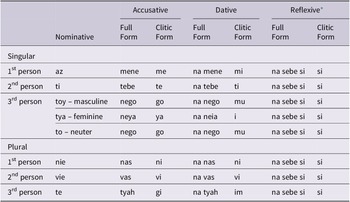
In Bulgarian, personal pronouns are also characterized by grammatical person, number, gender, and case (see Table 1 B). However, one of the differences between English and Bulgarian pronouns is that, in Bulgarian, both reflexive personal pronouns and also personal pronouns in the accusative and dative case have a full form and a clitic form (a shortened form that is syntactically independent but phonologically bound to another word). A unique feature of Bulgarian pronominal clitics is that they are subject to obligatory doubling in specific contexts (Kuehnast, Reference Kuehnast2009; Schick & Beukema, Reference Schick and Beukema2001). For exampleFootnote 1 :
-
(1) Na men mi e studeno.
-
To me me is cold.
-
‘I am cold.’
Personal pronouns in the Bulgarian language.

* Reflexive personal pronouns also change by case (accusative and dative). Here only the dative (full and short) forms are included.
Personal pronouns: pronoun dropping
In addition to the different forms of personal pronouns and their obligatory doubling, how parents use them can be affected by the syntactic and pragmatic rules in the language. In Bulgarian, as a null-subject, pro-drop language, pronouns can be omitted when they can be inferred based on the grammar or the pragmatic context (Kiss, Reference Kiss1995). Because Bulgarian verbs are inflected for person, number and gender, the subject of the verb can often be inferred, which allows for its omission, as in:
-
(2) Iskam voda.
-
want(1SG) water
-
‘I want water.’
In its null-subject, pro-drop quality as well as rich verb inflection system Bulgarian resembles Italian and Spanish – from the more commonly researched languages. To our knowledge, there are few studies examining the use of personal pronouns in child-directed speech to Italian or Spanish-speaking children and comparing it to that of English-speaking children (e.g., Tardif, Shatz & Naigles, Reference Tardif, Shatz and Naigles1997). In Tardif et al. (Reference Tardif, Shatz and Naigles1997), Mandarin-, Italian-, and English-speaking parents of TD children were compared on their use of pronouns (not just personal pronouns) that appeared in the subject position. They found that Italian- and Mandarin-speaking parents dropped significantly more syntactic subjects than English-speaking parents, who were more likely to pronominalize the sentence subjects (use ‘it’ instead of ‘the car’). Different rates of pronoun dropping were observed based on the function of the utterances.
Based on the findings from this study showing lower rates of pronouns (higher rates of pronoun dropping) in Italian (Tardif et al., Reference Tardif, Shatz and Naigles1997), we hypothesize that Bulgarian parents will use fewer personal pronouns than English-speaking parents when they are referring to themselves and their children.
Names
Another way parents refer to their children in everyday interactions is with their name. Parents can opt for the child’s full name, shortened version of the full name or various nicknames (e.g., Jonathan, Jon, Johnny). In English, there are some conventional abbreviations of proper names (e.g., Richard -> Dick), but also names are shortened based on the preference of the family (e.g., Kayla -> Kiki). Names in Bulgarian are shortened in a similar fashion based on the preference of the family (e.g., Kalina -> Kiki) and following conventional abbreviations (e.g., Aleksandar -> Sasho; Ivan -> Vanio). However, full names can also be turned into nicknames through lengthening by adding different suffixes that mark diminutives (e.g., Ivan -> IvanCHO, IvanchENCE). Names used in conversations are easier to comprehend than personal pronouns because they typically have a fixed referent (Johnny talking with his mother is the only Johnny in the interaction). Durkin, Rutter and Tucker (Reference Durkin, Rutter and Tucker1982) reported that parents’ use of their TD children’s name was not related to the children’s age but rather to the communicative situation, with names being used primarily to attract attention and to provide instructions. Because we do not have any a priori hypotheses about potential differences in parents’ play or communication style, we do not predict any differences in the use of names across Bulgarian and English-speaking parents.
Terms of Endearment. In addition to names, parents can use a wide range of nouns to address their child, such as ‘honey,’ ‘sweetie,’ ‘baby,’ ‘love,’ ‘sugar’. We call these terms of endearment. In Bulgarian, terms of endearment are often diminutive forms – for example, ‘slunchice’ [diminutive of sun], ‘pilence’ [diminutive of bird/birdie], ‘zaiche’ [diminutive of rabbit/bunny], ‘zaharche’ [diminutive form of sugar], but also ‘bonbon’ [candy]. Because it is up to the parent to choose how often to use terms of endearment with their child (and which particular terms), we do not predict language differences in their use.
Kinship Terms
Another way parents can refer to themselves and their children is with kinship terms – denoting the relationships between family members. Although it is common for parents across languages to use kinship terms to refer to themselves (e.g., a mom talking about herself in 3rd person and using ‘mommy’), only in Bulgarian is it acceptable from a discourse point of view for the parent to use kinship terms that would belong to them (e.g., ‘mother’, ‘mama’) to refer to their child. Although not extensively studied, this phenomenon has been reported for Arabic speakers (Aljenaie, Reference Aljenaie2006). A related but not as extensive use of kinship terms is found in Spanish speakers using ‘mami’ and ‘papi’ to refer to female and male children respectively and to other adults as well. Because the use of kinship terms has not been examined systematically (although there is some anecdotal evidence reported in the CHILDES forum), we only predict that Bulgarian parents will use them more than English-speaking parents.
Because of the acceptable use of kinship terms in Bulgarian along with personal pronouns, names and terms of endearment, we predict that Bulgarian parents will use significantly more different ways to address their children than English-speaking parents.
In summary, we compare person-reference in parental input to Bulgarian- and English-speaking children with ASD matched on language ability. We use a natural language sampling approach to examine parental input that is representative of everyday interactions, and focus on person-reference not just in terms of personal pronouns, but also in terms of names, nouns, and kinship terms providing a more comprehensive account of the phenomenon.
Methods
Participants
Institutional Review Board (IRB) approval for the project, and informed consent from each family, were obtained prior to participant enrollment.
Bulgarian-speaking Sample
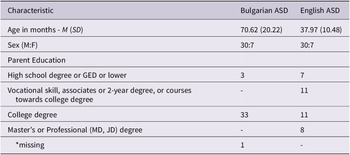
37 (7F) Bulgarian-speaking children between 2;7 and 9;10 years (M = 70.62 months, SD = 20.22) and their primary caregiver participated in this study (Table 2). They were recruited from posts on parent online forums, and from local centers providing services for children with developmental disorders in Sofia, Bulgaria. All children had a community diagnosis of ASD or PDD based on ICD-10 (WHO, 2003). Their diagnosis was confirmed with the administration of the Autism Diagnostic Observation Schedule-2 (ADOS-2; Lord et al., 2012). No information about race and ethnicity was collected from the Bulgarian-speaking sample.
Demographic characteristics of the Bulgarian-speaking and English-speaking children with ASD

English-speaking Sample
37 (7F) English-speaking children with ASD between 1;8 and 4;9 years (M = 37.97 months, SD = 10.48; Table 2) were included in this study. These participants were part of a larger study examining developmental trajectories in ASD conducted in Massachusetts, USA (see Luyster, Kadlec, Carter & Tager-Flusberg, Reference Luyster, Kadlec, Carter and Tager-Flusberg2008 for details; Barokova & Tager-Flusberg, Reference Barokova and Tager-Flusberg2019 drew on the same dataset). All children had an autism diagnosis confirmed with the administration of the Autism Diagnostic Observation Schedule-General (ADOS-G; Lord, Risi, Lambrecht, Cook, Leventhal, DiLavore, Pickles & Rutter, Reference Lord, Risi, Lambrecht, Cook, Leventhal, DiLavore, Pickles and Rutter2000) and the Autism Diagnostic Interview-Revised (ADI-R; Lord, Rutter & Le Couteur, Reference Lord, Rutter and Le Couteur1994). In terms of race, 30 of the children were white, 4 had more than one race, and 3 had missing data. In terms of ethnicity, 34 of the children were Non-Hispanic, and 3 had missing data.
Procedure
Bulgarian families’ participation consisted of one or two visits to a testing space in one of three centers providing services for children with developmental disorders in Sofia, Bulgaria. During the visits, the parents filled out a demographic questionnaire, a communication development questionnaire and an autism screener. In the meantime, the children were administered the ADOS. After that, the parent-child interaction data were collected. Data collection took place in two waves: in the summer of 2018 and in the summer of 2019.
English-speaking participants took part in a longitudinal study testing them once a year for three consecutive years. For each visit, demographic information was collected from the child’s parents. In addition, a battery of standardized assessments was administered to the child to confirm their autism diagnosis and to assess their cognitive and language abilities. Data collection took place between 2003 and 2007. After one-to-one matching with Bulgarian participants based on language level operationalized as number of different words produced per minute during parent-child interaction, data from only one time point were used per English-speaking participant.
Demographic Information
Parents filled out a demographic questionnaire asking about their child’s age, sex, and diagnosis, and about parent education (Table 2).
Diagnostic Confirmation
Both participant samples were administered the ADOS to confirm the children’s ASD diagnosis. The ADOS is a semi-structured behavioral assessment consisting a series of activities, which allow for the observation of core autism symptoms. Different modules are administered based on the chronological age and language ability of the child. The ADOS-2 (Lord, Rutter, DiLavore, Risi, Gotham & Bishop, Reference Lord, Rutter, DiLavore, Risi, Gotham and Bishop2012) was used with the Bulgarian sample, and the ADOS-G (Lord, Risi, Lambrecht, Cook, Leventhal, DiLavore, Pickles & Rutter, Reference Lord, Risi, Lambrecht, Cook, Leventhal, DiLavore, Pickles and Rutter2000) was used with the English-speaking sample. Because different versions were used (the most up to date at the time of testing), this does not allow for a comparison of scores across the two samples.
Parent-Child Interactions
A parent-child interaction was videorecorded, while the parent was engaging their child in free play with developmentally appropriate toys. The set of toys included a baby doll, 2 firefighter hats, 2 balls, 2 cars, 2 school buses, 2 sharks, a puzzle with numbers, 2 musical toys, and a set of building blocks. The parent was instructed to play with their child as they normally would at home.
The parent-child interactions (PCIs) from both the English and Bulgarian samples were video-recorded and later transcribed using the Systematic Analysis of Language Transcripts-12 software (SALT; Miller & Iglesias, Reference Miller and Iglesias2012). The PCIs were transcribed for speech and segmented into communication units defined as independent clauses with their modifying clauses (Loban, Reference Loban1976). Each PCI was transcribed by a trained transcriber, then checked by a second transcriber. Disagreements were resolved through consensus. Number of Different Words produced by the child was extracted from all transcripts using SALT-12, and number of different words per minute (NDW) was computed to account for the different duration of the interactions.
The Bulgarian- and English-speaking children with ASD were matched on sex (30 males and 7 females) and NDW during the PCI (BG: M = 2.83, SD = 3.30; ENG: M = 3.06, SD = 3.37; Mann-Whitney U = 701, p = .858). The choice of this language measure for matching the participant groups was motivated by past literature showing that when children with ASD and TD were matched on expressive vocabulary, there were no differences in their parental input in general measures of communication (e.g., number of word tokens, word types, number of different words; for review see Nadig & Bang, Reference Nadig, Bang and Naigles2016). Because the children could not be matched on age, their age in months was included in the regression analyses.
Person-Reference Coding
Transcripts were coded for how the parents referred to and addressed their child and themselves. At Step 1, each instance/token of person-reference was coded for referent or who was being referred to (child vs. parent). At Step 2, each token of person-reference was coded for form or how the child/parent was being referred to (personal pronoun, name, term of endearment or a kinship term; see Table 3). Note that in the Bulgarian transcripts we coded both the full pronoun forms and the short clitic forms. We also counted the number of different ways the parent referred to their child within each form category, as well as the total number of different ways across categories (e.g., 4 different names: Jonathan, Jon, Johnny, Joe; 2 different terms of endearment: honey, sweetie, for a total of 6 different ways).
Person-Reference coding scheme of parental input. Coding every instance of person-reference for referent (who) and for form (how)

% The kinship terms were adjusted to account for the identity of the adult (mother, father, grandparent).
& The use of kinship terms to address the child was only found in the Bulgarian transcripts.
Coding reliability was achieved separately for English and Bulgarian. Prior to coding for reliability, each coder coded 3-4 files and received extensive feedback after each one. All transcripts were coded by the first author. A native English speaker coded 24% (N = 9) of English transcripts, and a native Bulgarian speaker coded 24% (N = 9) of the Bulgarian transcripts. Reliability was computed by calculating an intraclass correlation coefficient (ICC) between the primary coder’s and the second coder’s codes. ICC of .95 was achieved for Bulgarian, and .99 was achieved for English.
Person-reference codes were extracted from each PCI using either the first 10 minutes of the interaction or, when the PCI was shorter, its full duration (7 out of the 74 PCIs). First, we computed the relative frequency of each form of person-reference (personal pronouns, names, terms of endearment, or kinship terms) as a percentage out of total child-reference tokens. This allowed us to account for the variability in total number of person-reference tokens across participants (as done in He et al., Reference He, Luyster, Hong and Arunachalam2018; Tardif et al., Reference Tardif, Shatz and Naigles1997). Second, we operationalized the number of different ways parents referred to their child as a child-reference type-token ratio. This ratio was computed as the number of different types of ways parents addressed their child (e.g., ‘honey’ and ‘sweetie’ would be two different types even though they belong to the same person-reference form of terms of endearment) out of total number of child-reference tokens.
Analysis Plan
Person-reference codes from the transcripts were imported and analyzed using the Statistical Package for Social Sciences Version 26.0 (SPSS 26.0). All analyses were conducted separately for parents’ reference to their child and parents’ reference to themselves. First, we reported the number of Bulgarian- and English-speaking parents who used each person-reference form. Then we compared the relative frequency of each person-reference form and type-token ratio across languages (Bulgarian vs. English) by running a series of multiple linear regressions. In each regression, we regressed the relative frequency of a person-reference form (pronouns/names/terms of endearment/kinship terms) onto the child’s age and language (Bulgarian vs. English). Regression analyses allowed us to look for cross-linguistic differences, while controlling for children’s chronological age. Bonferroni correction for multiple comparisons was applied to all regression analyses.
Results
First, we examined the number of parents who used each of the person-reference forms to refer to their child. As can be seen in Table 4A, almost all Bulgarian (N = 35) and all English-speaking (N = 37) parents used personal pronouns to address their child. The number of parents who used their child’s name was much lower for both groups with only 9 Bulgarian and 7 English-speaking parents using it. There were group differences in the use of terms of endearment, where over twice as many English-speaking parents (N = 23) used terms of endearment than Bulgarian-speaking parents (N = 10). However, the majority of Bulgarian-speaking parents (N = 32) used kinship terms to address their child, whereas none of the English-speaking parents did.
The number of parents across groups, who used each form of person-reference.

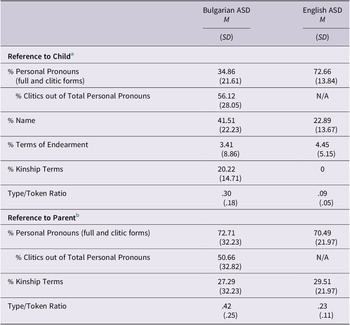
The relative frequency of person-reference forms (pronouns, names, etc.).

a All 37 Bulgarian and 37 English-speaking parents were included in these computations.
b One Bulgarian parent did not use any reference to themselves and was excluded from these analyses.
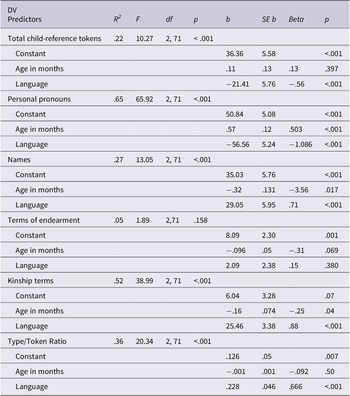
Overall, English-speaking parents used an average of 40.46 (SD = 19.52) person-reference tokens to address their child during the PCI, while Bulgarian-speaking parents used only 22.57 (SD = 14.66) tokens. A multiple linear regression model revealed that 22% of the variance in the total number of child-reference tokens was explained by variance in child age and language operationalized as NDW produced by the child during the PCI (Table 5A; F(2, 71) = 10.27, p < .001, R2 = .22). Language was the only significant contributor to this model (p < .001). Speaking Bulgarian during the interaction rather than English was associated with a lower number of child-reference tokens, even after accounting for child age. That is, Bulgarian-speaking parents, on average, addressed their child less than English-speaking parents.
Regression analyses predicting parents’ use of person-reference to their child. Multiple comparisons correction (p = .05/26 = .002)

Regression analyses predicting parents’ use of person-reference to themselvesFootnote @ .

@ One Bulgarian parent did not use any reference to themselves and was excluded from these analyses.
Statistics: R2 = R-square; F = F-test for the significance of the model; df = regression degrees of freedom, residual degrees of freedom; b = unstandardized beta coefficients; SE b = standard error of the beta coefficients; Beta = standardized beta coefficients.
Next, we examined the relative frequencies of person-reference forms across the two language groups (see Table 4B). English-speaking parents most frequently used personal pronouns when referring to their child, at a rate of 72.66% (i.e., on average, 72 out of 100 child-reference tokens were personal pronouns). In contrast, Bulgarian-speaking parents only used personal pronouns to refer to their child at a rate of 34.86%, out of which 56% were clitic forms. A multiple linear regression model revealed that 65% of variance in personal pronoun use was explained by variance in child age and language (F(2, 71) = 65.92, p < .001, R2 = .65; see Table 5A). Both age and language added significantly to this prediction (p < .001). One unit increase in child age was associated with 0.57 unit increase in personal pronouns, while holding language constant. This suggests that the older the child, the more pronouns their parents used when referring to them. Speaking Bulgarian was associated with 56.56 unit decrease in personal pronouns, while holding child age constant. Therefore, as predicted, Bulgarian-speaking parents, on average, used significantly fewer pronouns than English-speaking parents, even while controlling for their children’s age.
The second most frequently used form of child-reference for English-speaking parents was the child’s name, used at a rate of 22.89%. In contrast, Bulgarian-speaking parents used it the most out of all child-reference forms, at a rate of 41.51% (see Table 4B). Another multiple linear regression model revealed that speaking Bulgarian was associated with significantly more child name tokens used (p < .001; see Table 5A).
Terms of endearment were used scarcely by both English-speaking (M = 4.45, SD = 5.15) and Bulgarian-speaking parents (M = 3.41, SD = 8.86), and there was no statistically significant difference between the groups (see Table 5A).
The last form of child-reference, kinship terms, was not used by English-speaking parents at all, but was used at a rate of 20.22% by Bulgarian-speaking parents (see Table 4B). As predicted, our regression model showed that Bulgarian-speaking parents used significantly more kinship terms than English-speaking parents (see Table 5A).
In terms of the number of different ways parents used to address their children, the type-token ratio of English-speaking parents (M = .09, SD = .05) was significantly lower than that of Bulgarian-speaking parents (M = .30, SD = .18; see Table 5A). That is, Bulgarian-speaking parents used a significantly larger variety of ways to refer to their children than did English-speaking parents (see Figure 1).
Distribution of the number of different ways the parents used to address their child by group (with Bulgarian in white and English in gray). The horizontal axis represents the number of parents, and the vertical axis represents the number of different ways the parents used to refer to their child. Number of different ways is computed by summing the number of different words the parent used to refer to their child during the PCI regardless of their form (e.g., honey, sweetie, John, Johnny, you, son is 6 different ways). Looking at the figure, 11 English-speaking parents used 4 different ways to refer to their children.

Next, we conducted similar analyses to examine how parents referred to themselves (Table 4A). Just like with child-reference, the majority of Bulgarian (N = 34) and all English-speaking (N = 37) parents referred to themselves with personal pronouns. However, the pattern for the use of kinship terms was quite different with 23 Bulgarian-speaking parents and 31 English-speaking parents using ‘mom’ and ‘mommy’ to refer to themselves. No parents used names or terms of endearment to refer to themselves. We tested for a language difference in parents’ total number of self-reference tokens (English: M = 16.84, SD = 8.53; Bulgarian: M = 11.33, SD = 9.03) by running a multiple linear regression. The model accounted for 41% of variance in parents’ self-reference tokens (F(2, 70) = 7.19, p < .001, R2 = .41; Table 5B). However, only language significantly contributed to the prediction (p < .001). Bulgarian-speaking parents, on average, used significantly fewer self-reference tokens than English-speaking parents during the parent-child interaction.
In terms of the relative frequency of person-reference forms in parents’ self-reference, both English-speaking and Bulgarian-speaking parents preferred to use personal pronouns, (English: M = 70.49, SD = 21.97; Bulgarian: M = 72.71, SD = 32.23; Table 4B). The second most frequently used form of person-reference used by parents in both groups was kinship terms (English: M = 29.51, SD = 21.97; Bulgarian: M = 27.29, SD = 32.23). In terms of diversity of person-reference use, English-speaking parents had a type-token ratio of .23 (SD = .11), while Bulgarian-speaking parents had a type-token ratio of .42 (SD = .25). We ran regression analyses to examine language differences in the use of self-reference by the parents. After correction for multiple comparisons, there were no significant effects of language on the parents’ use of personal pronouns and kinship terms (see Table 5B). There was, however, a significant language effect on parents’ type-token ratio, with Bulgarian parents having a significantly higher type-token ratio. Bulgarian-speaking parents used a significantly larger variety of ways to refer to themselves than did English-speaking parents.
Discussion
No study to date had examined how parents refer to their children with ASD in a language other than English. Examining cross-linguistic differences in input, especially in the aspects of language that children with ASD typically struggle with, like person-reference, could be very informative considering the key role of verbal input in language development. Personal pronouns are more difficult to acquire than one’s proper name because of their shifting referent. However, little is known about how parents typically refer to their children in pro-drop languages. Our study begins to address these questions with its two main findings: 1) the way Bulgarian and English-speaking parents referred to their children with ASD differed both in terms of what person-reference forms parents chose and how often they used them; and 2) Bulgarian parents used more different ways to refer to their children than English-speaking parents.
The pattern of parents’ child-reference use differed across groups. Most accounts of person-reference in ASD have focused on the use of personal pronouns. In our study, almost all parents in both groups used personal pronouns, albeit at different rates. Personal pronouns made up the majority of English-speaking parents’ person-reference. They used pronouns at a rate of 73% when they referred to their children, and at a rate of 70% when they referred to themselves. The prevalence of this particular form of person-reference justifies the focus on it in past research. Nevertheless, the distribution of person-reference forms in Bulgarian parents’ speech paints a different picture. Bulgarian parents used personal pronouns to refer to themselves at the same rates as English-speaking parents (72%). However, when referring to their children, they used pronouns only 35% of the time – less than half the rate of English-speaking parents. This finding suggests that studies of person-reference in child-directed speech in languages other than English, especially those with different grammatical structure, should account for other forms of reference too. Interestingly, clitic forms made up 56% of all pronoun forms Bulgarian parents used to refer to their children, and 51% of pronoun forms they used to refer to themselves. Despite the high rates of clitic forms and the fact that Bulgarian pronouns are subject to obligatory doubling, Bulgarian parents still used personal pronouns to refer to their children at drastically lower rates than English-speaking parents. What then could explain this group difference? From a discourse standpoint, personal pronouns are mostly used in Bulgarian for emphasis and can be dropped at the discretion of the speaker. Therefore, the lower frequency of pronouns in Bulgarian could be attributed to pronoun dropping. This explanation goes along with findings that Italian parents of TD children dropped more pronouns in their child-directed speech than English-speaking parents (Tardif et al., Reference Tardif, Shatz and Naigles1997). However, why then are Bulgarian parents not dropping personal pronouns at the same rate when they are referring to themselves? One interpretation can be attributed to their conversational style. For example, Bulgarian parents could be using more commands (imperative forms) with their children, and commands allow for pronouns to be dropped more so than other utterances and for the child’s name to be used instead (e.g., Come. Come here, Johnny. Look. Johnny, look.). In fact, Tardif et al. (Reference Tardif, Shatz and Naigles1997) reported that Italian parents dropped pronouns in the subject position in 96% of commands, in 60% of declaratives, and in 58% of interrogatives, which supports this interpretation. Interestingly, English-speaking parents dropped pronouns in the subject position at similar rates in commands (93% of the time), but at much lower rates in declaratives (3%) and in interrogatives (14%; Tardif et al., Reference Tardif, Shatz and Naigles1997). Even though Tardif and her colleagues focused more broadly on all pronouns in the subject position, one can speculate that a similar tendency to drop pronouns can be applied to personal pronouns. Therefore, it could be that Bulgarian and English-speaking parents are equally likely to use personal pronouns to refer to themselves and others, but that Bulgarian parents proportionally used more commands with their children, which led to the different rates of pronouns referring to the child. In order to test this hypothesis, future studies should examine the play style of the parents and how it interacts with their communicative style. An analysis of cross-linguistic differences in utterance types used by parents is beyond the scope of this paper.
Another possible interpretation of the lower rates of personal pronouns for Bulgarian parents could be that from a discourse perspective whenever they did use child-reference, they simply substituted the pronouns with other forms of reference that are pragmatically acceptable, such as their child’s name. Our results show that the child’s name indeed was proportionally their most frequently used form of child-reference. In addition, the pragmatically acceptable use of kinship terms (‘mommy’) to address their child provides Bulgarian parents with more different ways to address their child, which could account for the language difference in pronoun use as well.
In contrast to the majority of parents, who used personal pronouns to refer to their child, fewer parents in both groups used their child’s name. Nevertheless, proportionally the child’s name constituted, on average, 23% of English-speaking parents’ and 42% of Bulgarian-speaking parents’ child-reference – a statistically significant difference. So even though not many parents used their child’s name, when they did, they used it very frequently. As past research has shown (Durkin et al., Reference Durkin, Rutter and Tucker1982) and we confirmed, parents’ use of their child’s name is not related to the child’s age. Therefore, our finding of a language difference could be accounted for by a cross-cultural/discourse difference, where Bulgarian parents are more likely to use their child’s name in everyday interactions.
Parents’ use of terms of endearment presented a very different pattern. Only 10 Bulgarian, but more than half of English-speaking parents (N = 23) used this form of child-reference, which often serves the pragmatic purpose of emphasizing the love and connection between the parent and the child (e.g., consider parents calling their child baby, honey, sweetheart). Regardless of the difference in number, parents in both groups used terms of endearment at similarly low rates making up, on average, only 3% and 4% of parents’ child-reference tokens respectively. Therefore, terms of endearment are not among the most preferred forms of address in parent-child interactions for both Bulgarian and English-speaking parents.
The fourth and last category of child-reference was kinship terms. Kinship terms followed the opposite pattern of use compared to terms of endearment, with the majority of Bulgarian parents (N = 32) but none of the English-speaking parents using them. Considering that kinship terms in Bulgarian, first, emphasize the relationship between the child and the parent and, second, are often used in their diminutive forms (e.g., mamence ‘mommy’ instead of maiko ‘mother’) thus expressing affection, perhaps they serve a similar pragmatic function to that of terms of endearment used by English-speaking parents. Indeed, if both kinship terms and terms of endearment express love and affection, then this would account for the differences in the number of parents across groups who chose to use these specific forms of child-reference. Examining the rate at which Bulgarian parents used kinship terms showed that kinship terms made up, on average, 20% of all instances of their child-reference. This is the first study to report the use of kinship terms in parental input in ASD. In fact, only one study to date has reported the similar use of kinship terms in parental input to TD children, specifically for speakers of Arabic (see Aljenaie, Reference Aljenaie2006), although anecdotal evidence has been provided for other languages (e.g., Romanian, CHILDES forum). Kinship terms are nouns and thus should have a fixed referent in the interaction; indeed, for English this is always the case. However, in the speech of Bulgarian parents, ‘mommy’ could be referring to either the child or the parent. In fact, it is quite common for parents to use the same kinship term twice within a single utterance – each time with a different referent as in Mamo, ela pri mama. ‘Mommy, come to mommy’. In these instances, one can identify the correct referent based on context or, sometimes, based on the use of vocative forms (e.g., mama -> mamO, mamE) and diminutives (e.g., mama -> mamENCE, mamICHKO). Nevertheless, imagine how confusing it could be for a child to keep track of the shifting referent of the same kinship term used multiple times in an interaction. Interestingly, more Bulgarian parents (N = 32) used kinship terms for child-reference than for self-reference (N = 23). This difference could be a reflection of the difficulty associated with the shifting referents of kinship terms, which, in turn, leads to fewer parents using these terms to refer to both themselves and their child within the same interaction. Nevertheless, considering the high cognitive and linguistic demands that kinship terms pose on listeners, future studies should investigate how and when children begin to comprehend them, and whether they influence children’s language and social cognitive development.
With their lower rates of personal pronouns and higher rates of names and kinship terms, it comes as no surprise that Bulgarian parents overall used more different ways to refer to their children than English-speaking parents. For example, one Bulgarian parent used up to 11 different ways to address their child within the 10-minute interaction (see Figure 1). Those included the child’s full name, 3 different shortened forms of the child’s name, ‘boy,’ 4 different forms of kinship terms, and 2 personal pronouns. Not only that but Bulgarian parents used more different terms (type-token ratio) to refer to themselves as well. This difference between groups found both in child-reference and in parents’ self-reference could be attributed to different discourse practices, such as asking more questions, giving more commands, or commenting more instead. It is unclear, however, whether the higher number of different ways to refer to one’s child is tailored to the child’s abilities (cognitive, behavioral, etc.) or whether it would, in turn, influence their person-reference. Past research has shown that parents who used both pronouns and nouns/names to refer to themselves and their TD children have children who acquire personal pronouns more readily than parents who only used personal pronouns (Smiley, Chang & Allhoff, Reference Smiley, Chang and Allhoff2011). In addition, Barokova and Tager-Flusberg (Reference Barokova and Tager-Flusberg2019) found that the more personal pronouns parents used, the more personal pronouns their children used. However, no study has examined the role of kinship terms, which can be especially confusing for children learning how to refer to themselves and others. Therefore, future studies should examine the potential associations between parents’ and children’s use of kinship terms, in particular, and between the diversity of their person-reference forms, more broadly, while also testing for language differences.
There were more similarities than differences in how parents across groups referred to themselves. The majority of Bulgarian (N = 34) and English-speaking (N = 37) parents used personal pronouns (‘I’, ‘me’, ‘myself’) for self-reference, and there were no differences across groups in how frequently pronouns were used. With regards to kinship terms, 23 Bulgarian parents and 31 English-speaking parents used them for self-reference. Despite this difference in number, there was no difference across groups in how often this form of reference was used out of total self-reference tokens. Parents’ self-reference in both groups was associated with their children’s age. The older the children, the more pronouns and fewer kinship terms their parents used. A similar trend of using increasingly more pronouns as children with ASD got older across time points was reported in Barokova and Tager-Flusberg (Reference Barokova and Tager-Flusberg2019) tooFootnote 2 . This pattern goes along with the explanation that personal pronouns are more difficult to comprehend (due to their shifting referent) than proper names or nouns and thus parents are more likely to use them with older children, who have better language abilities.
There are two more general patterns in our findings that need to be addressed. One is that there was an overall difference in the total number of child-reference tokens and in self-reference tokens between groups. Bulgarian parents referred to their children and to themselves significantly less than English-speaking parents. Because this difference was found in both child- and self-reference, it could be attributed to linguistic factors. Bulgarian’s pro-drop quality allowing for the omission of person-referential language in the subject position could lead to the overall lower rates of person-reference tokens for Bulgarian parents. An alternative non-linguistic interpretation could be that there is something fundamentally different in how Bulgarian parents communicate with their children that leads to these lower rates of person-reference – for example, parents opt for labelling toys or describing the environment without referring to their child or themselves. Future studies should examine the pragmatic functions of parents’ utterances, the specific activities chosen during the PCI, and how these interact with person-referential language.
The second general pattern in our findings pertains to the distribution of person-reference forms, specifically, the absence of language differences in parents’ self-reference and their presence in parents’ child-reference. When talking about themselves, Bulgarian parents used personal pronouns and kinship terms at proportionally similar rates as English-speaking parents. In contrast, when addressing their children, Bulgarian parents’ choice and frequency of using person-reference forms was different from that of English-speaking parents. This difference in Bulgarian parents’ reference contingent on the identity of the referent (parent or child) suggests that it cannot be solely linguistic factors that determine the ways parents address their children in everyday interactions, but rather that there are other ‘external’ or discourse/pragmatic factors at play. For example, there could be differences in parents’ play style that translate into different forms of address that are most pragmatically appropriate.
Limitations & Future Research
This is the first account of person-reference in parental input to non-English-speaking children with ASD. The pattern of person-reference forms used by Bulgarian parents significantly differed from that used by English-speaking parents, which underscores the importance of studying languages other than English when examining language and communication, two key areas of difficulty, in ASD. Although very informative our study possesses some limitations that should be addressed in future research. There are two main limitations in the present study: the lack of TD control groups, and the fact that participant groups were not matched on chronological age. Because we did not have a Bulgarian TD control group, it is unclear whether the differences found for the Bulgarian group are typical only of the speech of Bulgarian parents of children with ASD or whether they are typical of Bulgarian parents in general. With regards to age-matching, past studies have shown that when TD and ASD children are matched on expressive language rather than on chronological age, there are no differences in verbal parental input suggesting that parents are tailoring their speech not to the age of their child but to their language ability (Bang & Nadig, Reference Bang and Nadig2015). Furthermore, all comparisons in this present study statistically controlled for children’s age. Another way to address the different chronological ages of the two groups is to code the parent-child interactions for the specific activities that the dyads were engaging in to ensure that there is no different pattern of activities (e.g., book reading, social games, etc.) that could involve different parental input, but this is beyond the scope of the study.
Another limitation of the present study – one that characterizes most of the parental input research – is the possibility that parents changed their behaviors and the way they referred to their children during the PCIs because they knew they were being video recorded. This so-called Hawthorne Effect could have contributed to parents initiating more play activities with their children during the PCI and thus using a higher number of person-reference forms. Nevertheless, there is no reason to expect that parents across groups were affected to a different extent.
In addition to adding a TD control group and matching participants on age, future research should also explore which variables, in addition to child age, are associated with parents’ choice of person-reference forms and the frequency of their use. For example, at the level of the child, their cognitive ability and symptom severity could be related to parents’ preference for a certain form of person-reference. At the level of the interaction, it could be that Bulgarian parents’ play and communication style is different from that of English-speaking parents, such that it leads to higher rates of the child’s name, for example, which has been shown to be used more often to provide instructions and attract attention (Durkin et al., Reference Durkin, Rutter and Tucker1982). Furthermore, future studies should examine whether and how Bulgarian parents’ use of a higher number of different ways to refer to their children is related to their children’s own understanding and use of person-reference.
The present study examined how parents of children with ASD refer to them, while playing. We found striking differences between Bulgarian and English-speaking parents in this very specific aspect of their everyday communication. Questions remain about the potential cascading effects these differences might have on children’s understanding of person-reference as well as on their interactions with their most common conversational partners. Furthermore, finding group differences on such a granular level of the parent-child interaction lays the foundation for future cross-cultural comparisons of parental input in ASD examining play and communication styles more broadly.
Acknowledgements
We thank the families who participated in our research. We thank Dr. Elena Andonova for her wise advice during the development of the coding scheme for this project. We are also grateful to Ana Andreeva-Sapundzhieva, Andrea Bozhilova, Simona Ignatova, Ione Madsen-Hardy, Albena Rassiyska, Veselina Tchimova and Bozhidara Tsutsumanova for their help with transcription and coding. This research was supported by research grants from Boston University, Graduate Research Abroad Fellowship in 2018 and 2019, to Mihaela D Barokova, and a research grant from National Institutes of Health, #U54MH066398, to Helen Tager-Flusberg, PhD and Alice Carter, PhD.
Competing interests
The authors declare none.