INTRODUCTION
Language conveys meaning through the content of words and sentences, and this kind of meaning has been a traditional object of study in the field of language acquisition. However, language also provides meaningful information beyond the content which indexes social properties of the speaker and the speech situation. For example, people from different geographical regions talk differently, even when they are speakers of the same language. These differences have been extensively studied by linguists and prominently include systematic differences in the phonological systems and differing conditioning environments for various phonological rules, such as final consonant deletion (e.g., Labov, Reference Labov1972; Preston, Reference Preston1993; Trudgill & Hannah, Reference Trudgill and Hannah2002; inter alia). Native-speaking adults can perceive a wide range of dialect differences and can accurately group speakers according to their dialect (e.g., Clopper & Pisoni, Reference Clopper and Pisoni2007; Clopper, Rohrbeck & Wagner, Reference Clopper, Rohrbeck and Wagner2012). Moreover, they can also use that information to judge whether or not the speaker is from the local region (Clopper et al., Reference Clopper, Rohrbeck and Wagner2012), and identify which region of the country the speaker is from (Clopper & Pisoni, Reference Clopper and Pisoni2004), as well as provide social judgments about how friendly or intelligent they believe the speaker is (e.g., Clopper et al., Reference Clopper, Rohrbeck and Wagner2012; Giles, Reference Giles1970; Luhman, Reference Luhman1990; see also Finegan & Rickford, Reference Finegan and Rickford2004, and Long & Preston, Reference Long and Preston2002, for related work). Thus, for adults, a speaker's regional dialect is a rich source of information about that person. When children acquire a language, therefore, they must learn about indexical information, including how to recognize elements that signal it as well as how to interpret those signals in a meaningful way. The current studies examine five- and six-year-old children's perception of regional dialect: To what extent can these children perceive differences among dialects and have they begun to make meaningful social connections to specific dialects?
Dialect use in children's naturalistic production
Three main strands of research have investigated various aspects of children's dialect perception and production (see also Cristia, Seidl, Vaughn, Schmale, Bradlow & Floccia, Reference Cristia, Seidl, Vaughn, Schmale, Bradlow and Floccia2012, for a review). The first strand consists of close analyses of children's naturalistic speech (see Labov, Reference Labov, Putz, Robinson and Reif2012, for a review). This literature has revealed that children's early speech reflects the regional dialect properties of their primary caregiver, with children becoming increasingly sensitive to the specific constraints on using different linguistic variants with age (Foulkes, Docherty, Tillotson & Watt, Reference Foulkes, Docherty, Tillotson and Watt2006; Roberts & Labov, Reference Roberts and Labov1995; Sadis & Roberts, Reference Sadis and Roberts2006; Smith, Durham & Fortune, Reference Smith, Durham and Fortune2007, Reference Smith, Durham and Fortune2009). Beginning around age five years, children often shift their dialect to be more similar to the dialect of their peers (e.g., Labov, Reference Labov, Shuy, Davis and Hogan1964). This phenomenon is particularly striking in the case of children who move to a new dialect region so that this shift is quite extreme. For example, in seminal work, Chambers (Reference Chambers1992) analyzed the phonological systems of three children transplanted from Canada to Great Britain and showed how their vowels shifted over time to match the vowels of their new peers (see also Tagliamonte & Molfenter, Reference Tagliamonte and Molfenter2007). Related evidence of children's shifting towards the peer dialect has been found among children acquiring a second dialect of German (Berthele, Reference Berthele2002), among children acquiring dialects of the Sui language spoken in China (Stanford, Reference Stanford2008), and among English-speaking children acquiring the dialects of Detroit (Deser, Reference Deser1989), Philadelphia (Payne, 1990), and New Zealand (Starks & Bayard, Reference Starks and Bayard2002), as well as the newly created dialect of Milton Keynes in England (Kerswill & Williams, Reference Kerswill and Williams2000).
Although children are quite successful in general at shifting their dialect, several notable limitations have been identified. First, the age at which children begin their exposure to the new dialect matters. The younger children are when they learn the new dialect, the more likely, and more thoroughly, they are to make the shift (Deser, Reference Deser1989; Kerswill & Williams, Reference Kerswill and Williams2000; Payne, Reference Payne and Labov1980). Second, the process is rarely perfect. Even children with many years of exposure to a second dialect beginning from a young age do not always learn to use its intricacies like a native speaker. Particularly when the phonological rules of the second dialect are complex, children may acquire only a rough approximation of the second dialect (Chambers, Reference Chambers1992; Payne, Reference Payne and Labov1980; Tagliamonte & Molfenter, Reference Tagliamonte and Molfenter2007). A final limitation that has been noted on children's dialect shifting is that the process is highly influenced by social factors and cultural expectations. Children who are more integrated with their peers and have rich social networks of friends are more likely to shift their accent than children with smaller social networks (Berthele, Reference Berthele2002). A particularly dramatic example of cultural influence comes from children acquiring the Sui language of China (Stanford, Reference Stanford2008). In this culture, women typically marry outside of their dialect region, so that a child's mother and father typically speak different dialects. Young Sui speakers use the dialect of their mother, but by early adolescence they shift to speaking their father's dialect, which is the dominant variety in the community.
This strand of research is important for documenting children's abilities in production, and the extreme rigor with which children's phonological features have been analyzed makes these data especially compelling. The finding that children first acquire the dialect of their parents is not particularly surprising – it is simply a way of saying that children acquire the features of the language they are primarily exposed to. Of more importance is the fact that children can shift their dialect as their social experience expands beyond the family, and further that their shifting is governed in part by social factors. Children appear to be sensitive to indexical features in their input and have at least some nascent understanding of how to link those features to social categories.
However, these naturalistic studies suffer from two problems. First, they rely on children's spontaneous production. Although speech production is an important data source, it may not be a wholly accurate reflection of children's knowledge; children may be sensitive to distinctions they do not make themselves in spontaneous free production. Second, these studies have used quite small samples of participants – in some cases, the samples have consisted of fewer than five children. Thus, one might reasonably worry about whether these results will truly generalize to the population more widely. The current studies focus on controlled experiments looking at five- and six-year-old children's perceptual dialect abilities.
Children's social attitudes about language
The second strand of research on children's dialect knowledge has investigated children's social attitudes about language. For example, in Hirschfeld and Gelman's (Reference Hirschfeld and Gelman1997) study, three- to five-year-old children were asked to match pictures of what they termed ‘typical western’ and ‘non-western’ elements (e.g., a ranch home and an igloo) to voices speaking in English and Portuguese. They found that, by four years of age, children consistently matched ‘non-western’ elements to the foreign language. More recently, Kinzler and colleagues have investigated the preferences of infants and young children for speakers of their home language compared to speakers of a foreign language (Kinzler, Dupoux & Spelke, Reference Kinzler, Dupoux and Spelke2007). This line of work has consistently found that both infants and children prefer the native speaker over the foreign language speaker in a variety of contexts. Moreover, the preference for the home language speaker persists even when she is contrasted with a foreign-accented speaker. That is, when both speakers are speaking in English, children prefer to be friends with the one speaking English natively over the one speaking it with a French accent (Kinzler et al., Reference Kinzler, Dupoux and Spelke2007; Kinzler, Shutts, DeJesus & Spelke, Reference Kinzler, Shutts, DeJesus and Spelke2009).
Although the bulk of this work has used quite large contrasts between varieties (home vs. foreign language or home vs. foreign-accented language), one recent study has investigated children's social preferences across two regional accents – Northern and Southern American English (Kinzler & DeJesus, Reference Kinzler and DeJesus2013). In this study, children were asked a variety of social questions about speakers (e.g., Who is more intelligent? Who would you like to be friends with?) who differed in whether they spoke with a Northern American English or a Southern American English accent. The results showed that five- to six-year-old children in both accent regions made more positive judgments about their local dialect, but that only nine- to ten-year-old children also made judgments in line with general social stereotypes about American English varieties (e.g., speakers of Northern American English were judged as more intelligent); interestingly, children who were themselves Southern American English speakers were more precocious about using these general social stereotypes.
This strand of research is important for demonstrating the strength of the link between language and social cognition: even six-month-old infants have social preferences that are connected to the way people speak (Kinzler et al., Reference Kinzler, Dupoux and Spelke2007). Apparently, social indexical meaning in language can be extracted even before children can understand the meanings of most of the words they are hearing. However, the fact that some social attitudes, particularly those connected to regional dialects, take years to develop demonstrates that there is an ongoing learning process in this domain.
One limitation of this line of research is that it has focused primarily on quite extreme linguistic contrasts – Kinzler and DeJesus's (Reference Kinzler and DeJesus2013) study aside, the remaining research has contrasted wholly different languages, or native vs. non-native speakers of a language. It is possible that such large contrasts are critical to young children's success in these tasks; young children may have limited abilities to identify the indexical markers in their input and require extreme phonetic contrasts in order to find them. A second limitation of these studies is the indirect way they approach the indexical information. The presumed basis of children's social preferences and judgments lies in their understanding that language is a marker of group membership: people who speak differently are from a different social group and children's judgments are actually about those groups. However, given their focus on social attitudes, none of these studies directly asked children to categorize speakers into groups on the basis of their speech. It is possible that rather than their preferences being derived from their assessment of group membership, children's preferences about the speech itself (e.g., ‘I don't like people who sound different from me’) are in fact what helps them identify groups in the first place. Children's social attitudes towards different dialects were investigated in Experiment 2 for comparison with children's explicit dialect categorization performance, which was examined in Experiment 1.
Children's perception of dialects
The final strand of research that has investigated children's understanding of regional dialect has directly looked at children's perceptual abilities with different regional dialects. The basic ability to discriminate among regional dialects is found before children are even a year old. For example, Nazzi, Jusczyk, and Johnson (Reference Nazzi, Jusczyk and Johnson2000) found that five-month-old American infants could discriminate between American English and British English in a head-turn preference procedure. Regardless of which dialect the infants were familiarized to, they showed a preference for listening to the other dialect at test. However, infants may critically use their home dialect to succeed at this task. Butler, Floccia, Goslin, and Panneton (Reference Butler, Floccia, Goslin and Panneton2011) replicated Nazzi et al.'s results with both five- and seven-month-old infants when infants were tested with their home dialect (from the West Country in England) and a regional variant of English (from Wales), but infants did not succeed when tested on two non-local varieties (English from Wales vs. English from Scotland).
Turning to older children, Nathan, Wells, and Donlan (Reference Nathan, Wells and Donlan1998) asked London children to repeat words spoken either in their home dialect or in the dialect of Glasgow. They found that for items presented in the Glaswegian dialect, preschool-aged children (four-year-olds) often repeated items in a phonetically faithful way while school-aged children (seven-year-olds) filtered the items through their own London phonology, saying the correct word but with a London pronunciation. The authors suggested that the ability to map from one dialect onto another depends in part on the size of one's lexicon. In order for a child to notice that a word is being given an alternative pronunciation, she must already have that word in her lexicon with a detailed phonological representation. The drive to create such detailed representations comes, at least in part, from knowing a sufficiently large number of other words with minimally contrasting sounds. This result highlights a critical component of dialect perception: a person can only appreciate differences from her home dialect to the extent that she has a firm representation of that dialect.
Taking a very direct approach, Floccia and her colleagues have conducted a series of studies looking at children's ability to categorize speakers into groups based on their accents (Floccia, Butler, Girard, & Goslin, Reference Floccia, Butler, Girard and Goslin2009; Girard, Floccia, & Goslin, Reference Girard, Floccia and Goslin2008). These studies have found that at the end of the preschool years (around age six years) children can reliably group speakers into two categories when the contrasting accents involve the home dialect and a foreign-accented version of the home language (French vs. English-accented French; English vs. French-accented English). However, when the home dialect was contrasted with a regional variant of the same language (two dialects of French or two dialects of English) children failed to find two categories, nor could they pass a discrimination task with the two regional variants in which they had to state if a target sentence was produced in the same (or a different) dialect as the previous sentence. Floccia and colleagues suggested that their results may reflect the larger phonological differences between home and foreign accents compared to regional varieties, and considered the possibility that children of this age generally lack an understanding of the social significance of the regional varieties.
Taken together, these results point to a strong perceptual learning component to dialect understanding. Children may well be prepared to use language to make social judgments, but until they can reliably perceive differences among different language variants, there would seem to be little basis for those judgments to be made. Particularly in the case of regional dialect variation where the phonological differences among dialects are often rather subtle, it may take children many years before they can identify when they are hearing someone use a non-local dialect with sufficient robustness to use that information for an explicit judgment.
However, these studies do have limitations, and as the studies by Floccia et al. are quite similar to the studies conducted in Experiment 1, it is worth considering these limitations in some detail. First, the experimental techniques used in Floccia et al.'s categorization tasks may have been comparatively difficult for children. For example, in Experiment 1 of Floccia et al.'s (Reference Floccia, Butler, Girard and Goslin2009) study, children made judgments about thirty-eight token sentences on a computer. Obviously, the task was not entirely beyond children's capacities – they succeeded with the foreign accents – but it is possible that with an easier and more engaging task, children might be able to demonstrate success even with the more difficult contrasts involving regional varieties. Relatedly, the categorization task was a very explicit one in which children were directly asked to group speakers based on how they talked. While this approach has the virtue of being very direct, previous work (e.g., Wagner, Greene-Havas, & Gillespie, Reference Wagner, Greene-Havas and Gillespie2010) has found that explicit indexical judgments are correlated with higher cognitive functions, namely metalinguistic skills. Given the fact that, by six months of age, infants can discriminate between two dialects of the same language (Butler et al., Reference Butler, Floccia, Goslin and Panneton2011; Nazzi et al., Reference Nazzi, Jusczyk and Johnson2000) and can make language-based social judgments in more implicit tasks (Kinzler et al., Reference Kinzler, Dupoux and Spelke2007), it is possible that older children would also be able to show more sophistication if tested with less direct measures.
Finally, these studies (as well as all of the studies on children's social attitudes) have tested children primarily on contrasts involving the child's home dialect. The results, therefore, allow us to draw inferences about how children perceive various accents relative to the home dialect, but they do not allow any inferences about how different non-home dialects might be perceived relative to each other. Moreover, Butler et al.'s (Reference Butler, Floccia, Goslin and Panneton2011) finding that infants cannot discriminate between two non-local dialects raises the possibility that the home dialect is a critical anchor in this process. More generally at stake is the issue of whether children's representation of dialects is essentially qualitative in nature (a dialect is either like the home variety or not like it) or more quantitatively scaled (dialects can be more or less similar to each other and to the home dialect) (see Goslin, Duffy, & Floccia, Reference Goslin, Duffy and Floccia2012, for discussion).
Experimental overview
The current studies draw from the two latter strands of research discussed above. Experiment 1 is a conceptual replication of Floccia et al.'s (Reference Floccia, Butler, Girard and Goslin2009) and Girard et al.'s (Reference Girard, Floccia and Goslin2008) studies that explicitly asks six-year-old children to categorize speakers on the basis of how they talk. The current task is quite child friendly, involving only six categorization judgments and providing different colored puppets as a concrete categorization aid. It was hoped that such an easy experimental context would allow children to display their knowledge to its fullest extent.
A second major difference concerns the set of dialect contrasts investigated. As in previous work, children were asked to contrast their home dialect (Midland American English) with two different non-local dialects: a regional variant (British English) or a second-language variant (Indian English). The use of a second-language variant is a slight departure from previous work (e.g., Floccia et al., Reference Floccia, Butler, Girard and Goslin2009; Girard et al., Reference Girard, Floccia and Goslin2008) which used foreign-accented speech as the third dialect. The Indian English used in the current studies is itself a regional accent of English with specific, consistent phonological and prosodic features, and the talkers providing the speech samples all learned Indian English during early childhood (see below for details). We have termed it a second-language variant, however, because – as is common for Indian-English speakers – all of the talkers had learned at least one other language prior to learning English. Indian English, therefore, is not a foreign accent of the sort that a late-learning adult would use; for example, it is likely that Indian-English talkers are far more consistent in their phonological patterning than foreign-accented talkers are. However, Indian English is often influenced by the phonological patterns of the talker's first language, and more generally includes phonological elements that are quite uncommon in both British and American regional dialects (e.g., the use of retroflex segments). Nevertheless, it is an open question whether Indian English will pattern more like previously tested regional dialects or more like previously tested foreign-accented varieties.
A final notable feature of the current work was the fact that one group of children was presented with both non-home varieties to categorize. Although there have been some studies investigating infants' ability to discriminate dialects without the benefit of their home dialect as an anchor (Butler et al., Reference Butler, Floccia, Goslin and Panneton2011), to our knowledge no similar work has been done with older children and with more demanding tasks, such as categorization.
Experiment 2 is a conceptual replication of Hirschfeld and Gelman's (Reference Hirschfeld and Gelman1997) task asking children to link different languages to cultural objects. It extends that work by asking children to make judgments not about different languages but about different dialects – in particular, all of the dialect contrasts used in Experiment 1 were also tested in Experiment 2. However, Hirschfeld and Gelman's paradigm does not require children to make explicit judgments about social categories. Instead, it taps children's implicit impressions of the connections between culturally relevant objects and the speech they hear. This indirect measure may allow children to demonstrate their indexical understanding even if it is not robust enough to support explicit categorization judgments.
EXPERIMENT 1: EXPLICIT CATEGORIZATION JUDGMENTS
This experiment investigated children's ability to explicitly categorize talkers on the basis of their dialect. Children were presented with speech samples from two different dialects and asked to categorize them into groups. Across conditions, children were presented with either a home dialect vs. a regional dialect contrast, a home dialect vs. a second-language dialect contrast, or a regional dialect vs. second-language dialect contrast.
METHOD
Participants
The participants were thirty-six children equally divided among the three conditions (Home vs. Regional dialects M=6;3, range=5;4–8;2, six girls; Home vs. Second-Language dialects M=6;2, range=5;6–6;10, seven girls; Regional vs. Second-Language dialects, M=6;2, range=5;2–8;10, five girls). The experiment was conducted in a private space at a science museum located in central Ohio, where the local dialect is Midland American English. By parental report, 86% of the children were being raised in Ohio, and 86% of the children's parents were also raised in the same state. The remainder of the children were from a directly neighboring state (Michigan, Pennsylvania, or Indiana). In addition, only 17% of the participants had traveled outside the US, and 67% were reported to have absolutely no regular contact with someone who spoke English with a non-American accent. None of the participating children were bilingual or had a family member who spoke a non-American dialect of English (such children were routed to an alternative experiment at the science center). An additional six children participated, but their data were excluded because of experimenter error (5) or refusal to finish the task (1).
Stimuli
The stimuli for the categorization task consisted of one- to two-sentence passages drawn from the children's books The Rainbow Fish (by Marcus Pfister) and If You Give a Mouse a Cookie (by Laura Numeroff). Additional sentences for the comprehension portion of the test consisted of simple descriptive sentences (e.g., ‘This is a lion.’ ‘Here is a bubble.’). Four adult female talkers for each dialect were recorded in a quiet room using a camcorder. The audio-recordings were downsampled to 22,050 Hz and leveled to 65 dB, and one half second of silence was added to the beginning of each stimulus sentence.
The home dialect used was the local, central Ohio variety of Midland American English. All talkers had been born and raised in the area and were monolingual native speakers of the dialect. The stimuli were recorded in a local university lab space. The regional dialect was the Lancashire variety of British English. The British talkers were recorded using the same camera in a university lab space in Lancashire, Great Britain. All talkers had been born and raised in the Lancashire area and were monolingual native speakers of the dialect. The second-language dialect was the Maharashtran variety of Indian English. The Indian-English talkers were recorded using the same camera in a home setting in Maharashtra, India. All talkers had been born and raised in the Maharashtra State in India and all learned English as a second language in their early school years. However, all of these second-language dialect speakers were multilingual and spoke at least Hindi and Marathi in addition to English.
There are numerous acoustic and phonological differences among these three dialects. Trudgill (Reference Trudgill1999) characterizes the British (Lancashire) variety primarily with reference to vowels, including raising of /∧/ to [Ʊ] (i.e., British buck is pronounced closer to American book), backing of /æ/ to [a] (i.e., British spat is pronounced closer to American spot), and a shift of word-final /i/ to [ɪ] or [ε] (i.e., the vowel in British see is pronounced closer to the vowel in American sit or American set). An additional difference is word-initial /h/-deletion (i.e., hello is pronounced as ‘ello). Indian English has been characterized by Maxwell and Fletcher (Reference Maxwell and Fletcher2009) and Masica (Reference Masica1972) as having distinctive differences from other English varieties in both the vowel and consonant domains. With respect to vowels, Indian-English talkers may produce tense/lax distinctions using vowel duration only, rather than using both vowel duration and vowel quality (i.e., the difference between seat and sit is the length of the vowel), and may not distinguish /ε/ and /æ/ from each other (i.e., set and sat may be pronounced the same). Consonantally, Indian-English talkers may replace /w/ with [v] (i.e., wet may sound somewhat like vet), and exhibit interference from ambient languages of the area (in the current case, Marathi), such as producing retroflexed alveolar obstruents in some environments (i.e., /t/ and /d/ may be pronounced with the tongue tip curled back somewhat). In addition, Indian English has consistently different prosodic patterns from both British English and American English. For example, Indian English is more syllable-timed, follows different rules in the assignment of primary stress, and less often reduces vowels to schwa (Gargesh, Reference Gargesh, Schneider, Burridge, Kortmann, Mesthrie and Upton2004).
To insure that the specific recordings of the dialects used in these experiments were in fact distinguishable with respect to dialect, thirty-six adults completed the procedure used with the children (described below). All of the adults were monolingual native speakers of American English. Adults performed at ceiling in the comprehension task (overall mean scores across conditions ranged from 97% to 100% correct) and were similarly successful in the categorization task (overall mean scores across conditions ranged from 90% to 100% correct). Thus, the dialect token sentences are sufficiently clear to be understood and sufficiently distinct to be categorized, at least by adults.
Procedure
All participants began with a brief comprehension task. The purpose of this task was to acclimate the children to a non-home dialect. Previous work (Clarke & Garrett, Reference Clarke and Garrett2004; Maye, Aslin & Tanenhaus, Reference Maye, Aslin and Tanenhaus2008) has found that adults can adapt to an unfamiliar dialect quickly, perhaps in as little as a single sentence. The children in this task were given six trials in which they heard talkers of a non-home dialect identify one picture from a set of four and had to choose the right picture (e.g., ‘Show me the bubble!’). Children who were in the condition that did not involve the home dialect (the regional vs. second-language dialect contrast) were acclimated to only one of those dialects and the choice of acclimation dialect was counterbalanced across participants (note that this design creates smaller Ns for statistical comparisons for this condition). During both the comprehension and following categorization tasks, the target sentences were presented via computer using the iTunes program.
Following the comprehension task, children were trained in the group membership for the categorization task. Training began with the introduction of two monster puppets – one purple and one green. These puppets remained in view during the entire categorization task; when one of the puppets was purportedly speaking, the experimenter would hold it up and jiggle it. Participants were told that they would hear what the puppets of that color sounded like (e.g., ‘This is what green puppets sound like!’). Each puppet was held up in turn and a sound file was played to accompany it. The specific dialect associated with each puppet color was counterbalanced across children.
Children were trained in this fashion with two token sentences of each dialect (all four token sentences spoken by different talkers) and were also given a pair of reminder trials after the first pair of test trials (consisting of new sentences spoken by talkers from the initial training). For the test trials, children were told that some puppets had gotten lost in the computer and needed to be restored to the right puppet family – either the green or the purple family. A total of six test trials were presented, including three of each target dialect. Two token sentences in each dialect were spoken by new talkers and one token sentence in each dialect was spoken by a talker previously heard (but uttering a new sentence). Children were uniformly praised for their choices with the test trials.Footnote 1
RESULTS
Children succeeded in the comprehension task at above chance levels in all conditions with both the Regional dialect (M=·97 in the Home vs. Regional condition; comparison to chance=·25, t(11)=38·6, p<·001; M=·94 in the Regional vs. Second-Language condition, t(5)=19·8, p<·001) and the Second-Language dialect (M=·88 in the Home vs. Second-Language condition, t(11)=13·5, p<·001; M=·81 in the Regional vs. Second-Language condition, t(5)=8·3, p<·001). There were no significant differences between these comprehension scores across conditions.
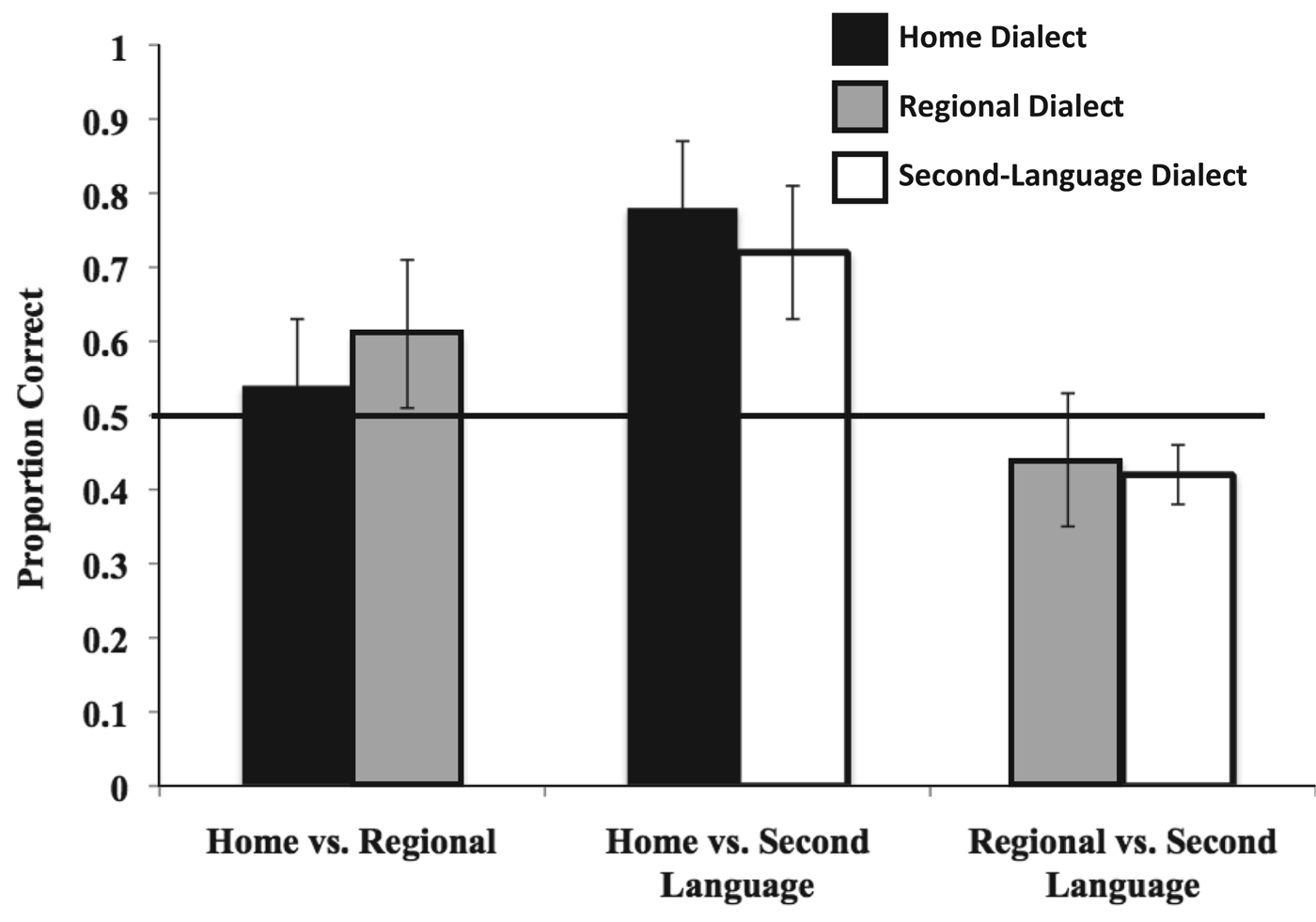
Children's performance in the categorization task is shown in Figure 1. To assess children's overall success rates, the mean categorization score (across both dialects in the pair) was compared to chance for each condition. Children performed above chance when categorizing the Home vs. the Second-Language dialect (t(11)=2·9, p<·014), but not when categorizing the Home vs. Regional dialect (t(11)=0·86, n.s.) nor the Regional vs. Second-Language dialect (t(11)=1·2, n.s.). There were no significant differences in success between the two dialects in each pair (although given that there were only three test trials with each dialect, this result is hardly surprising). A one-way ANOVA conducted with condition as the independent factor (Home vs. Regional; Home vs. Second-Language; Regional vs. Second-Language) on the overall categorization score for each condition revealed a significant effect (F(2, 33)=4·25, p=·023, η2=·21). Post-hoc tests (Tukey's test, all significant ps<·05) showed that children performed significantly better in the Home vs. Second-Language dialect condition than the Regional vs. Second-Language dialect condition, but that the Home vs. Regional condition was intermediate and not significantly different from the other two conditions.
Proportion correct in the categorization task. note: Children performed at above chance levels (p<·05) in the Home vs. Second Language dialect condition with token sentences from both of the dialects; the remaining scores were not significantly different from chance.

DISCUSSION
These results essentially replicated the results of Girard et al. (Reference Girard, Floccia and Goslin2008) and Floccia et al. (Reference Floccia, Butler, Girard and Goslin2009). Despite the fact that the procedures were somewhat simpler and more child friendly, children still failed to use a Home dialect vs. Regional dialect difference to correctly categorize talkers, although they were able to use a Home dialect vs. Second-Language dialect difference to do so. These results also extend that previous work in two ways. First, they show that it is not necessary for a dialect variant to be a true foreign accent for it to be treated differently from monolingually spoken regional variants: the Second-Language variant here was learned in early childhood, but like the foreign-accented speech used in previous studies, children were successful at using it for categorization purposes (at least when it was contrasted with the Home dialect). Second, the current work demonstrated that children failed to use a Regional dialect vs. Second-Language dialect difference to guide their categorization. This latter finding suggests that children's representations of dialect are organized along a quantitatively defined continuum. The fact that the Regional dialect was similar enough to the Home dialect to interfere with categorization did not mean that the Regional dialect was treated as being categorically the same as the Home dialect; if it had been, children would have succeeded equivalently in both conditions involving the Second-Language dialect. Instead, it appears that the Regional dialect is treated as being intermediate between the other two dialects: not different enough from the Home dialect to support categorization in the Home vs. Regional dialect condition while also not different enough from the Second-Language dialect to support categorization in the Regional vs. Second-Language dialect condition either.
EXPERIMENT 2: USING DIALECT FOR JUDGMENTS ABOUT CULTURAL ITEMS
Children in Experiment 1 were explicitly asked to use dialect information to make a social judgment, namely group membership. Experiment 2 also asked children to use dialect information to make socially relevant judgments, but in this study, children were not asked to explicitly find groups, but instead to use their implicit knowledge about how properties of groups correlate. The methods follow closely from those of Hirschfeld and Gelman (Reference Hirschfeld and Gelman1997): children were presented with a single speech token and asked to link it to one of two pictures – one showing a familiar cultural item and one showing a non-local cultural item. In their experiment, three- to five-year-old children regularly matched their native language to the familiar items and a foreign language to the unfamiliar ones. Experiment 2 extends the work of Hirschfeld and Gelman by asking children to make these implicit judgments with the same dialect contrasts used in Experiment 1 (Home vs. Regional dialect; Home vs. Second-Language dialect; Regional vs. Second-Language dialect).
Previous work asking children to link language to implicit correlates of group membership has found success with children as young as six months old (Kinzler et al., Reference Kinzler, Dupoux and Spelke2007), at least with some extreme language contrasts and some social judgments. It was predicted, therefore that children might be more successful at using dialect information in this implicit task than they were in the explicit categorization task.
METHOD
Participants
The participants were thirty-six children, equally divided into the three conditions (Home vs. Regional dialects M=5;8, range=5;0–6;9, eight girls; Home vs. Second-Language dialects M=5;9, range=5;5–6;2, six girls; Regional vs. Second-Language dialects, M=5;10, range=4;7–7;0, eight girls). The experiment was conducted in a private space at the same science museum in central Ohio. None of the children had previously participated in Experiment 1. Full language background information could not be obtained for these children, but, by parental report, 100% of the participants were native speakers of English with no history of language impairment. An additional three children participated, but their data were excluded because of experimenter error (1) or because parents reported the children were either bilingual or a family member spoke a non-American variety of English (2).
Stimuli
The auditory stimuli were the same ones used in the categorization task in Experiment 1. The visual stimuli consisted of pairs of pictures depicting houses and clothing items, one that was familiar within the child's home culture and one that was unfamiliar in the child's home culture. Familiar houses included a picture of a ranch house and a Cape Cod style house; familiar clothing included a picture of a woman in a business suit and a housedress. Unfamiliar houses included a picture of a mud hut and a tepee; unfamiliar clothing included a picture of a woman in a kimono and in the traditional costume of Mongolia. There were six pairs of pictures of houses and six pairs of pictures of clothing. In addition, there were six control pictures showing a woman's head facing forward and the back of a woman's head. It was expected that children would have no systematic preferences for linking any dialect to a particular head orientation. In all conditions, half the picture pairs of each type were presented with one dialect and half with the other.
Procedure
Children were trained with a pair of practice trials. They saw a paired set of pictures depicting a cow and a child and heard a sound file of either a mooing sound or a child saying ‘hello’. They were told that their task was to indicate ‘where each sound came from’. All children successfully passed two trials involving these items. All sound files were played on a computer using iTunes.
Following the practice trials, children received a total of eighteen trials consisting of the house, clothing, and control items in one of two fixed orders. Each order contained the items in a pseudo-randomized order that insured that children did not receive more than two trials of one dialect in a row nor more than two pairs of the same picture type in a row. Children were played a single sound file and asked to choose between two pictures on each trial. They were uniformly praised for their performance.
RESULTS
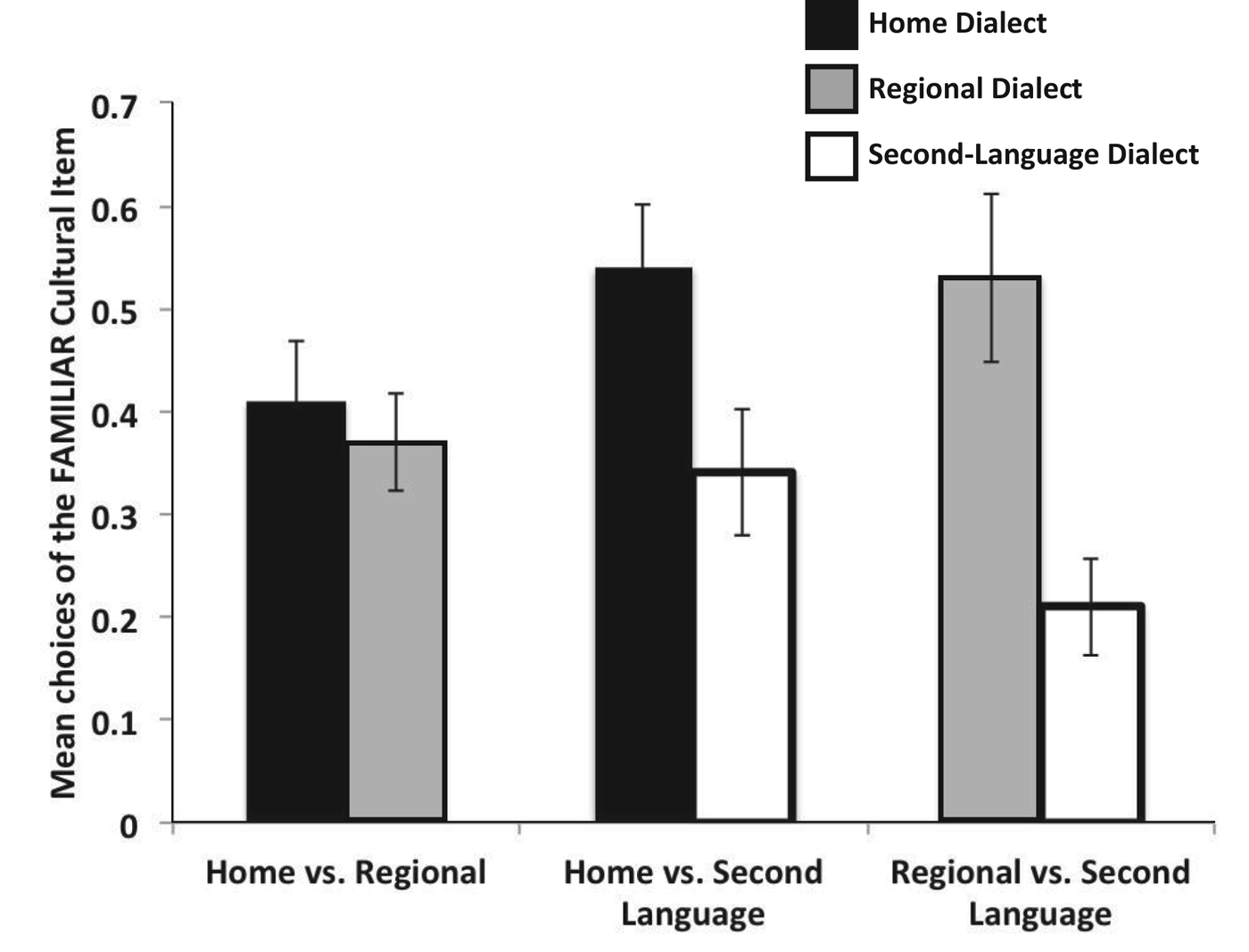
Proportion of familiar choices in the choice task. note: The y-axis shows the proportion of trials on which children chose the more familiar cultural item. Children chose the familiar item significantly more often (p<·05) for the Home dialect in the Home vs. Second Language dialect condition and for the Regional dialect in the Regional vs. Second Language dialect condition.
Figure 2 shows the proportion of children's choice of the familiar cultural items across conditions and dialects. The first analysis examined whether children showed differential responding within each condition: Did children link one dialect in each pair to the familiar cultural items more than they linked the other dialect? Repeated-measures ANOVAs were conducted within each condition with the independent variables of Item type (Clothing vs. Dwelling) and Dialect (the two used in the condition). In the Home vs. Regional dialect condition, there were no significant main effects or interactions: children chose the familiar item approximately equally often regardless of the item type or the dialect being heard. In the Home vs. Second-Language condition, there was a main effect of Dialect (F(1, 15)=8·83, p=·01, η2=·37; children chose the familiar artifacts more often with the Home dialect than the Second-Language dialect), but no effect of item type and no interaction between the two variables. Thus, parallel to the categorization results, children failed to use a Home vs. Regional dialect contrast to distinguish among these cultural artifacts, but they did use a Home vs. Second-Language dialect contrast to do so. The results diverge from the categorization findings in the Regional vs. Second-Language condition. In this condition, there was a main effect of Dialect (F(1, 15)=10·357, p=·006, η2=·41), as children chose the more familiar artifacts with the Regional dialect than the Second-Language dialect. In addition there was a marginally significant effect of item type (F(1, 15)=4·3, p=·055, η2=·22). On the whole, children were less likely to choose the familiar clothing choice than the familiar dwelling choice (Regional dialect M=·50 vs. ·56; Second-Language dialect M=·08 vs. ·33). However, there was no interaction between Item type and Dialect, suggesting that both types of item contributed to the main effect of Dialect.
To compare across conditions, a difference score was calculated for each item type for each child, consisting of the proportion of familiar choices for one dialect (A) minus the proportion for the other dialect in the pair (B). The identification of dialects as A or B was based on the overall group means: the dialect that received the greater proportion of familiar object choice for the group as a whole was designated the A dialect. This designation also corresponded to an intuitive order of distance, where the A dialect was also the one more like the child's own. Specifically, the A dialect was the home dialect for the Home vs. Regional and Home vs. Second-Language dialect conditions; the Regional dialect was the A dialect for the Regional vs. Second-Language condition. A repeated-measures ANOVA was conducted with condition as a between-subjects factor (Home vs. Regional; Home vs. Second-Language; Regional vs. Second-Language) and Item type (Dwellings vs. Clothing) as a within-subject factor; the difference score just described was the dependent variable. The results revealed a significant main effect for Dialect condition (F(2, 44)=19·53, p<·001, η2=·471), and a significant effect of Item type (F(1, 44)=4·07, p=·05, η2=·09), but no significant interaction between the two factors. The Item effect reflected the fact that A dialects showed a bigger familiarity effect for the clothing items (Mean difference=·12) than for the dwelling items (Mean difference=−·04). Post-hoc Tukey's tests (significant ps<·05) on the Dialect pairs revealed that children's differentiation between the Home and Regional dialects was significantly smaller than the differentiation made in the two conditions involving the Second-Language dialect, which did not significantly differ from each other. A partial explanation of this condition effect was suggested by Figure 2: it appears that in general, children were more likely to choose the unfamiliar cultural objects with the Second-Language dialect, regardless of condition.
Collapsing across conditions and items, an overall familiarity score was calculated for each of the three dialects. That is, over the entire experiment, how often did children link each dialect to the more familiar cultural item (regardless of whether that item was clothing or a dwelling, and regardless of what the contrasting dialect was in that condition)? Paired t-test comparisons confirmed that children were less likely to choose the familiar object for the Second-Language dialect (Mean familiarity score=·26) than either the Home dialect (Mean familiarity score=·50; t(23)=4·2, p<·001) or the Regional dialect (Mean familiarity score=·51; t(23)=3·36, p<·003), and the familiarity scores for the Home and Regional dialects were statistically equivalent (t(23)=0·85, n.s.).
Finally, an analysis of the control items demonstrated that in all conditions, children did not use dialect information to choose between the orientation of a person's head. All the mean scores hovered in the 50% range, and t-tests between dialects revealed no significant differences (Home vs. Regional t(11)=0·47, n.s.; Home vs. Second-Language t(11)=0·5, n.s; Regional vs. Second-Language t(11)=0·12, n.s). Thus, even in conditions where children do use dialect information to choose between cultural artifacts, they do not use dialect to make choices in a completely irrelevant domain.
DISCUSSION
Experiment 2 used a more implicit measure of group membership and found that children were in fact able to make more dialect distinctions than they did in the explicit categorization task of Experiment 1. Although children continued to fail to use the difference between the Home and Regional dialects to guide their choices, they were now able to use the Regional vs. Second-Language dialect difference in this task. Thus, both the Home and the Regional dialects were differentiated from the Second-Language dialect in this implicit cultural association task. One additional suggestive finding from these data was the fact that children made the strongest differentiation in the Regional vs. Second-Language dialects condition. This finding points out how robust children's ability to make this distinction is (despite the fact that children failed to use this contrast in Experiment 1); moreover, it may point to the possibility that the three dialects are not simply ordered on a single linear continuum but may be represented more multidimensionally.
GENERAL DISCUSSION
What do young children know about regional dialect? Adults can categorize speakers by the dialect they speak (Clopper & Pisoni, Reference Clopper and Pisoni2004) and they use this kind of indexical information to draw a variety of inferences about the speaker (Giles, Reference Giles1970). The children in the current studies showed limited abilities to make explicit categorization judgments on the basis of dialect, but performed somewhat better in a more implicit task asking them to link cultural items to speech in different dialects. These results suggest that as children enter their school years, they are still in the process of mastering regional dialect as an indexical category.
The finding that children have limited ability to use dialect in an explicit categorization task replicates results from the literature (Floccia et al., Reference Floccia, Butler, Girard and Goslin2009; Girard et al., Reference Girard, Floccia and Goslin2008). Despite the fact that the Second-Language variant used here (Indian English) was not a foreign accent as had been used in previous work, children were able to use a Home vs. Second-Language dialect contrast to categorize speakers but could not use a Home vs. Regional dialect contrast. Moreover, the current work also found that children could not use a Regional vs. Second-Language dialect contrast to categorize speakers. This pattern of results is consistent with gradient dialect representations in which the Home dialect forms the core set of children's experience and other varieties are identified relative to that core. Based on children's much more ample experience with the Home dialect, its phonological and acoustic properties define the best examples of all the words and phrases produced in the target sentences. The Regional dialect, although in fact phonetically quite different from the Home dialect, can apparently be interpreted by the children as being similar enough to the Home dialect that the two cannot be well contrasted. In effect, the Regional dialect may represent a set of relatively bad examples of the Home dialect, but they are not so bad as to be beyond the noise thresholds for it. By contrast, the Second-Language dialect provides examples that are well beyond what children can accept, even with the fairly wide noise range they do accept.
An immediate question that arises is why the Second-Language dialect examples are so much worse than the Regional dialect examples, relative to the Home dialect. Because our Second-Language dialect was itself an established dialect of English (Indian English) and our talkers had learned it in early childhood, it is extremely unlikely that the Regional and Second-Language dialect examples differed in terms of consistent overall phonological patterning or fluency. One might speculate instead that shifts in the vowel domain are easier to treat as noise than shifts in the consonant domain, given that the Home (Midland American English) and Regional (British English) dialects used differ primarily in their vowel inventories (Trudgill, Reference Trudgill1999), while the Home and Second-Language (Indian English) dialects differ in both vowel and consonant inventories (Masica, Reference Masica1972; Maxwell & Fletcher, Reference Maxwell and Fletcher2009). Indeed, a similar suggestion was made by Floccia et al. (Reference Floccia, Butler, Girard and Goslin2009), and recent research with infants has suggested that infants track the statistics of consonants and vowels differently, and are more likely to think that changes in consonants signal information for word segmentation (Bonatti, Peña, Nespor & Mehler, Reference Bonatti, Peña, Nespor and Mehler2005). In addition, the children in this study were native speakers of American English, which is known to exhibit substantial regional and ethnic variation in the vowel system (Labov, Ash & Boberg, Reference Labov, Ash and Boberg2006; Thomas, Reference Thomas2001). American children may therefore have greater experience with vowel variation than consonant variation and be better able to map vowel variability onto their home variety. Native speakers of a language such as Spanish, which exhibits substantial regional variation in the consonant system, may exhibit different biases in assessing dialect similarity.
Further support for gradient dialect representations comes from children's failure to use the Regional and Second-Language dialect contrast for categorization. If children were making a categorical distinction between their home dialect and other dialects, then the pattern of results involving comparisons with the Home dialect would put the Regional and Second-Language dialects on opposite sides of a qualitative divide: the Home dialect was categorized successfully when compared to the Second-Language dialect but not when presented with the Regional dialect. Such a division between ‘Home-like’ and ‘not Home-like’ should lead children to use the Regional vs. Second-Language dialect contrast for successful categorization, but in fact the results showed the opposite pattern. The Regional dialect is thus not perceived as the same as the Home dialect; it is simply within the noise tolerance for it. Since children do not have extensive experience with either the Regional or the Second-Language dialects used in this task, they should have extremely sparse representations for both of them; with two sparse representations to work with, children could not separate them thoroughly enough for explicit categorization (but see Goslin et al., Reference Goslin, Duffy and Floccia2012, for a differing view based on adult ERP data).
Based on the results of Experiment 2, however, these sparse representations were sufficient to support a more implicit way of tapping into the difference between these dialects through the choice of cultural items. In this experiment, children did use the difference between the Regional and Second-Language dialects to make their responses, although they still did not do so in the Home vs. Regional dialect condition. There are several factors that might contribute to the object choice task being easier for children than the categorization task and allowing them to attend to differences between the Regional and Second-Language dialects. The first is that children were not required to actually contrast the dialects explicitly. In the categorization task, children were explicitly told that the two puppet families were defined by the way they spoke; the structure of the task as well as the actual directions to the child made it clear that the speech had to be divided into two categories. By contrast, in the object choice task children were told to listen carefully to the speech, but were not instructed that the way people talked was a key to the properties of the pictures (and indeed, in the control case involving head orientation, there was no basis for linking dialect to the choices). It may be that when children could focus on a single dialect at a time without worrying about its relationship to other dialects, they were better able to tap into their intuitions about how familiar the speech sounded. With that kind of a judgment in mind, the fact that the Regional dialect examples were within the noise parameters of the Home dialect may have been sufficient to differentiate the Regional from the Second-Language dialect.
This analysis, however, raises a larger point. As adults, we tend to think that what regional dialects truly signal is something about group membership (and identity): a citizen of Ohio, USA, speaks in one fashion; a citizen of Lancashire, England, speaks in a different fashion. People who live in Ohio are part of a different group than people who live in Lancashire, and people who speak with those dialects are signaling their memberships in those groups (or at least, their identification as members of those groups). For children, however, it is possible that dialect indexes a somewhat different piece of information, such as familiarity. Familiarity certainly correlates with being in one's social in-group, but it is not co-extensive with it: my great-grandmother may be a very unfamiliar member of my in-group while my next-door neighbor may be a very familiar member of my out-group. If we assume that the Regional dialect was within the noise tolerance for children's Home dialect, it is possible to explain the results of Experiment 2 as simply reflecting familiarity matching. Or rather, children were engaged in unfamiliarity matching: The Second-Language dialect received the lowest number of familiar cultural item choices, and children used dialect information only when the Second-Language dialect was present. Thus, only when the speech exceeded some threshold of unfamiliarity were children able to reliably choose the unfamiliar cultural objects.
Future research should consider how children's ability to use finer distinctions among dialects to choose among cultural artifacts eventually translates into an ability to use these differences to explicitly categorize speakers into groups. It is possible that with a sufficiently easy task, children could perform as well at categorization as they do with object choice. Alternatively, it may be that children's assessment of familiarity is a necessary precursor to their categorization ability: the notion of group membership may be one that children derive from their knowledge of what is and is not familiar to them. In any event, these results suggest that as children are about to enter school, they have a broad understanding of how accent signals social information, but are still working out the details, particularly with respect to regional dialect.