Introduction
Experts have proposed removing obsessive–compulsive disorder (OCD) from the anxiety disorders section and grouping it with putatively related conditions in the fifth edition of the Diagnostic and Statistical Manual of Mental Disorders (DSM-5) (Hollander et al. Reference Hollander, Braun and Simeon2008); this remains controversial (Storch et al. Reference Storch, Abramowitz and Goodman2008). Proposed OCD-related conditions include obsessive–compulsive personality disorder (OCPD), tic disorders, hypochondriasis, body dysmorphic disorder (BDD), trichotillomania and other grooming disorders, eating disorders, pathological gambling (PG) and other impulse-control disorders, including substance dependence (Hollander et al. Reference Hollander, Braun and Simeon2008).
OCD is familial (e.g. Pauls et al. Reference Pauls, Alsobrook, Goodman, Rasmussen and Leckman1995; Nestadt et al. Reference Nestadt, Samuels, Riddle, Bienvenu, Liang, LaBuda, Walkup, Grados and Hoehn-Saric2000; do Rosario-Campos et al. Reference do Rosario-Campos, Leckman, Curi, Quatrano, Katsovitch, Miguel and Pauls2005; Fyer et al. Reference Fyer, Lipsitz, Mannuzza, Aronowitz and Chapman2005; Hanna et al. Reference Hanna, Himle, Curtis and Gillespie2005; Grabe et al. Reference Grabe, Ruhrmann, Ettelt, Buhtz, Hochrein, Schulze-Rauschenbach, Meyer, Kraft, Reck, Pukrop, Freyberger, Klosterkötter, Falkai, John, Maier and Wagner2006), and this familiality appears mainly due to genetic influences (van Grootheest et al. Reference van Grootheest, Cath, Beekman and Boomsma2005). Finding that certain conditions are highly co-morbid with and familially related to OCD may suggest a genetic relationship between OCD and these other conditions that could inform nosology. The current study examines how commonly anxiety disorders, related personality disorders and putative ‘spectrum’ conditions occur in OCD-affected probands and their first-degree relatives, compared with control probands and relatives. A higher prevalence of anxiety disorders and related personality disorders in OCD-affected probands and their relatives would support retention of OCD within the anxiety disorders section in DSM-5. A higher prevalence of putative OCD-related conditions in OCD-affected probands and their relatives would support acknowledgement of ‘OCD spectrum conditions’ in DSM-5, whether or not OCD is retained in the anxiety disorders section.
Previous controlled OCD co-morbidity and family studies (Black et al. Reference Black, Noyes, Goldstein and Blum1992, Reference Black, Noyes, Pfohl, Goldstein and Blum1993, Reference Black, Goldstein, Noyes and Blum1994; Pauls et al. Reference Pauls, Alsobrook, Goodman, Rasmussen and Leckman1995; Torres & Del Porto, Reference Torres and Del Porto1995; Bienvenu et al. Reference Bienvenu, Samuels, Riddle, Hoehn-Saric, Liang, Cullen, Grados and Nestadt2000; Samuels et al. Reference Samuels, Nestadt, Bienvenu, Costa, Riddle, Liang, Hoehn-Saric, Grados and Cullen2000; Grados et al. Reference Grados, Riddle, Samuels, Liang, Hoehn-Saric, Bienvenu, Walkup, Song and Nestadt2001; Nestadt et al. Reference Nestadt, Samuels, Riddle, Liang, Bienvenu, Hoehn-Saric, Grados and Cullen2001; Jaisoorya et al. Reference Jaisoorya, Reddy and Srinath2003; Carter et al. Reference Carter, Pollock, Suvak and Pauls2004; do Rosario-Campos et al. Reference do Rosario-Campos, Leckman, Curi, Quatrano, Katsovitch, Miguel and Pauls2005; Fyer et al. Reference Fyer, Lipsitz, Mannuzza, Aronowitz and Chapman2005) are summarized in Table 1. Results of these studies suggest that some anxiety disorders (especially generalized anxiety disorder; GAD) are relatively common in persons with OCD and their first-degree relatives. Cluster C (‘anxious cluster’) personality disorders (Bienvenu & Stein, Reference Bienvenu and Stein2003), especially OCPD, also appear relatively common in persons with OCD and, perhaps, their first-degree relatives. In addition, tic disorders, hypochondriasis, BDD and ‘grooming’ disorders [pathological nail biting (PNB), pathological skin picking (PSP) and trichotillomania] appear relatively common in persons with OCD and, perhaps, their first-degree relatives. Conversely, PG, kleptomania, pyromania, alcohol dependence (AlD) and drug dependence (DD) do not appear particularly common in persons with OCD or their family members. Based on these previous results, we predicted that at least some anxiety disorders and OCPD would be highly co-morbid in OCD-affected probands and would segregate in their families. We also predicted that tic disorders, hypochondriasis, BDD and ‘grooming’ disorders would be highly co-morbid in OCD-affected probands and would segregate in their families, but not PG, other impulse-control disorders or substance-use disorders.
Prior controlled studies of lifetime prevalence (%) of other diagnoses in patients with OCD and/or their first-degree relatives

n, Number of case (top) and control (bottom) probands (studies of co-morbidity) or relatives (studies of familiality); DX, semi-structured or structured diagnostic interview(s); SAD, separation anxiety disorder; PD, panic disorder; Ag, agoraphobia; SpP, specific phobia; SoP, social phobia; GAD, generalized anxiety disorder; OCPD, obsessive–compulsive personality disorder; AvPD, avoidant personality disorder; DPD, dependent personality disorder; TD, any tic disorder; Hyp, hypochondriasis; BDD, body dysmorphic disorder; TTM, trichotillomania; PNB, pathological nail biting; PSP, pathological skin picking; AN, anorexia nervosa; BN, bulimia nervosa; MDD, major depressive disorder; rMDD, recurrent major depressive disorder; Dys, dysthymia; BiD, bipolar disorder (I or II); PG, pathological gambling; Py, pyromania; Kl, kleptomania; AlD, alcohol dependence; DD, drug dependence; SIDPD, Structured Interview for DSM-III Personality Disorders; DSM, Diagnostic and Statistical Manual of Mental Disorders; SIDP-R, Structured Interview for DSM-III-R Personality; SADS, Schedule for Affective Disorders and Schizophrenia; STOBS, Schedule for Tourette Syndrome and Other Behavioral Syndromes; SCID, Structured Clinical Interview for DSM-IV; DIS, Diagnostic Interview Schedule.
a Control probands had no (or virtually no) known axis I psychopathology. b Case probands with panic disorder, agoraphobia and/or eating disorders were excluded. c Excluded probands with Tourette's disorder or schizophrenia. d Control probands with OCD or tic disorders were excluded. e Lifetime anxiety version. f School-aged children version. g Tourette's disorder.
* Statistically significantly higher prevalence in the case versus control group (two-tailed p=0.05).
† Trend towards a difference in prevalence in the case versus control group (p between 0.05 and 0.10).
Method
Sample
This project uses control family data from the Johns Hopkins OCD Family Study (JHOFS; Nestadt et al. Reference Nestadt, Samuels, Riddle, Bienvenu, Liang, LaBuda, Walkup, Grados and Hoehn-Saric2000) and case family data from the OCD Collaborative Genetics Study (OCGS; Samuels et al. Reference Samuels, Riddle, Greenberg, Fyer, McCracken, Rauch, Murphy, Grados, Pinto, Knowles, Piacentini, Cannistraro, Cullen, Bienvenu, Rasmussen, Pauls, Willour, Shugart, Liang, Hoehn-Saric and Nestadt2006). In the JHOFS, we directly interviewed 73 community control probands and 233 of their first-degree relatives, blind to proband/family status, between 1995 and 1999. The control probands were selected to demographically match case probands from OCD specialty treatment centers in the Baltimore, MD, and Washington, DC, areas (Nestadt et al. Reference Nestadt, Samuels, Riddle, Bienvenu, Liang, LaBuda, Walkup, Grados and Hoehn-Saric2000). [Note that, since we have reported on JHOFS case probands and relatives previously (Bienvenu et al. Reference Bienvenu, Samuels, Riddle, Hoehn-Saric, Liang, Cullen, Grados and Nestadt2000; Samuels et al. Reference Samuels, Nestadt, Bienvenu, Costa, Riddle, Liang, Hoehn-Saric, Grados and Cullen2000; Grados et al. Reference Grados, Riddle, Samuels, Liang, Hoehn-Saric, Bienvenu, Walkup, Song and Nestadt2001; Nestadt et al. Reference Nestadt, Samuels, Riddle, Liang, Bienvenu, Hoehn-Saric, Grados and Cullen2001), these participants are excluded in the current study. Also, we only include JHOFS data from participants who were directly interviewed in the current study, for the sake of comparability of methods across studies.]
In the OCGS, collaborators at Brown University (Butler Hospital), Columbia University, Massachusetts General Hospital, Johns Hopkins University (JHU), the National Institute of Mental Health and the University of California in Los Angeles interviewed over 400 families between 2001 and 2008; JHU was the coordinating center for the study (Samuels et al. Reference Samuels, Riddle, Greenberg, Fyer, McCracken, Rauch, Murphy, Grados, Pinto, Knowles, Piacentini, Cannistraro, Cullen, Bienvenu, Rasmussen, Pauls, Willour, Shugart, Liang, Hoehn-Saric and Nestadt2006). Participants were recruited from out-patient and in-patient clinics, referrals from clinicians in the community, websites, media advertisements, self-help groups and Obsessive–Compulsive Foundation annual conventions. The OCGS targeted families with OCD-affected sibling pairs and extended these when possible through affected relatives; in addition, two sites (JHU and Columbia) collected additional pedigrees with multiple affected relatives when available. (Note that we only include OCGS data from probands and first-degree relatives in the current study, for the sake of comparability of data across studies. In addition, though the OCGS included probands younger than the age of 18 years, we excluded these families in the current study, again for the sake of comparability of data across studies. The resulting dataset included 382 case probands and 974 of their first-degree relatives.)
In both the JHOFS and the OCGS, probands were excluded if they had schizophrenia, mental retardation, dementia or Tourette's disorder. In addition, control probands were excluded if they had OCD (JHOFS), while case probands were included if they had OCD – but not if OCD occurred only during a major depressive episode. In the OCGS, proband OCD symptoms had onset before the age of 18 years. In both the JHOFS and the OCGS, after a complete description of the study to the participants, written informed consent (or assent, for children) was obtained.
Diagnostic procedures
Doctoral-level clinicians made lifetime Diagnostic and Statistical Manual of Mental Disorders, fourth edition (DSM-IV) diagnoses using modified semi-structured interviews: the Schedule for Affective Disorders and Schizophrenia – lifetime anxiety version (SADS-LA; Mannuzza et al. Reference Mannuzza, Fyer, Klein and Endicott1986) and Kiddie-SADS (Kaufman et al. Reference Kaufman, Birmaher, Brent, Rao, Flynn, Moreci and Williamson1997) (JHOFS), the Structured Clinical Interview for DSM-IV (First et al. Reference First, Gibbon, Spitzer and Williams1996) (OCGS), and the Revised Structured Instrument for the Diagnosis of Personality Disorders (Pfohl et al. Reference Pfohl, Blum, Zimmerman and Stangl1989). The OCD section was adapted from the SADS-LA to include detailed screening questions and information regarding the nature and course of symptoms, and a similar section was developed for the assessment of tic disorders. Also, a section was developed for the assessment of other proposed OCD-related conditions using DSM-IV criteria (Nestadt et al. Reference Nestadt, Samuels, Riddle, Bienvenu, Liang, LaBuda, Walkup, Grados and Hoehn-Saric2000). Since PNB and PSP are not DSM-IV diagnoses, we modeled their criteria after those for trichotillomania (Bienvenu et al. Reference Bienvenu, Samuels, Riddle, Hoehn-Saric, Liang, Cullen, Grados and Nestadt2000). Examiners also interviewed knowledgeable informants to obtain additional diagnostic information (Mannuzza et al. Reference Mannuzza, Fyer, Endicott and Klein1985). For subjects who had received psychiatric treatment, examiners obtained medical records and contacted treatment providers, if necessary. The examiners completed a narrative formulation for each case.
At each site, two expert diagnosticians independently reviewed materials and met to resolve disagreements regarding diagnoses or ages of onset. In the OCGS, JHU consensus diagnosticians also reviewed materials from other sites; we resolved disagreements before editing case materials and sending them for data entry.
Several diagnoses were assessed in both studies. Anxiety disorders include OCD itself, separation anxiety disorder (SAD), panic disorder (PD), agoraphobia, specific phobia (SpP), social phobia (SoP) and GAD. Personality disorders include OCPD, avoidant personality disorder (AvPD) and dependent personality disorder (DPD). Putative ‘OCD spectrum’ conditions include tic disorder (Tourette's, chronic motor or vocal tic or transient tic disorder), hypochondriasis, BDD, trichotillomania, PNB, PSP, PG, pyromania, kleptomania, anorexia nervosa (AN), bulimia nervosa (BN), AlD and DD. Other axis I conditions include major depressive disorder [MDD; including recurrent MDD (rMDD)], dysthymia (Dys) and bipolar disorder (BiD: types I or II). Inter-rater reliabilities have been reported previously (Bienvenu et al. Reference Bienvenu, Samuels, Riddle, Hoehn-Saric, Liang, Cullen, Grados and Nestadt2000; Nestadt et al. Reference Nestadt, Samuels, Riddle, Bienvenu, Liang, LaBuda, Walkup, Grados and Hoehn-Saric2000, Reference Nestadt, Samuels, Riddle, Liang, Bienvenu, Hoehn-Saric, Grados and Cullen2001; Samuels et al. Reference Samuels, Riddle, Greenberg, Fyer, McCracken, Rauch, Murphy, Grados, Pinto, Knowles, Piacentini, Cannistraro, Cullen, Bienvenu, Rasmussen, Pauls, Willour, Shugart, Liang, Hoehn-Saric and Nestadt2006): for SAD, PD, SpP, SoP, GAD, hypochondriasis, BDD, PNB, PSP, MDD, Dys and AlD, κ values ranged from 0.6 to 1.0. κ Values were incalculable for agoraphobia, trichotillomania, AN, BN, PG, pyromania, kleptomania and DD, but inter-rater agreement ranged from 96% to 100%. The intraclass correlation coefficient for obsessive–compulsive personality traits was 0.78.
Statistical analysis
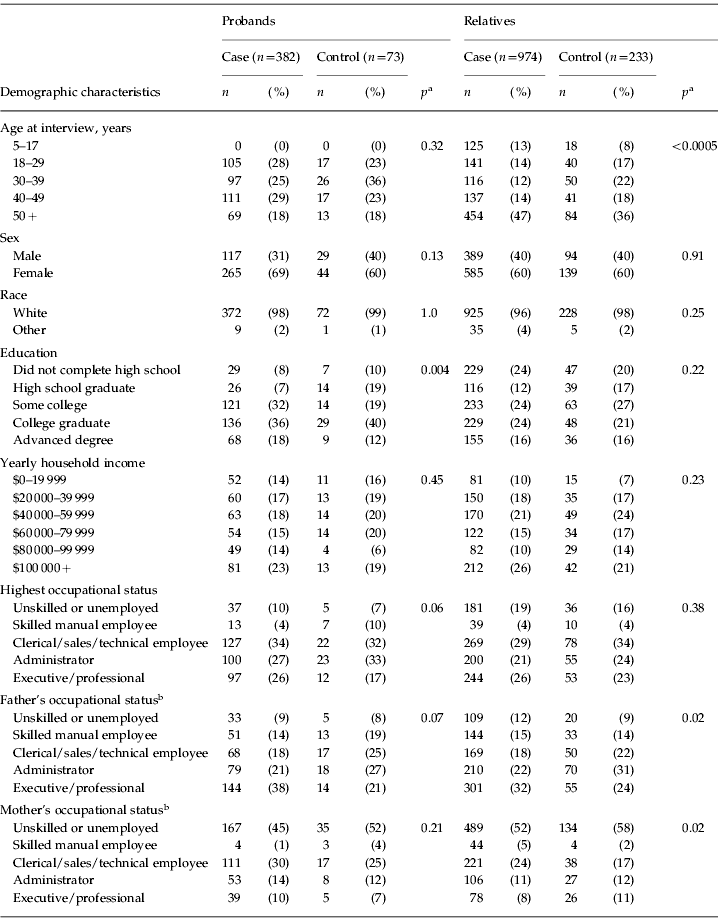
We first compared demographic characteristics of case (OCGS) versus control (JHOFS) probands and first-degree relatives using χ2 or Fisher's exact tests. As shown in Table 2, there was some evidence for higher socio-economic status in case versus control probands. Case relatives were more often in the lowest and highest age groups at interview, and there were non-monotonic relationships between case–control relative status and parents' occupational status.
Demographic characteristics of case and control probands and first-degree relatives

a By χ2 or Fisher's exact test. b Parents' occupational status refers to the highest status when the participant was growing up.
We next compared the lifetime prevalence of individual diagnoses in case versus control probands, using χ2 or Fisher's exact tests. In addition, we calculated the difference in lifetime prevalence of individual diagnoses in cases and control probands, as well as the number needed to harm (NNH). NNH, calculated in the same way as the number needed to treat (Cook & Sackett, Reference Cook and Sackett1995), is recommended as an indication of the clinical importance of a variable (Kraemer et al. Reference Kraemer, Wilson and Hayward2006). Here, NNH indicates how many persons would have to be sampled among those with OCD to have one more person with the individual co-morbid diagnosis, compared with a sample of persons without OCD; lower NNH estimates indicate higher co-morbidity. We calculated odds ratios (ORs), unadjusted and adjusted for potential demographic confounders, using logistic regression. In order to avoid overfitting, we included only those correlates of diagnoses that were also associated with case or control status (p⩽0.1). (Lower education was associated with SpP, and higher education with BDD. SpP was associated with higher occupational status, and DD with lower occupational status. PD, SpP, SoP and BN were associated with lower paternal occupational status.)
In the last set of analyses, we compared the lifetime prevalence of individual diagnoses in case versus control first-degree relatives, beginning as in the proband analyses. (SAD, PD, SoP, AvPD, DPD, tic disorder, hypochondriasis, BDD, trichotillomania, PNB, PSP, AN, BN, AlD, DD, MDD, rMDD and Dys were associated with younger age. SpP, tic disorder, MDD and AvPD were associated with higher maternal occupational status.) We performed two additional sets of logistic regression analyses with diagnoses for which there was evidence of higher prevalence in case versus control relatives. In the first set, we adjusted for proband diagnosis of the same individual disorder (to control for possible independent transmission of the disorder in these families); in the second, we adjusted for OCD in the relatives (to determine whether or not the disorder segregates independently of OCD in these families). All statistical tests were two-tailed.
Results
Proband (co-morbidity) analyses
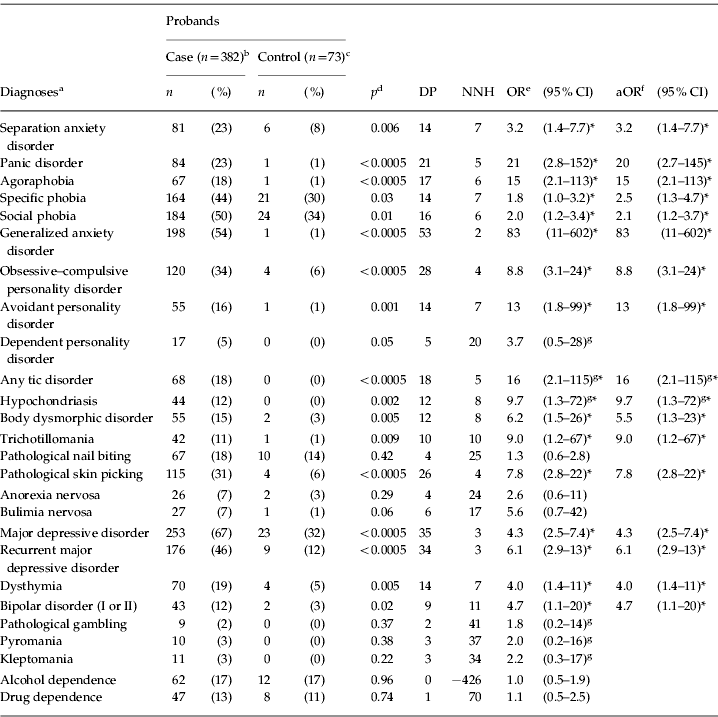
All of the anxiety disorders were statistically significantly associated with OCD (Table 3). Though GAD, PD and agoraphobia were particularly strongly associated with OCD (high ORs), the lifetime prevalence of each of the anxiety disorders was substantially higher in OCD-affected than control probands (the difference in lifetime prevalence ranged from 14% to 53%, corresponding to NNH estimates between 2 and 7). Cluster C personality disorders, especially OCPD and AvPD, were also strongly associated with OCD, affecting 34% and 16% of OCD-affected probands, respectively (NNH=4 and 7, respectively).
Lifetime prevalences of disorders in case (OCD-affected) and control probands

OCD, Obsessive–compulsive disorder; DP, difference in prevalence between case and control probands; NNH, number needed to harm; OR, odds ratio; CI, confidence interval; aOR, adjusted odds ratio.
a All diagnoses are probable or definite. b OCD-affected probands. c Non-OCD-affected probands. d By χ2 or Fisher's exact test. e Crude (unadjusted) OR. f OR adjusted for demographic factors associated with case/control status and diagnosis (if applicable). g A random control was assigned the diagnosis for calculation purposes.
* OR >1.0 (two-tailed p⩽0.05).
Tic disorders and the somatoform disorders hypochondriasis and BDD were also strongly associated with OCD, with substantial NNH estimates (5–8). PSP and trichotillomania were both strongly associated with OCD; PSP had a more substantial NNH estimate (4) than trichotillomania (10), the former affecting almost a third of OCD-affected probands. Neither eating disorder (AN or BN) nor the other impulse-control disorders (PG, pyromania or kleptomania) were common in case or control probands, and none of these conditions was statistically significantly associated with OCD. AD and DD were common, but prevalences were similar in case and control probands.
All of the mood disorders were associated with OCD, and the unipolar conditions (especially MDD and rMDD) had quite substantial NNH estimates (3–7), due to their high prevalence in case probands. Adjusting for demographic factors associated with case/control status and diagnosis (if applicable) did not appreciably affect the results.
First-degree relative (familiality) analyses
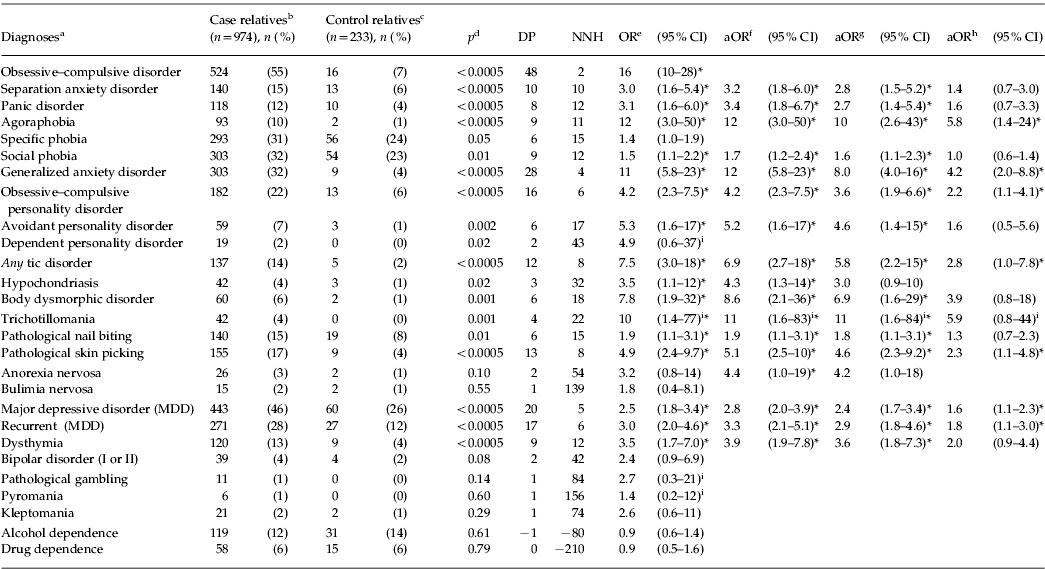
Familiality results largely mirrored those of the proband analyses, though with generally smaller ORs and larger NNH estimates (Table 4). Though a high prevalence of OCD was required in the relatives of OCD-affected probands by design (OCGS), we show results regarding OCD familiality at the top of Table 4. Of the anxiety disorders, agoraphobia and GAD were the most strongly familially related to OCD, though all of the anxiety disorders assessed except SpP had higher prevalences in case versus control relatives. GAD was particularly common in case relatives, affecting almost one third (NNH=4). Cluster C personality disorders, especially OCPD and AvPD, were also familially related to OCD, the former affecting more than a fifth of case relatives (NNH=5).
Lifetime prevalences of potential spectrum disorders in case (OCD-affected) and control first-degree relatives

OCD, Obsessive–compulsive disorder; DP, difference in prevalence between case and control relatives; NNH, number needed to harm; OR, odds ratio; CI, confidence interval; aOR, adjusted odds ratio.
a All diagnoses are probable or definite. b First-degree relatives of OCD-affected probands. c First-degree relatives of non-OCD-affected probands. d By χ2 or Fisher's exact test. e Crude (unadjusted) OR calculated using generalized estimating equations. f OR calculated using generalized estimating equations, adjusted for demographic factors associated with case/control status and diagnosis (if applicable). g OR calculated using generalized estimating equations, adjusted for demographic factors associated with case/control status and diagnosis (if applicable) and proband diagnosis of same disorder. h OR calculated using generalized estimating equations, adjusted for demographic factors associated with case/control status and diagnosis (if applicable), proband diagnosis of same disorder and OCD in relatives.i A random control was assigned the diagnosis for calculation purposes.
* OR >1.0 (two-tailed p⩽0.05).
Tic disorders, the somatoform disorders hypochondriasis and BDD, the grooming disorders trichotillomania, PNB and PSP, and AN were more common in case versus control first-degree relatives. Of these conditions, PSP had the lowest NNH estimate (8), and eating disorders the highest (54). None of the other impulse-control disorders (PG, pyromania or kleptomania) nor substance-dependence conditions (AlD or DD) differed in prevalence in case versus control relatives.
Unipolar depressive disorders were substantially more common in case versus control relatives, and these conditions showed the lowest NNH estimates of the remaining conditions, especially MDD (NNH=5–6). BiD was not significantly more common in case versus control relatives.
Adjusting for potential demographic confounders and proband diagnosis of the same condition did not substantially affect the results; however, adjusting for the relative's diagnosis of OCD did substantially decrease OR estimates, suggesting that conditions familially related to OCD occur most commonly in relatives who themselves have OCD. Nevertheless, agoraphobia, GAD, OCPD, tic disorders, PSP and MDDs remained significantly more common in case than control relatives when adjusting for all of these variables simultaneously.
Discussion
In this study, to our knowledge the largest OCD family study to date, we found that anxiety disorders, related personality disorders, several (but not all) putative OCD-related conditions (Hollander et al. Reference Hollander, Braun and Simeon2008) and depressive disorders were more common in persons with OCD and their first-degree relatives. Thus, using co-morbidity and familiality information, there is evidence supporting both grouping OCD with anxiety disorders, and grouping some additional conditions with OCD.
Anxiety disorders and related personality disorders
All of the anxiety disorders assessed except SpP showed elevated co-morbidity and familiality with OCD. Thus, consistent with previous studies (Black et al. Reference Black, Noyes, Goldstein and Blum1992; Nestadt et al. Reference Nestadt, Samuels, Riddle, Liang, Bienvenu, Hoehn-Saric, Grados and Cullen2001; Fyer et al. Reference Fyer, Lipsitz, Mannuzza, Aronowitz and Chapman2005), anxiety disorders (especially agoraphobia and GAD) appear an important part of a familial OCD spectrum. The converse is not necessarily true. Though Biederman et al. (Reference Biederman, Petty, Faraone, Henin, Hirshfeld-Becker, Pollack, de Figueiredo, Feeley and Rosenbaum2006) recently found significantly elevated prevalences of OCD in children of parents with PD or GAD (Biederman et al. Reference Biederman, Petty, Faraone, Henin, Hirshfeld-Becker, Pollack, de Figueiredo, Feeley and Rosenbaum2006), earlier studies did not find elevated prevalences of OCD in families of patients with PD, agoraphobia or GAD (e.g. Noyes et al. Reference Noyes, Clarkson, Crowe, Yates and McChesney1987; Goldstein et al. Reference Goldstein, Weissman, Adams, Horwath, Lish, Charney, Woods, Sobin and Wickramaratne1994). Nevertheless, many earlier studies employed outdated diagnostic methods with hierarchies no longer considered valid. On balance, we find little empirical support for separating OCD from other anxiety disorders in DSM-5.
Personality disorders from the ‘anxious cluster’ (especially OCPD) also showed elevated co-morbidity and familiality with OCD. The co-morbidity results are consistent with prior controlled studies (Black et al. Reference Black, Noyes, Pfohl, Goldstein and Blum1993; Torres & Del Porto, Reference Torres and Del Porto1995; Samuels et al. Reference Samuels, Nestadt, Bienvenu, Costa, Riddle, Liang, Hoehn-Saric, Grados and Cullen2000), and the familiality results are consistent with our previous family study (Samuels et al. Reference Samuels, Nestadt, Bienvenu, Costa, Riddle, Liang, Hoehn-Saric, Grados and Cullen2000). We view these results as further support that OCD should not be separated from other anxiety disorders in DSM-5. Alternatively, since OCPD in particular is highly co-morbid with and familially related to OCD, this personality disorder could be considered OCD-related.
Putative OCD-related disorders
Tic disorders
Despite the fact that we excluded probands with Tourette's disorder, tic disorders showed elevated co-morbidity and familiality with OCD, consistent with previous studies (Pauls et al. Reference Pauls, Alsobrook, Goodman, Rasmussen and Leckman1995; Grados et al. Reference Grados, Riddle, Samuels, Liang, Hoehn-Saric, Bienvenu, Walkup, Song and Nestadt2001; Jaisoorya et al. Reference Jaisoorya, Reddy and Srinath2003; do Rosario-Campos et al. Reference do Rosario-Campos, Leckman, Curi, Quatrano, Katsovitch, Miguel and Pauls2005). Interestingly, OCD also appears to be an important part of the familial spectrum of Tourette's disorder (e.g. Pauls et al. Reference Pauls, Raymond, Stevenson and Leckman1991). Thus, OCD and tic disorders are strongly familially related, and, from this standpoint, it would be sensible to group these conditions together in DSM-5. Further support for categorizing tic disorders as OCD-related comes from a study of co-morbidity in patients with OCD, SoP or PD (Richter et al. Reference Richter, Summerfeldt, Antony and Swinson2003); in that study, tics were significantly more common in persons with OCD than in persons with the other anxiety disorders.
Hypochondriasis and BDD
Hypochondriasis and BDD also showed elevated co-morbidity and familiality with OCD, as in our previous study (Bienvenu et al. Reference Bienvenu, Samuels, Riddle, Hoehn-Saric, Liang, Cullen, Grados and Nestadt2000). Others have also found elevated prevalences of hypochondriasis and BDD in persons with OCD (Jaisoorya et al. Reference Jaisoorya, Reddy and Srinath2003). Conversely, a controlled study of co-morbidity in patients with hypochondriasis showed elevated prevalences of OCD (and other anxiety disorders) (Barsky et al. Reference Barsky, Wyshak and Klerman1992). In a controlled family study of hypochondriasis, anxiety disorders were relatively common in case relatives, but not OCD in particular (Noyes et al. Reference Noyes, Holt, Happel, Kathol and Yagla1997). It is not yet clear whether or not the diagnosis hypochondriasis will appear in DSM-5 (Dimsdale & Creed, Reference Dimsdale and Creed2009); however, it seems likely that hypochondriasis is highly co-morbid with and familially related to other anxiety disorders besides OCD. Unfortunately, hypochondriasis has not typically been assessed in family studies of other anxiety disorders (e.g. Noyes et al. Reference Noyes, Clarkson, Crowe, Yates and McChesney1987; Goldstein et al. Reference Goldstein, Weissman, Adams, Horwath, Lish, Charney, Woods, Sobin and Wickramaratne1994; Biederman et al. Reference Biederman, Petty, Faraone, Henin, Hirshfeld-Becker, Pollack, de Figueiredo, Feeley and Rosenbaum2006). We know of no controlled family studies of BDD, though it would be of interest to know whether its co-morbid and familial relationships with OCD are bi-directional. Nevertheless, it seems reasonable to consider BDD an OCD-related condition on the basis of extant co-morbidity and familiality data.
Grooming disorders
Consistent with our previous study (Bienvenu et al. Reference Bienvenu, Samuels, Riddle, Hoehn-Saric, Liang, Cullen, Grados and Nestadt2000), grooming disorders showed elevated co-morbidity and familiality with OCD. Only one of these conditions, trichotillomania, is a DSM-IV diagnosis, currently grouped with ‘other impulse control disorders not elsewhere classified’. Unlike our previous study (Bienvenu et al. Reference Bienvenu, Samuels, Riddle, Hoehn-Saric, Liang, Cullen, Grados and Nestadt2000), which had a smaller sample size, trichotillomania by itself showed elevated co-morbidity and familiality with OCD in the current study. Other controlled studies have also shown elevated prevalences of trichotillomania in persons with OCD (Jaisoorya et al. Reference Jaisoorya, Reddy and Srinath2003), including in comparison to persons with other anxiety disorders (Richter et al. Reference Richter, Summerfeldt, Antony and Swinson2003). Conversely, OCD also appears relatively common in families of probands with trichotillomania (Lenane et al. Reference Lenane, Swedo, Rapoport, Leonard, Sceery and Guroff1992; Schlosser et al. Reference Schlosser, Black, Blum and Goldstein1994). Thus, on the basis of extant co-morbidity and familiality studies, it seems reasonable to consider trichotillomania OCD-related.
PSP by itself also showed elevated co-morbidity and familiality with OCD. PSP has not been studied as extensively as trichotillomania, and it is not clear whether or not PSP should be considered particularly OCD-related or, more generally, anxiety-related (Cullen et al. Reference Cullen, Samuels, Bienvenu, Grados, Hoehn-Saric, Hahn, Liang, Wellen, Dees, Riddle and Nestadt2001; Richter et al. Reference Richter, Summerfeldt, Antony and Swinson2003). In this study, PNB by itself was not particularly highly co-morbid with OCD, but it was familially related to OCD. As with PSP, it is not clear whether PNB is more appropriately considered an OCD-related or an anxiety-related condition.
Eating disorders
Eating disorders were uncommon in patients with OCD, control probands and their relatives. Thus, eating disorders do not appear to be an important part of the familial OCD spectrum. Our group and Black et al. came to similar conclusions in previous studies (Black et al. Reference Black, Goldstein, Noyes and Blum1994; Bienvenu et al. Reference Bienvenu, Samuels, Riddle, Hoehn-Saric, Liang, Cullen, Grados and Nestadt2000). Interestingly, though eating disorders do not appear particularly common in persons with OCD or their relatives, OCD appears very common in persons with eating disorders (especially AN) and their family members (e.g. Lilenfeld et al. Reference Lilenfeld, Kaye, Greeno, Merikangas, Plotnicov, Pollice, Rao, Strober, Bulik and Nagy1998). Nevertheless, we conclude there is insufficient evidence to consider AN or BN OCD-related.
Other impulse-control disorders not elsewhere classified
The other impulse-control disorders not elsewhere classified (i.e. PG, pyromania and kleptomania) were uncommon in patients with OCD, control probands and their relatives. Thus, these conditions do not appear an important part of the familial OCD spectrum. These findings are consistent with previous studies (Black et al. Reference Black, Goldstein, Noyes and Blum1994; Bienvenu et al. Reference Bienvenu, Samuels, Riddle, Hoehn-Saric, Liang, Cullen, Grados and Nestadt2000). Like eating disorders, the NNH for other impulse-control disorders was relatively high compared with other potential OCD-related conditions. Thus, it would seem sensible not to consider them particularly OCD-related in terms of co-morbidity and familiality.
Substance-use disorders
Neither AlD nor DD showed elevated co-morbidity or familiality with OCD, consistent with previous studies (Nestadt et al. Reference Nestadt, Samuels, Riddle, Liang, Bienvenu, Hoehn-Saric, Grados and Cullen2001; Fyer et al. Reference Fyer, Lipsitz, Mannuzza, Aronowitz and Chapman2005). Thus, on the basis of co-morbidity and familiality, there is little evidence that substance dependence is OCD-related.
Other psychiatric conditions
Mood disorders
Depressive disorders (MDD, rMDD and Dys) showed elevated co-morbidity and familiality with OCD. The findings for rMDD were similar to our previous study (Nestadt et al. Reference Nestadt, Samuels, Riddle, Liang, Bienvenu, Hoehn-Saric, Grados and Cullen2001); however, unlike our previous study, rMDD was transmitted independent of OCD itself here. Similar to other anxiety disorders, OCD may share genetic causes with depressive disorders (Hettema, Reference Hettema2008).
Implications for DSM-5
Though co-morbidity and familiality are just two of many potential validators of diagnostic groupings (Phillips et al. Reference Phillips, Stein, Rauch, Hollander, Fallon, Barsky, Fineberg, Mataix-Cols, Ferrão, Saxena, Wilhelm, Kelly, Clark, Pinto, Bienvenu, Farrow and Leckman2010; Stein et al. Reference Stein, Fineberg, Bienvenu, Denys, Lochner, Nestadt, Leckman, Rauch and Phillips2010), the current study offers guidance from these perspectives. First, since anxiety disorders are highly co-morbid with OCD, and they appear to share familial influences with OCD, we feel it would be erroneous to remove OCD from the anxiety disorders section in DSM-5. Second, since several additional conditions are highly co-morbid with and appear to share familial influences with OCD, we feel it would be sensible to consider these as OCD-related conditions, specifically OCPD, tic disorders, BDD, trichotillomania and possibly PSP. Putting these findings together, our results lend credence to the recent proposal to include an ‘anxiety and obsessive–compulsive spectrum disorders’ chapter in DSM-5 (Phillips et al. Reference Phillips, Stein, Rauch, Hollander, Fallon, Barsky, Fineberg, Mataix-Cols, Ferrão, Saxena, Wilhelm, Kelly, Clark, Pinto, Bienvenu, Farrow and Leckman2010; Stein et al. Reference Stein, Fineberg, Bienvenu, Denys, Lochner, Nestadt, Leckman, Rauch and Phillips2010). Our results do not support the inclusion of some proposed OCD spectrum conditions in this chapter, specifically AN or BN, the impulse-control disorders PG, pyromania or kleptomania, or AD or DD.
Implications for OCD genetics
Several conditions appeared to be ‘OCD equivalents’ from a familial perspective; i.e. they ‘ran in the families’ independently of OCD itself. Agoraphobia, GAD, OCPD, tic disorders, PSP and MDD all shared this characteristic. Thus, including these other conditions as ‘affected’ phenotypes may be a sensible alternative to OCD alone in future OCD gene-finding studies. Notably, the prevalences of BDD and trichotillomania were also elevated in the first-degree relatives of OCD-affected probands, though not statistically significantly so when adjusting for OCD in the relatives. Though statistical power was generally substantial because of the relatively large sample size here, it is difficult to ‘rule out’ that these other conditions are not transmitted independently of OCD itself, since these conditions were relatively infrequent (i.e. statistical power was lower). Indeed, the OR point estimates for trichotillomania and BDD adjusting for OCD in relatives were higher than those for most of the conditions that unambiguously ‘ran in the families’ independently of OCD. In addition, it is not clear that these conditions should segregate independently in families of OCD-affected probands, given the extent of co-morbidity of these conditions in OCD-affected probands. That is, this may be an example of ‘overadjustment’, since it is not clear where the boundaries lie in nature.
Limitations
Several limitations should be acknowledged when considering the implications of the current study. First, the family study approach is a ‘broad-brush’ method from which to extrapolate putative shared genetic causes; multivariable twin methods would be more direct, though such methods also involve certain assumptions. Second, in the OCGS, all families included OCD-affected probands, so examiners were aware that many of the participants would have OCD; nevertheless, OCD itself was not of interest here. Third, we did not assess all of the anxiety or putative OCD-related disorders; e.g. we did not assess post-traumatic stress disorder (PTSD) in the JHOFS. (In the OCGS, the PTSD lifetime prevalence was 12% in OCD-affected probands and 8% in their first-degree relatives.) Also, we only assessed compulsive hoarding in those with suspected OCD, and it would be of interest to determine whether or not ‘pure’ compulsive hoarding (without other OCD symptoms) is familially related to OCD. Fourth, the JHOFS and the OCGS recruited participants through clinics, advertisements and self-help groups, and the OCGS recruited participants with familial OCD (Nestadt et al. Reference Nestadt, Samuels, Riddle, Bienvenu, Liang, LaBuda, Walkup, Grados and Hoehn-Saric2000; Samuels et al. Reference Samuels, Riddle, Greenberg, Fyer, McCracken, Rauch, Murphy, Grados, Pinto, Knowles, Piacentini, Cannistraro, Cullen, Bienvenu, Rasmussen, Pauls, Willour, Shugart, Liang, Hoehn-Saric and Nestadt2006). Thus, it remains unclear the extent to which our results would generalize to persons with OCD (and their families) in the general population. Fifth, several of the conditions we considered were not common in case or control probands or their relatives, so statistical power was limited to detect differences between groups; nevertheless, using the metric of the NNH, it would be difficult to justify these conditions' inclusion in an OCD familial spectrum. Sixth, unlike our original family study (Nestadt et al. Reference Nestadt, Samuels, Riddle, Bienvenu, Liang, LaBuda, Walkup, Grados and Hoehn-Saric2000), case and control probands were not matched on demographic variables. We addressed this limitation by adjusting for potential demographic confounders, including age, sex, race and socio-economic status (as well as by excluding OCGS families in which the probands were younger than 18 years old). To adjust for potential age-related confounding (period at risk, recall bias or cohort effects), we adjusted for age group, recognizing that these effects are often non-linear. Notably, adjustment for potential demographic confounders had little effect on the strength of associations.
Acknowledgements
This study was commissioned and funded by the American Psychiatric Association to support the work of the DSM-5 Anxiety, Obsessive–Compulsive Spectrum, Post-Traumatic, and Dissociative Disorders Work Group. National Institutes of Health grants MH50125, RR00052, NS42609, MH64543, MH80221 and MH66284 also supported this work.
The authors thank the many families who have participated in the Johns Hopkins OCD Family Study and OCD Collaborative Genetics Study (OCGS); the Obsessive–Compulsive Foundation, Sally Winston, Psy.D., Donna Burns and Dorinda Shultz for access to patients; David Houseman, M.D., Salvatore Mannuzza, Ph.D., Kathleen Merikangas, Ph.D., Ann Pulver, Ph.D. and Alec Wilson, Ph.D. for consultation; and clinicians and coordinators at each OCGS site: Providence (Maria Mancebo, Ph.D., Richard Marsland, R.N. and Shirley Yen, Ph.D.); New York (Renee Goodwin, Ph.D., Joshua Lipsitz, Ph.D. and Jessica Page, Psy.D.); Baltimore (Dorothy Carpenter, Margaret Dees, Laura Eisen, B.S., Jennifer Hahn, Ph.D., Sandra Hensley, Malgorzata Lamacz, Ph.D., Karan Lamb, Psy.D., Tracey Lichner, Ph.D., Yung-mei Leong, Ph.D., Daniel McLeod, Ph.D., David Wellen, Ph.D., Krista Vermillion, B.A. and Ruth Zitner, Psy.D.); Boston (Dan Geller, M.D., Anne Chosak, Ph.D., Michelle Wedig, B.S., Evelyn Stewart, M.D., Michael Jenike, M.D., Beth Gershuny, Ph.D. and Sabine Wilhelm, Ph.D.); Bethesda (Lucy Justement, Diane Kazuba, V. Holland LaSalle-Ricci and Theresa B. DeGuzman); and Los Angeles (R. Lindsey Bergman, Ph.D., Susanna Chang, Ph.D., Audra Langley, Ph.D. and Amanda Pearlman, B.A.). Dr Fernando Goes provided helpful comments on an earlier version of this report.
Declaration of Interest
None.