


Introduction
Bemisia tabaci (Gennadius) (Hemiptera: Aleyrodidae) is a major agricultural pest of field and horticultural crops worldwide (Brown et al., Reference Brown, Frohlich and Rosell1995; Oliveira et al., Reference Oliveira, Henneberry and Anderson2001). Damage is caused primarily by feeding, induction of phytotoxic disorders and the transmission of devastating plant viruses (Brown et al., Reference Brown, Frohlich and Rosell1995). B. tabaci is best described as a species complex that comprises a large number of genetically-distinct sibling species and/or biotypes (Brown et al., Reference Brown, Frohlich and Rosell1995). More than 24 biotypes of B. tabaci have been identified by various techniques (Perring, Reference Perring2001). The most widespread one is biotype B, which is characterized by extreme polyphagy, high fecundity and insecticide resistance (Costa & Brown, Reference Costa and Brown1991; Costa et al., Reference Costa, Brown, Sivasupramaniam and Bird1993; Brown et al., Reference Brown, Frohlich and Rosell1995). Another biotype, biotype Q, was originally thought to be restricted to the Iberian Peninsula (Guirao et al., Reference Guirao, Beitia and Cenis1997) but is now found widely in the Mediterranean Basin and North Africa (Brown, Reference Brown2000; Simón et al., Reference Simón, Cenis, Beitia, Khalid, Moreno, Fraile and Garcia-Arenal2003; Horowitz et al., Reference Horowitz, Denholm, Gorman, Cenis, Kontsedalov and Ishaaya2003a, Reference Horowitz, Kontsedalov, Khasdan and Ishaaya2005). Biotype Q is also characterized by polyphagous behavior and by enhanced resistance to novel insecticides such as neonicotinoids and pyriproxyfen (Nauen et al., Reference Nauen, Stumpf and Elbert2002; Horowitz et al., Reference Horowitz, Kontsedalov, Khasdan and Ishaaya2005; Wilson et al., Reference Wilson, Moshitzky, Laor, Ghanim, Horowitz and Morin2007; Karunker et al., Reference Karunker, Benting, Lueke, Ponge, Nauen, Roditakis, Vontas, Gorman, Denholm and Morin2008). The B and Q biotypes differ in several life history traits, such as fecundity, lower and upper developmental thresholds, and developmental rates (Muniz, Reference Muniz2000; Muniz & Nombela, Reference Muniz and Nombela2001). Recently, due to introduction through international trade of ornamental plants, the Q biotype has been reported in the United States (Dennehy et al., Reference Dennehy, DeGain, Harpold, Brown, Morin, Fabrick and Nichols2005), Mexico (Martinez-Carrillo & Brown, Reference Martinez-Carrillo and Brown2007), Guatemala (Brown, Reference Brown2007), China (Zhang et al., Reference Zhang, Zhang, Zhang, Wu, Xu and Chu2005), Korea (Lee et al., Reference Lee, Kang, Lee, Lee, Choi, Lee, Kim, Lee, Kim and Uhm2005), Taiwan (Hsieh et al., Reference Hsieh, Wang and Ko2007) and Japan (Ueda & Brown, Reference Ueda and Brown2006).
Phylogenetically, the B and Q biotypes belong to separate but closely related clades of B. tabaci (Boykin et al., Reference Boykin, Shatters, Rosell, McKenzie, Bagnall, De Barro and Frohlich2007). The B biotype is the major member of the Mediterranean/Asia Minor/Africa clade. Although some controversy appears in the literature, this clade is believed to originate in the desert environments of northeastern Africa, the Middle East and the Arabian peninsula (Frohlich et al., Reference Frohlich, Torres-Jerez, Bedford, Markham and Brown1999; De Barro et al., Reference De Barro, Driver, Trueman and Curran2000). The Q biotype is part of the Mediterranean clade, which appears to have diverged more recently than the Mediterranean/Asia Minor/Africa clade. It most likely originated in Saharan and sub-Saharan Africa and spread throughout North Africa and the Mediterranean Basin (Boykin et al., Reference Boykin, Shatters, Rosell, McKenzie, Bagnall, De Barro and Frohlich2007). Two independent recent studies have indicated that biotype Q can be further separated into two subgroups, Q1 and Q2 (Tsagkarakou et al., Reference Tsagkarakou, Tsigenopoulos, Gorman, Lagnel and Bedford2007; Chu et al., Reference Chu, Wan, Tao, Liu, Fan and Bi2008). Subgroup Q1 is found in countries around the Mediterranean area, including Morocco, Spain, Algeria, Portugal, Greece and France; while subgroup Q2 is found in more eastern Mediterranean countries (Turkey, Cyprus and Israel). The two Q subgroups are not reproductively isolated (Chu et al., Reference Chu, Wan, Tao, Liu, Fan and Bi2008).
It is generally believed that the B and Q biotypes of B. tabaci went through allopatric (geographic) divergence, followed by secondary contact (Moya et al., Reference Moya, Guirao, Cifuentes, Beitia and Cenis2001; De Barro et al., Reference De Barro, Trueman and Frohlich2005). The effect of the previous geographic divergence on the current degree of gene-flow between the two biotypes is not clear. In Israel for example, monitoring indicated that B and Q populations are often found side by side (sometimes even on the same plant) at many locations (Horowitz et al., Reference Horowitz, Denholm, Gorman, Cenis, Kontsedalov and Ishaaya2003a; Khasdan et al., Reference Khasdan, Levin, Rosner, Morin, Kontsedalov, Maslenin and Horowitz2005) but no evidence was found for in-field hybridization between the two biotypes in places where they co-exist (Khasdan et al., Reference Khasdan, Levin, Rosner, Morin, Kontsedalov, Maslenin and Horowitz2005). Moreover, identification of the molecular mechanisms underlying resistance to pyrethroid and neonicotinoid insecticides have indicated that the B and Q biotypes share identical mechanisms, which have co-evolved independently (in-parallel) in each of them (Alon et al., Reference Alon, Benting, Lueke, Ponge, Alon and Morin2006; Karunker et al., Reference Karunker, Benting, Lueke, Ponge, Nauen, Roditakis, Vontas, Gorman, Denholm and Morin2008). Taken together, these data suggest that in sympatric regions and under extensive field-selection, no gene flow occurs between the two biotypes. In the laboratory, courtships and copulation behavior between the B and Q biotypes was documented (Pascual, Reference Pascual2006), and it was reported that the two biotypes are capable of producing viable F1 hybrid females (Ronda et al., Reference Ronda, Ada'n, Beitia, Cifuentes and Cenis2000). Ma et al. (Reference Ma, Hadjistylli, Gorman, Denholm and Devine2004) also reported that inter-biotype B and Q crosses can produce viable F1 females but that these females are sterile as their F2 generation failed to develop.
Summary of these data brings the understanding that the B and Q biotypes are probably completely reproductively isolated but continue to perform inter-biotype courtship behaviors. From the evolutionary perspective, however, misdirected courtship between biotypes or production of unfit or sterile offspring can be associated with high fitness costs. It may involve wastage of energy, time and gametes (Singer, Reference Singer1990) and can negatively affect the reproductive success of the individual involved. In such cases, the reinforcement model of speciation predicts that natural selection will favour the evolution of pre-copulatory isolating mechanisms – usually courtship behaviors – that will prevent the production of unfit hybrids (Dobzhansky, Reference Dobzhansky1937; Butlin, Reference Butlin1987; Coyne & Orr, Reference Coyne and Orr1989; Noor, Reference Noor1995; Saetre et al., Reference Saetre, Moum, Bures, Kral, Adamjan and Moreno1997).
In this work, we studied the degree of genetic distance and the stage in which reproductive isolation occurs between Israeli B and Q field-derived colonies of B. tabaci. Our working assumption was that Israeli B and Q colonies are an attractive model for testing the possibility for the existence of greater mating discrimination between sympatric taxa that were formerly allopatric, for at least two reasons. First, Israel is most likely a secondary hybrid zone where the B and Q biotypes met when they expanded their original ranges. Second, Israeli Q populations (Q2) show some level of geographic structuring that may reflect long co-existence with the B biotype. We report here that Israeli B and Q colonies of B. tabaci have evolved a pre-zygotic, pre-copulatory isolation mechanism but continue to perform all courtship stages prior to copulation. We also conducted mixed cultures experiments in order to test the reproductive consequences of these inter-biotype courtship attempts and found an asymmetric reproductive interference effect in favour of the B biotype.
Materials and methods
B. tabaci colonies
Five B. tabaci colonies, collected from the field in Israel, were used in this study: B-ref, PyriR-unsel, Ashalim-03, Arava-03 and Ayalon-02. Based on their cytochrome oxidase I (COI) sequences (Frohlich et al., Reference Frohlich, Torres-Jerez, Bedford, Markham and Brown1999), B-ref and Ashalim-03 were designated as B biotype while PyriR-unsel, Arava-03 and Ayalon-02 were designated as Q biotype. B-ref originates from cotton fields at Zora (near the Ayalon Valley) in 1987. PyriR-unsel was collected in 1991 from a rose greenhouse in the southwest of Israel. Between 1991 and 2004, it was reared on cotton seedlings under selection of the insect growth regulator pyriproxyfen. Since 2004, the colony was maintained without any additional exposure to pyriproxyfen or any other insecticide. Ashalim-03 was collected in the western Negev from melons in 2003. Arava-03 was collected from a pepper greenhouse (Ya'ir farm) in the Arava valley in 2003. Ayalon-02 was collected in 2002 from cotton fields in the Ayalon valley. Since their collection, these field-derived colonies were maintained in the laboratory, without exposure to insecticides, with separate rooms for the B and Q colonies. All colonies were reared under standard greenhouse conditions of 26±2°C, photoperiod 14:10 h. light:dark on Acala cotton (Gossypium hirsutum L cv Acala). The homogeneity and purity of the colonies was verified every two–three generations by cleaved amplified polymorphic sequences (CAPS) of the COI gene (Khasdan et al., Reference Khasdan, Levin, Rosner, Morin, Kontsedalov, Maslenin and Horowitz2005).
AFLP analyses
Genomic DNA was extracted from ten Individual male adults from each of the five B. tabaci colonies by homogenization in 0.5 ml lysis buffer (100 mM Tris-HCl, pH 8.0, 50 mM EDTA, 500 mM NaCl, 10 mM β-mecaptoethanol and 1.3% SDS). The mixture was incubated for 15 min at 65°C, subjected to treatment by phenol-chloroform-isoamylalcohol (25:24:1) followed by chloroform-isoamylalcohol (24:1) and isopropanol precipitation. The pellet was recovered by centrifugation at 10,000 g, washed with 1 ml 75% ethanol and re-suspended in 50–100 μl of DEPC-treated water.
The AFLP procedure was carried out as in Vos et al. (Reference Vos, Hogers, Bleeker, Reijans, Vandelee, Hornes, Frijters, Pot, Peleman, Kuiper and Zabeau1995) with minor modifications (Fang et al., Reference Fang, Kritzman, Yonash, Gera, Pollak and Lavi2005). Digestion of the genomic DNA and ligation of the adapters was carried out simultaneously for the EcoRI/MseI enzyme combination at 37°C for 2 h. Double-stranded adaptors were prepared from the following complementary single-stranded oligonucleotides: 5′ CTC GTA GAC TGC GTA CC 3′ and 5′ AAT TGG TAC GCA GTC TAC 3′ for the EcoRI adapter pair, and 5′ TAC TCA GGA CTC AT 3′ and 5′ GAC GAT GAG TCC TGA G 3′ for the MseI adapter pair. The digestion-ligation reaction contained 0.35–0.50 μg of DNA, 10 U of EcoRI, 12 U of MseI, 1.2 U of T4-DNA ligase, 5 pmol of EcoRI adapter, 50 pmol of MseI adapter, 0.5 M NaCl, 5 μg of bovine serum albumin (BSA), and 1 μl of 10×DNA ligase buffer in a final volume of 10 μl adjusted with double distilled H2O.
The adapter-ligated DNA was diluted (1:10) and was pre-amplified by adding 50 ng EcoRI primer, 50 ng MseI primer, 1 U Taq DNA polymerase (Promega), 2 μl of 10X Taq DNA polymerase buffer (Promega), 2 μl of 25 mM MgCl2, and 2.5 mM dNTPs in a final volume of 20 μl. Primers for the pre-amplification were EcoRI and MseI primers with one additional selective nucleotide (EcoRI: 5′ GAC TGC GTA CCA ATT C+A 3′; MseI: 5′ GAT GAG TCC TGA GTA A+C 3′). Thermal cycling parameters were 20 cycles of 30 s at 94°C, 1 min at 56°C, and 1 min at 72°C, followed by a 4°C hold.
The selective PCR used primer combinations of EcoRI/MseI primers having three selective nucleotides at their 3′ ends (see below). The EcoRI primers were end-labelled with [γ33P] ATP. Several selective amplifications were run from a single pre-selective amplification. The selective PCR samples contained: preamplified DNA diluted (1:20), 1 ng labelled EcoRI primer, 5 ng MseI primer, 1 U Taq DNA polymerase (Promega), 2 μl of Taq DNA polymerase buffer (Promega), 2 μl of 25 mM MgCl2 and 2.5 mM dNTPs, in a final volume of 20 μl. PCR conditions for selective amplification entailed 35 cycles beginning with 95°C for 2 min, 65°C for 30 s, and 72°C for 1 min. Subsequent cycles entailed a denaturing step of 95°C for 30 s, with annealing temperature reduced by 1°C each cycle and held at 56°C for the remaining 27 cycles. We used four primer combinations as follows: EcoRI+ACT/MseI+CAT, EcoRI+AGG/MseI+CTA, EcoRI+AGC/MseI+CTG, and EcoRI+AAC/Mse+CAC.
The selective PCR products were diluted 1:1 with 20 μl in formamide dye (98% formamide, 10 mM EDTA, bromphenol blue and xylene cyanol), denatured and separated on 5% denaturing polyacrylamide (20:1 acrylamide:bis, 7.5 M urea, 1×pH 8.3 Tris borate EDTA-TBE buffer) standard sequencing gel (43 cm in length), at 110-W for 1.5 h after 40–50 min of pre-run in the same conditions. The gel was dried for 1 h at 80°C and exposed to X-ray film (Eastman Kodak, Rochester, NY) for ∼50 h at −80°C.
Scoring of AFLP data entailed noting the presence or absence of same-sized fragments, or bands. Bands used in scoring ranged in size from 75 to 680 bp. Two bands were assumed to be homologous if they appeared on the X-ray film to be the same molecular weight. Band sizes were estimated using a 100-bp DNA ladder size standard (Gibco™, Invitrogen Corporation). A presence/absence matrix (‘1’ for present, ‘0’ for absent) was generated for all scorable loci for all individuals. Partitioning of the observed genetic variation and the corresponding F-statistics was carried out by means of a hierarchical analysis of molecular variance (amova; arlequin version 2.000). Such partitioning was made according to differences between B and Q biotypes (F CT), among colonies within biotypes (F SC) and within colonies (F ST). The contributions of the three partitions to the total variance, as well as the three F-statistics, were tested statistically by randomization tests based on 1023 permutations.
Crossing experiments between the B and Q biotypes
B. tabaci exhibit haplo-diploidy, that is, males (haploid) are produced parthenogenetically from unfertilized eggs, and females (diploid) are produced from fertilized eggs. Therefore, the production of F1 females indicates transfer of gametes in a cross, while failure to produce F1 females can indicate a reproductive barrier between the B and Q biotypes. Three unmated, newly emerged females and males from all four possible crosses (3B♀×3B♂, 3Q♀×3Q♂, 3B♀×3Q♂, 3Q♀×3B♂) were collected into clip cages and attached to clean cotton seedlings (first true leaf stage). Plants with clip cages were inserted into plastic jar-cages (3 litre) and females were allowed to mate and oviposit under standard greenhouse conditions for 10–14 days. The adults were removed by suction, and the area around the clip cage was marked. Cages were monitored from about day 21 until all adults had emerged (maximum 41 days), and the sex of each emerging individual was determined. The progeny sex ratio (number of F1 ♀/number of F1 ♀+number of F1 ♂) was compared amongst treatments by log-likelihood ratio test (G-test). All statistical analyses conducted in this paper (see below) used JMP statistical software version 7.0.1 (SAS Institute, USA). Statistical significance was assumed at P⩽0.05.
Screening for bacteria associated with reproductive manipulation
To search our B. tabaci colonies for the presence of bacteria associated with reproductive manipulation in arthropods (Perlman et al., Reference Perlman, Hunter and Zchori-Fein2006), ten females of each laboratory colony were ground individually in lysis buffer, as described above. To specifically detect the presence of Rickettsia, Wolbachia and Arsenophonus, the sampled B. tabaci lysates were subjected to PCR reactions as detailed in Chiel et al. (Reference Chiel, Gottlieb, Zchori-Fein, Mozes-Daube, Katzir, Inbar and Ghanim2007) that used primers described in Gottlieb et al. (Reference Gottlieb, Ghanim, Chiel, Gerling, Portnoy, Steinberg, Tzuri, Horowitz, Belausov, Mozes-Daube, Kontsedalov, Gershon, Gal, KatZir and Zchori-Fein2006), Heddi et al. (Reference Heddi, Grenier, Khatchadourian, Charles and Nardon1999) and Thao & Baumann (Reference Thao and Baumann2004), respectively. PCR products were visualized on 1.2% agarose gel containing ethidium bromide.
Courtship behavior
Male and female pupae were situated in 5-cm Petri dishes containing cotton leaf discs. All cotton leaves were placed on 1% agar, in order to provide humidity which kept the leaves viable for at least 72 h. Within 12 h from experiment setting, adults were expected to emerge, feed on the leaves and then look for mates (Li et al., Reference Li, Vinson and Gerling1989). When males and females stopped feeding and moved on the leaf, plates were carefully watched in order to locate courtship initiation. When an initiation event was identified, the plate was observed under a stereomicroscope, and the sequence of courtship behaviors was documented every 1 min. Behaviors were divided into six steps: Female and male contact (I), antennal drumming (II), body pushing (III), wing movement (IV), copulation (V) and guarding (VI), similar to Li et al. (Reference Li, Vinson and Gerling1989) . All plates were observed for four hours, or until the pair separated. The duration of total copulation and courtship time and the proportion of couples in each courtship step was monitored in four different, no-choice combinations: homogenous pairs which contain male and females from the same biotype (B biotype=B♀B♂; Q biotype=Q♀Q♂) and heterogeneous pairs in which male and the female were from a different biotype (B♀Q♂ and Q♀B♂). At least 40 replicates were set for each combination. Observations were taken at room temperature of approximately 24±1°C. Within each biotype, the proportion of pairs that conducted each courtship step was compared amongst homogeneous and heterogeneous treatments by log-likelihood ratio test (G-test). Total courtship and copulation times were compared amongst treatments by ANOVA. When data did not meet the assumptions of ANOVA (homogeneity of variances among treatments), log-transformation was performed. Means were separated by the Tukey-Kramer honestly significant difference (HSD) test or by Dunnett's test. Statistical significance was assumed at P⩽0.05.
Sperm transmission
Three unmated newly emerged females and males from all four possible cross combinations (3B♀×3B♂, 3Q♀×3Q♂, 3B♀×3Q♂, 3Q♀×3B♂) were collected into clip cages and attached to clean cotton seedlings (first true leaf stage) for a three-day mating period. Females from all four combinations were dissected, and their intact spermathecae were placed on a microscope slide in a 50 μl drop of double-sterilized water containing 1% toluidine blue. Then, samples were immersed in diluted 4′-6-diamidino-2-phenylindole (DAPI) stain (final concentration 100 μg ml−1 in 45% acetic acid). DAPI stains nucleic acids, revealing the exact position of the nucleus when illuminated with UV light. The slide was immediately observed under a fluorescent microscope at ×400 magnification, and the presence of sperm within the spermathecae was examined. The ratio of inseminated females was compared amongst treatments by log-likelihood ratio test (G-test). Statistical significance was assumed at P⩽0.05.
Reproductive interference between the B and Q biotypes
We used fecundity and progeny sex ratio as indicators for biotype performance. Cotton seedlings, each with one mature leaf of 12 cm2 (cotyledons were cut off), were placed into 0.7 litre jar cages; and one of the six following combinations were added to each jar: 10 B♀, 10 B♂ and 10 Q♂ (B♀B♂Q♂); 10 Q♀, 10 Q♂ and 10 B♂ (Q♀Q♂B♂); 10 B♀ and 10 B♂ (B♀B♂); 10 Q♀ and 10 Q♂ (Q♀Q♂); 10 B♀ and 20 B♂ (B♀2B♂); 10 Q♀ and 20 Q♂ (Q♀2Q♂). This setting was chosen because it allowed separating between the intra-biotype density-related competition effect and the inter-biotype interference effect. The different biotype assemblages were set by cutting late fourth instars, in which sex can be easily determined (Horowitz et al., Reference Horowitz, Gorman, Ross and Denholm2003b). All treatments were positioned in a temperature-controlled greenhouse in cycles of 14:10 L:D and average day and night temperatures of 26°C and 16°C, respectively. After seven days, the jars were opened in order to remove the adults and to count the number of males and females that had emerged in each treatment (by counting empty pupae cases), as well as the total number of eggs that were oviposited. This method was selected for estimating the number of live females and males individual in each jar because experiments in the lab indicated that adult mortality during the first week is relatively negligible in both sexes and does not differ between the two biotypes (data not shown). Comparisons were preformed among treatments with the same female identity (B biotype assemblage: B♀B♂, B♀2B♂ and B♀B♂Q♂; or Q biotype assemblage: Q♀Q♂, Q♀2Q♂ and Q♀Q♂B♂). The mean number of emerging females (three means for each biotype assemblage) and males (four means for each biotype assemblage, because emergence of intra- and inter-biotype males in mixed cultures were monitored separately) were compared by one-way ANOVA followed by Tukey-Kramer honestly significant difference (HSD) test. To allow meaningful comparisons, means of the Q♀2Q♂ and B♀2B♂ assemblages were divided by 2. The total number of eggs were divided by the number of emerged females to estimate, within each jar, the number of eggs oviposited by each female. All jars were returned to the greenhouse for approximately 30 days in order to allow immatures to complete development and to determine F1 sex ratio. Sex-ratio proportionate data were arcsine transformed prior to analysis. Within each biotype (treatments with the same female identity), means were compared by one-way ANOVA. When ANOVA yielded a significant F value, comparisons were made between the two control homogenous cultures and the relevant heterogeneous culture using the Dunnett's test. Statistical significance was assumed at P⩽0.05.
Results
AFLP analyses
The four selective primer pairs produced a total of 225 fragments. From them, 196 were polymorphic. Table 1 shows the amova results of the male haplotypes, as well as their corresponding F-statistics of genetic differentiation. Three sources of variation, grouped hierarchically, have been considered: differences between biotypes, among colonies within biotypes and within colonies. As can be seen, all three sources make a statistically significant contribution to the total variance observed. The highest contribution corresponds to differences between biotypes (64.05%). A relevant result is the much higher contribution to the total variance of the difference among individuals (30.51%) than the difference among colonies within biotypes (5.44%).
Analysis of molecular variance, and F-statistics of genetic differentiation when male and haplotypes of B. tabaci are grouped hierarchically according to biotypes, among colonies within biotypes and within colonies, respectively. Asterisks indicate significance level of P⩽0.05.

Crossing experiments between the B and Q biotypes
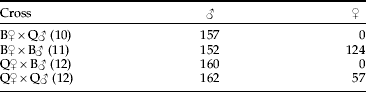
A summary of the reciprocal inter-biotype crosses as well as control intra-biotype crosses is given in table 2. As can be seen, F1 females were produced only in crosses within biotypes. Crosses between the B and Q biotypes produced only males. These progeny sex ratio differences were highly significant for both the B and Q biotypes (G=138.85, df=1, P<0.001 and G=69.81, df=1, P<0.001, respectively) and served as an indication for complete reproductive isolation between the B and Q biotypes in Israel. Subsequent work focused on determining whether a pre-zygotic or a post-zygotic isolation stage is involved.
Number of male and female offspring in B. tabaci B and Q inter- and intra- biotype crosses (3B♀×3B♂, 3Q♀×3Q♂, 3B♀×3Q♂, 3Q♀×3B♂). The colonies used in this experiment are Ashalim-03 (B) and Ayalon-02 (Q). The brackets indicate the number of replications.
Screening for bacteria associated with reproductive manipulation
Wolbachia, Rickettsia and Arsenophonus are known to cause reproductive manipulations in arthropods, but their role in B. tabaci is unknown (Chiel et al., Reference Chiel, Gottlieb, Zchori-Fein, Mozes-Daube, Katzir, Inbar and Ghanim2007). PCR screening of our colonies for determining the infection frequency of these three bacteria revealed that Rickettsia is present in all five colonies: B-ref (10/10), PyriR-unsel (10/10), Ashalim-03 (5/9), Arava-03 (9/10) and Ayalon-02 (2/10). Arsenophonus was found in the Q biotype colonies Arava-03 and PyriR-unsel (7/10 and 6/10, respectively) but not in the Q biotype colony Ayalon-02 and the B biotype colonies Ashalim-03 and B-ref. Wolbachia was not present in all five colonies analyzed.
Mating behavior
As described above, mating behaviors were divided into six steps (I–VI). All couples from all four treatments (B♀B♂, Q♀Q♂, B♀Q♂, Q♀B♂) performed step I (female contact). The frequency for conducting steps II–V was compared in each biotype between homogeneous and heterogeneous couples according to the identity of the females (B♀B♂ versus B♀Q♂ and Q♀Q♂ versus Q♀B♂). In the Q biotype (fig. 1a), the frequency of antennal drumming was significantly higher in heterogeneous couples Q♀B♂ than in homogeneous couples Q♀Q♂ (G=3.9, df=1, P=0.04). There was no significant difference in the frequency of homogenous and heterogeneous couples that performed body pushing (G=2.4, df=1, P=0.1). Significant difference between Q♀Q♂ and Q♀B♂ couples was also found in step IV (wing movement) frequencies (G=5.5, df=1, P=0.01). This time, however, the IV behavioral step was found to be more abundant in homogeneous couples. No copulation events were observed in heterogeneous couples (Q♀B♂) compared to 50% in the Q♀Q♂ couples (G=8.2, df=1, P=0.04). In the B biotype (fig. 1b), there was no significant difference between homogenous and heterogeneous couples in the frequency of antennal drumming (G=0.00, df=1, P=1), body pushing (G=0.36, df=1, P=0.54) and wing movement (G=1.5, df=1, P=0.22). Again, no copulation events were observed in heterogeneous couples B♀Q♂ compared to 54% in B♀B♂ couples (G=6.5, df=1, P=0.01). Copulation time did not differ significantly between homogeneous couples of the B and Q biotypes and lasted for 2.25±0.23 (SE) and 2.33±0.32 (SE) minutes, respectively (one-way ANOVA: F (1,20)=0.037, P=0.84). Total courtship time was significantly different between the four treatments: B♀B♂, B♀Q♂, Q♀Q♂, Q♀B♂ (one-way ANOVA: F (3, 53)=8.15, P=0.0001). Tukey-Kramer HSD test indicated that total courtship time was significantly shorter in B♀B♂ couples than in all other combinations (P<0.05), which did not differ between themselves (fig. 2). In copulated homogenous couples from both biotypes, males stayed 2–3 mm from the female after mating; this behavior was regarded as guarding (step VI). The mean guarding time was 52.8±16.1 (SE) minutes (N=13).
The proportions of couples that displayed each of courtship steps II–V in homogeneous and heterogeneous couples within each biotype. (a) Q♀Q♂ couples versus Q♀B♂ couples ( , Q♀Q♂;
 , Q♀B♂). (b) B♀B♂ couples versus B♀Q♂ couples (, B♀B♂; , B♀Q♂). Comparisons were made by log-likelihood ratio test (G-test). Asterisks indicate significant differences between homogeneous and heterogeneous couples within each courtship step (P⩽0.05). The colonies used in this experiment were Ashalim-03 (B) and Arava-03 (Q).

Total courtship time (min) in homogeneous and heterogeneous couples of B and Q (B♀B♂, B♀Q♂, Q♀Q♂, Q♀B♂). Different letters indicate significant differences between couple combinations (Tukey Kramer HSD test, P⩽0.05). Error bars represent standard error of the means. The number of replicates is indicated within each bar. The colonies used in this experiment were Ashalim-03 (B) and Arava-03 (Q).

Sperm transmission between the B and Q biotypes
In order to support our observation that there is no copulatory organ contact in inter-biotype crosses (a pre-copulatory isolation mechanism), we looked for the presence of sperm in the spermathecae (the sperm storage organ) of mated females. Evidence for sperm transfer was found only in females that mated with males from the same biotype (fig. 3). Sperm was found in the spermathecae of 11 out of 22 dissected females from the intra B biotype cross (50%) and in 5 out of 34 dissected females of the intra Q biotype cross (15%). We did not detect sperm in any of the dissected females from inter-biotype crosses (21 females from the B♀×Q♂ cross and 22 females from the Q♀×B♂ cross). These sperm transfer frequency differences were significant for both the B and Q biotypes (G=18.40, df=1, P<0.001 and G=5.30, df=1, P=0.021, respectively).
Sperm in spermatheca (×400) of inseminated female stained with DAPI. DAPI stains nucleic acids, revealing the exact position of the nucleus when illuminated with UV light. The colonies used in this experiment were Ashalim-03 (B) and Ayalon-02 (Q).

Reproductive interference between the B and Q biotypes
Comparisons were preformed among treatments with the same female identity (B biotype assemblage: B♀B♂, B♀2B♂ and B♀B♂Q♂; or Q biotype assemblage: Q♀Q♂, Q♀2Q♂ and Q♀Q♂B♂). The mean number of emerging females was not significantly different in both biotype assemblages (F (2,27)=1.80, P=0.18 and F (2,31)=0.54, P=0.59 for the B and Q assemblages, respectively; table 3). For males mean emergence, the same comparisons (F (3,37)=1.07, P=0.37 and F (3, 38)=3.45, P=0.03 for the B and Q assemblages, respectively; table 3) yielded a significant difference only between Q males in the Q♀2Q♂ assemblage and the B males in the Q♀Q♂B♂ assemblage (P=0.017). We used fecundity and progeny sex ratio as biotype performance indicators. In the B biotype, the number of eggs per female was not significantly different between the three treatments (F (2, 27)=2.02, P=0.15). In the Q biotype, there was a significant difference between the three treatments (F (2, 31)=3.4, P=0.04). Dunnett's test between the two homogenous control cultures and the mixed culture indicated that the mean number of eggs per female in Q♀Q♂B♂ was significantly lower than that of Q♀2Q♂ (P=0.03) and marginally significantly lower than that of Q♀Q♂ (P=0.055) (table 3). No significant difference was detected in F1 male proportion when the three treatments were compared within each of the biotype assemblages (F (2, 36)=2.02, P=0.12 for the B biotype and F (2, 32)=1.68, P=0.20 for the Q biotype).
Mean female and male emergence and mean eggs per female under six different assemblages of males and females from the B and Q biotypes. Comparisons were preformed on treatments with the same female identity (B biotype assemblage: B♀B♂, B♀2B♂ and B♀B♂Q♂; or Q biotype assemblage: Q♀Q♂, Q♀2Q♂ and Q♀Q♂B♂). Values followed by different letters are significantly different (P⩽0.05). N indicates number of replicates. The colonies used in this experiment were Ashalim-03 (B) and Arava-03 (Q).

$NA, not applicable.
* P⩽0.05 for Dunnett's test between Q♀Q♂B♂ and Q♀2Q♂.
+,P=0.05 for Dunnett's test between Q♀Q♂B♂ and Q♀Q♂
Discussion
We focused in this study on reproductive interactions between Israeli B and Q field-derived colonies of B. tabaci. A first indication for sever reduction in gene flow between the two biotypes came from amova analysis of AFLP markers. Given the fact that in many fields in Israel the B. tabaci populations are a mixture of the B and Q biotypes (Khasdan et al., Reference Khasdan, Levin, Rosner, Morin, Kontsedalov, Maslenin and Horowitz2005), the lack of intermediate haplotypes and the significant higher percentage of variance attributable to differences between biotypes as compared to differences between populations within biotypes suggested the existence of a reproductive barrier. To verify this finding, we set laboratory intra- and inter-biotype controlled crossing experiments. While intra-biotype crosses were capable of producing both males and females, crosses between the two biotypes produced only males. These experiments served as a second line of evidence supporting the existence of a strong reproductive barrier between the B and Q biotypes of Israel. Our subsequent work focused on determining whether the barrier stage is pre-zygoyic or post-zygotic.
As our inter-biotype crossing experiments failed to produce hybrids, we first checked our strains for the presence of Wolbachia, Rickettsia and Arsenophonus bacteria which are known to cause reproductive manipulations in arthropods (Stouthamer et al., Reference Stouthamer, Breeuwer and Hurst1999; Perlman et al., Reference Perlman, Hunter and Zchori-Fein2006; Chiel et al., Reference Chiel, Gottlieb, Zchori-Fein, Mozes-Daube, Katzir, Inbar and Ghanim2007). Our results indicated that from the three bacteria, only Arsenophonus could be considered a putative manipulator because it was found only in Q biotype strains (Rickettsia was present in all our colonies while Wolbachia was absent in all of them). However, Arsenophonus was not detected in the Q strain Ayalon-02 and was not fixed in the two other Q strains, Arava-03 and PyriR-unsel. We, therefore, conclude that reproductive manipulation by Arsenophonus is most likely not the main mechanism currently causing reproductive isolation between Israeli B and Q colonies, although the possibility that this bacterium or others may cause post-zygotic reproductive isolation between B. tabaci biotypes via cytoplasmic incompatibility or other mechanisms should be further explored (Chiel et al., Reference Chiel, Gottlieb, Zchori-Fein, Mozes-Daube, Katzir, Inbar and Ghanim2007).
On the contrary, we provide two independent lines of evidence that support the existence of an earlier, pre-zygotic (pre-copulatory) reproductive barrier, in Israeli B and Q colonies. First, monitoring of mating behaviors in homogeneous and heterogeneous couples (B♀B♂, Q♀Q♂, B♀Q♂, Q♀B♂) indicated no copulation events in heterogeneous couples compared to ∼50% in homogeneous Q and B couples. Second, we could not detect the presence of sperm in the spermathecae of females from heterogeneous couples, compared to 50% detection in intra-B biotype crosses and 15% detection in intra-Q biotype crosses. Ghanim et al. (Reference Ghanim, Sobol, Ghanim and Czosnek2007) also brought indirect evidence for the presence of a pre-copulatory barrier between Israeli B and Q colonies by studying the transmission of Tomato yellow leaf curl virus (TYLCV) between B. tabaci males and females during mating. TYLCV could be transmitted during copulation among individuals from the same biotype (from B♂ to B♀ and vice versa; and from Q♂ to Q♀ and vice versa). However, viruliferous males of the B biotype were unable to transmit the virus to females of the Q biotype (and vice versa); similarly, viruliferous males of the Q biotype were unable to transmit the virus to females of the B biotype (and vice versa). A possible pre-copulatory reproductive barrier was also observed between the B biotype and two indigenous biotypes from China (ZHJ1) and Australia (AN) (Liu et al., Reference Liu, De Barro, Xu, Luan, Zang, Ruan and Wan2007).
As was already mentioned, other previous studies have shown so far only the possibility of post-zygotic reproductive barriers between the B and Q biotypes of B. tabaci as indicated by the production of non-viable F2 hybrids (Ma et al., Reference Ma, Hadjistylli, Gorman, Denholm and Devine2004). This production of unfit offspring is likely to be associated with high fitness costs due to wastage of energy, time and gametes (Singer, Reference Singer1990). Because selection against unfit hybrids in conjunction with evolution of mating discrimination behaviors in sympatry, that prevent hybridization, are hallmarks of the reinforcement hypothesis (Dobzhansky, Reference Dobzhansky1940, reviewed in Howard, Reference Howard and Harrison1993; Butlin, Reference Butlin1995), the exhibition of these characteristics by Israeli colonies of the B and Q biotypes of B. tabaci suggest that they may be undergoing reinforcement. However, it can be caused by processes other than reinforcement and the alternative hypotheses will have to be ruled out in the future to ascribe this pattern to reinforcement alone (Noor, Reference Noor1999; Lemmon et al., Reference Lemmon, Smadja and Kirkpatrick2004). However, some alternative hypotheses like ecological character displacement, the evolution of size and/or shape differences that would reduce resource-use overlap and, hence, interspecific interaction in sympatric regions (reviewed in Dayan & Simberloff, Reference Dayan and Simberloff2005) seems unlikely due to the lack of evidence for morphological differences and the occurrence of both biotypes on the same plant host in many Israeli cropping systems (Khasdan et al., Reference Khasdan, Levin, Rosner, Morin, Kontsedalov, Maslenin and Horowitz2005).
Specific mate recognition systems should enable species to recognize conspecific mates correctly (Hochkirch et al., Reference Hochkirch, Groning and Bucker2007). By recording the proportion of couples that perform the main courtship steps prior to copulation (antennal drumming, body pushing and wing movement), we tried to locate, roughly, the behavioral step at which recognition between B and Q biotypes might occur. In the Q biotype, the frequency of antennal drumming was significantly higher in heterogeneous couples Q♀B♂ than in homogeneous couples Q♀Q♂. There was also a higher proportion (although not significant at P⩽0.05) of heterogeneous couples that performed body pushing. A reciprocal picture was observed at the more advanced wing movement courtship stage, as a significant higher proportion of Q♀Q♂ couples were observed conducting this stage when compared to Q♀B♂ couples. According to Kanmiya (Reference Kanmiya, Drosopoulous and Claridge2006), B. tabaci male and female exchange signals or reciprocal sounds for mate finding and further on, during courtship up to copulation. It is possible that the increase in the proportion of heterogeneous couples that perform the early stages (antennal drumming and body pushing) and the subsequent decrease in the proportion of heterogeneous couples that perform the later stages (wing movement and copulation), as compared to the homogenous pairs, are an indication for a problematic exchange of early recognition signals. This causes the heterogeneous couples to get ‘stuck’ and to continue performing the early steps continuously for a long period of time. A similar trend (although not significant at P⩽0.05) was also observed in the B biotype homogenous and heterogeneous couples (B♀B♂ and B♀Q♂, respectively), at least for the body pushing and wing movement steps, suggesting that mate discrimination signals have evolved in both biotypes.
Interspecific mating attempts can reduce fitness and lead to decreased conspecific matings in mixed cultures (McLain & Shure, Reference McLain and Shure1987; Singer, Reference Singer1990; Verrel, Reference Verrel1994). If both species are equally affected, the initial density should determine the reproductive success and survival (Foster et al., Reference Foster, Whitten, Prout and Gill1972). Nevertheless, asymmetric types of reproductive interference are probably more common in nature, as it is rather unlikely that two related species have completely similar reproductive properties (Hochkirch et al., Reference Hochkirch, Groning and Bucker2007). Our experiments indicated that asymmetric reproductive interference occurred in mixed cultures of the B and Q biotypes, as the mean number of eggs per female in Q♀Q♂B♂ cultures was significantly lower than that of Q♀2Q♂ cultures and marginally significantly lower than that of Q♀Q♂ cultures. A similar phenomenon was not observed in the B biotype cultures (B♀B♂, B♀2B♂ and B♀B♂Q♂). Pascual & Callejas (Reference Pascual and Callejas2004) also found evidence for asymmetric interspecific interactions between the B and Q biotypes that result in a significant increase in Q male proportion in mixed culture when the B biotype was present. Asymmetric mating interactions were also observed between the B biotype and the two aforementioned indigenous biotypes ZHJ1 (China) and AN (Australia). The ability of the B biotype to out-compete these indigenous biotypes was associated with its ability to increase the production of female progeny by increasing the frequency of copulation and its capacity to interfere with the mating of indigenous individuals (Liu et al., Reference Liu, De Barro, Xu, Luan, Zang, Ruan and Wan2007). De Barro & Hart (Reference De Barro, Driver, Trueman and Curran2000) observed reproductive interference between the B biotype and a local biotype (EAN) in Australia. However, in this case, both biotypes suffered a significant decrease in oviposition in mixed cultures. This phenomena was coined the ‘distracting male hypothesis’, where the presence of an incompatible male distracts the female from egg laying.
The extent to which asymmetric reproductive interference might affect the B and Q biotypes reproductive success when living in mixed populations for a few generations is yet to be examined. The B and Q biotypes differ in many life history parameters (Muniz, Reference Muniz2000; Muniz & Nombela, Reference Muniz and Nombela2001, Pascual & Callejas, Reference Pascual and Callejas2004) and also, due to their large distribution, experienced a range of biotic and abiotic selection forces such as different hosts, climates and insecticide spraying regimes. The combined effect of all of these different forces may be the balancing mechanism by which the B and Q biotypes coexist in Israel in sympatry without completely excluding each other.
Acknowledgements
This work was supported by the Israel Science Foundation grant 971/04.



