When adults migrate to a new country where another language is dominant, their children are likely to be educated in that language and use it as their primary means of communication. What are the consequences of such migrant parents speaking to their children mostly in their home language (also referred to as their heritage language: HL), versus speaking to their children mostly in the new language (also referred to as the majority language: ML)?
If HL were to be used, the children are likely to become fluent in the two languages (i.e., bilingual), which may also lead to advantages in the nonlinguistic cognitive domain, particularly in executive functions such as inhibition and switching, through continual practice in keeping their two languages apart (e.g., Bialystok, Craik & Luk, Reference Bialystok, Craik and Luk2008; Carlson & Meltzoff, Reference Carlson and Meltzoff2008; Costa, Hernández, Costa-Faidella & Sebastián-Gallés, Reference Costa, Hernández, Costa-Faidella and Sebastián-Gallés2009; Tao, Marzecová, Taft, Asanowicz & Wodniecka, Reference Tao, Marzecová, Taft, Asanowicz and Wodniecka2011; Tao, Taft & Gollan, Reference Tao, Taft and Gollan2015; see Bialystok, Craik, Green & Gollan, Reference Bialystok, Craik, Green and Gollan2009, for a review; although several recent studies have questioned the robustness of these advantages, particularly in relation to inhibition, e.g., Duñabeitia, Hernández, Antón, Macizo, Estévez, Fuentes & Carreiras, Reference Duñabeitia, Hernández, Antón, Macizo, Estévez, Fuentes and Carreiras2014; Kousaie & Phillips, Reference Kousaie and Phillips2012; Paap & Greenberg, Reference Paap and Greenberg2013; Paap, Johnson & Sawi, Reference Paap, Johnson and Sawi2015). However, on the negative side, the early and extended exposure to HL may interfere with the children's learning and attainment of the majority language of the society in which they reside. For example, they are likely to have lower accuracy in pronunciation (e.g., Flege, Munro & MacKay, Reference Flege, Munro and MacKay1995; see Hyltenstam & Abrahamsson, Reference Hyltenstam and Abrahamsson2000; Piske, MacKay & Flege, Reference Piske, MacKay and Flege2001, for reviews), and smaller vocabulary size in both their languages compared to monolingual speakers of either language (e.g., Bialystok, Luk, Peets & Yang, Reference Bialystok, Luk, Peets and Yang2010; Portocarrero, Burright & Donovick, Reference Portocarrero, Burright and Donovick2007; see Bialystok et al., Reference Bialystok, Craik, Green and Gollan2009, for a review). Further, there may be negative transfer effects from HL to the comprehension of spoken ML. Nguyen-Hoan and Taft (Reference Nguyen-Hoan and Taft2010) found that adult bilinguals show such processing deficits in a second language (L2) as a result of their experience in their first language (L1), even when L2 was now their dominant language.
Alternatively, migrant parents may speak to their children in the language of the new country, despite their nonnative pronunciation in that language and possibly incorrect use of grammar and vocabulary. The early and extended exposure to ML that their children therefore receive may optimize their ultimate attainment in the language that will become of greatest importance to their daily living. However, they will more than likely be unable to communicate effectively in their parents’ HL, which may be important in some families for maintaining cultural heritage. Additionally, it is possible that aspects of the incorrect use of ML by the nonnative parents may be adopted by their children. In fact, it is largely unknown what effects there might be on the perception and production of language when there is early and extended exposure to an accented version of that language, and this is the main issue to be pursued in the present study. On the one hand, early and extended exposure to accented ML speech (in this case, foreign-accented English) may lead to relative difficulty in understanding English spoken in the majority accent, as well as a greater degree of foreign accent in their own English production due to familiarity with nonstandard English speech sounds. On the other hand, it is possible that extended exposure to accented ML may help to enhance the ability to perceive foreign-accented speech in general, due to greater flexibility in processing nonstandard phonemic realizations.
Previous studies on the impact of early language experience have typically investigated the interference arising from early exposure to one language on the acquisition and development of a second language. For example, studies of the bilingual population in the Spanish region of Catalonia, where participants are exposed to both Catalan and Spanish from an early age, have shown that greater amount of exposure to one language over the other produces better perceptual discrimination of speech sounds in that language for both children (Bosch & Sebastián-Gallés, Reference Bosch and Sebastián-Gallés2003; Sebastián-Gallés & Bosch, Reference Sebastián-Gallés and Bosch2009) and adults (Sebastián-Gallés, Echeverría & Bosch, Reference Sebastián-Gallés, Echeverría and Bosch2005), even when participants are matched on lexical knowledge. In addition, there is greater sensitivity to restrictions in a given language on the permissible combinations of phonemes (i.e., phonotactic constraints) for both children and adults (Sebastián-Gallés & Bosch, Reference Sebastián-Gallés and Bosch2002). These findings indicate an impact of language exposure in the early home environment on aspects of L1 and L2 performance, both during the developmental period and in the longer term. Interference effects of a native language on L2 learning have also been examined in migrant populations (e.g., McCarthy, Mahon, Rosen & Evans, Reference McCarthy, Mahon, Rosen and Evans2014), where bilingual children show perception and production skills in L2 that reflect the phonetic properties of the L1 they had been exposed to during childhood. The present study examined participants whose early language experience might have involved more diverse language exposure due to their parents’ backgrounds, but extends beyond the previous studies by distinguishing between those who had been mostly exposed to HL and those who had been mostly exposed to foreign-accented versions of ML. That is, the present study investigated the impact of exposure to non-ML-accented speech, in addition to exposure to HL speech, in the early home environment.
It has been shown that listeners can perceptually adapt to nonstandard speech, even following only brief exposure within an experimental setting (e.g., Bradlow & Bent, Reference Bradlow and Bent2008; Clarke & Garrett, Reference Clarke and Garrett2004; see Samuel & Kraljic, Reference Samuel and Kraljic2009, for a review). Furthermore, such perceptual learning can generalize to previously untrained stimuli (e.g., Maye, Aslin & Tanenhaus, Reference Maye, Aslin and Tanenhaus2008; Sidaras, Alexander & Nygaard, Reference Sidaras, Alexander and Nygaard2009), and to novel speakers of the same accent (e.g., Bradlow & Bent, Reference Bradlow and Bent2008; Sidaras et al., Reference Sidaras, Alexander and Nygaard2009). However, generalization to a different accent has failed to be observed following brief training exposures (e.g., Bradlow & Bent, Reference Bradlow and Bent2008). Nevertheless, it is possible that over longer periods of exposure to accented speech, particularly daily exposure from an early age, listeners can produce perceptual adaptation that generalizes to other accents. Research on perceptual adaptation to accented speech has mostly focused on short-term exposure to that accent, typically in just one session of an experimental setting. Few studies have examined the effects of longer-term exposure to accented speech. In particular, no published studies to date have specifically examined groups of participants who were exposed mostly to foreign-accented ML at home, as opposed to their HL. Hence, the present research sought to investigate the effects of such longer-term exposure to accented speech by including this previously unexamined group. In everyday life, such individuals may be exposed to accented speech, both in their home environment and in the community at large. As is the case for brief exposures, extended exposure to accented speech may have the effect of enhancing performance on perception of accented speech through experience and adaptation. Specifically, extended exposure may produce a general broadening of phonemic categories through boundary relaxation, thus leading to greater tolerance for mispronunciations overall and greater flexibility in perceiving unfamiliar accented speech. Participants who were mostly exposed to foreign-accented ML during early childhood may, therefore, show enhanced perception of accented speech, even for accents with which they are unfamiliar.
Studies do exist that have examined the amount of exposure to accented speech in the home environment, but only to regional rather than nonnative accents. Floccia, Butler, Girard and Goslin (Reference Floccia, Butler, Girard and Goslin2009) observed that children who had been exposed to greater phonological variability due to their parents having different regional accents performed better on an accent categorization task compared to children who were growing up in a ‘mono-accentual’ environment (i.e., one where both parents spoke with the same regional accent as their surroundings). The impact of long-term exposure to pronunciation variability on a child's perceptual representation of accents was further demonstrated by Durrant, Delle Luche, Cattani and Floccia (Reference Durrant, Delle Luche, Cattani and Floccia2015), who found that infants whose home linguistic environment matched the surroundings did not accept mispronunciations as adequate exemplars of previously familiarized words. In contrast, those exposed to greater accent variability through their parents’ speech performed similarly for both correctly pronounced and mispronounced words, showing greater tolerance for mispronunciations. These findings provide support for the notion that continuous exposure to greater accent variability in the home leads to a general broadening of phonemic categories through boundary relaxation. From an early age, then, perceptual representations for pronunciations seem to be modified by experience or exposure (Durrant et al., Reference Durrant, Delle Luche, Cattani and Floccia2015; Floccia et al., Reference Floccia, Butler, Girard and Goslin2009; but see Floccia, Delle Luche, Durrant, Butler & Goslin, Reference Floccia, Delle Luche, Durrant, Butler and Goslin2012). As the children grow older, the continued exposure and modification of perceptual representations may lead them to develop even greater flexibility in dealing with accented speech, as their perceptual systems become more tolerant of pronunciation variations.
Studies have also explored the impact of extended exposure to accented speech outside the home environment. Native Catalan speakers living in Spain and exposed to Spanish-accented Catalan throughout their lives were found to be able to accurately distinguish Catalan words containing the /e/ vowel from corresponding nonwords created by replacing the /e/ with /ɛ/, but had more difficulty distinguishing words containing /ɛ/ and corresponding nonwords that replaced the /ɛ/ with /e/ (Sebastián-Gallés, Vera-Constán, Larsson, Costa & Deco, Reference Sebastián-Gallés, Vera-Constán, Larsson, Costa and Deco2009; see also Larsson, Vera-Constán, Sebastián-Gallés & Deco, Reference Larsson, Vera-Constán, Sebastián-Gallés and Deco2008; Sebastián-Gallés et al., Reference Sebastián-Gallés, Echeverría and Bosch2005). This was suggested to be due to exposure to mispronunciations of Catalan words in Spanish-accented Catalan. In Spanish, the vowels /e/ and /ɛ/ are not separate phonemes, but rather there is a single vowel /e/ that only partially matches with Catalan /e/ and differs from Catalan /ɛ/. Consequently, words containing these two sounds in Spanish-accented Catalan are typically pronounced with a single vowel that native Catalan speakers usually assimilate to their /e/ vowel. Thus, Catalan listeners may have developed greater tolerance for mispronunciations of words containing /e/ (Sebastián-Gallés et al., Reference Sebastián-Gallés, Vera-Constán, Larsson, Costa and Deco2009). In terms of the present study, participants who have had early and extended exposure to foreign-accented ML speech may well possess modified perceptual representations to accommodate both standard and accented pronunciations (Durrant et al., Reference Durrant, Delle Luche, Cattani and Floccia2015; Sebastián-Gallés et al., Reference Sebastián-Gallés, Vera-Constán, Larsson, Costa and Deco2009), potentially leading to more flexible or efficient processing of even unfamiliar accented speech compared to those who have not had such exposure.
In addition to affecting speech perception, the broadening of phonemic categories through extended exposure may also impact upon speech production, leading to greater flexibility in the phonetic realization of a phoneme when producing speech. Thus, people who have had early and extended exposure to accented ML may produce nonstandard pronunciations of ML speech sounds. People who were exposed more to HL may also speak ML with a nonstandard pronunciation, because they may have delayed learning of ML as well as greater usage and maintenance of HL. Both the age of learningFootnote 1 (e.g., Abrahamsson & Hyltenstam, Reference Abrahamsson and Hyltenstam2009; DeKeyser, Reference DeKeyser, Gass and Mackey2012; Piske et al., Reference Piske, MacKay and Flege2001) and the amount of relative language use (e.g., Flege et al., Reference Flege, Munro and MacKay1995; Piske et al., Reference Piske, MacKay and Flege2001) have been shown to impact pronunciation accuracy in L2. Further, according to the Speech Learning Model (SLM; Flege, Reference Flege and Strange1995, Reference Flege, Burmeister, Piske and Rohde2002), a bilingual's two languages exist in a common phonological space, where the phonemic categories of the two languages interact with and modify each other, resulting in shifted categories and in the formation of composite L1-L2 categories. Therefore, a bilingual speaker may have nonstandard phonemic categories in both of their languages, leading to nonstandard pronunciations. Greater amount of exposure to and usage of HL can result in greater modification of ML sound categories, and thus it might lead to a greater likelihood of producing accented speech in ML.
In summary, the present study sought to investigate the amounts of exposure to HL versus exposure to foreign-accented ML in the early home environment, and their effects on speech perception and production. That is, the consequences of migrant parents speaking to their children mostly in HL versus mostly in ML during the children's early childhood, despite having accented pronunciations in ML, were examined. Specifically, participants who differed in their early language exposure were assessed on their perception of both foreign-accented and non-foreign-accented English speech, as well as degree of foreign accent in their own English speech. Overall, it was predicted that those who were mostly exposed to accented ML during early childhood may have an enhanced ability to perceive accented speech in general, even to accents with which they are unfamiliar; but they may have a stronger degree of foreign accent in their own ML speech due to their exposure, and may also have some difficulty in understanding standard ML. Those who were exposed more to HL during early childhood may also produce nonstandard pronunciations of ML speech, along with disadvantages in other aspects of ML performance, due to their delayed learning of ML.
Method
Participants
In order to classify participants whose parents were from non-English-speaking backgrounds into two groups based on the nature of their early language exposure, a language background questionnaire was used. The participants could only be classified using retrospective self-report, whereby they were asked to estimate the average percentage of time they were exposed to non-English HL (as opposed to English) from people at home during the time period from birth to before starting school. Those who indicated greater than 50% exposure to HL were classified as belonging to the ‘HL’ home environment group, while those who indicated less than 50% exposure to non-English speech (i.e., greater than 50% exposure to accented English) were classified as belonging to the ‘Nonstandard ML’ home environment group. Those who reported approximately equal amounts of exposure were excluded (see subsections below for the average and range of exposure percentages for each group). The background questionnaire further collected information from the HL and Nonstandard ML groups relating to their language experience, so that differences in factors such as age of acquisition, proficiency, and usage could be examined. Participants in these two groups rated their proficiency in English and any other languages that they knew using a 7-point scale (1 = Not at all, 7 = Native-like), separately for speaking, understanding speech, reading, and writing. Estimates were also provided for the age of first learning to speak in English, and the amount of daily use of non-English HL (expressed in percentages), if any.
Demographic details were collected from all participants to allow any major differences between groups, such as age, gender, and socioeconomic background, to be identified and controlled for. For example, females have been found to outperform males on language tasks such as verbal fluency, verbal learning, and reading comprehension, particularly during childhood, but also to a lesser degree through adulthood (e.g., Burman, Bitan & Booth, Reference Burman, Bitan and Booth2008; Chiu & McBride-Chang, Reference Chiu and McBride-Chang2006; Wallentin, Reference Wallentin2009). In addition, socioeconomic status has been shown to be positively associated with academic outcomes, including graduation rates and standardized test scores, as well as with aspects of language performance (e.g., Sirin, Reference Sirin2005; Stevens, Lauinger & Neville, Reference Stevens, Lauinger and Neville2009). Both parental education and parental occupation have been shown to be good indicators of socioeconomic status (Marks, McMillan, Jones & Ainley, Reference Marks, McMillan, Jones and Ainley2000), but the former was chosen for the present study, determined as the average of the two parents’ number of years of education. The reason for this choice was that an earlier study had found that responses for parental occupation were often too vague to be used for determining accurate socioeconomic status scores, and that some participants’ parents were retired or did not work, leading to missing data points (Tao et al., Reference Tao, Marzecová, Taft, Asanowicz and Wodniecka2011).
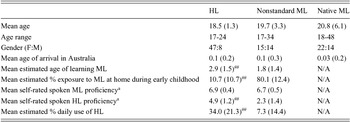
There were 120 participants, each belonging to one of three groups (described in detail in each of the following subsections): HL (n = 55), Nonstandard ML (n = 29), and a ‘Native ML’ group (n = 36). Table 1 presents the demographic and language characteristics for each of the three groups. All participants were either born in Australia (where the national language is English) or had arrived at or before age 1, and were raised and educated in Australia (i.e., had not spent a total of 1 year or more in another country). None reported having any hearing or speech impairments. The participants were students undertaking a first-year undergraduate psychology course at UNSW Australia, and participated in exchange for course credit. Those in the HL and Nonstandard ML groups were recruited with the criterion that their parents came from non-English speaking backgrounds.
Characteristics of Participant Groups (Standard Deviation in Parentheses).

Note. HL = heritage language. ML = majority language.
a 1 = Not at all, 2 = Very poor, 3 = Poor, 4 = Functional, 5 = Good, 6 = Very good, 7 = Native-like.
## Significant difference between HL and Nonstandard ML groups, p < .01.
Participants in both the HL and Nonstandard ML groups covered a wide range of language backgrounds. From a practical perspective, it was not possible to obtain large enough sample sizes of people from a homogeneous language background. However, the heterogeneous language backgrounds of participants actually helps to strengthen the interpretation of any observed differences between the two groups in terms of these being due to the effects of general language experience, independent of specific language background. Indeed, a particular accent may be more easily understood by listeners from one particular language background compared to listeners from another language background. Languages have a different phonetic distance or similarity between different pairings, which influences how easily certain accents can be understood by native speakers of a particular language (Bradlow, Clopper, Smiljanic & Walter, Reference Bradlow, Clopper, Smiljanic and Walter2010). Therefore, the use of multiple accents and multiple language backgrounds allows for results that are more likely to be generalizable across all language pairings. Having said that, post hoc analyses will nevertheless be carried out in the present study, where a subset of participants in the HL and Nonstandard ML groups are matched as effectively as possible on language background in order to explicitly control for that factor.
HL group
The HL group consisted of individuals who were exposed to their parents’ non-English HL in the home for the majority of their childhood (i.e., greater than 50% exposure to non-English speech). The average exposure to HL was 89.3%, ranging from 60% to 100%. Participants in this group indicated moderate levels of current usage and proficiency in HL (i.e., they were bilingual). In addition, they were either simultaneous bilinguals or early sequential bilinguals, who had learned to speak HL first (or at the same time as ML), but who had become dominant in ML. The language backgrounds included Arabic (n = 6), Chinese languages (19), Filipino (2), Indian languages (4), Indonesian (2), Japanese (1), Korean (5), Spanish (1), Thai (2), Ukrainian (1), Vietnamese (6), Chinese and Cambodian (1), Chinese and Malay (1), and Chinese and Vietnamese (4).
Nonstandard ML group
Those in the Nonstandard ML group were exposed to English spoken with a foreign accent in the home environment for the majority of their childhood (i.e., less than 50% exposure to non-English speech). The average exposure to HL was 19.9% (i.e., 80.1% exposure to accented English), ranging from 0% to 40%. Participants were also asked to identify up to four people at home who interacted with them the most from birth to before starting school, and rate those family members on their pronunciation of English using a 7-point scale (1 = Strong foreign accent, 7 = No foreign accent). Inclusion in the Nonstandard ML group was contingent upon at least one family member receiving an accent rating of 5 or lower in their English pronunciation. This was to ensure that participants in this group have indeed been exposed to accented varieties of English. In contrast to the HL group, those in the Nonstandard ML group reported minimal usage of HL, and only 16 out of the 29 participants (i.e., 55%) in this group reported any capacity at all to communicate in it. Therefore, although most would have had some exposure to HL, this group of participants could not be considered bilingual, and were mostly functionally monolingual ML speakers. Language backgrounds in this group included Arabic (n = 4), Chinese languages (6), Croatian (1), Filipino (1), French (1), German (1), Indian languages (3), Italian (4), Japanese (2), Malay (1), Russian (1), Swiss German (1), Chinese and Malay (2), and Chinese and Vietnamese (1).
Native ML Group
The Native ML group consisted of individuals who were native monolingual speakers of English and whose parents were also native English speakers. Native speakers who had grown up in English-speaking countries other than Australia (i.e., had spent a total of 1 year or more in another country) were excluded, as there may have been influences of regional accent.
Stimuli/materials
Nonverbal intelligence
In order to compare and control for differences across the three groups on general nonverbal intelligence, participants completed a shortened version of Raven's Advanced Progressive Matrices Set II (Raven, Raven & Court, Reference Raven, Raven and Court1998) containing 12 items. Each item consisted of a 3×3 matrix pattern, with the last figure blank, and with eight possible options to logically complete the pattern. Previous studies have shown differences between bilinguals and monolinguals in nonverbal intelligence, where bilinguals have obtained significantly higher scores (e.g., Marzecová, Asanowicz, Krivá & Wodniecka, Reference Marzecová, Asanowicz, Krivá and Wodniecka2012; Tao et al., Reference Tao, Marzecová, Taft, Asanowicz and Wodniecka2011). Thus, if the bilinguals showed a poorer performance on the language tasks than did the monolinguals, it would be unlikely to be accounted for by nonverbal intelligence. Nevertheless, it is necessary to ensure that differences in language task performance cannot be merely attributed to differences in general intelligence. So, if the groups did differ in performance on the nonverbal intelligence test, the scores could be entered into the analyses as a covariate and, hence, held constant.
Vocabulary
A vocabulary test was administered to obtain an objective indicator of one aspect of English proficiency. The test consisted of the final 30 items from the Vocabulary subtest of the Nelson-Denny Reading Test (Brown, Fishco & Hanna, Reference Brown, Fishco and Hanna1993). Each item involved a word embedded in a phrase (e.g., “To be impelled is to be”), with five possible answers (e.g., “A. hindered; B. helped; C. improved; D. invited; E. driven”).
Auditory comprehension
All auditory stimuli used in this study were recorded using a Redback C0384 microphone onto a desktop personal computer. Each item (passage, sentence, or word) then had the beginning and end trimmed at zero crossings (i.e., trimmed on or as closely as possible to the onset and offset of initial and final speech sounds).
An auditory comprehension task was used to assess ability to perceive and understand non-foreign-accented speech (i.e., standard Australian English pronunciation). The task involved two sets of 10 spoken passages, plus one practice item for each set, taken from Nguyen-Hoan and Taft (Reference Nguyen-Hoan and Taft2010). The passages were recorded by one male speaker of standard Australian English. The first set comprised regular passages (e.g., “The word Destiny appears in the ancient tablets, which were found in the early 8th century and are located close to the Evergreen River near the African border.”), while passages containing nonwords in the form of proper nouns constituted the second set (e.g., “The physicists of the planet Lipsonian were getting ready to experiment with a new space-monitoring device, to be used against a laser being pulsed into the Geophotic atmosphere by the Krinnians.”). Following each passage, there was one open-ended comprehension question (e.g., “What is the Evergreen?” or “What type of device was being experimented with?”). The passages were one to two sentences in length, so that the task was not too taxing on memory. Passages in both sets comprised a variety of genres, including historical, geographical, fantasy, and science fiction.
Auditory lexical decision
To further examine processing of nonwords and real words in standard Australian English, an auditory lexical decision task was used, which consisted of 40 words and 40 nonwords, plus 20 practice items (10 words and 10 nonwords). The stimuli were produced by the same speaker of standard Australian English who recorded the auditory comprehension passages. There were an equal number of monosyllabic and polysyllabic words (e.g., “score”, “discover”), and an equal number of monosyllabic and polysyllabic nonwords (e.g., “chusk”, “omsify”). The words were of a moderately high frequency of occurrence (ranging from 50 to 60 occurrences per million words, according to Carroll, Davies & Richman, Reference Carroll, Davies and Richman1971). Plural and past tense forms were avoided, as were conjunctions and prepositions. All nonwords were pronounceable, and were composed of syllables and sub-syllabic structures, including phonemes and phoneme groupings, that are found in real English words. Essentially, they were all potential English words that simply have never come into existence in the language. Given the wide variety of language backgrounds of the participants, nonwords were not purposely created to comprise phonological contrasts that may be specific to English and problematic for native speakers of other languages.
Accented sentence transcription
Differences in the ability to perceive accented speech were assessed using a sentence transcription task. The task involved a series of nonsense sentences spoken in different foreign accents, which participants were asked to report by writing them down. The number of times the sentence needed to be repeated in order to achieve perfect transcription was measured. Following previous studies of speech perception, semantically anomalous sentences were chosen to minimize the effect of contextual cues (e.g., Davis, Johnsrude, Hervais-Adelman, Taylor & McGettigan, Reference Davis, Johnsrude, Hervais-Adelman, Taylor and McGettigan2005). Two sets of semantically anomalous sentences were considered for use in the task, one involving grammatically correct sentences (e.g., “A story was used to capture the coffee”), and one involving ungrammatical sentences (e.g., “Underneath a highway loses his stated cylinder”). Pilot testing was conducted with a small set of participants who were representative of the three groups. Since the grammatical sentences produced ceiling level performance, with most participants being able to correctly transcribe the whole sentences on the first or second repetitions, the ungrammatical sentences were adopted for the task. The final set of stimuli consisted of 16 such sentences, created using an online random sentence generator (Creativity Tools, 2007). The sentences ranged from seven to nine words in length.
Four speakers, each with a different foreign accent, were recruited to record the sentences. Effort was made to select speakers with uncommon accents that participants were unlikely to be familiar with. There was a Burmese speaker (male), a Mongolian speaker (female), a speaker of Farsi from Iran (male), and a speaker of Kikuyu from Kenya (female). The number of sentences was evenly distributed among the four speakers (i.e., four sentences per speaker). Having multiple accents helped to ensure that any observed advantages in the perception of accent were not due to relative familiarity with any particular accent, but rather to foreign-accented speech in general. Furthermore, it has been shown that listeners can learn and apply knowledge of speaker-specific differences in pronunciation in real time, which can guide on-line speech perception and allow listeners to perceptually adapt to speech produced by a single speaker (Trude & Brown-Schmidt, Reference Trude and Brown-Schmidt2012). Thus, having multiple speakers helped to reduce any such speaker-specific perceptual learning effects.
Speech production
Degree of accent in speech was assessed through a verbal description task, using an emotionally neutral visual stimulus, which was the ‘Cookie Theft’ picture from Goodglass and Kaplan (Reference Goodglass and Kaplan1972). Description tasks, in contrast to reading or repetition tasks, elicit speech that is extemporaneous or free, which increases ecological validity as it more closely resembles natural speech. Moreover, potential differences in reading ability or verbal mimicry ability will have no impact on extemporaneous speech. Indeed, previous findings have often shown that speech produced by reading aloud is more accented than free speech, largely due to greater demands on self-monitoring during reading (e.g., Munro & Derwing, Reference Munro and Derwing1994; Oyama, Reference Oyama1976; Piske et al., Reference Piske, MacKay and Flege2001; Thompson, Reference Thompson1991).
Procedure
After providing informed consent and filling in the background questionnaire, participants completed the vocabulary test and nonverbal intelligence tests. They then performed the three speech perception tasks – auditory comprehension, auditory lexical decision, and accented sentence transcription. For the auditory comprehension and auditory lexical decision tasks, stimuli were presented and responses recorded using DMDX (Forster & Forster, Reference Forster and Forster2003), a Windows-based display program with millisecond timer, on a desktop personal computer. Auditory stimuli for all three tasks were delivered to participants through Sennheiser HD 202 headphones. Lastly, participants completed the speech production task. The whole set of tasks was carried out within one experimental session, lasting approximately 90 minutes. All participants were tested individually in the same sound-attenuated testing room. The study was approved by the UNSW Human Research Ethics Advisory Panel (Psychology).
Nonverbal intelligence
The nonverbal intelligence test was presented to participants via an online quiz platform, SurveyGizmo. Images from the original paper version were uploaded to SurveyGizmo and set up to have the same layout as the original paper format. Participants indicated their answers by clicking on one of the eight options that appeared below the matrix. A time limit of 10 minutes was imposed to ensure that participants took a standardized amount of time on the task. One point was given for each correct answer, with a maximum total of 12. The total score was used as an index of the person's general nonverbal intelligence.
Vocabulary
The vocabulary test was also presented via the online quiz platform SurveyGizmo. Participants indicated their answers by clicking on one of the five word options that appear below the test phrase. One point was given for each correct answer, with a maximum total of 30. All questions had to be answered before the responses could be submitted to finish the task. There was no time limit, though most participants took approximately 5 minutes.
Auditory comprehension
Each auditory passage was presented once to participants, following which the comprehension question was presented both verbally and in written form on the screen. Participants typed short-answer responses while the question remained on the screen, and then pressed the Enter key to continue to the next passage. The order of presentation of the regular and nonword sets was counterbalanced, with half of the participants in each group hearing the regular passages first and the other half hearing the nonword passages first. Passages within each set were presented in a randomized order, preceded by the practice item. The total number of questions correctly answered for the regular set provided an index of the ability to process regular speech, while the number of correct answers for the nonword set provided an index for ability to deal with an aspect of novelty in speech other than unfamiliar accents (i.e., novel utterances or nonwords). The whole task took approximately 10 minutes to complete.
Auditory lexical decision
All items were presented to participants in a randomized order, preceded by the practice items. Each item was presented once the participant had responded to the previous one or after 3 seconds had elapsed if there was no response. Participants were instructed to respond as quickly but as accurately as they could, by pressing the right Shift key labelled “Yes” for words, and the left Shift key labelled “No” for nonwords. Response times and error rates were recorded. The task took approximately 5 minutes to complete, including practice.
Accented sentence transcription
After each sentence was presented once in a randomized order, participants were asked to type out the sentence they heard. Feedback was then given by the experimenter as to which words were correctly identified. If the participant did not correctly identify all the words in the sentence, it was presented repeatedly until the whole sentence was correctly transcribed, or until up to 10 repetitions for each sentence were completed. If the sentence was not correctly transcribed after 10 repetitions, a score of 11 was given for that sentence. The proportion of words correctly transcribed on the first repetition and the total number of repetitions required to accurately transcribe the whole sentence were recorded for each sentence. The final scores for each participant were calculated as the average proportion of words and the average number of repetitions across all 16 sentences. The task took approximately 30 to 50 minutes to complete, depending on how quickly participants were able to transcribe the whole sentences correctly.
Speech production
Participants were asked to provide a brief verbal description of the visual stimulus using full sentences while their speech was recorded using a Redback C0384 microphone. A 10-second excerpt was then taken from the speech recordings of each participant, using an audio editing software, Audacity. The excerpts were selected to contain relatively continuous speech, that is, free of long silences and extensive speech fillers (e.g., “um”). These speech samples were presented, through Sennheiser HD 202 headphones on a desktop personal computer, to a new group of native English speakers (N = 16) to be rated for accentedness. The listeners were asked to rate on a 7-point scale “To what extent does the speaker have a non-Australian-English accent?” (1 = Not at all, 7 = Very much).
Results
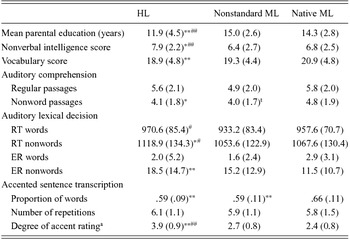
Table 2 presents the mean scores for each participant group on each of the outcome measures. Analyses of variance (ANOVAs) with three planned between-group contrasts were carried out: HL vs. Nonstandard ML, HL vs. Native ML, and Nonstandard ML vs. Native ML. The groups were found to differ on parental education and nonverbal intelligence, with the HL group having significantly lower parental education levels than both the Nonstandard ML group, F(1,117) = 13.14, p < .001, and Native ML group, F(1,117) = 9.35, p = .003. For nonverbal intelligence, the pattern was reversed, that is, the HL group had significantly higher scores than both the Nonstandard ML group, F(1,117) = 7.24, p = .008, and Native ML group, F(1,117) = 4.29, p = .041. The Nonstandard ML and Native ML groups did not differ significantly from each other on either of these two measures, F’s < 1.
Mean Scores on Outcome Measures for Participant Groups (Standard Deviation in Parentheses).

a 1 = Not at all, 7 = Very much.
* Significant difference compared to Native ML group, p < .05.
** Significant difference compared to Native ML group, p < .01.
t Trend compared to Native ML group, p < .10.
# Significant difference between HL and Nonstandard ML groups, p < .05.
## Significant difference between HL and Nonstandard ML groups, p < .01.
Controlling for pre-existing differences between groups
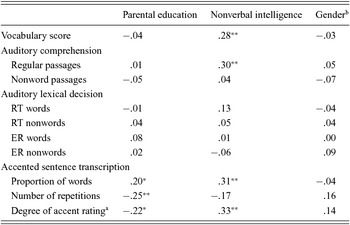
Because the groups differed on socioeconomic background and nonverbal intelligence, it is important to ensure that any differences between the groups in performance on the language tasks were not due to pre-existing differences other than early home language experience. In addition, gender was not evenly distributed across the groups (see Table 1) with proportionately more female participants in the HL group (85% females) than in either the Nonstandard ML (52%) or Native ML groups (61%). As mentioned, gender differences have consistently been found on a variety of language tasks, where females tend to outperform males (e.g., Burman et al., Reference Burman, Bitan and Booth2008; Chiu & McBride-Chang, Reference Chiu and McBride-Chang2006; Wallentin, Reference Wallentin2009). However, it should be noted that the group that had the highest proportion of female participants, the HL group, was the one that was expected to show the greatest disadvantage in English performance. So any gender bias that might exist should work against the hypotheses. Nevertheless, it is important to ensure that any differences observed between the participant groups were not attributable to differences in gender distribution. Therefore, the F values reported below are based on analyses of covariance (ANCOVAs), holding constant parental education, Raven's nonverbal intelligence score, and gender as three covariates (with gender coded as a binomial variable). Correlations between the covariates and the outcome variables are presented in Table 3.
Correlations between Covariates and Outcome Measures.

a 1 = Not at all, 7 = Very much.
b 1 = male, 2 = female.
* Significant correlation, p < .05.
** Significant correlation, p < .01.
Vocabulary
For vocabulary, the HL group scored significantly lower than the Native ML group, F(1,114) = 8.91, p = .003, while the Nonstandard ML group scored in between them, without differing significantly from either, F’s < 2.5.
Auditory comprehension
Due to program errors with DMDX, data for two participants were lost for the auditory comprehension tasks. Both participants were in the HL group. For the comprehension of regular passages, there were no significant differences, though the Nonstandard ML group had lower mean scores than both the HL and Native ML groups, with the largest F value being for the comparison between the Nonstandard ML and Native ML groups, F(1,112) = 2.63, p = .108. For the comprehension of passages containing nonwords, however, both the HL group and Nonstandard ML group scored lower than the Native ML group. The comparison between the HL and Native ML groups was statistically significant, F(1,112) = 4.31, p = .040, but the comparison between the Nonstandard ML and Native ML groups was only a trend, F(1,112) = 3.01, p = .085.
Auditory lexical decision
Prior to analysis of the auditory lexical decision data, trials with a response time less than 200 ms or greater than 2000 ms were discarded, and trials with a response time greater than 2 standard deviations from the grand mean were trimmed to those cutoff values. Due to a computer malfunction, data for one participant in the HL group were lost. In terms of RTs, the HL group responded more slowly than the Nonstandard ML group on both words, F(1,113) = 4.03, p = .047 and nonwords, F(1,113) = 6.29, p = .014, but only on nonwords when compared to the Native ML group, F(1,113) = 4.78, p = .031 (with F < 1 for words). Comparing the Nonstandard ML and Native ML groups, although the former showed faster RTs for both words and nonwords (particularly for the former, see Table 2), there were no significant differences, F’s < 2. For the measure of error rate, all three groups made very few errors on word items, and there were no significant differences among the groups, F’s < 2. For nonwords, though, the HL group made significantly more errors than the Native ML group, F(1,113) = 7.20, p = .008, while the error rate of the Nonstandard ML group fell between the other two groups, not differing significantly from either, F’s < 2.5.
Accented sentence transcription
For the perception of unfamiliar accents, the Native ML group performed better than either the HL or Nonstandard ML groups on the proportion of words correctly transcribed on the first repetition. The HL and Nonstandard ML groups did not differ significantly from each other, F(1,114) = 0.52, p = .471, but each showed significantly lower proportions of words correct than the Native ML group, F(1,114) = 14.95, p < .001, and F(1,114) = 8.07, p = .005, respectively. In terms of number of repetitions taken to correctly transcribe the whole sentences, all three groups showed similar levels of performance, and there were no significant differences, F’s < 1.
Speech production
Due to issues with the software for the recording device, speech samples could not be recorded for 15 participants; nine were in the HL group, five in the Nonstandard ML group, and one in the Native ML group. The degree of accent for the HL group was rated as being significantly stronger than both the Nonstandard ML group, F(1,99) = 19.80, p < .001, and Native ML group, F(1,99) = 42.68, p < .001, while the latter two groups did not differ significantly, F(1,99) = 1.82, p = .181.
Matching language background
As pointed out earlier, the HL and Nonstandard ML groups differed in the distribution of their language backgrounds, though there was some overlap. Different language combinations may entail different accents, both in quality and in quantity. Furthermore, it is plausible that parents who feel comfortable enough to use English in their day-to-day home life have different cultural backgrounds, with different HLs, to those who prefer to use their native tongue. This may, thus, produce systematic differences in HLs across groups, and in turn produce systematic differences in accent. Therefore, in order to compare language task performance while removing differences in language background between the HL and Nonstandard ML groups, a subset of participants (n = 21) was selected from each of these groups, where the two subsets were matched on language background. Pairs of matched participants shared either the same language background or closely related language backgrounds (e.g., Indonesian and Malay). Post hoc analyses were conducted using the data from the matched subsets, again holding constant parental education, nonverbal intelligence, and gender as three covariates within ANCOVA.
The results with the matched subsets of participants from the HL and Nonstandard ML groups showed a similar pattern of means to the original set of data. The only difference in the statistical analyses was that the nonsignificant difference between the two groups for the regular passages in the auditory comprehension task now became a weak trend in favor of the HL group, F(1,37) = 2.87, p = .099. In other words, matching the HL and Nonstandard ML groups on language background did not alter statistical significance outcomes for comparisons between the two groups on any of the tasks.
Discussion
This study investigated the effects of early home language environment on the perception and production of speech. Specifically, the effects of early and extended exposure to either non-English languages or foreign-accented English were examined. Performance on a series of language tasks was compared across the three participant groups. We will first consider the performance of the HL group, as it provides a baseline against which the performance of the Nonstandard ML group can be contrasted.
The results showed that those who grew up in a largely non-English home environment had disadvantages across all of the tasks in the present study compared to native monolingual English speakers. That is, on average, they performed more poorly on vocabulary, had greater difficulty in perceiving non-foreign-accented speech containing nonwords for both passages and single-word utterances (in both response times and error rates on the single-word items), were less able to identify sentences spoken in unfamiliar accents, and had a detectable foreign accent in their own English productions. Being more exposed to non-English languages in the home environment, participants in the HL group may have had delayed learning, and thus lower levels of ultimate attainment in English. Indeed, bilinguals have typically been found to have disadvantages in various aspects of language performance, even in the dominant language (e.g., Nguyen-Hoan & Taft, Reference Nguyen-Hoan and Taft2010; Portocarrero et al., Reference Portocarrero, Burright and Donovick2007; see Bialystok et al., Reference Bialystok, Craik, Green and Gollan2009, for a review). In particular, the disadvantage in vocabulary is consistent with extensive research showing that bilingual speakers typically have smaller vocabularies in both their languages compared to monolingual speakers of either language (e.g., Bialystok et al., Reference Bialystok, Luk, Peets and Yang2010; Portocarrero et al., Reference Portocarrero, Burright and Donovick2007; see Bialystok et al., Reference Bialystok, Craik, Green and Gollan2009, for a review) presumably through reduced exposure and experience. The disadvantage in vocabulary may have also contributed to the weaker speech perception performance for this group, particularly for the nonsense sentences, where participants need to identify each individual word in the ungrammatical, semantically anomalous sentences to be able to accurately perceive the whole sentence.
The HL group also showed statistically significant disadvantages compared to the Nonstandard ML group on the perception of non-foreign-accented speech containing nonwords, specifically in the speed of responding to both word and nonword items in the auditory lexical decision task. The perception of nonwords likely involves both the ability to decode the spoken stimulus and the ability to discriminate words from nonwords by accessing lexical information, and it would be difficult to tease these apart. It is possible that a comparison with visual lexical decision performance would help establish whether lexical discrimination is equal for different participants when the phonological element is removed. However, even then, individuals in the HL group may be less exposed to print and therefore be deficient in orthographic decoding as well as phonological decoding. In relation to lexical access, research has shown that spoken-word recognition involves simultaneous activation of multiple candidates, where the more active candidates there are, the greater the competition, and the slower the recognition (e.g., Weber & Cutler, Reference Weber and Cutler2004). Further, spoken-word recognition is more difficult for nonnative listeners, as there is added interference from word candidates in their native language, as well as inaccurate phonemic matches in L2 due to their nonnative proficiency (Weber & Cutler, Reference Weber and Cutler2004). Consequently, participants in the HL group may be disadvantaged in spoken-word recognition. The Nonstandard ML group, on the other hand, being functionally monolingual, are likely to be less affected by HL activation and inaccurate phonemic matches in ML, thus not displaying such disadvantages in spoken-word recognition.
In relation to phonological decoding, the disadvantage of the HL group in perceiving speech containing nonwords, compared to both the Native ML and Nonstandard ML groups, is in line with the principles of SLM. According to SLM, participants in the HL group are likely to have English phonemic categories that deviate from the prototypical ones as a result of having both L1 and L2 phonemic categories in a common phonological space, with corresponding L1 and L2 categories interacting with and modifying each other (Flege, Reference Flege and Strange1995, Reference Flege, Burmeister, Piske and Rohde2002). Thus, when identifying speech sounds, individuals in this group may need to rely more on contextual cues (i.e., other speech sounds within the words and sentences around the target speech sound), compared to those who have more prototypical phonemic categories (i.e., speakers who are more native-like, as in the Native ML and Nonstandard ML groups). When listening to speech containing nonwords and to isolated utterances, contextual cues will not be of help in identifying speech sounds, which explains the particular difficulty in processing the nonword passages and the isolated utterances presented for lexical decision.
Having modified phonemic categories also helps to explain the presence of a stronger degree of foreign accent in the speech of the HL group. Since their phonemic categories deviate from prototypical ones, they may also be more likely to produce speech sounds that deviate from prototypical pronunciations. Lastly, the results of the auditory comprehension task are consistent with previous findings, where monolinguals outperformed bilinguals who were early learners of English and dominant in it (Nguyen-Hoan & Taft, Reference Nguyen-Hoan and Taft2010). Thus, it has been suggested that having an L1, even a subordinate one like the HL of those in the HL group, can have a negative impact on the processing of the dominant L2 or ML (see Nguyen-Hoan & Taft, Reference Nguyen-Hoan and Taft2010).
In contrast to the HL group, the Nonstandard ML group did not show disadvantages relative to the Native ML group, except on the accented sentence transcription task. For vocabulary, the Nonstandard ML group may have also been exposed to a smaller set of words in the home than the Native ML group. However, the results suggest that a disadvantage in ML vocabulary arises most strongly from the reduced use of and exposure to ML (i.e., greater use of and exposure to HL), which was experienced by the HL group more than the Nonstandard ML group, resulting in fewer opportunities to learn and consolidate new vocabulary items (Bialystok et al., Reference Bialystok, Craik, Green and Gollan2009; Bialystok et al., Reference Bialystok, Luk, Peets and Yang2010).
The Nonstandard ML group, however, did not show enhanced ability in perceiving unfamiliar accented speech, contrary to the prediction. While flexibility in constantly dealing with two (or more) variants of the phonological input, standard and accented, may lead to the broadening of phonemic categories, and thus greater tolerance to the nonstandard variants they had been exposed to (see e.g., Bradlow & Bent, Reference Bradlow and Bent2008; Clarke & Garrett, Reference Clarke and Garrett2004; Samuel & Kraljic, Reference Samuel and Kraljic2009), it does not appear that such tolerance generalizes to unfamiliar accents (consistent with Bradlow & Bent, Reference Bradlow and Bent2008). In fact, the Nonstandard ML group showed a disadvantage on the accented sentence transcription task. It is possible that those with Nonstandard ML background try to interpret all accented speech within the framework of their previous experience with the one version of accented English that their parents spoke (or, at most, two different versions if their parents spoke with different accents), even with a novel accent that might have a different set of variations. More specifically, their extensive exposure to accented speech may have led to a perceptual tuning of their phonemic categories, which now likely contain exemplars of variations from the type of accent that they were extensively exposed to. These exemplars may be so well-established that the individuals try to match all novel accent variations to those exemplars, even when the novel variations do not match to the same categories. Therefore, in line with assimilation processes outlined in the Perceptual Assimilation Model (PAM; Best, Reference Best, Goodman and Nusbaum1994, Reference Best and Strange1995), novel variations might be assimilated to a wrong category and thus incorrectly perceived; or not assimilated to an existing category at all and thus not recognized (Best, Reference Best and Strange1995). When listening to standard speech, on the other hand, the Nonstandard ML group may still be able to use standard exemplars for perceptual matching of speech sounds, hence not affecting their perception of non-foreign-accented speech.
Participants in the Nonstandard ML group were also predicted to be more likely to produce nonstandard pronunciations compared to those in the Native ML group, as they may also have phonemic categories that deviate from the prototypical categories possessed by native speakers as a result of their extended exposure to accented speech. The results, however, did not show this to be the case. Furthermore, as discussed above in relation to the perception of accented speech, members of the Nonstandard ML group may possess phonemic categories that contain exemplars of variations from their extended exposure to accented speech. It is possible that these exemplars exist within broadened phonemic categories, rather than shifted ones. The broadened categories likely still contain standard exemplars, and may not deviate from the prototypical categories of native speakers, unlike those of the HL group. Therefore, people in the Nonstandard ML group are still able to produce native-like pronunciations of speech sounds, just as they show a similar level of performance to native speakers when perceiving non-foreign-accented speech.
There may also be other factors that impinge on speech production, such as sociolinguistic influences from other people in the community. Although participants in this group were mostly exposed to accented ML in the home environment while growing up, they may have received sufficient standard ML exposure from the community to overcome the nonstandard input from their parents. It has been shown that, in the early years of linguistic development, the speech of second-generation migrants (i.e., children born to migrant parents in the new country) is strongly influenced by the phonological features of the parental input (e.g., Baron-Cohen & Staunton, Reference Baron-Cohen and Staunton1994; Khattab, Reference Khattab, Bullock and Toribio2009). As the children grow older, however, friends and classmates become more linguistically and socially influential than parents and teachers. As a result, second-generation migrants living in the ML environment are more likely to acquire the accent of peers rather than their parents (e.g., Chambers, Reference Chambers2002; Khattab, Reference Khattab, Bullock and Toribio2009, Reference Khattab2013). A study by Evans, Mistry and Moreiras (Reference Evans, Mistry and Moreiras2007) found that second-generation migrants produced English vowels that were similar to native speakers, even though they were exposed to accented speech from their first-generation migrant parents. In contrast, first-generation migrants produced English vowels that were not like native English productions, despite living in the ML environment for 25 to 40 years and being highly fluent English speakers. Therefore, it is possible that participants in both the HL and Nonstandard ML groups acquired some of their parents’ accent as children, but as they grew older their pronunciations adjusted to be more like their native-speaking surroundings. People in the HL group, however, appear to still retain some degree of accent as a result of their modified phonemic categories (as proposed in SLM).
Another possibility is that some second-generation migrants may become ‘bi-accentual’. That is, they may speak with pronunciations more like their parents when at home, but adopt more native-like pronunciations when with peers, although they will typically prefer the accent of their peers over that of their parents (Khattab, Reference Khattab, Bullock and Toribio2009, Reference Khattab2013). Therefore, those in the Nonstandard ML group might have produced more native-like pronunciations in the present study, but may speak with a detectable accent when in the home environment. It is even possible that they normally speak with a detectable accent outside of the home environment, but their flexibility allowed them to mimic the standard accent to conform to what they thought was expected in the laboratory.
It is worth noting that the HL and Nonstandard ML groups in the present study comprised participants who came from a range of language backgrounds. However, the comparisons between the two groups appeared to produce the same outcomes regardless of whether the groups were matched on language background or not. Therefore, it seems fair to conclude that, the results obtained in the present study were not due to having specific language backgrounds, but rather due to effects of general language experience.
Despite the fact that all participants had learned ML at a very early age, in most cases from birth, and were strongly dominant in it, findings in the present study demonstrate that exposure to an HL has an impact on linguistic performance outcomes. Furthermore, the differences observed between the groups cannot be attributed to other factors, including differences in socioeconomic background, general nonverbal intelligence, and gender distribution, since these were controlled in the statistical analyses. However, it may be argued that the effects observed in the present study are due to maintenance of HL, rather than to the type of language exposure in the early home environment. Proficiency and usage of HL can influence performance, as people who have knowledge of a second language have been shown to differ from monolinguals on a number of performance outcomes (see Bialystok et al., Reference Bialystok, Craik, Green and Gollan2009, for a review). In the present study, maintenance of HL, along with the linguistic performance outcomes, was conceptualized as a consequence of the type of exposure, since those who were mostly exposed to HL in their early home environment are more likely to maintain greater proficiency and usage of it, compared to those who were mostly exposed to accented versions of ML. Indeed, both proficiency and usage of HL were strongly correlated with the amount of HL exposure in the early home environment (r = .68, p < .001, for proficiency, and r = .59, p < .001, for usage). Thus, it would be very hard to tease apart exposure and maintenance to examine the separate effects of these two factors. It would only be possible to do so by finding a highly specialized group of participants to test, namely those who were initially raised in a particular language environment which they then left during later childhood (e.g., individuals who were adopted from one language environment into another, as have been examined in studies of adoptee L1 attrition; Pallier, Dehaene, Poline, LeBihan, Argenti, Dupoux & Mehler, Reference Pallier, Dehaene, Poline, LeBihan, Argenti, Dupoux and Mehler2003; Ventureyra, Pallier & Yoo, Reference Ventureyra, Pallier and Yoo2004), or by comparing HL speakers of different age groups to examine HL attrition as a result of reduced input (e.g., Montrul, Reference Montrul2008; Polinsky, Reference Polinsky2011).
A limitation in the present study was that the grouping of participants could only be achieved using retrospective self-report of the amount of language exposure, which can be unreliable. Future research could explore longitudinal designs for investigating the effects of early language exposure on later outcomes. In the present study, to help gain greater accuracy, participants were asked to estimate the amount of exposure during a specific time period (i.e., from birth to before starting school), and from a specific source (i.e., from people at home), rather than overall exposure during early childhood. Future studies could also, given sufficient participants pools, include only those participants who indicated amounts of exposure closer to the two extreme ends (i.e., 0% and 100%), and exclude those closer to the middle (e.g., 40% and 60%), to ensure greater distinction between the groups. Another issue is in the parents’ English abilities for participants in the HL and Nonstandard ML groups. Although it is not expected that there be any particular bias towards either very strong or very poor parental proficiency in the present study, future studies could assess the parents’ language abilities and examine the influences of such on the participants’ performance. Finally, future studies could investigate morphosyntactic aspects of English performance in relation to the effects of early language experience, which were not examined in the present study. The results in those aspects may be more negative for the Nonstandard ML group than in the areas of phonological or lexical processing (Unsworth, Reference Unsworth, Nicoladis and Montanari2016).
In summary, the present findings show that greater exposure throughout early childhood to ML, even if spoken imperfectly, leads to a more native-like ability in some aspects of ML, including vocabulary, pronunciation, and the processing of novel words (i.e., nonwords), both in passages and in isolation. Early and extended exposure to accented speech, however, does not appear to enhance the ability to perceive foreign accents in general, and may in fact produce a disadvantage when listening to unfamiliar accents. Further, there appears to be a trade-off in terms of the ability to speak HL, where participants in the Nonstandard ML group reported lower levels HL proficiency and HL usage compared to those in the HL group. The present study provided a first investigation of people who were mostly exposed to accented versions of ML in the early home environment, with the only clear impact being in relation to the ability to understand utterances spoken in an unfamiliar accent. The findings provide some initial insight into the consequences of migrant parents choosing to speak one language over the other with their children.