Hand hygiene and the use of examination gloves in healthcare is critical. The WHO highlights that healthcare personnel should perform hand hygiene (HH), either using alcohol-based hand-rub (ABHR) or soap and water, before and after donning gloves and that gloves should only be worn in certain scenarios. 1 Evidence has suggested that inappropriate use of examination gloves was a significant cause of missed HH opportunities at our and other institutions.Reference Ghorbani, Sadeghi, Shahrokhi, Mohammadpour, Addo and Khodadadi 2 We performed a mixed-methods study to characterize glove use as a potential barrier to proper HH.
Methods
This prospective quantitative and qualitative study was performed between August 11, 2016 and December 30, 2016, in adult and pediatric medical–surgical wards and intensive care units at an urban, 1,541-bed, tertiary-care hospital. Periods of observation were selected to optimize timing for healthcare professionals (HCP) participation and observer efficiency and included observations during nights and weekends. Hand hygiene performance of HCP providing hands-on inpatient care was measured by a validated observer using a “secret-shopper” method focused on wash-in and wash-out HH opportunities and instances where gloves were worn in lieu of HH.
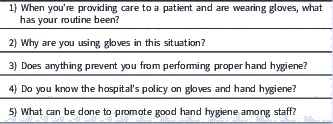
Between August 11, 2016, and August 18, 2016, a convenience sample of staff who did not perform HH and donned gloves prior to room entry (wash-in opportunity) were approached with request for a brief interview. The interviews were conducted by an investigator who was not involved in obtaining secret-shopper HH observations. Episodes where gloves were indicated (eg, visiting a patient on contact precautions) or where it appeared that an HCP was anticipating contact with body fluids were excluded. Interviews were semistructured in nature. Open-ended questions were used to prompt discussion and focused on glove use knowledge and practices in addition to barriers to HH (Table 1). No further interviews were sought once saturation appeared to be achieved. Survey results were analyzed to identify themes and their relation to the use of gloves in lieu of HH.
Open-Ended Questions Asked of Interviewed Healthcare Personnel

Results
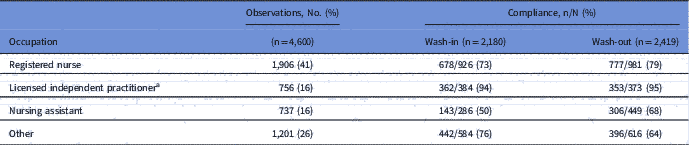
During the 4-month study period, compliance with HH was 74.5% for both wash-in (n = 2,181) and wash-out (n = 2,419) opportunities; 18% of these observations occurred outside of daytime, weekday working hours. Among all HH opportunities observed (n=4,600), 1,906 (41%) were performed by registered nurses, 756 (16%) were performed by licensed independent practitioners (LIPs, ie, physician, physician assistant, advanced practice registered nurses, etc), and 737 (16%) were performed by nursing assistants (Table 2). Of the 556 wash-in episodes lacking compliance with wash-in HH, 249 (45%) were performed by registered nurses, 143 (26%) were performed by nursing assistants, and 22 (4%) were performed by LIPs. Among the 556 wash-in episodes lacking compliance with wash-in HH, 247 of staff (44%) wore gloves. Episodes of glove use without HH were observed more frequently among registered nurses (47%) than LIPs (2%) and nursing assistants (29%).
Healthcare Personnel Hand Hygiene Observations and Compliance

a Includes physician, physician assistant, advanced practice registered nurses, etc.
Independent of the secret-shopper observations, 32 individual HCP were interviewed immediately after observing their use of gloves without HH performance. Staff interviewed were primarily RNs (15, 47%), technicians (5, 16%), and nursing assistants (4, 13%).
Interviews identified 4 major themes as drivers of glove use: protection and safety of staff and patients, availability of gloves, previous medical training guidance, and barriers to HH. In the 32 interviews, the word “protect” was mentioned by healthcare workers 14 times and the words “safe,” “safer,” and “safety” were mentioned 25 times. Additionally, the availability of gloves in terms of their close proximity to patients’ rooms was noted as a facilitator for glove use. Many nursing staff stated that they were taught in their professional training that gloves should be used on a more universal basis.
Other barriers to performing HH also emerged through interviews including workload, distance to hand-washing sinks, and growing use of hospital-supported cell phones. Facilitators to HH included awareness of the importance of HH and the high density of ABHR dispensers across patient care areas. Additionally, successful hospital-initiated interventions mentioned in interviews included the implementation of “Hand Hygiene Champions,” the addition of signs providing HH guidance, and the accessibility of gloves and ABHR in patient care areas.
Discussion
Overall, compliance with HH was high among HCP. Gloves were found to be a potential barrier to HH and use in lieu of HH was greatest among nursing staff. Glove use was shown to be driven by staff desire for personal safety and potentially learned during professional training.
We particularly noted HCP understanding of the importance of HH in protecting patients and staff. Additionally, recognition of interventions to increase HH on hospital units, such as ABHR accessibility and signage, demonstrates that the hospital’s emphasis on infection prevention and HH resonated with staff.
Re-education among HCP promoting proper glove usage and HH may prove useful in increasing HH compliance. Girou et alReference Girou, Chai and Oppein 3 showed that HH did not take place due to improper glove usage in 64.4% of cases, and Loveday et alReference Loveday, Lynam, Singleton and Wilson 4 demonstrated that glove use was inappropriate in 42% of episodes. In our study, many staff wore gloves at unnecessary times such as a physical therapist ambulating a patient, a nurse pushing a “workstation on wheels,” and a nurse administering medications to patients who were not on contact precautions.
Cell phone usage has emerged as a barrier to performing HH and reflects a growing concern about cell phones as a risk for the transmission of microorganisms.Reference Chao Foong, Green and Zargari 5 Described in our interviews as a “barrier” and “setback,” cell phones are increasingly used in healthcare settings to promote efficient communications. A 2015 study demonstrated that 100% of all tested phones collected from patients and HCP were contaminated with either single or mixed bacterial agents.Reference Selim and Abaza 6 Adaption of specific policies and/or work processes regarding cell phones and HH for HCP may help to mitigate concerns.
Through interviews, many HCP mentioned previous training for their profession as a main driver for glove usage. Glove use and the concern for safety may reflect a knowledge deficit about the limitations of glove use and effectiveness of HH and a need to assess the appropriateness of how schools of nursing and allied personnel are teaching students about these topics.
One possible limitation is the generalizability of the findings, as the study was conducted in the inpatient setting at a single academic medical center. Second, because the selection process for interviewing HCP occurred without the benefit of understanding whether he or she was anticipating contact with body fluids, we may have inadvertently captured HCP in situations for which glove use was indicated. However, many HCP upon interview were noted to be wearing gloves at unnecessary times without apparent indication. Additionally, few LIPs agreed to be interviewed. However, our quantitative data demonstrate that glove use did not appear to be a major barrier to HH among LIPs. This finding mirrors previous studies in which the rate of glove use was lower among physicians (4.5% of opportunities) than among nurses (31.2%).Reference Fuller, Savage and Besser 7 Finally, it remains unresolved whether HH prior to donning gloves decreases risk for pathogen exposure and/or transmission.Reference Rock, Harris, Reich, Johnson and Thom 8 This is an area of active investigation.
In conclusion, glove use was a potential barrier to HH and was most pronounced among nursing staff. Main drivers for this practice were personal safety, previous medical training, workload, distance to sinks, and cell phones. A more complete understanding of the drivers of behaviors limiting HH may lead to more effective interventions to improve HH performance by HCP.
Acknowledgments
We thank the employees and medical staff of Yale New Haven Hospital and the Yale New Haven Hospital Hand Hygiene Performance Improvement Team for their support of this project and efforts to improve patient safety.
Financial support
No financial support was provided relevant to this article.
Conflicts of interest
J.M.B is a consultant to, and has received travel support from, Diversey and GOJO Industries, and he has received research funding from GOJO Industries. R.A.M. has received nonfinancial research support from GOJO Industries. All other authors declare no conflicts of interest.