Adolescence is a period of increased vulnerability to depression. According to an epidemiological study, major depressive disorder (MDD) is more prevalent in Canadian adolescents than in any other segment of the population (Patten et al., Reference Patten, Williams, Lavorato, Wang, McDonald and Bulloch2015). In a recent systematic review, researchers reported that adolescents with MDD as well as those with subthreshold depression have higher rates of suicidality than those who do not suffer from depression (Wesselhoeft, Sørensen, Heiervang, & Bilenberg, Reference Wesselhoeft, Sørensen, Heiervang and Bilenberg2013). In the present study, we used a person-centered framework (latent class analysis, LCA) to identify subtypes of vulnerability factors in middle adolescence (14–15 years old) that are associated with moderate/high depressive symptoms and suicidal ideation 2 years later in late adolescence (16–17 years old). We further explored whether sex modified the associations between these latent classes and depressive symptoms.
The study of depression during adolescence is of primary importance, as onset during this developmental stage may predict the later recurrence of depressive episodes in adulthood (Rohde, Lewinsohn, Klein, Seeley, & Gau, Reference Rohde, Lewinsohn, Klein, Seeley and Gau2013). The 12-month prevalence of depressive episodes among adolescents is estimated to be 11% (Mojtabai, Olfson, & Han, Reference Mojtabai, Olfson and Han2016), and close to 30% of adolescents report subthreshold depression that does not meet diagnostic criteria (Balázs et al., Reference Balázs, Miklósi, Keresztény, Hoven, Carli, Wasserman and Wasserman2013). These data are troubling because adolescents who manifest subthreshold depression are more likely to develop major depressive episodes later (Bertha & Balázs, Reference Bertha and Balázs2013).
Suicidal thoughts and behaviors (STBs) are an important complication of depression in adolescence given the high number of deaths from suicide in the adolescent population (Hawton, Saunders, & O'Connor, Reference Hawton, Saunders and O'Connor2012; McLoughlin, Gould, & Malone, Reference McLoughlin, Gould and Malone2015). In Canada, suicide is the second leading cause of death in adolescents, with a rate of 12.2 per 100,000 boys and of 5.2 per 100,000 girls (Skinner & McFaull, Reference Skinner and McFaull2012). However, completed suicides represent only one facet of suicidal behavior in adolescence, and the prevalence of suicidal ideation and attempts among adolescents is also worrying considering that these behaviors generally precede suicide (Bridge, Goldstein, & Brent, Reference Bridge, Goldstein and Brent2006). Suicidal thoughts and behaviors can be considered to lie on a continuum that ranges from suicidal ideation to attempts to completed suicide (Joiner et al., Reference Joiner, Conwell, Fitzpatrick, Witte, Schmidt, Berlim and Rudd2005; Paykel, Myers, Lindenthal, & Tanner, Reference Paykel, Myers, Lindenthal and Tanner1974). While suicidal ideation may be relatively common with a lifetime prevalence of 12% among adolescents in the general population (Nock et al., Reference Nock, Green, Hwang, McLaughlin, Sampson, Zaslavsky and Kessler2013), these can signal important difficulties given this continuum. A recent meta-analysis based on studies over the past 50 years examined 16 broad domains of risk factors (e.g., biological factors, cognitive factors, psychopathology, social factors, etc.) for STBs in adolescent and adult samples (Franklin et al., Reference Franklin, Ribeiro, Fox, Bentley, Kleiman, Huang and Nock2017). The associations between each specific domain and STBs were weak. The authors highlighted that studies investigating the combined effect of multiple risk factors were lacking and may be more promising than the study of any single factor. They also suggested that it is more likely that many different paths lead to suicidality (i.e., equifinality), and thus they urged investigators to study risk in specific subpopulations. This way, researchers can add to the current literature on STBs by identifying specific configurations of multiple psychosocial vulnerability factors that may be differentially associated with moderate/high depressive symptoms and suicidal ideation in adolescence.
Sex differences in the prevalence of depression emerge in middle adolescence, with girls being at higher risk for depression than boys. Specifically, after puberty girls are twice as likely to develop depression than boys (Hyde, Mezulis, & Abramson, Reference Hyde, Mezulis and Abramson2008) and also manifest longer depressive episodes and more relapse over time (Essau, Lewinsohn, Seeley, & Sasagawa, Reference Essau, Lewinsohn, Seeley and Sasagawa2010). Furthermore, adolescent girls are twice as likely as adolescent boys to present suicidal ideation (Blum, Sudhinaraset, & Emerson, Reference Blum, Sudhinaraset and Emerson2012; Kaess et al., Reference Kaess, Parzer, Haffner, Steen, Roos, Klett and Resch2011).
According to a developmental psychopathology perspective, psychopathological outcomes such as depression and suicidality emerge as a result of the influence of biological, psychological, social, and cultural factors (Cicchetti, Reference Cicchetti2016). The presence of such vulnerability factors implies a higher probability of subsequent difficulties. Although studying the additive contribution of individual factors is informative (Buehler & Gerard, Reference Buehler and Gerard2013; Mash & Dozois, Reference Mash, Dozois, Mash and Barkley2003), another potentially more ecologically valid way of studying the significance of these factors in the development of adolescent psychopathology is through a person-centered approach, as presented in this study. This approach focuses on identifying different subgroups of individuals and examines how each of these subtypes may be uniquely associated with the emergence of psychopathology (Jobe-Shields, Andrews, Parra, & Williams, Reference Jobe-Shields, Andrews, Parra and Williams2015). Furthermore, the notion of equifinality in developmental psychopathology suggests that different configurations of factors may predict the same outcome regardless of the number of vulnerability factors (Cicchetti, Reference Cicchetti2016).
Within the person-centered framework, LCA is a statistical model that allows for the empirical identification of homogeneous subgroups based on a set of vulnerability factors. In a study about psychiatrically predictive configurations of psychosocial risk factors in a representative sample of youth, Copeland et al. (Reference Copeland, Shanahan, Costello and Angold2009) identified five latent classes based on 17 vulnerability factors pertaining to the domains of socioeconomic disadvantage, nonnuclear family structure, parental risk characteristics, family dysfunction, and stressful life events. Although associations between these profiles and psychiatric disorders (conduct disorder, oppositional defiant disorder, attention-deficit/hyperactivity disorder, MDD, dysthymia, generalized anxiety disorder, seasonal affective disorder, social phobia, and generalized anxiety disorder) were identified, the vulnerability factors were assessed concurrently with the outcome and thus were considered correlated vulnerability factors. Few longitudinal studies have examined similar associations between psychosocial vulnerability subtypes based on individual, family, peer, and sociocultural factors and the presence of depressive symptoms in adolescence (Cohen et al., Reference Cohen, Spiro, Young, Gibb, Hankin and Abela2015; Olino, Klein, & Seeley, Reference Olino, Klein and Seeley2019; Parra, Dubois, & Sher, Reference Parra, DuBois and Sher2006; St Clair et al., Reference St Clair, Croudace, Dunn, Jones, Herbert and Goodyer2015; Valdez, Lambert, & Ialongo, Reference Valdez, Lambert and Ialongo2011; Wadman, Hiller, & St Clair, Reference Wadman, Hiller and St Clair2019; Weaver & Kim, Reference Weaver and Kim2008; Zeiders, Roosa, Knight, & Gonzales, Reference Zeiders, Roosa, Knight and Gonzales2013). Although these studies support the perspective that specific empirically identified subtypes may be associated with depressive symptoms in adolescence, the moderating role of sex as well as the interplay of different psychosocial factors across multiple domains were not considered.
In the present study, we addressed these limitations by using data from a longitudinal study of Canadian youth to (a) identify configurations of various psychosocial vulnerability factors across multiple domains (e.g., sociodemographic, parental, peer-related, school-related, and individual) and (b) study how specific configurations of these vulnerability factors may be associated with later depressive symptoms and suicidal ideation in adolescence. We selected vulnerability factors based on three criteria: (a) data on the given factors were available in the study sample, (b) the factors were diverse and representative of multiple psychosocial domains, and (c) the factors have previously been demonstrated to be relevant correlates of depression with or without suicidal ideation in adolescence. Namely, we selected sociodemographic factors (e.g., family status and parental education), individual factors (e.g., symptoms of conduct disorder/physical aggression), and peer-related factors (e.g., deviant peer affiliation and low perceived peer popularity) because these variables have been previously linked to depressive symptoms in a separate independent study that used the same cohort (Benoit, Lacourse, & Claes, Reference Benoit, Lacourse and Claes2013). We also considered additional parental factors such as low parental warmth and monitoring, which have been associated with depressive symptoms in a recent meta-analysis (Yap, Pilkington, Ryan, & Jorm, Reference Yap, Pilkington, Ryan and Jorm2014). Individual factors that are known to predict depressive symptoms in adolescence such as low self-esteem (Sowislo & Orth, Reference Sowislo and Orth2013), low emotional intelligence (Balluerka et al., Reference Balluerka, Aritzeta, Gorostiaga, Gartzia and Soroa2013; Resurrección, Salguero, & Ruiz-Aranda, Reference Resurrección, Salguero and Ruiz-Aranda2014), internalizing and externalizing symptoms (Weeks et al., Reference Weeks, Ploubidis, Cairney, Wild, Naicker and Colman2016), and substance use (Cairns et al., Reference Cairns, Yap, Pilkington and Jorm2014) were also considered. Among the school-related factors, victimization in school has been frequently linked to depression and suicidality (Breton et al., Reference Breton, Labelle, Huynh, Berthiaume, St-Georges and Guilé2012; Klomek et al., Reference Klomek, Kleinman, Altschuler, Marrocco, Amakawa and Gould2011) and was thus included in our analyses. Our use of longitudinal data from a nationally representative sample of Canadian adolescents enabled us to provide a more comprehensive examination of adolescent vulnerability subtypes that are associated with depression and suicidal ideation. Our results also have relevant clinical implications because improving knowledge about specific vulnerability subtypes may help us to prevent and treat depression in adolescence more effectively. The present study further contributes to the literature by providing an examination of longitudinal associations with not only moderate/high depressive symptoms but also suicidal ideation. Very few studies based on large-scale samples have examined the associations between vulnerability subtypes and suicidality. Furthermore, the moderating role of sex was studied because identifying potential differential vulnerability (e.g., interaction effects) is critical to gaining a better understanding of depression in adolescence and developing more suitable intervention strategies for boys and girls.
Method
Study sample
The study sample comprised 1,290 participants (643 boys and 647 girls) from the National Longitudinal Survey of Children and Youth (NLSCY), a nationally representative and prospective survey that was conducted by Statistics Canada from 1994 to 2009 (Human Resources Development Canada & Statistics Canada, 1996). The sample is representative of noninstitutionalized Canadian youths from the 10 provinces of Canada, excluding individuals who were living in institutional settings, in the armed forces, in some remote regions, and on First Nations reserves. The NLSCY used a sequential cohort design. We included data exclusively from the original cohort, as it was the only cohort in which individuals were followed into adolescence. Data were collected at eight biennial cycles by using reports from the person who was most knowledgeable about the child (PMK; typically, the mother) from birth onward, and self-reports as of the age of 10 years. Children from the original cohort were recruited at the ages of 0 to 11 years old at Cycle 1 (1994–95) and followed to the ages of 14–25 years old at Cycle 8 (2008–09). For the purposes of the present study, we selected those participants who were aged between 14 and 15 years at Cycle 7 (Time 1 for our investigation). From this sample (n = 1,671), we selected only individuals who had available data on depressive symptoms and suicidal ideation at Cycle 8 (n = 1,290), when they had reached 16 to 17 years of age (Time 2 for our investigation). Ethical approval was obtained by Statistics Canada.
Measures
Middle Adolescence Vulnerability Factors (Time 1: 14–15 Years)
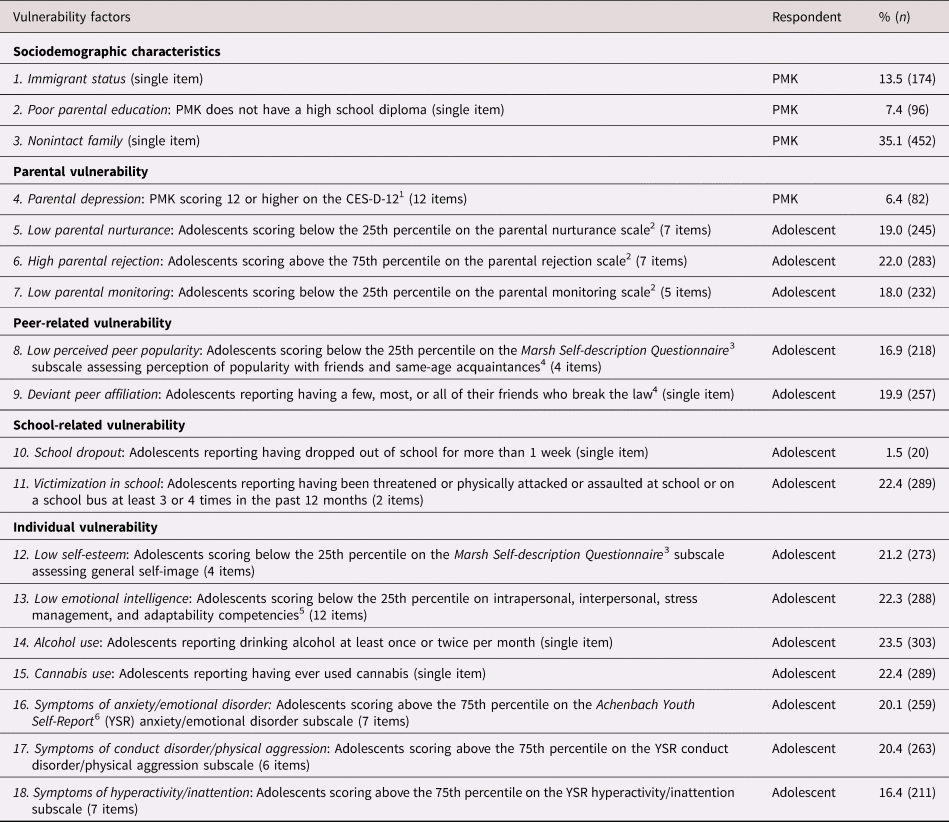
Eighteen psychosocial vulnerability factors from middle adolescence were considered to calculate our latent classes (see Table 1 for the full list and description). These were drawn from five domains: sociodemographic characteristics, parental vulnerability, peer-related vulnerability, school-related vulnerability, and individual vulnerability. Of the 18 factors, 4 were reported by the PMK and 14 were self-reported by the youths. All of the vulnerability factors were coded dichotomously, as LCA is more easily interpretable by using binary indicators (Lanza, Dziak, Huang, Xu, & Collins, Reference Lanza, Dziak, Huang, Wagner and Collins2015). Most of the categorical and continuous variables were dichotomized according to the upper or lower quartile depending on the direction of the variable. This approach is common in epidemiology and allows for working with the extremes of a distribution as risk factors (Mabikwa, Greenwood, Baxter, & Fleming, Reference Mabikwa, Greenwood, Baxter and Fleming2017; Turner, Dobson, & Pocock, Reference Turner, Dobson and Pocock2010). A complete list of available variables in the NLSCY can be viewed in the Microdata User Guides for cycles 7 and 8 (Statistics Canada, 2010a, 2010b).
Description and prevalence of adolescent vulnerability factors (n = 1,290)

Note: PMK = Person most knowledgeable about the child; 1Poulin et al., Reference Poulin, Hand and Boudreau2004; 2Lempers, Clark-Lempers, & Simons, Reference Lempers, Clark-Lempers and Simons1989; 3Marsh & Gouvernet, Reference Marsh and Gouvernet1989; 4Benoit et al., Reference Benoit, Lacourse and Claes2013; 5Bar-On & Parker, Reference Bar-On and Parker2000; 6Achenbach, Reference Achenbach1991.
Sociodemographic characteristics
Immigrant status (single item) distinguished participants who were Canadian citizens from those who were not. Parental education (single item, categorical data) was dichotomized to identify parents for whom the highest level of education was inferior to a high school diploma. The nonintact family variable (single item) distinguished participants who were living with both biological or adoptive parents from those who were living in nonintact families.
Parental vulnerability
Parental depression was derived from the 12-item abbreviated version of the Center for Epidemiologic Studies Depression Scale (CES-D-12) sum score (continuous data), which we dichotomized according to a validated cutoff point of 12 (Poulin, Hand, & Boudreau, Reference Poulin, Hand and Boudreau2004), distinguishing PMKs with minimal levels from those with moderate/high levels of depressive symptoms. Low parental nurturance, high parental rejection, and low parental monitoring were derived from three subscales of the Parenting Scale (Lempers, Clark-Lempers, & Simons, Reference Lempers, Clark-Lempers and Simons1989; continuous data). The parental nurturance and parental monitoring subscales were dichotomized according to the 25th percentile rank in order to identify participants whose parents showed low levels of nurturance and monitoring. The parental rejection subscale was dichotomized according to the 75th percentile rank to identify participants whose parents showed high levels of rejection.
Peer-related vulnerability
Perceived peer popularity was assessed by using the peer relations subscale (four items) of the Marsh Self-Description Questionnaire (Marsh & Gouvernet, Reference Marsh and Gouvernet1989). This continuous scale was dichotomized according to the 25th percentile rank, indicating participants who reported a low perception of popularity among peers. Deviant peer affiliation was assessed by using a single item based on a 4-point Likert-type scale to respond to the question “How many of your close friends do the following: break the law by stealing, hurting someone, or damaging property?” This variable was dichotomized in the same way as was reported by Benoit, Lacourse, and Claes (Reference Benoit, Lacourse and Claes2013) so as to distinguish adolescents who reported that a few, most, or all or their friends break the law from those who reported having no deviant peers. Previous studies have reported adequate validity for single items for measuring deviant peer affiliation in adolescent samples (Dupéré et al., Reference Dupéré, Lacourse, Willms, Vitaro and Tremblay2007; Lacourse et al., Reference Lacourse, Nagin, Vitaro, Côté, Arseneault and Tremblay2006; Lacourse, Nagin, Tremblay, Vitaro, & Claes, Reference Lacourse, Nagin, Tremblay, Vitaro and Claes2003).
School-related vulnerability
School dropout was a dichotomous variable that identified participants who had ever dropped out of school for at least one week. Victimization in school was derived from two categorical variables that assessed the number of times (never, once or twice, 3–4 times, 5 times or more) that participants reported having had someone threaten to hurt them or having had someone physically attack or assault them while at school or on a school bus in the past 12 months. As chronicity is considered to be a central characteristic of bullying (Olweus, Reference Olweus and Huesmann1994), the data were dichotomized in order to compare participants who had been exposed to victimization regularly (a minimum of 3–4 incidents of at least one type of victimization in the past year) versus none or occasional victimization (a maximum of 1–2 incidents of any one type of victimization in the past year).
Individual vulnerability
The low self-esteem variable was derived from the general self-image subscale (four items) of the Marsh Self-Description Questionnaire (Marsh & Gouvernet, Reference Marsh and Gouvernet1989). This continuous scale was dichotomized according to the 25th percentile rank in order to identify participants with a poor self-image. Low emotional intelligence was derived from 12 items for evaluating intrapersonal, interpersonal, stress management, and adaptability competencies. The summed score of these items (continuous data) was dichotomized in order to identify participants with low emotional intelligence (below the 25th percentile rank). Both items on substance use (alcohol and cannabis) were dichotomized according to the 75th percentile rank. Alcohol use (single item, categorical variable) was coded dichotomously in order to identify participants who drink alcohol regularly (0 = participants reporting having never had a drink of alcohol, having had a few sips, having only tried once or twice, or drinking a maximum of a few times a year; 1 = participants reporting drinking alcohol at least once or twice a month). Cannabis use (single item, categorical variable) was dichotomized in order to distinguish participants who have never used cannabis from those who have. The symptoms of anxiety/emotional disorder (seven items), the symptoms of conduct disorder/physical aggression (six items), and the symptoms of hyperactivity/inattention (seven items) subscales from the Achenbach Youth Self-Report (YSR; continuous data) were each dichotomized according to the 75th percentile rank to identify participants demonstrating high levels of these symptoms (Lacourse et al., Reference Lacourse, Baillargeon, Dupéré, Vitaro, Romano and Tremblay2010).
Outcome Variables (Time 2; 16–17 Years)
Depressive symptoms and suicidal ideation were measured at age 16–17 years and were used as outcome variables. Depressive symptoms were assessed by using a 12-item abbreviated version of the CES-D-12 (Radloff, Reference Radloff1977), a tool that is commonly used to screen for symptoms of depression in the general population, including studies in adolescence (Poulin et al., Reference Poulin, Hand and Boudreau2004). The presence and severity of depressive symptoms was assessed by using a 4-point Likert-type scale that indicated the extent to which each item adequately described the mood and behavior of the respondent during the past week (score range: 0–36). In a previous validation study in a sample of Canadian adolescents (Poulin et al., Reference Poulin, Hand and Boudreau2004), the CES-D-12 demonstrated good psychometric properties (Cronbach α = .85). Moreover, by using receiver operating characteristics curve analyses for an item pertaining to depression (“In the past 12 months, have you used any services or received help because you felt depressed?” with answer options Yes, No, and I have not felt depressed), the authors validated two cutoff points in the CES-D-12 that distinguish three levels of severity of depressive symptoms in adolescents. A first cutoff point of 12 corresponded to an intermediate category of depressive symptoms for the adolescents who reported having felt depressed (compared to adolescents who scored below 12) but did not report having received help for their depression in the past 12 months. A second cutoff point of 21 indicated high levels of depressive symptoms (consistent with clinical depression), as adolescents in this category reported having sought help because they felt depressed. In the present study, we chose to dichotomize depressive symptoms levels according to the validated cutoff point of 12 in order to distinguish participants with minimal levels of depressive symptoms (score below 12) from those who manifest moderate/high levels of depressive symptoms (score equal to or above 12). Suicidal ideation was assessed by using a single item: “During the past 12 months, have you seriously thought of committing suicide?” (original emphasis) with two response categories (yes or no). In our sample, 22% (n = 282) of the adolescents reported depressive symptoms that were above the selected threshold of 12, and 7% (n = 94) of the adolescents reported serious suicidal ideation in the past year. Moreover, 65% of the participants who reported suicidal ideation in the past year also scored above the cutoff of 12 on the CES-D, and 20% of participants who met the cutoff of 12 on the CES-D also reported suicidal ideation in the past year. It should be noted that these two variables have very different time ranges (the past week for depressive symptoms versus the past year for suicidal ideation), possibly leading to an underestimation of symptom overlap.
Statistical Analyses
The analyses for this investigation were conducted in two steps. First, LCA was used to identify configurations of vulnerability factors (in middle adolescence; Time 1). Second, these latent vulnerability classes were included in logistic regression analyses to determine which were most associated with an increased probability of moderate/high depressive symptoms and suicidal ideation 2 years later (late adolescence; Time 2). All of the statistical analyses were conducted by using the normalized longitudinal survey weights that were provided by Statistics Canada, which were adjusted for nonresponse and to match demographic counts by age, sex, and province (Statistics Canada, 2010b).
Step 1: Latent class analysis
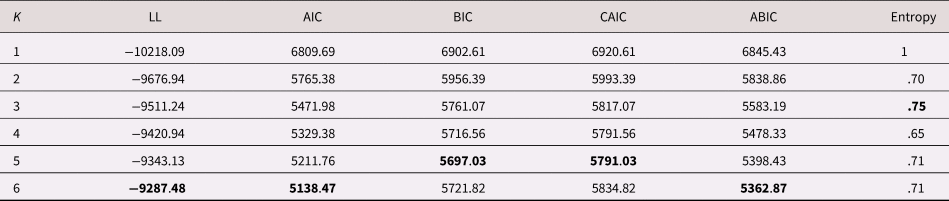
Latent class analysis is a statistical model that has been used extensively with binary indicators, assuming a discrete unobserved latent structure (McCutcheon, Reference McCutcheon1987). In the present study, the latent structure of 18 vulnerability factors was analyzed by using the PROC LCA (Lanza et al, Reference Lanza, Dziak, Huang, Wagner and Collins2015) procedure developed at the Methodology Center of Penn State (Proc LCA & Proc LTA, version 1.3.2) in SAS, version 9.4 (SAS Institute, Cary, North Carolina). This procedure allows for the identification of an optimal number of mutually exclusive latent classes that could explain the relationships among the 18 binary factors. The LCA model estimates latent class probabilities (e.g., prevalence for each class) and item endorsement probabilities (IEPs; the proportion of class members that report each vulnerability factor) that characterize each specific class. The models were tested sequentially, as was proposed by Nylund-Gibson and Choi (Reference Nylund-Gibson and Choi2018), beginning with a 1-class model and then increasing the number of classes up to a 6-class model (see Table 2). Four statistical information criteria were considered: Akaike's information criterion (Akaike, Reference Akaike1987), the Bayesian information criterion (Schwartz, Reference Schwarz1978), the consistent Akaike's information criterion (Bozdogan, Reference Bozdogan1987), and the Akaike Bayesian information criterion (Sakamoto, Ishiguro & Kitagawa, Reference Sakamoto, Ishiguro and Kitagawa1986). In addition, a content-oriented approach to the selection of classes supplemented this estimation method in order to ensure the selection of the most theoretically meaningful model (Muthén & Muthén, Reference Muthén and Muthén2000).
Fit statistics and classification coefficients for the configurations of psychosocial vulnerability factors
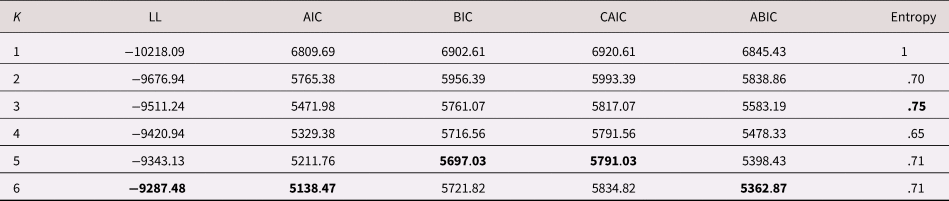
Note: K = number of classes; LL = log-likelihood; AIC = Akaike information criterion; BIC = Bayesian information criterion; CAIC = consistent Akaike information criterion; ABIC = Akaike Bayesian information criterion. The bolded values indicate the best fit for each respective statistic.
Step 2: Logistic regression analyses
We examined the longitudinal associations between the identified latent classes (at middle adolescence; Time 1) and our outcome variables (at late adolescence; Time 2) by using logistic regression analyses in SAS. For these analyses, participants were assigned to the latent classes based on their highest posterior probability of membership (classify-analyze approach; Bray, Lanza, & Tan, Reference Bray, Lanza and Tan2014). To assess the moderating role of sex, we tested the interaction terms between the latent class dummy variables and sex. Significant interactions were then probed. Because the moderator was dichotomous, the probing tested the main effects of latent class membership for girls and for boys in contrast to the lowest vulnerability class. The moderating role of sex was assessed only for the associations between the latent classes and depressive symptoms because we lacked the statistical power to run these analyses with respect to suicidal ideation.
Results
Model Selection
The Bayesian information criterion and the consistent Akaike's information criterion indicated that the 5-class solution provided the best fit for the data (5,697.03 and 5,791.03, respectively). Moreover, this solution appeared to be the most theoretically meaningful from the perspective of a content-oriented approach. Although certain fit statistics suggested that a 6-class solution also had an adequate fit (Akaike's information criterion = 5,138.47; Akaike Bayesian information criterion = 5,362.87), the classes in the 5-class solution were essentially maintained intact in the 6-class solution, and the new class that emerged was small and not easily interpretable. This contributed to our decision to opt for the more parsimonious model, thus retaining the 5-class solution.
Latent Vulnerability Classes
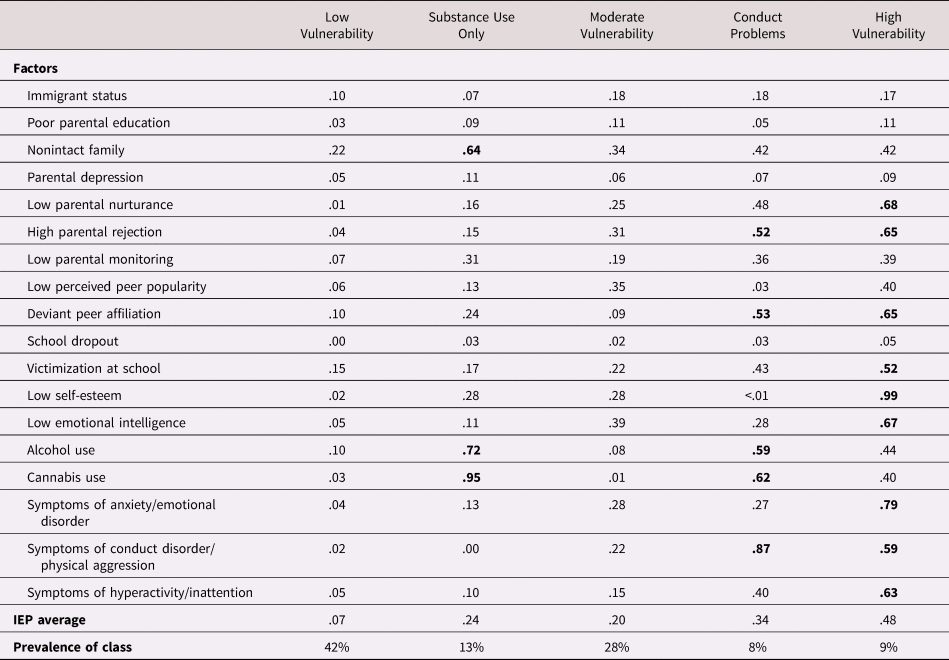
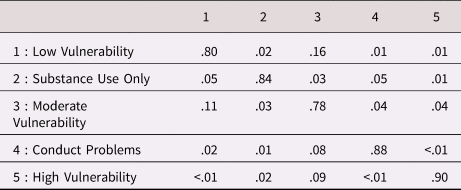
The 5-class solution included one low-vulnerability class (Low Vulnerability), two moderate-vulnerability classes (Substance Use Only and Moderate Vulnerability), and two high-vulnerability classes (Conduct Problems and High Vulnerability). Table 3 presents the prevalence rates and IEPs for each latent class, and Table 4 presents the classification probabilities for each latent class. Item endorsement probability values that were over .50 (i.e., conditional probabilities given a latent class) were considered high and are highlighted in bold. Items with such high IEP values were considered in describing and naming the vulnerability classes.
Latent class probabilities and item endorsement probabilities (IEPs)
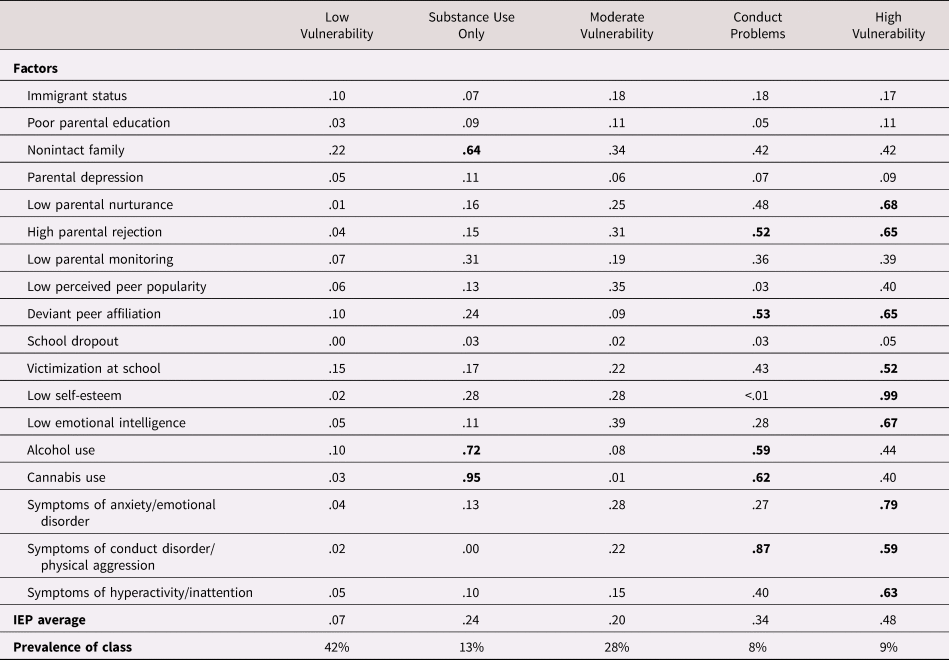
Note: The bolded values indicate IEPs over .50.
Classification probabilities for the configurations of psychosocial vulnerability factors
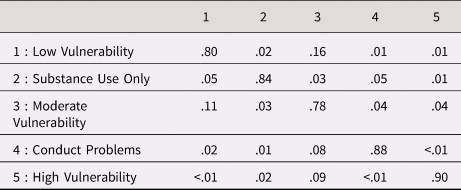
Note: The values indicate the probabilities of most likely class membership (column) by latent class assignment (row).
The Low Vulnerability class and the Moderate Vulnerability class were both characterized by IEPs that were below .50 on all of the factors. However, because the IEPs were generally higher for the Moderate Vulnerability class (average IEP = .20) than for the Low Vulnerability class (IEP average = .07), the former was categorized as a moderate-vulnerability class along with the Substance Use Only class (average IEP = .24). The Substance Use Only class was characterized by a high probability of alcohol and cannabis use and of having a nonintact family. The item endorsement probabilities were below .50 for all of the other vulnerability factors including deviant peer affiliation and symptoms of conduct disorder/physical aggression, differentiating it from the Conduct Problems class that also had high IEPs on substance use (alcohol and cannabis). Both of the high-vulnerability classes (the Conduct Problems class and the High Vulnerability class) were similar in that they were characterized by a high probability of high parental rejection, deviant peer affiliation, and symptoms of conduct disorder/physical aggression. However, the High Vulnerability class was uniquely characterized by a high probability of low parental nurturance, victimization at school, low self-esteem, low emotional intelligence, symptoms of anxiety/emotional disorder, and symptoms of hyperactivity/inattention. Both of the high-vulnerability classes also differed in that the Conduct Problems class had higher IEPs on most of the factors that are linked to conduct problems such as substance use (alcohol and cannabis) and symptoms of conduct disorder/physical aggression. Individuals in the Conduct Problems class also had an almost null probability of having low self-esteem (<.01), compared with a probability of .99 for participants who were in the High Vulnerability class, and a low probability of perceiving themselves as being unpopular (.03) compared with participants in the High Vulnerability class (.40).
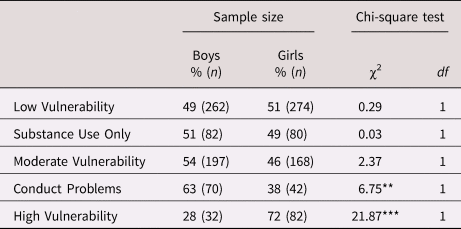
Chi-square tests were run to examine sex differences in latent class membership, the results of which are presented in Table 5. The Low Vulnerability class, the Substance Use Only class, and the Moderate Vulnerability class were composed of statistically equivalent proportions of girls and boys. However, significant differences emerged within the Conduct Problems class, χ2 (1, n = 112) = 6.75, p < .01, with a greater percentage of boys (63%) than of girls (38%), and within the High Vulnerability class, χ2 (1, n = 114) = 21.87, p < .001), with a lower percentage of boys (28%) than of girls (72%).
Sex differences by latent class membership
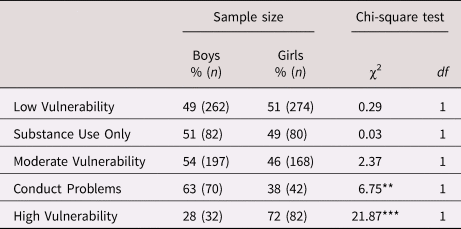
Note: Class membership was assigned according to the maximum-probability assignment rule (classify-analyze approach), which does not allow for considering imprecision in classification and may thus cause class prevalence to vary (Bray, Lanza, & Tan, Reference Bray, Lanza and Tan2014); *p < .05. **p < .01. ***p < .001.
Logistic regression models
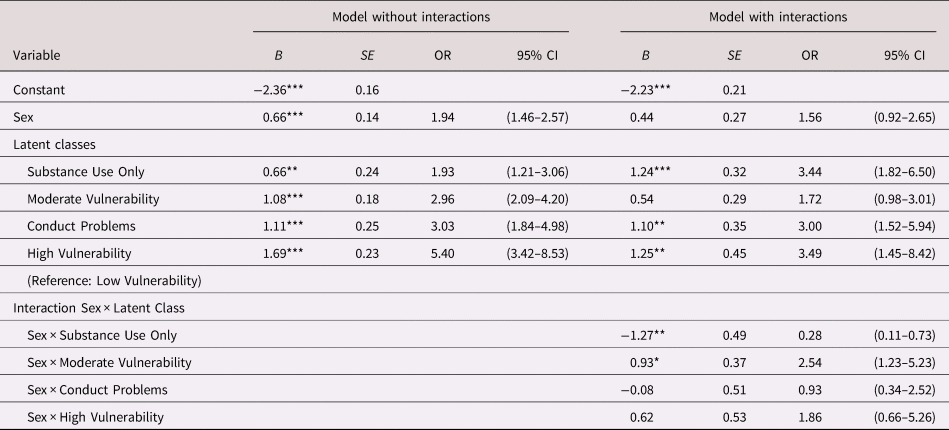
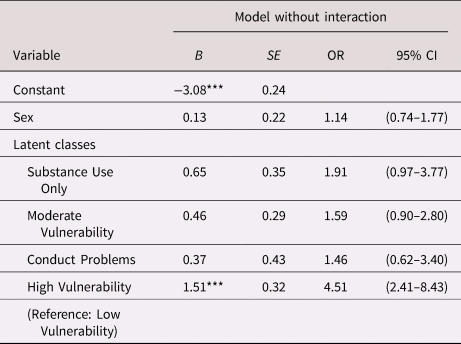
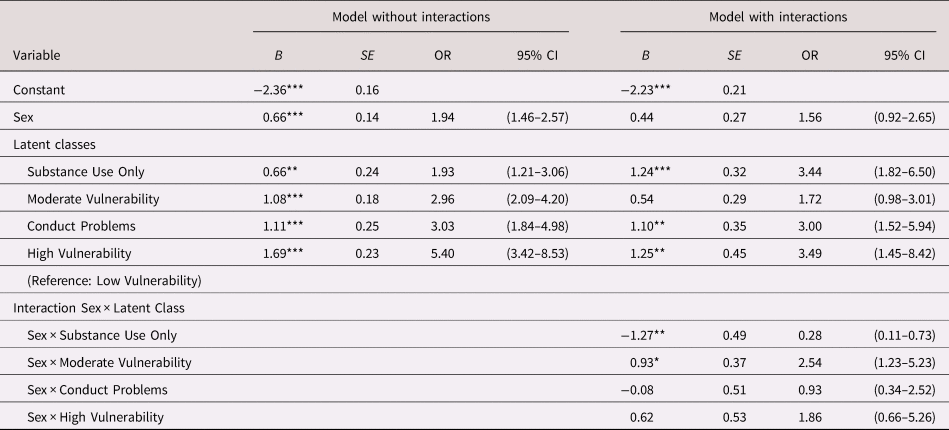
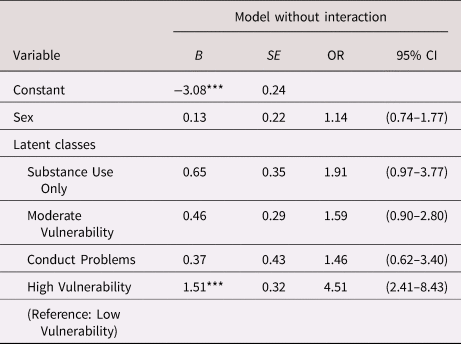
Tables 6 and 7 present the results from the multivariate logistic regression analyses that were used to examine the associations between latent class membership and both moderate/high depression and suicidal ideation. A p value of .05 was used for significance testing. The Low Vulnerability class was used as the reference group. Post hoc analyses were conducted to further probe the moderating effect of sex for the associations between the latent classes and depressive symptoms. The regression analyses were first executed with boys as a reference, and the data were then recoded to obtain the main effects for girls (Jaccard, Reference Jaccard2001).
Logistic regression models for depressive symptoms in late adolescence
Note: The models were adjusted for sex. *p < .05. **p < .01. ***p < .001.
Logistic regression models for suicidal ideation in late adolescence
Note: The model was adjusted for sex. *p < .05. **p < .01. ***p < .001.
Depressive symptoms
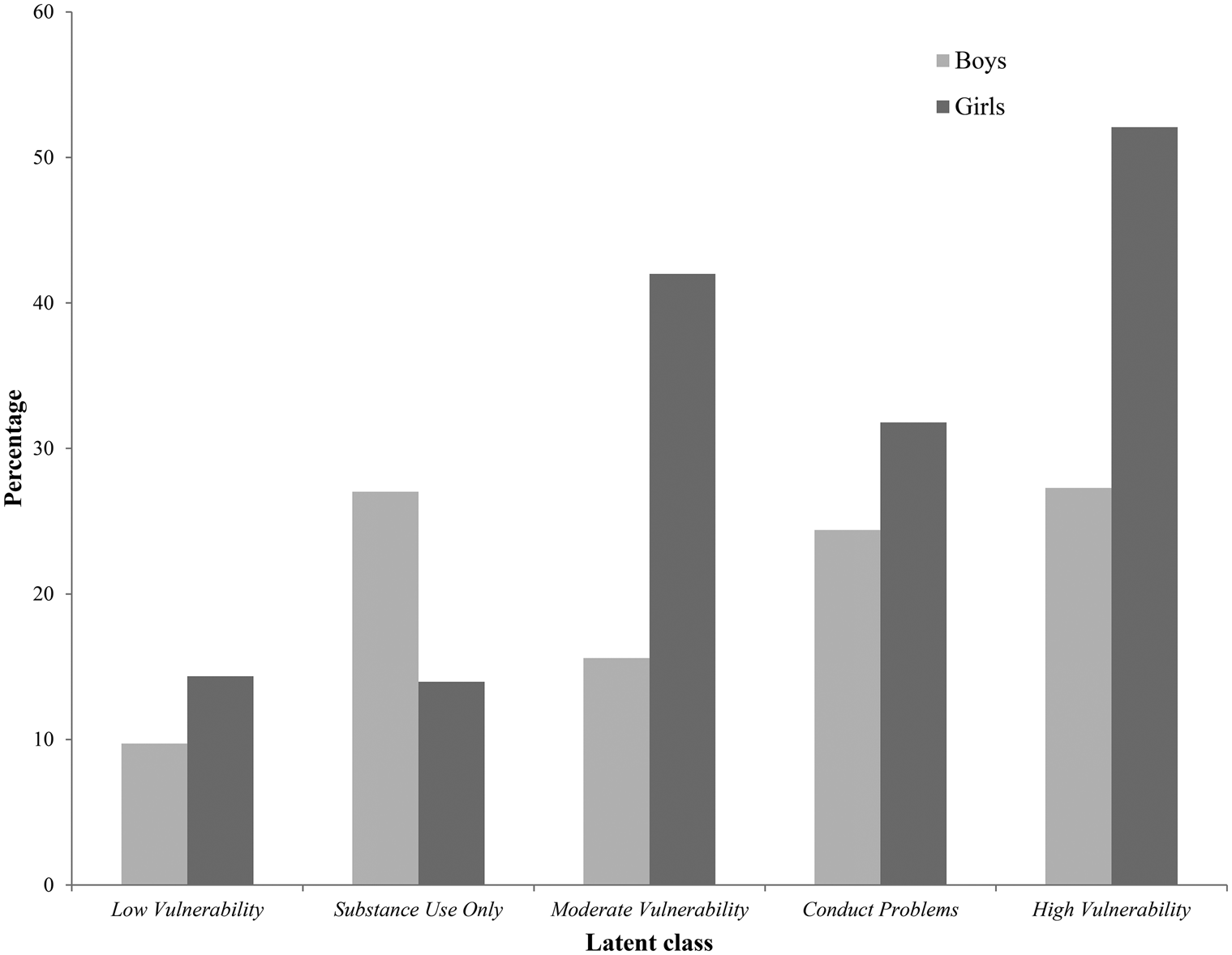
When compared with the Low Vulnerability class, the odds of presenting moderate/high depressive symptoms were significantly higher for the participants in the Substance Use Only class, OR = 1.93; 95% CI [1.21, 3.06], the Moderate Vulnerability class, OR = 2.96; 95% CI [2.09, 4.20], the Conduct Problems class, OR = 3.03; 95% CI [1.84, 4.98], and the High Vulnerability class, OR = 5.40; 95% CI [3.42, 8.53]. Furthermore, interaction effects were identified such that girls in the Moderate Vulnerability class were over four times more likely than girls in the Low Vulnerability class to present with moderate/high depressive symptoms, OR = 4.37; 95% CI [2.77, 6.89], whereas boys in the Moderate Vulnerability class were only 1.72 times as likely compared to boys in the Low Vulnerability class to show moderate/high depressive symptoms, OR = 1.72; 95% CI [.98, 3.01]. However, boys in the Substance Use Only class were at higher risk for moderate/high depressive symptoms than boys in the Low Vulnerability class, OR = 3.44; 95% CI [1.82, 6.5], whereas girls in the Substance Use Only class were not significantly more likely than girls in the Low Vulnerability class, OR = .97; 95% CI [.47, 1.98], to present with moderate/high depressive symptoms. These significant interactions were consistent with sex differences in the prevalence of moderate/high depressive symptoms by latent class membership in our sample (see Figure 1).
Sex differences in prevalence of moderate/high depressive symptoms (CES-D-12 score ≥12) by class membership. In the Low Vulnerability class, 9.71% (n = 25) of boys and 14.34% (n = 39) of girls presented moderate/high depressive symptoms, χ² (1, n = 536) = 2.70. In the Substance Use Only class, 27.02% (n = 22) of boys and 12.96% (n = 11) of girls presented moderate/high depressive symptoms, χ² (1, n = 162) = 4.25*. In the Moderate Vulnerability class, 15.61% (n = 31) of boys and 42% (n = 71) of girls presented moderate/high depressive symptoms, χ² (1, n = 365) = 32.01***. In the Conduct Problems class, 24.41% (n = 17) of boys and 31.79% (n = 13) of girls presented moderate/high depressive symptoms, χ² (1, n = 112) = 0.73. In the High Vulnerability class, 27.29% (n = 9) of boys and 52.08% (n = 43) of girls presented moderate/high depressive symptoms, χ² (1, n = 114) = 5.68*. *p < .05. **p < .01. ***p < .001.

Suicidal ideation
When compared with the Low Vulnerability class, the odds of presenting with suicidal ideation were significantly higher only for the participants in the High Vulnerability class, OR = 4.51; 95% CI [2.41, 8.43].
Additional comparisons
Additional logistic regression analyses were conducted in order to compare all of the latent classes with each other. Each latent class was sequentially used as a reference group in order to examine the associations between latent classes and depressive symptoms and suicidal ideation.
For the model that examined depressive symptoms (see Supplementary Table 1), the results indicated that participants who were in the High Vulnerability class had significantly higher odds of presenting with moderate/high depressive symptoms than those in the Moderate Vulnerability class, OR = 1.82; 95% CI [1.18, 2.86], or in the Conduct Problems class, OR = 1.79; 95% CI [1.01, 3.13]. Furthermore, significant interactions emerged between sex and the Substance Use Only class for various comparisons. More specifically, for girls, those in the Moderate Vulnerability class, OR = 4.50; 95% CI [2.24, 9.09], in the Conduct Problems class, OR = 2.87, 95% CI [1.16, 7.09], and in the High Vulnerability class, OR = 6.71; 95% CI [3.12, 14.49], were at higher risk for moderate/high depressive symptoms than girls in the Substance Use Only class. Conversely, for boys, those who were in the Conduct Problems class, OR = 0.87; 95% CI [0.42, 1.81], and in the High Vulnerability class, OR = 1.01; 95% CI [0.40, 2.56], did not significantly differ from boys who were in the Substance Use Only class, and boys in the Moderate Vulnerability class, OR = 0.50; 95% CI [.27, .93], were at lower odds of presenting with moderate/high depressive symptoms than boys in the Substance Use Only class.
For the model that was used to examine suicidal ideation (see Supplementary Table 2), the participants who were in the High Vulnerability class were at increased risk compared with any of the other classes: Substance Use Only, OR = 2.38; 95% CI [1.14, 5.00], Moderate Vulnerability, OR = 2.86; 95% CI [1.52, 5.26], and Conduct Problems, OR = 3.13; 95% CI [1.27, 7.69].
Discussion
The present study used a person-centered approach to investigate the longitudinal associations between configurations of vulnerability factors at age 14–15 years and later moderate/high depressive symptoms and suicidal ideation at 16–17 years in a large-scale representative study of Canadian adolescents. The main objectives were (a) to identify distinct vulnerability subtypes in 14- to 15-year-old adolescents and (b) to examine which of these subtypes is most associated with the presence of moderate/high depressive symptoms and suicidal ideation 2 years later in contrast to a low-vulnerability group. The moderating role of sex for the longitudinal associations between vulnerability subtypes and moderate/high depressive symptoms was also explored.
Latent class analysis was used to identify common patterns of vulnerability factors among a large sample of Canadian adolescents. Whereas previous studies have focused on specific domains of vulnerability, we based our analyses on 18 factors that span various psychosocial domains: sociodemographic characteristics, parental vulnerability, peer-related vulnerability, school-related vulnerability, and individual vulnerability. This allowed for the identification of five comprehensive latent vulnerability classes. Adolescents in the single low-vulnerability class (Low Vulnerability) represented 42% of the sample, those in the two moderate-vulnerability classes (Moderate Vulnerability and Substance Use Only) combined represented 41% of the sample, and those in the two high-vulnerability classes (Conduct Problems and High Vulnerability) combined represented 17% of the sample. These prevalence rates are somewhat different from those that were obtained by Copeland et al. (Reference Copeland, Shanahan, Costello and Angold2009), who reported that 49% of their sample fell into the low-risk classes, 43% in the moderate-risk classes, and only 9% in the high-risk class. However, the selection of factors in Copeland et al. (Reference Copeland, Shanahan, Costello and Angold2009) focused more specifically on the family environment, whereas we also studied peer- and school-related factors, which might account for the difference in prevalence rates across classes. Moreover, if we instead categorize our High Vulnerability class (9% of our sample) as the only high-vulnerability class because it was the only class that was associated with suicidal ideation, our prevalence rates for the high-vulnerability participants correspond more closely to those of Copeland et al. (Reference Copeland, Shanahan, Costello and Angold2009). However, a higher number of risk factors as well as a high IEP average led us to also consider participants in the Conduct Problems class as high vulnerability.
Among our five latent vulnerability classes, all of the moderate- and high-vulnerability classes were associated with moderate/high depressive symptoms 2 years later when compared with the Low Vulnerability class. These results are illustrative of equifinality, as different configurations of vulnerability factors were associated with the same outcome two years later. However, post hoc probing of the potential interaction effects of sex indicated that boys in the Substance Use Only class had a higher probability of presenting moderate/high depressive symptoms when compared with boys in the Low Vulnerability class. Further sex differences were identified in additional analyses that compared the classes with each other. For girls, these analyses revealed that the Moderate Vulnerability, the Conduct Problems, and the High Vulnerability classes were at increased risk for moderate/high depressive symptoms when compared with the Substance Use Only class. For boys, such differences did not emerge when comparing the Conduct Problems and the High Vulnerability classes with the Substance Use Only class, and boys in the Moderate Vulnerability class even showed an opposite tendency, with significantly lower odds of moderate/high depressive symptoms when compared with the Substance Use Only class. It is interesting to consider the increased risk for depression in girls in the Moderate Vulnerability class compared to the Substance Use Only class given the significant sex differences within these two classes. Specifically, there is a significantly higher percentage of boys with moderate/high depressive symptoms in the Substance Use Only class and a significantly higher percentage of girls with moderate/high depressive symptoms in the Moderate Vulnerability class (see Figure 1). Together, these results suggest that while depression in boys is specifically sensitive to factors pertaining to substance use and having a nonintact family, girls show a general increased vulnerability to moderate/high depressive symptoms (the Moderate Vulnerability class being characterized by a higher IEP average than the Low Vulnerability class without having any specific factor with a probability greater than .50).
Moreover, only the High Vulnerability class demonstrated significantly higher odds of presenting with suicidal ideation in the past year when compared with the other classes. This high-vulnerability class distinguished itself from the others in that it was characterized by a high probability of low parental nurturance, victimization at school, low self-esteem, low emotional intelligence, symptoms of anxiety/emotional disorder, and symptoms of hyperactivity/inattention. Furthermore, the High Vulnerability class was composed of a very high percentage of girls (72%). Interestingly, the Conduct Problems class was not associated with suicidal ideation despite sharing vulnerability factors pertaining to parental vulnerability and conduct problems with the High Vulnerability class. A particular aspect that discriminated these two high-vulnerability classes was the near absent probability of having low self-esteem in the Conduct Problems class (<.01) compared to the High Vulnerability class (.99). Given these results, future research should consider the potentially protective role of self-esteem in the emergence of suicidal ideation among adolescents. Indeed, recent research has shed light on the importance of studying resilience and protective factors in order to better understand the development of depression and suicidality (Breton et al., Reference Breton, Labelle, Berthiaume, Royer, St-Georges, Ricard and Guilé2015; Consoli et al., Reference Consoli, Cohen, Bodeau, Guile, Mirkovic, Knafo and Breton2015). Integrating both risk and protective factors in the identification of vulnerability subtypes of youths may be a relevant direction for future research and could have important clinical implications.
Limitations and directions for future research
While our study has a number of notable strengths, including the large-scale longitudinal sample and the use of LCA to probe configurations of vulnerability factors, we were faced with the following limitations. Because most vulnerability factors and both outcome variables were self-reported, the problem of shared methods variance may partly account for the associations that were found between vulnerability classes and depressive symptoms and suicidal ideation. However, this is unlikely to be of significant concern because the vulnerability factors and the outcome variables were measured at different times. Another potential limitation is linked to the fact that many of the factors were based on single items or shortened scales, although these are validated measures for assessing our constructs of interest. It was also necessary to dichotomize continuous and categorical variables, as LCA generally performs better and is easier to interpret with binary indicators (Nylund-Gibson & Choi, Reference Nylund-Gibson and Choi2018). For the variables without specified cutoff points, we worked with the extremes of the distribution (i.e., 25th or 75th percentile rank) as being indicative of the vulnerability factors. While this approach might reduce the variance in our data, it enabled us to consider a wide and diverse selection of variables at once and reduced the risk of over-extracting classes (Nylund-Gibson & Choi, Reference Nylund-Gibson and Choi2018). It should also be noted that, although the classify-analyze approach allows for addressing complex research questions by classifying individuals into latent classes according to their highest posterior probability of membership, this approach also precludes considering imprecision in classification, which may lead to variation in class prevalence in subsequent analyses (Bray, Lanza, & Tan, Reference Bray, Lanza and Tan2014). Moreover, although sex differences in the associations between latent classes and depressive symptoms were explored, sex-specific identification of latent classes were not studied. While vulnerability subtypes may be different for boys and girls, we considered it to be more relevant to explore sex differences in the associations between the latent classes and depressive symptoms, as these have previously been identified in the literature (Essau et al., Reference Essau, Lewinsohn, Seeley and Sasagawa2010; Hyde et al., Reference Hyde, Mezulis and Abramson2008). Furthermore, future research that investigates the onset of depressive symptoms and suicidal ideation as well as the evolution of these symptoms over time could help to better identify the natural course of such symptoms among specific vulnerability subtypes. Indeed, a limitation of the present study is that we did not examine change in depressive symptoms or suicidal ideation and were thus unable to determine whether class membership predicted prospective change in these outcome variables. Finally, future research could also examine the associations between adolescent vulnerability profiles based on psychosocial as well as biological or genetic vulnerability factors (unavailable in the NLSCY) and other forms of psychopathology (e.g., externalizing disorders).
Clinical implications
The present study generates a better understanding of vulnerability to depressive symptoms and suicidal ideation in boys and girls by considering particular configurations of vulnerability factors. Although studying individual vulnerability factors is necessary, delving into the complex interplay among factors and identifying specific subtypes of vulnerability generates a more ecological understanding of risk in adolescence that may be more relevant for clinical practice. Finally, our results suggest that special attention should be paid to the assessment of depression with or without suicidal ideation among adolescents who present with several risk factors in different spheres of life (family, school, friends, and self).
Supplemental Material
The supplementary material for this article can be found at https://doi.org/10.1017/S0954579420000012
Acknowledgments
*Second authorship is shared by Eric Lacourse and Réal Labelle. Eric Lacourse, Réal Labelle, and Catherine M. Herba were all senior investigators for this study. The analyses presented in this paper were conducted at the Quebec Interuniversity Centre for Social Statistics (QICSS), which is part of the Canadian Research Data Centre Network (CRDCN).
Financial Support
The services and activities provided by the QICSS are made possible by the financial or in-kind support of the Social Sciences and Humanities Research Council (SSHRC), the Canadian Institutes of Health Research (CIHR), the Canada Foundation for Innovation (CFI), Statistics Canada, the Fonds de recherche du Québec–Société et culture (FRQSC), the Fonds de recherche du Québec–Santé (FRQS), and the Quebec universities. Additionally, Catherine M. Herba holds a FRQS salary award.
Conflict of interest
No conflicts are declared.