I. INTRODUCTION
M-type hexaferrites (BaFe12O19 and SrFe12O19) have been widely used in applications such as permanent magnets, microwave devices, magneto-optics, and magnetic recording media due to their low cost, excellent chemical stability, and corrosion resistance.Reference Koutzarova, Kolev, Ghelev, Nedkov, Vertruen, Cloots, Henrist and Zaleski1,Reference Hessien, Rashad, Hassan and El-Barawy2 Various techniques have been developed to synthesize the M-type hexaferrites, such as the sol–gel method,Reference García-Cerda, Rodríguez-Fernández and Reséndiz-Hernández3,Reference Nga, Duong, Loan and Hien4 chemical co-precipitation method,Reference Davoodi and Hashemi5,Reference Gordani, Ghasemi and Saidi6 co-precipitation/molten salt method,Reference Liu, Drew, Liu, Wang and Zhang7 hydrothermal synthesis,Reference Xia, Zuo, Chen, Jin and Lv8 glass crystallization method,Reference Štěpánková, Kouřil, Chlan, Görnert, Müller and Štěpánek9 microemulsion method,Reference Chen and Chen10 self-propagating high temperature synthesis method,Reference Nikkhah-Moshaie, Ataie and Seyyed Ebrahimi11 and ceramic process.Reference Lechevallier, Le Breton, Morel and Teillet12 Compared with other synthesis methods, the ceramic process has been extensively used in industrial manufacturing. In the present work, the ceramic process is adopted to improve the magnetic properties of the M-type hexaferrite magnets.
To fulfill various applications, many attempts have been made to improve the magnetic properties of the hexagonal ferrites by adding or doping some elements. Liu et al.Reference Liu, Zhong, Yang, Yu, Gu and Du13 have explored the magnetic properties of La3+-substituted M-type strontium ferrites. It is found that with the La3+ addition for the same sintering temperature, saturation magnetization (σs) and intrinsic coercivity (H cj) increase at first, then decrease gradually. Ounnunkad et al.Reference Ounnunkad, Winotai and Phanichphant14 have prepared La3+-substituted M-type barium ferrites and found that with increasing the La content, saturation magnetization (σs) first increases and then decreases but coercivity (H c) increases. Yang et al.Reference Yang, Liu, Jin and Ma15 have synthesized La–Co substituted Sr–Ca hexaferrites and found that with the increase of La–Co content, the remanence (B r) continuously increases, but the intrinsic coercivity (H cj) and magnetic induction coercivity (H cb) for the magnets first increase and then decrease. Shen et al.Reference Shen, Liu, Song and Zhu16 have studied the effects of La–Zn substitution on the magnetic properties of strontium ferrite nanofibers and found that with the increase of La–Zn content, the saturation magnetization (σs) of Sr1−xLaxZnxFe12−xO19 initially increases, and then decreases while the coercivity (H c) exhibits a continuous reduction. Yang and LiuReference Yang and Liu17 have prepared La–Cu-doped M-type strontium ferrites by the ceramic process and found that with the increase of La–Cu content, the remanence (B r) for the magnets first increases and then decreases, but the intrinsic coercivity (H cj) and magnetic induction coercivity (H cb) for the magnets decrease linearly. Abbas et al.Reference Abbas, Ahmad, Kanwal, Murtaza, Ali, Khan, Akhtar and Ahmad18 have synthesized a series of M-type hexaferrites with the chemical formula Ba0.25Sr0.75PrxFe12−xO19 (0 ≤ x ≤ 0.25) and found that the sample with x = 0.10 exhibits maximum saturation magnetization (σs). Thakur et al.Reference Thakur, Singh and Barman19 have synthesized Nd3+-doped SrFe12O19 nanoparticles, and the magnetic measurements show a considerable improvement in coercivity (H c) with the substitution of Nd3+ at iron sites, while unsubstituted hexaferrites have highest value of saturation magnetization (σs). Wang et al.Reference Wang, Ponton and Harris20 have explored the magnetic properties of Sm-substituted M-type strontium ferrites and found that all samples with Sm addition exhibit a bigger remanence and coercivity than those of M-type strontium ferrites. Rai et al.Reference Rai, Iqbal and Kubra21 have prepared Ho3+-doped barium hexaferrites BaFe12−2xHo2xO19 (0 ≤ x ≤ 1.0) and found that coercivity (H c) shows a maximum value at x = 0.4, and then a decreasing trend is observed in the values of coercivity (H c) and saturation magnetization (σs) with the increase of Ho content. Choi et al.Reference Choi, An, Lee, Shim and Kim22 have studied the magnetic properties of Al-substituted BaFe12−xAlxO19 (0 ≤ x ≤ 4.0) and found that the substitution of Al3+ at the iron sites in the system causes a drastic reduction in saturation magnetization (σs), while the coercivity (H c) first increases to 684.7 kA/m, for x = 2.0, and then decreases to 549.4 kA/m, for x = 4.0. Yang and LiuReference Yang and Liu23 have prepared Ca2+-doped M-type hexaferrites Sr0.65−xCaxLa0.35Fe11.32Co0.28O18.435 (0 ≤ x ≤ 0.45) La–Cu-doped M-type strontium ferrites by the ceramic process and found that the remanence (B r), intrinsic coercivity (H cj), and magnetic induction coercivity (H cb) first increase with the Ca content (x) from 0 to 0.20 and then decrease when the Ca content (x) continues to increase. To date, there is no report on the influence of La content on the microstructure and magnetic properties of La–Co Zn-substituted hexaferrites.
In this study, the M-type hexaferrite Sr1−xLaxFe11.75Co0.10Zn0.15O19 magnetic powders and magnets were prepared by the ceramic process. The effects of La content on the structural and magnetic properties of the Sr1−xLaxFe11.75Co0.10Zn0.15O19 hexagonal ferrites have been studied systematically.
II. EXPERIMENTAL
The starting materials used in this study were SrCO3 (97% purity), La2O3 (99% purity), Fe2O3 (98% purity), ZnO (99% purity), and Co2O3 (98% purity), mixed together in the stoichiometric composition of Sr1−xLaxFe11.75Co0.10Zn0.15O19, where x varies from 0 to 0.7 with about 0.1 increment. Mixtures of these starting materials were charged in a ball mill together with hardened steel balls. The powders were milled in water for 6 h with an angular velocity of 80 rpm and a ball-to-power weight ratio of 12:1. The as-milled powders were dried, crushed, and sifted. The sifted powders were shaped into balls with a diameter of about 8 mm, and the balls were then calcined at 1250 °C for 2 h in a box furnace in air. Subsequently, the calcined balls were dry milled to particles less than 100 μm using a vibration mill then wet milled with additives (CaCO3, SrCO3, SiO2, and Al2O3) for 14 h using a ball mill. The finely milled slurry with a diameter of about 0.75 μm was pressed into disk shaped compacts with a diameter of 30 mm and a thickness of 15 mm by wet compacting under 310 MPa in a pulsed magnetic field of 900 kA/m, which was parallel to the pressing direction. The green compacts were sintered in a box furnace at 1200 °C for 1.5 h in air.
The phases of the Sr1−xLaxFe11.75Co0.10Zn0.15O19 magnetic powders with La content (x) from 0 to 0.7 were analyzed using an x-ray diffractometer in a continuous mode with Cu Kα radiation source (λ = 1.5406 Å) (PANalytical X'Pert Pro). The microstructures of the synthesized magnets were observed using field emission scanning electron microscopy (FESEM, Hitachi S-4800, Tokyo, Japan). The magnetic properties of the magnets were measured at room temperature in applied maximum magnetic fields up to 1.2 T using a permanent magnetic measure equipment (MATS-2000, manufactured by the National Institute of Metrology of China).
III. RESULTS AND DISCUSSION
A. Structural characterization
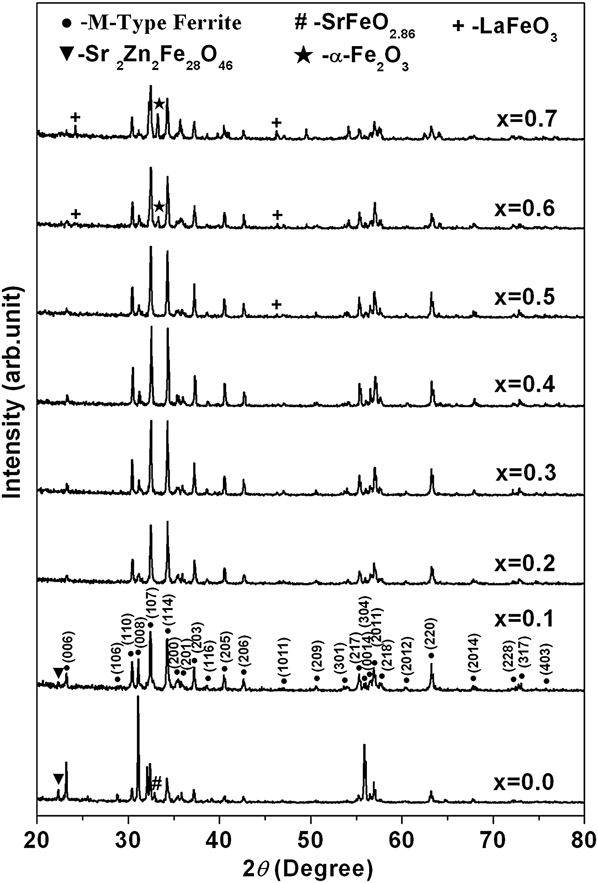
The x-ray diffraction (XRD) patterns of the hexaferrite Sr1−xLaxFe11.75Co0.10Zn0.15O19 magnetic powders with La content (x) from 0 to 0.7 are shown in Fig. 1. In comparison with the standard strontium ferrite (JCPDS card no. 80-1198), it can be seen that there is a single magnetoplumbite phase in the magnetic powders with La content (0.2 ≤ x ≤ 0.4). For the magnetic powders without La content (x = 0), the peaks of SrFeO2.86 and Sr2Zn2Fe28O46 occur in the XRD pattern. For the magnetic powders with La content (x = 0.1), Sr2Zn2Fe28O46 appears in the structure. For the magnetic powders with La content (x ≥ 0.5), the peaks of LaFeO3 phase are observed. For the magnetic powders with La content (x ≥ 0.6), α-Fe2O3 phase is present.
XRD patterns of the hexaferrite Sr1−xLaxFe11.75Co0.10Zn0.15O19 magnetic powders with La content (x) from 0 to 0.7.

The lattice constants a and c for the magnetic powders with different La contents (x) are calculated from the values of the d hkl corresponding to (107) peaks and (114) peaks according to the equation given by:
 $${d_{hkl}} = \left( {{4 \over 3}} \right. \cdot {{{h^2} + hk + {k^2}} \over {{a^2}}} + {\left. {{{{l^2}} \over {{c^2}}}} \right)^{ - {1 \mathord{\left/ {\vphantom {1 2}} \right. \kern-\nulldelimiterspace} 2}}}\quad ,$$
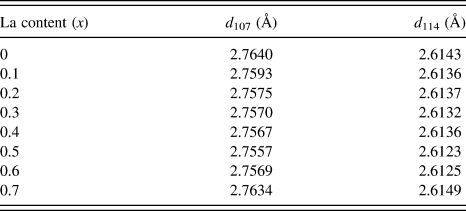
where d hkl is the interplaner spacing, and the values of h, k, and l are the Miller indices. The values of d hkl corresponding to (107) peaks and (114) peaks of XRD patterns are listed in Table I.
The values of d hkl corresponding to (107) peaks and (114) peaks of XRD patterns for the hexaferrite Sr1−xLaxFe11.75Co0.10Zn0.15O19 magnetic powders with La content (x) from 0 to 0.7.

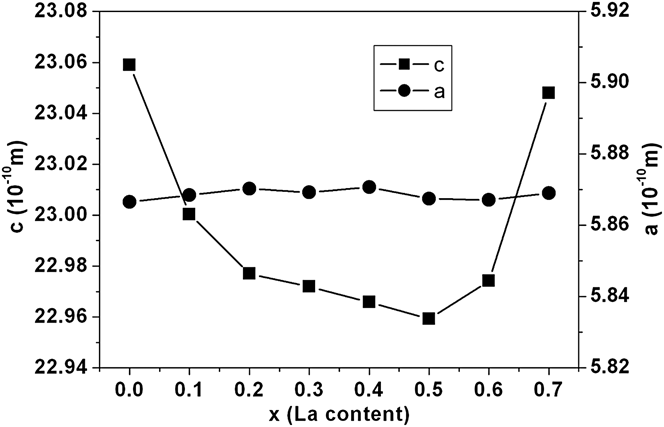
Figure 2 shows the lattice constants a and c of the hexaferrite Sr1−xLaxFe11.75Co0.10Zn0.15O19 magnetic powders with La content (x) from 0 to 0.7. It is observed that the lattice constant c of the magnetic powders decreases with an increase of x from 0 to 0.5 and then increases with x from 0.5 to 0.7. However, compared with the lattice constant c, the lattice constant a remains almost a constant. Liu et al.Reference Liu, Zhong, Yang, Yu, Gu and Du13 have reported that substitution of La3+ for Sr2+ in SrFe12O19 is associated with a valence change of Fe3+ to Fe2+ at 2a or 4f2 site. The decrease of the lattice constant c with La content x from 0 to 0.5 can be attributed to the fact that the radius of La2+ (1.22 Å) is smaller than that of Sr2+ (1.32 Å). And the increase of the lattice constant c with x from 0.5 to 0.7 is mainly due to the fact that the radius of Fe2+ (0.80 Å) is larger than that of Fe3+ (0.67 Å) as the abundance of Fe2+ ions is increased with increasing x.
Lattice constants a and c of the hexaferrite Sr1−xLaxFe11.75Co0.10Zn0.15O19 magnetic powders with La content (x) from 0 to 0.7.

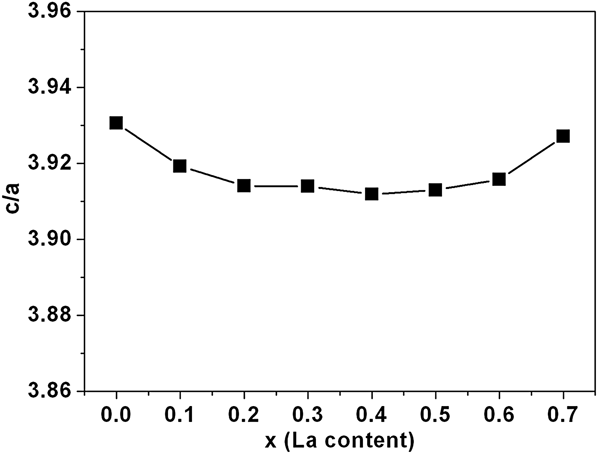
The variation of c/a ratios as a function of La content (x) for the hexaferrite Sr1−xLaxFe11.75Co0.10Zn0.15O19 magnetic powders is illustrated in Fig. 3. As can be seen, the c/a ratios decrease with increasing x up to 0.4. However, when x is beyond 0.4, the c/a ratios increase with increasing x. According to Wagner,Reference Wagner24 an examination of c/a parameter ratio may be used to quantify the structure type, as the magnetoplumbite structure can be assumed if the ratio is observed to be lower than 3.98. The c/a ratios for the magnetic powders with different x range from 3.9119 to 3.9306, which are well within the ratio range of magnetoplumbite structures.
c/a ratios as a function of La content (x) for the hexaferrite Sr1−xLaxFe11.75Co0.10Zn0.15O19 magnetic powders.

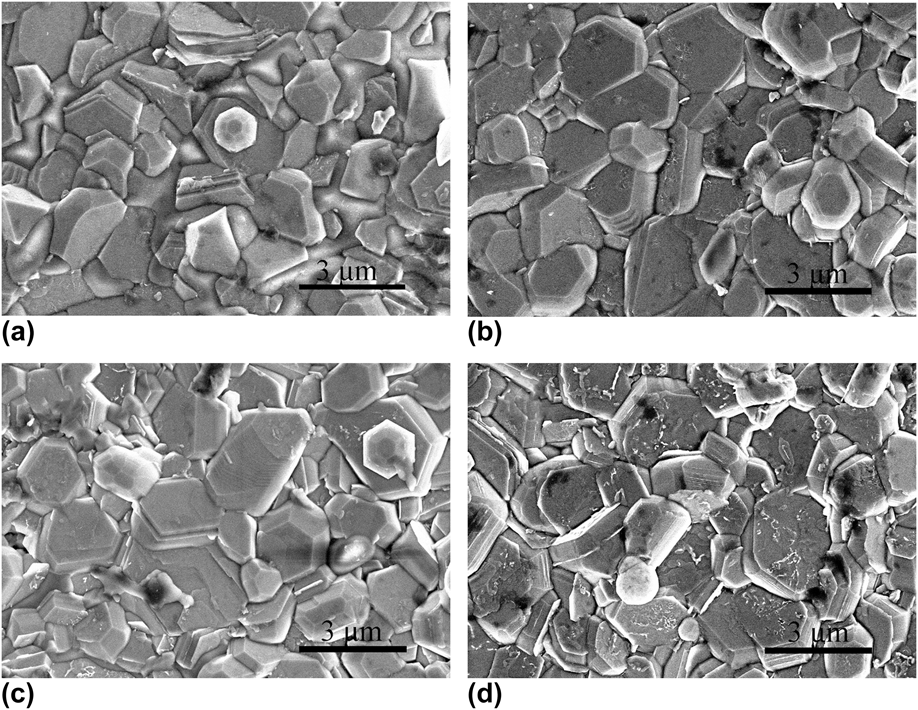
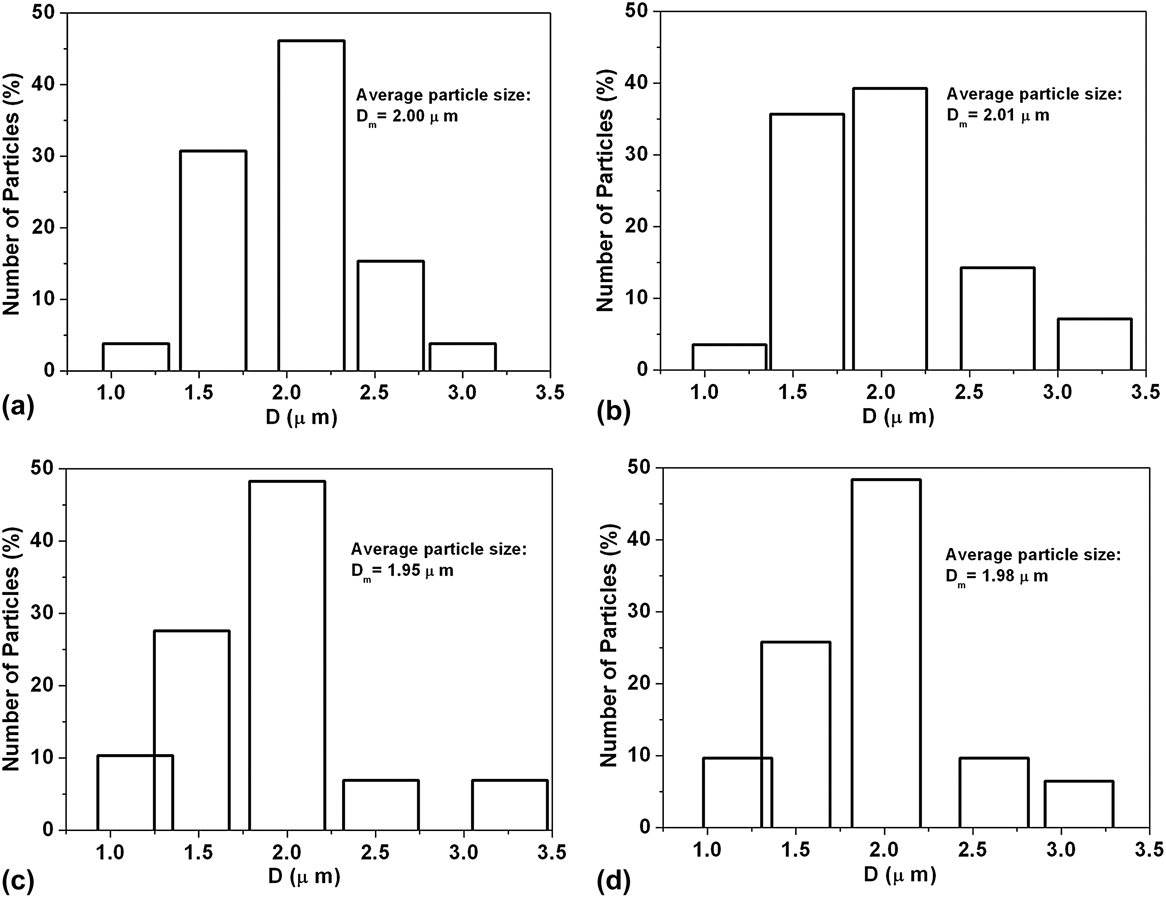
Figure 4 shows the representative FESEM micrographs of the hexaferrite Sr1−xLaxFe11.75Co0.10Zn0.15O19 magnets with La content (x) of 0.1, 0.3, 0.5, and 0.7. The particle size distribution obtained from the representative FESEM micrographs is shown in Fig. 5. It can be seen that the magnets consisted of homogeneously distributed ferrite particles with the hexagonal structures. In addition, the average particle size of the magnets essentially remains unchanged with the increase in La content (x).
Representative FESEM micrographs of the hexaferrite Sr1−xLaxFe11.75Co0.10Zn0.15O19 magnets with the La content (x) of: (a) 0.1, (b) 0.3, (c) 0.5, and (d) 0.7.

The particle size distribution obtained from the representative FESEM micrographs of the hexaferrite Sr1−xLaxFe11.75Co0.10Zn0.15O19 magnets with the La content (x) of: (a) 0.1, (b) 0.3, (c) 0.5, and (d) 0.7.

B. Magnetic properties
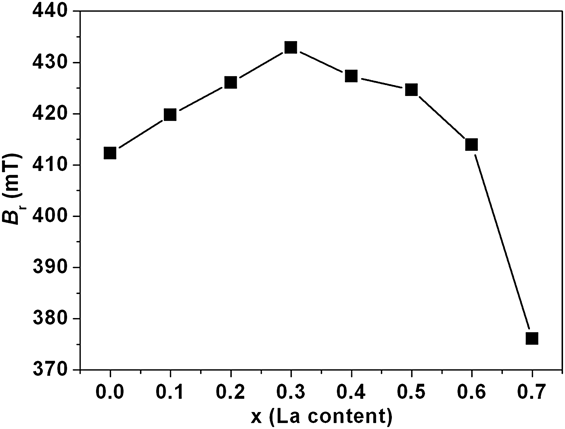
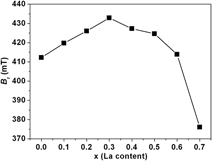
The influence of La content (x) on the remanence (B r) of the hexaferrite Sr1−xLaxFe11.75Co0.10Zn0.15O19 magnets is shown in Fig. 6. It is observed that B r first increases, reaching a maximum value of 432.9 mT at x = 0.3 and then decreases with x from 0.3 to 0.7. In the M-type hexaferrite crystals, Fe3+ ions occupy five different sites: spin up sites 2a, 2b, and 12k and spin down sites 4f1 and 4f2, where 2a, 12k, and 4f2 are octahedral sites, 4f1 is one tetrahedral site, and 2b is one bipyramidal site. Liu et al.Reference Liu, Zhong, Yang, Yu, Gu and Du13 have reported that substitution of La3+ for Sr2+ in SrFe12O19 is associated with a valence change of Fe3+ to Fe2+ at 2a or 4f2 site. It is well-known that for the M-type hexaferrites the magnetic moments of Fe3+ ions are arranged collinearly due to the existence of superexchange interaction. The change of B r can be attributed to an increase in hyperfine fields at 12k and 2b sublattice sites or increase in the Fe3+–O–Fe3+ superexchange interaction at 2b and 12k sites, as reported in previous studiesReference Liu, Zhong, Yang, Yu, Gu and Du13,Reference Liu, Zhong, Yang, Yu, Gu and Dou25 and canting spin structureReference Liu, Zhong, Yang, Yu, Gu and Du13 usually arising from rare earth ions. The increase of B r could be caused by enhancement of hyperfine fields at 2b and 12k sites. When the La content x is increased from 0 to 0.3, the lattice parameter c decreases as shown in Fig. 2. And then, the Fe3+–O2− distance that is parallel to the c-axis decreases, which will cause the Fe3+–O–Fe3+ superexchange interaction strength to increase. This results in an increase in the hyperfine fields at 2b and 12k sites. When x is above 0.3, the decrease in B r can be contributed to two factors including magnetic dilution with change of the Fe3+ (high spin) ions to Fe2+ (low spin) ions at the 2a site by substitution of the Sr2+ site with La3+ ions and appearance of canting spin structure leading to reduction in superexchange fields.Reference Liu, Zhong, Yang, Yu, Gu and Du13
The remanence (B r) as a function of La content (x) for the hexaferrite Sr1−xLaxFe11.75Co0.10Zn0.15O19 magnets.

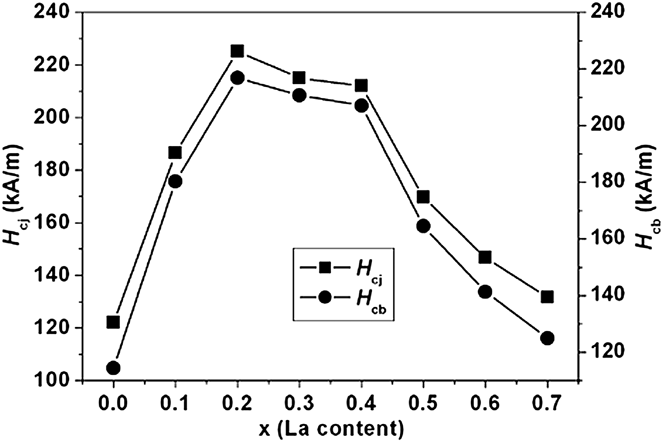
Figure 7 shows the impact of La content (x) on the intrinsic coercivity (H cj) and magnetic induction coercivity (H cb) of the hexaferrite Sr1−xLaxFe11.75Co0.10Zn0.15O19 magnets. It can be seen that H cj and H cb increase with increasing x from 0 to 0.2, and at x = 0.2, H cj and H cb reach the maximum values of 225.1 kA/m and 216.9 kA/m, respectively. And then, when x is above 0.2, H cj and H cb exhibit a continuous decrease and reduce to 131.7 kA/m and 125.0 kA/m at x = 0.7, respectively. The change of the coercivity with La content is in agreement with the conclusions reported by Liu et al.Reference Liu, Zhong, Yang, Yu, Gu and Du13 and Wang et al.Reference Wang, Li, Liu, Qiu and Xu26 The coercivity of the magnets depends both on their magnetocrystalline anisotropy and on their microstructure. According to the literature,Reference Kools, Morel, Grössinger, Le Breton and Tenaud27 the coercivity can be described by the equation given by:
 $${H_{\rm{c}}} = \alpha {H_{\rm{a}}} - {{N\left( {{B_{\rm{r}}} + J_{\rm{s}}^0} \right)} \over {{\mu _0}}}\quad ,$$
where α is the microstructure factor, N is the grain demagnetization factor, H a is the magnetocrystalline anisotropy field, and  $J_{\rm{s}}^0$ is the saturation polarization of the magnet. The factor α increases with decreasing grain size, thus reflecting the well-known H c-grain size dependency; the factor N is governed by the grain shape and increases when the grain shape becomes more platelet shaped. The representative FESEM micrographs shown in Fig. 4 illustrate that the grain size and grain morphology of the magnets do not change with increasing dopant contents, which implies that the factors α and N remain constant. Therefore, it can be concluded that the increase in H cj and H cb with increasing x from 0 to 0.2 can be due to two factors. First, the magnetocrystalline anisotropy field increases with increasing La content. As the content of La3+ increases, the Fe3+ ions present at octahedral sites are forced to migrate toward the tetrahedral sites. This leads to the conversion of Fe3+ (high spin) into Fe2+ (low spin) to maintain the electrical neutrality of M-type hexaferrite. The formation of any low spin iron ions at the tetrahedral site during processing preferentially occupies the 2a octahedral site.Reference Li, Wang and Wang28 As a result, the number of Fe2+ ions at the octahedral site increases with increasing La content. The Fe2+ ions enhance the coercivity due to strong magnetocrystalline anisotropy of Fe2+ at 2a sites.Reference Li, Wang and Wang28,Reference Ounnunkad29 Secondly, the amount of magnetic impurities such as SrFeO2.86 or Sr2Zn2Fe28O46, which will destroy the regular atomic arrangement of the Fe3+ ions, decreases with increasing La content, as shown in Fig. 1.Reference Wang, Li, Liu, Qiu and Xu26 This leads to an increase in coercivity. On the other hand, the decrease of H cj and H cb with increasing x from 0.2 to 0.7 can be attributed to two factors. The first factor is that an increase in the abundance of Fe2+ ions, which arises with increasing x, will destroy the regular atomic arrangement of the Fe3+ ions, resulting in a decrease in coercivity.Reference Thakur, Singh and Barman30 The second one is that the amount of magnetic impurities such as the LaFeO3 or α-Fe2O3 phase, which will destroy the regular atomic arrangement of the Fe3+ ions, increases with the increase of La content shown in Fig. 1,Reference Wang, Li, Liu, Qiu and Xu26 leading to a reduction in coercivity.
The intrinsic coercivity (H cj) and magnetic induction coercivity (H cb) as a function of La content (x) for the hexaferrite Sr1−xLaxFe11.75Co0.10Zn0.15O19 magnets.

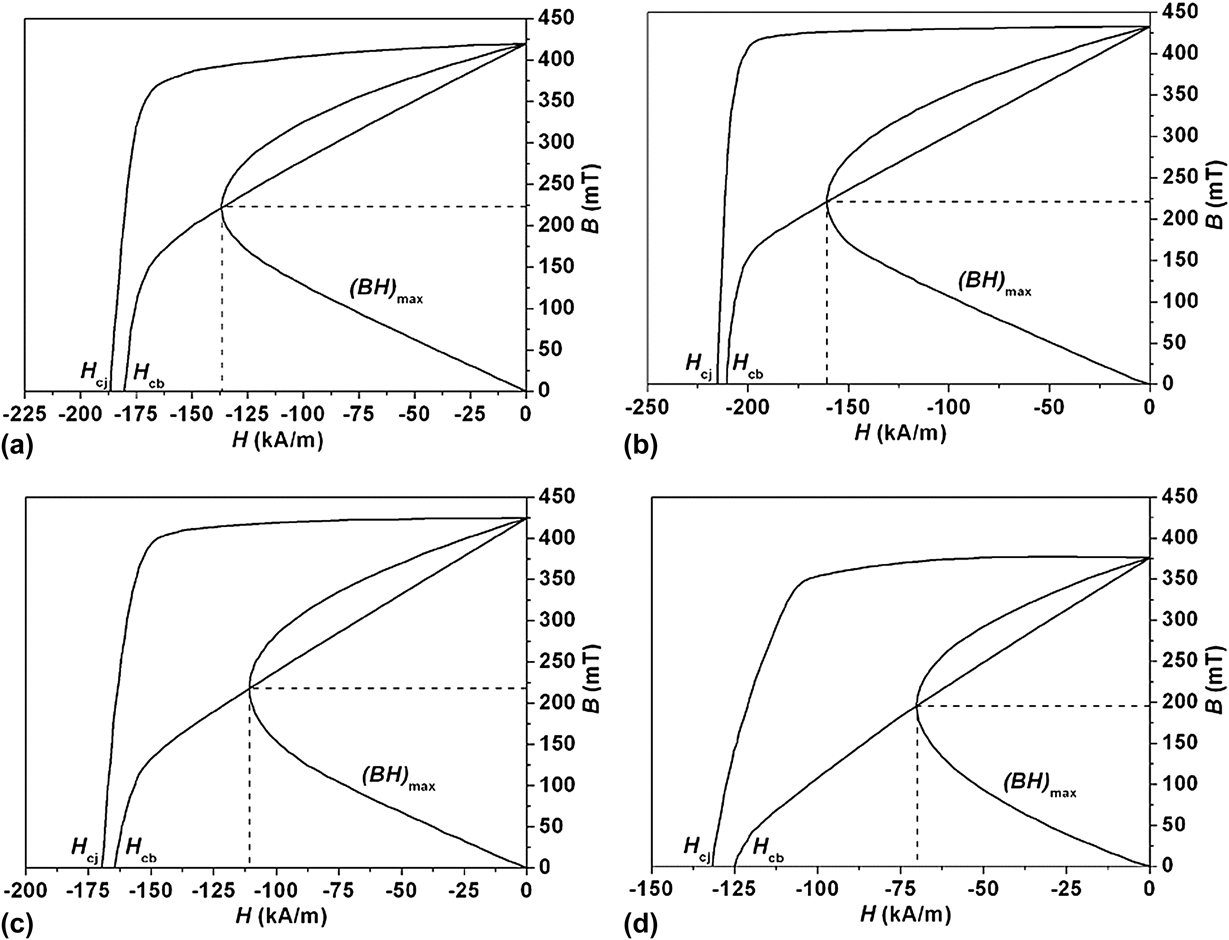
Figures 8(a)–8(d) present the typical demagnetizing curves obtained for the hexaferrite Sr1−xLaxFe11.75Co0.10Zn0.15O19 magnets measured at room temperature with the La content (x) of 0.1, 0.3, 0.5, and 0.7, respectively. It is observed from Fig. 8(a) that at x = 0.1, the Sr0.90La0.10Fe11.75Co0.10Zn0.15O19 magnet exhibits the magnetic properties, including B r = 419.7 mT, H cj = 186.6 kA/m, H cb = 180.3 kA/m, and (BH)max = 30.05 kJ/m3. As seen from Fig. 8(b), at x = 0.3, the Sr0.70La0.30Fe11.75Co0.10Zn0.15O19 magnet indicates the magnetic properties, including B r = 432.9 mT, H cj = 215.0 kA/m, H cb = 210.7 kA/m, and (BH)max = 35.61 kJ/m3. It is observed from Fig. 8(c) that at x = 0.50, the Sr0.50La0.50Fe11.75Co0.10Zn0.15O19 magnet shows the magnetic properties, including B r = 424.6 mT, H cj = 169.7 kA/m, H cb = 164.5 kA/m, and (BH)max = 32.79 kJ/m3. As seen in Fig. 8(d), at x = 0.7, the Sr0.30La0.70Fe11.75Co0.10Zn0.15O19 magnet indicates the magnetic properties, including B r = 376.1 mT, H cj = 131.7 kA/m, H cb = 125.0 kA/m, and (BH)max = 22.56 kJ/m3. When the La content (x) = 0.3, higher B r and (BH)max can be obtained.
Typical demagnetizing curves obtained for the hexaferrite Sr1−xLaxFe11.75Co0.10Zn0.15O19 magnets measured at room temperature with the La content (x) of: (a) 0.1, (b) 0.3, (c) 0.5, and (d) 0.7.

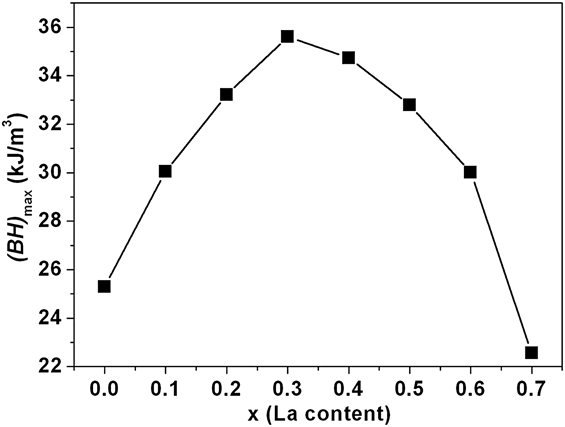
The influence of La content (x) on the maximum energy product [(BH)max] of the hexaferrite Sr1−xLaxFe11.75Co0.10Zn0.15O19 magnets is shown in Fig. 9. It is evident that (BH)max increases from 25.29 kJ/m3 (at x = 0) to 35.61 kJ/m3 (at x = 0.3). With a further increase in x from 0.3 to 0.7, (BH)max begins to decrease and reaches 22.56 kJ/m3 at x = 0.7. The maximum energy product of M-type hexaferrites is estimated by the product between the coercivity field and remanent magnetization and is considered as a comparative indication of the hysteresis area. Therefore, (BH)max has the same feature as B r as shown in Fig. 6.
The maximum energy product [(BH)max] as a function of La content (x) for the hexaferrite Sr1−xLaxFe11.75Co0.10Zn0.15O19 magnets.

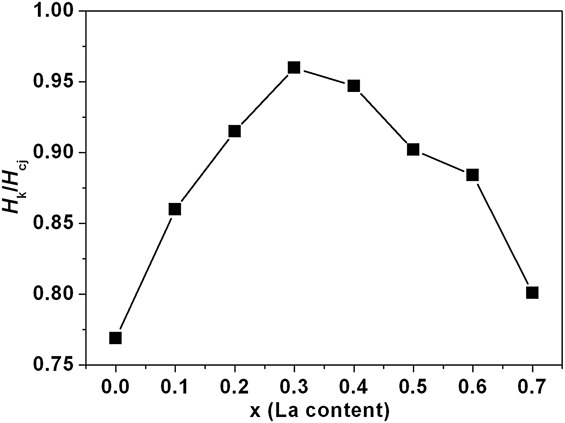
Figure 10 indicates the change of H k/H cj ratios as a function of La content (x) for the hexaferrite Sr1−xLaxFe11.75Co0.10Zn0.15O19 magnets. The H k/H cj ratio, which is one of the important indicators of the magnetic properties for permanent magnets, can intuitively indicate the rectangularity of the demagnetizing curves for the magnets. The H k/H cj ratio characterizes the stability of the magnets under dynamic working conditions.Reference Wang31 It can be seen from Fig. 10 that the H k/H cj ratios for the magnets increase with the increase of x from 0 to 0.3, at which the H k/H cj ratio reaches a maximum value of 0.960, and when x is above 0.3, H k/H cj ratios decrease continuously. The change of H k/H cj ratios is in agreement with that of the rectangularity for demagnetizing curves of the magnets as shown in Fig. 8. The decrease in the amount of magnetic impurities such as SrFeO2.86 or Sr2Zn2Fe28O46 can be partly responsible for the increase of the rectangularity with the increase of x from 0 to 0.3. On the other hand, the decrease of the rectangularity with x from 0.3 to 0.7 can be partly attributed to the increase in the amount of magnetic impurities such as LaFeO3 or α-Fe2O3.
H k/H cj ratios as a function of La content (x) for the hexaferrite Sr1−xLaxFe11.75Co0.10Zn0.15O19 magnets.

IV. CONCLUSIONS
A ceramic process was used to synthesize the M-type hexaferrite Sr1−xLaxFe11.75Co0.10Zn0.15O19 (0 ≤ x ≤ 0.7) magnetic powders and magnets. The phase constituents of the magnetic powders were analyzed by XRD. There is a single magnetoplumbite phase in the magnetic powders with La content (0.2 ≤ x ≤ 0.4). For the magnetic powders containing La content (0 ≤ x ≤ 0.1 or 0.5 ≤ x ≤ 0.7), magnetic impurities coexist in the structure. The synthesized magnets consist of homogenously distributed ferrite particles with the hexagonal structures.
The remanence (B r) and the maximum energy product [(BH)max] of the synthesized magnets first increase until the La content reaches x = 0.3 and then decrease with increasing x from 0.3 to 0.7. However, the intrinsic coercivity (H cj) and the magnetic induction coercivity (H cb) of the magnets increase with the increase of La content x from 0 to 0.2 and then decrease with x from 0.2 to 0.7. The H k/H cj ratios of the synthesized magnets increase with increasing x from 0 to 0.3, then continuously decrease with a further increase of x.