During the first act of Jackie Sibblies Drury’s Fairview, sisters Jasmine (Shannon Dorsey) and Beverly Frasier (Nikki Crawford) argue over the preparation of their mother’s birthday dinner. The absence of their brother Tyrone, and Beverly’s relationship to her husband, Dayton Frasier (Samuel Ray Gates), as well as her strict attitude toward her teenage daughter, Keisha Frasier (Chinna Palmer), have already emerged as major themes when Jasmine announces, “Girl you got drama. Tyrone drama, Mama drama, you all are like one of those movies.” Exhausted over the preparation of the meal, Beverly asks what kind of movie her life could resemble. After a litany of tropes, Jasmine concisely states “a good old family drama. A slice of life. I love those movies. You know, nothing big and flashy, just watching real stories about real people” (Drury Reference Drury2019:22–23). What first appears to be a key to the play turns into a sly wink to the audience that this will be far from a real story about real people. Indeed, Fairview makes good on a promise Drury once made to the New York Times that she would “under no circumstances” create “a family drama around a kitchen table” (Weinert-Kendt Reference Weinert-Kendt2013). Instead, in Fairview Drury uses the shibboleth of the family drama to address her audience and their demands on her, her characters, and the actors who embody them.
Directed by Stevie Walker-Webb at Washington, DC’s Woolly Mammoth, Drury’s Pulitzer Prize–winning play turns the concept of the Black family drama into a site of spectatorship, invasion, and punishment. In her three-act play, the proposed drama is violently dismantled by four white interlocutors who commandeer the Black family to construct a dollhouse for their destructive urges. First pre-miering at Soho Repertory Theatre in the summer of 2018, Drury’s play emerges at a time when Black playwrights find themselves in important metanarratives with their white subscriber bases. The play interpolates audience’s demands for Black performance to conform to comfortable narratives of Black life.
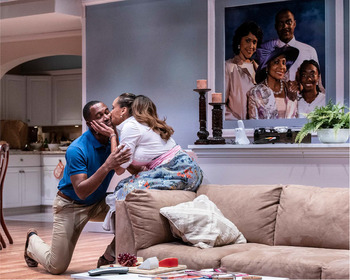
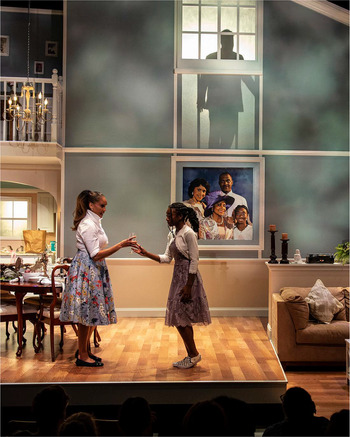
When the audience walks into the theatre for the DC production, the soundtrack of Black sitcoms fills the space where Misha Kachman’s set design resembles the inside of a two-floor modern American suburban home taken right out of Family Matters or The Fresh Prince of Bel-Air, complete with a large family portrait centered on the back wall. The first act follows the setup Jasmine alluded to: a family drama during which Dalton and Beverly squabble over dinner, revealing Beverly’s insecurities more so than the failing marriage. And Keisha similarly exposes her difference from her mother as she pleads to take a gap year before college. All is situated around making the night a success, less for Grandmother “Mama” Frasier and more for Beverly as her sense of dread grows. Everything is set to dramatically explode at the end of the first act when the birthday cake burns and Beverly faints.
Yet before one can accuse Drury of going against her word on never staging a family drama, the second act reveals a new perspective for the audience that all but exposes the first act as television soundstage. Fairview “replays” the first act with the Frasier family pantomiming their actions like a television on mute. Now, we are introduced to four unseen white interlocutors: Jimbo (Cody Nickell), Suze (Kimberly Gilbert), Mack (Christopher Dinolfo), and Bets (Laura C. Harris). The only hint of their physical presence is the projection of their shadows through upstairs windows of the Frasier household. Even though we can’t really see them, their illuminated silhouettes make clear the growing animosity among them, dominating the stage while the Frasier’s movements have become rote in their repetition. Where Suze and Jimbo are not given specific markers of whiteness, Bets is designated European in her broad criticisms of American culture and its obsession with race; and Mack’s whiteness grants him permission to appropriate Latina sassiness into his hinted-at queer identity. Under pressure from Jimbo to answer, “if you could choose to be a different race, what race would you be,” each reveals their understanding of how race functions, exposing how distinctively whiteness constructs the racial other. These are not characters, but caricatures of how they see identity. Together they debate the alleged essential aspects of the racial Other. To them, Asian Americans are repressed by their immigrant parents; Latinx people are passionate and sensual; and to be authentically Black one must be either a poor Black man or a fabulous Black woman. Where Jimbo, Mack, and Bets base their choices on caricatures, Suze responds to the question out of pathos: her inability to cross an unseen “membrane” to connect to her childhood Black nanny (59). It goes unspoken that Suze’s relationship is built out of the power differential of a child and a paid caregiver of color, but she is marked as different from the other observers in her willingness to respond to a real person in her life. Yet Jimbo’s question, which drives the second act, his voice booming over the Frasier family, leads into a broader conversation on the nature of brutality, between the powerful and the powerless: “You don’t just fall into that shit casually, you know. Like, you don’t build your whole life around brutality by mistake. You have to want that. You have to plan that” (69). Jimbo slowly distinguishes his view of life, one where he is not the protagonist but the villain who dominates those around him, forcing them to act in response to him: “all these fucking people, they wouldn’t know what to do if they couldn’t root for me. They’d be fucking lost without me, do you know what I mean?” (73). This proclamation abruptly ends the second act and takes us back to the Frasiers about to sit down to dinner, waiting for Mama and for act 3.
The Frasier family portrait dominates the living room of Dayton (Samuel Ray Gates) and Beverly Frasier (Nikki Crawford). Fairview by Jackie Sibblies Drury, Woolly Mammoth Theatre, Washington, DC, 9 September–6 October 2019. (Photo by Teresa Castracane; courtesy of Woolly Mammoth)

The illuminated silhouette of one of the four white interlocuters looms over Beverly Frasier (Nikki Crawford) and Keisha (Chinna Palmer). Fairview by Jackie Sibblies Drury, Woolly Mammoth Theatre, Washington, DC, 9 September–6 October 2019. (Photo by Teresa Castracane; courtesy of Woolly Mammoth)

As the family calls for Mama to descend the stairs, it surprises no one but Keisha when a white woman appears. It will become clear later that this is Suze, implanting herself in the Frasier family. Deferential to the family, she refuses to speak, sitting happily at the table with the family she desired. Shortly, the drama is ruptured by the appearance of Jimbo, Mack, and Bets who not only distract from the story of the Frasiers but also Suze’s desire to be embedded with them. They turn the scene into the frenzied depictions of racist tropes they desired in the second act. Where Suze attempted to integrate herself into the family, excited to pass through that invisible membrane between white and Black worlds, the others cannot agree on the story they want to tell. Each takes on a persona, effecting their own racist interpretation of new characters in the drama with Jimbo as Keisha’s uncle and Mack as Keisha’s friend. Bets, disagreeing with Suze’s version of Mama, appears as a “sassy” and “aggressive” iteration of a Black woman. As they dramatically hijack the narrative of the Frasier family, they turn Keisha into a pregnant teenager, Dayton into a gambler, and Beverly into a drug addict. Their verbal sparring devolves into an orgy of violence as Jimbo and his friends tear the set apart. It ends with Jimbo urinating on the dining table in front of Keisha.
Responding to the overflowing destruction Jimbo and his friends wrought on the Frasier home, Keisha demands quiet so she can think. She turns to the audience and meekly invites the audience members “who call themselves white” to come to the stage, promising the play is almost over (101). Unsure of herself in front of white spectators, Keisha wants to face the audience of color and address them directly, without white interference. With a destroyed family portrait, food strewn across the floor, broken furniture, and the white audience behind her, Keisha steps off the stage and slowly and evocatively lays out the story she wishes she could tell:
KEISHA: If I were out here, just us, I’d want to tell us a story. A story about ending. Or about leaving. Or about remaining. And how they’re all the same thing if the same people do them. (104)
But Keisha finds herself trapped in trying to explain the story she would tell as it is confined by the narratives that have defined the Black experience in America
KEISHA: Once upon a time, there was a bright little girl who knew that if she worked twice as hard as —
No. That’s not what I wanted to tell. Once, there was a little boy born with the deck stacked —
No. Once, there was an exceptional—It’s difficult because I’ve already heard so many stories. (105)
Keisha’s last action of the play is to dislodge the role of whiteness in Black storytelling and to call upon her audience to imagine “a person trying” who “took it all in. And in their estimation they found all of it, their view over all of it, the sum of all of it, to be fair” (106). Where she had been uncertain of what she was conveying to her audience, this last moment comes with clarity and self-assurance, confirming that she understands for herself what is necessary on the stage. By inviting the white audience members onstage to stand behind her as she addresses her audience, she physically removes the hindrances that had been so cruelly activated by Jimbo and his cohort, replacing them with her view of a different world built not out of narratives of struggle and striving but out of the perspective created by a woman of color.
Fairview finds itself as part of a growing trend of Black playwrights talking directly to their white audiences about their subject position. Footnote 1 It demands that each act be given a different kind of attention and a different kind of engagement. If one takes the play to have begun with the Black sitcom music during pre-show, then the play operates as the staging of a television show, with the audience substituting for a “live studio audience” and every joke demanding the appropriate canned response. This proves an important element of act 1’s artifice; as the audience becomes aware of tantalizing family secrets, they relax into the familiar tropes. In effect, the play invites the audience to partake of the family’s struggles as they are slowly divulged. The second act shatters that view, as the audience is thrust deeper into Drury’s metanarrative. The audience of the Woolly Mammoth production find themselves metaphorically viewing a drama alongside monstrous examples of white privilege who sit above the action on the stage. This is further substantiated by Keisha’s request at the end of the play. As the play actively calls on its audience to participate, a question of identification arises along the lines of division between the Black family and the white friends. Because the white audience is addressed directly, Drury aligns them with Jimbo and the terror brought on the Frasier family.
The effect of white audience members coming to the stage is meant to make them a spectacle, undermining the white gaze created throughout the earlier moments of the play. Yet, this creates new problems. First, the audience of color can neither tell nor feel that they are no longer a spectacle. For any audience member who has ever been on an active stage, they might recall that spotlights are blinding, making the audience hard to see. But one has to know when sitting in the audience that people of color are invisible to the white people on the stage, a fact that goes unremarked upon. Second, I sat relatively close to the middle of my row and when the white audience members went up to the stage, they had to pass me, a person of color. This required me to get up and make way for these now active white participants. So, while the audience of color sat, passive and irresponsive, white members had an active role in the theatre-making. The production counted on a white audience making an active choice in their engagement with Keisha’s request, but it offered nothing for people of color to show their active participation in her play, except as an attentive audience. Finally, as Jimbo and his compatriots take over the fate of the Frasier family, their existence is made more real than the Frasiers. As it is revealed that the Frasiers embody a mix of family drama tropes, they are stuck within a paradigm that is recognized by not only Jimbo but the audience as well. So, by the time Keisha implores her audience to imagine a fair view, from what perspective does the audience see her: as part of the Frasier family enacting a sitcom or as a figure that has emerged as more in control than Jimbo? There is little indication of how Keisha made the journey from sitcomic daughter to metacritic.
Keisha (Chinna Palmer) implores her audience to imagine a fair view. Fairview by Jackie Sibblies Drury, Woolly Mammoth Theatre, Washington, DC, 9 September–6 October 2019. (Photo by Teresa Castracane; courtesy of Woolly Mammoth)

The play inhabits a world similar to Richard Wright’s Native Son (1940) and Ralph Ellison’s Invisible Man (1952). Wright’s novel constructs American racism around how white America creates and perpetuates systems of oppression that produce Bigger Thomas. And similarly, Ellison’s novel follows its unnamed protagonist across the United States; and its revelations focus on watching white people force Black people into defined roles: fighters, deviants, activists, rapists. Both novels make visible white supremacy along the same lines as Keisha’s monologue. The hurdles put in front of Black Americans push them into roles they often actively try to avoid and thus they are forced into narratives of striving and overcoming. Yet Wright and Ellison remind us that white audiences are being watched too. Fairview’s final gesture is to give the audience of color a chance to watch the white audience. But we were always doing that, some more actively than others.
Sitting there as white audience members took the stage, I realized that the emotional impact was not designed for the remaining audience members. What does Fairview do for the knowing audience of people of color? If they identified with the Black family introduced in act 1, as I did, there is a moment of embarrassment for recognizing ourselves in this “good old family”—especially because Fairview’s first act harkens to Black family sitcoms, playing upon their well-known tropes. Yet those same sitcoms were not meant just for white audiences as Drury seems to use them here. They were important forms of representation for various communities that had not experienced a spectrum of representations of themselves on television (Bogle Reference Bogle2001:290–303). To be sure, these shows were not paragons of social justice but they certainly catered to Black audiences. Authentic representation or not, we saw faces like ours written by Black screenwriters. But this was, again, meant for a white audience to be lulled into the comfort of an observer beholding a slice of life that was not their own.
White critics were quick to laud the play for eliciting such feelings. As Sara Holdren commented of the 2018 run at the Soho Rep, “I’m contemplating metatheatrics and responsibility, spectatorship and representation […] And, most of all, I’m grappling with the question this play inherently asks of whether I (straight, white, cis) should be writing about it at all” (Holdren Reference Holdren2018). In a similar vein, Ben Brantley wrote in the New York Times: “You will also wind up questioning your basic right to sit there, especially if, like the majority of New York theatregoers, you are a white person” (Brantley Reference Brantley2018). These responses are fascinating as Fairview requires white attendance and asks for their involvement in theatre-making. It is not surprising that white critics feel such discomfort, yet it should not be thought of as incidental but central to Drury. There is a sense of outsiderness; a purposeful incitement of white spectators.
Although Keisha addresses the people of color at the end of the play, this reconfigured audience is now on display more so than the white audience members who took to the stage. Perhaps this is best understood by the response of critic Charles McNulty to the Berkeley Rep production when he found himself onstage viewing the audience: “I felt both socially implicated and artistically exhilarated. Audience members of color remained in their seats. One woman I spotted had tears streaming down her face and an expression of what looked like grat-itude” (McNulty Reference McNulty2018). What McNulty read or did not read on a woman of color’s face is immaterial as much as his gaze now falls on the audience to perform for him as well. At the end of the play, people of color are still performing for a white audience. Despite the desires of the play to uproot this dynamic, McNulty is still able to find Black spectacles. As theatres rely predominantly on white subscriber bases, Keisha’s speech does not offer a counterbalance to Jimbo’s monologue on white villainy. Instead, it gives white audience members like McNulty another chance to observe, take note, and report on race.
Fairview gives its audience of color little to respond to in comparison to white audience members, even though the final address is aimed at them. The vision of “a person try-ing” is not enacted but left for a possible future work. Again, a narrative of overcoming is our primary experience of Keisha’s monologue as she moves beyond Jimbo’s terrible enactments.
Without a doubt, Keisha’s monologue represents an important manifesto on a new configuration of Black playwriting, but as the script actively invites participation from white audience members alone, Drury created a work that enacts the problem without a way forward. Drury is capable of envisioning a white audience and inciting them to engage with her but fails to give equal footing to her audience of color. We are left to make room for the white audience to take the stage.