Introduction
Early childhood education and care are part of the agenda for a social Europe (Mahon, Reference Mahon2002). Increased provision of childcare services is considered important for several reasons. It is considered an investment in the ‘knowledge-based economy’; childcare services are seen as part of the educational system and the ‘lifelong learning’ strategy (OECD, 2001). It is also part of the European Union's employment strategy, aimed at raising women's employment levels and combating child poverty. The aim is that by 2010 there should be childcare places for 33 per cent of children up to the age of three, and 90 per cent of children aged between three and mandatory school age (six in most member states). While many European countries are far from meeting these targets, the Nordic countries, with the exception of Finland have reached both of the milestones.Footnote 1
The Scandinavian countries are thus among the best achievers, with a record of pioneering in publicly funded childcare provision. The Nordic/Scandinavian societal model is currently receiving considerable attention in European policy debates: not only for the economic model combining market flexibility with a high degree of social protection (Berman, Reference Berman2006), but also for the combination of relatively high fertility levels and high employment rates among mothers, supported by generous family policies. While many argue that these countries have distinctive welfare systems that cannot be copied, scholars such as Ulrich Beck and Anthony Giddens contend that much can be learnt from examples of best practice, including the provision of well-funded childcare (Beck and Giddens, Reference Beck and Giddens2005).
It is also important to understand how childcare provision in these countries has developed. In this article, we compare the current situation in the four Nordic countries – Denmark, Finland, Norway and Sweden – followed by a more detailed study of developments in Norway. We demonstrate that, although there are similarities between the Nordic countries, there are some striking differences. Childcare services have differed not only with regard to the timing of expansion, but also concerning policy rationales (Leira, Reference Leira1992). National differences are still visible in the institutionalisation, provision and use of childcare services, as will be described later. The comparison indicates a complex interplay between the provision and demand of childcare services. Such interactive processes have not received much attention in the debate about childcare policy so far. We maintain that addressing the interactive processes of changing provision and demand are particularly important in understanding childcare gaps.
This argument is substantiated by a more detailed exploration of these dynamics in Norway. Norway is particularly interesting in that the childcare gap has been bigger than in the other Nordic countries. Childcare coverage has lagged considerably behind that of Denmark and Sweden for three decades, but recent developments are likely to move Norway into the same league as them. We shall show that, in Norway, the interactive processes have produced an ever-increasing demand for childcare. Moreover, while research on childcare provision usually emphasises policies and institutions – the importance of the role of mothers in generating change is stressed in this study. Mothers’ changing labour market patterns and their demand for childcare have been important driving forces for policy change in Norway.
Nordic childcare differences
In the Nordic countries, publicly funded childcare includes both publicly and privately owned institutions. Publicly funded services are for the most part organised in daycare centres, but there are also some family daycare units, organised in private homes. The state's owner-role in daycare centres has varied significantly among the countries. While state ownership has been almost complete in Sweden, for example, the state has owned only half of Norwegian daycare institutions (for historical differences in organisation and financing, see Leira, Reference Leira1992).
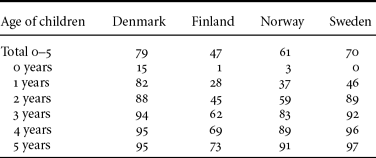
In 2005, Denmark had the highest coverage rate for children from birth to five years in publicly funded childcare (79 per cent), followed by Sweden (70 per cent, see Table 1). Also, in Norway, the majority of children in these age groups (61 per cent) were enrolled in publicly funded child daycare, compared to only 47 per cent in Finland. Thus, the difference between the highest and lowest Nordic coverage – between Denmark and Finland – is considerable (32 percentage points). These differences are caused by particular national configurations of the institutionalisation and provision of childcare, the composition of the childcare policy package, labour market opportunities and cultural ideas of motherhood and childhood, and mothers’ demands for childcare.
Children in publicly financed daycare services as per cent of the age group (2005 per cent).

Source: Nordic Council of Ministers (2006).
Publicly funded childcare may serve various policy aims. It can be a social policy instrument for increasing employment, for increasing gender equality, for equality in children's upbringing, at the same time as providing pedagogical stimulation and care in a safe environment (Bergqvist and Nyberg, Reference Bergqvist and Nyberg2001). Denmark and Sweden are the historical pioneers in developing well-funded public childcare. In these two countries, facilitating mothers’ employment and gender equality have been the main rationales, in addition to the pedagogical needs of children. Childcare services are approaching a universal arrangement, in terms of being an institutionalised right, and in terms of parents’ use. The right to childcare is enacted at the local level. In Denmark nearly 90 per cent of all municipalities have introduced a childcare guarantee (Borchorst, Reference Borchorst, Michel and Mahon2002). In Sweden, parents who are working or in education have a right to childcare, and 95 per cent of the municipalities report that they can provide childcare within three months on demand (Bergqvist and Nyberg, Reference Bergqvist and Nyberg2001).
The childcare gap – the gap between provision and demand of services – has more or less disappeared. In both countries, nearly all children in the three to five age group (between 92 and 97 per cent) were enrolled in publicly funded childcare in 2005 (see Table 1). Most two year olds (88–89 per cent) also had a childcare place. Differences in enrolment rates among children under the age of two are mainly due to differences in parental leave arrangements. Sweden has long parental leave (16 months in total) so childcare is usually demanded when children are about 18 months old. Children under a year old tend not to be in daycare, whereas 46 per cent of one year olds are (Table 1). In Denmark, parental leave was rather short until it was extended to one year from 2002. There are some infants in childcare: 15 per cent of children less than one year old. Among one year olds, however, the large majority (82 per cent) are in childcare.
In earlier comparative studies, Finland had been classified together with Denmark and Sweden as the same type of service regime. They are all classified as ‘service states’ regarding care provision, combining ‘abundant’ care services both to older people and to the youngest children (Anttonen and Sipilä, Reference Anttonen and Sipilä1996). The indicators measure the volume of care, and for children it includes coverage rates of children under three and those aged between three and five. The provision of childcare services for children under three is generally considered the ultimate test of the support of the dual breadwinner model, and thus of mothers’ employment, as arrangements for older children are often instituted as part of the educational system (Korpi, Reference Korpi2000).
In terms of the right to childcare, Finland's model is universalistic. Since 1996, parents have had a right to a place (Salmi, Reference Salmi, Ellingsæter and Leira2006). Parental leave in Finland is about one year, and few children under one year of age are in formal daycare (Table 1). However, what Finland does have, but Denmark and Sweden do not, is a cash-for-care benefit for children under three not using childcare services. It should be noted, however, that Sweden's former centre-right coalition government introduced a cash-for-care arrangement in 1994, but it was immediately dismantled when the social democrats came into power later that year. The Finnish combination of a right to childcare with a cash-for-care benefit was part of a national family policy compromise. The enrolment of one and two year olds in daycare is particularly low in Finland compared to the other Nordic countries (54 per cent lower for one year olds and 43 per cent lower for two year olds than Denmark). However, in principle, Finland has no childcare gap, since the existence of a right to childcare means that the enrolment reflects parents’ demand. This is, of course, an empirical question, but also in practice there do not appear to be waiting lists for daycare services. The Finnish case demonstrates that it is not only the provision of services that affects the coverage of childcare: demand by mothers is very important. One crucial factor in explaining the lower demand for childcare services is the cash-for-care arrangement. However, the impact of this arrangement is likely to be significantly influenced by the labour market situation. In recent years, Finland has had a much higher unemployment rate than the other Nordic countries, which makes employment less of a choice for mothers. That labour market opportunities are important to mothers is further supported when we compare Finland with Norway. Since 1998, Norway has also had a cash-for-care benefit for children aged between one and two not attending publicly funded childcare services: the benefit is close to the equivalent of the state subsidy of a full-time place in the childcare services.Footnote 2 However, this reform did not lower the demand for childcare; as will be shown later, the opposite is the case. A factor likely to be important in accounting for this difference is that while Finnish mothers have had limited labour market opportunities, since the mid-1990s Norwegian mothers have experienced a period of employment growth.
In contrast to the other three countries, Norway has been classified as belonging to the cluster of states that have generous services for older people but less developed services for children, in particular for children under the age of three (Anttonen and Sipilä, Reference Anttonen and Sipilä1996). Historically, Norwegian childcare services have been legitimated by a social pedagogical child perspective; gender equality has not been a main policy rationale, and attitudes toward mothers’ employment have been rather ambivalent (Leira, Reference Leira1992). Nevertheless, since the late 1980s, ‘full coverage’ of childcare services has been a unified political aim of Norwegian family policy. ‘Full coverage’ means provision of places in daycare centres to all children whose parents want them. However, childcare is not institutionalised as a right, and municipalities do not have to provide daycare. A main rationale has been to secure local political autonomy, which gives rise to the ‘problem of governance’ between the central as opposed to the local level (see Evers et al., Reference Evers, Lewis and Riedel2005). Moreover, the cash-for-care benefit continued Norway's dualistic family policy, combining dual earner support with traditional breadwinner elements, including generous cash transfers to families (Ellingsæter, Reference Ellingsæter2003).
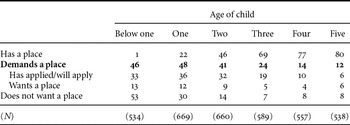
Like the other Nordic countries, Norway's one year parental leave means that very few infants have a place in the childcare services (see Table 1). In the three to five age group, childcare enrolment is quite high – 83–91 per cent – though somewhat lower than in Denmark and Sweden. However, large differences are found for one and two year olds. Compared to Denmark, Norway's coverage rates are 45 and 29 percentage points lower for one and two year olds, respectively. But the cash-for-care benefit is not the explanation for Norway's low coverage rates for children in these age groups. In contrast to Finland, the demand for places, in particular for children under three, exceeds provision. This was demonstrated in a survey carried out in the spring of 2002 that asked mothers with children aged five or younger about childcare use and preferences: whether they had a place in daycare or family childcare and, if not, had they applied or would they apply for a place for the coming autumn, and if they had not applied/would not apply, they were asked if they wanted a place. Table 2 shows that among mothers with children under the age of one, 46 per cent demanded a place, 33 per cent already had applied or would apply for a place for the coming fall, and 13 per cent wanted a place. Among mothers of one year olds, 48 per cent demanded a place (36 per cent had/would apply, 12 per cent wanted a place). Also, among mothers of two year olds, where 46 per cent already had a place, an additional 41 per cent of mothers demanded a place (32 per cent had/would apply and 9 per cent wanted a place). There is also demand for more places in the three to five age group: 24 per cent among three year olds, decreasing to 12 per cent among five year olds. All in all this shows that Norwegian mothers’ use of and demand for childcare services reaches a level fairly similar to coverage in Denmark and Sweden, implying a near universal use of childcare, including for the youngest children. In what follows we shall explain why the huge childcare gap accumulated, and why it is likely to close in the near future.
Mothers’ use of and preferences for childcare services for children 0–5 years old. Per cent.

Sources: Ellingsæter and Gulbrandsen (Reference Ellingsæter and Gulbrandsen2003: table 32).
The childcare gap: a historical and contextual perspective
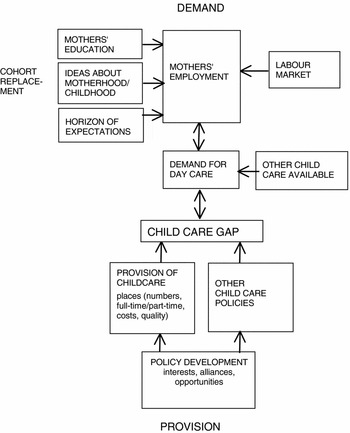
Our point of departure is that the existence and magnitude of a childcare gap is shaped by interactive processes of provision and demand. The analytical framework for our empirical analysis of these processes is outlined in Figure 1, specifying the main factors involved.
Factors affecting the child care gap.

The establishment of a sufficient provision of care services takes years, even decades, and is evolving through specific historical events deeply embedded in a broader national context and political culture (Esping-Andersen, Reference Esping-Andersen and Esping-Andersen2002; Michel, Reference Michel1999). Varying constellations of political actors and interests mean that there are different ‘windows of opportunity’ (Kingdon, Reference Kingdon1984) for expanding childcare services at different periods of time. A historical and contextual perspective is thus required in understanding its development. Of particular interest are the determinants maintaining or altering care policy paradigms, including the emphasis on establishing daycare centres relative to other care policies. History can be divided into periods of relative stability or of upheaval or ‘crisis’, with the latter likely to prompt paradigmatic change (Jenson, Reference Jenson2004). When old policy meets new socioeconomic circumstances, policy tends to underestimate change (Jenson, Reference Jenson2004). Thus, in periods of relatively stable family policy paradigms, change in parents’ preferences and practices may still occur, and may even transform into new patterns. This is why a period of standstill might be followed by a period of rapid change.
Accordingly, the need for a historical and contextual perspective also applies to parents’ demand for childcare services. Here we want to emphasise parents’, and particularly mothers’, agency in generating momentum for policy change. Agency means actions, activities, decisions and behaviours that represent some measure of meaningful choice (Deacon and Mann, Reference Deacon and Mann1999: 413). There has been a revival of the idea of human agency in policy theories and debates in recent years, but the main focus seems to have been placed upon the goodness or badness of the ‘welfare subject’ (see Deacon and Mann, Reference Deacon and Mann1999; Hoggett, Reference Hoggett2001). Less focus has been on people's agency in generating policy change; mothers’ and families’ active roles in establishing new practices are generally underrated. It can be argued, for example, that the usual categorisation of the Nordic countries as ‘women-friendly’ states is in danger of overemphasising the state's role in generating change, underplaying the role of social actors (Roseneil and Williams, Reference Roseneil and Williams2004). A simple stimulus-response model of social action often underpins social policy thinking, founded on a simplistic model of economic rational man, assuming that parents respond in a predictable manner to family policy initiatives, bringing about the intended effects (Edwards and Duncan, Reference Edwards, Duncan and Silva1996; Pfau-Effinger, Reference Pfau-Effinger2005).
Social action is an outcome of a choice within constraints, and preferences underlying choice are shaped by the constraints; preferences are adaptive (Elster, Reference Elster1983). Moreover, options come in bundles that cannot be disassembled and reassembled at will; and choices, once made, retroactively influence preferences (Elster, Reference Elster1983: 110). Preferences (as well as attitudes and orientations) emerge in a gradual but continually adaptive process (Fagan, Reference Fagan2001: 243). People's preferences thus are shaped by their perceived ‘horizon of opportunities’ (Mahon, Reference Mahon2002). Getting at people's ‘real’ preferences is hard, if not impossible, as they are always generated in a social context. What is needed is an understanding of the social preconditions of preferences: the circumstances shaping and changing preferences and choices. The opportunity structure and the individual's capacity to overcome constraints constitute two main preconditions of individual choice. A main point in our analysis is that change in opportunity structures and individuals’ capacities will alter preferences.
Mothers'/parents' demand for childcare services is shaped by various structures and constraints (see Figure 1): mothers’ labour market opportunities, which are correlated with their educational achievements; cultural ideas of motherhood and childhood; and the availability of daycare places, and their cost and quality compared to other care alternatives. A main point in our analysis is that opportunities and constraints change over time, and thus are different for succeeding cohorts of mothers. We shall argue that change in mothers’ education and employment opportunities are the main elements in the increasing demand for daycare. So also is the steady growth in publicly funded childcare, raising parents’ expectations of getting a place, and gradually normalising daycare centres as an ordinary part of early childhood. Moreover, uneven change in individuals’ capacities and opportunities might create contradictions that are change inducing. Hence, interactive processes of gradual but uneven change may produce a new momentum in the demand for childcare that will eventually undermine the stability of existing policy paradigms.
In contemporary societies, women's educational capacities and employment opportunities have changed dramatically. Some scholars argue that women's preferences today are formed more or less independently of social structures; for example, that family relationships are ‘essentially private, and shaped by quite different social factors from the public activities and the labour market, business and politics’ (Hakim, Reference Hakim1999: 33–4). Our position is that individual preferences are not formed outside larger society, above or beyond markets or politics. With regard to policies, preferences cannot be explained directly as a function of public policies. Rather, practices are formed in interaction with state policies, as the state is a ‘choice promoting institution’ (Olson, Reference Olson2002): state policies always promote certain choices over others. The state's ‘promotion’ of daycare as a choice is thus shaped by the state's provision of daycare places, and the quality and the cost to families of such care.
Material (economic) institutions are embedded in cultural practices and vice versa, and both have to be taken into account in social explanations: embedded normative and material patterns still persist and have continuing power (Crompton, Reference Crompton2006). Choice is formed in a context of social relations, of normative and moral dimensions. Mothers’ preferences and choice regarding childcare are embedded in moral considerations, based on an ‘ethics of care’, influenced by cultural ideas about what is good for the child. Hence the quality of childcare services, compared to other care alternatives, is vital. Cultural ideas about childhood, evident in views on what constitutes acceptable childcare, are found to constitute one of the most effective constraints on mothers’ employment. In their UK study, Himmelweit and Sigala (Reference Himmelweit and Sigala2004) indicate that preference for extra-familial care is prior to, or perhaps simultaneous with, employment decisions. Mothers’ decisions regarding employment and care were shaped by both internal and external constraints. Both personal identities and external circumstances limited mothers’ choice, but a main finding was that neither was fixed. Over time, behaviour and identities adjusted to each other. This clearly illustrates the adaptive nature of preferences, giving rise to feedback effects at both the individual and the societal levels. Identifying such feedback processes is essential in understanding the dynamics of change.
Childcare and mothers’ employment growth
The significance of welfare state policy in shaping mothers’ employment patterns has been a question of continuing theoretical interest. It is increasingly acknowledged that the role of childcare policy varies a lot and can be quite complex, as mothers’ employment practices are generated in the interplay of policies, economic structures, cultural norms and historic trajectories. The Scandinavian welfare states are often defined as interventionist, intervening in the societal organisation of childcare. However, Scandinavian mothers entered the labour market long before supportive public policies were in place (Leira, Reference Leira1992; Nyberg, Reference Nyberg2003). This is also a consistent finding from empirical research carried out in other western countries: women have increasingly chosen paid work when employment opportunities have emerged, and prior to a developed state care policy. Therefore, their employment rates cannot be explained as a simple function of public policies’ treatment of families with children (Daly, Reference Daly, Scharpf and Schmid2000: 491); indeed, the causal relation might just be in the opposite direction.
Huber and Stephens’ (2000) comparative analysis of 16 countries from the early 1960s to the late 1980s found that women's labour force participation is an important determinant of the expansion of public social welfare services, apart from other social, political and historical factors. Their hypothesis is that working women make demands on the state for better services, regardless of the institutional and political context, and that women are more successful in getting their demands met where their numbers are greater. Women make these demands because when they enter the labour force they need relief from the traditional female caregiving responsibilities. Huber and Stephens (Reference Huber and Stephens2000) found that social democratic governance was an important determinant of the provision of welfare state goods and services, particularly the public provision of services. Hence, the greater and gradual response of the Nordic welfare states to the mothers’ growing demand has created a different dynamic between mothers’ employment and childcare provision than in other types of welfare states.
Mothers’ employment is a vital basis for understanding the demand for extra-familial childcare in Norway. The expansion of childcare services was much more a consequence of than a prerequisite for mothers’ employment growth. Looking first at the period 1965–1990, it is evident that the transformation of the traditional role of mothers started in the mid-1960s, when childcare services were almost non-existent. From a small group of 14 per cent in 1965, employed mothers with pre-school children had grown to almost 50 per cent at the beginning of the 1980s. The growth was mostly in part-time work, representing a partial continuation of women's traditional maternal role. An arrangement that developed, and is still quite common, is mothers who work part-time outside normal working hours when their husbands are taking care of the child(ren), thus reducing the need for extra-familial childcare. In the 1980s, mothers’ employment rates increased enormously, by about 20 percentage points. This decade also saw a marked increase in full-time work among mothers.
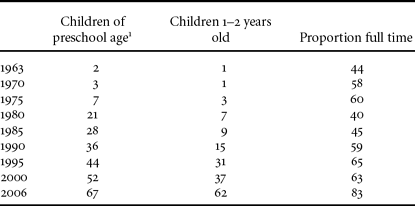
Contrasting the early growth in mothers’ employment with access to childcare services, only 2 per cent of pre-school children had a place in the mid-1960s, and there was hardly any growth in the following years (Table 3). However, the passing of a law in 1975 on daycare centres marked a new era. In the second half of the 1970s there was some advancement; in 1980 coverage had increased to 20 per cent. The expansion was mainly limited to part-time places for children aged five or six, however, signalling doubt as to the benefit of full-time care. Further, care services grew slowly in the 1980s. Frustrations over the slow progress made parental initiatives an important factor in service expansion, a literal expression of parents’ agency in creating change. By establishing childcare cooperatives that received public subsidies, parents took part in shaping their own opportunity structure. This has had a lasting impact on the ownership structure of Norwegian daycare centres.Footnote 3
Proportion of children in publicly funded daycare 1963–2005 (per cent).

Note: 1 The denominator is all 0–6 years olds for rates 1963–95, and all 0–5 years olds in 2000 and 2006.
The first attempts to expand childcare services in Norway were met with strong opposition (Leira, Reference Leira1992). The psychological and pedagogical development of children was promoted as the main policy rationale, while the needs of working parents for care services were not articulated, despite the preceding strong growth in mothers’ employment. This might have been a convenient strategy with regard to public opinion, as the pervasive attitude at the time was that care and education of young children was the responsibility of the family. In those days, a widespread opinion was that daycare centres were only supplemental. In contrast, childcare services in Denmark and Sweden were co-ordinated with and ideologically founded on mothers’ employment (Leira, Reference Leira1992). The more limited state involvement in Norwegian childcare services is visible in the central role of privately owned but publicly funded institutions. Most of the first institutions were private, and since the mid-1970s the public-private ownership distribution has been about fifty–fifty. Christian organisations established in the first expansion period account for a large number of part-time childcare facilities. Since the 1980s the share of full-time places has increased steadily, however, constituting 78 per cent in 2005 (see Table 3).
The policy of ‘full coverage’: a moving target
Development since the 1990s is particularly important in explaining the childcare gap revealed in the 2002 survey. First, we shall account for the provision of childcare services and the actual expansion of services, and four policy reforms that are of specific significance:
• the extension of parental leave to one year in 1993Footnote 4
• lowering of the mandatory school age from seven to six in 1997
• the introduction of the cash-for-care benefit in 1998, and
• the introduction of maximum payment for places in childcare centres in 2003.
At the beginning of the 1990s, only 36 per cent of children under school age had a place in daycare services (see Table 3). Coverage for children up to the age of three was particularly low: 11 per cent. The advancements of the 1990s look impressive judged by coverage rates. In 2000, 52 per cent of all pre-school children had a place. However, the main reason for the improvement was two reforms that virtually removed two birth cohorts from the childcare market: parental leave reform and the lowering of the mandatory school age. Thus, since 1997 ‘full coverage’ means provision for all children aged between one and five whose parents want a place. Expansion in the number of places was more modest; in fact, the rate of increase was much lower than in the preceding two decades. Until the end of the 1990s, the expansion in places was largest for children aged three or more. For this group, the childcare gap was significantly narrowed. There was also an increase in the number of places for children aged between one and two, particularly in the first half of the 1990s. But the majority of the new places were in family daycare: the usual arrangement being one employee taking care of four or five children in the home of one of the parents. Family daycare is a less expensive strategy, as state regulations require more staff per child in ordinary childcare centres. Family daycare was also thought to be more ‘family-like’ – and thus better suited for the youngest children – than ordinary daycare centres with many children. To parents, however, these units resemble private childminder arrangements, except for the public subsidy and some public control of the operation.
‘Full coverage’ has turned out to be a moving target. Successive governments – both social democratic and centre/centre-right coalitions – have had to adjust upwards the rate estimated to measure ‘full coverage’. It is important to note that the policy rationales supporting this ambition have differed among the political parties. For parties on the left, the provision of childcare services is part of supporting dual-worker families and gender equality. For the centre-right parties, the support is part of their overarching rationale of parental choice regarding form of care.
The 1990s family policy debate: ‘more time for children’
The low rate of expansion in childcare places in the 1990s shows that parents’ demand for childcare was overshadowed by the paramount policy debate of the 1990s: ‘more time for children’ (Ellingsæter, Reference Ellingsæter2003). This was the goal of the two major family policy reforms in the decade: parental leave extension and the cash-for-care reform. Most of the energy in the family policy field in the 1990s was coupled with the controversy over the cash-for-care benefit. The parental leave reform, proposed by a social democratic government, was not supported by the centre-right parties: they wanted a cash-for-care arrangement in its place. The cash-for-care reform was passed when a centre minority government came into office in 1997, with support from the two parties on the right, and the Labour Party and the Socialist Party in fierce opposition.
Improving parents’ opportunities by providing good childcare was stated as the main aim of the cash-for-care reform, and an underlying assumption was that parental care was the best for the youngest children. But another rationale was that the use of private childminders – such as nannies and au pairs – should be subsidised in the same way as publicly funded childcare. This would benefit not only parental care, but also the purchase of private care. More time for children and parental choice regarding the form of care were central in the heated public debate prior to the reform (Ellingsæter, Reference Ellingsæter2003).
The reform was expected to encourage mothers to leave the labour market or to shift their childcare arrangements from the public to the private sector. The reform was a success in that the majority of eligible parents received the cash benefit (nearly all are mothers). But since its introduction there has been a marked downward trend in the proportion receiving the benefit: declining from 74.8 per cent of parents with children aged one or two in 1999, to 47.8 per cent at the end of 2006: a reduction of 27 percentage points. The proportion receiving the benefit has in general been higher among parents with one year olds compared to those with two year olds (56.2 per cent versus 39.7 per cent in 2006). Evidently, the falling ‘take-up’ rate is closely associated with increased provision of daycare for children in this age group.
The reform has had a slight negative impact on mothers’ employment. Employed parents are entitled to one year of unpaid leave at the end of paid parental leave, so they have the right to return to their job up to one year if they choose the cash-for-care benefit. Since cash-for-care was introduced, employment rates among mothers of one and two year olds have not declined but have stabilised at around 70 per cent (Håland and Næringsrud, Reference Håland and Næringsrud2004). However, among mothers of three to five year olds, employment growth has continued. Based on various data sources, estimates of what could have happened if the cash benefit had not been introduced suggest that hours in paid employment could have been 6 to 20 per cent higher among mothers in the target group (Rønsen, Reference Rønsen2005; Schøne, Reference Schøne2002). The more time that has elapsed since the reform, however, the more insecure are these types of estimates and the interpretation of their causes. Reduced waiting time for daycare might, for example, make more mothers (and fathers) take some unpaid leave while waiting for a daycare place, instead of hiring a nanny temporarily (Ellingsæter, Reference Ellingsæter, Ellingsæter and Leira2006).
The reform's impact on parents’ demand for daycare is perhaps even more interesting. Norwegian childcare services have been rather expensive in a Scandinavian context, and forgoing the cash benefit would make the use of publicly funded childcare relatively even more expensive. What actually happened was a modest drop in the proportion of one and two year olds in childcare services in the first year of the reform. But this turned out to be an exception, probably caused by a reduction in provision and not in demand. In anticipation of a reduction in demand that did not occur, municipalities and daycare centres probably reduced the number of places available. A couple of years later, coverage rates were higher than before the reform, and demand continued to rise. Estimates suggest that the proportion of children in the target group (one and two year olds) that had a daycare place increased from 37 to 62 per cent from 1999 to 2006 (see Table 3).
Neither did the reform increase the market for private childminders, as was expected. The cash-for-care reform was introduced at a time when the use of private childminders had been declining for several years, indicating parents’ preferences for childcare services. Since the reform there has been a shift within state-supported services, with a reduction in the use of the family daycare arrangement (Gulbrandsen and Hellevik, Reference Gulbrandsen and Hellevik2000). Family daycare was mainly used as a temporary arrangement before a daycentre place could be found, and the decline mirrors the significant increase in the number of daycare places in recent years.
The aftermath – the 2003 price reform
After the introduction of the cash-for-care benefit, a new political situation emerged. With the benefit in place the political controversy could be put aside, at least temporarily, giving space for a stronger focus on childcare services. In 2003, the majority opposition pressured the minority centre-right government into agreement on a reform introducing maximum payment for daycare, which was difficult to reject as the main aim was to increase parents’ choice by lowering the cost of daycare to users.Footnote 5 In addition to the left-wing parties, the opposition included the right-wing Progress Party. This was an unusual alliance, as the Progress Party's principal family policy was to collect and convert all state subsidies to parents into a cash cheque: childcare services were not considered to be a public responsibility. However, the party's position on this issue can be seen in light of their general frustration at being marginalised by the centre-right government and excluded from political influence. Since 2005, the new majority centre-left government has further strengthened its commitment to ‘full coverage’, allocating even more funds to the expansion of daycare places.
Evidently, the cash-for-care reform seriously undervalued parents’ ‘care squeeze’: that is, the lack of childcare services. In a way the price reform also underestimated the gap between provision and demand, as the main reform focus was on prices and not on the lack of places. Declining prices have actually increased the demand for childcare, thus further escalating the pressure on providing ‘full coverage’. The price reform has also strengthened the demand for full-time places. A larger share of the increase in capacity was converted into longer hours for children who already had a place, rather than into new places (Asplan Viak, 2004). The fact that a considerable part of the expansion of services is swallowed up by parents choosing full-time places suggests that the choice of part-time childcare is not necessarily because this is seen as the best for the child, but may be due to economic considerations.
The importance of quality in parents’ choice of childcare has been underestimated in a political debate preoccupied with economic incentives, such as the cash-for-care debate. Daycare is at the top of parents’ preference hierarchy regarding non-parental care. Parental satisfaction and trust in childcare services are very high. In surveys ranking user satisfaction with various public services, childcare services receive the highest scores. Parents claim that money is not the main incentive for their choice of childcare (Magnussen et al., Reference Magnussen, Godal and Leira2001). The large number of parents preferring daycare for their one and two year olds, despite the considerable economic loss from not choosing the cash benefit, supports this claim. If one considers the high level of payment by Norwegian parents, their use of childcare services has actually been very high. Childcare institutions are strictly regulated, with norms for pedagogical competence, staff/child ratios and physical space. Private childminders are the less preferred arrangement: demand dwindles when childcare services expand. The same happens to family daycare: parents opt for ordinary daycare centres as soon as they get the chance.
The unnoticed change in expectations and attitudes
The huge increase in demand for daycare signifies a radical shift in cultural ideas of motherhood and early childhood. A major shift in parents’ attitudes to daycare occurred in the 1980s, the decade of mass movement of mothers into the labour market. In 1979, only 21 per cent of parents with children under the age of six thought that daycare was so advantageous that children should spend a significant part of the day there. In 1992 almost 50 per cent of all parents shared this view, and only a tiny minority – 2 per cent – thought that children should not go to daycare centres because care at home was best (Blix and Gulbrandsen, Reference Blix and Gulbrandsen1993). Daycare expansion has changed parents’ opinion about what is good care for children. The significant expansion of places for children aged three and above has more or less eradicated the number of parents with negative views (Gulbrandsen, Reference Gulbrandsen1996). The main difference in parents’ views in recent years concerns at what age children should start going to daycare, and how much time they should spend there. Attitudes about both these issues are undergoing a process of radical change, as already documented. Yet daycare for the youngest children has not been widely supported in public debate; there has been no consensus on its educational benefits.
A main vehicle of change is cohort replacement. Increasing educational levels among women affect ‘mothers’ as a group. The growth in employment of mothers is closely associated with their educational attainment, and successive cohorts of mothers have greater labour market capacities. Historically there has been, and still is, a significant empirical correlation between mothers’ educational level and their employment rates. In 2002, of mothers with children under school age, 44 per cent with only primary education were outside the labour market, compared to 5 per cent of those with university education (Ellingsæter and Gulbrandsen, Reference Ellingsæter and Gulbrandsen2003: Table 12). However, the number of mothers with only primary education has declined significantly, currently accounting for only 6 per cent. Highly educated mothers are more likely to demand childcare services, and at an earlier age of the child than mothers with lower levels of education. The highly educated also prefer more hours of childcare. Cohort replacement also affects mothers’ ‘horizon of expectations’. Successive cohorts have higher expectations regarding childcare, as they are meeting increasingly better provision.
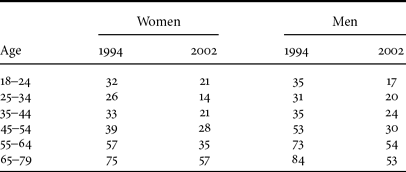
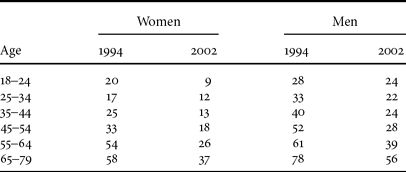
Over time, changing employment practices among mothers has tended to liberalise attitudes towards working mothers. The general normative climate is changing; popular attitudes are becoming increasingly favourable towards working mothers and daycare (Tables 4 and 5). Cultural ideas of motherhood and childhood show a remarkable shift. Between the mid 1990s and the early 2000s, traditional attitudes towards working mothers and negative views on childcare were more or less ‘phased out’. This arose due to a combination of steady liberalisation of attitudes in most age groups, and more liberal birth cohorts replacing the older more traditional ones, as indicated in Tables 4 and 5. The vast majority of younger cohorts consider employment among mothers of pre-school children the norm: the large majority do not agree that ‘it is best that women are not working when they have pre-school children’ or that ‘pre-school children suffer if their mother works’. They disagreed with these ideas in the early 1990s, but attitudes became further liberalised in the following decade. Among the older cohorts (55-plus), however, the change in attitudes on these issues is close to a paradigmatic cultural shift. Reductions in support of traditional attitudes are in the range of 20–30 percentage points (see Tables 4 and 5). One partial explanation is that these cohorts have seen their own daughters and sons engaging in these new practices, and have adjusted their own views (see Smart, Reference Smart2005).
Changing ideas of motherhood. Proportion considering that it is best that women are not working when they have pre-school children. 1994–2002 (per cent).

Source: Calculation based on ISSP Surveys on family and gender roles. Data are provided by the Norwegian Social Science Data Services (NSD).
Changing ideas of childhood. Proportion agreeing that pre-school children suffer if their mother works. 1994–2002 (per cent).

Source: Calculation based on ISSP Surveys on family and gender roles. Data are provided by the Norwegian Social Science Data Services (NSD).
Universal daycare – the normal childhood
The building up, and the eventual closing, of national childcare gaps follow national trajectories. A common denominator in the development of childcare services in the Nordic welfare states has been growth in the employment of mothers as the driving force. Mothers’ demands for employment and childcare services constitute a bundle of preferences, where the former should not be seen as an adaptation to government policies. But the Nordic welfare states’ response – a gradual expansion of high-quality services – has created a dynamic in which the changing opportunity structure is feeding back into, and further changing, the practices and ideas of parents. Yet the existing differences between childcare coverage rates in these welfare states demonstrate the continuing importance of the national context in the development of childcare services, and the complex, interactive processes of change in provision and demand.
Policy choices emerge from the identification of the problem, of the goals, and of the possible instruments (Jenson, Reference Jenson2004). The expansion of childcare services is embedded in struggles between political interests favouring different family models. In Norway, political conflict over support to the dual earner–dual carer family model versus the traditional one-income family one, following a left versus centre-right political cleavage, has been more prominent than in the other Nordic countries, visible in the country's childcare policy package (Ellingsæter, Reference Ellingsæter, Ellingsæter and Leira2006). While the dualistic Norwegian family policy model has been fairly effective in meeting parents’ needs in a particular historical period, the unnoticed paradigmatic shift in parents’ preferences in favour of childcare services is about to change all this.
Provision has an obvious place in explaining the development of childcare services, but our study has elaborated the less studied role of change in demand, as well as the interaction between the two. In Norway, change in practices and preferences among ‘mothers’ as a group has not been fully acknowledged by policy makers, particularly those belonging to the centre-right of the political spectrum. For example, the cash-for-care benefit rested on an outdated concept of mothers’ employment practices, differentiating between ‘working mothers’ and ‘stay-at-home mothers’ (Ellingsæter, Reference Ellingsæter2003). The dichotomy ignores that most mothers combine employment and motherhood in various ways; and that the mother/worker is increasingly an integrated identity. While the left's policy objectives constitute a combination paradigm – combining rationales of gender equality through women's paid work and investment in children's development – the centre-right, however, has been firmly embedded in a freedom of choice paradigm, which means that childcare provision in itself is not important. The latter ignores the fact that the demand for childcare increases not only because mothers need services in order to go out to work, but also because parents think a place in a daycare centre is a major welfare ‘good’ for their children. Daycare is not simply a way for mothers to get into employment, but is considered essential for the social development of children, including the youngest children too (Duncan and Strell, Reference Duncan and Strell2004). The quality of daycare has been an underrated element in understanding parents’ growing preferences for childcare services in Norway. Already from the mid-1960s European middle-class parents had begun to seek collective forms of childcare as an expression of their view on child development; group experience and educational focus were seen as beneficial to the child (Jenson and Sineau, Reference Jenson, Sineau, Jenson and Sineau2001).
The dynamics behind Norwegian mothers’ increasing demand for childcare clearly demonstrate the adaptive, situational nature of preferences. Cohort replacement is a main mechanism of change, transforming society through changing the ‘horizon of opportunities’. Cohorts of mothers of pre-school children change quickly, as few women are mothers of pre-school children for very long. Expansion in the number of daycare places and parents’ use of services transform cultural ideas of what is good for children. When a growing majority of children attend daycare centres, this form of care becomes increasingly attractive. In Norway, the preference for daycare centres has increased in all socioeconomic groups, significantly reducing socioeconomic differences. Universal childcare, including for the youngest children, is transforming ideas about ordinary childhood. A rather paradoxical effect is that in the end this may actually disconnect the relationship between mothers’ employment – the main driver for change – and the demand for daycare.
Acknowledgement
We wish to thank two anonymous referees for their useful suggestions.