Introduction
A widespread assumption among Christians since the Protestant Reformation has been that biblical interpretation should point the faith seeker to belief in salvation by faith in Christ. This vision of sola scriptura places much confidence in the human capacity to understand the Bible rationally and independently. Beyond this epistemological function, Christians also believe in the Bible's practical relevance for their everyday life. Whether it is the moral teachings of the apostolic letters in the New Testament or the wisdom literature in the Old Testament, the historical lessons derived from prominent biblical figures, or the call to persevere in times of persecution, many Christians hold that the Bible has answers for all situations. Translation of the Bible into local languages has been part of Christian missionaries’ conscientious efforts to enable native believers to discern such answers in their own languages. The historiography of the indigenisation of Christianity has shown why and how a vernacularised Bible met the needs of ethno-cultural communities.Footnote 1 This is particularly true for the production, distribution, and appropriation of the Chinese Union Bible, first published in 1919 and still widely used by Chinese churches today. The Union Bible was meant to enable Protestant missionaries and Chinese converts to communicate their doctrinal orthodoxy and strengthen their piety. To ordinary Chinese believers, the doctrinal and liturgical debates might be of little relevance. But such true indigeneity mattered when they fully embraced, practiced, and made the biblical teachings into their own.
What happened to Chinese churches during the turbulent period of the Maoist rule (1949–1976) when the Union Bible was banned from circulation in the public domain? When Christian leaders were silenced, church institutions were dissolved, and reading the Bible was deemed to be dangerous, how did ordinary believers use the Bible to sustain their religious commitment beyond initial conversion? How did church members construct a biblically-centred faith to counter the socialist propaganda? This article addresses these questions by investigating the centrality of the Union Bible among Chinese Seventh-day Adventist Christians in Wenzhou, Zhejiang Province from the 1950s to 1980s. In particular, it explores how Wu Guiying (吴桂英 1906?–1976), Huang Meide (黄美德1925–2010), and Chen Dengyong (陈登庸b. 1925) enmeshed the Chinese mode of divination with their daily Bible reading in order to seek biblical insights as they confronted personal and congregational crises in the Maoist era. They referred to this practice as qiuwen (求问spiritual inquiring).Footnote 2 This article argues that this indigenous mode of Bible reading sheds light on the ways in which the believers asserted and empowered their scriptural-textual authority, interpretative agency, and personal piety against the state's relentless atheistic propaganda.
Apart from declassified information on the Adventists in Wenzhou during the mid-1950s and 1960s,Footnote 3 the major sources used in this article include published Chinese and English Adventist history, ethnographic interviews, published Chinese Adventist biographies and sermons, and personal diaries of the figures investigated. The testimonies given by Adventists themselves appear to be hagiographical at first sight. Yet, this methodological problem is not sufficient reason to reject the Christian materials entirely. For one thing, the Communist state has not released all the archival materials concerning these local Adventist communities. The testimonies, personal diaries, and sermons give us valuable information about the clandestine operations of Seventh-day Adventists as well as their resistance to the state's co-optation. These details cannot be found in any other sources, and it was these very features that aroused state suspicion toward this tiny fraction of the Christian population.
This study seeks to make two contributions to the field of Chinese Christianity: First, whereas previous scholars have approached the question of how Christianity as a foreign belief system was transformed into an indigenous religion and became an integral part of local societies and cultures,Footnote 4 this article builds on their work and argues that the process of “translating” Christianity into an indigenous religion involved a unique strategy of reading the Union Bible by combining traditional Chinese popular religious rituals and a sola scriptura insistence on the biblical textual authority. This innovative strategy embraced by some Adventists reveals the varieties of theological orientations and faith practices within the broad spectrum of Chinese Christianity.
By studying the Adventist Christians, the second contribution of this article is to open a window onto how a unique mode of reading the Bible inspired members of one Chinese denomination and helped them lead a local church movement in the face of state persecutions. Much attention has been given to the history of prominent national Chinese church figures like Wang Mingdao (王明道 1900–1991), Ni Tuosheng (倪柝声Watchman Nee 1903–1972), Wu Yaozhong (吴耀宗Y. T. Wu 1893–1979) and Ding Guangxun (丁光训K. T. Ting 1915–2012). All shaped the development of church-state relations since the Maoist era.Footnote 5 These urban, educated Christian elites appropriated the Bible to engage with socialist politics and socioeconomic changes. While Wang Mingdao and Ni Tousheng drew on the Scriptures to oppose the Communist state's intervention in the spiritual affairs of the church, Wu Yaozhong and Ding Guangxun selected biblical passages to highlight the ideological commonalities between socialism and Christianity. Yet, Chinese Christianity also entails the story of grassroots believers who did not attract nationwide attention and who often lived out the faith in particular temporal and spatial contexts. Though less known nationally, they still exercised much influence on the local life of the church, and thus deserve equal scholarly attention. The article invites a critical reflection on the merits of studying Chinese church sources and minor Christian figures to broaden our understanding of Chinese Christian life.
Beginning with an overview of the Seventh-day Adventist movement in Wenzhou, this article describes the life histories of Wu Guiying, Huang Meide, and Chen Dengyong, all three members of the Chen family, and how the practice of reading the Bible through qiuwen led them to disseminate a message which they believed to be biblically grounded and relevant to themselves and to the broader Adventist churches in Ruian in Wenzhou.Footnote 6 The next section gives examples of qiuwen to illustrate that when Adventist clergymen were jailed and forced to abandon their ministry in the 1960s, the practice of qiuwen helped the Chen family to construct a space for the survival of their ideas and faith practices in a hostile society. Subsequently, I discuss the qiuwen practice from three perspectives, arguing that qiuwen is better understood as an indigenous Christian practice with traditional Chinese religious seasonings and Adventist flavours.
An Overview of the Seventh-day Adventist Movement in Wenzhou
Seventh-day Adventism was a homegrown Protestant group that originated in the Millerite movement in the mid-nineteenth century United States of America.Footnote 7 The group was institutionalised in 1863 as the “Seventh-day Adventist Church.” The Adventists share many basic Christian tenets with other Christian groups, but the denominational title signifies two distinct theological claims that the group particularly embraces. Eschatologically, the group's readings of the Bible lead them to believe in the imminent return of Jesus Christ (Second Advent). Ecclesiastically, they understand themselves as a “remnant” people whose church identity is presented in their keeping of the Ten Commandments in full, with an emphasis on the observance of the Sabbath on the seventh-day (Saturday) instead of the first-day (Sunday) of the week. A key figure who gave shape to the denomination's doctrinal development was Ellen G. White.Footnote 8 She was honoured by the Adventists as having the “spirit of prophecy”, a designation that indicated the denomination's belief in her special gift of receiving direct revelation from God.Footnote 9 Finally, combining the insights drawn from the Bible (mainly the health rules in Leviticus and Deuteronomy), mid-nineteenth-century's temperance movement, and modern health sciences, the church encourages the members to avoid tobacco and alcohol, and promotes vegetarianism as the best diet.Footnote 10
Seventh-day Adventism entered China in 1902. Though latecomers to the Chinese mission, the Adventists quickly established themselves by building schools, hospitals and a printing house,Footnote 11 also by cultivating relationships with the Chinese political elites.Footnote 12 The modern institutions combined with the social capital accumulated with people of power helped the Adventists gain a footing in China.Footnote 13 In 1912, two literature evangelists brought Adventism to Wenzhou. Early Adventist believers started meeting in houses there on Saturdays. Professional clergy then arrived to help develop the group of believers. Geographical proximity to Shanghai made Wenzhou one of Adventist's most effective evangelistic outposts. More mission resources were allocated there, and with the establishment of the mission station South Chekiang Mission (浙南区会 Zhenan Quhui) in today's Nantang (南塘 South Pond), Adventism expanded to become one of the six Christian denominations flourishing in mid-twentieth century Wenzhou.Footnote 14 By 1949, the mission station had 80 churches and 5,055 members, constituting a quarter of the denomination's national membership.Footnote 15
As with other Chinese Christians, the Adventists struggled to maintain their religious life in the political turmoil of the 1950s through 1970s. Adventists joined the Three-Self Patriotic Movement (TSPM hereafter), a state-supported Protestant institution to coopt the churches. But when the tide turned against Christianity during the Korean War (1950–1953), Adventist national leaders were denounced and expelled from the church.Footnote 16 When American mission funds stopped arriving after the outbreak of the Korean War in 1950, local Wenzhou Adventist leaders strove to maintain the ministry by dividing southern Zhejiang Province into seven parts, each one headed by a young worker to take charge of all evangelistic and pastoral matters. In 1958, the TSPM implemented the government policy of “unification of worship.” Local worship that was centralised in only a few churches was eventually shut down. As public church activities were vanishing in Wenzhou, in May 1959 the municipal authorities announced that their region was the country's first “region without religion” (无宗教区 wuzongjiao qu). Adventists joined with other Christians to meet clandestinely during the Cultural Revolution (1966–1976), and they were part of the Christian revival in the reform era.
Mother, Daughter-in-Law, and SonFootnote 17
When the Japanese army invaded Shanghai in 1937, the American Adventist missionaries decided to stay in the city where the mission had established the China Division (Zhonghua zonghui中华总会), the denomination's headquarters in China. Among the church staff was an Adventist nurse, Wu Guiying and her teenage son Chen Dengyong. Rather than staying in Shanghai as the missionaries had suggested to the staff, Wu fled the city with her son by taking the last ship out on August 7.Footnote 18 The Japanese troops launched an aerial bombing against the downtown on August 14, 1937, a day known as “Bloody Saturday”, causing serious casualties including three deaths in the Adventist mission headquarters. Family members related Wu's decision to her reading of the Bible, saying that what drove her to act decisively at that moment were three verses of the Bible that she read through the practice of qiuwen. Wu was convinced that God had urged her to leave Shanghai. Footnote 19 In the coming decades, this mode of engaging with the Bible would become the central tool for Wu to navigate many challenges and uncertainties.
Wu Guiying came from an Adventist family and was among the few women who graduated from the Adventist junior high school in Wenzhou. Given her outstanding school performances, the church recommended her to be trained in the Adventist Shanghai Sanitarium. As a young widow and a single mother, Wu excelled and became a professional midwife at the sanitarium.Footnote 20
Wu's daughter-in-law, Huang Meide was a daughter of Huang Rongchu (黄荣初1897?–1971), an Adventist art designer who worked at the church-run Signs of the Times Publishing House (时兆报馆 Shizhao baoguan), a modern and commercially viable Christian publishers in Shanghai. After his wife was tragically killed during the Japanese bombing of Shanghai in August 1937, Huang married Wu Guiying, and the union of the Huang-Wu families brought much comfort to Wu's son Chen Dengyong and Huang's daughter Huang Meide. Having spent their childhoods together, they eventually got married. Huang Meide followed in Wu Guiying's footsteps to become a midwife. On the other hand, Chen Dengyong received training as an accountant at the Adventist-run China Training Institute in the wartime capital of Chongqing. After working briefly as a school teacher, Chen was appointed by the American missionaries as a secretary-treasurer of the Adventist mission in southwestern China. Like many Catholic and Protestant church leaders in the 1950s, Chen was denounced during the accusation campaign, a mobilization tactic designed to integrate the Protestant communities into the socialist order and sever their ties with foreigners. Chen was removed from the church office. He spent a short time doing various jobs in Kunming, and with his mother's encouragement, the couple finally returned to join their aging parents in Wenzhou in 1954.
The year 1955 was a relatively calm period of church-state relations in China. The Maoist state stopped purging those church leaders critical of the TSPM. The Adventists in Shanghai reorganised the China Division under the TSPM, and Southern Zhejiang Province was one of its surviving mission fields. With Huang Meide as his assistant and Wu Guiying as his spiritual mentor, Chen Dengyong was responsible for leading the Chengguan Adventist Church (城关教会) of Ruian. A subdivision of the Adventist institution, Ruian was also one of the regions in which both Catholics and Protestants continued to worship actively during the Great Leap Forward (1952–1962). Yet it was one of the few; a government record of 1963 indicated a fifty percent drop in the number of self-identified Catholics and Protestants from 1957 to 1961,Footnote 21 a result of the numerous anti-Christian campaigns in the local area. Despite the suppression, Christians continued to worship. In one report, the people's collective complained that the entire production brigade in Qiaoyang of Huling (湖岭桥垟) worshipped on Sunday under the leadership of non-Adventist pastor Pan Yongfu.Footnote 22 Such Christian resilience led the local authorities to work even harder to suppress worship gatherings. In the case of the Chens, the first blow to their ministry appeared when Chen Dengyong refused to participate in any state-assigned collective economic activities. In March 1961, he was arrested and sentenced to a labour camp for fifteen years of “re-education.” Though devastated by this turn of events, Huang Meide did not give up the ministry. She filled the local church leadership vacuum and insisted on holding clandestine worship at her home for five years. In June 1966, she was arrested and given a ten-year term of hard labour. The couple were released in late 1979.
The Chens rebuilt Seventh-day Adventism in Zhejiang by raising a movement that came to be known as the “Wilderness” (旷野派kuangye pai). Refusing to register through the TSPM, the Wilderness was part of China's “house church” movement that sought to lead a church life independent of state intervention. The Wilderness, however, was different from the noncompliant house churches in one respect: based on their ecclesiastical self-understanding, they tried, in vain, to register in the denomination's name “Seventh-day Adventist Church”. Though such advocacy eventually alienated some of their followers, the Wilderness unified many Adventists in and outside Zhejiang Province who looked for an alternative way of practicing Adventism outside the TSPM's parameters.
Qiuwen: Seeking Divine Guidance from the Union Bible
The practice of qiuwen was intended for extracting divine guidance from the Union Bible. It remained an integral part of Wu Guiying's personal spirituality and became a family practice when Wu shared this skill with Chen Dengyong and Huang Meide. On many occasions, Wu derived the divine message from qiuwen and her son would deliver the message to Adventists in Ruian. After Chen was arrested in 1961, Huang Meide used this practice to seek inspiration from the Bible to sustain her own faith and support clandestine church activities. Though she too eventually lost her freedom, the previous biblical messages derived by Wu and Huang from qiuwen had a continuous influence on the spiritual life of Ruian Adventists. Congregants who visited Wu Guiying would share their worries and questions with her in Wenzhou. Upon hearing them, Wu would consult God with qiuwen on their behalf, and offer congregants a couple of Bible verses. Once back in Ruian, the congregants would circulate these Bible passages among other Adventists.
Qiuwen emphasized biblical textuality, piety, discernment, and innate hermeneutics. Importantly, believers considered it to be different from the conventional fortune telling and divination. The Chen family recalled that Wu Guiying often practiced qiuwen alone by placing the Union Bible on the table in a quiet room. After closing her eyes and expressing her worries, desires, and petitions to God in prayers, she opened the Bible randomly with her eyes closed. She then put her fingers on the pages, opened her eyes, and looked at the specific verses that her fingers rested upon. Sometimes she practiced qiuwen repeatedly in order to seek richer guidance, but she nonetheless took note of the Bible verses on each try. Usually she followed the same procedure twelve times to collect twelve sets of verses, for she understood the number “twelve” as the “perfect” numerical value in the Bible. Sometimes she even included sentences before and after the indicated verses. The purpose was to seek a clearer and exhaustive answer from God.Footnote 23 She would carefully write down the chosen biblical passages for intense study, reflection, and meditation in order to discern God's will over a particular matter.
Examples of Biblical Messages Derived from Qiuwen
Within the Chinese context of the mid-1950s to mid-1960s, the biblical messages that the Chen family spread among Adventists through qiuwen had a strong eschatological outlook, and highlighted the imminent return of Jesus Christ and the demise of the Communist regime as the two key themes. Such messages came to Chen Dengyong and Huang Meide not long after they began ministering the Chengguan Adventist Church in 1955. During the first year of their ministry, they referred to Joshua 3: 1-17 which focused on the Israelites crossing the River of Jordan at the end of three days, a key moment of God's chosen people moving a step closer to the Promised Land. Chen and Huang predicted that in three years (i.e., 1958), Jesus Christ would return from the heavens and bring his followers to Canaan, the Promised Land. The other verses that reinforced this belief of the end of the world were taken from the Book of Joel. The couple claimed that the Adventists had to sanctify themselves (Joel 2: 16), and their church leaders were to lament (Joel 1: 13) because God was about to punish the Communist regime, just as God had dealt with the plundering locusts in Joel 2:20.Footnote 24
In 1956, the Chens identified a passage from 1 Samuel: “Thus shall you say to the inhabitants of Jabesh-gilead: ‘Tomorrow, by the time the sun is hot, you shall have deliverance’” (11: 9). The Union Bible translated this passage as “Mingri taiyang jinwu de shihou, nimen bi de jiejiu 明日太阳近午的时候, 你们必得解救.” Based on the Adventist “a day for a year” principle of interpreting the biblical times, the Chens read this passage through a Chinese cultural lens in which they rendered “Mingri taiyang jinwu” as the summer noontime of the following year (i.e., 1957), “wu” as the Chinese lunar summer festival Duanwu jie (端午节 Dragon Boat Festival), and “nimen bi de jiejiu” as symbolizing “a regime change”. The subtext of this biblical interpretation was deeply subversive, as the Chens urged their followers to put God above secular authority and subject the latter to the spiritual judgement of the divine. In Ruian, the Adventists followed the Chens’ interpretation in light of the “Adar” oracle in chapter nine of the Book of Esther. They believed in the Chens’ proclamation that God's deliverance would come soon, just as He had liberated the Jews from a vicious plot of their enemy Haman in the Jewish month of Adar.Footnote 25
It was through qiuwen that the Union Bible helped the Adventists to make sense of the chaos and violence that engulfed their church. As noted earlier, the Great Leap Forward resulted the “no religion” period in Wenzhou. In December 1958, the government disbanded the Chengguan Adventist Church by confiscating the church premises and turning it into a leather belt factory.Footnote 26 Evicted from the church residence, the Chens strove to continue their ministry in a Buddhist temple for a few months under tremendous pressure from their neighbours and the local comrades. All thought that they refused to join the economic production because they were lazy, and they deceived their church members to support their living. Chen and Huang were eventually imprisoned in 1961 and 1966 respectively.
In the early 1970s, many Adventists in Wenzhou continued to meet and resumed regular house gatherings in secret, but the Ruian Adventists did not do so. In 1973 when a young Adventist evangelist from Wenzhou visited a group of laypeople in Ruian, he heard their concerns:
Now the church is in a time of anguish. God's servant Mr. Chen Dengyong is in captivity and has not returned. The entire nation has apostatised. Why on earth would we gather? We are steeped in sin. This is why God has kindled his wrath upon us.Footnote 27
Upon investigation, the young evangelist realised that the Ruian Adventists had built their faith primarily on the divine guidance of Wu Guiying's qiuwen-reading of the Bible. By referring to the biblical passages through qiuwen, Wu became convinced that the imprisonment of her son and daughter-in-law further reinforced their status as God's faithful messengers as opposed to those “patriotic” church leaders. Like the Jews in the Babylonian captivity, the Ruian Adventists were taught to be contrite, repent, and wait for divine mercy.
Despite all the confidence that the Ruian Adventists placed in qiuwen, this mode of approaching the Union Bible presented difficulties to other Adventists. The most evident example was the prediction about the collapse of the Maoist regime and the return of Christ in 1958 mentioned above. Soon after this prophecy failed, some Ruian Adventists became disillusioned with qiuwen-based warnings. As the Chens struggled to use qiuwen for answers to their followers’ everyday challenges, it became clear to them that qiuwen-informed answers did not always work. One example concerned an Adventist woman. One day, she felt that her abdomen was swelling. She chose to consult Wu Guiying instead of going to the doctor. Wu told the woman that she was pregnant. Wu's judgement seemed to be based on her qiuwen but it might also be based on her midwifery knowledge. Time passed and the woman remained sick. Wu practiced qiuwen for her again and found a biblical verse: “This illness does not lead to death” (John 11: 4). Later the woman went to see the doctor and was told that in fact she had a benign tumor. Another failed incident concerned a boy. A widow brought her sick son to Huang Meide in the hope that Huang possessed the divine power to heal him. Upon practicing qiuwen, Huang read John 11: 4 where Jesus commented on the death of Lazarus, “This illness does not lead to death; rather it is for God's glory, so that the Son of God may be glorified through it.” Believing that the boy's health condition was not life-threatening, Huang let him rest on her own bed. A few days later, the boy died under her care. The text of John 11: 4 once again came up in qiuwen, prompting Huang to think that the boy would resurrect like Lazarus in the Johannite story. And when God led her to the biblical account of the prophet Elijah reviving the Zaraphah widow's son in 1 Kings 17: 17-23, Huang did the same to the dead boy. For a few days, she prayed and prayed, until the neighbours complained about the smell of the decaying corpse. An Adventist elder and deacon stepped in and buried the dead boy on a hill.Footnote 28 The incidents mentioned above convinced some Adventists that what Wu and Huang were practicing with the Bible not only did not prove the efficacy of God, it actually undermined their belief in God and in the Bible. These opponents attacked qiuwen as “witchcraft” that Wu and Huang used to deceive and intimidate.Footnote 29
Despite these setbacks, the practice of qiuwen served as a powerful tool for the Chen family to stay vigilant in their ministry. Wu Guiying comforted Huang Meide with qiuwen-biblical passages after Chen Dengyong was arrested in 1960. With this mode of Bible-reading, Huang held on to her faith and laboured to manage the Adventist meetings for six more years. A number of Huang Meide's diary entries in 1965 indicated that she had received letters along with specific biblical passages from Wu Guiying. These passages strengthened Huang's resolve to continue the church services at home despite countless episodes of harassments by the local authorities.Footnote 30 As the difficulties of her ministry grew, she increasingly turned to qiuwen for answers. Huang received a qiuwen passage on November 11, 1964, notifying her that “You shall know that your tent is safe, you shall inspect your flock and miss nothing” (Job 5: 24). That biblical verse assured her of God's protection of the church and of her faithfulness to pastoral duty. On the next Sabbath (November 16), she daringly held worship services at home. The police raided her home, captured her and another Adventist woman, and only released them after beating them up. Returning home wounded and bleeding, Huang immediately turned to the Bible, and qiuwen took her to Jeremiah 44, which described the waste and desolation of Jerusalem. To Huang, the Bible confirmed what her church gathering had just experienced.Footnote 31
Armed with qiuwen, Huang Meide was ready to take on the daunting task of rebuilding the Seventh-day Adventist ministry after she was freed from the labour camp. Huang's diary showed that upon her release in 1979, she practiced qiuwen frequently. While she did not indicate what hermeneutical principle guided her reading of the qiuwen texts nor how those texts informed her action, she always rejoiced that on each occasion of qiuwen, the Lord gave her “invaluable” and “nice” indications. These passages gave her “comfort and peace” and inner strength.Footnote 32 In 1981, after she and Chen Dengyong were exonerated, Huang retrieved her mother's two qiuwen notebooks in the old family house. “How faithful mother was! She has drunk the cup of bitterness. We [she and Chen Dengyong] should keep on fighting for our ministry”, Huang mentioned in her diary. For the rest of the day, she studied those qiuwen records closely.Footnote 33 Like the Bible, the life and impact of the qiuwen-derived biblical passages did not stop at their immediate inquirers but continued to shape other readers.
Whereas in the 1950s the Chens isolated the eschatological warnings from the Bible with qiuwen, in the1980s, qiuwen led Huang Meide to confront new challenges facing the Adventist churches. These challenges included reclaiming the former mission properties from the district authorities, seeking divine directions for rebuilding the church,Footnote 34 providing pastoral care to the believers, and protecting her husband from the government's harassment.Footnote 35 Numerous entries in her diary suggest that she used qiuwen to deal with down to earth matters such as reclaiming the old church premises.Footnote 36 On other occasions, she practiced qiuwen for the people for whom she cared. She performed it for a female Adventist named Aizhi (爱芝), a close friend of Huang with whom Huang often traveled to visit rural churches.Footnote 37 Huang also conducted qiuwen for a male Adventist named Renqian (仁谦).Footnote 38 When Chen Dengyong traveled around Shanghai and Tianjin to seek ordination from three separate pastors, Huang turned to the practice to seek guidance for him.Footnote 39 When the Wenzhou municipal religious affairs bureau ordered Chen Dengyong to attend a week-long political education class in 1987, Huang worried about his safety and used qiuwen to pray for him on the day of the class.Footnote 40
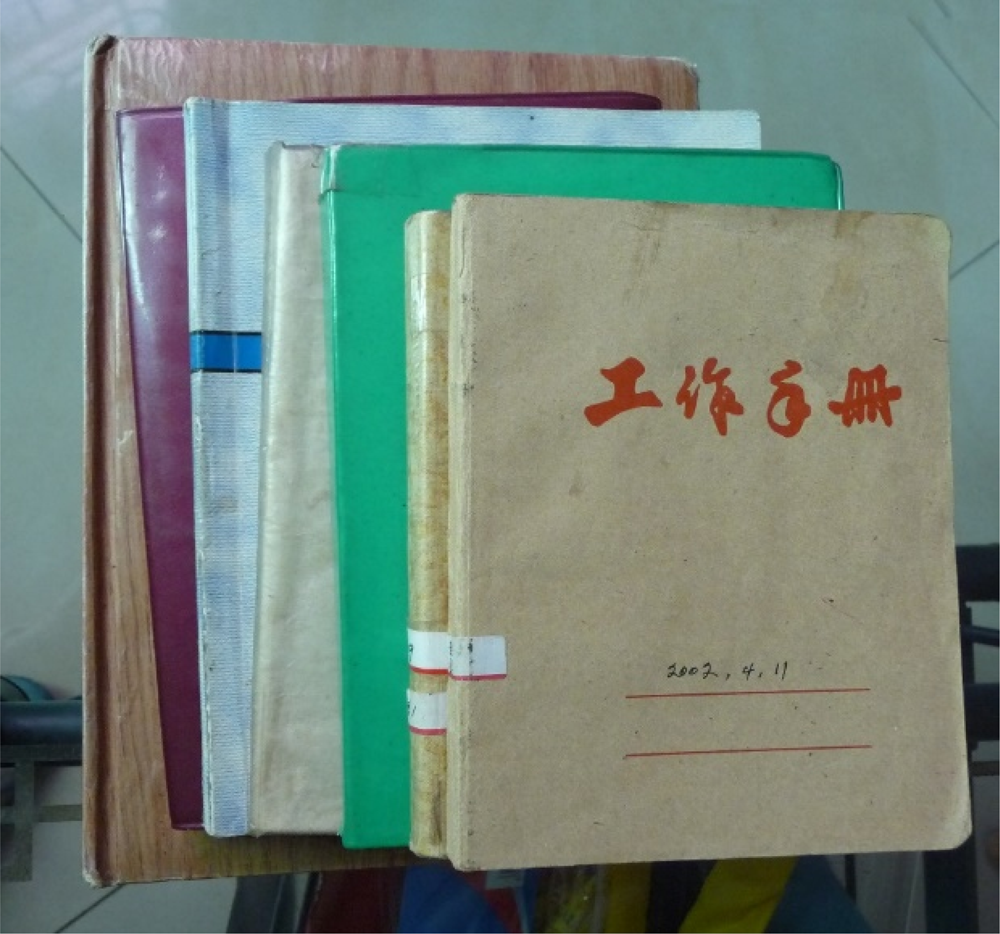
Huang Meide practiced qiuwen throughout her life. Like her mother-in-law, she carefully copied down the qiuwen biblical passages without adding notes and commentaries (Figure 1). These records are in red, blue, and dark colour, and one can imagine that the red ones might be those that inspired her the most. According to Chen Dengyong, a gift which Huang was happy to offer to those she cared about was biblical passages.Footnote 41 The qiuwen passages thus found their way to Huang's followers without having them to practice qiuwen themselves.
Huang Meide's notebooks for recording her qiuwen bible passages.

Qiuwen as a Chinese Christian Practice with Adventist Denominational Components
The Western scholarly conceptualisation of bibliomancy, in which a biblical verse is randomly selected for divination, resonates with the Adventist practice of qiwen.Footnote 42 The Chinese mode of bibliomancy, as embraced by Wu and Huang in the form of qiuwen, appears to be what Theodore Ziolkowski calls the “epiphany of the book” where the inquirer gains “moments of insight” from the biblical passages.Footnote 43 Unlike daily Bible study,Footnote 44qiuwen is a strategy of turning to specific sections in the Bible for particular answers. With respect to the deep local religious culture in Zhejiang Province, qiuwen would have been widely perceived as a popular religious practice in a literate society.Footnote 45 In many ways, qiuwen has much in common with the Chinese practice of divination. The worshippers approach the Chinese deities through a complex system, using devices like wooden or bamboo divination sticks, and consulting ancient texts like The Book of Changes (易经 Yi Jing) and various kinds of folklore.Footnote 46 The special care that Wu and Huang gave to qiuwen-retrieved biblical passages reverberates with Chinese popular religious specialists who transmit their religious knowledge by circulating the precious volumes (宝卷 baojuan) and conducting spirit-writing on the sand.Footnote 47 Understood from this perspective, the process of qiuwen is about considering the Union Bible to be a divine object for spiritual consultation.
However, given the ways in which the Chen family used the Union Bible, the conventional category of religious bibliomancy cannot fully explain the appeal of qiuwen. For Chinese Adventists who firmly believe in the absolute authority of the Bible, the Chens understood the qiuwen practice as in line with their biblical and denominational heritages. Strongly advocating the biblical roots of qiuwen, Chen Dengyong theorised the act of qiuwen as building an intimate relationship with God through the reading of the Bible. This mode of reading was perceived as being different from seeking pragmatic advice from spirit mediums.Footnote 48 Chen Dengyong found the Chinese term qiuwen in 1 Chronicles 10:13; Joshua 9:14; 1 Samuel 23:2, 4; 1 Samuel 14:41, and Isaiah 30:2, and drew on such biblical evidences to legitimate qiuwen as part of normal Christian life. In his interpretation, the meaning of qiuwen ranged from seeking guidance through consulting a spirit medium, and asking direction from God, to praying for the right answers in times of crisis. He declared that Christians should use qiuwen to seek the divine will because God promised to answer Christians’ prayers (Mark 11:24). Like the ancient temple priest using the Urim and Thummim to make statements, Chen asserted that qiuwen was the modern versions of these ancient religious devices in the Old Testaments.Footnote 49 By consulting the Bible, he maintained, Adventists should “receive the Word of the Lord” and “understand the will of God”.Footnote 50 The aim of qiuwen was understood to be part of one's spiritual responsibility to ask “the Holy Spirit to teach you everything, and remind you of” what Jesus had “said to you” (John 14:26).Footnote 51
Following the same reasoning of many missionaries and evangelical Christians that the Bible is inerrant and infallible, for Wu and Huang the absolute textual authority of the Bible served as a foundation for the exercise of qiuwen. These two practitioners took the literal meaning of the biblical passages seriously and relied on the Bible as a master script for practical consultations. Both Wu and Huang might take those biblical passages collected through qiuwen out of the immediate literal contexts, but they rearranged the texts as a new repertoire of religious knowledge, and reinterpreted them to yield new insights for contemporary challenges. By isolating the qiuwen passages from the entire Bible, they created a bible within the Bible, placing the selected texts over the rest of the Bible for intense scrutiny. The practitioners thus treated these specific verses with great care because they were convinced that these biblical remarks contained God's peculiar revelatory responses to a pressing situation.
Finally, the denominational aspect of qiuwen should be understood from the Adventist belief in special revelation and eschatology. Within Seventh-day Adventism, qiuwen pointed the Chens to the immediate return of Christ and to the end of a repressive regime. Besides, the textual authority of the Bible does not exclude the possibility of lived and direct revelation. The denomination revered Ellen G. White as its prophetess and believed that White had channelled a truthful message to humanity through the special revelation she received from God. It would seem that to Wu and Huang qiuwen held a similar conviction in their search for specific revelations. If God had raised an American woman to receive revelatory messages in the late nineteenth century, there would have been no reason for the Chens to disbelieve the gift of qiuwen to empower, enrich, and enlighten the Chinese people in Maoist China.
Conclusion
From the time of the arrival of Robert Morrison (1782–1834), the first Protestant missionary to China, Chinese Christians were taught to experience the power of the Bible by studying it diligently and systematically. Whether it was in personal devotion, family worship, fellowship meeting or congregational gathering, Bible study was a core part of the Christian life. To make sure that the “truth” in the Bible was most fully conveyed to believers, the missionaries paid great attention to the proper translation of the biblical words. The Chinese Union Bible, a result of an ecumenical collaboration, confirmed the longstanding Christian belief that God could speak directly to his Chinese followers in a faithfully-translated sacred text. Despite the missionaries’ effort to overcome the doctrinal, denominational, and liturgical differences and produce a unified version of the Bible, the outcomes continued to surprise the initial translators. In practice, the Union Bible was never thought to be read independent from any church authority. From the early church fathers to modern missionaries, the churches produced numerous extra-biblical commentaries to ensure that the congregants read the Bible appropriately. Given the diverse biblical genres and themes, different denominational churches guided their congregants to properly approach the Bible with the help of all sorts of Christian literature, public sermons, and group study. Faith in the Christian God, therefore, can be rationally obtained by ways of reading, studying and meditating on the Bible alongside other interpretive genres.
The qiuwen mode of reading the Union Bible as practiced by Wu and Huang and endorsed by Chen challenges us to rethink the use of the Bible by Chinese believers. Because Christianity instilled some elements of dissent among them, their beliefs and experiences were bound together in a set of spiritual, family, and peer relationships. Their Christian upbringing taught them to value piety over politics, and to avoid internalising the culture of intrigue, class struggle, and betrayal. As insignificant as it seemed, their struggles exhibited different modes of survival commonly found in the Christian communities during some of the darkest moments in modern China. Cherishing the ultimate authority of the Union Bible, they also believed that there needed to be a special way to approach the sacred text for particular situations in which they found themselves. While normative approaches such as reading, studying, and memorising were important, the Bible had to speak unequivocally to address urgent circumstances, as time was short and one had to act to deal with crises as they arouse. The qiuwen-based method of Bible reading, which took the believers to direct revelation from God, met this need.
In many ways, the qiuwen mode of engaging with the Bible was indeed unconventional. It was derivative, contextual, and functionalistic, with a clear purpose of seeking practical and specific information. But the reader was also faith-inquirer who sought to extract spiritual meaning from the written texts, apply it to everyday life, use it as a reference point for making sense of a particular situation, and above all, motivate oneself to be faithful to God.Footnote 52 Historical urgency and contingency had much to do with the manifestations of qiuwen practice. When organised religions were suspended and any sacred literature was banned in public, the Chen family turned to the Bible through qiuwen in order to overcome many moments of crisis which faced them and to develop effective strategies to lead their church during the Maoist period. At that time, reading any type of religious literature was itself a highly political act, and the Adventists engaged in this dangerous activity because of their faith in the efficacious power of the Bible. The practice of qiuwen is reminiscent of reading and studying the Bible, teaching the biblical message to family members, or circulating the biblical messages (sometime through hand-copied form) in secret during the most suppressed moments of Maoist era. For spiritual strength and practical divine guidance, this unique mode of reading would appear to be of little significance in the larger Chinese church history. Yet, through lesser known bible-reading agents such as the Chens, who played a predominant role in sustaining the Adventist movement in Ruian, we learn that this mode of reading the Bible gave much hope and comfort to their humble followers.
The longstanding Adventist denominational openness to special revelation also played a key part in shaping the widespread acceptance of qiuwen as a legitimate strategy for spiritual formation. Undeniably an indigenous Christian practice, qiuwen pointed to the Chinese Adventists’ deep faith in the spiritual authority of the Union Bible and the “malleability” of Christianity.Footnote 53 Because no Christian agency is ever static, a standardised translation of the Bible does not determine how Christians live. Our discussion of qiuwen has revealed the mystery and openness of the Union Bible to the Wenzhou Adventists in Maoist China. The Adventist example urges us to re-conceptualise an indigenous way of treating the Bible in unique temporal and spatial settings. Instead of dismissing practices like qiuwen as a form of religious syncretism, it is important to re-evaluate it as a distinct mode of reading that inspired and benefited the faithful in their resistance to socialist propaganda in China.