INTRODUCTION
Access to renal replacement therapy (RRT) is paramount for a subset of patients in renal failure. While routinely available in developed countries, access to conventional RRT platforms may be compromised following natural disasters, such as hurricanes or earthquakes. Reference Erek, Sever and Serdengecti1-Reference Murakami, Siktel and Lucido9 Large scale disasters may be associated with numerous cases of acute kidney injury (AKI) due to crush injury. Forty-two percent of patients with AKI following the 1999 Marmara earthquake in Turkey had hyperkalemia requiring dialysis. Reference Erek, Sever and Serdengecti1 Following the 2008 Wenchuan earthquake in China, 8% of victims admitted to the hospital experienced crush syndrome; 16% of crush syndrome victims suffered hyperkalemia, and 22% required RRT. Reference He, Wang and Li6 Following the 2010 Haiti earthquake, 70% of patients with AKI requiring hemodialysis suffered crush injury; the remainder were deemed to have suffered from undiagnosed chronic kidney disease. Reference Vanholder, Borniche and Claus7 Access to RRT may be limited due to overwhelmed or compromised facilities, as well as damaged infrastructure, including roads and transportation systems. Following 2005 Hurricane Katrina in the United States, 44% of patients on chronic hemodialysis missed at least 1 treatment. Seventeen percent of patients missed more than 3 hemodialysis sessions; this subgroup of patients had higher odds of hospitalization when compared with those who did not miss their hemodialysis sessions. Reference Anderson, Cohen and Kutner2 In the aftermath of Hurricane Sandy in 2012, 26% of patients missed a median of 2 hemodialysis treatments, Reference Murakami, Siktel and Lucido9 and functioning hemodialysis units were overwhelmed by the inflow of patients requiring RRT. Reference Lin, Pierce, Roblin and Arquilla8 Earthquakes have been associated with comparable deleterious effects on accessing RRT platforms. Reference Portilla, Shaffer and Okusa4,Reference Bonomini, Stuard and Dal Canton5,Reference Vanholder, Borniche and Claus7 While there are no peer-reviewed publications, press reports have described serious challenges to providing hemodialysis following the most recent 2017 Hurricanes Irma and Maria in Puerto Rico. Reference Hill10
Developing RRT platforms that can be easily used following natural disasters is a humanitarian endeavor that will benefit patients with both acute and chronic renal failure.
Similarly, AKI is a frequently described complication of combat injury, and RRT capabilities are often overwhelmed or unavailable in war zones. While severe AKI is a relatively rare event among combat casualties, with incidence ranging from 1% to 5%, mortality rates as high as 65% have been reported. Reference Stewart, Tilley and Cotant11-Reference Stewart, Sosnov, Howard and Chung15 The survival rate in this population would be much lower without access to RRT. In addition to providing care to wounded warriors, medical military personnel may be involved with civilian care. Following the 2010 Haiti earthquake, 4 of the 19 patients referred to the Renal Disaster Relief Task Force were transferred to the US Naval Ship Comfort for continued care. Reference Vanholder, Gibney, Luyckx and Sever16 While venovenous hemofiltration has been achieved with blood pumps, those early improvised renal replacement therapies (ImpRRT) do not provide sufficient safety features. Reference Rifai, Murad and Sekkarie17 Efforts to develop RRT capabilities compatible with the austere nature of war theaters are therefore critical to improving patient outcomes.
Our group has developed an extracorporeal circuit that has the potential to satisfy the demands of austere environments. We hypothesized that our ImpRRT system, using improvised replacement fluids (made of commercially available isotonic crystalloids and electrolyte stock solutions), would achieve comparable clearance to a standard continuous renal replacement therapy (CRRT) platform, using commercially available replacement fluids, in a porcine model of AKI.
METHODS
This study was approved by the Institutional Animal Care and Use Committee at David Grant USAF Medical Center, Travis Air Force Base, CA. All animal care and use were in compliance with the Guide for the Care and Use of Laboratory Animals in a facility accredited by AAALAC International.
Animal Preparation
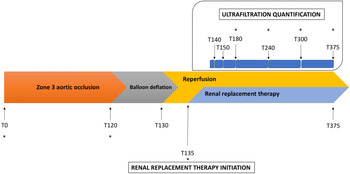
An overview of the experiment is provided in Figure 1. Twelve Yorkshire-cross pigs (Sus scrofa), weighing 73.7 (69.5–74.6) kg, were acclimated for at least 10 days in conventional housing. After an 8- to 12-hour fast with free access to water, they were anesthetized with an intramuscular injection of 6.6 mg/kg tiletamine/zolazepam followed by isoflurane mask induction. After endotracheal intubation, animals were maintained under anesthesia with isoflurane mixed in 100% oxygen. Mechanical ventilation with tidal volumes of 6–8 mL/kg and positive end-expiratory pressure of 4 cmH2O was regulated to maintain end-tidal CO2 between 35 and 45 mmHg. Body temperature was maintained between 35 and 37°C using warmers. Intravenous 0.9% saline was administered at 5 mL/kg/hr throughout the experiment.
Experimental Overview.

A 13.5 Fr 20 cm Niagara® temporary dialysis catheter (Bard Access Systems, Salt Lake City, UT) was introduced into the right external jugular vein, and bilateral nephrectomies were performed. The urinary bladder was emptied. Animals were given an intravenous bolus of heparin (100 IU/kg) followed by an infusion titrated to maintain their activated clotting time at least double baseline value or above 200 seconds, whichever was greater. A balloon-tipped catheter was inserted in the abdominal aorta via a 12Fr femoral arterial sheath. The aortic balloon was inflated for 2 hours immediately above the iliac bifurcation. Animals were then randomized to either CRRT (NxStage System One®, NxStage Medical, Lawrence, MA) or ImpRRT.
Renal Replacement Therapy
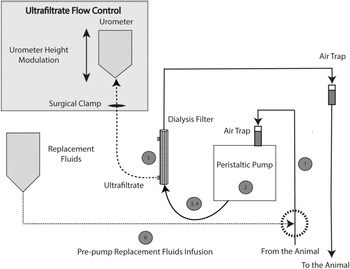
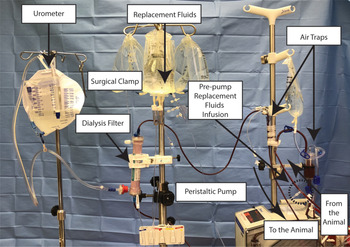
At the end of the 2-hour occlusion period, the aortic balloon was deflated over 10 minutes and animals received 4 hours of RRT. In the ImpRRT group, the arterial line of the dialysis catheter (from the patient to the circuit) was connected to a Belmont Rapid Infuser® (Belmont Instrument Corporation, Billerica, MA), which was then connected to a dialysis filter (Revaclear 300, Baxter, IL), and subsequently to the venous line of the dialysis catheter (from the circuit to the patient). The Belmont Rapid Infuser® was used because it offers a peristaltic pump with precisely controlled flow. In addition, it has a built-in warmer to reduce iatrogenic hypothermia. The ultrafiltrate was collected from the dialysis filter into a urometer and quantified (Figures 2 and 3). Improvised replacement fluid solutions were custom-made with Food and Drug Administration (FDA)-approved stock solutions (0.45% NaCl, 3% NaCl, 10% Ca Gluconate, 50% MgSO4, 8.4% NaHCO3, 50% dextrose; the ratio of each component is presented in Table 1) and infused into the system pre-pump (see Figures 2, 3). In the CRRT group, we used a commercially available circuit (NxStage CAR 505 circuits, which include a PUREMA™ dialysis filter) designed for the CRRT platform (NxStage Medical, Lawrence, MA), along with commercially available replacement fluids (NxStage PureFlow RFP 402, NxStage Medical, Lawrence, MA) (Table 2). For both groups, we aimed to achieve an ultrafiltration rate of 25 mL/kg/hr to simulate common clinical scenarios, as recommended by the KDIGO guidelines. Reference Kellum, Lameire and Aspelin18 For both groups, blood flow through the circuit was set at 250 mL/min. For the CRRT group, this was achieved by dialing the prescription in the machine. In the ImpRRT group, the height of the urometer was changed manually to control the pressure across the membrane of the dialyzer. Elevation of the bag was associated with a reduction in ultrafiltration, and lowering was associated with an increased rate of ultrafiltrate production (see Figure 2). Other methods used to titrate the ultrafiltration rate were to apply a surgical clamp to the effluent tubing or to change the rate of the blood pump by 10 mL/min.
Improvised Renal Replacement Therapy Circuit Overview.

Improvised Renal Replacement Therapy Circuit.

Volumes of Stock Solutions Used to Prepare the Improvised Replacement Fluids

Labeled Concentrations of Various Solutes in the Commercial Replacement Fluids

Critical Care Phase
Throughout the rest of the experiment, animals were treated with isotonic crystalloid boluses and norepinephrine to maintain their mean arterial pressure (MAP) between 65 and 75 mmHg. If the MAP was < 65 mmHg and the central venous pressure (CVP) was < 7 mmHg, animals received 500 mL 0.9% NaCl over 10 minutes; if the MAP was < 65 mmHg and the CVP was ≥ 7 mmHg, the norepinephrine rate was increased by 0.02 mcg/kg/min increments.
Data Collection
Arterial blood samples were obtained at regular intervals (see Figure 1) for evaluation of blood gases, white blood cell, and platelet counts. Serum creatinine, potassium, calcium, magnesium, and phosphorus concentrations were also measured. Additionally, sodium, potassium, chloride, calcium, magnesium, bicarbonate, and glucose concentrations were evaluated in both the commercial and improvised replacement fluids. Animals were humanely euthanized at the end of the experiment with a lethal injection of pentobarbital.
Statistical Analysis
Data were assessed for normality with analysis of skewness and kurtosis. Results are expressed as mean ± standard deviation or median (interquartile range [IQR]) for parametric and non-parametric data, respectively. For parameters measured over time (creatinine, potassium, calcium, magnesium, phosphorus, and lactate concentrations), mixed effect model was used to compare parameters between the 2 groups and over time. If a significant difference was found, post hoc pairwise comparisons were performed with Scheffe’s adjustment. Baseline characteristics, replacement fluid and ultrafiltrate volumes, replacement fluid electrolytes and glucose concentrations, as well as total IV isotonic crystalloids and norepinephrine requirements were compared using either a t-test or Mann-Whitney rank sum test, as appropriate. A statistical analysis was accomplished using a commercial statistics software package, Stata version 13 (Stata Corp, College Station, TX).
RESULTS
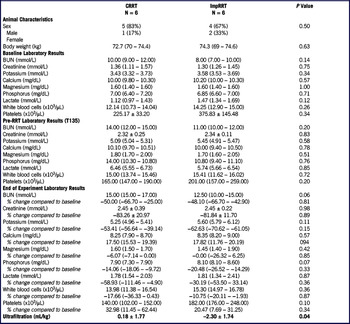
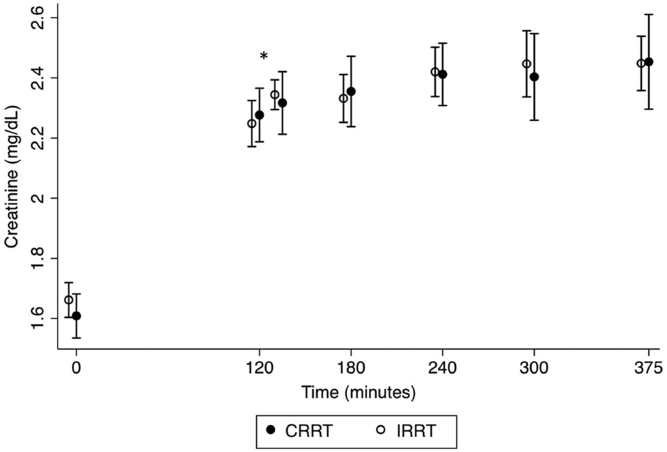
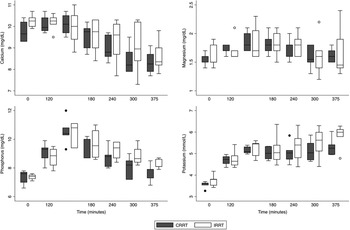
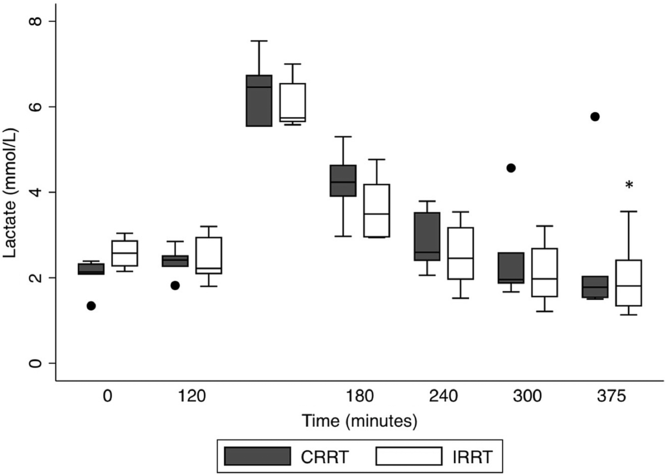
Baseline, pre-RRT, and final characteristics are presented in Table 3. The NxStage machine weighted 67.0 kg; the cartridge 965 g totaling 67.965 g for the CRRT platform. The Belmont Rapid Infuser® weighted 20.5 kg, the dialyzer 140 g, the circuit 614 g, the urometer 340 g, totaling 21.594 kg. While serum creatinine concentration was significantly higher than baseline from T120 until the end of the experiment, there was no difference in serum creatinine between groups (P = 0.91) (Figure 4). Similarly, there were no differences in serum calcium, magnesium, or phosphorus concentrations between groups (P = 0.1, 0.77, and 0.48, respectively) (see Figure 5). While there was a difference between groups in serum potassium concentration over time (P < 0.001), significance was lost in pairwise comparison at specific time points (see Figure 5). There was no difference in serum potassium concentration at the end of the experiment (Median [IQR]: CRRT, 5.25 [4.96-5.41]; ImpRRT, 6.0 [5.79-6.12] mmol/L; P = 0.11). Overall, serum potassium concentration was significantly higher than baseline from T120 until the end of the experiment (P < 0.001 for each time point). There were no differences in replacement fluid rates (CRRT, 24.1 [23.6-24.5]; ImpRRT, 24.7 [23.8-25.0] mL/kg/hr; P = 0.42) or ultrafiltrate flows (CRRT, 24.1 [23.5-24.8]; ImpRRT 24.0 [23.1-24.7] mL/kg/hr; P = 0.75) between the CRRT and ImpRRT groups. There was no difference in serum lactate between groups (P = 0.43) or over time (P = 0.06) (see Figure 6). There were no differences in isotonic crystalloids (CRRT, 124.7 [88.6-169.4]; ImpRRT, 132.3 [89.1-156.6] mL/kg; P = 1.00) or norepinephrine doses (CRRT, 5.1 [3.3-15.6]; ImpRRT, 10.5 [3.3-16.3] mcg/kg; P = 0.81) required for resuscitation between groups. There were no differences in sodium (P = 0.17), chloride (P = 0.14), calcium (P = 0.08), magnesium (P = 0.27), bicarbonate (P = 0.27), or glucose (P = 0.31) concentrations between the commercially available and the improvised custom-made replacement fluid (see Tables 1 and 2).
Baseline (Prior to Nephrectomies) and Final Characteristics

Note: Data are presented as mean ± standard deviation or median (interquartile range) for parametric and non-parametric data, respectively.
CRRT = conventional renal replacement therapy; IRRT = improvised renal replacement therapy; RRT = renal replacement therapy.
Serum Creatinine Concentration Over Time.

Serum Calcium, Magnesium, Phosphorus, and Potassium Concentrations Over Time.

Serum Lactate Concentration Over Time.

Final laboratory data and fluid balance volumes are presented in Table 3. There were no differences in laboratory results between groups. There was a slight but significant difference in net ultrafiltration between groups.
DISCUSSION
We established that the ImpRRT system achieved clearance equivalent to that of CRRT. Furthermore, electrolyte concentrations in the improvised custom-made replacement fluid were comparable to those of the commercially available product. This ImpRRT system could represent a compact, low-cost method to care for patients in both acute and chronic renal failure if access to conventional RRT platform is compromised and if these materials are available.
Natural disasters can prevent access to conventional RRT platforms for patients with AKI or chronic kidney disease. First, even if RRT centers do not sustain physical damage during a disaster, they can quickly become overwhelmed by the number of patients requiring care. Crush injury as a result of an earthquake is a major source of AKI and hyperkalemia potentially requiring RRT. Reference Erek, Sever and Serdengecti1,Reference He, Wang and Li6,Reference Vanholder, Borniche and Claus7 Efforts to improvise platforms that can be used at or near the disaster site may simplify the medical response and reduce the need for immediate patient transport. Second, natural disasters may cause physical destruction to RRT platforms and other infrastructure (such as transportation systems), preventing patients from accessing hemodialysis centers. Reference Anderson, Cohen and Kutner2,Reference Lin, Pierce, Roblin and Arquilla8,Reference Murakami, Siktel and Lucido9
Armed conflicts are also responsible for a high incidence of AKI, and RRT availability is vital for the care of combat casualties. With an incidence ranging from 1% to 5%, severe AKI is a relatively rare event in modern warfighters. Nonetheless, mortality rates as high as 65% have been reported. Reference Stewart, Tilley and Cotant11-Reference Stewart, Sosnov, Howard and Chung15 Lack of access to RRT would potentially lead to even higher mortality rates. The nature of the next major armed conflict is unknown and could involve numerous casualties, which could be further complicated by delayed evacuation times. It is therefore important for the military community to develop RRT platforms that satisfy the demands of care in austere environments. Reference Hoareau, Beyer and Walker19
The ImpRRT system achieved similar clearance when compared to CRRT as evidenced by the lack of a difference in serum creatinine or potassium between the 2 groups. In addition, there was no difference in any other laboratory results at the end of the experiment. Since replacement fluids were infused before the dialyzer, we reduced the clearance of the system. While post-filter replacement fluid would have increased clearance, it can also lead to circuit thrombosis (of note, pre-filter fluid replacement is the default mode for the CRRT machine used in our control arm). In addition to pre-filter infusion of replacement fluids, we used heparin to reduce the risk of circuit thrombosis. Although not investigated in this experiment, extracorporeal anticoagulation with citrate would be feasible with this setup and might be beneficial for patients where heparin would be contraindicated. Even though we did not aim to perform ultrafiltration in this experiment, there was a significant difference in net ultrafiltration between groups. Animals in the ImpRRT groups had slight negative fluid balance overall, although the difference between the 2 groups is unlikely to be of clinical significance.
We aimed to evaluate the composition of custom-made replacement fluids since scenarios where the ImpRRT system could be used are likely to face a shortage in replacement fluids. We established that their composition could approach that of commercially available solution and that their performance invivo was sufficient. Clinicians electing to resort to ImpRRT with a custom-made solution may tailor replacement fluid compositions to patients’ needs.
Our ImpRRT system leverages features that would make it a suitable option for use in response to both natural disasters and armed conflicts. While not approved for patient care, the system utilizes FDA-approved devices, and the required connectors to customize the extracorporeal circuit can be purchased in sterile packets. Furthermore, this ImpRRT system has a small footprint and benefits from the safety of the devices we use, including pressure sensors, as well as air traps and detectors. Clinical use of this system would still require management by users with advanced knowledge and experience in RRT in critically ill patients.
However, there are certain limitations. First, serum potassium concentration increased over time, despite RRT, due to ischemia-reperfusion, which demonstrates that the ultrafiltration goal for both groups was not sufficient to control hyperkalemia. Intermittent hemodialysis, when available, remains the ideal therapeutic choice because it provides rapid clearance and allows prompt changes between patients. While we aimed at comparing the 2 RRT systems, the optimal ultrafiltration rate to prevent hyperkalemia in our model remains unknown. Second, we performed RRT for only 4 hours due to laboratory technical constraints. CRRT is usually performed for a longer period of time. The shorter duration of treatment might be representative of a military scenario where patient transport might be delayed by < 4 hours. Our model with bilateral nephrectomies represented nonetheless a worst-case scenario whereby renal function would be completely compromised. Future studies should compare CRRT and ImpRRT for a longer duration. Third, in austere environments, access to a power supply can be difficult; similar to CRRT, the ImpRRT requires electricity. Future endeavors should focus on technologies that do not rely on electricity, such as peritoneal dialysis. The use of peritoneal dialysis has been described in both natural disasters and war zones. Reference Gorbatkin, Bass and Finkelstein20 However, this modality is a poor option for major life-threatening acid base and electrolyte imbalances due to slow clearance. Likewise, continuous arteriovenous hemofiltration (CAVH) could also be considered in austere environments. CAVH uses cardiac output to circulate blood and establish a transmembrane pressure for the purposes of hemofiltration. While this has the advantage of obligating the need for an external blood pump, it may not be tolerated from a hemodynamic standpoint in a critically ill patient. Fourth, while animals in our model were subjected to tissue damage via laparotomy and aortic occlusion, it is unknown how this ImpRRT would perform in more critical situations, such as crush injury, polytrauma, and severe hemorrhagic shock. Finally, the ImpRRT platform should not be used as a replacement for CRRT and should remain a last resort option.
CONCLUSION
The ImpRRT system achieved a similar performance to CRRT over the course of the experiment. Our ImpRRT platform shows potential promise for the care of patients with severe AKI following natural or man-made disasters, where conventional RRT is not available. However, advance knowledge and experience with RRT might be required to safely utilize the ImpRRT in a clinical setting.
Financial Support
This study was funded by The United States Air Force, Headquarters, Office of the Surgeon General. This research was supported in part by an appointment to the Postgraduate Research Participation Program at the David Grant USAF Medical Center Clinical Investigation Facility, administered by the Oak Ridge Institute for Science and Education through an interagency agreement between the US Department of Energy and USAF-DGMC-CIF.
Disclaimer
The opinions or assertions contained herein are the private views of the authors and are not to be construed as official or as reflecting the views of the Department of the Air Force or the Department of Defense. The animals involved in this study were procured, maintained, and used in accordance with the Laboratory Animal Welfare Act of 1966, as amended, and the Guide for the Care and Use of Laboratory Animals, National Research Council. The work reported herein was performed under United States Air Force Surgeon General-approved Clinical Investigation Number FDG 20170017A.
Acknowledgments
We extend our deepest appreciation for the administrative and laboratory staff at the Clinical Investigation Facility at Travis Air Force Base for their tremendous support.
Conflict of Interest Statement
The authors have no conflicts of interest to declare.