Introduction
Fall armyworm (FAW), Spodoptera frugiperda J.E. Smith (1797) is a polyphagous lepidopteran that belongs to the family Noctuidae and is native to South and North America (Otim et al. Reference Otim, Tay, Walsh, Kanyesigye, Adumo, Abongosi, Ochen, Sserumaga, Alibu, Abalo, Asea and Agona2018). The FAW is a highly invasive agricultural pest with a wide host range. It feeds on more than 80 plant species, including all major cereals. In 2016, a severe outbreak of FAW was first reported from West and Central African corn fields, where it caused severe economic losses that drew global attention to the possibility that this destructive pest could spread rapidly to other continents (Goergen et al. Reference Goergen, Kumar, Sankung, Togola and Tamo2016). In 2018, the pest reached the Indian subcontinent, arriving in Asia for the first time (Sharanabasappa et al. Reference Sharanabasappa, Kalleshwaraswamy, Asokan, Mahadeva Swamy, Marutid, Pavithra, Hegde, Navi, Prabhu and Goergen2018). In India, FAW was reported feeding on both corn and sorghum fields. This alarmed the surrounding Asian countries because of the outbreak’s threat to the region’s food security (Chormule et al. Reference Chormule, Shejawal, Sharanabasappa, Kalleshwaraswamy, Asokan and Swamy2019). By early 2019, it was confirmed that FAW had invaded corn fields in Sri Lanka. It spread rapidly on the island, affecting nearly 82 000 ha of corn cultivations at or near harvest stage (Dissanayake Reference Dissanayake2019).
The FAW has two known biotypes that are morphologically indistinguishable (Gouin et al. Reference Gouin, Bretaudeau, Nam, Gimenez, Aury and Duvic2017): the corn strain (C-FAW) feeds mostly on corn, cotton, and sorghum, and the rice strain (R-FAW) feeds mostly on rice and various pasture grasses (Nagoshi and Meagher Reference Nagoshi and Meagher2003). However, both FAW biotypes have been reported in corn, sugarcane, rice, vegetable, and cotton fields, irrespective of their reported feeding preferences (Saldamando and Vélez-Arango Reference Saldamando and Vélez-Arango2010; Early et al. Reference Early, Gonzalez-Moreno, Murphy and Day2018). Based on population-structure analysis, Saldamando and Vélez-Arango (Reference Saldamando and Vélez-Arango2010) reported that 42% of the FAW found on corn was C-FAW and only 0.045% of the FAW found on rice was C-FAW, which indicates high specificity of C-FAW to corn. However, the analysis found 53% R-FAW on rice and 35% on corn, revealing that R-FAW’s host-plant specificity is less specialised than that of C-FAW. Occurrence of both strains has been reported in Uganda, Colombia, India, China, Ethiopia, Kenya, the United States of America, and Senegal (Westbrook and Sparks Reference Westbrook and Sparks1986; Nagoshi et al. Reference Nagoshi, Meagher, Flanders, Gore, Jackson, Lopez, Armstrong, Buntin, Sansone and Leonard2008; Gouin et al. Reference Gouin, Bretaudeau, Nam, Gimenez, Aury and Duvic2017; Brévault et al. Reference Brévault, Ndiaye, Badiane, Bal, Sembène, Silvie and Haran2018; Otim et al. Reference Otim, Tay, Walsh, Kanyesigye, Adumo, Abongosi, Ochen, Sserumaga, Alibu, Abalo, Asea and Agona2018; Assefa and Ayalew Reference Assefa and Ayalew2019; Kumela et al. Reference Kumela, Simiyu, Sisay, Likhayo, Mendesil, Gohole and Tefera2019; Wu et al. Reference Wu, He, Shen, Jiang, Liu, Hu and Wu2019).
It is reported that corn and rice strains of FAW have significant variations at the genomic level (Dumas et al. Reference Dumas, Barbut, Le Ru, Silvain, Clamens, d’Alençon and Kergoat2015; Gouin et al. Reference Gouin, Bretaudeau, Nam, Gimenez, Aury and Duvic2017; Brévault et al. Reference Brévault, Ndiaye, Badiane, Bal, Sembène, Silvie and Haran2018). The FAW biotypes have been previously identified based on sequence comparison of barcoding genes, and this method has been accepted as the prime standard of identification of FAW biotypes (Otim et al. Reference Otim, Tay, Walsh, Kanyesigye, Adumo, Abongosi, Ochen, Sserumaga, Alibu, Abalo, Asea and Agona2018). The mitochondrial cytochrome c oxidase subunit I gene (mt-COI) is commonly targeted as a barcoding gene for FAW (Goergen et al. Reference Goergen, Kumar, Sankung, Togola and Tamo2016; Gouin et al. Reference Gouin, Bretaudeau, Nam, Gimenez, Aury and Duvic2017; Otim et al. Reference Otim, Tay, Walsh, Kanyesigye, Adumo, Abongosi, Ochen, Sserumaga, Alibu, Abalo, Asea and Agona2018). The molecular markers HC02198 and LCO1490 (Folmer et al. Reference Folmer, Black, Hoeh, Lutz and Vrijenhoek1994) have been used to amplify a region of mt-COI that can diagnostically separate the two biotypes (Goergen et al. Reference Goergen, Kumar, Sankung, Togola and Tamo2016; Gouin et al. Reference Gouin, Bretaudeau, Nam, Gimenez, Aury and Duvic2017; Brévault et al. Reference Brévault, Ndiaye, Badiane, Bal, Sembène, Silvie and Haran2018; Otim et al. Reference Otim, Tay, Walsh, Kanyesigye, Adumo, Abongosi, Ochen, Sserumaga, Alibu, Abalo, Asea and Agona2018; Kalleshwaraswamy et al. Reference Kalleshwaraswamy, Asokan, Mahadevaswamy and Sharanabasappa2019) and reconstruct the molecular phylogeny of FAW. The process has clearly shown the FAW biotypes diverge into two clades: the rice and corn clades (Goergen et al. Reference Goergen, Kumar, Sankung, Togola and Tamo2016; Gouin et al. Reference Gouin, Bretaudeau, Nam, Gimenez, Aury and Duvic2017; Brévault et al. Reference Brévault, Ndiaye, Badiane, Bal, Sembène, Silvie and Haran2018; Otim et al. Reference Otim, Tay, Walsh, Kanyesigye, Adumo, Abongosi, Ochen, Sserumaga, Alibu, Abalo, Asea and Agona2018; Kalleshwaraswamy et al. Reference Kalleshwaraswamy, Asokan, Mahadevaswamy and Sharanabasappa2019). In addition, several molecular marker tools have been used to identify the biotypes. These tools include restriction fragment length polymorphism (RFLP) profiling (Lu et al. Reference Lu, Kochert, Isenhour and Adang1994; Prowell et al. Reference Prowell, McMichael and Silvain2004; Nagoshi et al. Reference Nagoshi, Meagher, Adamczyk, Braman, Brandenburg and Nuessly2006) and dominant DNA molecular markers (Dumas et al. Reference Dumas, Barbut, Le Ru, Silvain, Clamens, d’Alençon and Kergoat2015). However, for correct identification and cost-effectiveness, a single-reaction, gel-based polymerase chain reaction (PCR) assay would be an ideal solution. Such an assay would be especially important for identifying the two biotypes in technology-limited countries that seek rapid low-cost options. Here, we report the first molecular identification of FAW biotypes in Sri Lanka using mt-COI gene and development of a gel-based molecular marker for rapid low-cost, sequencing-free identification of FAW biotypes.
Materials and Methods
At the onset of the FAW outbreak in Sri Lanka in early 2019, entomologists K.M.D.W. Prabhath Nishantha of the Horticulture Research Development Institute, Gannoruwa, Sri Lanka, and A.B.M. Wijayatunga of Extension and Training Centre, Department of Agriculture, Peradeniya, Sri Lanka, identified nine larval specimens to species level as S. frugiperda based on taxonomic keys. The samples were collected from farmers’ fields in the Ampara (seven specimens) and Badulla (two specimens) districts of Sri Lanka. The biotypes of the nine FAW samples were identified by enerating the mt-COI gene from the samples and including these in a molecular phylogenetic study with reference sequences of R-FAW [GenBank accession: U72977] and C-FAW [GenBank accession: U72974].
DNA extraction and mt-CO1 gene-based barcoding
The FAW larvae were dissected into small pieces; DNA was extracted using a DNeasy Blood & Tissue Kit® (Qiagen, Germany). DNA was quantified using a nano-spectrophotometer (Nabi, South Korea) and was normalised to 50 ng/μL working stocks. The universal barcoding primers LCO1490 (5′ to 3′: GGTCAACAAATCATAAAGATATTGG) and HC02198 (5′ to 3′: TAAACTTCAGGGTGACCAAAAAATCA) targeting the mt-COI gene of FAW, as reported in Folmer et al. (Reference Folmer, Black, Hoeh, Lutz and Vrijenhoek1994), were used to amplify the COI region of the collected samples. The PCR amplification was carried out using a 15-µL final PCR reaction volume that included 50 ng/µL of template DNA, 1 × GoTaq® Green master mix (Promega, United States of America), and 0.66 mM of primer mix that consisted of the forward and reverse primer. In the no-template control, the template DNA was replaced with nuclease-free water (Promega, United States of America). The PCR program consisted of 95 °C for 5 min, followed by 30 s denaturation at 95 °C, 30 s primer annealing at 51 °C, and 30 s primer extension at 72 °C, repeated for 35 cycles, and concluded with an additional primer extension for 5 min at 72 °C, followed by 1 min incubation at 37 °C in a thermal cycler (CT1000, Bio-Rad, United States of America). The amplified products were sequenced bi-directionally using an Applied Biosystems® 3500 Genetic Analyzer (with eight capillaries; ThermoFisher Scientific, United States of America) at the DNA Sequencing Core Facility, Faculty of Science, University of Peradeniya, Peradeniya, Sri Lanka. The sequences were checked manually, and consensus sequences were generated using Geneious v7.1.3. (Biomatters Ltd., New Zealand; Kearse et al. Reference Kearse, Moir, Wilson, Stones-Havas, Cheung, Sturrock, Buxton, Cooper, Markowitz, Duran, Thierer, Ashton, Meintjes and Drummond2012). The sequences were subjected to a homology search against the National Center for Biotechnology Information (NCBI) database, and the species-level identification was done based on sequence similarity. All generated sequences were deposited in GenBank sequence repository [GenBank accessions: MN732549 to MN732557].
A homology search using the reference C-FAW [GenBank accession: U72974] and R-FAW [GenBank accession: U72977] accessions retrieved 164 mt-CO1 sequences of S. frugiperda from the NCBI database. The mt-CO1 sequence of the sister species, S. litura [GenBank accession: JQ647918], was used as the outgroup, following Otim et al. (Reference Otim, Tay, Walsh, Kanyesigye, Adumo, Abongosi, Ochen, Sserumaga, Alibu, Abalo, Asea and Agona2018). The multiple sequence alignment was generated using the ClustalW feature (Thompson et al. Reference Thompson, Higgins and Gibson1994) in Geneious v7.1.3. (Biomatters Ltd., New Zealand; Kearse et al. Reference Kearse, Moir, Wilson, Stones-Havas, Cheung, Sturrock, Buxton, Cooper, Markowitz, Duran, Thierer, Ashton, Meintjes and Drummond2012) with a gap open cost of 15 and a gap extension cost of 6.66; these alignments were then refined by eye. The molecular phylogeny was reconstructed using the maximum likelihood method in MEGA v7.0 (Kumar et al. Reference Kumar, Stecher and Tamura2016) and adopting a Tamura three-parameter with discrete Gamma distribution (T92 + G) model. The phylogeny was visualised using FigTree v1.4.3 (Rambaut Reference Rambaut2016). The branch support was estimated using 1000 bootstrap (BS) pseudoreplicates. The phylogeny was simplified by removing redundant entrees to visualise only the unique lineages in the final presented molecular phylogeny.
Development of the novel molecular marker ABUOP0002
Based on Gouin et al. (Reference Gouin, Bretaudeau, Nam, Gimenez, Aury and Duvic2017), the genomic sequences for R-FAW [GenBank accession: U72977] and C-FAW [GenBank accession: U72974] were retrieved from the NCBI repository and were aligned using the ClustalW feature in Geneious v.7.1.3 (Biomatters Ltd., New Zealand; Kearse et al. Reference Kearse, Moir, Wilson, Stones-Havas, Cheung, Sturrock, Buxton, Cooper, Markowitz, Duran, Thierer, Ashton, Meintjes and Drummond2012). Based on the nucleotide alignment, polymorphic sites that are diagnostic for each FAW biotype were identified. Targeting one of the identified polymorphic sites, the novel marker ABUOP0002 was designed to amplify an allele-specific PCR fragment based on the technique described in Tabone et al. (Reference Tabone, Mather and Hayden2009). The two primer pairs of ABUOP0002 were designed using the Primer3 platform on Geneious v7.1.3 (Biomatters Ltd., New Zealand; Kearse et al. Reference Kearse, Moir, Wilson, Stones-Havas, Cheung, Sturrock, Buxton, Cooper, Markowitz, Duran, Thierer, Ashton, Meintjes and Drummond2012). The first pair of primers was locus-specific (LS_F/R) and defined the region of interest. The second pair of primers had a non-complimentary tail and comprised nested locus-specific primers (NLS_F/R) that targeted the specific single nucleotide polymorphism (SNP) within the locus-specific amplicon. The designing was done based on the parameters, conditions, and attributes described in Tabone et al. (Reference Tabone, Mather and Hayden2009).
Marker-based biotyping with ABUOP0002 marker assay
The PCR amplification was carried out in a 25-µL final PCR reaction volume that includes 50 ng/µL of template DNA, 1 × GoTaq® Green master mix (Promega, United States of America), 0.1 µM of locus-specific primer pair (LS_F and LS_R), 1.0 μM of nested locus-specific primer pair (NLS_F and NLS_R), and 0.5 mM of magnesium chloride (Promega, United States of America) in a thermal cycler (CT1000, Bio-Rad, United States of America). In the no-template control, the template DNA was replaced with nuclease-free water (Promega, United States of America). The amplification was conducted with an initial denature at 95 °C for 3 min, followed by 30 s denaturation at 95 °C, 30 s primer annealing at 63 °C (for the locus-specific primer pair), and 1 min primer extension at 72 °C, repeated for 15 cycles, and then 10 s denaturation at 95 °C, 30 s primer annealing at 45 °C (for the nested locus-specific primer pair without the tail sequence) for five cycles and, finally, another 15 cycles of PCR amplification were conducted with 10 s denaturation at 95 °C, 15 s primer annealing at 53 °C (for nested locus-specific primer with the tail sequence), and 5 s primer extension at 72 °C for 15 cycles. The products were resolved on a pre-stained 3% agarose gel with 5% (v/v) ethidium bromide to visualise and capture the profile through a gel documentation system (Model UVCI-1100, Major Science, United States of America).
Results and discussion
Based on the mt-CO1 sequences amplified, samples MN732549, MN732550, MN732551, MN732552, MN732553, MN732554, and MN732557 shared highest sequence similarity (100% identity similarity, 100% query coverage, and 0.00 E-value) with U72977, the R-FAW reference sequence, and 171 other sequences that are of S. frugiperda. Similarly, samples MN732555 and MN732556 shared highest sequence similarity (100% identity similarity, 100% query coverage, and 0.00 E-value) with U72974, the C-FAW reference sequence, and 51 other sequences of S. frugiperda. Based on the homology search, it is evident that all nine samples are of S. frugiperda; however, they are of two biotypes.
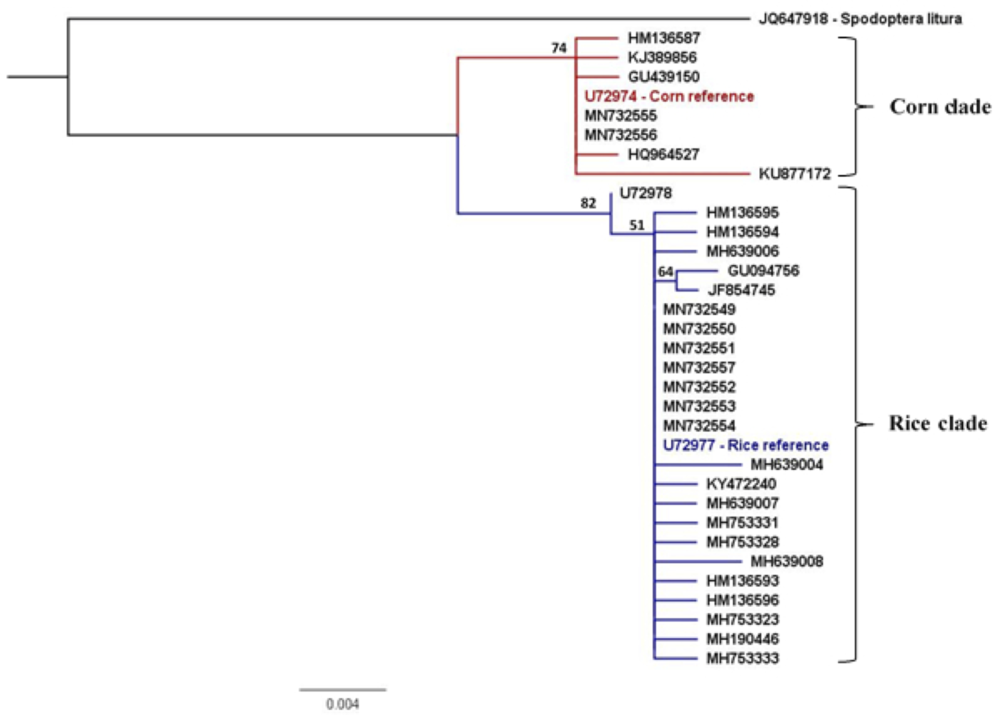
The phylogeny resulted in two well-supported FAW clades (bootstrap support ≥ 70) corresponding to the rice and corn biotypes (hereafter referred to as “corn-clade” and “rice-clade”; Supplementary Table S1), as previously reported in several other studies (Lu et al. Reference Lu, Kochert, Isenhour and Adang1994; Nagoshi and Meagher Reference Nagoshi and Meagher2003; Prowell et al. Reference Prowell, McMichael and Silvain2004; Nagoshi et al. Reference Nagoshi, Silvie, Meagher, Lopez and Machado2007; Gouin et al. Reference Gouin, Bretaudeau, Nam, Gimenez, Aury and Duvic2017; Nagoshi et al. Reference Nagoshi, Goergen, Du Plessis, van den Berg and Meagher2019; Boaventura et al. Reference Boaventura, Bolzan, Padovez, Okuma, Omoto and Nauen2020). Two of the Sri Lankan FAW sequences – MN732555 and MN732556 – were placed in the corn-clade, and the remaining seven samples [GenBank accessions: MN732549 to MN732557] were placed in the rice-clade (Fig. 1).
Phylogenetic analysis of Spodoptera frugiperda based on the DNA sequencing of the mt-COI gene of the isolates from Sri Lanka [GenBank accessions: MN732549–MN732557].
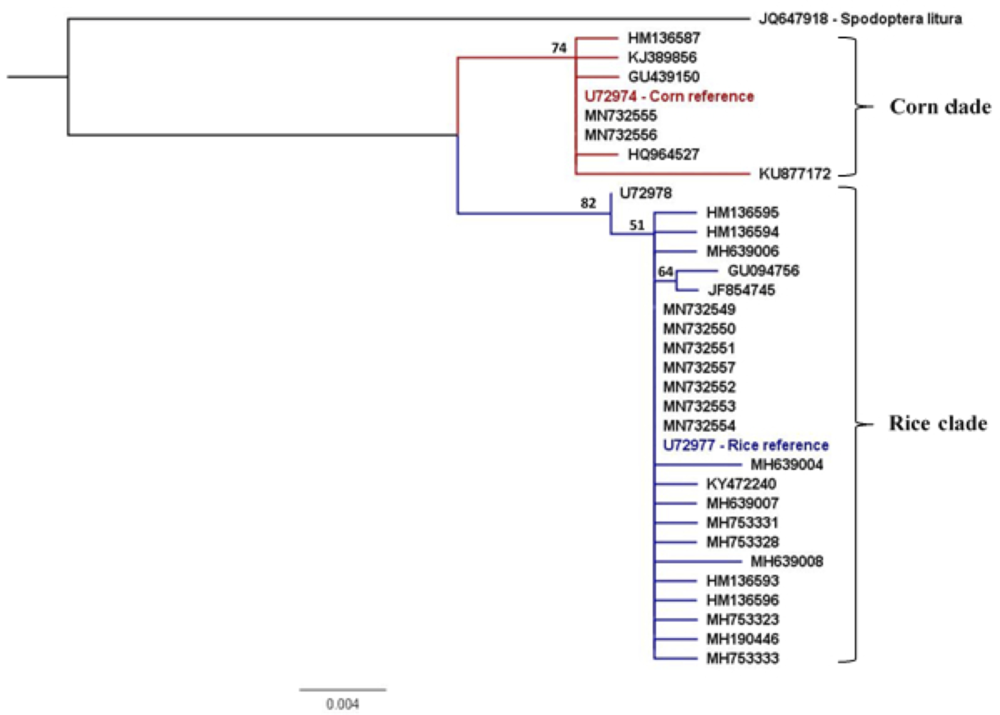
These findings indicate that both C-FAW and R-FAW biotypes are present in corn fields in Sri Lanka. The presence of the R-FAW biotype in corn fields agrees with the previous reports of R-FAW’s low host specificity (Saldamando and Vélez-Arango Reference Saldamando and Vélez-Arango2010). In the 2019 outbreak in Sri Lanka, crop damage was mainly reported for corn and, therefore, C-FAW biotype was assumed to be present in Sri Lanka. However, our findings indicate that both biotypes were present. Although the findings clearly show that the R-FAW biotype was present in Sri Lanka, FAW on rice in Sri Lanka was reported only in isolated incidences and did not lead to significant damage to the country’s rice crop. To better understand the distribution and prevalence of the two biotypes and the host-crop selection of FAW in Sri Lanka, a study that extensively samples and identifies the biotypes present in the country’s major crop districts is warranted.
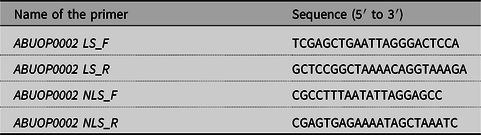
While mt-COI DNA barcoding enables accurate and efficient identification of an organism, the focus on mt-COI limits identification of recently diverged species and detection of introgressive hybridisation (Costa and Carvalho Reference Costa and Carvalho2007). For FAW, this and other studies (Nagoshi et al. Reference Nagoshi, Meagher, Flanders, Gore, Jackson, Lopez, Armstrong, Buntin, Sansone and Leonard2008; Saldamando and Vélez-Arango Reference Saldamando and Vélez-Arango2010; Nagoshi et al. Reference Nagoshi, Meagher and Hay-Roe2012; Dumas et al. Reference Dumas, Barbut, Le Ru, Silvain, Clamens, d’Alençon and Kergoat2015; Goergen et al. Reference Goergen, Kumar, Sankung, Togola and Tamo2016; Brévault et al. Reference Brévault, Ndiaye, Badiane, Bal, Sembène, Silvie and Haran2018; Otim et al. Reference Otim, Tay, Walsh, Kanyesigye, Adumo, Abongosi, Ochen, Sserumaga, Alibu, Abalo, Asea and Agona2018; Sharanabasappa et al. Reference Sharanabasappa, Kalleshwaraswamy, Asokan, Mahadeva Swamy, Marutid, Pavithra, Hegde, Navi, Prabhu and Goergen2018; Chormule et al. Reference Chormule, Shejawal, Sharanabasappa, Kalleshwaraswamy, Asokan and Swamy2019; Kalleshwarsamy et al. Reference Kalleshwaraswamy, Asokan, Mahadevaswamy and Sharanabasappa2019; Nagoshi et al. Reference Nagoshi, Goergen, Du Plessis, van den Berg and Meagher2019) successfully used mt-COI for biotyping. One other major limitation in using mt-COI is sequencing cost and the limited availability of technology, which are of particular concern in developing countries with limited resources. The aforesaid limitation could be mitigated via development of a gel-based molecular marker targeting diagnostic polymorphisms at the mt-COI. The nucleotide alignment of R-FAW (U72977) and C-FAW (U72974) reference sequences revealed 13 SNP sites over a 709-bp region of the mt-COI gene. All 13 sites could be considered as potential sites for development of molecular markers. Of these sites, the novel molecular marker ABUOP0002 was designed targeting the fifth SNP site at the 245-bp position to identify a C/T SNP within the amplified COI region (Table 1; C in C-FAW and T in R-FAW).
Primer sequences of ABUOP0002.
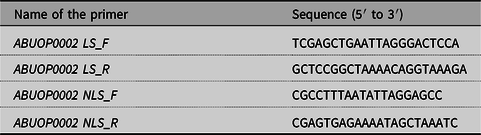
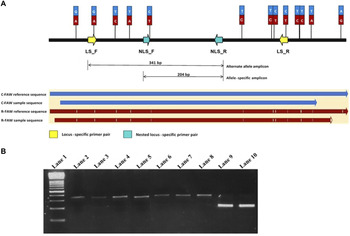
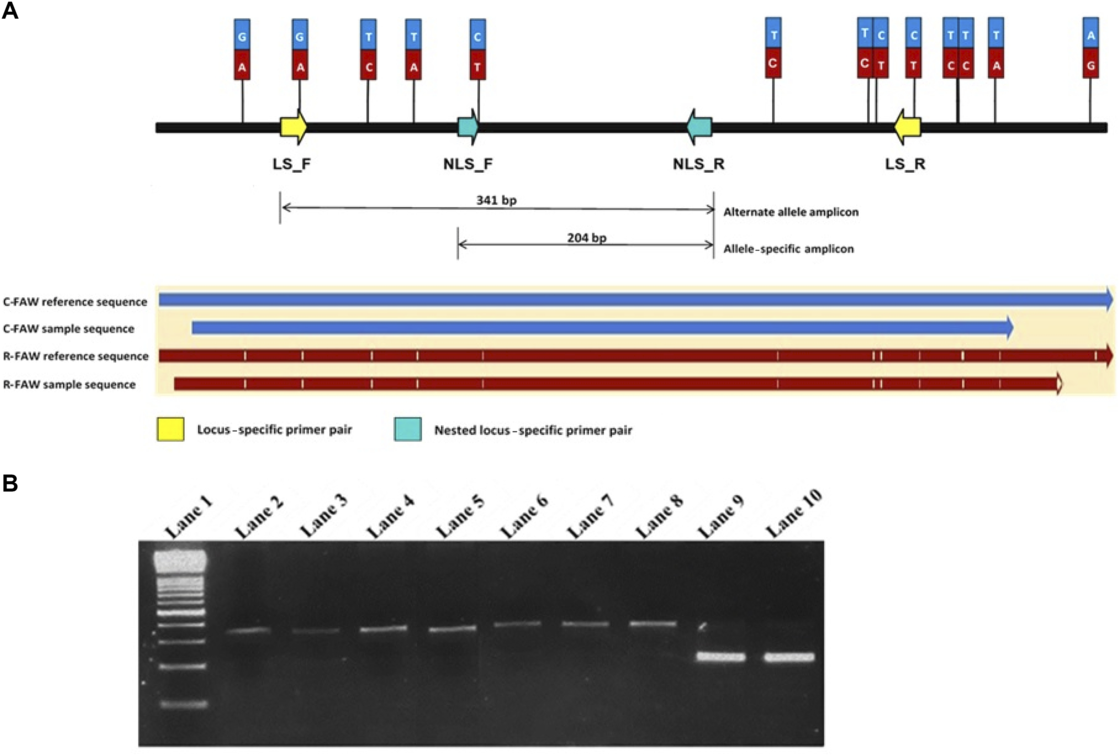
The marker ABUOP0002 consists of two primer pairs, namely ABUOP0002 LS_F/R (a locus-specific primer pair designed to target the region of interest) and ABUOP0002 NLS_F/R (a nested locus-specific primer pair designed to interrogate the SNP alleles), based on the principles of temperature-switch PCR to amplify the targeted SNP at the position 245 bp (Fig. 2A). The ABUOP0002 LS_F/R amplified an amplicon of 504 bp spanning over the target SNP during the initial 15 PCR cycles carried out at 65 °C primer anneal, and the resulting amplicon served as the template for the subsequent amplifications. The ABUOP0002 NLS_F primer was designed complementary to the C-FAW sequence and thereby amplified an allele-specific amplicon of 204 bp only with a C-FAW template DNA (with a C at the target SNP site) by coupling with ABUOP0002 NLS_R primer. For R-FAW template DNA (with a T at the target SNP site), where the 3′ end base complementation requirement in annealing is not met exactly by the ABUOP0002 NLS_F primer, a 341-bp amplicon was amplified as an alternate amplicon by the primer combination of ABUOP0002 LS_F and ABUOP0002 NLS_R (Fig. 2A). In this way, the marker ABUOP0002 can be identified as a marker with a dimorphic banding pattern. Out of the nine FAW samples, the ABUOP0002 assay identified two samples as C-FAW biotype, amplifying the 204-bp (allele-specific) amplicon, and seven samples as R-FAW biotype, amplifying the 341-bp (alternate allele) amplicon (Fig. 2B). The observed product sizes ideally matched with the expected sizes considering the nucleotide call at the target SNP in the mt-COI sequence. Therefore, the gel-based marker ABUOP0002 can diagnostically identify corn and rice biotypes of samples that have been taxonomically identified to the species S. frugiperda.
Illustration of the A, single nucleotide polymorphism positions and the anchoring position of the ABUOP0002 on the nucleotide alignment, and B, marker-based biotyping of nine Spodoptera frugiperda samples collected from Sri Lanka using the ABUOP0002 assay. Lane 1: 1 kb ladder (Applied Biological Materials, Canada); Lane 2: MN732549; Lane 3: MN732550; Lane 4: MN732551; Lane 5: MN732552; Lane 6: MN732553; Lane 7: MN732554; Lane 8: MN732555; Lane 9: MN732556; Lane 10: MN732557.
The temperature-switch PCR technique used in the current study has been commonly used to assay SNPs in many crop species (Hayden et al. Reference Hayden, Tabone and Mather2009; Pagliarani et al. Reference Pagliarani, Dapena, Miñarro, Denancé, Lespinasse, Rat-Morris, Troggio, Durel and Tartarini2016; Samad et al. Reference Samad, Kurokura, Koskela, Toivainen, Patel, Mouhu, Sargent and Hytönen2017; Bueno et al. Reference Bueno, God, Prata, Pereira, Teixeira, Piovesan and de Barros2018). The technique eliminates the need for sequencing or RFLP profiling for the identification of SNP-based polymorphisms and enables gel-based genotyping as a less expensive alternative. Hence, the ABUOP0002 molecular marker can be recommended for use in identifying FAW biotypes in technology-limited settings and where samples have been taxonomically identified to the species level as S. frugiperda.
Conclusions
This is the first report of the existence of the two corn and rice biotypes of S. frugiperda in Sri Lanka based on the updated molecular phylogeny of mt-COI gene. We developed a gel-based diagnostic marker ABUOP00002 targeting a SNP site at the mt-COI gene to identify corn and rice FAW biotypes of samples taxonomically identified as S. frugiperda.
Acknowledgements
The authors wish to acknowledge the Ministry of Mahaweli, Agriculture, Irrigation & Rural Development Sri Lanka for funding the research (Grant: 188-2-3-20-2509/PM1) and the Entomology Division of the Horticultural Research and Development Institute, Gannoruwa, Sri Lanka, for providing FAW samples. The authors also thank Dr. Venura Herath and Prof. Devika de Costa, of the Faculty of Agriculture, University of Peradeniya, Sri Lanka, for their support, Ms. Shanika Denipitiya, for graphics support, and Dr. Kanishka Ukuwela, of Rajarata University of Sri Lanka, Mihintale, Sri Lanka, for advice on the molecular phylogeny.
Supplementary material
To view supplementary material for this article, please visit https://doi.org/10.4039/tce.2020.52.