Introduction
The number of people aged over 65 years will rise from 390 million now to 800 million by 2025, and this age group will then comprise 10% of the total global population (WHO, 1998). Researchers, policy-makers, administrators and health care providers generally agree that our changing demographics will have a significant impact on the health care system and society as a whole. Increasingly, the global consensus is that we should not only be interested in living longer lives but we should also be concerned about the quality and meaning of life for older people. Many gerontologists share the view that the degree of satisfaction elderly people get from life should be considered to be an area of increasing importance (Ebersole, Reference Ebersole1995). Life satisfaction is widely accepted to be a key aspect of human welfare and is a central concept in research on subjective quality of life – to the extent that all quality of life surveys involve questions on life satisfaction (Reig, Reference Reig and Fernandez-Ballasteros2003; Lupien and Wan, Reference Lupien and Wan2004).
Life satisfaction is thought to be a global concept, referring to life as a whole rather than to specific aspects of it (Bowling, Reference Bowling1997). The distinction between life satisfaction and quality of life is not clear and the concepts are sometimes used interchangeably; however, life satisfaction is essentially considered a subjective well-being measure of quality of life (Mannel and Dupuis, Reference Mannel, Dupuis and Birren1996). Subjective well-being most often refers to a positive orientation toward life and is generally based upon such feelings as happiness, morale and positive affect. Research has shown that these various measures are mostly interrelated and that they frequently constitute a single dimension that can be measured (Slocum-Gori et al., Reference Slocum-Gori, Zumbo, Michalos and Diener2009). In this way, both well-being and happiness relate to being satisfied with one's life and can be measured as such (Haybron, Reference Haybron2000).Whilst a simple happiness scale measures a transient affective state, an assessment of life satisfaction measures a more enduring and stable cognition (Mannel and Dupuis, Reference Mannel, Dupuis and Birren1996).
One of the commonest approaches to the evaluation of life satisfaction as a parameter of subjective well-being is through satisfaction scales. These represent a cognitive judgment of one's life as a whole, reflecting an individual personal interpretation of satisfaction based on physical health, social role, psychological make-up, and interaction with the environment (Schwarz and Strack, Reference Schwarz, Strack and Argyle1991; Bowling, Reference Bowling2005). Low life-satisfaction scale scores are indicators of a serious deficit in physical and mental health and in social relations (Veenhoven, Reference Veenhoven1996), whereas high life-satisfaction scores are an indicator of successful aging, which is sustained in an adequate optimization of the three dimensions of life quality: psychological, social and physical functioning (Mannel and Dupuis, Reference Mannel, Dupuis and Birren1996; McCamish-Svensson et al., Reference McCamish-Svensson, Samuelsson, Hagberg, Svensson and Dehlin1999).
It is not surprising then that population-based studies including mixed samples of older people have demonstrated that several aspects of life may contribute to life satisfaction. Different studies looking at separate variables have identified an array of factors thought to contribute to this, including personality, social support, psychological support and physical functioning (Neugarten et al., Reference Neugarten, Havighurst and Tobin1961). However, there are still some inconsistencies about the role and relative importance of these factors particularly within an older population. The Dublin Healthy Aging Study is a community-based study examining physical, mental, cognitive and social health characteristics of older people. Our objective within the context of this study was to determine which factors predicted subjective well-being in older people living in the community as determined by their satisfaction with life.
Methods
Study population and design
The study design comprised a cross-sectional examination of 466 subjects, stratified for age, and randomly selected from the patient lists of four general practitioners (GPs) in the catchment area of St. James's Hospital, Dublin. This is an urban residential area of Dublin encompassing 350,000 inhabitants of whom 10% are over the age of 65. All community-dwelling individuals aged over 65 years who were medically stable and without dementia, and who were able to provide consent and cooperate with testing, were eligible for recruitment. Ethical approval was obtained from both the Hospital and GP ethics committees. Subjects were contacted by post and invited to participate. A total of 1349 letters to individuals were sent. Of these, 419 (31%) individuals refused to participate, 159 (11.8%) did not meet inclusion criteria, 175 (13%) had died, 71 (5.3%) were no longer at their given addresses, and 57 patients were no longer on the GP list. A research psychologist and a doctor visited the individuals who agreed to participate in their own home on a single occasion. All assessment measures were administered during this domiciliary visit. The duration of each assessment was approximately two hours.
Assessment
Detailed structured assessments of mental health, personality, medical, cognitive and social characteristics were performed. A structured interview recorded self-reported information on demographic details, education, medical history, current medications, exercise, psychosocial history and family history.Variables included in the analysis with life satisfaction as our outcome measure were drawn from the three dimensions of psychological, social and physical functioning that were explored within the context of the Dublin Healthy Aging Study. We attempted to include variables from all three domains that reflect current thinking in relation to potential predictors of life satisfaction. Among the sociodemographic characteristics we included the explanatory variables of age, gender and age on leaving education. We also included marital status, which was categorized dichotomously into those who were widowed/separated or never married and those who were married or had a current partner.
Instruments
Life satisfaction
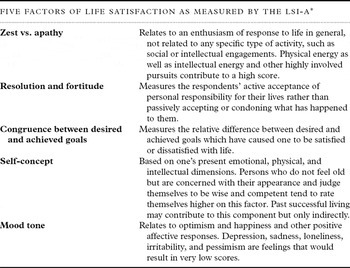
Life satisfaction was assessed using the Life Satisfaction Index – version A (LSI-A) (Neugarten et al., Reference Neugarten, Havighurst and Tobin1961). As life satisfaction is a theoretical construct it cannot be observed directly. This 20-item questionnaire is based on a theoretical framework of five key domains, which provide an operational definition of life satisfaction (Table 1). The LSI-A provides for a two-point agree/disagree score, rating items 0 for a response indicating dissatisfaction and 1 for satisfaction. A cumulative score is generated which is acknowledged as a valid index of subjective well-being in older people. No significant differences have been found in score reliability by language of administration, sample size or sample type, thereby providing evidence for the reliability of this measurement scale across a variety of sample characteristics (Wallace and Wheeler, Reference Wallace and Wheeler2002).
Life satisfaction as measured by the LSI-A Index

* Based on Neugarten et al. (Reference Neugarten, Havighurst and Tobin1961).
Personality
Personality was measured using the Eysenck Personality Inventory-Revised (EPI-R), a 48-item personality questionnaire, which measures two important personality dimensions, extroversion–introversion and neuroticism-stability (Eysenck and Eysenck, Reference Eysenck and Eysenck1964). The EPI-R has been shown to have good internal consistency, test-retest reliability, and concurrent validity particularly for the measurement of extroversion and neuroticism (Sato, Reference Sato2005).
Mood and psychological well-being
Mood and psychological well-being were assessed using the Structured Clinical Interview for DSM-IV Axis I Disorders (SCID-I) and a number of items taken from the Centre for Epidemiological Studies Depression (CES-D) scale. The SCID-I is a well-known semi-structured interview which includes a Mood Disorders Module that provides a framework on which to make DSM-IV Axis I diagnoses including major depressive disorder (Michael et al., Reference Michael, Spitzer, Robert, Gibbon and Williams2002). Several studies have demonstrated the superior validity of the SCID over standard clinical interviews and it is considered the “gold standard” in determining accuracy of diagnoses for psychiatric illness including depression (Steiner et al., Reference Steiner, Tebes, Sledge and Walker1995). The CES-D is derived from previously validated depression scales and its individual items were selected to represent the major symptom components of depression and well-being that had been identified in previous clinical and factor analytic studies (Radloff, Reference Radloff1977). We utilized four statements from the CES-D that the patient may have experienced in the past week. We included questions regarding loneliness –“I felt lonely”; sleep – “My sleep was restless”; and two already identified measures of subjective exhaustion that have been utilized in the measurement of frailty, “I could not get going” and “I felt everything I did was an effort”. Each item could be answered by one of four responses – “rarely or none of the time (less than one day in the past week), “some or a little of the time” (1–2 days), “occasionally or a moderate amount of time” (3–4 days), and “most or all of the time” (5–7 days), giving a score of 0–3 depending on the response provided.
Physical health related variables
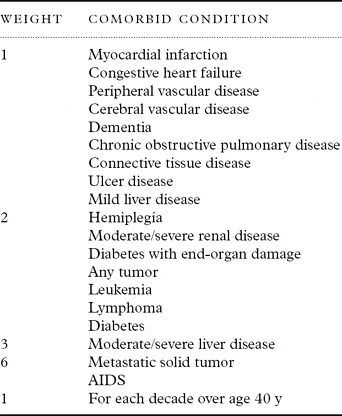
Physical condition, functional ability, activity levels and chronic health complaints are all also potential contributors to life satisfaction (Ebersole, Reference Ebersole1995). We therefore included a number of health-related explanatory variables. Cognition was measured by the Mini-Mental State Examination (MMSE), and comorbidities were quantified by the Age-adjusted Charleson Comorbidity Index (AACI) where comorbid conditions are weighted and scored, with additional points added for age (Table 2) (Charlson et al., Reference Charlson, Szatrowski, Peterson and Gold1994). Independent living skills were assessed using the Lawton Instrumental Activities of Daily Living Scale (IADL), which measures eight domains of function to include areas such as shopping, cooking and managing finances, with a summary score from 0 (low function) to 8 (high function). This instrument is intended to be used among older adults, and has been validated for use in both community and hospital settings with acceptable levels of inter-rater reliability and construct validity both in research and in clinical practice (Lawton and Brody, Reference Lawton and Brody1969). Physical activity was measured by asking the question, “Have you done any exercise in the past 2 weeks”. If “Yes” the participant was then asked to identify what type of exercise from a list of the following: Walking for exercise, Jogging/Running, Gardening, Dancing, Callisthenics or General exercise, Golf, Cycling, Swimming, Other. They were also asked to specify how many times they exercised in the past week and on average the length of time spent exercising on each occasion. In terms of daily activity, retirement from driving has been identified as a factor in reduced quality of life (Musselwhite and Haddad, Reference Musselwhite and Haddad2010). For this reason we included this variable when evaluating life satisfaction by establishing participants’ driving status as a current driver or having never driven or retired from driving.
Charlson Age Comorbidity Index

AIDS = Acquired Immune Deficiency Syndrome.
Power calculation and statistical analysis
A power calculation for multiple regression analysis of life satisfaction showed that to detect a medium effect size (power = 0.8 and α = 0.05) with 12 predictor variables required a minimum sample size of 127. The collected data were analyzed using the SPSS 13.0 statistical package program. Bivariate analysis using the Spearman correlation coefficient was carried out to assess the strength of association between the independent variables and life satisfaction.Variables that in the bivariate analyses were associated with life satisfaction were entered into a hierarchical model determined by the strength of their association with the outcome variable. We set the critical value for significance in all analyses at p<0.05.
Results
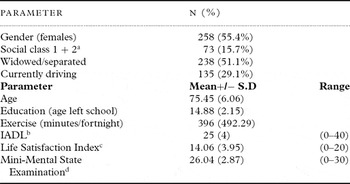
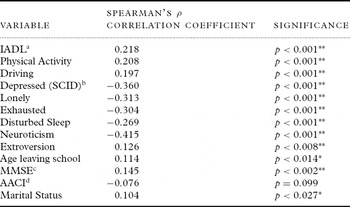
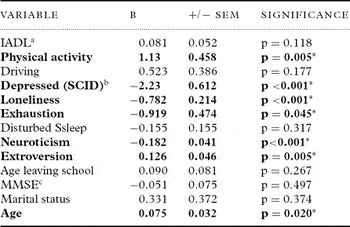
Of the 466 participants in the study, 55.4% were female and 44.6% were male. Their population characteristics are summarized in Table 3. The average Life Satisfaction Index (LSI) score of the whole group of participants was 14.06 ±3.95 out of a maximum score of 20. Bivariate analysis revealed that neither age nor gender had a significant correlation with life satisfaction scores (Spearman's rho, p = 0.097, p = 0.659 respectively) Table 4 shows the explanatory variables that were significantly associated with life satisfaction on bivariate analysis. Higher scores on the IADL, participating in some form of physical activity in the previous two weeks, being a current driver, having an extroverted personality, leaving school at an older age, having higher cognitive scores and being married or having a current partner all correlated positively with life satisfaction scores. Being depressed, having neurotic personality traits, having a higher level of comorbid illness, expressing more frequent feelings of loneliness, reporting increasing frequency of disturbed sleep in the past week and subjectively expressing more feelings of exhaustion in the previous week all correlated negatively with life satisfaction. Having identified a number of significant associations we conducted a stepwise hierarchical linear regression analysis to include all of the variables as described in Table 4. To determine the key predictors of life satisfaction in our older cohort, age was also included as a covariate (Table 5). We found that depression, loneliness, neuroticism, extroversion, participation in physical activity within two weeks of assessment, age and subjective exhaustion were the statistically significant independent predictors of life satisfaction in this elderly community dwelling population.
Population characteristics (n = 466)

a Higher social class.
b Lawton Instrumental Activities of Daily Living Scale.
c Neugarten Life Satisfaction Index – version A.
d Folstein Mini-Mental State Examination.
Correlates of life satisfaction on bivariate analysis

* Correlation is significant at the 0.05 level (two-tailed).
** Correlation is significant at the 0.01 level (two-tailed).
a Lawton Instrumental Activities of Daily Living Scale.
b Structured Clinical Interview for DSM-IV Axis I Disorders (SCID-I).
c Folstein Mini-Mental State Examination.
d Age-adjusted Charleson Comorbidity Index.
Stepwise regression model showing predictors of life satisfaction

* = statistically significant; B = the mean partial regression coefficient in the regression equation; S.E.M. = the standard error of the mean B; R2 = 0.414; R = 0.387.
a Lawton Instrumental Activities of Daily Living Scale.
b Structured Clinical Interview for DSM-IV Axis I Disorders (SCID-I).
c Folstein Mini-Mental State Examination.
Discussion
Our study adds to the current body of evidence that shows that correlates of life satisfaction span the social, physical and cognitive domains. However, we have identified that the key determinants of life satisfaction in an older community-dwelling cohort appear to be more closely related to personality and mental health variables. Being depressed, expressing increasing feelings of loneliness, reporting higher levels of subjective exhaustion, underlying personality traits of extroversion or neuroticism as well as recent participation in any form of physical activity were the independent determinants of life satisfaction identified in our cohort. The majority of these factors represent modifiable mental health, social and physical engagement issues that could be targeted in a bid to improve life satisfaction for our older community-dwelling population.
One of the original concepts of life satisfaction in gerontology was that it only reflected functional ability (Ebersole, Reference Ebersole1995). We have moved on from this concept and a general consensus has emerged that contributors to life satisfaction are more likely to be multi-factorial and so it is important to approach this area from the perspective of a bio-psycho-social model (Ferring et al., Reference Ferring2004). Several sociodemographic characteristics have been suggested as potential explanatory variables of life satisfaction, specifically age, gender marital status and educational levels. Our study did not find any association between age or gender and life satisfaction on bivariate analysis; however, age retained significance in a multivariate model. Other studies have also been inconsistent in finding clear associations between life satisfaction, gender and age in an older population (Subasi and Hayran, Reference Subasi and Hayran2005).We did find that on bivariate analysis older age on leaving education correlates with a rising life satisfaction index, indicating that being older when you leave school may have a positive effect on well-being. Similarly being married or having a current partner was positively associated with life satisfaction on bivariate analysis. However, neither association retained its significance in our multivariate regression model.
With regards to physical and functional domains there is evidence relating these positively to life satisfaction. Among the health measures used in the literature, illness, functional ability, activity level, chronic problems or pain have had large effects on life satisfaction (Asakawa et al., Reference Asakawa, Koyano, Ando and Shibata2000). From a theoretical viewpoint, it is reasonable to assume that life satisfaction decreases with activity limitations. However, there have been inconsistent findings, with some studies of older adults supporting the importance of activity for quality of life and others showing limited influence. Within the context of our study on healthy, non-demented community dwelling elders it was simply the participation in some form of physical activity in the two weeks prior to assessment rather than our measure of independence in ADLs that represented a key determinant within the cohort. This provides support for the theory that that those elderly persons with activity limitations might have fewer opportunities to be satisfied, which can have a negative effect on their general well-being. However, when other variables are controlled for, it is actually mere engagement in recent physical activity of any kind on a regular basis that may positively affect life satisfaction regardless of independence in ADLs. This is a clearly modifiable factor for many elderly and so may represent an important area for future intervention. Further studies into how controlled leisure time physical activities in the elderly could be promoted and evaluated in terms of improving life satisfaction may be a welcome addition to the field.
From the psychological perspective it is clear from our work that it is not just the external environment that may influence life satisfaction as we grow older. Baseline personality traits such as neuroticism appear to influence how satisfied you may be at an older age. Neuroticism is primarily associated with an anxious, avoidant interpersonal style as well as a lower sense of competence, which may lead to an overdependence or reliance on others for emotional and instrumental support affecting psychological well-being (Miller and Pilkonis, Reference Miller and Pilkonis2006). Conversely, we have shown that extroverted personality traits act as a predictor of higher life satisfaction and may represent a protective factor as we age. Whilst these factors are not modifiable it is important to highlight the strength of their association with life satisfaction so as they may be taken into account in future studies examining this phenomenon. Including the assessment of personality in our analysis strengthens the findings of this study as it has been robustly shown to influence satisfaction with life (Hilleras et al., Reference Hilleras, Jorm, Herlitz and Winblad2001).
Despite the importance of underlying personality traits and the inclusion of other physical and sociodemographic factors in our multivariate analysis, our findings suggest that it is the mental and emotional status of geriatric individuals that plays the most significant role in determining life satisfaction. Consistent with previous studies, depression had an important influence on life satisfaction (Ghubach et al., Reference Ghubach, El-Rufaie, Zoubeidi, Sabri, Yousif and Moselhy2009). Nonetheless we can provide further evidence to suggest that subjective loneliness, independent of depression, acts as a predictor of satisfaction within community-dwelling elderly people. Other psychological factors, such as subjective exhaustion as measured by two items in the CES-D, “Everything was an effort” and “I just couldn't get going,” also determined life satisfaction scores. The strong influence of emotional factors such as depression and symptoms of depression rather than physical or sociodemographic disorders suggest that mental health issues may be more detrimental to life satisfaction than physical frailty, comorbid illness or loss of independence in ADLs. Our results support a growing body of evidence that this is the case among older adults (Headey et al., Reference Headey, Kelly and Wearing1993; Meyer et al., Reference Meyer, Rumpf, Hapke and John2004).Given the cross-sectional nature of our work we cannot infer a causal relationship between low level of satisfaction with life and depressive disorder, although our findings support the conclusion that life satisfaction is strongly affected by poor mental health, particularly depression. Future research should involve in-depth investigation into the relationship between physical and mental symptoms and level of life satisfaction as a predictor of late-life psychiatric disorders. Factors such as exhaustion, loneliness and depression all represent key modifiable areas where interventions could be targeted in attempts to improve well-being and enhance successful aging.
There are several shortcomings in the present study. Its cross-sectional nature makes it extremely difficult to assess causality, apart from theoretical considerations. Self-report bias may occur, especially with subjective well-being and life quality measures such as the LSI. However, this is a shortcoming in any study assessing quality of life variables. Previous research in this area has focused mainly on sociodemographic and physical factors relating to life satisfaction in older populations. Further work to include more psychological, social and physical factors than those measured in the scope of our work could evaluate how these factors interact to influence life satisfaction. Despite these limitations, this paper contributes significantly to current knowledge on factors influencing life satisfaction among healthy, non-demented community-dwelling older people and helps to inform future research in this important area. We add further support to the growing body of evidence that the care of older people needs an interdisciplinary approach that not only focuses on the medical problems of our geriatric population but is always cognisant of the importance of underlying emotional health issues in order to preserve a high level of life satisfaction.
Conclusion
A comprehensive perspective on the factors contributing to life satisfaction among elderly people is needed in order to form a basis for preventive and interceptive actions. We have identified that underlying personality traits, depression, exhaustion, loneliness and participation in physical activity are key determinants of life satisfaction in a healthy, older community-dwelling population. Some of these factors may in fact be modifiable and a higher number than anticipated fall within the psychological domain. Our study suggests that any interventions aimed at improving the satisfaction with life and general well-being of our older population should consider their mental health needs and address physical activity as key targets.
Conflict of interest
None.
Description of authors' roles
Dr Aine Ni Mhaolain, as the primary author, established the specific study hypothesis and design, completed all analysis and interpretation of data, and prepared the paper in full. Dr Damien Gallagher was involved with acquisition and interpretation of data, completed a review of the data analysis and reviewed the completed paper. Dr Henry O'Connell, Dr A. V. Chin, Ms Irene Bruce, Ms Fiona Hamilton and Ms Erin Teehee were involved in the acquisition of subjects and data. Dr Robert Coen had a supervisory role and was involved in the selection of the measurement tools, and in the supervision of analysis and interpretation of data findings. Professor Davis Coakley, Dr Conal Cunningham and Professor J. B. Walsh had supervisory roles and were involved in approving the study concept and design, and in reviewing the analysis and interpretation of data as well as the critical analysis of the completed paper. Professor Brian A. Lawlor was the primary supervisor of the study and was involved in approving the study concept and design, reviewing the analysis and interpretation of data as well as overseeing the critical analysis of the paper at all stages from initial data analysis to completion of the final paper.