Introduction
With the increasing use of groundwater resources for water supplies, there has been a growing awareness of natural, or geogenic, contaminants that are injurious to human and environmental health. One of the most widespread geogenic contaminants is the fluoride ion which can be deleterious to teeth and bones when concentrations are consistently higher than 1.5 mg/L (Fawell et al., Reference Fawell, Bailey, Chilton, Dahi, Fewtrell and Magara2006) and recent research indicates that ~0.7 mg/L is optimal (Heller et al., Reference Heller, Eklund and Burt2007). Fluoride concentrations in groundwater are associated commonly with the presence of fluoride minerals such as fluorite and/or fluorapatite. Cryolite and villiaumite mineral solubilities are rarely a source of high fluoride concentrations in aquifers, but they play a key role in the thermodynamic network involving fluoride species. This thermodynamic network will ultimately expand and connect with other mineral solubility systems and contribute to improvements in databases of geochemical codes used to interpret water–rock interactions (May and Murray, Reference May and Murray2001; Oelkers et al., Reference Oelkers, Benezeth, Pokrovski, Oelkers and Schott2009; Nordstrom and Nicholson, Reference Nordstrom and Nicholson2017). The scope of this study is to evaluate the thermodynamic consistency at 25°C and 1 bar and a second paper is in preparation to examine the temperature-dependent data.
Methods
The methods used in this paper are thermodynamic calculations and depend on (1) the quality of the original measurements; (2) the aqueous speciation for computing solubility product constants; and (3) the weighting of derived thermodynamic properties, especially arguments made in favour of some data over others. The aqueous speciation depends on stability constants and activity coefficients. For dilute solutions, such as for fluorite and cryolite solubilities, the activity coefficient model has only a small effect on the results. For the high solubility of villiaumite, the problem is avoided by using the mean activity coefficient at saturation.
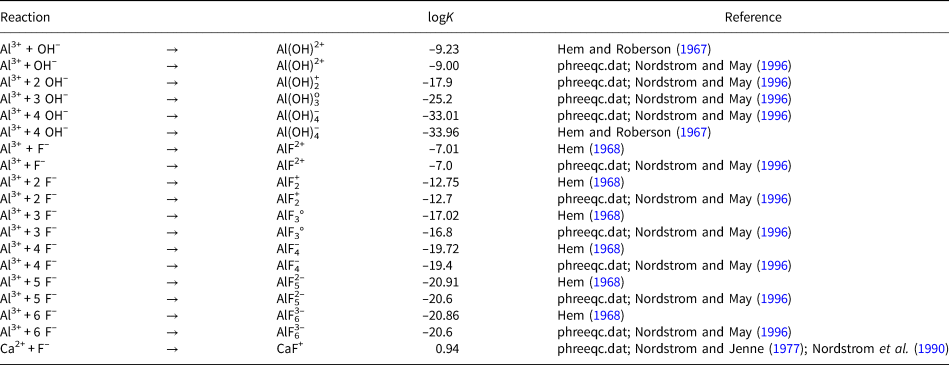
Calculations were obtained with the aid of PHREEQC (v.3.4.0, Parkhurst and Appelo, Reference Parkhurst and Appelo1999) and because of the important role of stability constants in some of these calculations they are listed in Table 1. The values are those used by Roberson and Hem (Reference Roberson and Hem1968) for aluminium fluoride and hydroxide complexes in cryolite solubility along with those used from phreeqc.dat in the computations shown in the results section.
Thermodynamic stability constants used to determine aqueous speciation and solubility product constants at 25°C. A few stability constants from other studies are shown for corroboration.

The phreeqc.dat database uses the Hückel equation (Hückel, Reference Hückel1925) for Na+ and Ca2+ ions and the extended Debye–Hückel equation for Al3+ and F– ions (Nordstrom and Campbell, Reference Nordstrom, Campbell and Drever2014) which are quite adequate for the ionic strength range of cryolite and fluorite solubilities (<0.12 m).
Special mention should be made of the Ca–F complexes. Several investigations have obtained values for the monofluoride ion pair that are in good agreement (logK = 0.94 ± 0.1) (Nordstrom and Jenne, Reference Nordstrom and Jenne1977) and more recent data has not changed this value substantially, e.g. Zamorano-Santander (Reference Zamorano-Santander1985) reported logK = 1.14, Majer and Stulik (Reference Majer and Stulik1982) reported logK = 0.68 and Millero and Pierrot (Reference Millero and Pierrot1998) reported logK = 1.33. For fluorite solubility in pure water, this ion pair is <1% of the speciation and within analytical error, so it does not really affect the calculation of the ion activity product. However, Fovet and Gal (Reference Fovet and Gal2000) reported on the formation constant for the CaF°2 ion triplet with log β2 = 5.7. This constant affects the ion activity product because now the $m_{{\rm CaF}_ 2^{\rm O} }$ > $m_{{\rm CaF}_{}^{\rm +} }$
 , comprising 5% of the calcium speciation and 3% of the fluoride speciation. Ion triplets are not usually important unless the metal or the ligand is present at much higher concentrations than the oppositely charged ion. For fluorite solubility, the molal concentrations of the cation and anion are about the same and having the logK2 >> logK1 does not seem reasonable so this formation constant has not been used in the calculations below. Recent ab initio computations by Zhang et al. (Reference Zhang, Tang, Luo, Wang and Zeng2021) demonstrated the configurational feasibility of the CaF°2 ion triplet but it had a large energy barrier which make it less likely. Higher-order ion clusters were shown not to be feasible.
Results
Villiaumite, NaF, solubility
Villiaumite dissolution is a simple dissociation reaction:

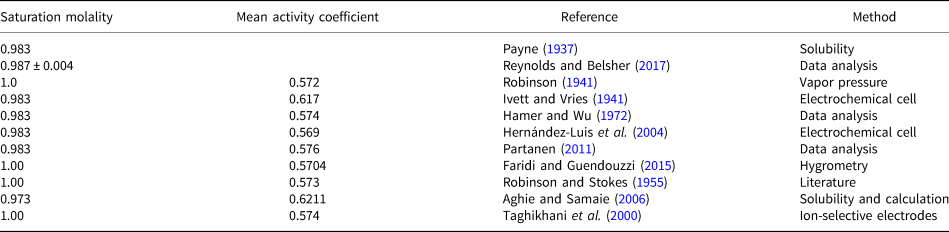
Twenty-two solubility measurements of NaF from 18 reports have been compiled by Reynolds and Belsher (Reference Reynolds and Belsher2017) for 25°C. They screened outliers using statistical methods and concluded the best value was 0.987 m. Prior to their work the solubility was usually based on Ivett and Vries (Reference Ivett and Vries1941) who reported saturation at 0.983 m and was earlier reported by Payne (Reference Payne1937) with the same value. The recommended value from Reynolds and Belsher is S = 0.987 m and their standard error is ±0.004. With reliable mean activity coefficient data, the logKsp and ΔrG° can be calculated (Nordstrom and Munoz, Reference Nordstrom and Munoz1994). A summary of the solubility studies is tabulated in Table 2 along with mean activity coefficient data.
Villiaumite solubilities and mean activity coefficients reported at 25°C.

Seven mean activity coefficients of NaF solutions at saturation and 25°C were found in the literature of which four were primary measurements. The values vary between 0.569 (Hernández-Luis et al., Reference Hernández-Luis, Galleguillos and Vázquez2004) and 0.6211 (Aghie and Samaie, Reference Aghie and Samaie2006). Hamer and Wu (Reference Hamer and Wu1972) regressed the data of Ivett and Vries (Reference Ivett and Vries1941) and Robinson (Reference Robinson1941) to obtain their value of 0.574. If we eliminate the data of Ivett and Vries (Reference Ivett and Vries1941) and Aghamie and Samaie (Reference Aghie and Samaie2006) because they are outliers and take the mean value among the remaining four (Robinson, Reference Robinson1941; Taghikhani et al., Reference Taghikhani, Modarress and Vera2000; Hernández-Luis et al., Reference Hernández-Luis, Galleguillos and Vázquez2004; Faridi and Guendouzzi, Reference Faridi and Guendouzzi2015), the result is 0.571 ± 0.002. The activity is then 0.5636 ± 0.004 and the logKsp = –0.4981 ± 0.006. For dissolution, ΔrG° = 2.843 ± 0.034 kJ/mol from equation 2. These results are often more precise and accurate than what can be achieved from calorimetry.

In the CODATA book on key thermodynamic values, Cox et al. (Reference Cox, Wagman and Medvedev1989) chose the solubility value from Payne (Reference Payne1937) and the mean activity coefficient from Hamer and Wu (Reference Hamer and Wu1972). These were probably the best values available at that time and nearly identical to the values recommended here. Their value for ΔrG° = 2.837 ± 0.050 transforms to logK sp = –0.4969 ± 0.0088.
Villiaumite solubility from calorimetric data
Villiaumite solubility can also be calculated from the Gibbs energies of formation for the species designated in reaction 1 using calorimetric data and equation 2. There is an important caveat attached to using equation 2. The Gibbs energies of reactants and products are always much larger in absolute magnitude than the Gibbs energy of the reaction. Consequently, the Gibbs energy of the reaction is usually the difference between two large numbers, and it gets overwhelmed by the cumulative errors. For accurate and precise data, any logK sp value based on calorimetric data should always be supported by solubility data and solubility data can be used to better constrain calorimetric data for the same system.
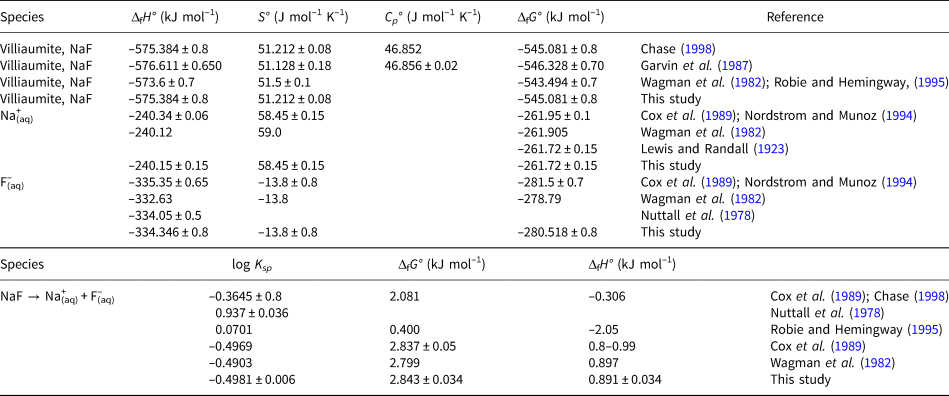
Using the data compiled in Table 3, we find that the logK sp is either –0.3645 or +0.0701 depending on whether one chooses the ΔfG°(NaF) value of −545.081 kJ/mol from Chase (Reference Chase1998) or –543.494 kJ/mol from Wagman et al. (Reference Wagman, Evans, Parker, Schuman, Halow, Bailey, Churney and Nuttall1982), respectively. The same value from Wagman et al. (Reference Wagman, Evans, Parker, Schuman, Halow, Bailey, Churney and Nuttall1982) was also used in Robie and Hemingway (Reference Robie and Hemingway1995). For these values, the errors listed are reflecting something of the precision of the measurements, not the accuracy because these Gibbs energies do not overlap when errors are considered.
Thermodynamic properties for villiaumite dissolution at 25°C.

If one uses all the ΔfG° values (ions and solid) from Wagman et al. (Reference Wagman, Evans, Parker, Schuman, Halow, Bailey, Churney and Nuttall1982) for calculating ΔrG° for the dissolution reaction, the results are very similar to those obtained from solubility and isopiestic data (Table 3). Both the Gibbs energies of the ion and the solid phase are offset by the same amount from the more recent Gibbs energies from CODATA and Chase (Reference Chase1998). These differences appear to be related to the older references for the Wagman NBS tables (Wagman, Reference Wagman, Evans, Parker, Schuman, Halow, Bailey, Churney and Nuttall1982) and the NBS Technical Note series that preceded it (prepared 1968). It only takes a small error in the calorimetric data to change substantially the logK sp value. The combined uncertainty in the Gibbs energy values for the ions, Na+ and F–, is quite small, only about ±0.7, mostly from the F– ion. These uncertainties in ion values should not be the source of the discrepancy because it would call into question several heat measurements on fluoride (and sodium) solutions that are in very close agreement (Cox et al., Reference Cox, Wagman and Medvedev1989). For the solid phase, a consistency check was performed to confirm that the ΔfG°(NaF) could be calculated from

for the data of Chase (Reference Chase1998). The result was indeed confirmed. It should be because the data in Chase (Reference Chase1998) had undergone Second Law and Third Law methods of evaluation.
The next step is to consider the sources of data used by Chase (Reference Chase1998) and by Wagman et al. (Reference Wagman, Evans, Parker, Schuman, Halow, Bailey, Churney and Nuttall1982). Unfortunately, the NBS tables do not have references, but we do know that the references are older than 1968. The NIST–JANAF tables (Chase, Reference Chase1998) have shown nine references from which heat measurements can be used to obtain the ΔfH°(NaF). The measurements were reported between 1884 and 1965. These were in remarkably precise agreement giving the reported value of 575.384 ± 0.8 kJ/mol which is used in this study as more reliable than other sources.
The value of 2.843 ± 0.034 kJ/mol for the ΔrG° of the solubility equilibrium is considered more accurate and that leaves the matter of clearing up the discrepancy between the derivation of the ΔrG° from the solubility determination and from the derivation based on calorimetry. Because the ΔfH°(NaF) is the largest contributor to the value of ΔfG°(NaF) and seems highly reliable from the NIST–JANAF analysis, the thermodynamic properties of the ions need to be examined.
The ΔfG°(Na+(aq)) in Table 3 is shown from several sources, but the most direct and careful measurement is reported from Lewis and Kraus (Reference Lewis and Kraus1910) and reproduced in Lewis and Randall (Reference Lewis and Randall1923) based on measurements of the sodium electrode for the reaction:

which were accomplished with a sodium and a sodium amalgam electrode and measurements of the half-cell potential of the amalgam electrode. The uncertainty on that potential is considered to be 1 millivolt in the potential measurement (Lewis and Kraus, Reference Lewis and Kraus1910; Latimer Reference Latimer1952), which leads to an uncertainty of only ±0.15 kJ/mol for the ΔfG°(Na+aq) and cannot be a major source of uncertainty for the villiaumite dissolution reaction. Hence, we are left with the ΔfG°(F–(aq)) as the source of the greater uncertainty. There is a 2.7 kJ/mol difference between the value reported by CODATA and the value reported by the NBS tables. Because the two sources of data agree on the entropy and the entropy has little effect on the Gibbs energy value, the ΔfG°(F–(aq)) must be examined.
Using the ΔrG° from solubility and mean activity coefficient data along with the ΔfG°(NaF) from Chase (Reference Chase1998) and the ΔfG°(Na+(aq)) from Lewis and Randall (Reference Lewis and Randall1923), the result is

The ΔfH°(F–(aq)) can be calculated from

which agrees quite closely with the experimental value of –334.05 + 0.34/–0.69 kJ/mol reported by Nuttall et al. (Reference Nuttall, Churney and Kilday1978). A consistency check shows that the data from this study in Table 3 results in a ΔrH° = 0.891 ± 0.034 kJ/mol for NaF dissolution which compares well with data compiled by Cox et al. (Reference Cox, Wagman and Medvedev1989) who report experimental values of 0.8 to 0.99 kJ/mol (after correction to infinite dilution). It also demonstrates that it is not possible to maintain consistency between the data evaluation of Chase (Reference Chase1998) and that of Cox et al. (Reference Cox, Wagman and Medvedev1989) without the modifications shown in this study, even though internal consistency is maintained within each evaluation.
Cryolite, Na3AlF6, solubility
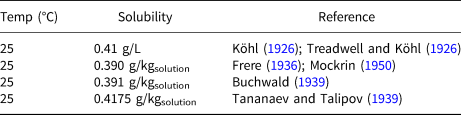
Only six reports on cryolite solubility have been found in the published literature. The first was that of Frere (Reference Frere1936) in which cryolite solubility was measured with variable concentrations of Al and Fe salts at 25°C. One measurement in pure water was reported but the concentration was an order of magnitude too high and a correction was published later by Mockrin (Reference Mockrin1950) to be 0.390 g/kgsolution. The next study (Buchwald, Reference Buchwald1939) reported a concentration of 0.391 g/Lsolution at 25°C. The study by Tananaev and Talipov (Reference Tananaev and Talipov1939) reported 0.4175 g/kgsolution at 25°C and was reported again by Tananaev and Vinogradova (Reference Tananaev and Vinogradova1957). A dissertation by A. F. Köhl (Reference Köhl1926) reported a solubility similar to that of Buchwald (Reference Buchwald1939) and Tananaev and Talipov (Reference Tananaev and Talipov1939). Solubilities at other than 25°C were reported by Buchwald (Reference Buchwald1939) and Tananaev and Talipov (Reference Tananaev and Talipov1939) but are not listed in Table 4.
Reported solubilities of cryolite, Na3AlF6, at 25°C with references.

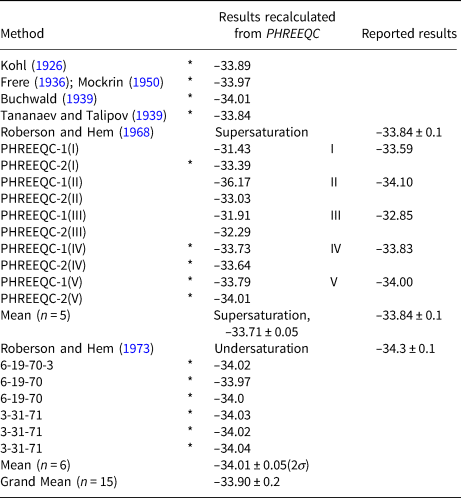
Using the PHREEQC code (v.3.4.0) with molar volume data to calculate density, the solubility results from Frere (Reference Frere1936), Buchwald (Reference Buchwald1939) and Tananaev and Talipov (Reference Tananaev and Talipov1939) gave pH values close to 7 and logK sp values very close to –34.0 (Table 5) which are remarkably consistent with the more carefully done studies by Roberson and Hem (Reference Hem1968 and Reference Roberson and Hem1973).
Comparison of logK sp values. * Indicate values chosen for averaging. Roman numerals refer to the experimental run number listed in Roberson and Hem (Reference Roberson and Hem1968). Arabic numerals refer to Method 1 or 2 and are explained in the text for PHREEQC recalculations of their data.

Using sodium and fluoride ion-selective electrodes, Roberson and Hem (Reference Roberson and Hem1968) measured sodium and fluoride ion activities, dissolved fluoride was also measured colorimetrically, together with dissolved sodium and aluminium by atomic absorption spectrometry. They made five determinations of cryolite solubility with variable pH, aluminium and fluoride concentrations. They reported that one of the five determinations was an outlier and averaged the other four to find logK sp = –33.84 ± 0.1. In agreement with the authors, the outlier is excluded here as well in averaging values, not just because it was an outlier but because it was a solution with the highest pH (8.46) and may have had interferences from hydroxidofluorido complexes in solution, or on surfaces, or Al(OH)3 as a surface phase. This solution (number III) was much closer to amorphous gibbsite solubility equilibrium than any of the other samples.
Because they mixed reagents in different proportions, added perchlorate as an inert electrolyte, and covered a range of pH, they did not measure the simple solubility in pure water. Their solutions were made to be supersaturated and allowed to age for 8 to 15 months. Calculation of activities were obtained without the benefit of a geochemical code so that their data was rerun for speciation in the present study using PHREEQC to check charge balances and to corroborate their results with slightly different complex stability constants and activity coefficients. The ionic strengths of the solutions were all very close to 0.11 m so that activity coefficient variations were not a concern. There are two ways of doing this test. One way is to take their reported concentration values and recalculate the speciation and the logK sp, (Method 1). The other way is to accept their measured sodium and fluoride activities, which were the original measurements, and change the sodium and fluoride concentrations until the PHREEQC calculated activities matched those reported (Method 2). Both methods were employed, and the results are compiled in the Supplementary Appendix. When optimising for two ion activities, an exact match was usually not possible, in which case the fluoride free-ion activity took precedent over the sodium free-ion activity because it has proven to be a more accurate and precise method.
In a later study, Roberson and Hem (Reference Roberson and Hem1973) used natural cryolite from Greenland to determine the solubility from undersaturation. The same analytical and calculational techniques were used as in their earlier study with similar ageing periods. For this study, the solubility in pure water was measured for six runs of ageing times from 8 to 17 months. Their results were also run through PHREEQC in the present study to check charge balances and to confirm their interpretation. Only the concentration data for Na, F and Al were used because ion-selective electrode activities were not available for all samples. After recalculating all experimental values from six reports, minus outliers, the grand mean for the logK sp from undersaturation and oversaturation is –33.90 ± 0.19, which converts to a ΔrG° of 193.524 ± 1 kJ/mol.
Cryolite solubility from calorimetric data
Calorimetric data for cryolite have been evaluated by Wagman et al. (Reference Wagman, Evans, Parker, Schuman, Halow, Bailey, Churney and Nuttall1982), Robie and Hemingway (Reference Robie and Hemingway1995) and Chase (Reference Chase1998). For the ΔfG° of cryolite the values from Chase (Reference Chase1998) and Robie and Hemingway (Reference Robie and Hemingway1995) are nearly identical, –3152.168 kJ/mol and –3152.1 kJ/mol, respectively, whereas the divergent value in Wagman et al. (Reference Wagman, Evans, Parker, Schuman, Halow, Bailey, Churney and Nuttall1982) is –3136.6 kJ/mol and does not include the later work by Anovitz et al. (Reference Anovitz, Hemingway, Westrum, Metz and Essene1987). Furthermore, Chase (Reference Chase1998) does not mention the Anovitz et al. (Reference Anovitz, Hemingway, Westrum, Metz and Essene1987) paper so that their evaluation seems independent of Robie and Hemingway (Reference Robie and Hemingway1995) and yet entirely consistent with it. The enthalpies and entropies are also nearly identical. Chase (Reference Chase1998) has evaluated the enthalpy of formation from eight different enthalpy studies and Robie and Hemingway (Reference Robie and Hemingway1995) only cite the study by Ogorodova et al. (Reference Ogorodova, Kiseleva and Shuriga1989). Hence, a high degree of confidence is attributed to the values from these two sources.
Using ΔfG° = –3152.168 kJ/mol for solid cryolite and the ΔfG° for Na+ and F– ions from those reported above from the villiaumite solubility evaluation in this study and the ΔfG°(Al3+) = –487.7 ± 1.5 kJ/mol from Palmer and Wesolowski (Reference Palmer and Wesolowski1992) results in ΔrG° = 196.21 kJ/mol or a logK sp = –34.37, which is remarkably close to the solubility derived value. Chase (Reference Chase1998) reports an uncertainty of ±3.3 kJ/mol and Robie and Hemingway (Reference Robie and Hemingway1995) report an uncertainty of ±6 kJ/mol. The close agreement also suggests that because of the much higher uncertainty on the calorimetric values compared to the solubility-derived values, the ΔrG° for the solubility reaction should be based on the solubility data and that the main sources of uncertainty are with the ΔfG° for cryolite and the ΔfG°(F–).
It is worth mentioning here that the uncertainty on the ΔfG° of Al3+ has varied from –489.4 to –478 kJ/mol (Hemingway and Robie, Reference Hemingway and Robie1977; Shock and Helgeson, Reference Shock and Helgeson1988) and the enthalpy has varied from –538 kJ/mol (Cox et al., Reference Cox, Wagman and Medvedev1989) to –525 kJ/mol (Hemingway and Robie, Reference Hemingway and Robie1977), an even larger energy spread. The argument advocated by Hemingway and Robie (Reference Hemingway and Robie1977) was that a careful solubility measurement of gibbsite combined with revised calorimetric data on the same gibbsite sample should give a more direct and accurate value for the ΔfG°(Al3+). Based on carefully treated samples to minimise uncertainties from crystallinity, grain size and other defects, the gibbsite solubility studies by Bloom and Weaver (Reference Bloom and Weaver1982) and Palmer and Wesolowski (Reference Palmer and Wesolowski1992) have constrained the ΔfG° of Al3+ to –487.7 ± 1.5 kJ/mol. The fact that the calorimetric data is now much more consistent with the solubility data is another confirmation that the ΔfG°(Al3+) from Palmer and Wesolowski (Reference Palmer and Wesolowski1992) is the most accurate value. Hence, an internally consistent network has been confirmed for the thermodynamic properties of the solubilities of villiaumite and cryolite at 25°C.
Fluorite, CaF2, solubility
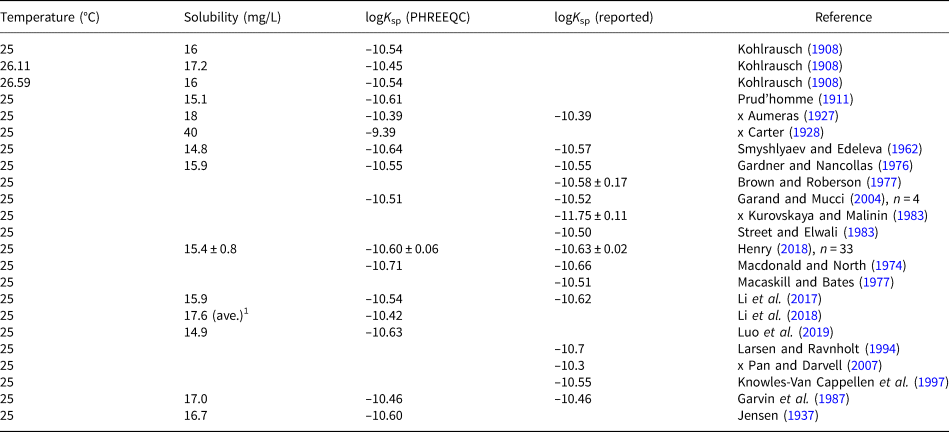
Numerous solubility measurements of fluorite solubility are found in the literature and those measured at or close to 25°C are listed in Table 6 along with the logK sp values, both reported and calculated from PHREEQC when the solubility value is given.
Reported values for fluorite solubility in pure water at or near 25°C. References marked with an ‘x’ were identified as outliers and excluded from averaging. ‘n’ refers to the number of measurements.

1 Average between two methods of measuring the fluoride concentration.
Excluding the same outliers (‘x’ in Table 6) that were excluded in the CODATA review, but updating with some of the new measurements, we have averaged the solubility determinations and, separately, the solubility product constants because not all of the solubility data is available to derive solubility products. Where there is a difference between the solubility products calculated from PHREEQC and those reported, we have chosen the PHREEQC results for consistency. Particular weight has been given to the data of Gardner and Nancollas (Reference Gardner and Nancollas1976) because they obtained both dissolution and precipitation rate data, they determined both dissolved Ca and dissolved F in congruent concentrations, they determined the heat of precipitation, and they obtained a large data set of precise values. The data points were not tabulated, but they could be read from the graph as an average between the dissolution curve and the precipitation curve as they nearly plateaued to a constant value. Additional weight was also afforded the results of Knowles-Van Cappellen et al. (Reference Knowles-Van Cappellen, Van Cappellen and Tiller1997) because that was also a kinetic growth study of fluorite in which they monitored the reaction with Ca and F ion-selective electrodes and obtained identical results as Gardner and Nancollas (Reference Gardner and Nancollas1976) for the equilibrium value.
From 12 reports of fluorite solubility, the mean is 16.0 ± 0.9 mg/L, which converts to a logK of –10.54 ± 0.08. From 18 reports of logK, the mean is –10.57 ± 0.08. Taking into consideration the dissolution and precipitation rate studies of Gardner and Nancollas (Reference Gardner and Nancollas1976) and Knowles-Van Cappellen et al. (Reference Knowles-Van Cappellen, Van Cappellen and Tiller1997), and the large number of measurements by Henry (Reference Henry2018), the mean from these three sources is –10.57. Consequently, this study recommends a logK = –10.57 ± 0.08 and a ΔrG° = 60.34 ± 0.45 kJ/mol based on solubility data.
Fluorite solubility from calorimetric data
For the solubility reaction,

we need the Gibbs energies of the three species, solid fluorite and the Ca2+ and F– aqueous ions. The largest source of uncertainty is the Gibbs energy of the solid phase. Thermodynamic evaluations of fluorite properties are listed in Table 7.
Enthalpy of formation, entropy, heat capacity and Gibbs energy of formation for fluorite from major compilations.

The fluorite enthalpies and Gibbs energies of formation from CODATA (Garvin et al., Reference Garvin, Parker and White1987) and Robie and Hemingway (Reference Robie and Hemingway1995) are nearly identical because Robie and Hemingway (Reference Robie and Hemingway1995) took their values from the NBS tables (Wagman et al., Reference Wagman, Evans, Parker, Schuman, Halow, Bailey, Churney and Nuttall1982) which was the same source as those from CODATA. Also, the CODATA evaluation considered more than 15 solubility measurements and averaged them after rejecting several other measurements that were outside a reasonable range of values, some that were too high and others that were too low. By comparison, Chase (Reference Chase1998) based their Gibbs energy for fluorite on only two averaged solubility measurements, those from Smyshlyaev and Edeleva (Reference Smyshlyaev and Edeleva1962) and Kohlrausch (Reference Kohlrausch1908). Those are among the more reliable solubility measurements and in close agreement, however, they then combined those data with Gibbs energies for the ions from an unpublished evaluation by V. Parker for ΔfG°(Ca2+) and a value for ΔfG°(F–) consistent with ΔfG°(HF) dissolution data. For some reason, the CODATA key values for the ions (Cox et al., Reference Cox, Wagman and Medvedev1989) were not used. The consistency is rather good with only a 2 kJ/mol difference between the two sets of values, but 2 kJ/mol can propagate to a large uncertainty in the logK sp. The same 2 kJ/mol difference is seen in the enthalpy values. Because the solubility reaction has a lower uncertainty than that for solid fluorite, it would be better to derive the ΔfG°(CaF2) from solubility and aqueous ion data.
The standard state thermodynamic values for F– have already been addressed. The most direct and potentially the most reliable value for ΔfG°(Ca2+) would be from measurements of the calcium metal (amalgam) electrode. Unfortunately, there have been challenging problems with the electrode, mostly from preventing oxidation and showing that it is reversible. These concerns have been described by Butler (Reference Butler1968) who was able to show reversibility for the Ca amalgam electrode and evaluating his results along with research reports concluded that the standard potential, E° = 1.996 ± 0.002 V. He was not able to obtain a quantitative measurement to deduce ΔfG°(Ca2+), but he did indicate a semi-quantitative value that was in agreement with the estimate of –2.87 V from Latimer (Reference Latimer1952) and he cited the work of Jakusewski and Taniewska-Osinska (Reference Jakusewski and Taniewska-Osinska1962) whose measurements on the Pb–PbCO3–CaCO3–CaCl2 cell with a calomel reference gave a value of −2.868 V. This latter value converts to –553.43 kJ/mol for ΔfG°(Ca2+) and almost exactly coincides with estimates solely based on solubility, enthalpies of reaction, and entropies from CODATA (ΔfG°(Ca2+) = –552.8 ± 1.1 kJ/mol). In the present evaluation, a median value of –553.0 ± 0.5 kJ/mol will be used and recommended. Finally, using the recommended value for the Gibbs energy of the dissolution reaction and solving for the Gibbs energy of formation of fluorite, ΔfG°(CaF2) = –1174.38 kJ/mol. This value falls conveniently midway between the values recommended by CODATA and those recommended in the NIST–JANAF tables, 4th edition (Chase, Reference Chase1998). Using this Gibbs energy and the entropies of fluorite and the elements from CODATA, the ΔfH°(CaF2) becomes –1227.097 kJ/mol which is also midway between the enthalpy of formation values recommended by CODATA and by NIST–JANAF. This result gives further confidence that this network of minerals and aqueous species are internally consistent.
Conclusions
A survey and evaluation of the internal consistency of thermodynamic data for the fluoride minerals, fluorite, cryolite, and villiaumite and their solubilities and aqueous species has led to a revision in values that resolves differences in databases based on solubility, calorimetry, and electrochemistry. Table 8 summarises these data. This study has shown that: (1) calculations of solubility product constants from calorimetric data often have larger uncertainties than those calculated from solubility determinations; (2) calorimetric data is nevertheless very helpful in constraining spurious values or identifying outliers among several sets of data; and (3) when evaluating a network of interconnected compounds and species, it is important to begin with those measurements that are the most accurate and precise and the most direct in terms of the network path and the computational complexity.
A summary of thermodynamic data for the fluoride minerals, fluorite, cryolite, and villiaumite and their solubilities and aqueous species.

Acknowledgements
I am pleased to make this contribution in honour of Peter Williams with whom I had the great pleasure of meeting and dining at the antimony conference in Jena, Germany. I would like to extend my appreciation to the U.S. Geological Survey in their support of this work, primarily through assisting me in obtaining numerous references. Any use of trade, firm, or product names is for descriptive purposes only and does not imply endorsement by the U.S. Government.
Supplementary Material
To view supplementary material for this article, please visit https://doi.org/10.1180/mgm.2022.40