INTRODUCTION
Pseudo-nitzschia pungens is a eurythermal and euryhaline planktonic diatom species distributed widely in coastal areas around the world (Hasle, Reference Hasle2002; Casteleyna et al., Reference Casteleyna, Chepurnov, Leliaert, Mann, Bates, Lundholm, Rhodes, Sabbe and Vyverman2008). Rhodes et al. (Reference Rhodes, White, Syhre, Atkinson, Yasumoto, Oshima and Fukuyo1996) reported that P. pungens isolated from certain coastal areas of New Zealand produced domoic acid, whereas the same species from other areas of New Zealand did not. Prior to this, P. pungens was considered non-toxic (Smith et al., Reference Smith, Odense, Angus, Bates, Bird, Cormier, de Freitas, Leger, O'Neill, Pauley and Worms1990; Bates et al., Reference Bates, Worms and Smith1993; Villac et al., Reference Villac, Roelke, Chavez, Cifuentes and Fryxell1993; Wang et al., Reference Wang, Maranda, Hargraves, Shimizu, Smayda and Shimizu1993; Lundholm et al., Reference Lundholm, Skov, Pocklington and Moestrup1994; Villareal et al., Reference Villareal, Roelke and Fryxell1994; Vrieling et al., Reference Vrieling, Koeman, Scholin, Scheerman, Peperzak, Veenhuis and Gieskes1996). However, Trainer et al. (Reference Trainer, Adams, Bill, Stehr, Wekell, Moeller, Busman and Woodruff2000) reported toxin-producing P. pungens in many other parts of the world. Since P. pungens is widely distributed along China's coast and a major component of the toxic algal blooms, e.g. in Dalian, Qingdao, Yellow Sea, Changjiang River mouth, Xiamen and South China Sea (Zou et al., Reference Zou, Zhou, Zhang, Smayda and Shimizu1993; Qi et al., Reference Qi, Wang, Zheng, Nontji, Soemodihardjo, Iladude, Setiapermana, Praseno, Moosa and Ongkosongo1996), it is important to study the physiology, population ecology, and toxicity of the species to understand the bloom-forming mechanism and develop bloom prevention and seafood safety monitoring programmes. In recent years, Pseudo-nitzschia spp. has been studied extensively under laboratory conditions, however, population ecology of the species in its natural environment has rarely been reported in China and worldwide. The need for rigorous field investigations of these diatom populations has been recognized repeatedly in recent literature (e.g. Bates & Trainer, Reference Bates, Trainer, Granéli and Turner2006).
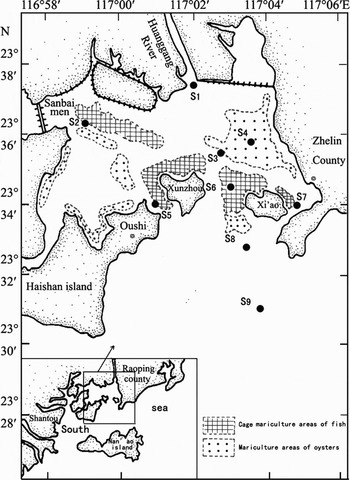
Zhelin Bay is located in south-eastern China, on the north shore of the South China Sea (Figure 1). The aquaculture operations in the bay have increased dramatically since the late 1980s, with approximately half of the water surface occupied by either oyster or cage-fish farms (Huang et al., Reference Huang, Du, Chen, He, Dong and Huang2004). The rapid expansion of aquaculture, human population increase and inadequate sewage treatment have all contributed to the severe eutrophication conditions (e.g. high nutrients) and frequent occurrence of algal blooms (e.g. Skeletonema costatum and Thalassosira diporocyclus) in the bay, negatively impacting the fisheries and ecosystem (Chen et al., Reference Chen, Gao, Du, Dong and Huang2004; Huang et al., Reference Huang, Du, Chen, He, Dong and Huang2004). To quantify the degree of eutrophication and understand the mechanisms of harmful algal blooms, we have conducted a comprehensive survey and monitoring of environmental parameters, nutrients, plankton, microorganisms, heavy metal, and organic pollutants in the water and sediment since 2000. The present study reports the results of the population dynamics of P. pungens.
Map of the sampling sites.

MATERIALS AND METHODS
Sampling stations
Nine stations along the inner to outer bay gradient were established (Figure 1). Station S1 was located at the mouth of Huanggang River; S2 at the Sanbaimen Port; S3 and S4 at the edge and centre of an oyster culture area (–15 km2), respectively; S5 and S7 were at the edge of the fish-cage culture areas; S6 was at the centre of a fish-cage culture area; S8 and S9 were on the outer bay, away from the aquaculture areas. Locating the sampling stations and calculating the culture area were accomplished with the help of a Global Positioning System (GPS12, Garmin Corporation).
Sample collection and analysis
From May 2000 to June 2001, the eight stations (except for S3) were sampled twice per month during the winter (December to February) and 3–4 times per month during the other seasons. From July 2001 to December 2003, all the nine stations were sampled once a month. In 2004, all the nine stations were sampled once per season: spring (March to May), summer (June to August), autumn (September to November) and winter (December to February). Each sampling was accomplished around the high tide (±1.5 h). A shallow water type III plankton net (diameter of 37 cm, area of 0.1 m2 and mesh size of 77 µm) (Administration of Technical Supervision of People's Republic of China, 1992) was pulled vertically from about 0.5 m above the bottom up to the water surface. The samples collected were fixed in situ with formalin to a final concentration of 4% and transported back to the laboratory for algal species identification. To quantify the algal composition and density, a Niskin bottle (HQM-1) was used to collect a 1 l water sample from the bottom (about 0.5 m above the bottom surface) and surface (about 0.5 m below the water surface). Each sample was poured into a polyethylene bottle, fixed with Lugol's solution to a final concentration of 15 and transported back to the laboratory. In the laboratory, the samples were transferred to glass beakers. Twenty-four hours later, the supernatant was repeatedly siphoned off using a meshed (77 µm) pipe until the sample volume was reduced to 30–100 ml. The sample was well mixed before a subsample (1 ml) was taken and placed into a Sedgwick–Rafter phytoplankton counter and under an inverted microscope (Zeiss, Axiovert 25). The algae were identified to the lowest taxa possible and enumerated. Zooplankton samples were collected and enumerated as described previously by Dong et al. (Reference Dong, Lin, He, Kelso and Huang2006).
Water temperature, salinity, turbidity, dissolved oxygen (DO) and pH were measured in situ using a portable water quality analyser (YSI 6600-02, USA). At each station, a water sample of 250 ml was taken from surface and bottom, respectively, filtered (mesh size of 1–3 µm) and transported back to the laboratory in a cooler. A continuous flow analysis (SKALAR, Netherlands) was used to measure the total dissolved inorganic nitrogen (DIN), ammonia (NH4-N), nitrate (NO3-N), nitrite (NO2-N), total dissolved inorganic phosphorous (DIP) and SiO3-Si. The iron (Fe) and chlorophyll-a concentrations were measured spectrophotometrically (UV-2501PC spectrophotometer, Japan).
Data analyses
Average monthly and yearly densities of P. pungens at each station and average monthly density at all the stations were calculated. Because the water was relatively shallow (3–12 m) and well mixed, the surface and bottom values were averaged when calculating densities for each station. Grey incidence–regression analysis was used to evaluate the relationship between the density of P. pungens and the 13 environmental parameters (detailed in Lin et al., Reference Lin, Huang and Chen2005). The samples taken prior to September 2001 were incomplete (lacking certain environmental parameters) and therefore excluded from the analysis.
RESULTS
A total of 1045 samples were collected. Density of P. pungens in these samples ranged from 0 to 50.94 × 10⁴ cells l−1, with an overall average of 1.43 × 10⁴ cells l−1, accounting for 0–53.4% (average 2.9%) of the total phytoplankton density. Two hundred and fourteen samples (20.5%) had densities above 104 cells l−1 (considered harmful algal bloom for the species) and 40 samples (3.8%) had densities above 105 cells l−1. Eighty-seven (40.7%) of the 214 samples that had densities above 104 cells l−1 and 14 (35.0%) of the 40 samples that had densities above 105 cells l−1 were found in the two outer bay stations (S8 and S9).
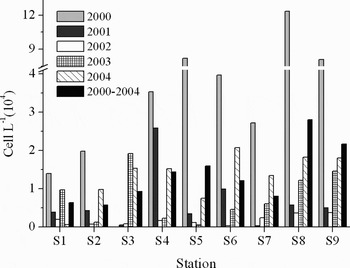
The overall average density of P. pungens per station during the study period ranged from 0.58 × 10⁴ to 2.80 × 10⁴ cells l−1, with a trend of increasing from inner to outer bay, except for the low density (0.80 × 10⁴ cells l−1) at S7 (Figure 2). There are variations among the years, with 2000 having the highest average density (5.28 × 10⁴ cells l−1) when compared to the other years and 2002 having the lowest density (0.19 × 10⁴ cells l−1). The average density of P. pungens over the whole investigation area throughout the study period was 1.43× 10⁴ cells l−1.
The station average of Pseudo-nitzschia pungens during the investigation (2000–2004).

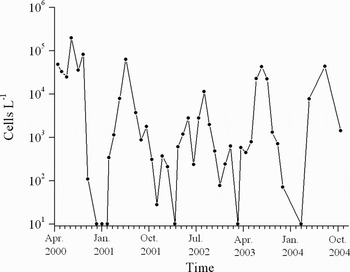
Monthly average density over the study period ranged from 0 to 19.88 × 10⁴ cells l−1, with a peak during the warm (July to September) and a low during the cold months (December to April) (Figure 3). During the cold season (December to March), P. pungens exhibited zero population density at six sampling periods (at least once a year) (Figure 3). On the other hand, the population density was exceptionally high in January 2002 and February 2003 (Figure 3). In general, the population density of P. pungens exhibited a unimodal annual variation during the study period (Figure 3).
The monthly average of Pseudo-nitzschia pungens over the investigation area.

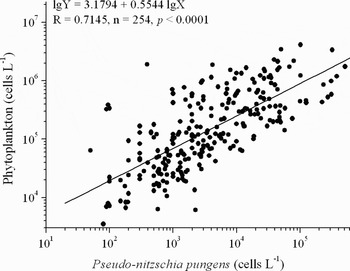
There is a highly significant linear relationship between the densities of P. pungens and total phytoplankton (Figure 4).
Linear relationship between the densities of Pseudo-nitzschia pungens and total phytoplankton.

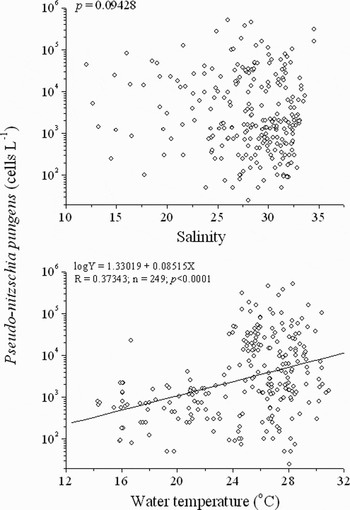
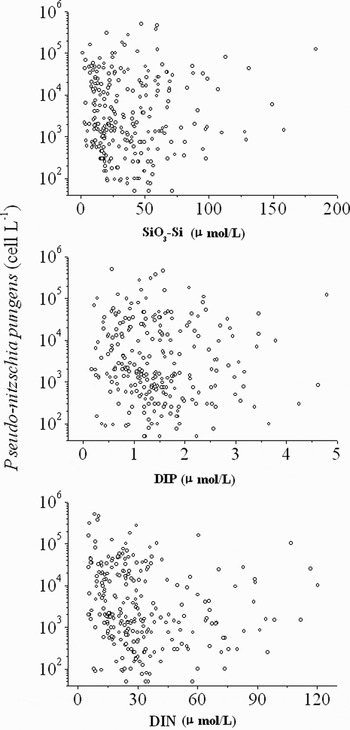
There is a significant linear relationship between the P. pungens density and water temperature (Figure 5). With one exception, water temperatures of the 214 samples with a density 104 cells l−1 or higher were all in the range of 23.8–30.4°C and temperatures of the 40 samples with a density of 105 cells l−1 or higher were all in a range of 29.0–30.4°C (Figure 5). The relationships between the algal density and salinity (Figure 5) and various nutrients (Figure 6), however, are not significant.
The relationship between densities of Pseudo-nitzschia pungens and water temperature and salinity.

The relationship between densities of Pseudo-nitzschia pungens and nutrients.

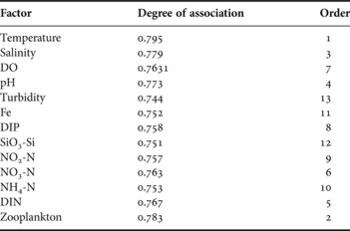
Results of the grey incidence–regression analysis show that the influence of the various environmental factors when P = 0.1 are: temperature > zooplankton > salinity > pH > DIN > NO3-N > DO > DIP > NO2-N > NH4-N > Fe > SiO3-Si > turbidity (Table 1).
Results of the grey incidence–regression analysis between Pseudo-nitzschia pungens and other variables.

DISCUSSION
Although P. pungens only accounted for an average of 2.9% of the total phytoplankton cells during the study period, its grand mean density reached 1.43 ×10⁴ cells l−1 and it is the second most abundant species after Skeletonema costatum in Zhelin Bay (Huang et al., Reference Huang, Wang, Dong and Lin2007). A survey at the Guanghai Bay, Nanhai, Guangdong province in July 1988 found that the population density of P. pungens only reached the order of 103 cells l−1 (Lu et al., Reference Lu, Qi, Qian and Liang1993). Another survey at the Daya Bay, also in Guangdong province, in April 1991, found that during the two P. pungens algal blooms, the densities were 1.82 × 10⁴ and 3.50 × 10⁴ cells l−1, respectively (Li et al., Reference Li, Lu and Liang1993). On the other hand, the total algal density reached the order of 106 cells l−1 during a harmful algal bloom of P. pungens and related taxa at the Amurskii Bay, Japan in June 1992 (Orlova et al., Reference Orlova, Zhukova, Stonike, Yasumoto, Oshima and Fukuyo1996). Based on the cell size (length of P. pungens cell is about 102–134 µm) and population dynamics of the species, it was concluded that a density of 104–106 cells l−1 should be considered a harmful algal bloom (Smith et al., Reference Smith, Odense, Angus, Bates, Bird, Cormier, de Freitas, Leger, O'Neill, Pauley and Worms1990; Li et al., Reference Li, Lu and Liang1993; Martin et al., Reference Martin, Haya, Wildish, Smayda and Shimizu1993). In a review of the nine harmful algal blooms of Pseudo-nitzschia species in North America during the 1980s and 1990s, Bates et al. (Reference Bates, Garrison, Horner, Anderson, Cembella and Hallegraeff1998) found that seven of them had a density of 104–105 cells l−1 and the other two had a density of 106 and 107 cells l−1. In the present study, over 20% of the samples had a P. pungens density of 104 cells l−1 or higher, indicating that there are possibilities for P. pungens blooms to occur around Zhelin Bay. Since the eutrophication is high in Zhelin Bay (Huang et al., Reference Huang, Du, Chen, He, Dong and Huang2004) and algal blooms have occurred frequently during recent years (Huang et al., Reference Huang, Dong and Zheng1999; Chen et al., Reference Chen, Gao, Du, Dong and Huang2004), the possibility of large-scale bloom of P. pungens would be high if the ecosystem degenerates further or physical and chemical conditions change to favour the competitive ability of P. pungens.
Although P. pungens occurred in samples with a water temperature of 14.3–32.3°C in Zhelin Bay, it normally disappeared during the cold months each year and had a strong positive correlation with water temperature. A laboratory study also found that growth rate of P. pungens f. multiseries correlated positively and significantly with temperature in a range between 5°C and 25°C (Lewis et al., Reference Lewis, Bates, McLachlan, Smith, Smayda and Shimizu1993). Because there were excess nutrients available at Zhelin Bay, the P. pungens population is likely to increase exponentially if water temperature is optimal. Water temperature was unusually high during January 2002 and February 2003, and resulted in high densities of P. pungens, indicating that dominant phytoplankton species in eutrophic waters are mainly controlled by water temperature or non-nutrient factors (Huang et al., Reference Huang, Wang, Dong and Lin2007).
The present study suggests that a threshold temperature of 23.8°C was an essential condition for the bloom of P. pungens to occur (reached a density of 104 cells l−1 or higher). This finding agrees with many other studies conducted in North America (e.g. Taylor & Hargh, Reference Taylor and Hargh1996; Horner et al., Reference Horner, Garrison and Plumley1997; Bates et al., Reference Bates, Garrison, Horner, Anderson, Cembella and Hallegraeff1998). Water temperature at Zhelin Bay is normally higher than 23.8°C from May to October each year, when densities of other phytoplankton (e.g. Skeletonema) and zooplankton species are also high (Dong et al., Reference Dong, Lin, He, Kelso and Huang2006). Therefore, competition and grazing might sometimes slow down the increase of P. pungens populations and prevent the bloom from occurring. The formation of an algal bloom is a complicated process resulting from interactions of many factors such as temperature, salinity, nutrients, competition, grazing and current (Keller et al., Reference Keller, Oviatt, Walker and Hawk1999; Boyd et al., Reference Boyd, Watson, Law, Abraham, Trull, Murdoch, Bakker, Bowie, Buesseler, Chang, Charette, Croot, Downing, Frew, Gall, Hadfield, Hall, Harvey, Jameson, LaRoche, Liddicoat, Ling, Maldonado, McKay, Nodder, Pickmere, Pridmore, Rintoul, Safi, Sutton, Strzepek, Tanneberger, Turner, Waite and Zeldis2000; Yang & Hodgekiss, Reference Yang and Hodgekiss2003). The large-scale bloom of Phaeocystis pouchetii along the south-eastern coast of China (including Zhelin Bay) in November–December 1997 (Huang et al., Reference Huang, Dong and Zheng1999) and a bloom of Thalassiosira diporocyclus off Zhelin Bay in December 2001 (Chen et al., Reference Chen, Gao, Du, Dong and Huang2004) were probably initiated by the unusually high water temperature in the winter, as competition and grazing pressure may be low then (Yao, Reference Yao2005; Dong et al., Reference Dong, Lin, He, Kelso and Huang2006). The scope, season, range and duration of harmful algal blooms around the world are all showing the trend of expansion, due to global warming, eutrophication and ecological degradation (e.g. Bates & Trainer, Reference Bates, Trainer, Granéli and Turner2006). Winter algal blooms of other species have occurred at Zhelin Bay and adjacent waters; therefore it is possible that the P. pungens bloom can occur there as well. A P. pungens bloom at the nearby Daya Bay occurred when the water temperature was only 19.7°C in April 1991 (Li et al., Reference Li, Lu and Liang1993). Another P. pungens bloom happened at the Amurskii Bay, Japan in June 1992 when the water temperature was only 14.5°C (Orlova et al., Reference Orlova, Zhukova, Stonike, Yasumoto, Oshima and Fukuyo1996).
There is a trend of increasing population density of P. pungens from the inner to outer bay, similar to that for the total phytoplankton density. Salinity at Zhelin Bay fluctuated between 8.96 and 35.02 and may be one of the important factors influencing the distribution and density of P. pungens. A survey of the Peudo-nitzschia spp. in the Willapa Bay, Wahsington, USA shows that the algae only reached high densities when the salinity was close to 29 (Sayce & Horner, Reference Sayce, Horner, Yasumoto, Oshima and Fukuyo1996). The optimal salinity-range for growth of the P. pungens isolated from Nova Scottia, Canada was 15–30 (Jackson et al., Reference Jackson, Ayer and Laycock1992). Therefore, although the species may live throughout Zhelin Bay, its growth may be depressed in the low salinity regions. However, since more than half of the samples with a density of 104 cells l−1 or higher were found inside of the bay and the large-scale aquaculture in the bay is mainly concentrated in the outer bay, where the salinity is 25 or higher (Dong et al., Reference Dong, Lin, He, Kelso and Huang2006), a P. pungens bloom could occur in the large-scale mariculture areas of the bay despite the low salinity inside the bay.
Grey incidence analysis is a mathematical method that ranks the sequence of importance of various variables in a complicated system, and has been used successfully to elucidate the significant factors in ecosystems (e.g. Huang et al., Reference Huang, Huang, Jiang and Qi2000; Lin et al., Reference Lin, Huang and Chen2005; Liu & Lin, Reference Liu and Lin2006). The present study showed that zooplankton is the second most important factor, after temperature, in influencing the population density of P. pungens. This suggests that the algae are good feed for the zooplankton, a fact that has been verified in several laboratory feeding studies (Wang, Reference Wang1990; Lincoln et al., Reference Lincoln, Turner, Bates, Léger and Gauthier2001). Because the temporal and spatial distribution of the zooplankton richness (Yao, Reference Yao2005) is similar to that for the algae, the zooplankton in Zhelin Bay may be able to suppress the algal growth to a certain degree. But with the ever increasing eutrophication and pollution, the zooplankton community richness in the bay has gradually declined in recent years and its components have changed to species of smaller sizes (Dong et al., Reference Dong, Lin, He, Kelso and Huang2006). The diatom Skeletonema accounted for an average of 67.1% of the total phytoplankton cells and may reduce the grazing pressure on P. pungens (Curl & McLeod, Reference Curl and McLeod1961; Huang et al., Reference Huang, Wang, Dong and Lin2007). If the trend of zooplankton community change continues, the grazing pressure may continue to decline and the probability of harmful algal blooms at Zhelin Bay may increase.
ACKNOWLEDGEMENTS
This project is funded by the Major Projects of Wenzhou Medical College (No. XNK06008) and the Major Marine Technology Projects of Guangdong Province (No. A200005F02). We thank K. Zhou, L. Zhu and C. Wang for assistance with data collection, and S. Rodenburg for English editing.