INTRODUCTION
The establishment of the Radiocarbon Laboratory of the Universidade Federal Fluminense (LAC-UFF), the first radiocarbon (14C) accelerator mass spectrometry (AMS) dedicated facility in South America (Anjos et al. Reference Anjos, Macario, Gomes, Linares, Queiroz and Carvalho2013; Macario et al. Reference Macario, Gomes, Anjos, Carvalho, Linares, Alves, Oliveira, Castro, Chanca, Silveira, Pessenda, Moraes, Campos and Cherkinsky2013, Reference Macario, Oliveira, Carvalho, Santos, Xu, Chanca, Alves, Jou, Oliveira, Brandão, Moreira, Muniz, Linares, Gomes, Anjos, Castro, Anjos, Marques and Rodrigues2015a), and subsequent research about the marine reservoir effect (MRE), particularly on the southeastern Brazilian coast (Macario et al. Reference Macario, Souza, Aguilera, Carvalho, Oliveira, Alves, Chanca, Silva, Douka, Decco, Trindade, Marques, Anjos and Pamplona2015b, Reference Macario, Alves, Chanca, Oliveira, Carvalho, Souza, Aguilera, Tenório, Rapagna, Douka and Silva2016a, Reference Macario, Alves, Belém, Aguilera, Bertucci, Tenório, Oliveira, Chanca, Carvalho, Souza, Scheel-Ybert, Nascimento, Dias and Caon2018; Carvalho et al. Reference Carvalho, Macario, Oliveira, Oliveira, Chanca, Alves, Souza, Aguilera and Douka2015; Alves et al. Reference Alves, Macario, Souza, Pimenta, Douka, Oliveira, Chanca and Angulo2015a, Reference Alves, Macario, Souza, Aguilera, Goulart, Scheel-Ybert, Bachelet, Carvalho, Oliveira and Douka2015b), have contributed to improve 14C-based studies on archaeological shellmounds. The materials that have traditionally been used for 14C analysis are charcoal, seed, shell (Lima et al. Reference Lima, Macario, Anjos, Gomes, Coimbra and Elmore2004; Angulo et al. Reference Angulo, Reimer, Souza, Scheel-Ybert, Tenório, Disaró and Gaspar2007; Macario et al. Reference Macario, Souza, Trindade, Decco, Lima, Aguilera, Marques, Alves, Oliveira, Chanca, Carvalho, Anjos, Pamplona and Silva2014, Reference Macario, Souza, Aguilera, Carvalho, Oliveira, Alves, Chanca, Silva, Douka, Decco, Trindade, Marques, Anjos and Pamplona2015b; Alves et al. Reference Alves, Macario, Souza, Pimenta, Douka, Oliveira, Chanca and Angulo2015a; Carvalho et al. Reference Carvalho, Macario, Oliveira, Oliveira, Chanca, Alves, Souza, Aguilera and Douka2015) and human bones (e.g. Wesolowski et al. Reference Wesolowski, de Souza, Reinhard and Ceccantini2010; Figuti et al. Reference Figuti, Plens and DeBlasis2013; Colonese et al. Reference Colonese, Collins, Lucquin, Eustace, Hancock, Ponzoni, Mora, Smith, DeBlasis, Figuti, Wesolowski, Plens, Eggers, Farias, Gledhill and Craig2014). Mollusk shells constitute important proxies for sea-related information, being widely used in 14C analyses (Thomas Reference Thomas2015a, Reference Thomas2015b). This is mostly due to their calcium carbonate (CaCO3) composition, that implies in relatively easier sample preparation, their abundance in shellmounds and the possibility of taxonomic identification. However, in order to perform studies with such material, methodological issues concerning the sample size, the nature of the samples and taphonomic processes taking place in the archaeological layers (Williams Reference Williams2012) need to be taken into account.
The most frequently used mollusks for the 14C dating of Brazilian shellmounds are Anomalocardia brasiliana (Gmelin 1791), Iphigenia brasiliana (Lamarck 1818), Lucina pectinata (Gmelin 1791) and Neritina virginea (Linnaeus 1758) (de Souza et al. Reference de Souza, Lima and Silva2010). These marine mollusks are benthic invertebrates that occupy sediments in the near shore environment, under the influence of tidal cycles, coastal freshwater drainages and brackish environment (Rios Reference Rios1994). The use of marine organisms depends on the knowledge of the local 14C MRE (Alves et al. Reference Alves, Macario, Ascough and Bronk Ramsey2018).
Some terrestrial mollusks found in the archaeological context, such as the land snails Thaumastus achilles (Pfeiffer 1852) and Megalobulimus sp., can also be used in chronological studies (Carvalho et al. Reference Carvalho, Macario, Oliveira, Oliveira, Chanca, Alves, Souza, Aguilera and Douka2015; Macario et al. Reference Macario, Alves, Chanca, Oliveira, Carvalho, Souza, Aguilera, Tenório, Rapagna, Douka and Silva2016a, Reference Macario, Alves, Carvalho, Oliveira, Bronk-Ramsey, Chivall, Souza, Simone and Cavallari2016b, Reference Macario, Tenório, Alves, Oliveira, Chanca, Netto, Carvalho, Souza, Aguilera and Guimarães2017). However, care should be taken when dealing with such organisms, since variations in the environmental conditions and natural history of some species can generate significant uncertainty in the isotopic signal records according to their growth (Duprey et al. Reference Duprey, Galipaud, Cabioch and Lazareth2014).
The debate over the use of bones for establishing 14C chronologies is still open, with successes and failures. The preparation of bone samples depends on whether the bone is calcinated or unburnt (Zazzo and Saliège Reference Zazzo and Saliège2011). For the latter, the feasibility of dating is limited to the degree of contamination and the preservation of the original collagen (Brock et al. Reference Brock, Higham and Bronk Ramsey2010; Colonese et al. Reference Colonese, Collins, Lucquin, Eustace, Hancock, Ponzoni, Mora, Smith, DeBlasis, Figuti, Wesolowski, Plens, Eggers, Farias, Gledhill and Craig2014). Bone samples within archaeological remains comprise both human and animal bones, from terrestrial or marine origin. Fish skeletons in general can be highly susceptible to diagenesis (Aguilera et al. Reference Aguilera, Belem, Angelica, Macario, Crapez, Nepomuceno, Paes, Tenório, Dias, Souza, Rapagnã, Carvalho and Silva2016) but specifically fish otoliths are extremely resistant.
Fish otoliths found in shellmounds are diverse and abundant, representing an excellent marker of environmental isotope signals, since otoliths are metabolically inert and can retain elements accreted onto their growing surface (Campana and Neilson Reference Campana and Neilson1985). Also known as ear bones, otoliths are acellular structures of aragonite and their composition is relatively pure compared to most biological and mineralogical structures, being dominated by calcium carbonate that is resistant to the diagenetic process under burial conditions. Furthermore, their biomineralization differs from that of vertebrate bone, mollusk shell, and coral skeleton since the otolith epithelium is not in direct contact with the region of calcification (Campana Reference Campana1999). Therefore, it represents an ideal carbonate substrate for geochemical studies, particularly for 14C and isotope analyses. Just like mollusk shells, otoliths are subject to the 14C MRE (Alves et al. Reference Alves, Macario, Ascough and Bronk Ramsey2018) and, in the case of fish bone, care should be taken to avoid species that travel long distances as their carbon isotopic ratio would reflect a mixture of several reservoirs.
Previous research involved the use of otolith for 14C chronology (Piner and Wischniowski Reference Piner and Wischniowski2004; Alves et al. Reference Alves, Macario, Souza, Aguilera, Goulart, Scheel-Ybert, Bachelet, Carvalho, Oliveira and Douka2015b), reservoir effect calculations (Kalish Reference Kalish1993; Alves et al. Reference Alves, Macario, Souza, Aguilera, Goulart, Scheel-Ybert, Bachelet, Carvalho, Oliveira and Douka2015b; Milheira et al. Reference Milheira, Macario, Chanca and Alves2017; Macario et al. Reference Macario, Alves, Belém, Aguilera, Bertucci, Tenório, Oliveira, Chanca, Carvalho, Souza, Scheel-Ybert, Nascimento, Dias and Caon2018), isotope-derived paleotemperature (Thorrold et al. Reference Thorrold, Campana, Jones and Swart1997; Ghosh et al. Reference Ghosh, Eiler, Campana and Feeney2007; Darnaude et al. Reference Darnaude, Sturrock, Trueman, Mouillot, Steven, Campana and Hunter2014; Bertucci et al. Reference Bertucci, Aguilera, Vasconcelos, Nascimento, Marques, Macario, de Albuquerque, Lima and Belém2018), fish growing (Cook et al. Reference Cook, Fitzhugh and Franks2009; Andrews et al. Reference Andrews, Kalish, Newman and Johnston2011), isotope fish migration signals (Holbach et al. Reference Holbach, Cowley, Kramar and Neumann2012; Darnaude et al. Reference Darnaude, Sturrock, Trueman, Mouillot, Steven, Campana and Hunter2014), environmental geochemistry (Albuquerque et al. Reference Albuquerque, Miekeley, Muelbert, Walther and Jaureguizar2012; Stanley et al. Reference Stanley, Bradbury, DiBacco, Snelgrove, Thorrold and Killen2015) and palaeoceanography (Schloesser et al. Reference Schloesser, Rooker, Louchuoarn, Neilson and Secor2009; Grammer et al. Reference Grammer, Fallon, Izzo, Wood and Gillanders2015). Following these works, we discuss the use of otolith for improving the accuracy in the 14C dating of Brazilian shellmounds.
In the present work we use whitemouth croaker (Sciaenidae, Micropogonias furnieri [Desmarest 1823]) otoliths collected from Brazilian shellmounds for 14C analysis and compare the results with those of traditionally dated materials such as marine mollusk shells and charcoal. We also present x-ray diffractograms for crystallographic and quantitative multi-element analyses of some archaeological otoliths, aiming to understand the geochemistry and the diagenesis process under burial conditions, following the criterion that accuracy in 14C dating depends on whether the sampled material is mineralogically pristine in composition.
STUDY AREA
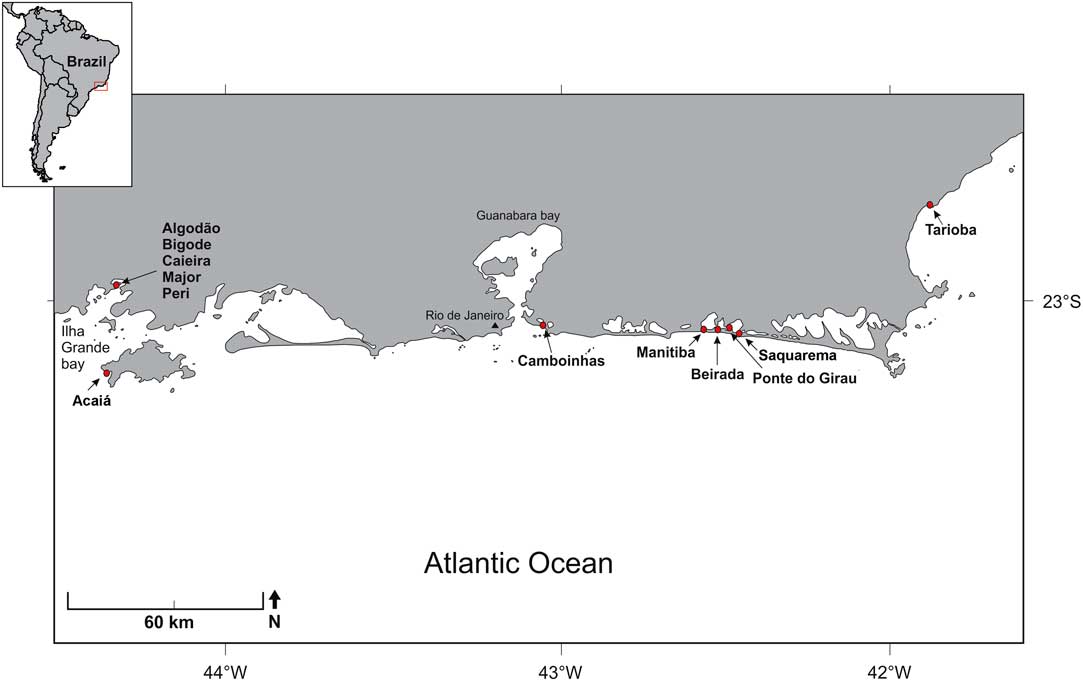
The geomorphology of Rio de Janeiro state is characterized by two large tectonic basins: (1) the Guanabara bay is a structural semi-graben formed during the Tertiary and has numerous Precambrian rock outcrops, with palaeobeaches and marine terraces around the bay and (2) the Ilha Grande bay in the inland, entirely surrounded by the mountainous relief of Serra do Mar and whose coast has numerous islands and islets with little development of transitional sedimentary coastal plains (Eirado et al. Reference Eirado, Heilbron and Almaeida2006; Dias and Kjerfve Reference Dias and Kjerfve2009). The sedimentary coastal plain along the Rio de Janeiro region (Figure 1) is characterized by many coastal lagoons isolated from the Atlantic Ocean by well-developed double sandy barriers and dunes: the Pleistocene landward barrier and the Holocene seaward barrier (Turcq et al. Reference Turcq, Martin, Flexor, Suguio, Pierre and Tasayco-Ortega1999).
Study area along the southeastern Brazilian coast. The red dots on the map show the locations of the studied shellmounds. (Please see electronic version for color figures.)

The northeastern coast of Rio de Janeiro state is a sedimentary plain dominated by delta wave and the modern course of the Paraiba do Sul River (Dias and Kjerfve Reference Dias and Kjerfve2009). The coastal areas along the Rio de Janeiro state are characterized by the absence of calcareous rocks, large coral algae or coral reef community and minimal freshwater inputs. The coastal shelf is strongly influenced by the Brazil Current, which exhibits a pole ward flow of nutrient-poor waters along the shelf edge (Lessa et al. Reference Lessa, Venancio, dos Santos, Belem, Turcq, Sifeddine and Albuquerque2016; Venancio et al. Reference Venancio, Gomes, Belem and Albuquerque2016). However, in the Cabo Frio coastal shelf, seasonal marine upwelling takes place, associated with deep and cold South Atlantic Central Water that rises into the euphotic zone, especially in the austral summer, as a consequence of persistent Northeaster winds (Cordeiro et al. Reference Cordeiro, Belem, Bouloubassi, Rangel, Sifeddine, Capilla and Albuquerque2014). The organic carbon content in the marine sediments of Cabo Frio area was calculated around 1–2% (Sanders et al. Reference Sanders, Caldeira, Smoak, Ketterer, Belem, UMN, LGMS, Silva-Filho, Patchineelam and Albuquerque2014). This geomorphology is directly associated with the coastal environment and the oceanographic influence. Prehistoric research on shellmounds in Brazil, summarized by Wagner et al. (Reference Wagner, Hilbert, Bandeira, Tenório and Okumura2011), has addressed the chronology of gatherers and fishermen settlements along the Brazilian coast. The range of ages recorded in Rio de Janeiro state, in the southeast of Brazil, spans from 8.72 ka cal BP for the Algodão shellmound in the Ribeira Bay, Angra dos Reis (Lima et al. Reference Lima, Macario, Anjos, Gomes, Coimbra and Elmore2003) to 1.30 ka cal BP for the sites in the Cabo Frio Island, Arraial do Cabo (Tenório et al. Reference Tenório, Afonso and Pinto2010), with most of the dates ranging from 6.00 to 2.00 ka cal BP (Wagner et al. Reference Wagner, Hilbert, Bandeira, Tenório and Okumura2011).
MATERIAL AND METHODS
The studied sites are Manitiba, Beirada, Saquarema and Ponte do Girau shellmounds in the Saquarema region (22º55′66″S, 42º29′00″W); the Tarioba shellmound in the Rio das Ostras region (22°31′40″S, 41°56′22″W); the Camboinhas shellmound in the so-called oceanic region of Niterói (22°57′54″S, 44°02′53″W) and the Acaiá, Algodão, Bigode, Caieira, Major, and Peri shellmounds in the Ribeira Bay islets complex, in Angra dos Reis city (22°55′48″S, 44°20′48″W) (Figure 1).
All otolith samples came from the zooarchaeological collection of the National Museum of the Universidade Federal do Rio de Janeiro (MNUFRJ), except the Tarioba samples, recovered during an excavation conducted by the Universidade Federal Fluminense. Among the fish otolith assemblies, those of whitemouth croaker were the most frequent in all shellmounds and this was considered the main target species of native populations (Lopes et al. Reference Lopes, Bertucci, Rapagnã, Tubino, Monteiro-Neto, Tomas, Tenorio, Lima, Souza, Carrillo-Briceño, Haimovici, Macario, Carvalho and Aguilera2016). Based on the importance of this species in terms of prehistoric fisheries and its well-known natural history, we have selected M. furnieri otoliths for 14C analysis. For comparison, we used the data on whitemouth croaker otoliths from the Saquarema shellmound published in Alves et al. (Reference Alves, Macario, Souza, Aguilera, Goulart, Scheel-Ybert, Bachelet, Carvalho, Oliveira and Douka2015b) plus shell and charcoal data from Kneip et al. (Reference Kneip, Pallestrini, De Morais and Cunha1981, Reference Kneip2001), Lima et al. (Reference Lima, Macario, Anjos, Gomes, Coimbra and Elmore2003, Reference Lima, Macario, Anjos, Gomes, Coimbra and Elmore2004), Macario et al. (Reference Macario, Souza, Trindade, Decco, Lima, Aguilera, Marques, Alves, Oliveira, Chanca, Carvalho, Anjos, Pamplona and Silva2014, Reference Macario, Oliveira, Carvalho, Santos, Xu, Chanca, Alves, Jou, Oliveira, Brandão, Moreira, Muniz, Linares, Gomes, Anjos, Castro, Anjos, Marques and Rodrigues2015a, Reference Macario, Alves, Belém, Aguilera, Bertucci, Tenório, Oliveira, Chanca, Carvalho, Souza, Scheel-Ybert, Nascimento, Dias and Caon2018), Alves et al. (Reference Alves, Macario, Souza, Aguilera, Goulart, Scheel-Ybert, Bachelet, Carvalho, Oliveira and Douka2015b), and Carvalho et al. (Reference Carvalho, Macario, Oliveira, Oliveira, Chanca, Alves, Souza, Aguilera and Douka2015).
14C analyses were performed at the Radiocarbon Laboratory of Universidade Federal Fluminense (LAC-UFF) and the Beta Analytic lab. At LAC-UFF the otolith samples were chemically treated with HCl and converted to CO2 by hydrolysis with H3PO4. The obtained gas was purified by means of cryogenic traps and the CO2 was transferred to Pyrex® tubes with zinc and titanium hydride and an inner tube with iron, and graphitization took place in a muffle oven. Graphitized samples were placed in the 40 samples wheel of the SNICS (Source of Negative Ions by Cesium Sputtering) ion source and measured in a NEC 250 kV Single Stage Accelerator System (SSAMS) (Macario et al. Reference Macario, Gomes, Anjos, Carvalho, Linares, Alves, Oliveira, Castro, Chanca, Silveira, Pessenda, Moraes, Campos and Cherkinsky2013, Reference Macario, Oliveira, Carvalho, Santos, Xu, Chanca, Alves, Jou, Oliveira, Brandão, Moreira, Muniz, Linares, Gomes, Anjos, Castro, Anjos, Marques and Rodrigues2015a). Typical currents were 50 μA12C–1 (measured at the low energy Faraday cup). Graphite standard and calcite blanks yielded average 14C/13C ratios of 6 × 10–13 and 7 × 10–13, respectively. The average machine background was around 50 ka for the unprocessed graphite, while the average precision ranged from 0.3 to 0.5%. Data analyses were carried out on the LACAMS software developed at the Physics Institute of the Universidade Federal Fluminense (Castro et al. Reference Castro, Macario and Gomes2015). Calibration of otolith 14C dates was performed with the OxCal software v 4.2.3 (Bronk Ramsey Reference Bronk Ramsey2009) using the Marine13 curve (Reimer et al. Reference Reimer, Bard, Bayliss, Beck, Blackwell, Bronk Ramsey, Buck, Cheng, Edwards, Friedrich, Grootes, Guilderson, Haflidason, Hajdas, Hatte, Heaton, Hoffmann, Hogg, Hughen, Kaiser, Kromer, Manning, Niu, Reimer, Richards, Scott, Southon, Staff, Turney and van der Plicht2013) within the 95% confidence interval. Specific ∆R offsets calculated independently for each site were used to account for local marine reservoir corrections: –140 ± 66 14C yr (Alves et al. Reference Alves, Macario, Souza, Aguilera, Goulart, Scheel-Ybert, Bachelet, Carvalho, Oliveira and Douka2015b) was used for the Saquarema shellmound, –87 ± 71 14C yr (Carvalho et al. Reference Carvalho, Macario, Oliveira, Oliveira, Chanca, Alves, Souza, Aguilera and Douka2015) was used for the Manitiba shellmound and –127 ± 67 14C yr (Macario et al. Reference Macario, Oliveira, Carvalho, Santos, Xu, Chanca, Alves, Jou, Oliveira, Brandão, Moreira, Muniz, Linares, Gomes, Anjos, Castro, Anjos, Marques and Rodrigues2015a) was used for the Tarioba shellmound. In these sites, despite the proximity with a seasonal upwelling area evidenced by the Usiminas shellmound, in llha de Cabo Frio, with ∆R of 67 ± 33 14C yr, the contrasting negative reservoir offsets disclose the competing freshwater influence in this lagoon system (Macario et al. Reference Macario, Alves, Chanca, Oliveira, Carvalho, Souza, Aguilera, Tenório, Rapagna, Douka and Silva2016a). For the Acaiá, Algodão, Caieira, Bigode, Major, and Peri shellmounds located in the Ribeira Bay a ∆R of –80 ± 87 14C yr (Macario et al. Reference Macario, Alves, Belém, Aguilera, Bertucci, Tenório, Oliveira, Chanca, Carvalho, Souza, Scheel-Ybert, Nascimento, Dias and Caon2018) was used. For the other sites, where no specific study on the MRE is available, we used the pre-bomb mean value 32 ± 44 14C years (Alves et al. Reference Alves, Macario, Souza, Pimenta, Douka, Oliveira, Chanca and Angulo2015a) for the coast of Brazil.
For crystallographic characterization, fish otolith samples were prepared and analyzed at the Universidade Federal do Pará, Institute of Geosciences, Mineral Characterization Laboratory. The analysis was performed on an X-ray diffractometer, model X PERT PRO MPD (PW 3040/60), a PANalytical PW3050/60 goniometer (θ/θ), an x-ray tube and ceramic anode Cu (Kα1 = 1.540598 Å; model PW3373/00 fine focus; 2200 W / 60 kV) and a Nickel filter Kβ. The detector was a Real Time Multiple Strip (RTMS), X’Celerator. The samples were pulverized in a mortar to create fine particles and were subsequently packed into a portable specific sample disc for the analysis. The instrumental conditions were as follows: scan range (°2θ) of 3–75°, voltage of 40 kV, amperage of 30 mA, step size of 0.02°, time per step of 81 s, divergent slit of 1/4° and anti-scattering fixed angle of 2°, mask fixed at 10 mm, and a sample rotation frequency of 1 cycle/s in circular movement. Data acquisition was performed with the X’Pert Data Collector software and processed with X Pert High Score software, version 2.1b. Modal concentrations were calculated using the peak area analysis equation of Milliman (Reference Milliman1974). The mineral identification was performed using the standard comparative diffractogram form of ICDD-PDF (International Center for Diffraction Data – Powder Diffraction File).
The quantitative chemical analyses of the total elemental concentrations of major and trace elements in otolith samples included Sr, Zr, Mn, U, Y, A, S, Zn, Ba, Rb, Cr, Nb, and Ni. The analysis was performed on a XR fluorescence spectrometer (XRF) using wavelength-dispersive x-ray spectroscopy (WDS), a sequential spectrometer model from Axios Minerals, and PANalytical’s x-ray anode ceramic tube of rhodium and a maximum power level of 2.4 kW. The samples were prepared for analysis by converting the powder into melted pellets using a mixture of 0.5 g of sample, 0.15 g paraffin wax and 2.35 g of boric acid. The powder was compressed into pellets using a 2-ton weight. Data acquisition was performed with the Super Q Manager software from PANalytical. Standard results were normalized to 100% because the quantified data were based on the relative x-ray intensity emitted by the chemical elements in the sample. The intensity values were mathematically corrected using a fundamental parameter equation and were used to establish a detection limit of 0.1%. Instrumental sensitivity was calibrated using 20 standards of compressed powder (Wroxi, PANalytical).
RESULTS
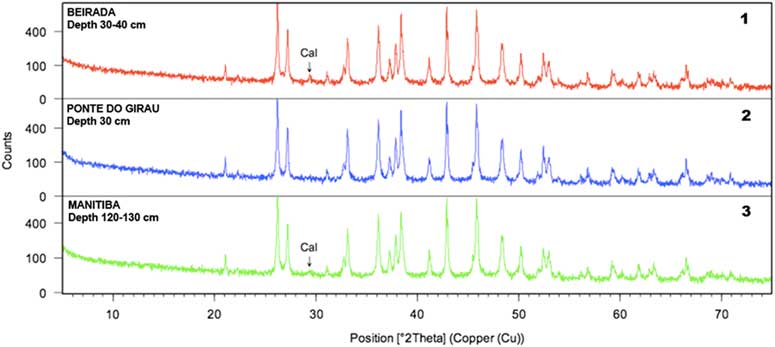
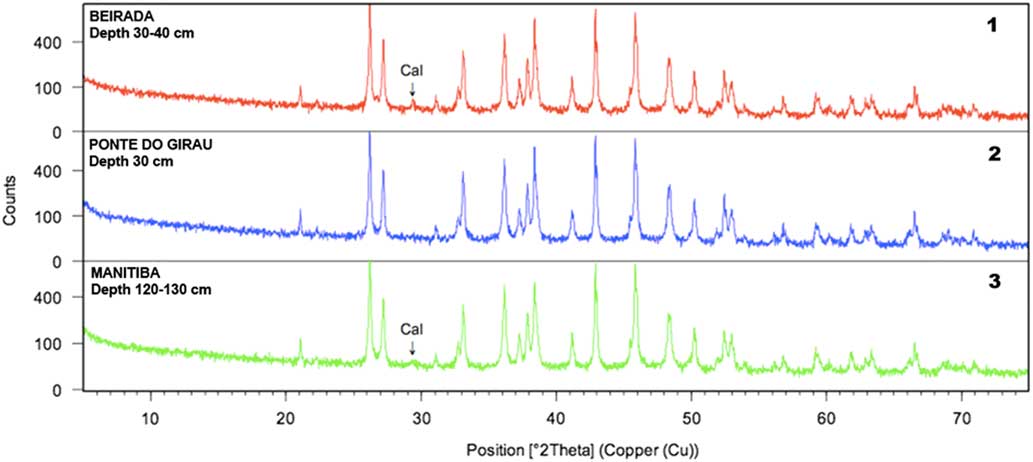
In order to obtain crystallographic composition and to verify if the fish otoliths are resistant to the diagenetic process and recrystallization, we studied otolith samples from three different archaeological sites. Otolith diffractograms obtained for Beirada, Ponte do Girau and Manitiba shellmounds showed significant correlation in their composition of calcium carbonate (CaCO3), with almost exclusive acellular aragonitic structures (orthorhombic crystal) and few traces of calcite (trigonal crystal) (Figure 2). The concentrations of major element oxides for fish otolith from Beirada, Manitiba, and Ponte do Girau shellmound exhibit high calcium values (52–54%), which are followed by low phosphate percentages (0.3–2.6%).
Diffractograms of otoliths (Micropogonias furnieri): (1) Beirada shellmound; (2) Ponte do Girau shellmound; (3) Manitiba shellmound. The arrows indicate the presence of insignificant amounts of calcite (Cal).
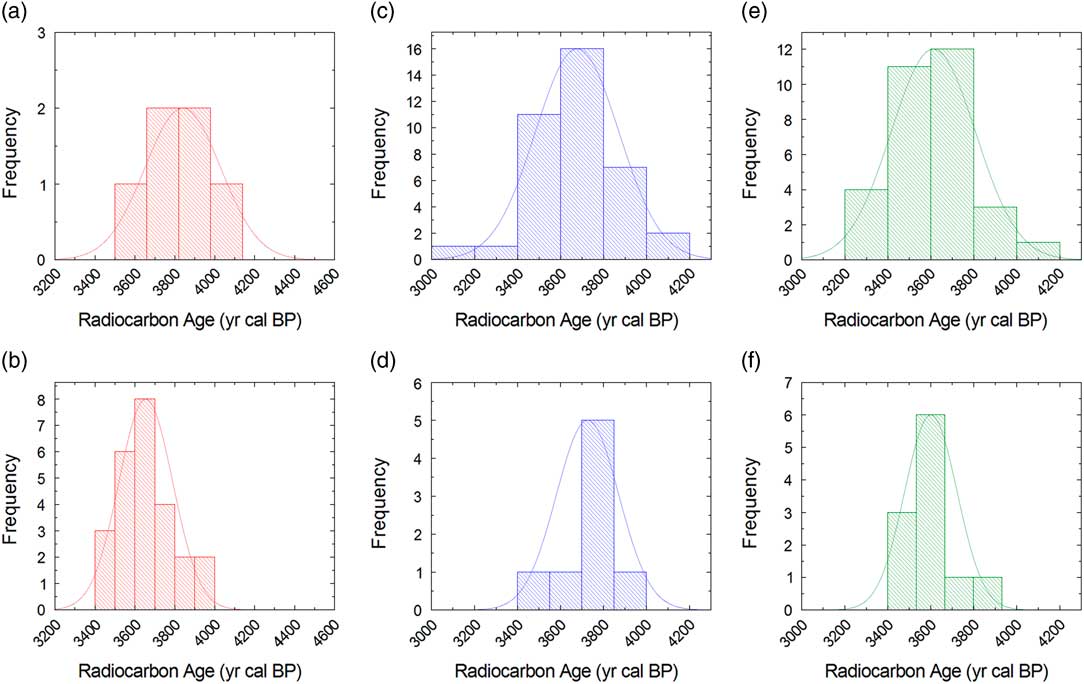
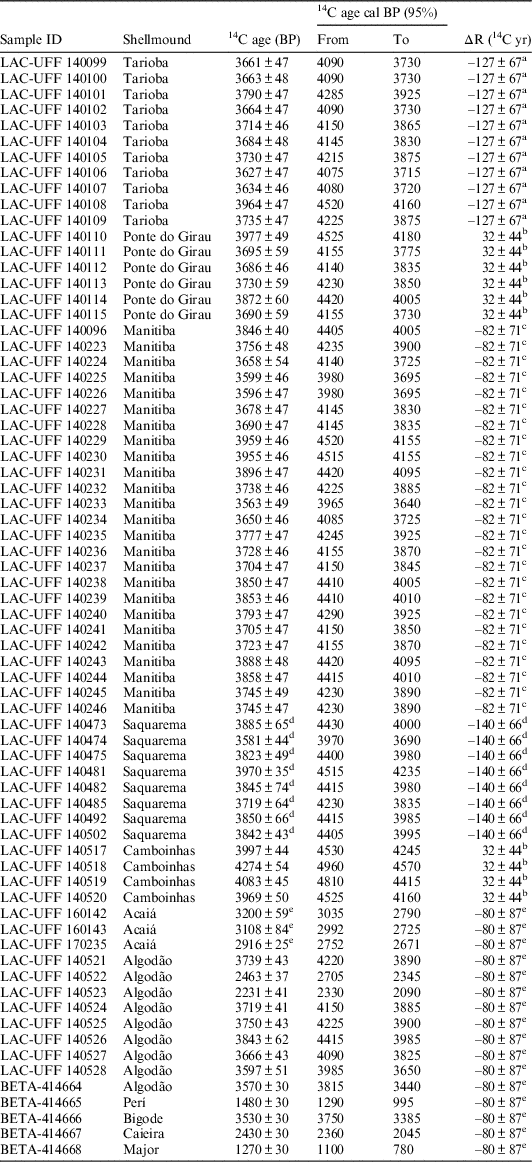
The 14C chronology of Manitiba, Saquarema, and Tarioba shellmounds based on calibrated mean ages of otolith shows narrower age ranges when compared with results from shells (Figure 3; Table 1).
Distribution of calibrated mean ages for each sample and normal tendencies in archaeological otolith (Micropogonias furnieri) and shell: (a) Manitiba shell (n = 6, mean = 3840, SD = 190); (b) Manitiba otolith (n = 25, mean = 3654, SD = 135); (c) Saquarema shell (n = 37, mean = 3677, SD = 194); (d) Saquarema otolith (n = 8, mean = 3726, SD = 145); (e) Tarioba shell (n = 33, mean = 3611, SD = 196); (f) Tarioba otolith (n = 11, mean = 3601, SD = 122).

14C conventional age and calibrated age based on fish otolith (Micropogonias furnieri).

a Macario et al. (Reference Macario, Oliveira, Carvalho, Santos, Xu, Chanca, Alves, Jou, Oliveira, Brandão, Moreira, Muniz, Linares, Gomes, Anjos, Castro, Anjos, Marques and Rodrigues2015a)
c Carvalho et al. (Reference Carvalho, Macario, Oliveira, Oliveira, Chanca, Alves, Souza, Aguilera and Douka2015)
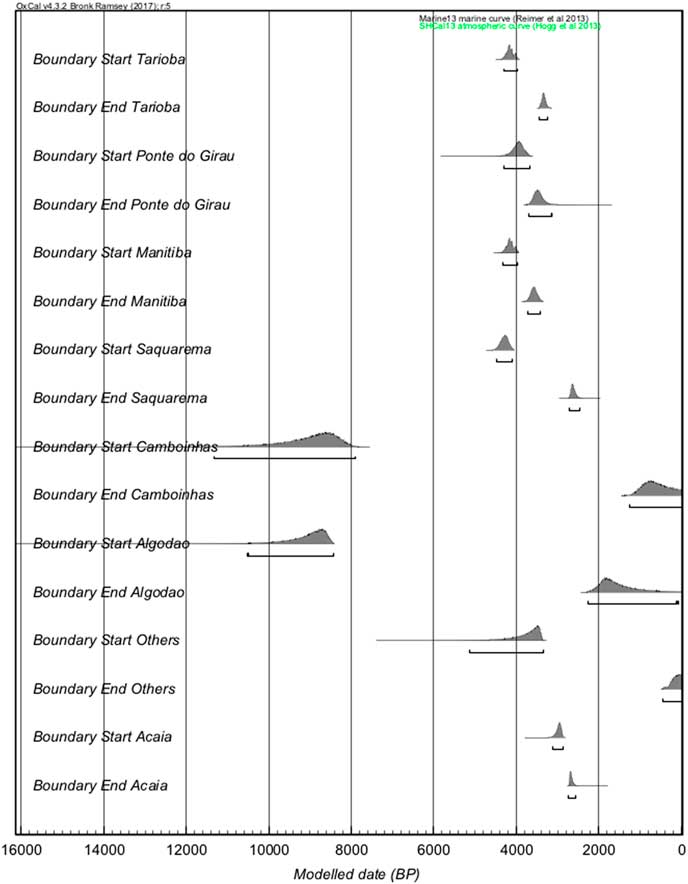
The shallow profiles of most shellmounds on the coast of Rio de Janeiro make it difficult to distinguish between occupational layers since they are often disturbed by burials and other human activities (Macario et al. Reference Macario, Souza, Trindade, Decco, Lima, Aguilera, Marques, Alves, Oliveira, Chanca, Carvalho, Anjos, Pamplona and Silva2014). Therefore, the occupation of each site is treated as a single event. Statistic fluctuations and uncertainties derived from the marine curve and the local MRE also contribute to the occupation range estimate. The time-series of shellmound settlement records is almost continuous during around 400 years of occupation (Figure 4), except in the Camboinhas and Algodão shellmounds (Figure 5; Table 1). Particularly, the Algodão settlement shows two clear periods of occupation, with two distinct stratigraphic levels: the inferior, where an abundant capture of mollusks took place (yellow layer); and the superior, where there was a clear increase in fishing as a means of compensating the smaller availability of mollusks (black layer) (Lima Reference Lima1991; Lima et al. Reference Lima, Macario, Anjos, Gomes, Coimbra and Elmore2003).
Summarized ranges of occupation for the studied archaeological sites. The Peri, Bigode, Major, and Caieira shellmounds are represented in the boundary “Others.”

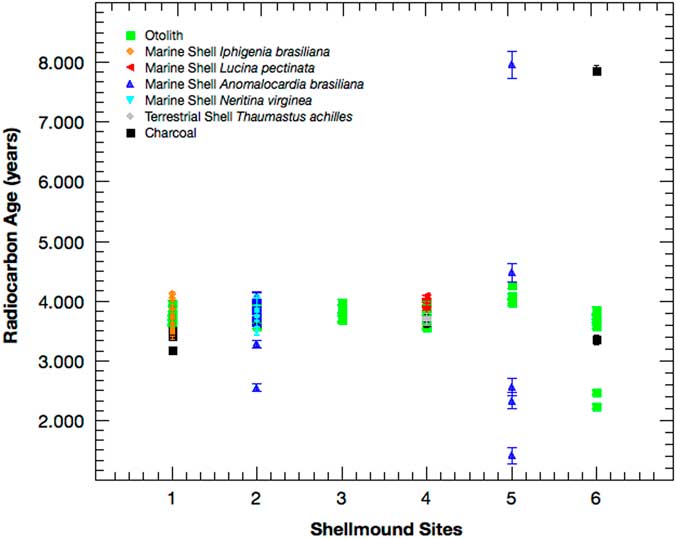
14C age dispersion of archaeological otolith (Micropogonias furnieri), terrestrial and marine shells of different species and charcoal samples in some of the studied sites: (1) Tarioba; (2) Saquarema; (3) Ponte do Girau; (4) Manitiba; (5) Camboinhas; (6) Algodão.

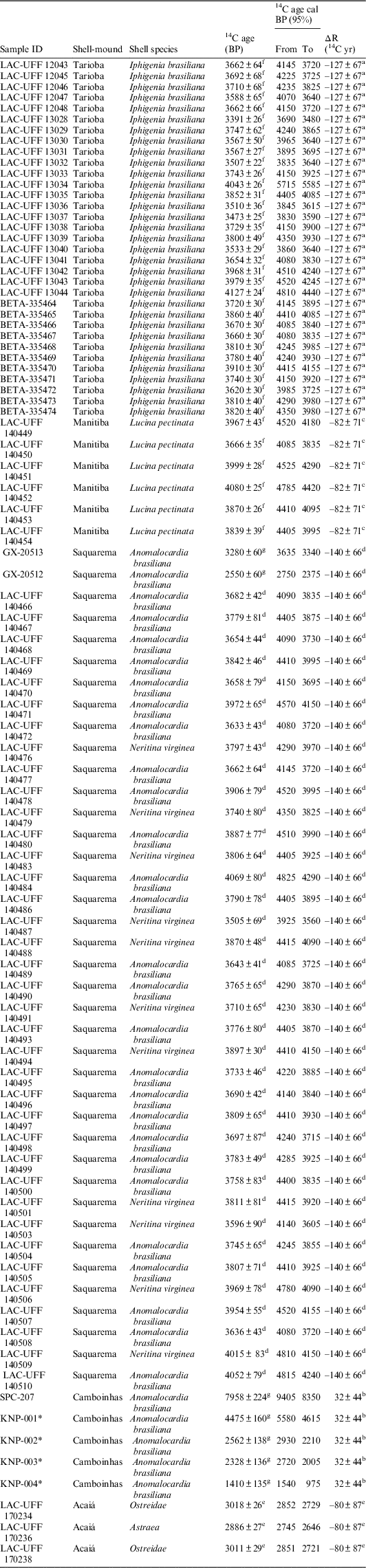
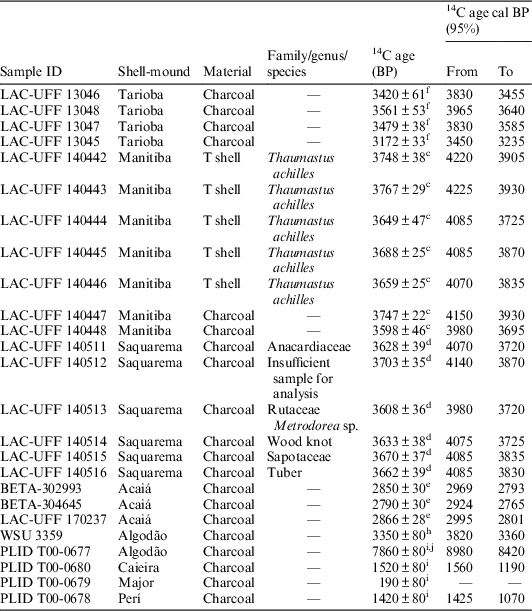
14C data of shell and charcoal exhibits close relationship with otolith 14C chronology results. However, dispersal data and wide age ranges were found in the referential dating of shell and charcoal for Camboinhas and Algodão shellmounds (Figure 5; Tables 2 and 3).
14C conventional age and calibrated age based on shell.

a Macario et al. (Reference Macario, Oliveira, Carvalho, Santos, Xu, Chanca, Alves, Jou, Oliveira, Brandão, Moreira, Muniz, Linares, Gomes, Anjos, Castro, Anjos, Marques and Rodrigues2015a)
c Carvalho et al. (Reference Carvalho, Macario, Oliveira, Oliveira, Chanca, Alves, Souza, Aguilera and Douka2015)
d Alves et al. (Reference Alves, Macario, Souza, Aguilera, Goulart, Scheel-Ybert, Bachelet, Carvalho, Oliveira and Douka2015b)
e Macario et al. (Reference Macario, Alves, Belém, Aguilera, Bertucci, Tenório, Oliveira, Chanca, Carvalho, Souza, Scheel-Ybert, Nascimento, Dias and Caon2018)
f Macario et al. (Reference Macario, Souza, Trindade, Decco, Lima, Aguilera, Marques, Alves, Oliveira, Chanca, Carvalho, Anjos, Pamplona and Silva2014)
g Kneip et al. (Reference Kneip, Pallestrini, De Morais and Cunha1981).
* Sample ID for Camboinhas samples does not represent a laboratory code; it represents a reference to Kneip et al. (Reference Kneip, Pallestrini, De Morais and Cunha1981) samples.
14C conventional age and calibrated age based on terrestrial shell and charcoal.

c Carvalho et al. (Reference Carvalho, Macario, Oliveira, Oliveira, Chanca, Alves, Souza, Aguilera and Douka2015)
d Alves et al. (Reference Alves, Macario, Souza, Aguilera, Goulart, Scheel-Ybert, Bachelet, Carvalho, Oliveira and Douka2015b)
f Macario et al. (Reference Macario, Souza, Trindade, Decco, Lima, Aguilera, Marques, Alves, Oliveira, Chanca, Carvalho, Anjos, Pamplona and Silva2014)
h Lima (Reference Lima1991)
i Lima et al. (Reference Lima, Macario, Anjos, Gomes, Coimbra and Elmore2003)
j Lima et al. (Reference Lima, Macario, Anjos, Gomes, Coimbra and Elmore2004). T shell = terrestrial shell.
DISCUSSION
Technological advancement, alternative chemical treatments of samples and statistical models represent important resources for increasing precision and accuracy of chronological records. However, the environmental conditions, the shellmound cultural context, the nature of samples and the collection methods in the archaeological excavation need to be clear and well-defined, because the archaeostratigraphic interpretation prevents any taphonomic distortion of the analyzed material and dispersion of data to be discussed. For this reason, most of the results can only be grouped as single occupational events. Variability among the 14C dates limits the ability of calculating a settlement period. When compared to shell and charcoal, otolith data reveal lower dispersion during settlement time period for Beirada, Manitiba, Ponte do Girau and Tarioba shellmounds.
The age dispersion of shellmounds records can be associated with up to 400 years of occupation, except for the Camboinhas and Algodão shellmounds (Figure 4; Tables 1–3). The Algodão settlement shows two periods of occupation, represented here by the so-called upper black layer and lower yellow layer. For most sites, 14C data of charcoal and shells (Tables 2 and 3) exhibit close relationship with otolith 14C chronology results, independent on the mollusk species. However, dispersal data and wide ages range were found in the referential dating of shell and charcoal for Camboinhas and Algodão shellmounds (Tables 2 and 3).
The otolith diffractograms from Beirada, Ponte do Girau and Manitiba shellmound corroborate previous studies (Campana Reference Campana1999; Darnaude et al. Reference Darnaude, Sturrock, Trueman, Mouillot, Steven, Campana and Hunter2014; Alves et al. Reference Alves, Macario, Souza, Aguilera, Goulart, Scheel-Ybert, Bachelet, Carvalho, Oliveira and Douka2015b) and reinforces the potential use of otoliths for accurately 14C dating the Brazilian shellmounds. Their acellular aragonite structure, differently from fish bones analyzed from the same shellmounds (Aguilera et al. Reference Aguilera, Belem, Angelica, Macario, Crapez, Nepomuceno, Paes, Tenório, Dias, Souza, Rapagnã, Carvalho and Silva2016), revealed no diagenetic changes driven by variations in environmental conditions. Moreover, the geochemical condition of the otoliths analyzed in this study reflects their resistance to the diagenetic process under burial conditions in the three different studied sites.
Results of 14C chronology from Camboinhas show a similar period of settlement, however, the shell records for this shellmound show a large span in the occupation interval of settlement compared with other sites in the region. The unusual old age of 7.96 ± 0.22 ka BP recorded by Kneip et al. (Reference Kneip, Pallestrini, De Morais and Cunha1981), occurred during a Holocene transgression while the sea level was around five meters below the present, and started to raise to the present sea level according to sedimentological research of Bartholomeu (Reference Bartholomeu2010) in the Itaipu-Camboinhas region. The natural taphonomy is a real effect that could be increased artificially by the random gatherers of shells, and the most plausible hypothesis is that some shells could have been transported from the natural older sediments dated in 7.18 ± 0.06 ka BP in the Itaipu-Camboinhas area (Bartholomeu Reference Bartholomeu2010) and do not represent a direct relationship with the age of pre-historic settlements. A younger age of 1.41 ± 0.14 ka BP recorded by Kneip et al. (Reference Kneip, Pallestrini, De Morais and Cunha1981) from the same shellmound, could be interpreted likewise. Therefore, the 14C chronology results based on otoliths (4.43–3.80 ka cal BP [95%]) from the Camboinhas shellmound could be a more probable age range.
The shellmound in the Algodão islet is characterized by two archaeological layers, the upper soft black layer, rich in humus mixed with sand, small shells and bones, and, the lower yellow layer characterized by a consolidated mixture of large shells and clay sediments (Lima Reference Lima1991). Otolith analyses reveal two distinct age zones, the younger black upper layer with a minimal age of 1.71 ka cal BP (95%) and the yellow lower layer with maximal age of 3.86 ka cal BP (95%). Previous 14C ages based on charcoal samples records from the Algodão shellmound show 3.64–3.45 ka cal BP (95%) for the black layer and 8.72–8.46 ka cal BP (95%) for the yellow layer (Lima Reference Lima1991; Lima et al. Reference Lima, Macario, Anjos, Gomes, Coimbra and Elmore2003, Reference Lima, Macario, Anjos, Gomes, Coimbra and Elmore2004). The Algodão shellmound is located in the same environmental context of other rocky islets, in the Ribeira Bay of Angra dos Reis. However, the 14C ages from the islets of Major (charcoal age 0.19 ± 0.08 ka BP in Lima et al. Reference Lima, Macario, Anjos, Gomes, Coimbra and Elmore2004 and otolith age 1.27 ± 0.03 ka BP in the present paper), Peri (charcoal age 1.42 ± 0.08 ka BP in Lima et al. Reference Lima, Macario, Anjos, Gomes, Coimbra and Elmore2004 and otolith age 1.48 ± 0.03 ka BP in the present paper) and Caieira (charcoal age 1.52 ± 0.08 ka BP in Lima et al. Reference Lima, Macario, Anjos, Gomes, Coimbra and Elmore2004 and otolith age 2.43 ± 0.03 ka BP in the present paper), show that the shellmounds within the islets complex of Ribeira Bay do not seem to be contemporary. However, the recent age from the islets of Major is probably related to the historical occupation of the site, which in situ evidences testified a colonial occupation in the 19th century. This site was disturbed and it is likely that the dated sample was mixed with the prehistoric layers.
The old charcoal age of 7.86 ± 0.08 ka BP attributed to the yellow layer in the Algodão shellmound is incompatible with the otolith-derived age estimated here. However, further information could be obtained with additional analyses of charcoal samples and mollusk from this site.
Quaternary sedimentology research and references for the Ribeira bay in Angra dos Reis are not available, however the eustatic sea level curve, compiled by Fleming et al. (Reference Fleming, Johnston, Zwartz, Yokoyama, Lambeck and Chappell1998), shows that around 7.00 ka the sea level was almost 4 m below the present sea level, and in younger ages, two in situ samples in Angra dos Reis-Paraty dated at 5.20 ± 0.20 ka BP and 4.80 ± 0.20 ka BP (Martin and Suguio Reference Martin and Suguio1978; Angulo et al. Reference Angulo, Lessa and Souza2006) indicate an elevation of 4.8 m. The more parsimonious chronology for Ribeira Bay islets could be the otolith-derived age for black and yellow layer age zones. Although a few dates are insufficient to perform a significant statistical series and the debate over the use of multi proxies sources (charcoal, mollusk, bones and otoliths) for establishing 14C chronologies is still open.
CONCLUSIONS
In the present work, we studied fish otoliths from the whitemouth croaker from some archaeological settlements on the southeastern Brazilian coast. Diffractograms have shown similar aragonite composition in three different studied sites indicating resistance to diagenesis during burial conditions. 14C dating distributions for each archaeological site agree with the results from the literature based on charcoal and mollusk shells. Moreover, otolith results have shown lower dispersion when compared with charcoal and shells, leading to a more precise estimate of the occupational period for each site.
ACKNOWLEDGMENTS
This work was financially supported by FAPERJ (APQ1, Grant E-26/111.278/2014 to OA; CNE, Grant E-26/203.019/2016 to KDM; Grant E-26/110.138/2014 to KDM and CC), PROPPI-UFF (Grant 46094044157201298 to OA). CNPq (INCT-FNA 464898/2014-5, KDM grant 305079/2014-0 and CC grant 311354/2016-5) and CAPES. The authors would like to thank A. Camardella for assistance in the shellmounds repository of MN-UFRJ, R. Sousa and E. Pereira for the support with Tarioba samples, C. Monteiro-Neto for ECOPESCA-UFF laboratorial facilities. R. Angelica helped us with the diffractometer and geochemical composition analyses of otolith samples, the reviewers and to the associate editor Irka Hadjas for their comments.