


Introduction
Awareness of the importance of the genetic diversity of crop plants has been increasing since the early 1970s, which has prompted much investment in genebank development and maintenance (Hawkes, Reference Hawkes1983). More recently, the concept of on-farm in situ conservation has emerged (Altieri and Merrick, Reference Altieri and Merrick1987; Maxted et al., Reference Maxted, Ford-Lloyd and Hawkes1997), involving permanent cropping and management of crop populations within the environment where the species has evolved (Bellon et al., Reference Bellon, Pham, Jackson, Maxted, Ford-Lloyd and Hawkes1997). It is now widely recognized that these two approaches are complementary and should be jointly included in conservation strategies (Olfield and Alcorn, Reference Olfield and Alcorn1987; International Plant Genetic Resources Institute, 1993; Brush, Reference Brush and Brush1999; Wood and Lenné, Reference Wood and Lenné1999). However, efficient in situ conservation methods have yet to be developed (McKey et al., Reference McKey, Emperaire, Elias, Pinton, Robert, Desmoulière and Rival2001).
As in situ conservation requires active farmer participation, much recent research has focused on factors which influence farmers' decision making (Cox and Wood, Reference Cox, Wood and Lenné1999). Jarvis and Hodgkin (Reference Jarvis, Hodgkin and Brush2000) identified five aspects of farmers' decision making that have a direct impact on crop diversity, including: (i) preferred agromorphological traits; (ii) cropping systems practised; (iii) plot characteristics; (iv) crop population size; and (v) varietal origins. Since farmers maintain crop genetic diversity according to supply–demand imperatives, Bellon (Reference Bellon2003) proposed that in situ conservation support should be designed to influence diversity supply and demand. Demand-oriented interventions should enhance the value of the diversity for farmers or reduce on-farm diversity maintenance costs, while supply-oriented interventions should promote access to the diversity.
Another key point in developing a methodology for in situ conservation is the gain of insight into the extent and spatial distribution of the genetic diversity to be preserved and current extinction risks. This insight is essential for choosing genetic entities to be preserved, deciding on the scale of potential conservation support operations, as well as for selecting ecogeographical units and social organization (farm, village, village group, agricultural region, etc.). Early ecological theories regarding local or complete extinction risks were based on wild populations, and focus mainly on population size (Pimm et al., Reference Pimm, Jones and Diamond1988; Caughley, Reference Caughley1994), frequency (Hanski and MGyllenberg, Reference Hanski and Gyllenberg1993) and distribution (Lawton, Reference Lawton1994). These cannot be applied directly to explain trends in local varieties of crop species preserved by farmers in traditional agrosystems, but may still be useful as a guide to develop an in situ strategy for the conservation of crop genetic resources.
In situ conservation of rice particularly is pressing in Africa, where the replacement of traditional varieties with modern high-yielding varieties is less advanced than in Asia. An in situ conservation strategy is now urgent, since the co-cultivation of indigenous Oryza glaberrima with Asian O. sativa has likely given rise to a unique genetic diversity. This diversity has been described both on a continental and on a subregional scale (Second, Reference Second1982; Ghesquière and Second, Reference Ghesquière and Second1983; Kochko, Reference Kochko1987; Bezançon, Reference Bezançon1995), and some conclusions have been reached concerning the centres of diversification of O. glaberrima, the introduction and secondary diversification of O. sativa, the extent of diversity of these two cultivated species in relative terms, and the existence of reproductive barriers. However, little effort has been made to analyse this diversity and its distribution on an operational scale for the purposes of in situ conservation, i.e. agricultural region, village, farms and farmers' fields. The aim of this study was therefore to: (i) document the spatial distribution of rice genetic diversity at the grass-root scales (village and small agricultural region) based on molecular marker genotyping; (ii) identify the most effective strategy for the conservation of the genetic diversity; and (iii) contribute to the development of a rice genetic resource conservation strategy in a region of Guinea, where the two rice cultivated species occur together, by identifying the most vulnerable genetic entities and basic ecogeographical units that should ultimately be the focus of conservation support operations.
Material and methods
Plant collection
The plant material was collected as part of a broader study involving an analysis of farmers' management of rice varieties and seeds in Maritime Guinea, on a regional, village and farm scale. Fourteen villages (Fig. 1) were chosen to account for the agro-ecological diversity in the region on the basis of current agro-ecological zoning data (Beavogui et al., Reference Beavogui, Diallo and Dillo2000). The distance between villages was between 5 and 280 km. In each village, a public survey was conducted on the history of rice growing over the previous 20 years, rice cropping practices used (cropping in flooded mangrove ecosystems, freshwater plains or upland ecosystems), and rice varieties and seed management practices. An inventory was carried out to list the names of rice varieties cultivated in the village and to note the main ecosystem in which each variety was cropped (Table 1). Finally, for each variety, a seed sample was collected in the field in the presence of a group of farmers who identified the variety by consensus agreement. The ‘consensus sample’ was formed from 15 panicles, each from a different plant belonging to the predominant phenotype growing in the same field. Classification into O. glaberrima or O. sativa was effected on the basis of the degree of panicle ramification. In all 170 accessions were collected, of which 144 were O. sativa and 26 O. glaberrima; 94 were collected in a lowland ecosystem (LLE) and 77 in an upland ecosystem (ULE).
Ecogeographical distribution of the 14 research villages in Maritime Guinea. The villages 01 (Douprou), 03 (Kaboguessy), 05 (Katako), 06 (Katep) 08 (Kifinda) and 13 (Wassou) are in lowland ecosystems; the villages 02 (Hlafou), 04 (Kantch), 07 (Kenende), 09 (Lafoub), 10 (Mokefot), 11 (Saraya), 12 (Thia) and 14 (Yenya) are situated in upland ecosystems.

Main characteristics of the 14 research villages

a LLE, lowland ecosystem; ULE, upland ecosystem.
b DM, dyked mangrove rice; FWLL, freshwater lowland; RUL, rainfed upland rice in slash and burn system; UDM, undyked mangrove rice. Rice is transplanted in the DM, UM and FWLL cropping systems; rice is sown direct in the RUL cropping system.
c O.s., Oryza sativa; O.g., Oryza glaberrima.
d***Good/high quality; **medium; *bad.
Genotyping
Eleven genetically unlinked simple sequence repeats (SSR) loci were chosen on the basis of their informativeness (Luce et al., Reference Luce, Noyer, Tharreau, Ahmadi and Feyt2001). The DNA representing each accession was extracted (using the method of Risterucci et al., Reference Risterucci, Grivet, N'Goran, Pierett, Flament and Lanaud2000) from young leaves taken from four seedlings, each derived from an independent panicle. PCR was conducted following Risterucci et al. (Reference Risterucci, Grivet, N'Goran, Pierett, Flament and Lanaud2000) and the products separated in duplex in 7 or 8% polyacrylamide gels on a LiCor IR2 DNA sequencer. Allele sizes were determined using the SAGA (version 3.2) software package, which encodes genes in base pairs using size markers every eight wells on each gel.
Data analysis
Genotypic data were assessed to detect duplicates (i.e. accessions with different names but the same genotype), but no case of complete identity was found. Genetic diversity was estimated on the basis of allele number (Na), allele frequency, heterozygosity rate (Ho) and polymorphism information content (PIC) using Power Marker version 3.20 (Liu and Muse, Reference Liu and Muse2001–Reference Liu and Muse2004). Genetic distances between accessions was calculated using the Dice similarity index (Saitou and Nei, Reference Saitou and Nei1987), and accessions were grouped using the neighbour-joining (NJ) method with DARWIN version 5.0 (Perrier et al., Reference Perrier, Flori, Bonnot, Hamon, Seguin, Perrier and Glaszmann2003). The hierarchical distribution of the molecular variance between the three sampling levels, i.e. ecosystem, village and accession, was analysed by analysis of molecular variance (AMOVA; Excoffier et al., Reference Excoffier, Smouse and Quattro1992) with Arlequin version 2.0 (Schneider et al., Reference Schneider, Roessli and Excoffier2000). Genetic differentiation between pairs of villages was evaluated by the F ST statistic (Wright, Reference Wright1978) calculated using Arlequin version 2.0. F ST estimation was based on the between-group variance in allele frequency, which represented the genetic distance. F ST significance was assessed with 1023 permutations. A Mantel test was performed using GENPOP 3.4 software to compare genetic distance (evaluated by F ST) correlation matrix and geographical distance correlation matrix in order to determine whether genetic isolation had occurred according to the geographic distance between the different villages.
Results
Consistency of accession names
In total, 113 names were recorded for the 170 accessions, of which 81 shared 23 names. There were 13 homonyms for two accessions, eight for three accessions, five for four accessions, two for six accessions and one for 11 accessions. This homonymy begs the question of genotypic identity, which was tested by assessing closeness of homonyms on the NJ tree (Fig. 2). There were marked variations in the consistency levels for the different names. For some, many accessions were clustered on the same branch of the tree, whereas for others, the accessions were dispersed. For 10 of the 23 names, homonym accessions were closely located to one another, without any complete overlap. These names were considered as consistent. For instance, accessions named Djou Kémé (number 9 on Fig. 2) were tightly clustered. Accessions with seven other names were highly dispersed, making these names inconsistent—for example Caroline (number 8 on Fig. 2).
Relative closeness of homonym accessions on the neighbour-joining tree based on the Dice similarity index calculated for 81 accessions and 11 SSR loci. Accessions identified with the same number are homonyms; for instance, number 9 identifies accessions with the name Djou Kémé; number 8 identifies accessions with the name Caroline.

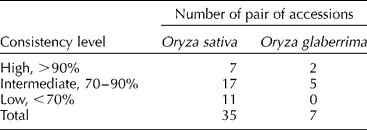
Direct comparison of the allelic identity between pairs of accessions with the same name (Table 2) revealed perfect consistency in only nine cases out of the 42. For O. sativa, seven out of 18 names were consistent, including four traditional (Djou Kémé, Tagna, Mafoudi and Moromi) and three improved (Rok5, B38D2 and Kablack) varieties. Djou Kémé and its synonyms identified very similar genetic entities in 11 of the 14 villages. In contrast, three names out of 18 had a very low level of consistency, e.g. Missi Missi, Caroline and Kinsampéna. The first two are generic names designating small- and long-grain varieties, respectively. The consistency level in O. glaberrima was high (four names out of five consistent).
Genotypic consistency of varieties' names evaluated by comparison of allelic identity at 11 SSR loci
Genetic diversity
The number of varieties per village varied from four to 34 (mean 13.7), according to the village size. A total of 128 SSR alleles (mean of 12 alleles per locus, with a range of 9–15) were detected (Table 3). Mean PIC per locus was 0.81 (range 0.68–0.88), and the heterozygosity rate ranged from 1 to 16% (mean 7%), although these estimates conflate heterozygosity with intra-accession variability due to the use of pooled template. The mean number of alleles per locus was 11 for O. sativa and four for O. glaberrima. Loci RM164 and RM1 were among the most polymorphic in O. sativa but the least so in O. glaberrima. Conversely, RM332 and RM7 were highly polymorphic in O. glaberrima but less so in O. sativa.
Diversity at 11 SSR loci

N, Number of accessions; Na, mean number of alleles per locus; PIC, polymorphism information content; Ho, mean heterozygosity rate per locus.
The mean number of alleles per locus (Na) and per village ranged from 2.6 to 6.7 (Table 4) and represented almost half of the mean Na recorded for the region, indicating that each village pooled a relatively high share of the regional allelic diversity. A positive correlation (r = 0.906) was noted between the number of varieties per village and the allelic diversity, indicating that accessions collected in each village corresponded fully to different genetic entities, thereby confirming the validity of the methods used to inventory and sample rice varieties in each village.
Number of alleles per locus at the village level

N, Number of accessions; Na, mean number of alleles per locus.
Ecogeographical structure of genetic diversity
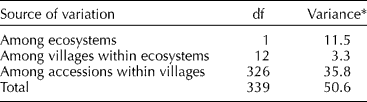
A hierarchical analysis of the molecular variance showed highly significant genetic differentiation at the three sampling levels (Table 5). The molecular variation distribution was, however, very uneven. The differentiation between accessions from the same village represented 70% of the total variation. Of the total genetic diversity, 23% was due to differentiation between the two ecosystems, LLE and ULE. The smallest share of the molecular variance (7%) was associated with differences between villages within the same ecosystem.
Summary of AMOVA results
* P < 0.001.
The F ST values per pair of villages (Table 5) showed that genetic differentiation between villages was low, especially when the villages were located in the same ecosystem. In LLE, the F ST per pair of villages was significant in 12 cases out of 15 (Table 6). However, the correlation between the F ST and the geographical distance between the pair of villages was not significant. The genetic differentiation between villages therefore was not related to the geographical distance but rather to the rice-growing conditions (freshwater plain, open or embanked mangroves) and to the number of varieties per village (Table 7). In ULE, only six pairs of villages out of 28 had significant F ST values. F ST values between pairs of villages located in two different ecosystems were all significant. The ULE village Saraya had the lowest F ST when paired with villages located in LLE (Table 6). Such a low genetic differentiation could likely be explained by the fact that three accessions collected in this village were from a ULE, although genotypically they seemed to belong to an indica subset.
Genetic differentiation (F ST) among pairs of villages

Significance of F ST was tested with 1100 permutations: a, P>0.05; b, P < 0.05; c, P < 0.01; d, P < 0.001.
Value and significance of F ST per pair of villages, according to their ecosystem of origin

Significance of F ST was tested with 1100 permutations: a, P>0.05; b, P < 0.05; c, P < 0.01; d, P < 0.001.
Discussion
Importance of rice genetic diversity
The surface area of Maritime Guinea is relatively small but the genetic and allelic diversity present is comparable to that in much larger geographical areas. The mean number of alleles per locus was 10 for indica and eight for japonica sativa accessions from Maritime Guinea, but only 7.3 and 6.1, respectively, for 234 indica and tropical japonica entries representative of the genetic diversity of rice worldwide (Garris et al., Reference Garris, Tai, Coburn, Kresovich and McCouch2005). This greater number of alleles per locus may reflect our choice of SSR loci on the basis of their high PIC level. However, in a population of over 400 Mediterranean varieties, Luce et al. (Reference Luce, Noyer, Tharreau, Ahmadi and Feyt2001) detected 9.5 alleles per locus across the same SSR loci. Thus the allelic diversity of Maritime Guinea rice cannot be solely explained by the choice of SSR loci. Instead, we suggest that it is a consequence of the co-existence of virtually all rice-growing ecosystems in this region.
For O. glaberrima, the mean number of alleles per locus among the 29 accessions was lower than that observed by Semon et al. (Reference Semon, Nielsen, Jones and McCouch2004). Note, however, that these authors analysed variation at 93 SSR loci across 198 accessions derived from all rice-growing ecosystems throughout Africa, whereas our glaberrima sample was mainly derived from upland ecosystems.
Varietal diversity managed by farmers
In traditional cropping systems, a given genotype is commonly known by different names in different villages, so diversity with respect to names is an unreliable indicator of prevailing genetic diversity. We were unable to identify any accessions of the same genotype under different names, while accessions having the same name seldom had exactly the same genotype.
Consistency in varietal name is a good indicator of the performance of the rice identification systems developed by farmers. In Maritime Guinea, naming combines morphological traits (seed format and colour, tillering capacity, leaf colour), with adaptation to different rice-growing ecosystems, e.g. mangrove, deep water, ground water and upland. Hence, the best name consistency was noted for varieties with marked morphological features.
The high consistency level noted in this study was in line with the survey data (data not shown), indicating that only 3% of the varieties had changed name when introduced in a new village.
Finally, variety name consistency is also a potential indicator of genetic drift which may occur when varieties are disseminated between villages. The inter-village genotypic consistency in variety names generally ranged from 70 to 90%. Dissemination of rice varieties between villages thus likely results in modifications in their genetic structure. However, these modifications could not be considered as full-fledged genetic drift, but rather as a succession of foundation effects.
The ratio between the number of accession names and the total number of accessions is a key indicator of the spatial partitioning of genetic diversity. In Maritime Guinea, this ratio was 66%, indicating that the diversity was largely partitioned between villages. Less than 20% of the accessions occurred in two to three villages and only 15% of the remainder were present in more than three of the villages studied. Each village therefore contained a high proportion of unique genetic diversity.
The non-unique proportion of genetic diversity in the villages could be explained by either the recent introduction of new sativa varieties, and/or to the attachment of most glaberrima varieties to a particular ethnic group, geographical area or a combination of these parameters. The traditional variety Djou Kémé, and the modern varieties Rok5, War73 and War77, clearly fall in the first category. In contrast, the glaberrima varieties have long been cropped in the region; the names of those cropped in LLE have the prefix ‘Baga malé’; those cropped in ULE have the prefix Samanden and Sagnakhi in northern regions inhabited by the Fulani and Landouma ethnic groups, and Sali in southern regions inhabited by the Soussous and Bagas ethnic groups.
On a village scale, rice genetic diversity can be divided into as many as three components according to the duration of their presence in the village: a very old component shared with neighbouring or ethnically related villages, composed mainly of glaberrima varieties; a rather ancient component of traditional sativa varieties that is no longer, or hardly at all shared with other villages on account of its differentiation induced by local agro-environmental factors; and a more recent component, composed of improved sativa varieties introduced recently in the village by the extension services; this last component has not yet undergone substantial differentiation and is thus shared with other villages in the region. The sativa components are composed of indica subspecies varieties in villages belonging to LLE and of japonica subspecies varieties in ULE villages.
Ecogeographical distribution of genetic diversity
Diversity between accessions within the same village was the most important component of regional genetic diversity. This prevalence of the diversity between accessions of geographical or genetic subsets has also been reported in other contexts in cultivated rice (Yu et al., Reference Yu, Xu, Geo and Song2003; Garris et al., Reference Garris, Tai, Coburn, Kresovich and McCouch2005), in populations of the wild African rice species O. longistaminata (Kiambi et al., Reference Kiambi, Newbury, Ford-Lloyd and Dawson2005) and in sorghum (Nkongolo and Nsapato, Reference Nkongolo and Nsapato2003). These data indicate that, to ensure efficient conservation of genetic diversity, each basic genetic and/or geographical subset must be carefully sampled. The low level of genetic differentiation recorded between villages within the same ecosystem was in line with the results of our survey of rice variety and seed management practices in this region (data not shown), which indicated intense exchanges of varieties between villages within the same ecosystem. In LLE, it was found that, more than the distance, it is the extent of exposure of rice crops to salinity that determines the possibility of between-village exchanges and the resulting level of genetic differentiation.
Allele richness varied substantially among the 14 villages studied. The mean number of alleles per locus depended on the number of varieties cropped in the village (r = 0.909) as well as on the status of rice in the cropping system. The number of varieties cropped depended on the number of inhabitants in the village (r = 0.56). The cropping systems had an especially marked influence in the villages of Yenya and Thia which, despite being of medium size, i.e. 800 and 520 inhabitants (mean 700 inhabitants for the 14 villages), had the lowest mean number of alleles per locus. In these two villages, the status of rice in the cropping systems had sharply decreased during the last two decades. Due to decrease of soil fertility rice is replaced by groundnut and fonio.
In conclusion, the regional distribution of rice genetic diversity follows the diversity in rice-growing ecosystems, the social organization in villages and the extent of between-village exchanges. In terms of variety, thus of allelic combinations, each village pools a large proportion of unique genetic diversity. However, in terms of allele number, each village pools a large share of the regional diversity.
The village is clearly a basic geographical and social unit to be considered in initiatives aimed at preserving the genetic diversity of rice. However, other levels of differentiation should also be taken into consideration. The subdivision into two large ecosystems, i.e. lowland and upland, accounts for the indica–japonica differentiation and a large share of the sativa–glaberrima differentiation. In each of these ecosystems, the diversity in soil constraints is also important. This level of differentiation needs to be taken into account since there can be marked temporal changes in this parameter. In LLE, the main change under way is the development of some plains to reduce the salinity constraint. This change should enhance rice genetic diversity because recently introduced higher-yielding modern varieties are only cropped in these developed areas. In ULE, the main changes under way concern loss of soil fertility, which is leading to a shift in cropping systems whereby rice is being replaced by hardier crops. This is a serious impediment to the conservation of the genetic diversity of rice. This situation is especially worrisome since Maritime Guinea is one of the only African regions where upland glaberrima varieties are still cropped on a large scale.
Acknowledgement
The French Ministry of Foreign Affairs, the Centre de Coopération en Recherche Agronomique pour le Développement provided funding for this research.



