Introduction
Ganjam is one of the recognized sheep breeds of the eastern region of India. The animals are mainly distributed in Orissa State and derive their name from the Ganjam District of the state. According to the Basic Animal Husbandry Statistics from the Government of India (2006), the indigenous sheep comprise about 99.25 percent of the total sheep population of Orissa. The Ganjam breed animals are well adapted to the agroclimatic conditions and vegetation of the region. Families that are less privileged economically, especially of the Gola community, normally rear these sheep for mutton under a fairly simple and extensive management system with the help of their family members. Despite their economic importance to the rural poor for living and sustenance, Ganjam sheep are inadequately characterized (Acharya, Reference Acharya1982; Mishra et al., Reference Mishra, Barik, Patro and Nayak2004). The present study was therefore undertaken to evaluate the characteristics of the Ganjam breed both phenotypically and at the DNA level to have a holistic picture (information) of this breed. The results of this study may prove useful in suggesting some guidelines for suitable improvement and conservation of this breed.
Methodology
The breeding tract was visited, and the distribution of the breed was identified through discussions with various officers of the Animal Husbandry Department. The survey was conducted in the Ganjam, Nayagarh, Cuttack, Gajpati, Rayagada, Koraput, Phulbani, Khorda and Puri Districts of Orissa State for phenotypic characterization of this breed under field conditions. Information on the morphological characterization and performance parameters of Ganjam sheep was collected through interaction with the farmers, personal observations and on the spot recording from 49 farmers' flocks totaling more than 1500 sheep.
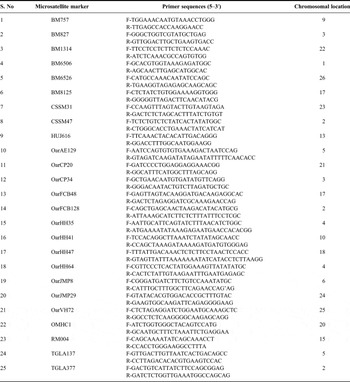
Genetic characterization of Ganjam sheep was achieved using ovine microsatellite markers (Table 1; FAO, 1996) that are highly polymorphic, codominantly inherited and ubiquitous in nature (Litt and Luty, Reference Litt and Luty1989). Fresh blood samples were randomly collected from 50 unrelated Ganjam sheep across their breeding tract in line with Global Project for the Maintenance of Domestic Animal Genetic Diversity (MoDAD) recommendations (FAO, 1996). Blood sampling was coordinated with owners and veterinary officers. DNA was extracted from the white blood cells using the standard phenol/chloroform/isoamyl alcohol extraction protocol (Sambrook, Fritsch and Maniatis, Reference Sambrook, Fritsch and Maniatis1989).
The primer sequences and chromosomal localization of the used microsatellites.

The loci were amplified by polymerase chain reaction in 25-μl volumes using 100-ng template DNA, 200 µM of each deoxyribonucleotide triphosphate, 50 ng of each primer, 1.5 mM of MgCl2, 0.5 U of Taq DNA polymerase and 1× Taq buffer. A common touchdown programme as suggested under the MoDAD Project with no extension step was used. Polymerase chain reaction products were checked on 2 percent agarose gel, and the alleles were resolved on a 6 percent denaturing polyacrylamide gel by silver staining according to Bassam, Gustavo and Gresshoff (Reference Bassam, Gustavo and Gresshoff1991). The genotype of each individual animal at 25 different loci was recorded by direct counting. Allelic size range was estimated using a 10-bp sequencing ladder as a standard molecular weight marker.
Statistical analysis
The allele number for each locus was scored manually from the silver stained gels. The effective number of alleles was calculated as the reciprocal of the homozygosity.
Estimates of the expected heterozygosity were calculated according to Nei (Reference Nei1978). A measure of heterozygote deficiency or excess (average within population inbreeding estimate [F IS]) was estimated according to Wright's method (Reference Wright1978). The software package POPGENE 3.2 (Yeh et al., Reference Yeh, Boyle, Rongcai, Ye and Xian1999) was used for the analyses. The polymorphism information content was calculated according to Botstein et al. (Reference Botstein, White, Skolnick and Davis1980). The population was analyzed for the presence of genetic bottlenecks via the Sign Test, Standardized Differences Test and Wilcoxon Test (under the infinite allele mode, two phase model and stepwise mutation model of microsatellite evolution) using BOTTLENECK software (Piry, Luikart and Cornuet, Reference Piry, Luikart and Cornuet1999).
Results and Discussion
Habitat
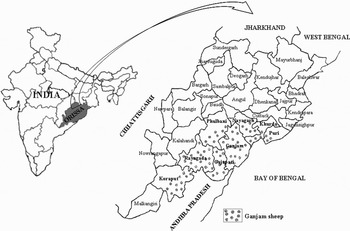
Based on the present survey observations, Ganjam sheep breed are distributed in the Ganjam, Gajpati, Rayagada, Koraput, parts of Phulbani, Nayagarh, Khorda and Puri Districts of Orissa (Figure 1). Some animals of this breed, although in less pure form, are also found in Cuttack District. However, according to earlier reports, the breed exists only in the Koraput, Phulbani and part of Puri Districts of Orissa (Acharya, Reference Acharya1982). The area mostly consists of saline and sandy coastal soil. The temperature ranges from a minimum of 11.5 °C in winter (i.e. December–January) to a maximum of 39 °C in summer (i.e. May–June). The region receives annual rainfall of about 134 cm from the southwesterly monsoons, and 74 percent of this rainfall is received during June to September. Cyclones and hail are common in this area. Irrigation is mainly by tubewell and open wells. Rice (Oriza sativa) is the major crop; pulses (Family Leguminosae), groundnut (Arachis hypogaea), potato (Solanum tuberosum) and sugarcane (Saccharum officinarum) are also cultivated.
Distribution of Ganjam sheep.

Morphological characterization
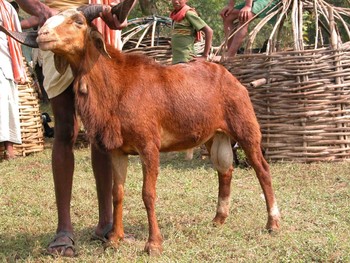
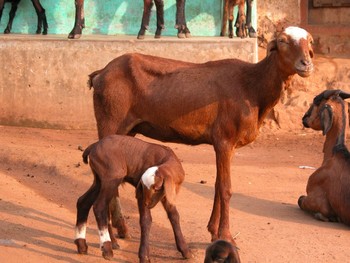
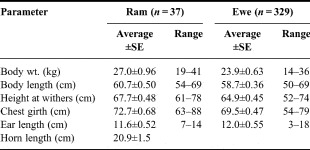
Physical characteristics were established for 604 animals (37 rams, 329 ewes and 238 lambs). The animals are medium sized, slender and leggy. The backline and noseline are straight. The coat colour ranges from brown to dark tan, but some of the animals are white. Some animals have white spots on the forehead, face and body (Figures 2, 3 and 4). The ears are medium to long, and the tail is short and thin. Males are horned and females polled, and the sheep are usually not shorn. Hairy and short fleece covers the body of Ganjam animals. However, rams have long hair below the neck and hindquarters. Body measurements were recorded on 366 animals of both sexes. The averages of the various body measurements are presented in Table 2. The farmers dispose of the surplus males to local traders according to their need or breeding requirements, so the males that were measured were mostly breeding rams. The rams exhibited higher estimates for all parameters except ear length, which was slightly higher in ewes. Mishra et al. (Reference Mishra, Barik, Patro and Nayak2004) documented the effect of season and sex on body weight and body measurements (length, height and girth) in a flock of Ganjam sheep raised by a farmer of the Gola community.
Ganjam ram.

Ganjam ewe with lamb.

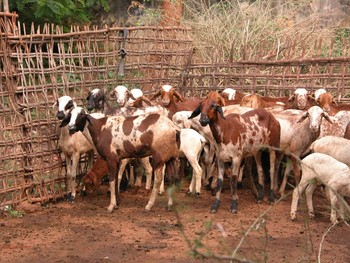
Housing of Ganjam sheep.

Body measurements in Ganjam sheep.

Note: SE, standard error.
Management practices
A typical flock consists of about 35 animals with 1 ram, about 26 ewes and 8 lambs or hoggets. Acharya (Reference Acharya1982) reported the average flock size to be 60 animals (1 ram, 36 ewes and 23 lambs) with a range of 10 to 500 animals, depending on the economic condition and landholding of the farmer. Other livestock kept by some of the farmers are cattle, goats and poultry. The animals are usually housed in separate open sheds adjacent to or in part of the owner's house (Figure 4). In some cases they are also kept in the open. However, the lambs up to 1 month of age are provided with basket-type enclosures (Figure 2). Providing tree loppings to the sheep is a common practice, but no supplementations are given. The animals are allowed to graze on natural grasses (Cynodon doctylon, Cenchrus cilliaris) and shrubs (Acacia arabica, Ziziphus mauritiana) from 9 to 10 a.m. in the morning to 6 p.m. in the evening for a distance of 5–10 km. During migration this distance may increase to 15–20 km. Most of the flocks migrate from January to June to nearby areas like Nimsala, Palur, Ambri, Sunkara, Khalikot, Rambha, Narayan, Phasla and Bhalsa.
Reproduction and breeding
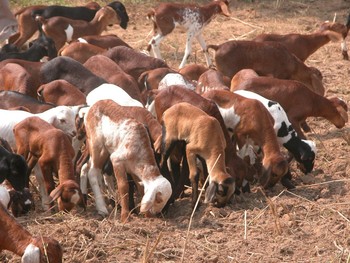
Pure and selective breeding is followed in the farmer's flock. Rams are selected on the basis of body size, conformation and long horns. Mating is by natural service, and breeding takes place from July to October. The age of first breeding for males is 8–12 months with a breeding life of 2–4 years. Mishra et al. (Reference Mishra, Barik, Patro and Nayak2004) reported that the average age at first conception for females was 11.36 ± 0.11 months in a farmer's flock. The majority of the lambing takes place during November–February. The age at first lambing observed in the present study was 15–24 months. The lambing rate is 60–90 percent, which varies from farmer to farmer and year to year. Litter size is single, and twinning is rare. Similar observations were made by Acharya (Reference Acharya1982) and Mishra et al. (Reference Mishra, Barik, Patro and Nayak2004) in Ganjam flocks. A photograph of Ganjam lambs taken during the survey is presented in Figure 5.
Ganjam lambs.

Health management
Only some of the farmers vaccinate their sheep against foot and mouth disease, enterotoxaemia and peste des petits ruminants and use anthelmintics like Oxyclozanil, Albendazole, Fenbendazole, Piperazine and so forth. Others neither vaccinate their sheep nor deworm them.
Utility
Ganjam sheep are primarily maintained for mutton. Male lambs are sold at 5–6 months of age for US $13–15 or at 7–10 months of age for US $20–30 to the traders. Old ewes are sold for US $15–20. Rams are sold for slaughter at a price of US $38–50. The selling price of the animals is based on body size, body weight and arbitrary body score determined by butchers or middlemen. Sheep are not slaughtered for personal consumption, but some of the sheep farmers reported consumption of dead sheep. Sheep droppings are either sold or used to fertilize the farmer's own fields. Some of the farmers exchange it for straw or fodder. The income from sheep droppings is about US $0.006–0.008 per sheep per day. Milk production is 100–250 ml per day, and the lactation length is about 4 months. The milk is used for the lamb and rarely for home consumption.
Genetic characterization
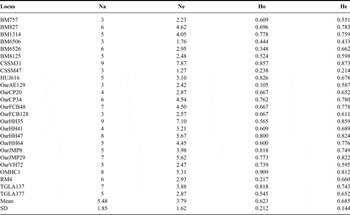
Microsatellite profiles for 25 loci located on 19 chromosomes were recorded for Ganjam sheep. Allele frequencies ranged from 0.022 to 0.863. Genetic diversity indices are provided in Table 3. A total of 138 alleles were detected across the 25 microsatellite loci that were typed, and the actual number of observable alleles at each locus ranged from 3 (BM757, BM6506, CSSM47, OarAE129, OarFCB128) to a maximum of 9 (CSSM31 and OarHH35) in this breed. The mean number of alleles (allele diversity) was 5.48 across these loci. The effective number of alleles, which is lower than the observed number of alleles, was between 1.27 (CSSM47) and 7.87 (CSSM31). The average observed heterozygosity was less than expected. The intrapopulation observed heterozygosity ranged from 0.105 (OarAE129) to 0.909 (OMHC1). The expected heterozygosity per locus varied from 0.214 (CSSM47) to 0.873 (CSSM31) in Ganjam sheep. The values of the mean observed heterozygosity and gene diversity (mean expected heterozygosity) were 0.623 and 0.685, respectively, which were relatively similar to those of other domestic sheep breeds investigated earlier (Arora and Bhatia, Reference Arora and Bhatia2004, Reference Arora and Bhatia2006; Bhatia and Arora, Reference Bhatia and Arora2007; Sodhi, Mukesh and Bhatia, Reference Sodhi, Mukesh and Bhatia2006). The results showed that Ganjam sheep breed possesses a substantial level of genetic diversity that might be used in planning breeding strategies.
Genetic diversity indices across 25 microsatellite markers in Ganjam sheep.

Note: Na, observed number of alleles; Ne, effective number of alleles; Ho, observed heterozygosity; He, expected heterozygosity; SD, standard deviation.
The Ganjam breed showed a significant (p < 0.05) deviation from Hardy–Weinberg equilibrium at four loci (BM757, BM6506, BM6526, OarVH72). This deviation might represent nonrandom mating, selection or the presence of null alleles. It was not possible to estimate the extent of null alleles because no pedigree records were available for analysis and care was taken to collect blood samples from unrelated animals only. However, there did not appear to be significant deviations from equilibrium across all loci within this population. Subsequent analyses were therefore carried out on the basis that Hardy–Weinberg equilibrium prevailed in the investigated breed.
The polymorphic information content, a parameter indicative of the degree of informativeness of a marker, exhibited a range of 0.199 (CSSM47) to 0.859 (CSSM31). In the present study the majority of the markers (84 percent) were highly informative (PIC > 0.5), followed by moderately informative (12 percent, 0.25 < PIC < 0.5) and least informative (4 percent, PIC < 0.25) markers (Botstein et al., Reference Botstein, White, Skolnick and Davis1980). These observations suggested the additional utility of these markers for population assignment (MacHugh et al., Reference MacHugh, Loftus, Cunningham and Bradley1998) in indigenous sheep.
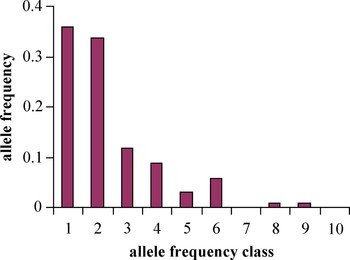
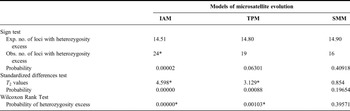
The BOTTLENECK program was used to test for genetic bottlenecks in the recent breeding history of this breed (Cornuet and Luikart, 1996). Under the assumption of the stepwise mutation model, the most suitable model for microsatellite evolution, neither the sign and standardized differences tests nor the Wilcoxon Signed Rank Test revealed any significant results (p > 0.05, Table 4). These findings indicated the absence of a genetic bottleneck in the investigated population, and the population can be considered in mutation drift equilibrium. In addition, the typical L-like distribution of the allele frequencies (Figure 6) further supported that a recent genetic bottleneck or reduction in effective population size (up to 40–80 generations) was not present in Ganjam sheep.
Mode shift analysis depicting absence of genetic bottleneck in Ganjam sheep.

Test for null hypothesis under three microsatellite evolution models.

Bottleneck (rejection of null hypothesis of mutation drift equilibrium).
The F IS value was 0.087 with a range of −0.241 (OarVH72) to 0.821 (OarAE129). The positive F IS value that was observed was not significant (p > 0.05), thereby indicating a very low rate of inbreeding in the population.
Conclusion
Ganjam is an important sheep genetic resource in its habitat and contributes substantially to the income of the poor farmers rearing them. Because of the substantial genetic variation comparable with other indigenous sheep breeds of India that were investigated earlier and the absence of any systematic cross-breeding programme in the area, there is no immediate threat to Ganjam sheep from a conservation point of view. Nevertheless, Ganjam has sufficient potential for improvements in body weight and meat output, so the need for improvement programmes through selective breeding is imperative. Efforts have been initiated in this direction at the Orissa University for Agriculture and Technology, Bubhaneshwar, Orissa. The proposed programme of the Orissa State Livestock Policy Sector in 2002 (http://www.orissa.gov.in/fisheries&ard/livestockpolicy.pdf) also involved the supply of breeding rams through selected breeders. Proper implementation and strengthening of these measures along with (i) creation of awareness among the sheep rearers for better health and management practices by training of small holders or rural technicians and (ii) provision of proper support and subsidy to the farmers by the appropriate agencies for acquiring breeding stocks will not only improve production but will also ensure the sustainable conservation of Ganjam sheep.
Acknowledgements
This work was financially supported by the Indian Council of Agricultural Research (ICAR, New Delhi). The authors thank the Director, National Bureau of Animal Genetic Resource, for providing laboratory facilities. Thanks are also extended to Dr N.K. Routray, Chief District Veterinary Officer, Dr D. Hota, Subdivisional Veterinary Officer, and the Animal Husbandry Directorate, Birhampur, Orissa, for their help and coordination in the collection of blood samples from farmers' flocks; and Mr Rakesh Kumar, Sheep Genomics Laboratory, and Mr Deepak Rai, DNA Fingerprinting Unit, National Bureau of Animal Genetic Resource, Karnal, for accomplishing the blood sampling from Ganjam animals.