Introduction
Cleft palate patients have multiple handicaps affecting their appearance and pronunciation, including occlusion disorder and impaired hearing (due to otitis media with effusion (OME) and its sequelae). They are also at risk of cholesteatoma and its complications. Malformation of the epipharyngeal region causes an enlarged epipharyngeal space, localised postero-inferior narrowing of the pharyngeal tubal ostium, tube cartilage hypoplasia, and shortening and general deformity of the Eustachian tube. Additionally, the angle between the tubal cartilage and the tensor veli palatini muscle is wider and the muscle inserts into a different location.Reference Kuo, Lien, Chia and Shiao 1 – Reference Sheer, Swarts and Ghadiali 4 Malformation of the tensor and levator veli palatini muscles, especially in the hamulus area, prevent normal opening of the pharyngeal tubal ostium during swallowing and yawning.Reference Kuo, Lien, Chia and Shiao 1 , Reference Rajion, Al-Khatib, Netherway, Townsend, Anderson and McLean 2 Pneumatisation of the temporal bone pyramid is reduced by thinning in the mediolateral and anteroposterior directions, resulting in a significantly decreased volume, similar to in sclerotised bones.Reference Kuo, Lien, Chia and Shiao 1 , Reference Rajion, Al-Khatib, Netherway, Townsend, Anderson and McLean 2 However, this causes OME to develop due to poor long-term middle-ear ventilation. The consequences are conductive hearing loss, defective and delayed speech development, consecutive episodes of chronic adhesive otitis (retraction pockets), and acquired cholesteatoma. The incidence of acquired cholesteatoma in these children is 100–200 times higher than in unaffected children, ranging between 1 and 6 per cent.Reference Sheahan, Blayney, Sheahan and Earley 3 , Reference Alper, Losee, Mandel, Seroky, Swarts and Doyle 5 – Reference Vincenti, Marra, Bertoldi, Tonni, Saccardi and Bacciu 8 Different studies have documented the relationship between the type of corrective cleft palate surgery and the development of hearing loss or OME,Reference Alper, Losee, Mandel, Seroky, Swarts and Doyle 5 , Reference Spilsbury, Miller, Semmens and Lannigan 7 , Reference Carroll, Padgitt, Liu, Lander, Tibesar and Sidman 9 – Reference Tiwari, Sharma, Panda, Munjal and Makkar 13 compared different ventilation tube induction protocolsReference Sheahan, Blayney, Sheahan and Earley 3 , Reference Klockars and Rautio 14 , Reference Szabo, Langevin, Schoem and Mabry 15 and explored the relationship between cleft type and cholesteatoma development.Reference Harris, Cushing, Hubbard, Fisher, Papsin and James 6 After pharyngofixation using the inferiorly based pharyngeal flap, the incidence of OME is reported to decrease significantly.Reference Spauwen, Ritsma, Huffstadt, Schutte and Brown 12
Various procedures can be used to correct the palate defect: the most common are Veau-Wardill-Kilner palatoplasty with two lobes, von Langenbeck palatoplasty with two or three lobes and Furlow double-opposing Z-plasty.Reference Carroll, Padgitt, Liu, Lander, Tibesar and Sidman 9 , Reference Smith, Gubbels, MacArthur and Milczuk 11 The first two can be supplemented by pharyngofixation using an inferiorly or superiorly based pharyngeal flap to minimise velopharyngeal insufficiency; the latter two are used to minimise maxillary growth restriction.
This study aimed to determine whether the use of pharyngofixation in corrective cleft palate surgery was associated with the occurrence of OME sequelae such as chronic adhesive otitis or cholesteatoma.
Materials and methods
Patients
A retrospective study was performed of patients who underwent cleft palate repair at the Cleft Palate Care Centre of Královské Vinohrady University Teaching Hospital between 2001 and 2006. Patients were divided into four groups according to age at the time of surgery (range, 5 months to 8 years; mean ± SD, 36 ± 19.45 months): 0–29, 30–39, 40–59 and at least 60 months.
Surgery
Patients underwent Veau-Wardill-Kilner palatoplasty with two lobes or von Langenbeck palatoplasty with two or three lobes, with optional pharyngofixation using an inferiorly based pharyngeal flap. The use of pharyngofixation was not randomised: the decision was made by the surgeon. In general, pharyngofixation was used more often in surgery for complicated clefts with significant velopharyngeal insufficiency and in revision surgery.
In pharyngofixation, the inferiorly based flap containing the mucosal and muscle layer on the posterior wall of epipharynx was elevated. The flap was then tubulised, turned anteriorly and sutured in the midline to the nasal surface of the repaired soft palate close to the uvula. The defect was covered by primary suture of the mobilised mucosal layer. Complete healing took approximately six weeks.
Outcome
Patients were followed up for 36–84 months to evaluate the development of adhesive and/or retraction changes, especially retraction pockets and cholesteatoma. As Eustachian tube function gradually improves after the age of six or seven years,Reference Kuo, Lien, Chia and Shiao 1 the most important examinations were those performed after patients had reached seven years of age. The degree of retraction, an important prognostic factor for cholesteatoma development, was assessed using the Charachon scale for the superior posterior quadrant and the Tos scale for epitympanic retractions. After otological assessment, patients were divided into four groups according to their need for further surgical intervention: normal group (normal otology findings); no surgical intervention group (Tos grade I–II, Charachon grade I; surgical treatment not needed); possible surgical intervention group (Tos grade III, Charachon grade II; surgical intervention may be needed); and definite surgical intervention group (Tos grade IV, Charachon grade III; requiring retraction pocket elevation or resection and tympanoplasty plus eventual scutum reconstruction).
Ethical standards
All procedures complied with the ethical standards of the relevant national and institutional guidelines on human experimentation and with the Helsinki Declaration of 1975, as revised in 2008.
Statistical analysis
Ordinal logistic regression was used because the use of pharyngofixation was unequally distributed among age groups. This statistical method allowed the influence of age at the time of surgery to be disregarded. The test hypothesis was that a relationship exists between the severity of otological findings (as expressed by surgical group, i.e. Tos and Charachon grade) and use of the pharyngofixation technique.
Results
Of the 180 patients (359 ears) examined, 22 were lost to follow up and 3 had a cleft as part of a syndrome defect. A total of 155 patients (85 boys and 70 girls; 308 ears) for whom complete surgical and follow-up data were available were included in the final analysis. They were aged 7–11 years at the time of significant investigation.
At the final follow-up, 72 patients had a complete cleft (46 per cent); of these, 52 (72 per cent) had undergone pharyngofixation. In all, 83 patients had a palate cleft (54 per cent); of these, 32 (39 per cent) had undergone pharyngofixation.
Assessment of malformations identified one external auditory canal atresia, one microtia connected with hypoplasia of half of the face, two middle-ear malformations (one of which was associated with a third mobile window – the large internal auditory meatus), three auricle malformations, four preauricular appendices and four external auditory meatus stenoses were identified. A total of 56 patients had otitis media with effusion (OME).
Tympanostomy was performed once in 18 patients, twice in 8 patients, 3 times in 10 patients, 4 times in 4 patients, 5 times in 1 patient and 6 times in 1 patient.
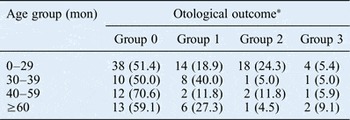
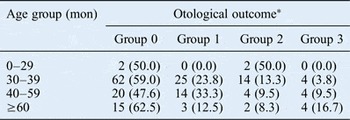
At the final follow up, 14 patients had bilateral OME and 25 had unilateral OME. Five patients had tympanostomy tubes at presentation, four bilaterally. The parents of five patients with OME lasting for at least three months refused the recommended tympanostomy. Two patients had a perforated eardrum; one of these had undergone three tympanostomies. Retraction pocket elevation or resection and myringoplasty or tympanoplasty were indicated for all 23 ears in the definite surgical intervention group and 23 ears in the possible surgical intervention group (53 per cent). In all, five patients (3 per cent) developed cholesteatoma, two developed epitympanic cholesteatoma, two developed sinus cholesteatoma and one developed extensive cholesteatoma of the middle ear, mastoid and epitympanum with supralabyrinthine propagation. Cholesteatoma was unilateral in three patients and bilateral in two; four of these patients had previously undergone tympanostomy (once for one patient, twice for one and three times for two). Otological findings in patients who underwent surgery without pharyngofixation are shown in Table I and in patients who underwent pharyngofixation otological findings are shown in Table II. Figure 1 shows the distribution of otological findings with respect to pharyngofixation and age at the time of surgery.
Distribution of ear-findings in groups 0–3 with respect to pharyngofixation stratified by age at the time of surgery. Group 0, normal otological findings; group 1, Tos grades I–II or Charachon grade I; group 2, Tos grade III or Charachon grade II; Group 3 Tos grade IV or Charachon grade III.

Surgery without pharyngofixation: otological outcome by age at time of surgery

Data are n (%). *Group 0, normal otological findings; group 1, Tos grades I–II or Charachon grade I; group 2, Tos grade III or Charachon grade II; Group 3 Tos grade IV or Charachon grade III. Mon = months
Surgery with pharyngofixation: otological outcome by age at time of surgery

Data are n (%). *Group 0, normal otological findings; group 1, Tos grades I–II or Charachon grade I; group 2, Tos grade III or Charachon grade II; Group 3 Tos grade IV or Charachon grade III. Mon = months
As there was an unequal distribution of patient age with respect to pharyngofixation, the statistical analysis could not evaluate the influence of each factor separately. Ordinal logistic regression is a multivariate statistical method that can separately assess the effects of several independent factors on an observed endpoint. Pharyngofixation and age at the time of surgery were used as independent factors (regressors) in the logistic regression model. This analysis showed that neither pharyngofixation (p = 0.53) nor age (p = 0.48) had a significant effect on post-operative otological findings.
Discussion
Cleft palate patients are at a higher risk of cholesteatoma, among other disorders, compared with healthy children.Reference Sheahan, Blayney, Sheahan and Earley 3 , Reference Harris, Cushing, Hubbard, Fisher, Papsin and James 6 – Reference Vincenti, Marra, Bertoldi, Tonni, Saccardi and Bacciu 8 , Reference Reiter, Haase and Brosch 10 Most have otitis media with effusion (OME) from early childhood,Reference Kuo, Lien, Chia and Shiao 1 , Reference Sheahan, Blayney, Sheahan and Earley 3 , Reference Alper, Losee, Mandel, Seroky, Swarts and Doyle 5 , Reference Bluestone, Cummings, Fredrickson and Harker 16 , Reference Phua, Salkeld and de Chalain 17 which can develop into chronic adhesive otitis and cholesteatoma. There has been considerable discussion on how to improve OME progression and its sequelae with conservative treatments or different strategies using ventilation tubes. Treatment varies from obligatory grommet insertion for all cleft palate patients to a watch-and-wait strategy.Reference Kuo, Lien, Chia and Shiao 1 , Reference Carroll, Padgitt, Liu, Lander, Tibesar and Sidman 9 , Reference Klockars and Rautio 14 , Reference Szabo, Langevin, Schoem and Mabry 15 Sheahan et al. suggested a conservative approach because of the higher incidence of cholesteatoma and retraction pockets in patients who undergo multiple tympanostomies.Reference Sheahan, Blayney, Sheahan and Earley 3 However, whether these problems are the cause or sequelae of multiple tympanostomies is open to debate. In contrast, Spilsbury et al. advocate early tympanostomy in these patients because their tubal function is very poor.Reference Spilsbury, Miller, Semmens and Lannigan 7
In the cleft palate centre in the present study, patients undergo tympanostomy and re-tympanostomy after three months of persistent middle-ear secretion, and retraction pockets are managed by elevation or resection and myringoplasty or tympanoplasty. These procedures should be timed to take place when an assessment of Charachon grade II in the middle ear or Tos grade III in the epitympanum has been made.
The impact of cleft palate reconstruction techniques on hearing and tubal function improvement has been investigated.Reference Carroll, Padgitt, Liu, Lander, Tibesar and Sidman 9 , Reference Tiwari, Sharma, Panda, Munjal and Makkar 13 , Reference Guneren, Ozsoy, Ulay, Eryilmaz, Ozkul and Geary 18 The surgical technique usually has no significant influence on these parameters, although Smith et al. demonstrated a significantly lower frequency of tympanostomy when using Furlow double-opposing Z-plasty.Reference Smith, Gubbels, MacArthur and Milczuk 11 So far, no studies have reported an association between the surgical technique used for cleft palate correction and post-operative otological findings.
-
• Few studies have investigated whether the surgical cleft palate correction technique affects otological outcome
-
• Cholesteatoma incidence is 100–200 times more common in children with a cleft palate than in unaffected children
-
• Cholesteatoma increases the risk of intracranial complications and hearing loss, and causes considerable discomfort
-
• Pharyngofixation is reported to decrease the incidence of otitis media with effusion, a common premorbidity to adhesive otitis and cholesteatoma
-
• This study found no significant effect of pharyngofixation on the long-term incidence of retraction pockets and cholesteatoma
Spauwen et al. reported a significant 60 per cent reduction in the incidence of OME at 3 months after pharyngofixation in a group of 51 patients.Reference Spauwen, Ritsma, Huffstadt, Schutte and Brown 12 These results were explained by an apparent reduction in oronasal air leakage and retro-positioning of the levator veli palatini muscle hinge. Consistent with these findings, the present study found no relationship between surgery type, the sidedness of the cleft and the occurrence of bilateral OME. There was no positive long-term impact of pharyngofixation on otological findings. However, it is possible that the use of a randomised selection procedure might have produced different results. Alternatively, pharyngofixation may have only a short-term effect on the otological outcome.
Further evidence showing that pharyngofixation has no effect on otological outcome was provided by the theoretical work of Sheer and colleagues using a three-dimensional mathematical model based on the finite element method. They showed that in children, particularly in those with a cleft palate, tubal function depends much more on the function of the peri-luminal mucosal tissue than of the tensor veli palatini muscle.Reference Sheer, Swarts and Ghadiali 4
Conclusion
This retrospective study found that the type of cleft palate surgery had no impact on otological outcome. However, the study had the same limitation of all retrospective studies: lack of randomisation. Therefore, it cannot be definitively stated that pharyngofixation has no effect on the otological outcome. A prospective study using randomised selection of the surgical procedure is necessary to demonstrate the influence of the surgical technique used for cleft palate correction on otological outcomes. This should exclude cases in which tubal and nasopharyngeal malformations are so extensive that no type of corrective cleft palate surgery (including pharyngofixation) would be expected to have a positive long-term otological outcome.Reference Sheer, Swarts and Ghadiali 4