Implications
When trialling new farrowing systems, both experimentally and commercially, the previous experience of the sows is often overlooked. However, as sow behaviour at farrowing affects piglet mortality, is mediated by the environment and is believed to develop over successive parities, it is likely that a change of farrowing system would disrupt maternal behaviour and subsequently increase piglet mortality. This topic is especially important as more farmers consider the uptake of higher welfare farrowing systems, as piglet mortality may initially increase until sows adapt to, and preferably return to, the same farrowing system throughout their reproductive life.
Introduction
Consumers prefer livestock to have freedom of movement and the opportunity to perform natural behaviours (Lassen et al., Reference Lassen, Sandøe and Forkman2006), which has contributed to the increase of outdoor breeding sows in the UK from 19% to 42% of the national herd size in the past two decades (Farm Animal Welfare Council, 1996; Royal Society for the Prevention of Cruelty to Animals, 2016). Globally, indoor pork producers are increasingly interested in transitioning to less restrictive systems, particularly for farrowing and lactation (Farm Animal Welfare Committee, 2015). However, piglet mortality is often considered to be higher in alternative farrowing systems (Hales et al., Reference Hales, Moustsen, Nielsen and Hansen2014), although this is not always the case (KilBride et al., Reference KilBride, Mendl, Statham, Held, Harris, Cooper and Green2012). Furthermore, a recent Opinion of the UK Farm Animal Welfare Committee recommended further research to reduce piglet mortality in free farrowing systems before the abolition of farrowing crates in the UK can be considered (Farm Animal Welfare Council, 2015).
Research has developed multiple indoor alternatives to the farrowing crate, some of which are already in commercial use (e.g. PigSAFE pen, Edwards et al., Reference Edwards, Brett, Ison, Jack, Seddon and Baxter2012; SWAP pen, Hales et al., Reference Hales, Moustsen, Nielsen and Hansen2015). However, alternative farrowing systems are sometimes used alongside more traditional farrowing crates within the same herd, causing sows to be housed interchangeably between farrowing systems. This can occur acutely whilst a farm transitions to a new farrowing system, or chronically as multiple farrowing systems are used long term. Whilst some higher-welfare Assurance Scheme standards recommend continually housing sows in the same farrowing system to avoid negatively impacting sow welfare (Royal Society for the Prevention of Cruelty to Animals, 2016), very little research has investigated the effect that a change in farrowing system has on the sow.
Extensive research has shown the immediate farrowing environment to affect the behaviour and physiology of the sow during farrowing and lactation (e.g. Cronin and van Amerongen, Reference Cronin and van Amerongen1991; Arey and Sancha, Reference Arey and Sancha1996; Yun et al., Reference Yun, Swan, Vienola, Farmer, Oliviero, Peltoniemi and Valros2013). Consequently, the farrowing system not only affects piglet mortality directly via the level of physical protection from accidental crushing, but also indirectly by influencing the maternal care that a sow will provide. Indeed, proficiency of sow behaviour is considered even more critical for piglet survival in less restrictive systems, where physical and human intervention are often more difficult to implement (Arey, Reference Arey1997). Sow productivity is considered an individually stable trait, measurable via piglet survival in early lactation (Wechsler and Hegglin, Reference Wechsler and Hegglin1997; Su et al., Reference Su, Lund and Sorensen2007). However, sow maternal behaviour may develop over successive parities, as the previous farrowing environment influences subsequent maternal behaviour (Jarvis et al., Reference Jarvis, Van der Vegt, Lawrence, McLean, Deans, Chirnside and Calvert2001; Thodberg et al., Reference Thodberg, Jensen and Herskin2002a and Reference Thodberg, Jensen and Herskin2002b), meaning sow welfare and productivity may be optimised by routinely returning individuals to the same farrowing system.
The aim of the current study was to determine if the farrowing system used during the first and second parity affected current and future piglet mortality. Individual consistency in sow performance between different phases of the same parity and across parities was also explored. It was hypothesised that second parity sows which return to the same farrowing system would have lower piglet mortality than sows which changed farrowing systems, and that mortality would be particularly high for sows which change from a restrictive to the less restrictive farrowing system.
Material and methods
Animals and dry sow management
Data were collected on a commercial pig breeding unit in the north east of England. The farm consisted of 1300 Camborough (Genus PIC, Basingstoke, UK) breeding gilts and sows, bred with Hampshire semen. During gestation, all animals were kept in straw pens in groups according to age, for gilts, or by size for multiparous sows, and were fed via dump-feeders once daily with ~3 kg of pelleted feed per sow per day (gilts=12.42% CP, 12.52 digestible energy (DE) MJ/kg; sows=11.85% CP, 12.47 DE MJ/kg). Animals were moved into the farrowing accommodation 1 week before the expected farrowing date.
Farrowing sow housing and management
During farrowing and lactation, sows were housed in one of three farrowing systems within the same farm: standard farrowing crates (crates), a temporary crate system (360s; 360° Freedom Farrower®; Midland Pig Producers, Burton-on-Trent, UK) or a kennel and run straw-based pen system (pens; see Supplementary Figures S1–S3 for images or www.freefarrowing.org for further information). Data collection was performed as the farm transitioned from using crates to 360s; with 132 crates and zero 360s at the beginning of data collection, and 20 crates and 168 360s by the end of data collection; whilst 62 pens were used throughout the study period.
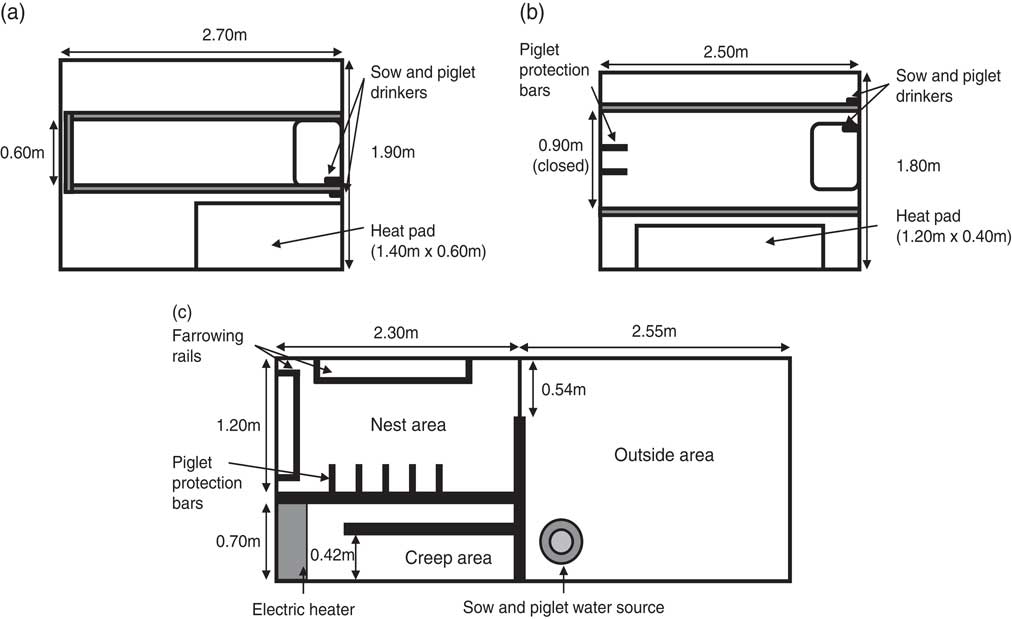
Crates on the farm consisted of two types, in either one of three older buildings or two new PortaPig cabins. The old farrowing crates were 2.65×0.60 m within a 2.70×1.90 m pen with solid concrete flooring and metal slats to the rear of the pen and contained a 1.40×0.60 m heat pad to the top right of the pen and covered in wood shavings for old crates only (Figure 1a). The new farrowing crates were 2.50×0.60 m within a 2.50×1.80 m fully plastic slatted pen including a 1.20×0.40 m heat pad centrally located along the pen side adjacent to the central walkway.
Sow farrowing system pen layouts to scale for (a) the standard farrowing crate, (b) the 360° Freedom Farrower and (c) the straw-based pen with outside run.

The 360s comprised of a stainless steel crate (2.50×0.90 m when closed, 2.50×1.60 m at sow shoulder height when opened) within a 2.50×1.80 m pen (Figure 1b). Pens with 360s had plastic slatted flooring, a solid panel containing drainage slots in the sow lying area plus a 1.80×0.40 m heat pad to one side of the crate. Two parallel vertical bars were positioned at the rear of the crate for additional piglet protection. The 360s crates were closed from sow entry into the farrowing house until approx. 10 days postpartum, with handfuls of shredded paper provided on the floor of the 360s crate from 2 days before expected farrowing and removed at first litter handling (4 to 16 h post-farrowing). Of the 168 360s on the farm by the end of data collection, 120 were located in six PortaPig cabins containing 20 farrowing places each. The remaining 48 places were in a converted farrowing house (previously farrowing crates) of three adjoining rooms containing 16 360s each (refer to King et al., Reference King, Baxter, Matheson and Edwards2018 for additional details of the 360s configuration). Buildings containing crates and 360s were kept at 22±1°C, with the additional heat mat along one side of each pen starting at 36°C and reducing to 30°C by weaning. Room temperature was gradually reduced automatically to 18±1°C by day 10 postpartum and to 16±1°C by weaning.
The pens were in rows of individual units constructed from timber in the 1960s, each consisting of a 2.30×1.20 m indoor nest area with adjacent 2.30×0.70 m separate covered piglet creep area and access to a 2.55×2.00 m outdoor run (Figure 1c). Pens had a solid concrete floor throughout, whilst the nest area contained farrowing rails and piglet protection bars across three sides to reduce piglet crushing risk. The nest area contained 5 kg of long straw from sow entry, whilst the creep floor was covered in wood shavings. The pens had no central heating system, however, a 400 W electric heater was placed at one end of the creep, which was individually switched off 3 to 5 days postpartum. Pens were routinely cleaned out weekly with straw and wood shavings replenished. Prepartum, additional straw or wood shavings were added to nests when required and soiled straw was removed and replenished postpartum.
Farrowing sow and piglet husbandry
Sows were fed once daily in the morning until all sows in the building had farrowed, after which sows were fed twice a day (15.98% CP, 13.69 DE MJ/kg). All animals were hand fed, either into a feed trough in both crated systems or onto the nest floor in the pen system. The feed was gradually increased from 2 to 10 kg per sow per day in 1 kg increments during lactation. Water was provided ab libitum, either from drinkers in the two crated systems or from a floor trough in the outdoor area of the pen system. In accordance with veterinary recommendation, piglets were tail docked, teeth clipped, and injected with 1 ml of Gleptosil (Ceva Animal Health Ltd, Amersham, UK) and 0.5 ml of Betamox (Norbrook Laboratories Ltd, Newry, UK) within 24 h of birth. Placentae and deceased piglets were removed, and live litter size was equalised for both piglet number and size by cross-fostering piglets of a similar age. Super Dry Klenz powder (A One Feed Supplements Ltd, Thirsk, UK) was distributed across crates and 360s daily to minimise bacterial infections. A handful of creep feed (Primary Diets; AB Agri Ltd, Peterborough, UK; followed by Flat Deck; A One Feed Supplements Ltd) was provided once daily on the floor in all systems from ~10 days of age until weaning. The farm’s management routines included piglet cross-fostering throughout lactation as necessary to ensure piglet and litter sizes remained similar.
Experimental design
Sows were housed in one of the three described farrowing systems during their first and second farrowings, creating a 3×2 factorial design of farrowing system and parity. Animals were allocated to whichever farrowing system was in rotation at their time of housing.
Data collection
Data were collected from farm records for farrowings which occurred from November 2013 to January 2016. Sows which did not complete their first two lactations in full were excluded from the database. Variables recorded for both parities were: animal ID, farrowing system, farrowing date, litter size (live-born and stillborn), number and cause of piglet mortality, weaning date and number of piglets at weaning. Piglet mortalities were recorded as occurring either before or after litter processing, when litters were first handled by staff at 4 to 16 h postpartum. Cause of death was recorded as either crushing, low viability, savaged or miscellaneous (including hypothermia, congenital defects, or unknown cause) according to standard practice for the mortality records on-farm.
Statistical analysis of results
Litter size and piglet mortality data were analysed in SAS 9.2 using the GLIMMIX procedure. Models for first parity litter size (total born and live-born) included season at farrowing (Spring=March, April, May; Summer=June, July, August; Autumn=September, October, November; Winter=December, January, February), whilst models for second parity litter size included first parity season at farrowing, first parity litter age at weaning and first parity farrowing system. Due to a low incidence of mortality caused by savaging and by other miscellaneous reasons, the cause of mortality was grouped as either crushing or all other causes (low viability, savaged and miscellaneous). All models regarding mortality (including stillborn) included an underlying Poisson distribution. First parity mortality models included total born litter size, the current farrowing system, the season at farrowing and interaction of the current farrowing system and season at farrowing. Second parity base models also included the previous farrowing system and an interaction between the current and previous farrowing system. For models concerning post-processing and total mortalities, lactation length was also included in the base model for both parities. Variables were excluded in a step-wise manner, with all variables of P<0.10 and interactions of P<0.05 included in the final models.
Sow consistency between and within parities was analysed in SAS 9.2 using the GENMOD procedure. Repeated measures models were created with sow ID as the repeated subject. For between parity consistencies, the final second parity models from the GLIMMIX procedure were used plus the corresponding first parity variable as an additional independent variable (e.g. first parity pre-processing crushed to predict second parity pre-processing crushed). For within parity consistencies, the pre-processing variable was used to predict the post-processing variable (e.g. first parity pre-processing crushed to predict first parity post-processing crushed) for both the first and second parities independently.
Results
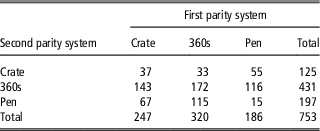
Data were collected from 753 sows across the three farrowing systems in parity one and parity two; however, system combination groups were not ideally balanced as increasing numbers of 360s came into use on the farm (see Table 1).
Distribution of sows across farrowing systems in first parity (columns) and second parity (rows)

Parity one mean total born litter size was 13.72±0.10, and did not differ across seasons at farrowing (P>0.10). Parity two mean total born litter size was 12.94±0.11, and also did not differ across seasons at farrowing (P>0.10). However, there was a tendency for parity one farrowing season to affect parity two total born litter size (P=0.068; spring=13.01±0.22; summer=13.43±0.23; autumn=12.54±0.24; winter=13.03±0.21), being significantly higher for sows that previously farrowed in the summer than the autumn (P<0.01). Parity two total born litter size also tended to increase with increasing parity one weaning age (+0.056±0.031 piglets per day; P=0.075).
Total piglet mortality across all farrowing systems was significantly higher in the first parity (16.85%; 14.84% of live-born piglets, 2.36% stillborn of total born piglets) than the second parity (12.72%; 10.59% of live-born piglets, 2.38% stillborn of total born piglets; Wilcoxon’s signed-rank test; P<0.0001). Litter age and litter size at weaning were similar for both parities (parity one: litter age=24.85±0.13 days, litter size=12.79±0.03 piglets; parity two: litter age=25.61±0.12 days, litter size=12.78±0.03 piglets).
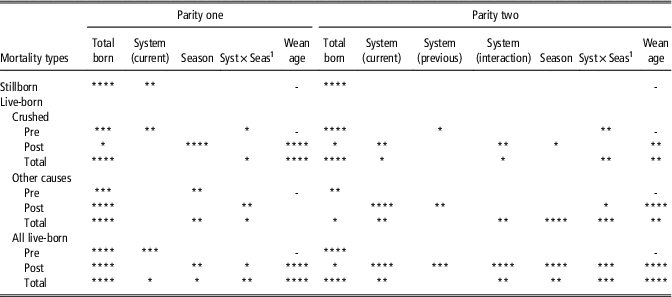
Significance levels of all variables from the final piglet mortality models are provided in Table 2. Total born litter size, litter age at weaning, season and the interaction between farrowing system and season were included in models only to account for their possible effects on piglet mortality, and therefore will not be discussed further.
Significance level of independent variables for piglet mortality in the first and second parity. Mortality is classified by cause and whether it occurred before (Pre-) or subsequent to (Post-) piglet processing at 4 to 16 h after birth. The direction of association for continuous variables is positive in all cases

1 Current system and current season interaction.
*P<0.05, **P<0.01, ***P<0.001, ****P<0.0001, – not included in base model.
Parity one
Effect of current farrowing system
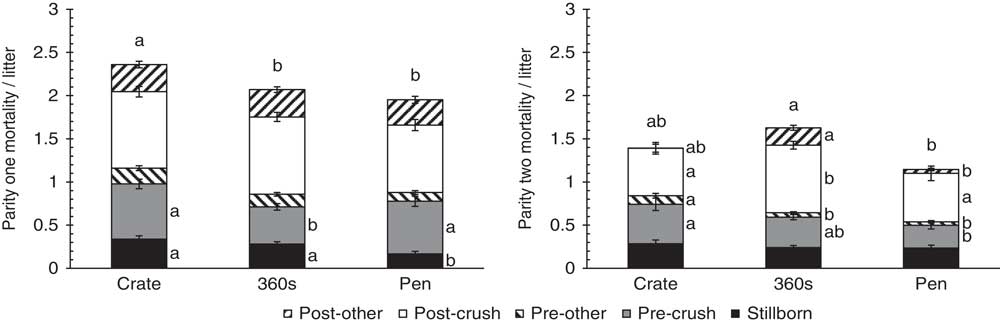
Total born litter size did not differ significantly between farrowing systems (crate=13.76±0.18; 360s=13.86±0.16; pens=13.43±0.20). Figure 2 presents all mortality by category and current farrowing system for parity one and two. There were significantly fewer stillbirths (number per litter) in the pens than the 360s (P<0.01) or the crates (P<0.001). Pre-processing mortality from crushing was significantly lower in the 360s than in the pens or the crates (both P<0.01), whilst no significant difference in pre-processing mortality from other causes across farrowing systems was observed. This meant that pre-processing mortality from all causes was significantly higher in the crates than the 360s (P<0.0001), whilst mortality in the pens tended to be both lower than the crates (P=0.066) and higher than the 360s (P=0.063). Farrowing system had no significant effect on post-processing mortality (crushing, other or all). Total piglet mortality from crushing was lower in the 360s than the crates (P<0.05) but not the pens; whilst total piglet mortality from other causes did not differ significantly between farrowing systems. As a result of these individual components, total live-born mortality and total born mortality were significantly higher in the crates than both the pens (live-born: P<0.05; total born: P<0.01) and the 360s (both P<0.01).
Least square means (±SE) for total piglet mortality by type and current farrowing system for parities one (left) and two (right). Piglet mortality type is classified by both cause (stillborn, crushing or other) and whether it occurred pre- or post- piglet processing at 4 to 16 h after birth. a,bSignificantly differing frequencies (P<0.05) between farrowing systems are indicated with differing letters for each piglet mortality type (alongside each system) and total piglet mortality (above each system).

Parity two
Effect of current farrowing system
Total born litter size did not differ significantly between farrowing systems (crate=12.89±0.29; 360s=13.06±0.15; pens=12.94±0.23). Figure 2 presents all mortality by category and current farrowing system for parity two. There was no effect of the current farrowing system on the incidence of stillborn piglets. Pre-processing mortality from crushing was significantly higher in the crates than the pens (P<0.05); whilst pre-processing mortality from other causes was significantly higher in the crates than both the pens and the 360s (both P<0.05). Post-processing mortality from crushing was significantly higher in the 360s than both the crates and the pens (both P<0.05), however, in combination, total crushing mortality was significantly higher in the 360s than the pens only (P<0.05). Post-processing mortality from other causes, and therefore total mortality from other causes, was significantly higher in the 360s than the pens (pre-other: P<0.0001; total-other: P<0.01). Post-processing mortality from all causes was significantly higher in the 360s than both the crates and the pens (both P<0.001), whilst total live-born mortality and total born mortality were significantly higher in the 360s than the pens (live-born: P=0.001; total born: P<0.01), but not the crates.
Effect of previous farrowing system
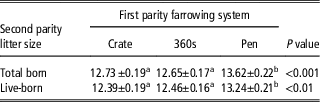
Parity two total born and live-born litter sizes were significantly affected by the parity one farrowing system, being higher if a sow previously farrowed in the pens than both the 360s (total born: P<0.001; live-born: P<0.01) and the crates (both P<0.01; Table 3).
Table of least square means (±SE) for second parity sow total born and live-born litter size by first parity farrowing system

a,b Values within a row with different superscripts differ significantly as indicated.
There was no effect of the previous farrowing system on the incidence of stillborn piglets, pre-processing mortality from other causes or total pre-processing live-born mortality. However, sows that previously farrowed in the pens had significantly lower pre-processing crushing mortality (0.27±0.04) than sows that previously farrowed in the 360s (0.41±0.04; P<0.05), with previously penned sows also tending to be lower than sows that previously farrowed in the crates (0.38±0.05; P=0.055). Whilst post-processing crushing mortality was not significantly affected by the previous farrowing system, post-processing mortality from other causes was significantly higher if a sow had previously farrowed in the 360s (0.017±1.48) than the pens (0.008±0.68; P<0.01), but not the crates (0.012±1.04). Moreover, post-processing mortality from all causes was significantly higher for sows that previously farrowed in the 360s (0.94±0.08) than either the pens (0.60±0.09; P<0.01) or the crates (0.61±0.07; P<0.01). There was no effect of the previous farrowing system on total mortality from crushing or total mortality from other causes, however total live-born mortality from all causes was significantly higher if a sow had previously farrowed in the 360s (1.40±0.10) than the pens (1.06±0.11; P<0.05), but not the crates (1.17±0.10).
Effect of farrowing system interaction
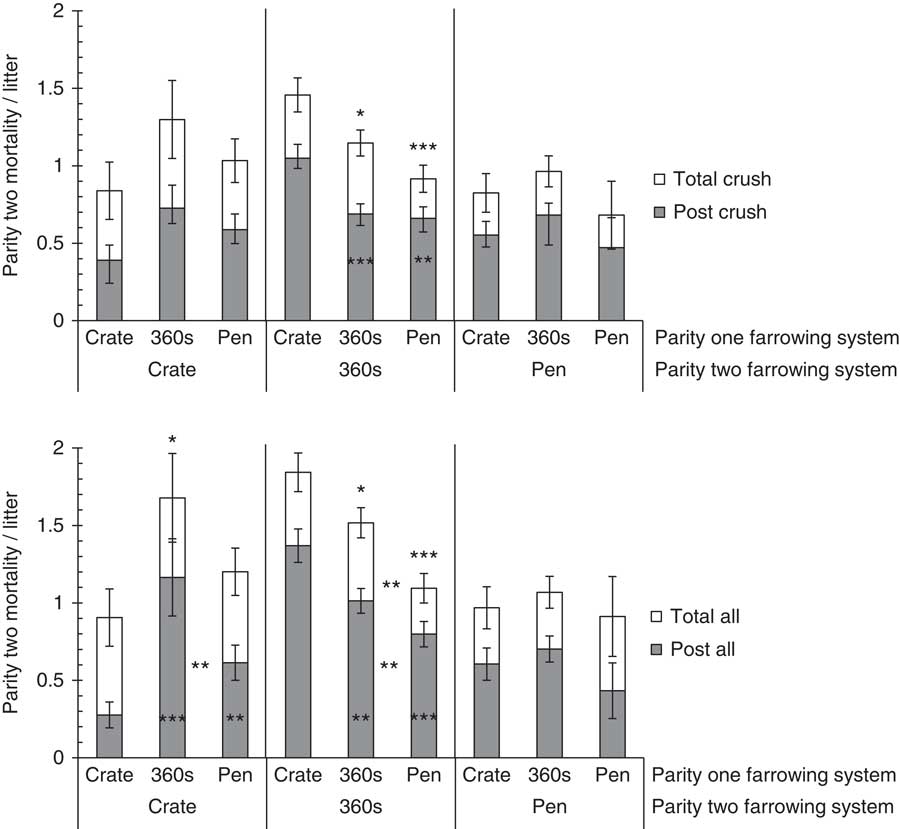
Total born litter size did not differ significantly between farrowing system combinations (crate–crate=12.27±0.52; 360s–crate=11.89±0.54; pen–crate=14.14±0.42; crate–360s=12.94±0.25; 360s–360s=12.72±0.23; pen–360s=13.48±0.28; crate–pen=12.51±0.37; 360s–pen=12.78±0.28; pen–pen=12.77±0.80). The interaction of the first and second farrowing systems had no significant effect on the incidence of stillborn piglets, pre-processing mortality (crushing, other or all) or post-processing mortality from other causes. However, an interaction of the first and second farrowing systems did affect post-processing mortality from crushing (P<0.01) and therefore post-processing mortality from all causes (P<0.001; Figure 3). Consequently, total mortality from crushing (P<0.05), total mortality from other causes (P<0.01) and total live-born mortality (P<0.01) were affected by the farrowing system interaction (Figure 3).
Least square means (±SE) of post-processing and total (pre- plus post-processing) second parity live-born piglet mortality from crushing (upper) and all causes (crushing plus other; lower) by parity one and parity two farrowing systems. Parity one system effects within each parity two farrowing system are indicated, with significant differences between Crate–360s and Crate–Pen indicated on the latter system and between 360s–Pen indicated between these systems (*P<0.05, **P<0.01, ***P<0.001).

Effect of individual consistency of sow performance
Parity two live-born litter size and total born litter size increased with increasing parity one litter sizes (parity two live-born piglets=+0.156±0.042 parity one live-born piglets, P<0.001; parity two total born piglets=+0.155±0.043 parity one total born piglets, P<0.001). The incidence of piglet mortality in parity two was not associated with the same category of piglet mortality in parity one, except for the case of savaging (parity two savaging frequency=+0.281±0.139 parity one savaging frequency, P<0.05). Within the same parity, first parity post-processing mortality (crushing, other and all) was significantly associated with pre-processing mortality (post-crushing=+0.083±0.039 pre-crushing, P<0.05; post-other=+0.235±0.067 pre-other, P<0.001; post-all=+0.126±0.035 pre-all, P<0.001). However, in the second parity, there was no association between pre- and post-processing mortality.
Discussion
To our knowledge, this is the first research paper to report a significant effect of an interaction between the current and previous farrowing systems experienced by the sow on current piglet mortality. Specifically, in the second parity, post-processing mortality in the crates was significantly decreased if a sow previously farrowed in a crate, whereas post-processing mortality in the 360s was significantly increased if a sow previously farrowed in a crate. These findings support our primary hypothesis that inter-parity farrowing system consistency is important for sow performance, in some cases more so than the specific farrowing system used. Previously crated sows may have increased piglet mortality in less confined systems as they have had no previous experience of learning to avoid the increased risk of piglet crushing associated with reduced confinement. Moreover, sows that previously farrowed in the pens or 360s have no experience of prolonged confinement, which is associated with increased physiological stress (Jarvis et al., Reference Jarvis, D’Eath, Robson and Lawrence2006). Sow maternal behaviour is considered an important factor for piglet survival (Wechsler and Hegglin, Reference Wechsler and Hegglin1997; Andersen et al., Reference Andersen, Berg and Bøe2005), and its performance is highly dependent on the physical constraints of the immediate farrowing environment. Earlier studies have also shown sow farrowing behaviour to be affected by the preceding environment of the sow, including during gestation (Boyle et al., Reference Boyle, Leonard, Lynch and Brophy2002), farrowing (Thodberg et al., Reference Thodberg, Jensen and Herskin2002a and Reference Thodberg, Jensen and Herskin2002b) and rearing (Chidgey et al., Reference Chidgey, Morel, Stafford and Barugh2016), indicating that sow maternal behaviour develops according to previous environmental experiences. Repeated housing in the same farrowing system would, therefore, enable sows to adapt and perfect their maternal behaviours for that specific farrowing system, resulting in optimised reproductive success. However, in the current study, this reasoning was not entirely supported, as post-processing mortality in the 360s was lowest if a sow previously farrowed in a pen. Therefore, prior experience of farrowing without confinement may be important for reducing piglet mortality across systems with periods of non-confinement. The condition of repeated housing in the 360s may not have reduced piglet mortality as data collection occurred whilst this system was being introduced on-farm, meaning that management routines fluctuated across the study period as stockpersons developed the most appropriate management.
Second parity post-processing piglet mortality in the pens was also lowest for sows that had previously farrowed in the pens. However, this result was not significant, which may be attributable to the small sample size of the pen-pen group (15 sows) and hence the larger standard error around the numerically lower mean value. Alternatively, differences in mortality caused by the previous farrowing system may have been less pronounced due to the pen system being a distinctly different farrowing system. Consequently, second parity sows which previously farrowed in a crate or 360s may have easily discriminated the pen as a different environment and not used their prior experience to adapt farrowing behaviour, opting instead to relearn how to optimise behaviour for the new environment. This reasoning would also explain why post-processing mortality was particularly high for sows that interchanged between the crate and 360s systems. When these sows were housed for farrowing in their second parity, they would have been less able to discriminate a change of environment and therefore relied upon previous farrowing experience. In later lactation, this would be problematic as the behaviours adapted for prolonged confinement or reduced confinement may not be optimal for piglet survival in the contrasting environment (crate–360s or 360s–crate). Our suggestion would be that if farms do require to change sows between farrowing systems, they should ensure the farrowing systems are sufficiently different for sows to easily discriminate between them.
The majority of piglet mortality occurs during the first 24 h of life, with a predominant cause being accidental crushing by the sow (Marchant et al., Reference Marchant, Rudd, Mendl, Broom, Meredith, Corning and Simmins2000). In the current study, pre-processing crushing mortality was significantly lower in the 360s than the crates or pens in first parity gilts. Earlier studies have shown gilts to exhibit increased sensitivity to the farrowing environment (Jarvis et al., Reference Jarvis, Van der Vegt, Lawrence, McLean, Deans, Chirnside and Calvert2001; Thodberg et al., Reference Thodberg, Jensen and Herskin2002a), whilst prepartum confinement without nesting material in crates causes physiological stress (Jarvis et al., Reference Jarvis, Lawrence, McLean, Deans, Chirnside and Calvert1997). Conversely, gilts in both the 360s and pens may have had sufficient space and material to perform prepartum nesting, leading to increased sow responsiveness towards the piglets (Cronin and van Amerongen, Reference Cronin and van Amerongen1991; Thodberg et al., Reference Thodberg, Jensen and Herskin2002b). Therefore, the lower mortality observed in the 360s may have resulted from the combined benefits of both facilitated nest-building for the dam and increased protection from crushing for the neonates. However, pre-processing crushing mortality in the second parity was unaffected by the current farrowing system but lower if a sow had previously farrowed in a pen than a crate, further suggesting that early periparturient behaviour is adapted to the farrowing system experienced during the first farrowing. The prior experience of unconstrained nest-building and/or farrowing in previously penned sows may have resulted in improved maternal behaviour in the second parity, whilst behaviour later in lactation developed to reflect the previous and current environments as sows continually try to adapt their behaviours to the farrowing system in use.
Piglet mortality was lower in parity two across all farrowing systems, suggesting improvements in maternal behaviour with prior experience across all treatment combinations. However, the reduction in piglet mortality was the least in the 360s, specifically due to higher post-processing mortality in this system. When the 360s crates are opened at 10 days postpartum, sows are required to adapt their behaviour mid-lactation due to the abrupt environmental change from confinement to non-confinement. A separate study conducted by the authors on the same farm found significantly increased piglet mortality during the period immediately after temporary confinement crates are opened (King et al., Reference King, Baxter, Matheson and Edwards2018), therefore temporary confinement systems may not have improved piglet survival over free farrowing systems, as found in the current study. The effect of crate opening in increasing piglet mortality may not have been observed in the first parity where post-processing mortality was equally high across all systems, as all gilts were learning how to cope with lactation irrespective of the farrowing system. Piglet mortality in the second parity may also have been higher in the 360s due to the relatively small area available to the larger sow after crate opening in comparison to the pen, as piglet mortality has been found to increase in loose lactation pens smaller than 5.0 m² (Weber et al., Reference Weber, Keil, Fehr and Horat2009). The results from the second parity sows in the current study are consistent with this, with total piglet mortality higher than crates in the 360s (4.0 m²) but not pens (total 7.86 m²).
Whilst the current study relied on stockperson records regarding the incidence and cause of piglet mortality, data were collected on a single farm by the same staff. Therefore, any inaccuracies regarding piglet mortality incidence and diagnosis would have been similar across farrowing systems and parities, and consequently should not have confounded the final results. However, stockperson biases regarding the different farrowing systems might subconsciously affect the reported cause of piglet mortality, i.e. stockpersons may attribute more deaths to crushing in free farrowing systems as they believe crushing to be more prevalent in these systems. Whilst stockpersons in the current study were unavoidably aware of which farrowing system a sow was currently housed in, stockpersons were predominantly unaware of which system a sow had previously farrowed in.
The farrowing system used can also have longer term effects on sow performance, as sows which farrowed in the pens during their first parity had a significantly larger total born and live-born litter size in their second parity. To our knowledge, only one other study has investigated the effect of the lactation environment on subsequent litter size and found no difference between standard and temporary confinement crates (Chidgey et al., Reference Chidgey, Morel, Stafford and Barugh2015), which was also found to be the case in the current study. A lower weight loss during lactation results in improved subsequent reproductive performance (Thaker and Bilkei, Reference Thaker and Bilkei2005), which may have occurred in penned gilts. For example, voluntary feed intake of sows is sometimes higher in free farrowing than crated systems (Cronin et al., Reference Cronin, Lefébure and McClintock2000), whilst sows housed in non-restrictive systems exhibit more control over nursing behaviour (Arey and Sancha, Reference Arey and Sancha1996; Thodberg et al., Reference Thodberg, Jensen and Herskin2002b), and therefore may begin weaning the litter and reducing metabolic demand before on-farm weaning occurs. In the current study, increasing first parity lactation length also tended to increase second parity litter size, which has been found previously and postulated to result from an improved metabolic status at service (Hidalgo et al. Reference Hidalgo, Friendship, Greiner, Manjarin, Amezcua, Dominguez and Kirkwood2014).
Sows are believed to show individual consistency in reproductive performance. Total born and live-born litter sizes are known to be individually consistent across parities, as found in the current study, meaning this trait is already used within commercial breeding indices (Su et al., Reference Su, Lund and Sorensen2007). However, piglet survival to 5 days postpartum has also become a selected indicator of reproductive performance (Su et al., Reference Su, Lund and Sorensen2007). The current study found no sow consistency in piglet mortality across parities, whilst piglet mortality did show individual consistency between pre- and post-processing mortality in the first but not second parity. Sow behaviour during the first parity will be highly dependent on the immediate farrowing environment, but also the individual reaction pattern of the sow (Thodberg et al., Reference Thodberg, Jensen and Herskin2002a), and therefore it would be expected for piglet mortality to show individual consistency throughout the first farrowing and lactation. In contrast, pre-processing mortality in the second parity is more affected by the previous than the current farrowing system; whilst individual differences in the behavioural adaption of sows to the second parity system may mean pre- and post-processing mortality are not consistent. To our knowledge, no previous studies investigating the consistency of sow performance did so across different farrowing systems; therefore the observed consistencies in previous studies may actually reflect the sows’ individual ability to adapt to the particular farrowing system used. This highlights the need for farms using multiple farrowing systems to ensure sows return to the same system over repeated farrowings to express individual consistency in reproductive performance.
In conclusion, housing second parity sows in the same farrowing system as their previous farrowing may reduce piglet mortality. Sows which farrowed in the pens during their first parity had additional production benefits of a significantly larger litter size and lower pre-processing crushing mortality in their second parity. It is recommended that commercial farms rehouse sows in the same farrowing system to maximise consistency in sow performance. However, if sows must be changed between farrowing system, the systems should be sufficiently different to enable sows to discriminate between, which may reduce the impact on piglet mortality.
Acknowledgements
The authors would like to thank the stockpersons and owner of the commercial farm involved for their commitment to using higher welfare farrowing systems, permitting the use of their existing farm records and facilitating the research. The authors would also like to thank J Sainsbury plc for financial support under the FREESOW project.
Declaration of interest
No conflict of interest to declare.
Ethics statement
The project received ethical approval from Newcastle University.
Software and data repository resources
Data not available in an official repository.
Supplementary material
To view supplementary material for this article, please visit https://doi.org/10.1017/S1751731118000927