INTRODUCTION
Immigrants seeking asylum in the United States face an unpredictable area of the law. Recent research by Jaya Ramji-Nogales, Andrew Schoenholtz and Philip Schrag (2007) indicates that there is considerable variation within the system and that immigrants' chances of success depend primarily upon the immigration officials who hear their claims.Footnote 1 These findings are problematic in a nation committed to equal protection of the law, but the widespread differences that these researchers found tell only one part of the story. A close reading of asylum cases involving gay and lesbian applicants suggests that people seeking refugee status on the basis of their homosexuality face additional obstacles. Not only must they present credible evidence of their homosexuality, a task that requires a stable definition of something that is culturally and historically flexible, but they are also required to narrate their stories of sexual persecution in a manner that links their sexuality to an ongoing pattern of harsh treatment.
In immigration law, homosexuality is a legally recognized category that may give rise to successful claims of persecution and, thus, refugee status. But as these case opinions indicate, defining sexual minority membership and granting refugee status also give judges an opportunity to stabilize their conceptions of what homosexuality is and, therefore, what persecution on that basis requires. These immigration judges (IJs), officials with the Bureau of Immigration Appeals (BIA), and appellate court judges have interpreted the stories of gay and lesbian applicants through lenses colored by other expectations, namely, gender, ethnicity, and citizenship.
The argument is developed in four parts. The first section surveys the history and legal standards in U.S. law governing asylum petitions for gays and lesbians. The second part sketches the relevant models of sexuality and gendered citizenship at issue in such claims. The next section turns to specific case examples that illustrate the complexity of interpreting models of sexuality in a cross-cultural setting. The final section offers an intersectional analysis of these materials. Here, we see that working at the intersection of race and gender (see Crenshaw Reference Crenshaw and Adrien2003) becomes even more complicated when sexuality is added to the equation. The following analysis shows that for gay and lesbian litigants, race and gender may align along a single trajectory that intersects with sexuality along a third dimension, causing additional distortions.
A BRIEF OVERVIEW OF STANDARDS FOR ASYLUM
To qualify for refugee status and asylum, an applicant must show a well-founded fear of persecution based on race, religion, nationality, membership in a particular social group, or political opinion.Footnote 2 A successful petition for asylum specifically based on sexual minority status consists of three elements. First, the applicant must be deemed a member of a sexual minority. The second element requires demonstrating persecution, that is, a pattern of mistreatment that is, third, the result of being a sexual minority member.
The first step alone, presenting evidence of homosexuality, can often be a daunting task. To survive in homophobic environments, many gay or lesbian refugees have hidden their sexuality, leaving little evidence that might be presented to immigration officials. Often, because there is no evidence of sexual minority status, IJs must determine for themselves whether or not applicants are credibly gay or lesbian. Effeminate men and masculine women may be “read” as gay or lesbian at immigration hearings, but, as will become apparent in the following, people whose gender presentation comports with other expectations may have difficulty convincing officials that they are members of a sexual minority or that their claims of persecution are related to such membership. Demonstrating persecution on the basis of sexuality is also difficult. Usually, it requires the applicant to show that some identifiable group in his or her home country is targeting gays and lesbians for harsh treatment. In some cases, immigration officials require that the identifiable group be police officers or other agents of the state; in others, applicants have succeeded by showing that police or state officials were indifferent to acts of violence. Even when an applicant's homosexuality is deemed credible and persecution seems clear, drawing a persuasive causal link between these elements can be elusive.
It is impossible to determine precisely how many gays and lesbians have successfully petitioned for asylum since 1994 because the Department of Homeland Security (formerly the Immigration and Naturalization Service) does not collect such information. Estimates of successful claims run as high as 2,000 cases in the past 13 years (see Neilson Reference Neilson2005), demonstrating that success is possible. Historically, homosexuality provided sufficient reason to deny an immigrant entry into the United States. The Immigration Act of 1917 excluded immigrants afflicted with “psychopathic inferiority,” a catchall phrase that, at the time, included not only homosexuality but a variety of socially undesirable traits. Revisions to the nation's immigration laws in 1952 and 1965 further codified these exclusions by adding “mental defects” and “sexual deviation” to the list of undesirable characteristics; again, both phrases were interpreted as including homosexuality. It was not until 1990 that things began to change, but even then, the immigration status of gays and lesbians remained uncertain (Park Reference Park1995, 1118–19). In the 1990 case In re Toboso-Alfonso (Bureau of Immigration Appeals 1990), a gay Cuban refugee petitioned for asylum and ultimately succeeded.Footnote 3 Four years later, Attorney General Janet Reno directed immigration boards to adopt the decision as policy, thereby recognizing sexual minority status as a basis for persecution and yet, defining membership in the “particular social group” of homosexuals remains difficult.
In Hernandez-Montiel v. INS (2000) the Ninth Circuit articulated a very specific definition:
Gay men with female sexual identities in Mexico are a “small, readily identifiable group.” Their female sexual identities unite this group of gay men, and their sexual identities are so fundamental to their human identities that they should not be required to change them. We therefore conclude as a matter of law that the “particular social group” in this case is comprised of gay men with female sexual identities in Mexico.Footnote 4
Read broadly, this historical survey shows that gays and lesbians are being legitimately recognized as a particular social group and that persecution on the basis of sexual orientation is a problem recognized by American officials. Nevertheless, the very precise definition set forth in Hernandez-Montiel—that is, gay men with female sexual identities in Mexico—opens a rhetorical gap between the significant precedent it established and homosexuality writ large as applicable to other cases. The definition presupposes a specific model of sexual orientation, one that elides sexual identity and sexual behavior in much the same way that Janet Halley (Reference Halley1993a) observed at work in Bowers v. Hardwick (1986). Moreover, it does so in a manner that binds that specific conception of homosexuality to gender performance as well as national origin.
The following section disentangles these elements in order to show how such a limited and often inaccurate formulation works to the disadvantage of applicants from other cultures or who understand sexuality and gender in other ways.
INTERSECTIONALITY, SEXUALITY, AND THE GENDER OF CITIZENSHIP
Three interlocking theoretical frameworks structure this discussion. The first draws from Kimberlé Williams Crenshaw's (Reference Crenshaw and Adrien2003) work on intersectionality; the second borrows from Sonia Katyal's (Reference Katyal2002) models of sexuality; the third relies on Stephen Leonard and Joan Tronto's (Reference Leonard and Tronto2007) discussion regarding the gender of citizenship.
Intersectionality
In her analysis of how courts deal with black women's claims of discrimination, Crenshaw observes that “in race discrimination cases, discrimination tends to be viewed in terms of sex- or class-privileged Blacks; in sex discrimination cases, the focus is on race- and class-privileged women” (2003, 23). This tendency, she shows, relies on a single-axis analysis that distorts the experiences of black women when they take their claims to court. This judicial inability to recognize discrimination that happens at the intersection of multiple identities means that when black women make claims of discrimination on the basis of race, judges tend to interpret their claims in a manner that foregrounds their blackness and, consequently, they render decisions that rely on the experiences of black men, thus occluding the possibility that black women and black men may experience discrimination differently. On the other hand, Crenshaw argues, when black women raise claims of gender discrimination, judges interpret their stories through the lenses of gender discrimination alone. This tendency allows judges to overlook litigants' blackness and to render decisions that cast them among the category of women, thereby masking the possibility that black and white women experience gender discrimination differently. This implicit privileging of either whiteness or maleness puts black women litigants at a disadvantage in a way that denies the “unique compoundedness” of the forms of discrimination they have experienced (p. 29).
In the cases that follow, a similar problem of intersectionality appears, but in a slightly altered form. Because these applicants were required to demonstrate persecution on the basis of membership in an already unprivileged class, they had to situate themselves not among the most privileged members of a minority group but among those that were recognizable as victims. Such recognition required not only confessing the “truth” of their sexuality in distinctly Foucaultian terms (Foucault Reference Foucault1978) but also establishing that they were persecuted on the basis of that truth.
Sexuality
The large and growing body of scholarship on sexuality shows that defining homosexuality is not nearly as simple as it is imagined to be, especially when the analysis crosses histories and cultures (see, e.g., Abelove et al. Reference Abelove1993; Leap and Boellstorff Reference Leap and Boellstorff2004; Luibhéid and Cantú Reference Luibhéid and Cantú2005; Patton and Sánchez-Eppler Reference Patton and Sánchez-Eppler2000). Katyal (Reference Katyal2002) argues that the Western, predominantly American, system of sexuality has become a global export. Following the Supreme Court's decision in Bowers v. Hardwick (1986), she notes, the U.S. gay and lesbian movement adopted a “substitutive” model of sexuality, one wherein sexual acts define sexual identities and vice versa. According to this logic, someone who has same-sex sexual experiences will adopt a public identity by coming out as gay or lesbian; someone who identifies as gay or lesbian is expected to commit sexual acts with partners of the same sex.
Although this is an accurate description of the way sexuality is usually understood in the United States, Katyal argues, it overlooks alternative ways that sexuality is understood in other cultures. Consequently, she posits two additional models: The “transformative” and the “additive.” Both models, she admits, are drawn from expressions of male sexuality. Under the transformative model, sexual minority status is not assigned primarily by the gender of sexual object choice as it is in the substitutive model, but instead depends upon masculine or feminine gender presentation and the role one assumes during sexual encounters. In these systems, feminine men who are the penetrated partner in anal sex are marked as sexual deviants. Masculine men who assume the insertive, “top” role during sex may identify as heterosexual and remain free of stigma; the penetrated partner is “transformed,” placing him in a passive and thus degraded, feminine identity category. Katyal identifies the kathoey in Thailand as an example; the maricón in Mexico and the cochón in Nicaragua are others (Almaguer Reference Almaguer and Abelove1993; Lancaster Reference Lancaster1988.) The additive model, exemplified by India, is seen in societies where marriage and procreation are compulsory, there is a general lack of privacy, and people tend to live in extended family networks. In such systems, nearly everyone identifies as heterosexual, marries, and reproduces, but many men also have regular sexual encounters with other men. These individuals do not identify themselves as gay but see their homosexual experiences as something additive, an extra form of sexual behavior tacked on to the roles and identities they are expected to adopt, identities that are not dependent on gender performance or sexual role.
Katyal's insights are important and useful; exporting Western understandings of sexuality into other cultures causes problems. Illustratively, when U.S. organizations committed to gay rights, HIV prevention, or AIDS treatment set up programs abroad, the failure to account for differences in systems of sexuality can compromise their success. But even from this brief overview it becomes apparent that any fixed, and thus legally precise, definition of homosexuality may fail in U.S. courts as well because it raises more questions than it answers. Law depends on linguistic clarity, and defining sexuality is anything but clear. Judges may reasonably ask: Is it defined by acts or identities (Pfitsch Reference Pfitsch2006)? Is it contingent upon gender performance or the role one adopts during sexual encounters (Almaguer Reference Almaguer and Abelove1993; Lancaster Reference Lancaster1988)? Is it static across the course of an individual life or across histories or cultures? How might these elements be woven together or teased apart, and what does that mean about the sexuality of a specific individual? How does the meaning of these factors change when race and citizenship are added to the mix?
Halley (Reference Halley and Michael1993b) observes that understanding sexuality requires understanding not only categories but also practices of categorization, and her insights are especially potent here (see also Foucault Reference Foucault1978). Exporting the Western system of sexuality is problematic, but so are the practices we see at work when applicants attempt to translate their own self-conceptions into the dominant framework common among U.S. immigration officials. The Hernandez-Montiel formulation illustrates the point. Under that model, victims of persecution must be gay—that is, they are men whose sexual behaviors and identities are mutually interdependent—a configuration that excludes men who have sex with men but who do not identify as gay, as well as those who identify as gay but may not have sex at all. The requirement of female gender identity may work to exclude men whose gender performance is traditionally masculine. Moreover, these conceptions of sexuality and masculinity vary culturally, a possibility that is restricted by the specific focus on men of Mexican origin. How such a formulation might apply to lesbian applicants is difficult to know. Nonetheless, gay men with female sexual identities, that is, men whose sexuality is framed by the transformative model, may translate their narratives into the substitutive model because their femininity marks them as legibly homosexual within the substitutive model, too, an advantage for men who understand their sexuality from within a transformative framework, most notably men of Latin origin.
Gendered Citizenship
In a recent analysis of the gendered nature of citizenship, Leonard and Tronto (Reference Leonard and Tronto2007) argue that eighteenth-century conceptions of gender, that is, masculinity and femininity, operated very differently from the ways that we understand those terms today. Rather than understanding masculinity and femininity as social constructs that are primarily linked to embodied performances (Butler Reference Butler1990), Leonard and Tronto (Reference Leonard and Tronto2007, 37) observe:
In [historical] context, masculinity marked the line where citizenship ended and the condition of civil emasculation—effeminacy—began. In this respect, effeminacy was at once the antithesis of both good citizenship and a well-ordered gender identity; “effeminacy” was not originally framed in the contrast between men and women, but in the contrast between publicly minded men and those for whom the object of their ardor had turned from public life to private. Throughout most of the eighteenth century, to be effeminate was to be concerned with one's private interests, and the term could be intelligibly applied to males and females, and indeed any who indulged their passions—including their sexual passions—to the detriment of their public responsibilities.
Although I will return to a more careful application of this insight below, for the moment it must be noted that our understanding of rape still relies heavily on a gendered conception of citizenship. The opinions examined in the following section suggest that these applicants had to narrate their experiences in a manner that established persecution as relational; it required both a masculine, citizen, rapist and a feminized, private, victim.
ASYLUM PETITIONS BY GAYS AND LESBIANS
The texts collected for this project are judicial opinions from the circuit courts of appeals. In each case, applicants for asylum had been unsuccessful before immigration officials and subsequently appealed to the circuit courts for review of their claims. Many, if not most, of these opinions are brief, perfunctory, and procedural; they simply affirm or remand the decisions of immigration officials and offer no detailed material for sustained analysis. In some cases, however, circuit court judges engaged more deeply with the cases before them, assessing for themselves the credibility of the claims under review. As noted, these credibility contests required judges to determine 1) whether an applicant was credibly gay or lesbian; 2) whether the applicant had suffered persecution; and 3) whether persecution was related to the applicant's sexual orientation. The first three case opinions examined in the following section show how difficult this can be; the next three cases illustrate the additional complexities that arise when other intersecting identity categories structure the narrative.
Defining Homosexuality: Mockeviciene v. The U.S. Attorney General
Determining membership in the social group “homosexuals” presupposes an ability to define what a homosexual is. While some applicants were taken at their word on this point, others were subjected to a more searching inquiry. In Mockeviciene v. The U.S. Attorney General (11th Cir. 2007), a Lithuanian woman's petition was denied largely because immigration officials did not believe that she was a lesbian.Footnote 5 The circuit court's assessment of that determination inspired a reiteration of the IJ's findings. First, the IJ noted that the applicant defined being a lesbian as a “woman who wants to be around other women and … it does not necessarily involve sexual relationships”; “although she had been in the United States for four years, she had not had a lesbian partner” in that time and was, therefore, deemed to be “a non-practicing lesbian”; the applicant presented no documents to establish that she was a lesbian, had not joined any groups or involved herself in any “lesbian activities” while in the United States; and she provided no documentation of alleged persecution by the police.Footnote 6 Perhaps most fatally, as stated by the court, “Mockeviciene's subsequent marriage to a man undercut the credibility of her claim to be a lesbian and thus the IJ's credibility determination was not clearly erroneous.”Footnote 7 The Eleventh Circuit took issue with the IJ's definition of what might define a homosexual, asserting that the lack of lesbian relationships in Mockeviciene's recent past was not dispositive. Apparently, while the IJ had insisted upon a substitutive model of sexuality, the Eleventh Circuit's definition was more flexible. But the aspect of Mockeviciene's story that is perhaps most troubling involves her allegations of rape. As described by the court, “Mockeviciene's troubles with the police began in 1994 when she told her husband that she was a lesbian. According to her, her husband beat and raped her while his friends held her down.”Footnote 8 Nevertheless, the Eleventh Circuit found that her recent marriage to a man had compromised her credibility, and thus the BIA's credibility determination was left intact. That adverse credibility determination regarding her status as a lesbian thus undercut her claims of persecution, as well as the potency of her claim of having been raped. Those claims, limited to two instances of detention by the police, were deemed insufficient evidence of persecution.Footnote 9
Defining Persecution: Nabulwala v. Gonzales
Even when an applicant's homosexuality is clear and agreed upon, immigration officials must also be convinced that an individual has suffered persecution. Of the cases collected for this project, only seven were brought by women and only one of those was successful before the circuit courts. In Nabulwala v. Gonzales (8th Cir. 2007), a woman from Uganda convinced immigration officials as well as the circuit court that she was, indeed, a lesbian, largely by presenting evidence of having joined a gay rights organization while in college. Nabulwala had initially come out to her parents in 1994 while she was in high school. In 2001, when her family found that she was “still a lesbian,” they held a meeting and two relatives “forced her to have sex with a stranger” before expelling her from her clan.Footnote 10 Nabulwala's narrative satisfied the requirements of the substitutive model, but immigration officials were not persuaded that the rape arranged by her family was a form of persecution. On this point, the circuit court took issue with immigration officials' requirement that Nabuwala demonstrate that her persecution had been at the hands of government officials. While the IJ viewed the family-arranged rape as “private family mistreatment” that did not rise to the level of persecution, the circuit court argued that Nabulwala did not have to demonstrate official involvement but, instead, that she suffered at the hands of “persons or an organization that the government was unable or unwilling to control.”Footnote 11 This broader construction of persecution led the circuit court to remand the case, asserting that the IJ had applied an incorrect legal test and that the BIA had engaged in unauthorized fact-finding. Here, the applicant's homosexuality was not in question; immigration officials and the circuit court were at odds over a proper definition of persecution as it operated along the public/private, citizen/victim, masculine/feminine axes.
Homosexuality and Persecution: Karouni v. Gonzales
Linking credible homosexuality to persecution recognized on that basis can also be a difficult task. In Karouni v. Gonzales (9th Cir. 2005) a Lebanese applicant presented evidence of his homosexuality that was deemed credible by the IJ, BIA, and circuit court judges.Footnote 12 The evidence in that case, as reiterated by the Ninth Circuit, showed that Karouni had a long history of participation in the very clandestine homosexual subculture of Lebanon, that he had AIDS (something that would be taken as de facto evidence of homosexuality in his home country), and that he had had relationships with men who had been questioned and tortured, primarily at the hands of Hezbollah, and who had ultimately disappeared. Clearly, Karouni's narrative satisfied the requirements of a substitutive model of sexuality. Moreover, Karouni testified that he was Shi'ite, further compounding his fear of future persecution if he were deported.
In this case, the IJ and the BIA were left unconvinced that Karouni had a well-founded fear of future persecution if he were returned to Lebanon; the circuit court disagreed. Although the opinion is rich with details about Karouni's biography, one aspect illustrates with disquieting force how difficult it might be to link homosexuality and persecution on that basis. Karouni testified that his cousin Khalil, also a gay man, had been shot in the anus and later killed by Hezbollah. Moreover, Karouni testified that forcing weapons into the rectums of gay men was not an uncommon form of punishment for homosexuality in Lebanon. While the IJ asked Karouni if he could prove that Khalil was shot and killed because he was gay, the Ninth Circuit took a rather different approach:
In this case, we agree with Karouni that shooting Khalil in the anus is essentially res ipsa loquitur evidence, or an “obvious sign,” that Khalil was shot because he was a homosexual. We can conceive of no explanation why members of a society hostile to homosexuality would shoot Khalil in the anus other than that the perpetrators primitively and abhorrently believed that they were punishing Khalil for his perceived sins by mutilating, as Karouni characterized it, “the locus of Khalil's homosexual sin.”Footnote 13
In Karouni's case, the public, masculine, citizen persecutors were recognized, as was the private, feminized, victim; immigration officials and the circuit court differed as to whether discharging a weapon into someone's anus might serve as evidence linking sexuality to persecution.
These three opinions illustrate the difficulties faced by gay and lesbian asylum applicants claiming refugee status. In them, we see that each step toward producing a credible narrative is complicated by variation in the models of sexuality applied, elastic interpretations of persecution and who qualifies as agents or victims thereof, and a limited interpretive ability to draw these elements together within a framework of gendered citizenship. Applicant narratives that fit neatly within the transformative model specified in Hernandez-Montiel, that is, effeminate gay men whose gender performance marks them as “female” victims of male sexual abuse, have less trouble translating their stories into the Western, substitutive framework in a way that makes sense to immigration officials and judges. Such men announce their homosexuality and, indeed, as many of the cases involving transgender applicants demonstrate, they are incapable of hiding it because it is so intimately bound up with their feminine gender performance.Footnote 14 This particular configuration works well within both the substitutive and transformative models, in part because it also supports a particularly gendered notion of citizenship. The visibly feminine, marked, stigmatized homosexual suffers at the hands of a masculine, citizen abuser.
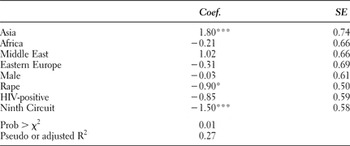
Such conceptual volatility is unsurprising given the findings of Ramji-Nogales, Schoenholtz, and Schrag (Reference Ramji-Nogales, Schoenholtz and Schrag2008), but the added ingredient of sexuality, as these cases indicate, suggests that further and more specific exploration is warranted. Because these case materials appeared to be so unpredictable on a first reading, the opinions collected for this project were coded for several descriptive variables and subjected to exploratory statistical modeling (see Appendix). The probit model reported in the Appendix indicates that the asylum applicants in this data set were more likely to be granted refugee status if they were gay men whose claims of persecution included allegations of rape. There is, however, a notable exception: Such claims did not succeed if the men making them were Asian. This finding suggests not only that claims of homosexuality and persecution may be linked together or taken apart in ways that are contingent upon particular models of sexuality, but also that the heuristic potency of those models intersects with and is distorted by cultural conceptions of gendered citizenship. While most of the cases in this data set contain too little textual material for a sustained exegesis, three exceptions illustrate the point.
Asian Applicants: Tan and Suherwanto
In Tan v. Ashcroft (2004), Jen Djuan Tan, an applicant from Indonesia, sought review of the BIA's denial of his application for asylum and withholding of removal, and petitioned the Ninth Circuit to reopen his case, asserting, in part, that he was denied asylum because of ineffective counsel.Footnote 15 The details of the case are spelled out most clearly in a dissent written by Judge Paez :
Tan, a gay Chinese citizen of Indonesia, was raped by three Muslim natives in a public bathroom in 1989. Although he discussed the incident with his counsel, Tan did not disclose (1) that he had been raped or (2) that the three men targeted him on account of his sexual orientation. In his motion to reopen, Tan explains that his initial reluctance to volunteer these details stemmed from his lingering trauma from the rape and his internalized shame about his sexual orientation. When counsel later acknowledged that he knew Tan was gay, Tan specifically asked whether he should disclose his sexual orientation to the immigration judge and whether “it was in any way relevant to [his] case.” Without asking any questions, counsel advised Tan not to mention his sexual orientation to the immigration judge.Footnote 16
The dissent here argues that Tan had presented sufficient evidence of ineffective counsel, and it notes that if the applicant's sexual orientation had been brought forth in the original proceedings, he might have succeeded.
In Suherwanto v. Attorney General of the United States (2007), a gay Indonesian's asylum petition was denied because the Third Circuit, agreeing with the IJ and BIA, found that “Mr. Suherwanto has failed to demonstrate that he was subjected to past persecution because he is homosexual.”Footnote 17 According to that opinion, the applicant claimed persecution on the basis of five different events. First, he claimed to have been forced into an act of anal sex at the age of 9 by an adult male who was teaching him about the Muslim religion. Second, he alleged that after he realized his homosexuality at the age of 16, he was observed kissing another man on the front porch of the family residence. Village leaders told Suherwanto's parents that they would have to leave the village because the Muslim faith does not tolerate homosexuality. Instead of leaving, his parents committed suicide by drinking insecticide; Mr. Suherwanto discovered their bodies the following day. He testified that he believed they had killed themselves because they were ashamed of him. A third event took place after he began a relationship with a Chinese grocer. During a spate of ethnic riots in 1998, the grocer's store was looted and burned; the police were called but did nothing. Six months later after the store had reopened, it was looted again, and ethnic Indonesians ransacked the store and burned Mr. Suherwanto with a cigarette butt and a hot iron. Police again refused to help and the store was closed. The final event took place after Mr. Suherwanto enrolled in law school. According to his testimony, school officials discovered his homosexuality and insisted that he leave school. After his partner died of a heart attack in 2001, Mr. Suherwanto left Indonesia for the United States. In this case, the petition was denied because the court could not find a persuasive connection between the applicant's homosexuality and the persecution he endured.
The Mexican Applicant: Pozos
In Pozos v. Gonzales (2005), Miguel Pozos, a citizen of Mexico, successfully appealed to the Ninth Circuit after his petition for asylum had been denied by both an IJ and the BIA. His argument before the Ninth Circuit operates along two axes, inviting the court to consider two questions that gave rise to tension between the majority and dissenting judges. The first inquiry pursued by the majority involves the extent to which the persecution Pozos suffered was sanctioned by government officials; the second investigates Posoz's sexuality. As noted previously, successful claims include an applicant showing both homosexuality and persecution and linking the two together. But according to the opinion:
Both Pozos and the social worker who examined him testified that they did not know what Pozos's sexual orientation was. Pozos testified that while he has had no sexual relationships since coming to the United States, his sexual fantasies have involved both men and women. It would be unreasonable to assume (or require), however, that he will refrain from homosexual actions or the public manifestation of homosexual feelings for the indefinite future.Footnote 18
Pozos's disinclination to adopt a gay identity for himself was the reason his application failed before the IJ and the BIA; it also provides a point of departure for Judge Kozinski's dissent: “Pozos maintains he is not a homosexual, and this surely constitutes sufficient evidence to support a finding to that effect.”Footnote 19 Judge Kozniski goes on to point out that Pozos had also been diagnosed with sexual aversion disorder, thereby undermining his ability to claim homosexuality within the substitutive model and disqualifying him from protected group membership. The court majority, however, determined that Pozos was, in fact, a homosexual, thereby assigning to him a sexual identity that he had not claimed for himself.
EMBARGOED SEXUALITY AND THE GENDER OF CITIZENSHIP
Arguably, any of the differences among these cases could have determined their outcome. But what merits further examination is the way that each opinion operates at the intersecting axes of Katyal's models of sexuality and Leonard and Tronto's characterization of gendered citizenship. In Tan, Katyal's substitutive model appears most clearly in the dissenting opinion by Judge Paez:
The majority faults Tan for not explicitly informing his counsel that he was attacked in 1989 because he was homosexual. This erroneously shifts the focus away from his counsel's failure to ask Tan whether he was persecuted because of his sexual orientation to Tan's reluctance to volunteer information about his sexual assault. We have noted that rape victims are often reluctant to reveal information about their sexual assault. Tan, who did not know that his sexual orientation was a potential ground for asylum, should not be faulted for failing to press the issue of sexual orientation after his counsel implied that it was not relevant. … Tan's “right to a full and fair presentation of his [asylum] claim included the right to have an attorney who would present a viable legal argument on his behalf supported by relevant evidence. …” Here, counsel knew that Tan had been persecuted in Indonesia and that Tan was gay, but never investigated the possible connection between these two facts. And when Tan asked whether he should reveal his sexual orientation to the immigration judge, counsel advised him not to disclose his sexual orientation. In my view, a reasonably competent counsel would have acted otherwise.Footnote 20
Judge Paez's opinion shows the substitutive model in action: Tan identified himself as gay, his lawyer knew it, and the responsibility for building an appropriate legal argument from this information was the lawyer's—not Tan's—responsibility. The dissent focuses on the word “because,” thus taking the sexual orientation of the applicant as a given, as well as the persecutory nature of rape, and signaling that it is the linkage between the two that should be considered more carefully by the court. The majority opinion, however, dismisses not only the relationship between the applicant's sexuality and the rape but also rhetorically obscures Tan's homosexuality.
Describing the IJ's initial decision, the court majority observes that “Tan's claim to asylum fails because the IJ's decision was the final agency action, and the IJ determined that Tan was not persecuted on account of his race or religion.”Footnote 21 Here, the majority correctly recognizes that the IJ was unlikely to have known that Tan was gay, largely because Tan's lawyer had advised his client to remain silent about that fact. The only time the word “homosexual” appears in the majority opinion is when it is linked to the “because” of the rape, as quoted in the passages. The court continues to describe Tan's failure before the IJ as follows: “neither counsel nor the IJ nor the BIA could be expected to engage in extispicy rather than law.” Describing the knowledge of Tan's sexuality as “extispicy”—the act of divining the will of a deity from anomalies in the entrails of a ritually slaughtered animal—reveals the court's insistence on a substitutive model of sexuality.
As Lee Edelman (Reference Edelman and Abelove1993) has argued, homosexuality today is imagined to be legibly written on the body: Some stigmatizing mark, such as effeminacy, should be apparent or publicly announced so that the average “heterosexual” citizen may, at all times, know where the subversives are; the homosexual is forced to confess (Foucault Reference Foucault1978). This practice comports with the substitutive model of sexuality and, under Hernandez-Montiel, it also makes it possible for an applicant to translate his transformative model of identity into the substitutive framework. Because Tan—an applicant whose sexual identity emerged from within an additive framework—had been reluctant to reveal his homosexuality and because, on the advice of counsel, he kept that information to himself, the blame for an unsuccessful application is here placed on the applicant rather than his lawyer. Characterizing this knowledge formation as “extispicy” shows the court's insistence that homosexuals are obligated to reveal themselves, and that even when such revelations are made, that knowledge is of little more social value than ritualistic acts of divination. That the word itself is rather obscure adds an additional layer of obfuscation to the court's refusal to see and to know what was readily apparent. The majority's rhetorical sleight of hand has here rendered something unknowable—denied something that was clearly there to be known—and then relied on that constructed ignorance to shift the blame for legal failure onto the applicant. That shift in blame is underscored in the final paragraph of the majority opinion: “[T]o the extent that the motion was based on newly discovered evidence, it necessarily failed because the evidence was not new at all—it related to events of long ago, which Tan had not chosen to reveal at an earlier time.”Footnote 22
Ironically, the court here simultaneously admits and denies Tan's homosexuality and suggests that the triptych of questions in his petition were not displayed in the proper order: Who knew, what did they know, and when did they know it? Tan's homosexuality and his status as a rape victim were old information, but they were not known by the right people at the right time: a temporal ordering of information that suits the court's purpose, but one which is inaccurate and untrue. Each of the determinative categories required by a substitutive model—acts and identities—is here also held to a very specific set of standards regarding a time line of revelation. Tan's sexual orientation was made literal within a discursive community that knew but did not need to articulate a definition of his homosexuality. Simultaneously, his homosexuality was figuratively obscured when the court announced the possibility that he was persecuted on the basis of racial prejudice alone (he was ethnically Chinese). Such results are common in the ironic jurisprudence of sexuality. Heterosexuality serves as the common framework, which, though unacknowledged, unspecified, and undefined, creates a common discursive community that may speak of and evaluate sexual nonconformists without admitting that judgment is taking place and without any hint of self-reflection (Rollins Reference Rollins2004). Because organizing these bits of information properly required, on the majority's reading, an act of extispicy, it would seem that Tan's application was doomed before it was even filed.
In Suherwanto, we learn that rapists may not need to rely on extispicy in order to determine the sexual orientation of a victim. Here, the court orders events in a manner that ultimately obscured the relationship between Suherwanto's sexual orientation and ethnicity and the sexual abuse he suffered. But while the question of whether or not Tan's victimizers knew he was gay is left unaddressed in that case, the matter of Suherwanto's sexual orientation and the timing of his coming out are dispositive. Much of the court's opinion in Suherwanto is appropriately concerned with the same “because” question that dogged the Tan court; in short, both the IJ and BIA appear to have had difficulty parsing whether or not Suherwanto's hardships were a result of his sexual orientation or his ethnicity.
The IJ, BIA, and the Third Circuit all agreed that Suherwanto's problems were the result of civil unrest and the behavior of criminals. All three also agreed that the government of Indonesia was not implicated in acts of persecution against homosexuals. Thus, while Suherwanto's sexual orientation was apparent to all relevant officials throughout his legal ordeal, it was not construed as the impetus behind his persecution. Near the end of the opinion, however, the court makes an unsettling observation:
Here … there is no evidence in the record that the sexual abuse forced upon Mr. Suherwanto when he was nine years old was motivated by his teacher's belief that the child was a homosexual. Mr. Suherwanto asserted in the statement attached to his application for asylum that he was unaware of his homosexuality until he was sixteen years old. Mr. Suherwanto also testified that the physical assault he suffered during the rioter's conduct in the grocery store resulted from the fact that he was working for a Chinese grocery store owner. Mr. Suherwanto has not demonstrated that he was assaulted by the ethnic Indonesian vandals because he is a homosexual.Footnote 23
This passage displays a contrived but judicially useful arrangement of the evidence related to Suherwanto's suffering. Because Suherwanto did not come out to himself until the age of 16, the court dismisses the possibility that he was raped for that reason. While the court admits that ethnicity—a category that might also have resulted in a successful claim of persecution—played a role in the rioters' destruction of the grocery store where Suherwanto worked with his partner, that element of the case is eclipsed by his sexual orientation, and the claim of persecution is dismissed because, according to the court, a rapist could not have known that a child was gay long before that child realized it for himself.
The courts in Tan and Suherwanto literally distinguish between persecutory events based on ethnicity and those based on sexual orientation, that is, rape, and the conceptual segregation of these elements works as rhetorical support as they deny the applicants' claims. As argued in the following, however, these intersecting identity categories were figuratively elided, a reading that is underscored by the different outcome of Pozos. The court in Pozos recognized that “[a] persecutor may have multiple motives for inflicting harm on an asylum applicant. As long as the applicant produces evidence from which it is reasonable to believe that the persecutor's action was motivated, at least in part, by a protected ground, the applicant is eligible for asylum.”Footnote 24 Rather than compartmentalize identity categories as possible grounds for asylum, the court in Pozos adopts the same approach as dissenting Judge Paez in Tan when he observes that extispicy was not required to recognize the applicant's sexuality as grounds for persecution; instead, to use the dissent's language: Simple perlustration—taking a broad view —would have sufficed.Footnote 25
What is odd about Pozos, what animates the tension between the majority and the dissent, and what makes Pozos so different from Tan and Suherwanto is the way that relevant factors were organized into a coherent narrative so that the court could put Pozos into a protected category that he had not claimed for himself. Viewed from this angle, the opinion seems to operate within the substitutive model that Katyal describes: Sexual acts and identities are substituted for one another even if that act of categorization is imposed by a court.
The juxtaposition of these opinions brings into focus a serious problem with the legal definition of the category “homosexual,” particularly as that category is influenced by different models of sexuality and variations in the gendered nature of citizenship. The protected categories recognized by U.S. immigration officials and courts—race, religion, nationality, membership in a particular social group, or political opinion—should be much more conceptually stable than this discussion reveals them to be. Not only is homosexuality an unstable category, but it appears that what might qualify as persecution on that basis is dangerously restricted to rape. Such restriction is dangerous because it overlooks the possibility that members of sexual minorities might suffer forms of persecution that are not necessarily sexual. As Katherine Franke (Reference Franke1998) has shown so clearly, to call something sexual is simultaneously to say too much and too little about it; not all genital acts are sexual and not all sexual persecution is genitally focused. Indeed, rape was only one of several ways that Suherwanto was persecuted, and the observation underscores Franke's argument: Rape should also be seen as a form of persecution when inflicted on a victim because of his or her race, religion, nationality, or other nonsexually defined grouping. At the same time that homosexuality continues to be unstable as a legal category, the form of persecution with which it is associated seems to be stabilized.
Not only can we see that defining homosexuality is unstable and persecution limited to rape, but these decisions also overlook important connections between other protected categories. Why is homosexuality so opaque in some instances and rendered so brightly in others? To answer this question, we should return to the formulation articulated in Hernandez-Montiel: Eligible applicants for asylum are gay men with female sexual identities in Mexico. Although this precedent has been expanded to include all sexual minorities, it suggests that the legibility of an applicant's sexuality cannot be read in isolation from gender, culture, citizenship, and ethnicity.
In his book Racial Castration, David Eng examines “the numerous ways in which articulations of national subjectivity depend intimately on racializing, gendering, and sexualizing strategies” (Reference Eng2001, 3). The ways these strategies operate in Tan and Suherwanto reinforces what Richard Fung refers to as the conflation of “Asian” with “anus” (Reference Fung1991, 153). In sum, Asian men are already viewed as feminine and thus assigned to a subordinate social location. As Eng observes, “whiteness and heterosexuality work collectively to articulate and secure their universal status in relation to a devalued Asian racial positioning” (2001, 152). On this reading, we may posit that Tan and Suherwanto were denied asylum in the United States because the sexuality and gender performance of Asian men are seen by American judges as insufficiently masculine, both in their countries of origin and at the U.S border. Thus, they fail to serve as the constitutive outside against which American masculinity and whiteness are defined and deviance punished (Butler Reference Butler, Wendy and Janet2002; Halley Reference Halley and Michael1993b; McIntosh Reference McIntosh1968). Because the Asian applicants interpreted their own sexuality from within an additive model of sexual orientation, they could not make sense of their own self-conception and translate it into the substitutive model insisted upon by these courts and immigration officials. Furthermore, because all Asian men are seen as feminized subjects, the rapists, too, were figuratively emasculated and therefore the applicants for asylum could not claim to have been victimized; the gendered nature of citizenship Leonard and Tronto identify also got lost in the translation.
These two decisions call into doubt the masculinity of both rapists and victims, minimizing the threat of the former and, simultaneously, the possibility of damage to the latter. Without a masculine, citizen rapist there could be no effeminized, private victim. Pozos, on the other hand, came to the U.S. from a culture marked by a default masculine citizenship. Because he did not rely on a recognizable model of sexual orientation to structure his narrative, his sexual orientation remained an open question for U.S. judges to decide. Despite a diagnosis of sexual aversion and an unwillingness to claim any sexual orientation at all, he could still be rendered legible as a homosexual and, thus, a victim of rape by virtue of his national origins.
In contrast to Crenshaw's version of intersectionality, these cases show that in order to gain refugee status, gay and lesbian applicants fare best when they can be placed among the most unprivileged members of a protected group, a practice that requires persecution to be a relational interaction between a masculine, citizen rapist and a feminized, private victim. Finally, although not all gay and lesbian refugees in these cases were required to prove that they were raped, the fact that rape assumes such a prominent role in linking homosexuality to persecution is problematic. Karouni most clearly illustrates the point. Although Karouni succeeded before the circuit courts, immigration officials were apparently uncertain about whether discharging a gun into a gay man's anus might portend a future risk of persecution for other homosexuals. When New York City police inserted a toilet plunger into the rectum of Abner Louima, determining whether the act was sexual, as the media depicted it, was an open question (Franke Reference Franke1998). In Karouni's story, immigration officials determined that inserting a gun into someone's rectum was not, further underscoring Franke's concern. Nabulwala and Pozos succeeded because both were located as unprivileged members of a protected group and they were sexually violated by abusers defined by their masculine citizenship; Tan and Suherwanto failed because they were not. Because Mockeviciene's lesbianism was in doubt, her status as a rape victim was also rendered questionable. Despite the gaps and inconsistencies in her narrative, the fact that she was married and came from a culture marked by a default, masculine conception of citizenship allowed the court's heterosexualization of her to discount her rape as a form of persecution; it became, it seems, an expected instance of heterosexual male access to a heterosexual woman's body (MacKinnon Reference MacKinnon1988).
In conclusion, what this discussion offers is an enriched understanding of how intersectionality works when sexual orientation is a component of the identity conflicts that arise in American law. To claim refugee status as a persecuted member of a sexual minority requires that litigants be situated among the least privileged members of groups defined at the intersection of sexuality, gender, and citizenship. Refugees who presented rape as evidence of their persecution were granted asylum when the racialized and gendered conceptions through which officials understood the gender of citizenship in the applicants' countries of origin intersected in a manner that allowed the applicants to be placed in the unprivileged, victimized group. The Asian applicants failed not only because their claims of homosexuality did not translate easily into the substitutive model but also, it seems, because a particularly gendered model of citizenship made it difficult to link their sexuality to their persecution. Pozos succeeded because the substitutive model was imposed on his narrative despite an imperfect fit. While that model may be dominant in American law, it is clearly unstable, unpredictable, and idiosyncratically applied, particularly when other models have guided applicants' self-conceptions.
These case opinions indicate that race and gender may be aligned along a single axis of analysis, which then, in turn, distorts the third dimension of sexuality. Immigration law may be a craps game for most asylum applicants, but what remains intact are our gendered and racialized conceptions of citizenship and the dominant, substitutive model of sexual orientation.
APPENDIX
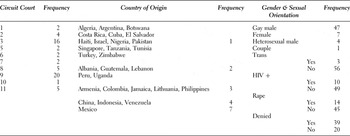
In his study of immigration cases, Michael Scaperlanda (Reference Scaperlanda2002) worries that asylum petitions by gays and lesbians may represent a “kulturkampf in the backwaters.” His argument is that immigration law—an underattended and marginal area of American jurisprudence—has become a site where homosexuality is recognized and given legitimacy in ways that may ultimately seep out into other types of cases, most notably into the marriage debate. In order to unpack and explore the premises of his argument, data for this project were collected by searching the Lexis-Nexis database of immigration appeals for the words “homosexual” and “lesbian” between the time that Lawrence v. Texas (2003) extended a constitutional right of privacy to homosexuals in July 2007. A first reading of the resulting 126 cases revealed a number of decisions that mentioned homosexuality only in citations or other tangential references; these were excluded from analysis. A summary of the data is presented in Table 1. Several descriptive trends become apparent. Applicants came to the United States from all regions of the globe. The highest number came from Mexico or Latin America (25). Each of the circuit courts of appeals is represented except the Fourth, and the largest number of opinions were issued by the Ninth Circuit. Most applicants were gay men (47); among opinions originating with applications filed by women (7), sexual orientation was often unclear in the text. Few cases involved transgendered applicants (3), roughly one-sixth of the applicants were HIV-positive (10), and slightly more reported being raped in their home countries (14). Approximately one-third of the applicants were successful at the circuit court level (20 cases).

Given the holding in Hernandez-Montiel (2000) and the conditions under which that applicant succeeded, the hypothesis test reported here was designed to determine which criteria stated in that decision were likely to predict an applicant's success. Because the largest number of cases originated with the Ninth Circuit, a circuit known for a relatively liberal political inclination as well as the source for Hernandez-Montiel, a binary variable was generated categorizing opinions as either from that circuit or not. Following the holding of Hernandez-Montiel, it is reasonable to hypothesize the following: Gay applicants for asylum will be more likely to succeed if they are 1) male, 2) from Mexico or Latin America, 3) if their claims are heard on the Ninth Circuit, and 4) if they report having been raped in their home countries. Because HIV status remains a contentious matter in immigration cases, we might expect that seropositive applicants would be less successful (see Bromer Reference Bromer2006). Because the dependent variable “denied” is binary, probit analysis was used to determine the relative effect of these independent variables on applicants' success. Results are reported in Table 2. The model is significant at the 0.01 level with a pseudo-R2 of 0.27, indicating that applicants whose claims were heard on the Ninth Circuit and those who reported being raped were more likely to succeed. Unexpectedly, the analysis also shows that Asian applicants were more likely to see their petitions for asylum denied, even when their reports of persecution included allegations of rape.
Probit coefficients for denied (n = 59)

* p < .10
** p < .05
*** p < .01
**** p < .001.