Introduction
Evidence is accumulating that personality traits, the consistent behavioral patterns that originate within the individual (Burger, Reference Burger1993), correlate with particular neurochemical markers (Farde et al. Reference Farde, Gustavsson and Jonsson1997; Alia-Klein et al. Reference Alia-Klein, Goldstein, Kriplani, Logan, Tomasi, Williams, Telang, Shumay, Biegon, Craig, Henn, Wang, Volkow and Fowler2008; Frokjaer et al. Reference Frokjaer, Mortensen, Nielsen, Haugbol, Pinborg, Adams, Svarer, Hasselbalch, Holm, Paulson and Knudsen2008; Mickey et al. Reference Mickey, Ducci, Hodgkinson, Langenecker, Goldman and Zubieta2008; Kalbitzer et al. Reference Kalbitzer, Frokjaer, Erritzoe, Svarer, Cumming, Nielsen, Hashemi, Baare, Madsen, Hasselbalch, Kringelbach, Mortensen and Knudsen2009; Love et al. Reference Love, Stohler and Zubieta2009). Identifying these relationships is important as they may explain how personality relates to vulnerability to psychiatric illness and/or to treatment responsiveness of psychiatric illness. Abnormalities of monoamine oxidase A (MAOA) binding is an important neurochemical target for research as lower binding is associated with greater aggression (Alia-Klein et al. Reference Alia-Klein, Goldstein, Kriplani, Logan, Tomasi, Williams, Telang, Shumay, Biegon, Craig, Henn, Wang, Volkow and Fowler2008) and tobacco smoking (Fowler et al. Reference Fowler, Volkow, Wang, Pappas, Logan, Shea, Alexoff, MacGregor, Schlyer, Zezulkova and Wolf1996), and greater binding is associated with major depressive disorder (MDD) (Meyer et al. Reference Meyer, Ginovart, Boovariwala, Sagrati, Hussey, Garcia, Young, Praschak-Rieder, Wilson and Houle2006, Reference Meyer, Wilson, Sagrati, Miler, Rusjan, Bloomfield, Clark, Sacher, Voineskos and Houle2009). Excessive aggression, tobacco smoking and MDD are important conditions with great burden to society; MDD has a high prevalence rate of 2–5%, and is the fourth leading cause of death and disability (Murphy et al. Reference Murphy, Laird, Monson, Sobol and Leighton2000; Ustun et al. Reference Ustun, Ayuso-Mateos, Chatterji, Mathers and Murray2004). Antisocial behavior has a lifetime prevalence in adults of 12% (Compton et al. Reference Compton, Conway, Stinson, Colliver and Grant2005), and this 12% of individuals accounts for half the public health and social expenditures (Scott et al. Reference Scott, Knapp, Henderson and Maughan2001). Cigarette smoking resulted in at least 443 000 premature deaths in the USA between 2000 and 2004 (Centers for Disease and Prevention, 2008).
MAOA has a key role in the brain as it metabolizes serotonin, norepinephrine and dopamine (Haefely et al. Reference Haefely, Burkard, Cesura, Kettler, Lorez, Martin, Richards, Scherschlicht and Da Prada1992; Youdim et al. Reference Youdim, Edmondson and Tipton2006). The predominant location for this enzyme is on outer mitochondria membranes in neurons (Saura et al. Reference Saura, Bleuel, Ulrich, Mendelowitsch, Chen, Shih, Malherbe, Da Prada and Richards1996). MAOA density is highest in locus coeruleus, high in the cortex, striatum and hippocampus, and minimal in white matter (Saura et al. Reference Saura, Kettler, Da Prada and Richards1992, Reference Saura, Bleuel, Ulrich, Mendelowitsch, Chen, Shih, Malherbe, Da Prada and Richards1996). MAOA may be viewed as having an ongoing role in influencing monoamine levels, and inherited levels of MAOA may also have influence upon neurodevelopment. MAOA knockout (KO) mice (Cases et al. Reference Cases, Vitalis, Seif, De Maeyer, Sotelo and Gaspar1996; Lebrand et al. Reference Lebrand, Cases, Adelbrecht, Doye, Alvarez, El Mestikawy, Seif and Gaspar1996; Yang et al. Reference Yang, Seif and Armstrong-James2001) and wild-type mice given MAOA inhibitors during development (Vitalis et al. Reference Vitalis, Cases, Callebert, Launay, Price, Seif and Gaspar1998) show excess brain serotonin during development, which disrupts the organization of somatosensory thalamocortical afferents and retinal afferents in the dorsal lateral geniculate nucleus and superior colliculus (Cases et al. Reference Cases, Vitalis, Seif, De Maeyer, Sotelo and Gaspar1996; Upton et al. Reference Upton, Salichon, Lebrand, Ravary, Blakely, Seif and Gaspar1999). The abnormal development of thalamocortical afferents is also associated with abnormalities in the somatosensory cortex barrel fields (Cases et al. Reference Cases, Vitalis, Seif, De Maeyer, Sotelo and Gaspar1996). It has been proposed that impulsive aggression observed in MAOA KO mice is consequent to impairment in organizing sensory input secondary to the loss of barrel field structure in the somatosensory cortex (Chen et al. Reference Chen, Cases, Rebrin, Wu, Gallaher, Seif and Shih2007; Bortolato et al. Reference Bortolato, Chen and Shih2008).
There is good reason to believe that reduced MAOA levels are associated with personality traits related to aggression in humans. A recent positron emission tomography (PET) study found that reduced prefrontal cortex MAOA binding is associated with self-reported aggression in males (Alia-Klein et al. Reference Alia-Klein, Goldstein, Kriplani, Logan, Tomasi, Williams, Telang, Shumay, Biegon, Craig, Henn, Wang, Volkow and Fowler2008). Males who are deficient in MAOA, consequent to an X-chromosome defect at the vicinity of the MAOA gene, demonstrate frequent aggressive behavior (Brunner et al. Reference Brunner, Nelen, Breakefield, Ropers and van Oost1993). Moreover, a genotype associated with low levels of MAOA in an in vitro assay has been associated with greater risk of developing antisocial behavior (Caspi et al. Reference Caspi, McClay, Moffitt, Mill, Martin, Craig, Taylor and Poulton2002; Kim-Cohen et al. Reference Kim-Cohen, Caspi, Taylor, Williams, Newcombe, Craig and Moffitt2006). Low 5-hydroxyindoleacetic acid (5-HIAA) levels in cerebrospinal fluid (CSF) are associated with greater likelihood of developing antisocial personality disorder and aggressive criminal behavior (Brown et al. Reference Brown, Goodwin, Ballenger, Goyer and Major1979; Linnoila et al. Reference Linnoila, Virkkunen, Scheinin, Nuutila, Rimon and Goodwin1983; Linnoila & Virkkunen, Reference Linnoila and Virkkunen1992); and lower 5-HIAA levels can occur when MAOA is pharmacologically inhibited (Waldmeier & Baumann, Reference Waldmeier and Baumann1983; Garrick et al. Reference Garrick, Seppala, Linnoila and Murphy1985). In rodents, both MAOA KO or inhibitor administration reduce MAOA levels. In such paradigms, these animals display increased aggression, decreased latency to attack in the resident-intruder paradigm (Cases et al. Reference Cases, Seif, Grimsby, Gaspar, Chen, Pournin, Müller, Aguet, Babinet, Shih and Maeyer1995; Shih et al. Reference Shih, Ridd, Chen, Meehan, Kung, Seif and De Maeyer1999b) and enhanced fear conditioning (Kim et al. Reference Kim, Shih, Chen, Chen, Bao, Maren, Anagnostaras, Fanselow, De Maeyer, Seif and Thompson1997). MAOA-deficient animals, compared to animals with normal levels, also show decreased positive social exploration and far fewer investigative behaviors such as time spent exploring novel areas, nose-poking, and social investigations of cage-intruders (Cases et al. Reference Cases, Seif, Grimsby, Gaspar, Chen, Pournin, Müller, Aguet, Babinet, Shih and Maeyer1995; Popova et al. Reference Popova, Vishnivetskaya, Ivanova, Skrinskaya and Seif2000, Reference Popova, Skrinskaya, Amstislavskaya, Vishnivetskaya, Seif and de Meier2001). There is a substantial body of data to argue that reduced MAOA levels should correlate with aggression but only one study of brain MAOA binding has assessed this in humans (Alia-Klein et al. Reference Alia-Klein, Goldstein, Kriplani, Logan, Tomasi, Williams, Telang, Shumay, Biegon, Craig, Henn, Wang, Volkow and Fowler2008).
Although it is known that self-reports of greater aggressive behavior are associated with lower MAOA binding in humans, given the major role of MAOA in metabolizing multiple monoamines, it is expected that a number of adaptive and maladaptive traits may relate to MAOA binding in prefrontal cortex. The objective of this study was to measure brain MAOA binding in healthy individuals and concurrently evaluate a broad range of personality traits based on the Five-Factor Model (FFM) of personality. The NEO Personality Inventory Revised (NEO PI-R; Costa & McCrae, Reference Costa and McCrae1992) was chosen for this purpose, as it is a well-validated measure of personality including 30 facets within five domains (Costa & McCrae, Reference Costa and McCrae1988; Young & Schinka, Reference Young and Schinka2001; Aluja et al. Reference Aluja, García, García and Seisdedos2005). The NEO-PI-R is an excellent descriptive tool, due to its extensiveness; moreover, it can be used to describe normal to pathological personality characteristics (Digman, Reference Digman1990; Costa & McCrae, Reference Costa and McCrae1992). The prefrontal cortex was chosen as the primary region for analysis because it is a key functional area in monoamine-linked aggression (Caramaschi et al. Reference Caramaschi, de Boer, de Vries and Koolhaas2008) and emotional regulation (Quirk et al. Reference Quirk, Beer, Quirk and Beer2006). Structural or neurochemical variations within this region are associated with impulsive (Siever et al. Reference Siever, Buchsbaum, New, Spiegel-Cohen, Wei, Hazlett, Sevin, Nunn and Mitropoulou1999) or aggressive behavior (Meyer-Lindenberg et al. Reference Meyer-Lindenberg, Buckholtz, Kolachana, Hariri, Pezawas, Blasi, Wabnitz, Honea, Verchinski, Callicott, Egan, Mattay and Weinberger2006; Buckholtz et al. Reference Buckholtz, Callicott, Kolachana, Hariri, Goldberg, Genderson, Egan, Mattay, Weinberger and Meyer-Lindenberg2008; New et al. Reference New, Hazlett, Newmark, Zhang, Triebwasser, Meyerson, Lazarus, Trisdorfer, Goldstein, Goodman, Koenigsberg, Flory, Siever and Buchsbaum2009) and variations in personality (Chow, Reference Chow2000; Berlin et al. Reference Berlin, Rolls and Kischka2004; Love et al. Reference Love, Stohler and Zubieta2009; Matsuo et al. Reference Matsuo, Nicoletti, Nemoto, Hatch, Peluso, Nery and Soares2009). We specifically hypothesized that prefrontal cortex MAOA binding would correlate inversely with the angry-hostility facet, which is closely associated with aggression (Alia-Klein et al. Reference Alia-Klein, Goldstein, Kriplani, Logan, Tomasi, Williams, Telang, Shumay, Biegon, Craig, Henn, Wang, Volkow and Fowler2008). Given the major role of MAOA and the wide range of behavioral changes in MAOA KO mice (especially in relation to social and environmental investigative behaviors) (Cases et al. Reference Cases, Seif, Grimsby, Gaspar, Chen, Pournin, Müller, Aguet, Babinet, Shih and Maeyer1995; Popova et al. Reference Popova, Vishnivetskaya, Ivanova, Skrinskaya and Seif2000, Reference Popova, Skrinskaya, Amstislavskaya, Vishnivetskaya, Seif and de Meier2001), we also hypothesized that other facets of personality would relate to MAOA. To investigate this we conducted an exploratory analysis to investigate whether other facets would be correlated with prefrontal cortex MAOA binding. We expected that that one or more personality traits intuitively related to investigation/assessment of environment would also be associated with prefrontal MAOA binding.
Method
Subjects
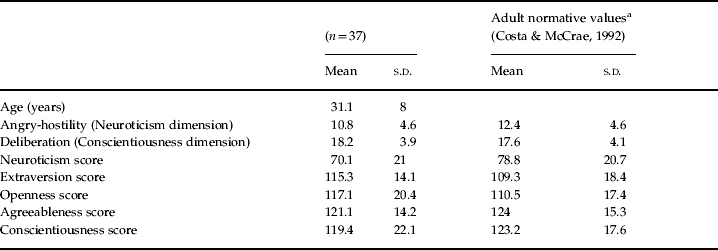
All 37 subjects were healthy non-smokers aged 19–49 years, with no history of neurotoxin, psychotropic or antipsychotic use (mean age 31.1±8.0 years, 20 males). Twenty-five of these subjects had participated in previous studies as healthy controls (Meyer et al. Reference Meyer, Wilson, Sagrati, Miler, Rusjan, Bloomfield, Clark, Sacher, Voineskos and Houle2009; Sacher et al. Reference Sacher, Wilson, Houle, Rusjan, Hassan, Bloomfield, Stewart and Meyer2010). The demographics for each group are listed in Table 1. Potential subjects were screened to rule out any Axis I disorders using the Structured Clinical Interview for DSM-IV (First et al. Reference First, Spitzer, Williams and Gibbon1995). Current or past DSM-IV Axis I diagnosis, neurological conditions, current use of prescription medication including oral contraceptives, pregnancy, claustrophobia or metal in the body were exclusion criteria. Use of over-the-counter medications within the past month and herbal remedies within 3 months before scanning were also exclusionary. All participants underwent common blood tests to rule out medical causes of disturbed mood (thyroid function, electrolyte levels, and complete blood cell count), and a urine drug screen that included over-the-counter, psychotropic and illicit drugs on the day of the [11C]harmine PET scan. Each study participant provided written consent after the procedures had been fully explained. The study and recruitment procedures were approved by the Research Ethics Board for Human Subjects at the Centre for Addiction and Mental Health, University of Toronto.
Sociodemographics and personality

s.d., Standard deviation.
a Norms calculated by weighting population sex norms for 20 males and 17 females.
PET image acquisition and analysis
PET scans were obtained with a high-resolution research tomography (HRRT) PET camera (in-plane resolution; full width at half maximum, 3.1 mm; 207 axial sections of 1.2 mm; Siemens Molecular Imaging, USA). A dose of approximately 370 MBq of intravenous [11C]harmine was administered as a bolus for the PET scan and emission data were then acquired over a 90-min period. [11C]Harmine was of high radiochemical purity (mean±s.d.=98.6±0.9%, n=37) and high specific activity (mean±s.d.=46.8±33 TBq/mmol) at time of injection. The radioactivity in whole blood and plasma was measured as described previously (Meyer et al. Reference Meyer, Wilson, Sagrati, Miler, Rusjan, Bloomfield, Clark, Sacher, Voineskos and Houle2009). Procedures for frame acquisition and reconstruction are described elsewhere (Meyer et al. Reference Meyer, Ginovart, Boovariwala, Sagrati, Hussey, Garcia, Young, Praschak-Rieder, Wilson and Houle2006, Reference Meyer, Wilson, Sagrati, Miler, Rusjan, Bloomfield, Clark, Sacher, Voineskos and Houle2009).
For the region of interest (ROI) analysis, each subject underwent a T1-weighted magnetic resonance imaging (MRI) scan for anatomical localization (GE Signa 1.5-T scanner; fast spoiled gradient echo, T1-weighted image; x, y, z voxel dimensions, 0.78, 0.78, and 1.5 mm; GE Medical Systems, USA). PET emission frames were summed and the individual's MRI was co-registered to each summed PET image using a mutual information algorithm (Studholme et al. Reference Studholme, Hill and Hawkes1999). ROIs were determined using a semi-automated method whereby regions on a template MRI are transformed onto the individual MRI through a series of transformations and deformations that match the template image to the co-registered MRI (Ashburner & Friston, Reference Ashburner and Friston1997, Reference Ashburner and Friston1999), followed by selection of gray-matter voxels within the ROI (Ashburner & Friston, Reference Ashburner and Friston1997; Rusjan et al. Reference Rusjan, Mamo, Ginovart, Hussey, Vitcu, Yasuno, Tetsuya, Houle and Kapur2006). Each ROI was overlaid upon both the co-registered MRI and summated [11C]harmine PET image for visual anatomical confirmation.
The ROIs were selected for their functional or neurochemical involvement in emotional regulation or personality (Drevets, Reference Drevets2000; Ressler & Mayberg, Reference Ressler and Mayberg2007; Love et al. Reference Love, Stohler and Zubieta2009; Matsuo et al. Reference Matsuo, Nicoletti, Nemoto, Hatch, Peluso, Nery and Soares2009). The ROIs sampled were the whole prefrontal cortex (and subregional ROI of orbitofrontal and dorsolateral prefrontal cortex), anterior cingulate cortex (including Brodmann area 24, part of 32), subgenual cingulate cortex (Cg25), putamen, thalamus, anterior temporal cortex (Brodmann area 38, part of 20, 21, 22), occipital cortex, midbrain, and hippocampus. Total volume of distribution (V T) is an index of harmine binding and represents the concentration of the total radiotracer in tissue relative to plasma concentration at equilibrium (Ginovart et al. Reference Ginovart, Meyer, Boovariwala, Hussey, Rabiner, Houle and Wilson2006). MAOA V T was calculated using the Logan method with a plasma arterial input (Logan et al. Reference Logan, Fowler, Volkow, Wolf, Dewey, Schlyer, MacGregor, Hitzemann, Bendriem and Gatley1990). With [11C]harmine PET, this measure of the MAOA V T is comparably robust in magnitude alongside the kinetically determined two-tissue compartment model, and computationally efficient (Ginovart et al. Reference Ginovart, Meyer, Boovariwala, Hussey, Rabiner, Houle and Wilson2006).
Psychological measures
Personality was assessed with the NEO PI-R (Costa & McCrae, Reference Costa and McCrae1992), which measures five broad dimensions of personality: neuroticism, extraversion, agreeableness, conscientiousness and openness to experience, and also their facets. The NEO PI-R is based on the FFM (Digman, Reference Digman1990; Goldberg, Reference Goldberg1990), and emerged from factor-analytic research on normal personality descriptors. It can be used to describe any personality from normal to pathological (Digman, Reference Digman1990; Costa & McCrae, Reference Costa and McCrae1992). It is probably the most popular and validated measure of normal personality (Costa & McCrae, Reference Costa and McCrae1988; Young & Schinka, Reference Young and Schinka2001; Aluja et al. Reference Aluja, García, García and Seisdedos2005). The Hamilton Depression Rating Scale (Hamilton, Reference Hamilton1960) was used as an additional measure to rule out depressive episodes.
Statistical analyses
The primary analyses corresponded to the main hypotheses. We chose the prefrontal cortex for our primary analyses because of a constellation of evidence implicating a variety of prefrontal regions in personality functioning (Damasio, Reference Damasio1995; Barrash et al. Reference Barrash, Tranel and Anderson2000; Chow, Reference Chow2000; Raine et al. Reference Raine, Lencz, Bihrle, LaCasse and Colletti2000) and emotional regulation (Quirk et al. Reference Quirk, Beer, Quirk and Beer2006), in addition to monoamine-linked aggression (Caramaschi et al. Reference Caramaschi, de Boer, de Vries and Koolhaas2008). The angry-hostility facet of the NEO-PI-R was chosen a priori for the primary analysis as it is similar to the trait aggression reported by Alia-Klein et al. (Reference Alia-Klein, Goldstein, Kriplani, Logan, Tomasi, Williams, Telang, Shumay, Biegon, Craig, Henn, Wang, Volkow and Fowler2008), and we aimed to confirm that low MAOA levels were correlated with this self-report of aggression. We then conducted a stepwise linear regression analysis to determine whether other facets were predictors of prefrontal cortex ROI V T (the dependent variable), after entry of angry-hostility based on the a priori hypothesis. For each identified facet, correlations between the facet and prefrontal MAOA V T were assessed with Pearson's r and those that remained significant after Bonferroni correction were retained. We conducted subsequent exploratory analyses assessing the relationship between retained factors from the regression model and several subregions of the prefrontal cortex (orbitofrontal, dorsolateral prefrontal cortex), and other brain regions that may have involvement in affective regulation or aggression, such as the anterior cingulate cortex, subgenual cingulate cortex, anterior temporal cortex, putamen, thalamus, and midbrain (e.g. Drevets, Reference Drevets2000; Ressler & Mayberg, Reference Ressler and Mayberg2007; Buckholtz et al. Reference Buckholtz, Callicott, Kolachana, Hariri, Goldberg, Genderson, Egan, Mattay, Weinberger and Meyer-Lindenberg2008).
It was planned to exclude age or gender in the primary analyses as it was expected that these would have no effect upon MAOA binding based on previous work (Saura et al. Reference Saura, Andrés, Andrade, Ojuel, Eriksson and Mahy1997; Meyer et al. Reference Meyer, Ginovart, Boovariwala, Sagrati, Hussey, Garcia, Young, Praschak-Rieder, Wilson and Houle2006, Reference Meyer, Wilson, Sagrati, Miler, Rusjan, Bloomfield, Clark, Sacher, Voineskos and Houle2009).
Results
Sample demographics
Age, gender, mean and standard deviations for main factors and the two facets (see later analysis regarding facets), and also sex-specific norms, are shown in Table 1. All personality measures were in the normal range for age and sex. As expected, neither sex [F(11, 25)=0.78, p=0.66, n.s.] nor age [F(11, 25)=0.194, p=0.08, n.s.] had an effect on regional MAOA V T.
Personality predictors of MAOA binding
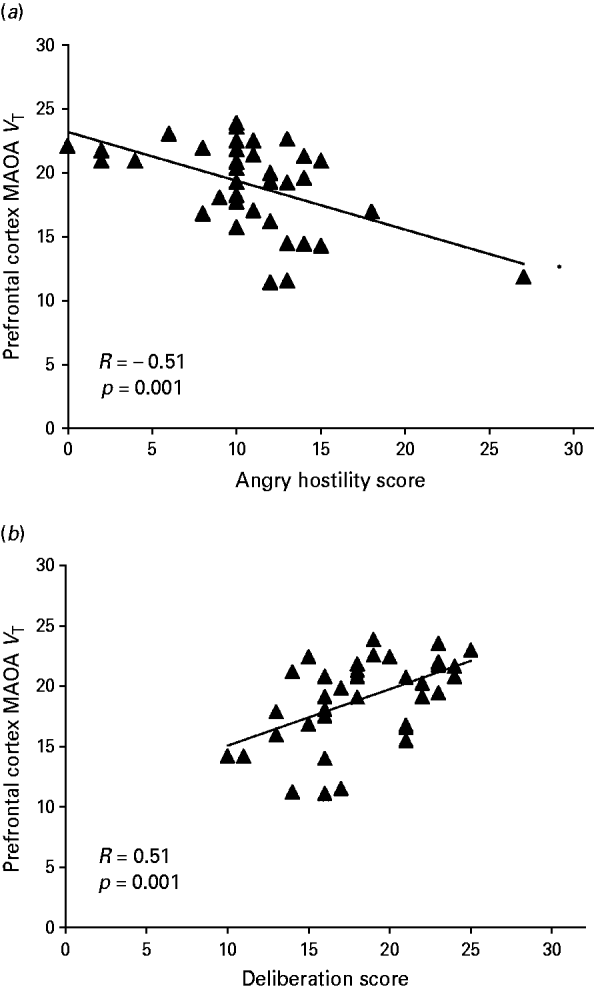
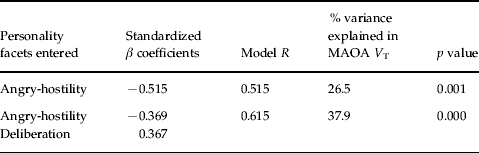
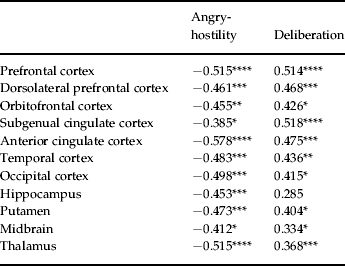
We found that prefrontal MAOA binding was best described by a two-factor model containing two personality facets, which accounted for 38% of the variance in MAOA V T [model R 2=0.378, F(2, 34)=10.36, p=0.009; angry-hostility (Neuroticism dimension) standardized β=−0.369; deliberation (Conscientiousness dimension) standardized β=0.367; Table 2]. Both factors had large tolerances (0.84 and 0.84; 1−R 2 for the regression of one independent variable on all other independent variables in the model). Correlation coefficients between the angry-hostility personality facet and prefrontal cortex MAOA V T (r=−0.515, p<0.001) and also between the deliberation facet and prefrontal cortex MAOA V T (r=0.514, p=0.001) were highly significant (Fig. 1). The correlation between prefrontal MAOA V T and the newly discovered facet of deliberation remained significant after correcting for multiple analyses. The angry-hostility personality facet was strongly negatively correlated with the subregions of the prefrontal cortex and the deliberation facet was strongly positively associated with the subregions of the prefrontal cortex assessed (Table 3). As MAOA binding correlated strongly among regions, this model was applied to other regions and explained their variance as follows: temporal cortex 30.4%, occipital cortex 30.4%, anterior cingulate cortex 40.6%, putamen 28.0%, hippocampus 21.8%, midbrain 19.8%, and thalamus 29.7%.
Prefrontal monoamine oxidase A (MAOA) levels and personality dimensions. (a) Prefrontal cortex MAOA binding correlates negatively with angry-hostility (n=37). Lower prefrontal MAOA binding is related to higher angry-hostility, a Neuroticism facet related to aggression. (b) Prefrontal cortex MAOA binding correlates positively with deliberation (n=37). Higher prefrontal MAOA binding is associated with higher deliberation, a conscientiousness facet related to caution and careful planning.

Predictors of prefrontal MAOA VT
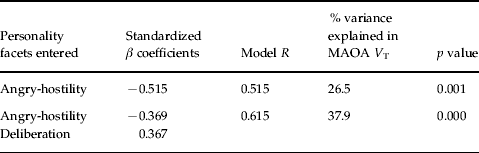
MAOA, Monoamine oxidase A; V T, total volume of distribution.
Correlations of regional MAOA VT and personality
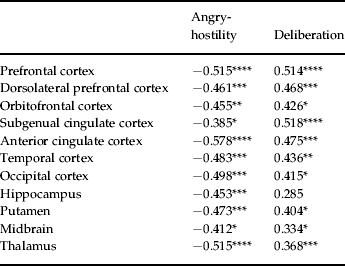
MAOA, Monoamine oxidase A; V T, total volume of distribution.
**** p⩽0.001, *** p⩽0.005, ** p⩽0.01, * p<0.05.
Secondary analyses showed a similar relationship between these two facets and MAOA binding in other brain regions (subgenual and anterior cingulate cortices, hippocampus, putamen, midbrain and thalamus). Among the other facets of personality, several others within the Neuroticism dimension (anxiety, depression, impulsiveness) were also significantly correlated with the prefrontal cortex MAOA binding, but to a lesser extent than the angry-hostility facet (r=−0.402, p=0.018; r=−0.377, p=0.028; r=−0.443, p=0.009, respectively). This was to be expected, given that scores on these facets are often correlated with each other.
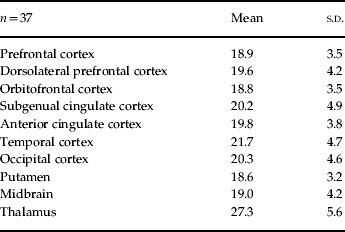
A normal range of values for regional MAOA V T was found (Table 4). Prefrontal cortex MAOA was also correlated with other regions, even when applying a Bonferroni correction for multiple comparisons (anterior cingulate cortex r 2=0.946, p=0.000; subgenual anterior cingulate r 2=0.633, p=0.000; hippocampus, r 2=0.700, p=0.000; temporal cortex, r 2=0.840, p=0.000; putamen, r 2=0.919, p=0.000; midbrain, r 2=0.846, p=0.000; thalamus, r 2=0.864, p=0.000; Bonferroni corrected). The correlation between angry-hostility and prefrontal MAOA binding was still significant, even when a subject with extremely high angry-hostility (score=27) was removed (angry-hostility r=−0.404, p=0.014).
Regional MAOA VT values
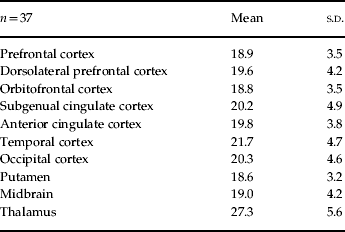
MAOA, Monoamine oxidase A; V T, total volume of distribution; s.d., standard deviation.
Discussion
Our study found that angry-hostility and deliberation together predicted 38% of the variance in prefrontal cortex MAOA binding in a multiple linear regression model. The first factor in the model, angry-hostility, was highly correlated with low MAOA binding. This first factor replicated the finding of Alia-Klein et al. (Reference Alia-Klein, Goldstein, Kriplani, Logan, Tomasi, Williams, Telang, Shumay, Biegon, Craig, Henn, Wang, Volkow and Fowler2008), while using different subjects, a reversible tracer and a different questionnaire. The second factor in the model was an entirely new finding, and confirmed our second hypothesis concerning MAOA binding relating to an investigative or evaluative personality trait, by showing that deliberation was correlated with higher MAOA binding. To our knowledge, this is the first study to examine brain MAOA binding in the context of a wide range of validated healthy personality traits, and it is intriguing that MAOA binding is strongly correlated with a highly adaptive trait. As the deliberation facet reflects a potentially adaptive component of personality, this has implications for understanding why greater MAOA binding may occur in the general population despite its association with MDD. The continuum of MAOA binding highest in deliberative individuals and lowest in individuals high in angry-hostility and impulsiveness may help us to understand the role of MAOA in relation to the range of healthy human behavior.
The data illustrate that deliberation, an additional personality facet related to the careful exploration and assessment of solution options, is highly correlated with MAOA binding, confirming our second hypothesis. The data also support our first hypothesis by bolstering the relationship found previously between low MAOA binding and self-reported aggression. MAOA binding is higher in individuals experiencing a depressive episode (Meyer et al. Reference Meyer, Ginovart, Boovariwala, Sagrati, Hussey, Garcia, Young, Praschak-Rieder, Wilson and Houle2006), or in high-risk-for-onset individuals (Meyer et al. Reference Meyer, Wilson, Sagrati, Miler, Rusjan, Bloomfield, Clark, Sacher, Voineskos and Houle2009; Sacher et al. Reference Sacher, Wilson, Houle, Rusjan, Hassan, Bloomfield, Stewart and Meyer2010). As higher MAOA binding here is associated with deliberation, an adaptive personality trait, this might offer a new way to understand why moderately elevated levels of MAOA are retained in the general population, despite the association of high MAOA binding with MDD. Deliberation includes the ability to maintain awareness of a situation while still interacting with it (Courbasson, Reference Courbasson2006). It is positively associated with academic achievement (Luciano et al. Reference Luciano, Wainwright, Wright and Martin2006) and negatively correlated with impulsivity (Whiteside & Lynam, Reference Whiteside and Lynam2001), but does not merely reflect lack of impulsivity. High deliberation does not exclude sensation-seeking; rather, it is protective against risk-taking behavior ending in failure, regardless of an individual's level of sensation-seeking or frequency of risk-taking activities (Fischer & Smith, Reference Fischer and Smith2004). In the present study we propose that retention of a biological marker of vulnerability to illness (when extreme) might in fact relate to an adaptation in the population as a whole at moderate levels, thereby explaining why moderately high MAOA binding is retained in healthy people, despite the relationship of very high MAOA binding with MDD.
There are several ways to interpret the association between prefrontal cortex MAOA binding and these two personality facets. One way to understand the results is that individual variability in MAOA influences personality development; another view is that personality facets modify MAOA levels, and a third is that the relationship is an epiphenomenon with intermediate correlating events. We favor the model of MAOA levels during development influencing personality. Support in favor of this model includes the set of findings that decreasing MAOA levels through MAOA KO or MAOA inhibitor administration early in life are associated with aggressive behavior in adult animals (Cases et al. Reference Cases, Seif, Grimsby, Gaspar, Chen, Pournin, Müller, Aguet, Babinet, Shih and Maeyer1995, Reference Cases, Vitalis, Seif, De Maeyer, Sotelo and Gaspar1996; Shih et al. Reference Shih, Chen and Ridd1999a; Shih, Reference Shih2004; Bortolato et al. Reference Bortolato, Chen and Shih2008). Moderately high MAOA binding in humans is associated with a positive trait, so it is possible that such levels are adaptive. An argument in favor of developmental MAOA levels influencing adaptive aspects of personality also comes from observations of investigative behaviors of MAOA KO mice contrasting with those of wild-type. Compared to mice with normal MAOA levels, MAOA-deficient animals do not show normal investigative behaviors, and seem to take more risks. For example, compared to wild-type, KO mice had fewer amiable social explorations and environmental investigative behaviors, but spent more time in the centre of an open field, with long hesitations before choosing an exploratory direction (Cases et al. Reference Cases, Seif, Grimsby, Gaspar, Chen, Pournin, Müller, Aguet, Babinet, Shih and Maeyer1995). MAOA-deficient animals also show fewer nose-pokes through a hole-board (a test of investigative activity) and fewer exploratory line-crossings in a dark–light test (assessing investigative motivation; Popova et al. Reference Popova, Vishnivetskaya, Ivanova, Skrinskaya and Seif2000, Reference Popova, Skrinskaya, Amstislavskaya, Vishnivetskaya, Seif and de Meier2001).
The model describing reduced MAOA binding associated with greater aggression and lower deliberation also fits well in a concept of buffering monoamine surges in health. All animals, including humans, experience surges of brain monoamines when facing stressful stimuli (Kawahara et al. Reference Kawahara, Yoshida, Yokoo, Nishi and Tanaka1993; Pruessner et al. Reference Pruessner, Champagne, Meaney and Dagher2004; Soliman et al. Reference Soliman, O'Driscoll, Pruessner, Holahan, Boileau, Gagnon and Dagher2008), and chronic phasic monoamine release, if not regulated, may lead to homeostatic compensatory mechanisms, encouraging exaggerated phasic monoamine release in response to stimuli (see Grace, Reference Grace1991; Lieberman et al. Reference Lieberman, Sheitman and Kinon1997). MAOA KO mice, compared to wild-type, experience exaggerated synaptic serotonin and norepinephrine surges following a fenfluramine challenge (Holschneider et al. Reference Holschneider, Scremin, Huynh, Chen, Seif and Shih2000); so it could be that higher levels of MAOA act as a buffer to handle the phasic release of monoamines that occurs when animals encounter stressors (Kawahara et al. Reference Kawahara, Yoshida, Yokoo, Nishi and Tanaka1993; Pruessner et al. Reference Pruessner, Champagne, Meaney and Dagher2004; Soliman et al. Reference Soliman, O'Driscoll, Pruessner, Holahan, Boileau, Gagnon and Dagher2008). As moderate MAOA binding is associated with deliberation and lower impulsiveness, the related aspect of moderate MAOA may be an underlying adaptive mechanism, whereby phasic monoamine release is more transient, thus improving adaptive resilience to stressful situations (see also Grace, Reference Grace1991; Lieberman et al. Reference Lieberman, Sheitman and Kinon1997).
A limitation of our interpretation is that the MAOA–personality relationship might change during an individual's transition from health to illness. However, the angry-hostility facet remains constant through depressive state to remission (Harkness et al. Reference Harkness, Bagby, Joffe and Levitt2002); and our model in healthy people predicts 38% of the variance in MAOA prefrontal binding. We hypothesized a priori that the prefrontal cortex MAOA binding would be related to personality and this finding was significant. However, we cannot assume that this is specific to the prefrontal cortex alone because we also found a relationship between these personality facets and MAOA binding in other brain regions. Although we were able to measure in vivo MAOA binding with PET, the PET method has some limitations. The spatial resolution of PET does not allow us to pinpoint differences in V T at the level of cell type. In addition, although we were able to find a strong correlation with several personality facets and compute a regression model to predict MAOA binding in the prefrontal cortex, it is possible that there are other facets of personality not assessed by the NEO-PI-R that may also contribute to the variation in MAOA binding. Although the focus of the investigation was the relationship between personality facets and prefrontal cortex MAOA V T, the high correlations between prefrontal cortex MAOA V T and other regions' MAOA V T may indicate that other ROIs are also relevant. Finally, our study is not able to assess the sequence of events with respect to MAOA binding and personality.
To our knowledge, this is the first study to image brain MAOA binding in a healthy population in relation to a very broad range of personality facets using the FFM of personality. We discovered a positive relationship between deliberation and prefrontal cortex MAOA binding. We also confirmed a previous study that aggression is correlated with lower MAOA binding (Alia-Klein et al. Reference Alia-Klein, Goldstein, Kriplani, Logan, Tomasi, Williams, Telang, Shumay, Biegon, Craig, Henn, Wang, Volkow and Fowler2008). This relationship in humans is consistent with observed effects of altered MAOA availability early in development and the subsequent individual behaviors expressed in rodents. A mechanistic interpretation of the personality facet–MAOA relationship is that MAOA-mediated metabolism represents a process by which the monoamine system can regulate the amount of stress-induced synaptic serotonin affecting behavior. The association between greater prefrontal MAOA binding and the adaptive, positive personality facet of deliberation can explain why moderately high MAOA binding is retained in healthy people, despite the relationship of very high MAOA binding with MDD. The advantages of greater deliberation in the general population may outweigh the hazards of MDD.
Acknowledgements
This research received project support from the Canadian Institutes of Health Research, the Ontario Mental Health Foundation, the Canadian Foundation for Innovation, and the National Alliance for Research in Schizophrenia and Depression. We thank research technicians A. Ng and J. Fong, chemistry staff J. Parkes, A. Garcia, W. Stableford and M. Wong, and engineers T. Bell and T. Harris-Brandts for their assistance with this project.
Declaration of Interest
Drs Meyer, Wilson and Houle have received operating grant funding for other studies from Eli-Lilly, Lundbeck, GlaxoSmithKline, and Bristol-Myers Squibb and Dr Meyer has consulted to several of these companies. In the future, it is possible that Dr Meyer will receive operating grant funding from companies that make MAOA inhibitors and/or other antidepressants. None of these companies participated in the design or execution of this study or the writing of the manuscript.