Introduction
Infections from water-related organisms are a serious concern in healthcare facilities. Healthcare premise plumbing systems are complex and prone to stagnation, contamination, and biofilm formation. Challenges with temperature management and disinfectant levels can promote the persistence of pathogenic organisms, thereby increasing the risk for infections with water-related organisms.Reference Hayward, Ross and Brown1–Reference Yiek, Coenen, Nillesen, van Ingen, Bowles and Tostmann5 Water is used in a variety of ways in healthcare facilities such that patients can be exposed to water through direct or indirect contact, ingestion, inhalation of aerosols dispersed from water sources, or aspiration.6 In addition, patients in healthcare facilities are often particularly vulnerable to infections caused by water-related organisms due to compromised immune status, comorbidities, and exposure to invasive procedures and devices.Reference Isigi, Parsa, Alasqah, Mahmud and Kabir7,Reference Kollef, Torres, Shorr, Martin-Loeches and Micek8
A variety of water-related microorganisms, including Legionella and nontuberculous mycobacteria (NTM), can cause healthcare-associated infections (HAIs).Reference Decker and Palmore4,Reference Decker and Palmore9,10 Water-related HAIs are associated with hospitalizations, antimicrobial resistance, increased mortality, and excess healthcare costs.Reference Hayward, Ross, Brown and Whiley2,Reference Abbas, Khan and Iqbal11,Reference Collier, Deng and Adam12 NTM infections are difficult to diagnose and treat, oftentimes requiring surgery, removal of medical devices, and intensive and lengthy treatment with multiple antibiotics due to NTM’s intrinsic antimicrobial resistance.Reference Abbas, Khan and Iqbal11,Reference Malhotra, Arias and Backx13 Additionally, some NTM species have prolonged incubation periods, ranging from weeks to months, further complicating timely diagnosis and management.Reference Malhotra, Arias and Backx13,14
NTM infections are not nationally notifiable. Estimates of national NTM infection burden based on data from 2009 to 2020 have utilized data sources, such as claims data, and suggest that both pulmonary and extrapulmonary NTM infections are increasing in the United States.Reference Bents, Mercaldo, Powell, Henkle, Marras and Prevots15–Reference Bents, Powell, French, Prevots and Mercaldo18 The burden of healthcare-associated NTM infections, specifically, is less well-described, but a recent 10-hospital network study found that 24% of NTM infections had onset in a hospital.Reference Baker, La Hoz and Anesi19
Over 20% of consultations for HAIs to the Centers for Disease Control and Prevention (CDC) during 2014–2017 involved water-related organisms (excluding Legionella); NTM were involved in more investigations and affected more patients than any other bacterial pathogen.Reference Perkins, Reddy, Fagan, Arduino and Perz20 Given the number of consultations received for NTM, we aimed to describe and characterize more recent CDC outbreak consultations to identify potentially preventable sources of NTM infections and inform water management efforts in healthcare settings.
Methods
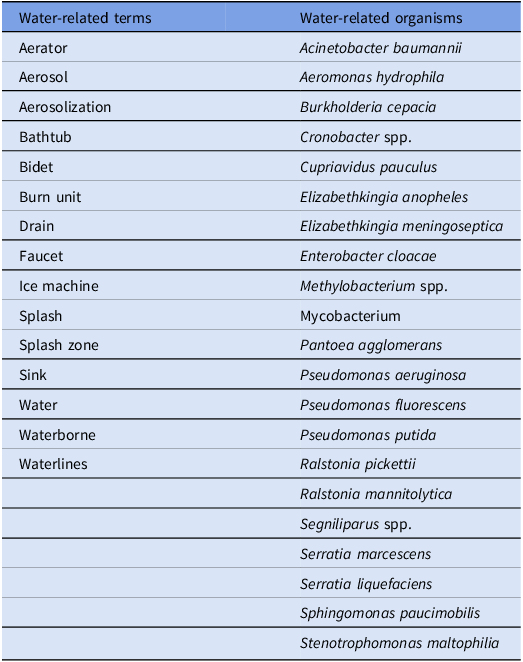
CDC’s Division of Healthcare Quality Promotion (DHQP) assists health departments and healthcare facilities with investigations of potential outbreaks and infection control breaches in healthcare facilities. We previously conducted a review of CDC consultations for water-related investigations from 2014 to 2017 by reviewing internal records for water-related terms and organisms to identify consultations that involved potential or confirmed transmission of water-related organisms in healthcare.Reference Perkins, Reddy, Fagan, Arduino and Perz20 We used the same approach to review our internal database for consultations initiated between January 1, 2018, and December 31, 2024. We applied the same predefined set of water-related terms and organisms previously used (Table 1) to identify consultations potentially involving water-related organisms or water as a potential source of transmission.Reference Perkins, Reddy, Fagan, Arduino and Perz20
Search terms used to query Division of Healthcare Quality Promotion consultation records to identify water-related investigations, CDC, United States, 2018–2024

Table 1. Long description
A table with two columns and 21 rows. The first column is labeled ‘Water-related terms’ and the second column is labeled ‘Water-related organisms’. The table lists various water-related terms and the organisms associated with them. Row 1: Aerator, Acinetobacter baumannii. Row 2: Aerosol, Aeromonas hydrophila. Row 3: Aerosolization, Burkholderia cepacia. Row 4: Bathtub, Cronobacter spp. Row 5: Bidet, Cupriavidus pauculus. Row 6: Burn unit, Elizabethkingia anopheles. Row 7: Drain, Elizabethkingia meningoseptica. Row 8: Faucet, Enterobacter cloacae. Row 9: Ice machine, Methylobacterium spp. Row 10: Splash, Mycobacterium. Row 11: Splash zone, Pantoea agglomerans. Row 12: Sink, Pseudomonas aeruginosa. Row 13: Water, Pseudomonas fluorescens. Row 14: Waterborne, Pseudomonas putida. Row 15: Waterlines, Ralstonia pickettii. Row 16: Waterlines, Ralstonia mannitolytica. Row 17: Waterlines, Ralstonia mannitolytica Segniliparus spp. Row 18: Waterlines, Serratia marcescens, Serratia liquefaciens, Sphingomonas paucimobilis, Stenotrophomonas maltophilia.
Investigations were then reviewed and excluded if (1) water was not considered a potential source of transmission; (2) an alternate transmission pathway other than water was determined; (3) the consultation was for laboratory reference testing only; (4) the infections were likely community acquired; (5) the infections occurred only among animals; (6) the infections or outbreak involved Legionella; or (7) the infections occurred outside of the United States among non-U.S. patients. In contrast, infections or outbreaks related to medical tourism where U.S. patients travelled abroad for medical care and acquired infections while abroad were included. Multistate investigations, which may have involved individual consultations with multiple health departments for a single outbreak, were analyzed and counted as a single investigation (e.g., investigation of a contaminated medical product that is distributed across the country). After applying the exclusion criteria, the remaining investigations were considered water-related and were included in this analysis.
We calculated the number and proportion of included water-related consultations that involved NTM. For NTM-related consultations, we identified the species of NTM involved, the number of patients affected, and type of infections (i.e., extrapulmonary, pulmonary, both). Consultations were also reviewed to determine the type of healthcare setting where the potential exposure was thought to have occurred (i.e., inpatient, outpatient, dialysis, long-term care, multiple facilities, or other); whether pediatric patients were involved; if patient notification was conducted, and if so, how many patients were notified of their potential exposure; and potential exposures, including medical products, such as medical devices, medications, and biological products.
Medical devices included central venous catheters, endoscopes, and ventilators among others. We included ice machines as medical devices for this analysis. Medications were defined as drugs used for therapeutic purposes and could include prescription drugs, over-the-counter drugs, or other substances used to treat or manage health conditions. We classified investigations as involving biological products if the use of a biological product (e.g., vaccines, acellular dermal matrix, porcine valve, stem cells) was an exposure of interest.21,22 We classified investigations that implicated medical products as either intrinsic contamination (i.e., medication or other medical product supplied in a contaminated state due to a manufacturing error) or extrinsic contamination (e.g., medication or other medical product became contaminated at the point of care). We also identified whether whole genome sequencing (WGS) or environmental sampling was completed as part of the investigation. Determination of isolate relatedness was based on a combination of strain type, high core genome coverage, low high-quality single-nucleotide variant (hqSNV) differences, and supporting epidemiological and clinical context. Although sources of transmission for patient colonization or infection were not always confirmed or documented for each investigation, we determined plausible exposure pathways based on available epidemiologic and laboratory information. We also identified exposures which were associated with >1 investigation.
Two authors (A.L.V. and K.M.P) reviewed a sample of 30% of the investigations to ensure agreement that all included consultations met the inclusion and exclusion criteria and agreement on investigation characteristics and classification. One author (A.L.V.) reviewed the remaining investigations.
This activity was reviewed by CDC and was conducted consistent with applicable federal law and CDC policy (See e.g., 45 C.F.R. part 46, 21 C.F.R. part 56; 42 U.S.C. §241(d); 5 U.S.C. §552a; 44 U.S.C. §3501 et seq.).
Results
Our database included 1,458 consultations between 2018 and 2024 (data not shown). Of those, 639 (43.8%) consultations were deemed to be water-related, involving 60 different organisms and 4,685 patients, with a median of 2.0 affected patients per investigation (range, 0–346).
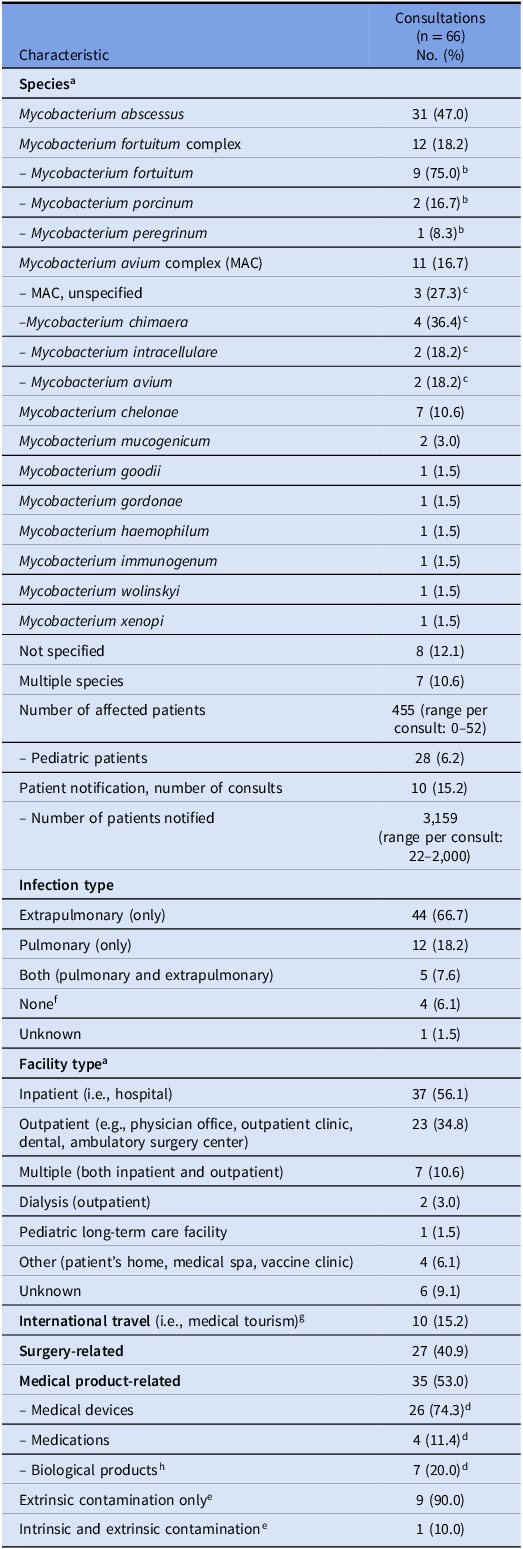
Investigations involving NTM accounted for one-tenth of these water-related investigations (n = 66, 10.3%) and nearly one-tenth of patients affected (n = 455, 9.7%). We identified 15 distinct species among these NTM investigations, including nine rapid-growing NTM species (M. abscessus, M. chelonae, M. fortuitum, M. goodii, M. immunogenum, M. mucogenicum, M. peregrinum, M. porcinum, and M. wolinskyi) and six slow-growing species (M. avium complex [including M. avium, M. chimaera, and M. intracellulare], M. gordonae, M. haemophilum, and M. xenopi) (Table 2).14,Reference Brown-Elliott and Philley23 NTM investigations most frequently involved M. abscessus (n = 31, 47.0%). Seven investigations (10.6%) involved multiple species of NTM.
Characteristics of water-related nontuberculous mycobacteria (NTM) investigations, Division of Healthcare Quality Promotion, CDC, United States, 2018–2024

Table 2. Long description
A table detailing characteristics of water-related nontuberculous mycobacteria (NTM) investigations. The table has 21 rows and 3 columns. The columns are labeled ‘Characteristic’, ‘Consultations (n=66)’, and ‘No. (%)’. The ‘Characteristic’ column lists various species, number of affected patients, patient notification details, infection types, facility types, international travel, surgery-related, medical product-related, extrinsic contamination, and intrinsic and extrinsic contamination. The ‘Consultations (n=66)’ column provides specific details for each characteristic. The ‘No. (%)’ column shows the number and percentage of consultations for each characteristic. Notable species include Mycobacterium abscessus (31 consultations, 47.0%), Mycobacterium fortuitum complex (12 consultations, 18.2%), and Mycobacterium avium complex (11 consultations, 16.7%). The table also includes data on the number of affected patients, patient notification, infection types, facility types, international travel, surgery-related cases, medical product-related cases, and contamination types.
a Categories are not mutually exclusive.
b Denominator is consultations involving the Mycobacterium fortuitum complex (n = 12).
c Denominator is consultations involving the Mycobacterium avium complex (MAC) (n = 11).
d Denominator is the subset of consultations which documented exposure to a medical product (n = 35).
e Denominator is consultations for which a source of contamination could be determined (n = 10).
f For consults identified as having no infection, three of these had NTM isolated from heater-cooler devices. Although patients were exposed, no infections were identified at the time of consultation. The fourth consult had a patient suspected of having NTM infection, but additional pathology was negative for NTM.
g Consults identified as having international travel included those for which U.S. patients travelled abroad for medical care and acquired NTM infections while abroad.
h Biological products included vaccines, stem cells, a porcine valve, a dermal matrix, and an allograft.
Investigations involving only extrapulmonary infections constituted the majority (n = 44, 66.7%) of NTM investigations, while those involving only pulmonary infections constituted 12 (18.2%) investigations. Five (7.6%) investigations involved both pulmonary and extrapulmonary infections. Among investigations with extrapulmonary NTM infections, the most common infections were skin and soft tissue infections (n = 20, 45.5%) and bloodstream infections (n = 6, 13.6%) (data not shown).
Among the 66 NTM investigations, more than half (n = 37, 56.1%) occurred in acute care hospitals, 34.8% (n = 23) occurred in outpatient settings, of which two were in dental practices, and seven (10.6%) occurred in facilities with both inpatient and outpatient services. Four (6.1%) investigations occurred in other settings, including medical spas, a vaccine clinic, and a patient’s home. Two (3.0%) investigations occurred in outpatient dialysis clinics. In addition, 10 investigations (15.2%) involved medical tourism during which a patient was treated for an NTM infection in the United States after receiving surgery or other procedures abroad. Surgery was common in these investigations, occurring in 27 (40.9%) investigations.
Medical products (i.e., medical devices, biological products, and medications) were an exposure of concern in over half (n = 35, 53.0%) of NTM investigations. Of these 35 investigations, medical devices were involved in 26 (74.3%), including 10 (28.6%) with heater-cooler devices, seven (20.0%) with bronchoscopes, and seven (20.0%) with ice machines. Biological products involved in these investigations (n = 7, 20.0%) included vaccines, stem cells, a porcine valve, a dermal matrix, and an allograft. Medications were implicated in four (11.4%) investigations. The process of contamination was determined and documented for 10 (28.6%) of the 35 medical product-focused NTM investigations. Of these, most involved extrinsic contamination (n = 9, 90.0%) whereas one involved both extrinsic and intrinsic contamination of stem cells.Reference Nguyen, Hasan and De Moura24
Nearly half (n = 32, 48.5%) of investigations used WGS and/or environmental sampling during their investigation. WGS was conducted for 23 (34.8%) investigations and environmental sampling for 23 (34.8%) investigations (data not shown). More than one-fifth of investigations (n = 14, 21.2%) used both WGS and environmental sampling, of which 6 (42.9%) revealed clinical and environmental isolates were closely related.
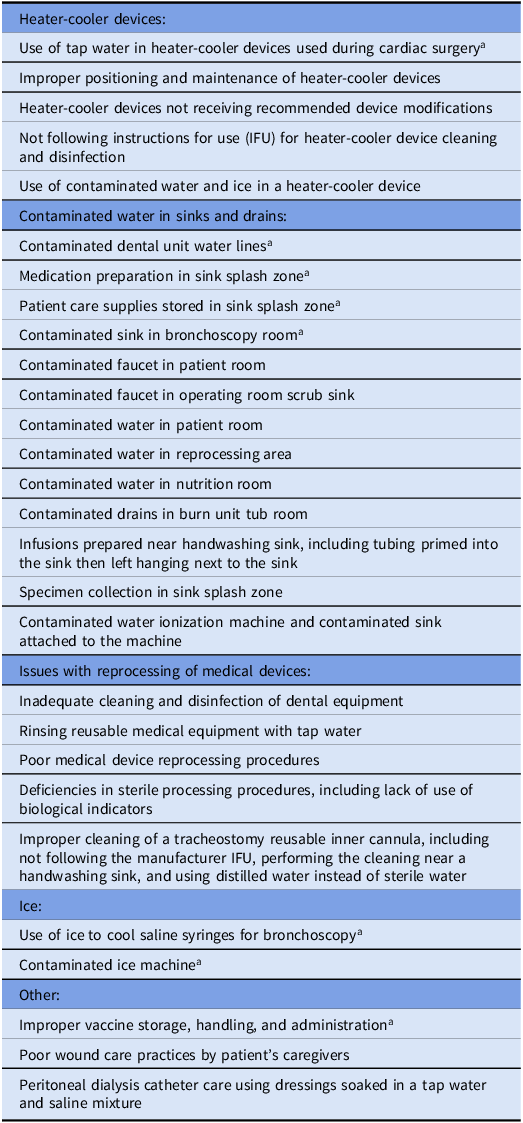
We identified numerous infection control concerns which could have resulted in water exposures, such as the use of nonsterile or unfiltered water in heater-cooler devices; contaminated water in sinks and drains; medication preparation and storage of patient care supplies within the sink splash zone; not adhering to manufacturer’s instructions for use for proper cleaning and disinfection of medical devices; rinsing reusable medical equipment with tap water; and the use of ice during procedures or from contaminated ice machines, among others (Table 3). Multiple investigations identified more than one exposure of concern.
Infection control concerns and possible exposures for NTM in water-related NTM healthcare investigations, Division of Healthcare Quality Promotion, CDC, United States, 2018–2024

Table 3. Long description
A table listing infection control concerns and possible exposures for NTM in water-related healthcare investigations. The table has 3 columns and 25 rows. Column headers are: Heater-cooler devices, Contaminated water in sinks and drains, Issues with reprocessing of medical devices, Ice, Other. Row 1: Use of tap water in heater-cooler devices used during cardiac surgery. Row 2: Improper positioning and maintenance of heater-cooler devices. Row 3: Heater-cooler devices not receiving recommended device modifications. Row 4: Not following instructions for use (IFU) for heater-cooler device cleaning and disinfection. Row 5: Use of contaminated water and ice in a heater-cooler device. Row 6: Contaminated dental unit water lines. Row 7: Medication preparation in sink splash zone. Row 8: Patient care supplies stored in sink splash zone. Row 9: Contaminated sink in bronchoscopy room. Row 10: Contaminated faucet in patient room. Row 11: Contaminated faucet in operating room scrub sink. Row 12: Contaminated water in patient room. Row 13: Contaminated water in reprocessing area. Row 14: Contaminated water in nutrition room. Row 15: Contaminated drains in burn unit tub room. Row 16: Infusions prepared near handwashing sink, including tubing primed into the sink then left hanging next to the sink. Row 17: Specimen collection in sink splash zone. Row 18: Contaminated water ionization machine and contaminated sink attached to the machine. Row 19: Inadequate cleaning and disinfection of dental equipment. Row 20: Rinsing reusable medical equipment with tap water. Row 21: Poor medical device reprocessing procedures. Row 22: Deficiencies in sterile processing procedures, including lack of use of biological indicators. Row 23: Improper cleaning of a tracheostomy reusable inner cannula, including not following the manufacturer instructions for use, performing the cleaning near a handwashing sink, and using distilled water instead of sterile water. Row 24: Use of ice to cool saline syringes for bronchoscopy. Row 25: Contaminated ice machine. Row 26: Improper vaccine storage, handling, and administration. Row 27: Poor wound care practices by patient’s caregivers. Row 28: Peritoneal dialysis catheter care using dressings soaked in a tap water and saline mixture.
a Indicates an exposure or infection control concern that was documented as the possible source of infection in two or more investigations.
Ten investigations (15.2%) involved notification of patients of their potential NTM exposure; across these, 3,159 patients (range: 22–2,000) were notified. Of these, 4 (40.0%) involved contaminated heater-cooler devices used during cardiac surgery. In 3 (30.0%) investigations, notification stemmed from concerns that substandard medication preparation or injection practices might have contaminated vaccines or saline flushes, including preparation within the sink splash zone, as well as improper storage, handling, and administration. Two (20.0%) notification events involved postsurgical infections following cosmetic and orthopedic procedures; these investigations highlight deficiencies related to environmental cleaning, medical equipment and surgical instrument reprocessing, and improper personal protective equipment used by operating room (OR) personnel.
Discussion
Outbreaks from water-related organisms and NTM continue to be an issue in healthcare and represent a significant burden among consultations received by CDC. From 2018 to 2024, water-related investigations represented 44% of CDC HAI consultations, a twofold increase compared to 22% from our last review of consultations received between 2014 and 2017.Reference Perkins, Reddy, Fagan, Arduino and Perz20 NTM accounted for more than 10% of the water-related healthcare investigations in our current study period. In 2017, the Centers for Medicare & Medicaid Services (CMS) began requiring that CMS-certified facilities establish water management policies and procedures to reduce the growth and spread of water-related organisms. CDC developed several resources for healthcare facilities, including the Water Infection Control Risk Assessment (WICRA) and the Infection Control Assessment and Response (ICAR) tool for water exposures, to promote better water management and to help with implementation of the CMS requirements.6,25 Water management programs identify hazardous conditions and corrective actions that can minimize the growth and spread of water-related organisms in healthcare facilities.10,26,27 Prevention of HAIs due to NTM and other water-related organisms is challenging and depends on multiple factors, including the quality of water as it enters the facility to the point of use, the design of plumbing systems, and maintenance of fixtures.
While pulmonary NTM infections are more common than extrapulmonary infections in the general community population,Reference Grigg, Jackson and Barter17,Reference Desai and Hurtado28–Reference Sood and Parrish30 we were primarily consulted for extrapulmonary NTM infections. Two-thirds of NTM-related investigations involved only extrapulmonary patient infections, such as skin and soft tissue infections and bloodstream infections, with an additional 8% involving both extrapulmonary and pulmonary infections. Extrapulmonary NTM infections can result from surgery and other invasive procedures, such as injections, with contaminated medications or devices offering a direct transmission route for NTM, bypassing the patient’s natural host defenses.Reference Desai and Hurtado28–Reference Crist and Perz31
A recent laboratory, population-based surveillance project showed that close to 40% of patients with extrapulmonary NTM had infections at a body site associated with a medical device or procedure or related to a recent surgery, injection, or dental procedure.Reference Grigg, Jackson and Barter17 We found exposures to specific medical products, such as devices, medications, and biological products, were an exposure of concern in over half of NTM investigations. This highlights the importance of healthcare facilities focusing on ensuring the safe use of medical products and adherence to manufacturer’s instructions for use for medical devices to reduce the risk of water-related NTM outbreaks. While the source of contamination could only be determined for 10 investigations for which medical products were implicated, nearly all involved extrinsic contamination, indicating lapses in IPC practices that could lead to introduction of water-related organisms into medical products.
During healthcare-associated NTM outbreak investigations where medical product contamination is suspected, extrinsic contamination should be ruled out before focusing on intrinsic contamination, unless clear evidence indicates the latter.32 Training healthcare personnel on proper handling and reprocessing of medical products to prevent water contamination at the point of care is critical. We found several possible sources of exposure to water-related organisms in our analysis which could have resulted in extrinsic contamination of medical devices and medications. Although several of these potential exposures, such as contaminated sinks in patient care areas and the use of tap water to rinse medical equipment, have been described previously, these issues continue to contribute to healthcare NTM outbreaks.Reference Perkins, Reddy, Fagan, Arduino and Perz20,Reference Li, Abebe, Cronk and Bartram29
Ice machines emerged as an exposure of interest which was not identified in our previous review of water-related consultations.Reference Perkins, Reddy, Fagan, Arduino and Perz20 Contaminated ice machines have been reported as the cause of healthcare NTM outbreaks; they are susceptible to biofilm growth and allow for the proliferation of water-related organisms.Reference Kaul, Chan and Phillips33,Reference Millar and Moore34 NTM have been found at higher concentrations in hospital ice machines than the incoming tap water, demonstrating their ability to proliferate in hospital ice machines.Reference Cazals, Bédard, Soucy, Savard and Prévost35 Education and training on appropriate maintenance, cleaning, and disinfection of ice machines, appropriate filter use, and avoiding the use of ice from ice machines for clinical care of vulnerable patient populations or during invasive procedures and surgeries may help prevent future NTM outbreaks arising from ice machines in healthcare facilities.Reference Vazquez Deida, Spicer and McNamara36
Compared with our previous review, another novel source of NTM was biological products, such as stem cell products. These products have been increasingly used to treat conditions for which they are not FDA-approved or scientifically proven.37 Administration of these products can occur in settings or by providers lacking education and awareness of safe medication preparation and injection practices, allowing water-related organisms to be introduced into products at the point of use and leading to serious skin and soft tissue infections.Reference Spicer, Beshearse, Perz and Perkins38 Biological products accounted for one-fifth of medical product-related NTM investigations in our review, which may reflect poor IPC practices in some facilities where these therapies are offered, both within the United States and abroad.Reference Nguyen, Hasan and De Moura24,Reference Lyons, Salgaonkar and Flaherty39,Reference Wolf, Money and Chandnani40
Contaminated water sources, including ice machines, sinks, faucets, and drains, in patient care and procedure areas, were exposures of concern in several investigations. Storage of patient care supplies and medication preparation within sink splash zones remain a concern. These findings underscore the continued importance of recognizing the risks posed by sinks in healthcare facilities due to microbial colonization and biofilm formation in premise plumbing. Education of healthcare facilities and healthcare personnel on adherence to regular cleaning and disinfection of sinks, thoughtful sink design and placement, and IPC practices to prevent transmission of water-related organisms from sinks can help prevent future outbreaks.Reference Parkes and Hota41
WGS or environmental sampling, or a combination of the two were used in nearly half of NTM investigations. Especially when used together, these tools can help trace the sources of water-related infections and elucidate transmission dynamics to inform targeted interventions needed to end an outbreak and strategies to prevent future outbreaks. WGS has been used not only for responding to NTM outbreaks but also to identify healthcare-associated transmission of NTM.Reference Schrank, Gozum, Martin and Snyder42 Our review included six investigations where WGS demonstrated clinical and environmental isolates to be closely related, confirming transmission pathways and exposures of concern. Increasing the use of these advanced molecular technologies can enhance timely identification and response to NTM healthcare outbreaks and improve our understanding of the epidemiology of water-related HAIs. However, the current understanding of the genetic diversity of NTM species is complex and incomplete, limiting our ability to interpret genomic results in isolation.Reference Masters, Toney and Ewing43 Therefore, successful NTM outbreak investigations utilizing advanced molecular tools, such as genomics, are done within the context of a thorough epidemiologic investigation to better interpret results and implement an effective response.Reference Davidson, Nick and Kammlade44
About 15% of NTM investigations included in our review involved patient notification, with over 3,000 patients notified across ten investigations. Given the challenges in diagnosing NTM infections, such notifications inform patients about the signs and symptoms of NTM infection and encourage timely medical evaluation and treatment, helping prevent delays in diagnosis and care. Additionally, provider notification can help encourage healthcare personnel to consider NTM infection when evaluating patients with potential exposures of concern.
The findings in this report are subject to several limitations. First, consultations with CDC are voluntary and do not capture all investigations of water-related organisms in healthcare settings across the country. Our review only represents investigations for which CDC support was requested and does not represent systematic, nationwide surveillance. CDC consultations focus on information needed to identify and interrupt sources of transmission; patient-level treatment and outcome data are not routinely collected. As such, CDC does not always receive complete or final information regarding an investigation, limiting available data for analysis. NTM are not reportable in most states, so the public health burden of these infections is not well-known, and reported outbreaks may underestimate the true number.Reference Shih, Cassidy, Perkins, Crist, Cieslak and Leman45,Reference Winthrop, Henkle, Walker, Cassidy, Hedberg and Schafer46 Healthcare facilities and public health may not always have the resources to conduct an in-depth epidemiological and laboratory investigation to help identify a definitive mode of transmission. A limited investigation cannot always confirm, but may only suggest, potential transmission routes.
A multifaceted approach is important for the prevention and management of HAIs, including those related to water.Reference Kanamori, Weber and Rutala3,Reference Sartelli, Marini and McNelis47 This includes training of healthcare personnel focused on preventing water-related exposures for specific patient populations and during clinical care, such as during surgery and invasive procedures, maintaining sink hygiene, adhering to medical device manufacturer’s instructions for use, and ensuring medical devices and medication preparation and administration are free from tap water contamination. Healthcare facilities are encouraged to review opportunities for exposures to water during clinical care activities and during procedures, use of medical devices, and preparation and administration of medications to reduce NTM and other water-related infection risks. CDC recently developed a resource to assist in the investigation of healthcare outbreaks due to water-related organisms, such as NTM, which can serve as a helpful investigative and response tool for hospitals and public health. (Outbreaks of Infections Caused by Water-Related Organisms in Acute Care Hospitals) Additionally, advanced molecular tools, such as WGS, can aid outbreak investigations within the context of epidemiological data, while improved surveillance systems can be used to monitor for potential HAIs related to NTM and other water-related organisms, enabling timely outbreak identification and rapid response.
Acknowledgements
The authors thank Ayana Hart for her assistance in database management, and the Prevention and Response Branch, the Clinical and Environmental Microbiology Branch, and other DHQP and CDC staff who assisted with the consultations included in this report. The authors also thank the health departments and other institutions who contributed to investigations reviewed in this paper.
Financial support
No financial support was provided relevant to this article.
Competing interests
All authors report no conflicts of interest relevant to this article.
Disclaimer
The findings and conclusions in this report are those of the authors and do not necessarily represent the official position of the Centers for Disease Control and Prevention.