


Introduction
Worry is a type of recurrent, dysfunctional and rigid form of negative thinking that is considered to be a primary attribute of generalized anxiety disorder (GAD) (American Psychiatric Association, 2000; Borkovec, Reference Borkovec, Davey and Tallis1994). It has been defined as a negatively affect-laden and relatively uncontrollable chain of thoughts and images, representing an attempt to engage in mental problem-solving on an issue with an uncertain outcome (Borkovec, Robinson, Pruzinsky and DePee, Reference Borkovec, Robinson, Pruzinsky and DePee1983). More recent formulations have extended this definition describing it as an anxious apprehension for future and negative events that involves a predominance of negatively valenced verbal thought activity and minimal levels of imagery (Borkovec, Ray and Stöber, Reference Borkovec, Ray and Stöber1998).
Parental overprotection refers to the limits that parents set for their child and the degree to which parents intrude in activities that the child is capable of undertaking independently. A growing body of evidence has shown how parental styles characterized by children's perception of anxious rearing, control and rejection are associated with anxiety symptoms (Grüner, Muris and Merckelbach, Reference Grüner, Muris and Merckelbach1999; Messer and Beidel, Reference Messer and Beidel1994; Muris and Merckelbach, Reference Muris and Merckelbach1998; Silverman, Cerny and Nelles, Reference Silverman, Cerny, Nelles, Lahey and Kazdin1988) and may be the most consistently observed parenting variable in families of children with anxiety disorders (Chorpita and Barlow, Reference Chorpita and Barlow1998). Research that has specifically examined the antecedents of worry has shown that anxious rearing and overprotection of both mother and father are related to adolescents’ worry (Muris, Reference Muris2002) and that parental overprotection is related to worry in adults (Manfredi et al., Reference Manfredi, Caselli, Rebecchi, Rovetto, Ruggiero, Sassaroli and Spada2011). These studies suggest the importance of parental overprotection in the aetiology and development of anxiety and worry, with researchers suggesting that parental overprotection has an effect on both these constructs through hindering children's exploration experiences and preventing the learning of action-oriented coping strategies (Cheron et al., Reference Cheron, Ehrenreich and Pincus2009; Nolen-Hoeksema et al., Reference Nolen-Hoeksema, Wolfson, Mumme and Guskin1995).
Metacognitions refer to schematic information individuals hold about the significance of cognitive experience and how it should be managed (Wells, Reference Wells2009). An ample research base has demonstrated that metacognitions are fundamental in the escalation and maintenance of worry and anxiety (e.g. Cartwright-Hatton and Wells, Reference Cartwright-Hatton and Wells1997; Spada, Nikčević, Moneta and Wells, Reference Spada, Nikčević, Moneta and Wells2008; Wells, Reference Wells2009; Wells and Cartwright-Hatton, Reference Wells and Cartwright-Hatton2004; Wells and Papageorgiou, Reference Wells and Papageorgiou1998). In the metacognitive model of worry Wells (Reference Wells1995, Reference Wells2000) proposes that worry is not merely a symptom of anxiety, but an active and motivated style of appraisal and coping driven by metacognitions. The model asserts that positive metacognitions about worry (e.g. “I must worry in order to be prepared”) are linked to the activation of worry as a coping strategy; however, when worrying is appraised as dangerous and uncontrollable through the activation of negative metacognitions about worry (e.g. “my worry is uncontrollable”) anxiety increases leading the individual to engage in unhelpful control strategies such as avoidance of worry triggers, reassurance seeking and thought suppression. These strategies prevent the disconfirmation that worry can be controlled and lead to its perseveration.
Wells purports that early learning experiences are likely to play an important role in the development of metacognitions (Wells, Reference Wells2000). In support of this view Cartwright-Hatton and colleagues (Reference Cartwright-Hatton, Mather, Illingworth, Brocki, Harrington and Wells2004) have found that metacognitions identified in adult populations are also endorsed by adolescents. Moreover, levels of these metacognitions are positively associated with self-reports of emotional symptoms. More recent evidence has also shown that metacognitions are associated with parental overprotection and predict trait anxiety independently of parental overprotection (Gallagher and Cartwright-Hatton, Reference Gallagher and Cartwright-Hatton2008). It is plausible to assume, therefore, that parental overprotection may contribute to the development of positive and negative metacognitions, which in turn may increase the likelihood of the activation and escalation of worry.
In summary, parental overprotection may have a direct effect on both worry and anxiety through hindering children's exploration experiences and preventing the learning of action-oriented coping strategies (Cheron et al., Reference Cheron, Ehrenreich and Pincus2009; Nolen-Hoeksema et al., Reference Nolen-Hoeksema, Wolfson, Mumme and Guskin1995) and an indirect effect through fostering the development of metacognitions that are associated with the activation and escalation of worry (Wells, Reference Wells2000). No research, to date, has investigated whether metacognitions can contribute to predicting current levels of worry over and above the established influence of recalled parental overprotection. A deeper knowledge of this area may have implications in understanding developmental aspects of worry and its possible links to metacognitions. In this study we hypothesized that metacognitions would predict levels of worry independently of gender, anxiety and parental overprotection. Gender and anxiety were included as control variables because women consistently report higher levels of worry than men, and because anxiety can impact on the completion of all self-report instruments employed in this study.
Method
Participants
Convenience sampling was used for selecting participants who were recruited from the general population through leaflets and advertisements in work environments and public places. For purposes of inclusion in this study the participants were required to be at least 18 years of age. Three hundred and twenty-seven individuals participated in this cross-sectional study between September 2009 and June 2010 with 301 (155 females and 146 males) completing it. Following the elimination of four multivariate outliers (see section 3.1) the data from 297 participants were used for the purposes of the present study. The mean age of the participants was 33.6 years (SD = 13.1) and the age range was 18 to 65 years. The sample was entirely White.
Self-report instruments
Beck Anxiety Inventory (BAI; Beck, Epstein Brown and Steer, Reference Beck, Epstein, Brown and Steer1988). This is a 21-item self-report instrument designed to assess the common symptoms of anxiety, such as nervousness and fear of losing control. Respondents are required to indicate the degree to which they are bothered by each symptom “during the past week including today”. Each symptom is rated on a 4-point scale ranging from 0 (not at all) to 3 (severely, I could barely stand it). Total scores range from 0 to 63, with higher scores corresponding to higher levels of anxiety. The BAI shows high internal consistency and test-retest reliability (Beck et al., Reference Beck, Epstein, Brown and Steer1988).
Parental Bonding Instrument (PBI; Parker, Tupling and Brown, Reference Parker, Tupling and Brown1979). This is a 25-item self-report instrument designed to assess individual recall of parental rearing styles over the first 16 years of life. Father and mother are judged on a 4-point scale (from true to not true) and two factors are derived for each parent (care and overprotection). The four scales (two scales for each parent) have high internal consistency and have been used in a large number of studies on parental rearing styles (Brewin, Andrews and Gotlib, Reference Brewin, Andrews and Gotlib1993; Parker, Barrett and Hickie, Reference Parker, Barrett and Hickie1992). The PBI has been used in many studies of parenting and has demonstrated adequate split-half reliability: Care 0.74, Overprotection 0.88 (Gerlsma, Emmelkamp and Arrindell, Reference Gerlsma, Emmelkamp and Arrindell1990; Parker et al., Reference Parker, Tupling and Brown1979). Ratings of mother and father have been combined as in previous studies (e.g. Rankin, Bentall, Hill and Kinderman, Reference Rankin, Bentall, Hill and Kinderman2005) and in the light of results by Overbeek, Ten Have, Vollebergh and De Graaf (Reference Overbeek, Ten Have, Vollebergh and De Graaf2007), who found no differences in the impact of paternal and maternal rearing behaviours on mental disorders.
Meta-Cognitions Questionnaire 30 (MCQ-30; Wells and Cartwright-Hatton, Reference Wells and Cartwright-Hatton2004). This is a 30-item self-report instrument designed to assess individual differences in metacognitive beliefs, judgments and monitoring tendencies. It consists of five replicable factors assessed by 30 items in total. The five factors measure the following dimensions of metacognition: (1) positive beliefs about worry (e.g. “worrying helps me cope”); (2) negative beliefs about thoughts concerning uncontrollability and danger (e.g. “when I start worrying I cannot stop”); (3) lack of cognitive confidence (e.g. “my memory can mislead me at times”); (4) beliefs about the need to control thoughts (e.g. “not being able to control my thoughts is a sign of weakness”); and (5) cognitive self-consciousness (e.g. “I pay close attention to the way my mind works”). Respondents are asked to rate whether they “generally agree” with the statements presented. Higher scores indicate higher levels of maladaptive metacognitions. The MCQ possesses good internal consistency and convergent validity, as well as acceptable test-retest reliability (Spada, Mohiyeddini and Wells, Reference Spada, Mohiyeddini and Wells2008; Wells and Cartwright-Hatton, Reference Wells and Cartwright-Hatton2004).
Penn State Worry Questionnaire (PSWQ; Meyer, Miller, Metzger and Borkovec, Reference Meyer, Miller, Metzger and Borkovec1990). This is a 16-item self-report instrument designed to assess the generality, excessiveness and uncontrollability of pathological worry (Fresco, Mennin, Heimber and Turk, Reference Fresco, Mennin, Heimberg and Turk2003). Respondents are required to indicate how characteristic each item is of them. Each item is rated on a 5-point scale ranging from 1 (not at all typical) to 5 (very typical). Total scores range from 16 to 80, with higher scores corresponding to higher levels of worry. The instrument shows good psychometric properties (Molina and Borkovec, Reference Molina, Borkovec, Davey and Tallis1994) and distinguishes patients with GAD from other anxiety disorders (Brown, Antony and Barlow, Reference Brown, Antony and Barlow1993).
Procedure
The research project was approved by a university ethics committee. Participants received the research project content by direct distribution and all took part on a voluntary and unpaid basis. The research project was described to participants both verbally and in a written introduction. All participants were informed that data provided in the research project would be anonymous and that they could withdraw at any time if they so wished. Following a brief introduction to the aim of the research project and the granting of informed consent, participants were instructed to complete the research project content anonymously in a location of their choice. All participants had the possibility of contacting the second author for debriefing and to receive more details about the research project.
Results
Data description and configuration
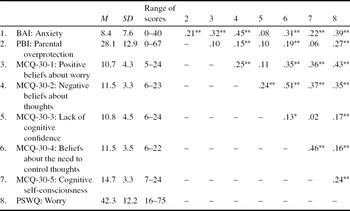
Descriptive statistics for all variables are presented in Table 1. Pearson product-moment correlations showed that anxiety, parental overprotection and all five dimensions of metacognitions were positively correlated with worry. An inspection of histograms, skewness and kurtosis showed that all variables were normally distributed, considering both symmetry and peakedness.
Means, standard deviations, ranges, and two-tailed Pearson product-moment correlations of study variables in the combined samples

Note: n = 297; *p<.05; **p<.01.
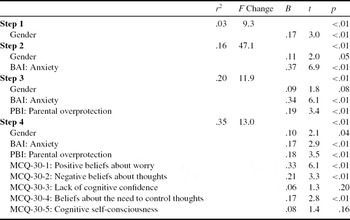
Hierarchical multiple linear regression statistics with worry as the outcome variable and gender, anxiety, parental overprotection and metacognitions as predictor variables

Note: n = 297.
In view of the potential overlap between the MCQ-30 and the PSWQ, as both self-report instruments measure beliefs about worry, a further hierarchical regression analysis was run to test the contribution of metacognitions to anxiety controlling for gender, worry and parental overprotection (see Table 3). In this analysis anxiety was entered as the outcome variable with the predictor variables of gender entered in step 1, worry entered in step 2, parental overprotection entered in step 3, and four dimensions of metacognitions entered in step 4. Results of this analysis indicated that metacognitions accounted for 14.0% (p<.0001) of variance in anxiety over and above the variance accounted for by gender, worry and parental overprotection combined (18.0%, p<.0001). A closer inspection of the final equation in the analysis reveals that gender, worry and two dimensions of metacognitions (positive beliefs about worry and negative beliefs about thoughts concerning uncontrollability and danger) were significant predictors of anxiety.
Hierarchical multiple linear regression statistics with anxiety as the outcome variable and gender, worry, parental overprotection and metacognitions as predictor variables

Note: n = 297.
Discussion
The objective of this work was to investigate the relative contribution of recalled parental overprotection in childhood and metacognitions in predicting current levels of worry whilst controlling for gender and anxiety. Results indicated that three facets of metacognitions (positive beliefs about worry, negative beliefs about thoughts concerning uncontrollability and danger, and beliefs about the need to control thoughts) predicted levels of worry independently of gender, anxiety and parental overprotection. In order to verify the independent contribution of metacognitions towards emotion, a hierarchical regression analysis was run, investigating the relative contribution of recalled parental overprotection in childhood and metacognitions in predicting current levels of anxiety whilst controlling for gender and worry. Results indicated that two facets of metacognitions (positive beliefs about worry and negative beliefs about thoughts concerning uncontrollability and danger) predicted levels of anxiety independently of gender and worry.
The finding that parental overprotection predicts levels of worry adds further weight to earlier studies that reported similar findings (e.g. Spasojevic and Alloy, Reference Spasojevic and Alloy2002). Metacognitions appear to add to this process as an independent contributor to levels of worry. The role of metacognitions can be explained through: (1) positive beliefs about worry increasing the use of worrying as a coping strategy, and leading, in some cases, to overuse (Wells, Reference Wells2009); and (2) negative beliefs about thoughts concerning uncontrollability and danger and beliefs about the need to control thoughts increasing levels of distress, and leading some individuals to engage in further and counterproductive attempts to control worry, such as avoidance and thought suppression (Wells, Reference Wells2009).
The results of this study have a number of possible implications, especially for interventions aimed at reducing vulnerability to emotional distress. In particular, the assessment of both family environmental factors and metacognitions may help to identify individuals at risk of developing problematic worry routines. With respect to interventions three avenues could be pursued: (1) the facilitation of skills that promote more concrete strategies to cope with problems and stressful situations; (2) parent training oriented to modifying the tendency towards overprotection, which may be helpful in reducing the vulnerability to emotional distress; and (3) metacognitive interventions aimed at restructuring metacognitions and gaining control over the worry process (Wells, Reference Wells2009).
Results of this study must be considered with regard to several limitations. First, without behavioural demonstrations to corroborate data from self-report instruments, results have to be viewed as purely suggestive. Second, a cross-sectional design was adopted and this does not allow causal inferences. For example, it may be that metacognitions lead to worry but the opposite could also be valid, with metacognitions being the by-products of psychological distress. Third, social desirability, self-report biases, context effects and poor recall may have contributed to errors in self-report. Fourth, parental overprotection was measured retrospectively, with maternal and paternal ratings combined in the interest of parsimony. Finally, the sample was almost entirely White, taken from one geographic region and non-clinical. Therefore caution should be exercised in generalizing findings, particularly to clinical settings.
Future studies may wish to employ clinical samples and adopt longitudinal designs to assess the relative contribution of parental overprotection and metacognitions to worry. In addition, direct measures of parental overprotection, through the involvement of parents and family, as well as behavioural measures, should be employed. Finally, it would be important to evaluate the mediating role of the direct change in parental overprotection and metacognitions in reducing the tendency to engage in worry in longitudinal studies.
In conclusion, the combination of a family environment perceived to be characterized by overprotection, and high levels of maladaptive metacognitions, are a risk factor for the development of worry. These risk factors appear to be independent of gender and current levels of anxiety.




Comments
No Comments have been published for this article.